Discovery Day 2014

THE CONFERENCE CALLER: What are the elements that make a significant mineral discovery?

On the day before the Explorers Conference kicks off in Fremantle, the Centre for Exploration Targeting (CET) is conducting a one-day seminar, which will provide participants with real-world case studies of world class discoveries within Australia and internationally.

The CET is a research institution which focuses on a wide range of Economic Geology-related studies by combining pure science and applied research from an industry point of view.

CET was established with the intention of increasing both the rate and quality of mineral discoveries without relying on substantial increases in exploration expenditure.

Since its inception the Centre has been acknowledged among its industry and academic peers for the results achieved by its researchers and its ability to work so effectively with industry.

Speakers selected for Discovery Day were key players in the discoveries made by the teams they worked with.

They will endeavour to give seminar participants a clear picture of the corporate and technical landscape before discovery, take them through the roller-coaster ride of the discovery process, and elaborate on how this experience changed their views on how successful exploration should be undertaken.

This day is a must for any geologist who expects to contribute to a major discovery and investor who wishes to better understand the technical process of best-practice exploration.

For further information regarding the CET Discovery Day including the program and online booking details, please Click Here

Date: 18 February 2014

Duration: 1 day

Location: Southern Cross Gala Room, Esplanade Hotel by Rydges, Fremantle, Western Australia.

Presenters: Professor Allan Trench, Richard Schodde, John Miller, Ned Stolz, Mike Young, Jens Balkau/Tom Ridges, Christian Easterday, Mark Bennett, Tim Craske/Mike Webb, John Hicks/Peter Harold, Matt Briggs, David Groves, “Rocky” Osborne, Peter Buck, Liam Twigger & Wayne Spilsbury.

Cost: All delegates $AUD 750.00 (inc GST).

Nominees announced for 2014 Craig Oliver Award

THE CONFERENCE CALLER: An impressive field of nine small to mid-cap miners has been announced as nominees for the 2014 Craig Oliver Award.

The award is presented each year at the RIU Explorers Conference in Fremantle to recognise the achievements of a small to mid-cap Australian mining company, which has excelled in several areas of performance, including exploration, mining, community and environment.

The nominees for this year’s award are:

Beadell Resources;

Gold producer Beadell Resources’ primary asset is the company’s 100 per cent owned Tucano gold project, in Brazil, which includes the high-grade Duckhead deposit, where mining in the December Quarter of 2013 produced 272,000 tonnes at 4.7 grams per tonne gold for 41,000 ounces.

Gold ore stockpiles at Tucano at the end of December totalled 6.8 million tonnes at 0.83g/t gold for 181,000 ounces plus marginal stockpiles of 1.1 million tonnes at 0.45g/t gold for 15,000 ounces.

Total stockpiles including marginal totals 7.9 million tonnes at 0.78g/t gold for 196,000 ounces.

BC Iron;

The BC Iron story centres on the Nullagine iron ore project, a 75/25 joint venture with Fortescue Metals Group.

During FY2013 BC Iron shipped a record 5 million tonnes (41% increase) of iron ore, its share being BC Iron share 3.15 million tonnes.

The company completed a landmark transaction with Fortescue, which increased its stake in the JV from 50 to 75 per cent as well as increasing the Nullagine JV infrastructure access from
5 million tonnes per annum to 6Mtpa.

In April it achieved 6Mtpa production rate ahead of schedule and EBITDA of $115.3 million (63% increase) and underlying NPAT of $71.4 million (41% increase).

BC Iron declared a total of 35 cents per share in fully franked dividends.

Doray Minerals;

Doray Minerals officially opened its Andy Well gold mine late last year.

The company’s first full quarter of gold production from Andy Well yielded 24,162 ounces at 13.09g/t head grade at a cash operating post (C1) of $448 per ounce.

An all in cost (AISC) of $949 per ounces rates as one of the lowest in Australia.

Exploration carried out by Doray at Andy Well has demonstrated the upside potential of the project, following the discovery of a third high-grade mineralised zone, known as the Suzie Zone, and the intersection of additional mineralised structures.

Gindalbie Metals;

Gindalbie Metals’ Karara project, located 200km east of Geraldton in Western Australia, is a joint venture with Ansteel, one of China’s largest steel makers and the country’s biggest iron ore producer.

The project consists of a long-life, magnetite concentrate operation with a smaller-scale supporting hematite operation.

Gindalbie completed total of 39 shipments during the December Quarter totalling 2.39 million wet metric tonnes (wmt) of combined magnetite concentrate and hematite DSO.

Karara Mining Limited (KML) expects production of magnetite concentrate to be in the range of 2.4 to 2.7 million wmt for the six months to 30 June 2014.

Shipments of DSO hematite for this period are expected to be in the range of 1.6 to 1.8 million wmt at an average weighted grade of 58 per cent.

Northern Star Resources;

Northern Star Resources has agreed to acquire 51 per cent of the East Kundana Joint Venture (EKJV) in Western Australia from Barrick Gold Corporation.

The deal is set to make it the fifth-largest ASX-listed gold miner, taking its annual production to more than 350,000 ounces of gold per annum.

The price tag on the acquisition is $75 million, which also includes 100 per cent of the Kanowna Belle gold mine.

The addition of Kanowna Belle alone is expected to increase Northern Star’s total reserves by 134 per cent to 1.1 million ounces and its resource base by 43 per cent to 5.6 million ounces.

The EKJV, which is located 20km west of Kalgoorlie, comprises the operating Raleigh and Rubicon-Hornet mines as well as the new Pegasus deposit.

It is forecast to produce 70,000 to 75,000 ounces this financial year at an all-in sustaining cost of $800 to $950 per ounce.

Phoenix Gold;

Just as 2013 was drawing to a close Phoenix Gold announced it had almost doubled total Mineral Reserves at the company’s 100 per cent-owned Castle Hill Stage 1 gold project following an independent open cut reserve study.

Phoenix’s total Mineral Reserves now stand at 26.77 million tonnes at a fully diluted grade of 1.23g/t gold for 1,057,830 ounces of gold (at a 0.4 – 0.8g/t cut-off grade).

The Castle Hill project is located on the Kunanalling shear zone in the heart of the Western Australian Goldfields less than 50km from Kalgoorlie.

Regis Resources;

Regis Resources major project is the Duketon gold project, located in the Laverton region of Western Australia 350 kilometres north-north east of Kalgoorlie.

The project comprises a tenement package covering over 2,000 square kilometres.

Within this project area is the Moolart Well gold mine and the Garden Well gold mine producing in excess of 300,000 ounces of gold per annum.

These have been augmented with Rosemont gold project coming on stream, which is expected to add an additional 80,000 ounces of gold per annum from the September 2013 quarter.

In the December 2013 Quarter, Rosemount produced 8,259 ounces of gold.

Sandfire Resources;

Very little introduction needed for the DeGrussa copper gold mine, which has become the nearology epicentre of the Murchison region of Western Australia.

At the end of FY2013 Degrussa had produced 68,000 tonnes of copper and 46.000 ounces of gold.

Total Mineral Resources stood at 13.4 million tonnes at 4.7 per cent copper, 1.9g/t gold for 634,000 contained tonnes of copper and 795,000 contained ounces of gold.

Toro Energy.

Toro Energy’s Wiluna mine is set to become Western Australia’s first ever uranium mine following final environment approvals granted in April 2013.

Toro’s Wiluna regional resource contains approximately 54 million pounds of U3O8 (as uranium oxide), with Toro planning to mine the Lake Way and Centipede deposits over a period of 14 years.

The company received a nice Christmas present in the form of a binding Subscription Agreement with RealFin Capital Partners of South Africa for the investment of up to $10 million in new equity in Toro.

The winner of the 2014 Craig Oliver Award will receive a unique sculpture in silver, titanium, copper and gold created by Thomas Meihofer Jewellers in Subiaco, which will be presented by a member of Mr Oliver’s family at the conference.

Past winners include Independence Group in 2011, Silver Lake Resources in 2012 and Sirius Resources in 2013.

The award was created in memory of Mr Oliver, former non-executive director of Sundance Resources, who passed away on 19 June 2010 when a plane carrying the entire Sundance Resources board crashed in the Congo, killing all on board.

Exploration upside trumps boardroom power struggle

THE INSIDE STORY: South Australian uranium and South American copper form the basis of Alliance Resources’ current focus.

The flagship project of Alliance Resources (ASX: AGS) is its 25 per cent interest in the Four Mile uranium project located 550 kilometres north of Adelaide in South Australia. Quasar Resources has a 75 per cent interest in the project.


Under the terms of the JV, Alliance is free carried through exploration.

Quasar is an affiliate of Heathgate Resources, owner and operator of the adjacent Beverley uranium mine – Australia’s third uranium mine and the only in situ leach mine.

The Four Mile project boasts an impressive set of numbers, including a 2012 JORC Code-compatible Indicated and Inferred Mineral Resource estimate of 9.8 million tonnes at 0.33 per cent uranium oxide (U3O8) containing 32,000 tonnes (71 million pounds) of contained U3O8.

With these figures it’s understandable the Four Mile uranium deposit is considered by most pundits to be one of the larger uranium deposits going around, not only in Australia but on the global stage.

However, not all is as happy as it could be between the JV partners at present as they disagree over how to develop the project.

“During the year, Alliance announced that a decision to recommence development of the Four Mile uranium project was made with Quasar Resources Pty Ltd (Quasar) voting its 75 per cent interest in favour and Alliance’s wholly owned subsidiary, Alliance Craton Explorer Pty Ltd (ACE) voting its interest against Quasar’s Start-Up Plan and Proposed Program and Budget,” Alliance stated in its Annual Report last year.

“Quasar has advised that an updated schedule of activities and cash flow projections will be provided once all government approvals have been received, taking into account later commencement and completion dates from those set out in its Start-Up Plan and Proposed Program and Budget.

“Notwithstanding this decision to recommence development, ACE still considers the construction of an appropriately sized stand-alone plant at Four Mile would produce a better outcome for ACE and Alliance in general.”

The potential of the Four Mile deposit was highlighted recently with the announcement of drilling results, which encountered further uranium intercepts at the discovery area Alliance announced in December 2013, located 1.2 kilometres to the northeast of the Four Mile East uranium deposit.

Results included:

FMD0017: 3.7 metres at 0.39 per cent uranium; and

FMD0018: 3.2m at 0.45 per cent uranium, 1.7m at 0.3 per cent uranium, 2.6m at 0.39 per cent uranium.

Alliance also recently reported the intersection of high-grade uranium mineralisation over a strike length of approximately 1100m and a maximum width of 800m, which is an increase of 300m of what had previously been reported.

While all this has been happening Alliance has added a further project to its fleet, this time casting an exploratory eye over the South American country of Chile.

Alliance’s Chilean properties are located in the Cabeza de Vaca district of Atacama Region III, placing them in northern Chile’s iron-oxide copper-gold belt, close to the mining centre of Copiapo and 27km southeast of the 479 million tonnes at 0.95 per cent copper, 0.22 grams per tonne gold, 3.1g/t silver La Candelaria mine owned by Freeport-McMoran Copper & Gold Inc.

The company’s Chilean subsidiary company, Alliance Chile has secured several options to acquire copper-gold properties and has submitted applications to acquire three exploration licences covering the greater part of the Cabeza de Vaca district.


“It’s in the northern regions that the bulk of the country’s major copper deposits exist,” Alliance Resources managing director Steve Johnston told The Resources Roadhouse.

“We believe there is much potential for large porphyry deposits in the region, however we are trying to target and focus on high-grade, near-surface deposits, which are related to the porphyry style deposits at depth.

“Our exploration manager and are contract geologist are on the ground in Chile at the moment and reviewing and sampling specific third party opportunities.

“We’ll get those samples back, analyse them and then make the decision as to which of these prospects we may follow up.”

Johnston said the company was excited to be exploring in Chile saying it is a great place to be as a junior exploration play with many deposits outcropping at surface as well as some of the world’s biggest copper mines already operating there.

“We are looking for a porphyry-style deposit but we haven’t ruled out the smaller high-grade deposits,” he said.

“We feel that if we can find an area that hosts enough of these smaller deposits we then have a chance of locating a feeder zone of a buried porphyry that hasn’t been unroofed.

“That’s really our focus at the moment, identifying second tier targets first with the hope of finding a first tier target.

“Financially, developing a tier one target is tough for a company the size of Alliance, so if it did intersect one, then we would be seeking Joint Venture interest from a major to come in and help to develop it.

“Alternatively, should we hit a smaller deposit of high-grade copper at one to two per cent, then we are more than capable of doing that by ourselves.”

In recent times Chile has developed a reputation as a country with low sovereign risk that encourages exploration, even though it does have a slightly complex tenement structure to navigate.

Basically a lot of Chilean people own one or more mining tenements or concessions.

These get handed down through the family who typically option these tenements out to companies to earn a modest fee each year with a much larger fee if the option is exercised.

The system allows exploration concessions over the top of the mining concessions, allowing exploration over the tenements, enabling companies to conduct drilling, airborne geophysics and geochemistry, however companies ultimately require the permission of the underlying mining concession holder when it comes to exploitation.

“It has taken us just on two years, but we now have established a pretty firm footing in Chile,” Johnston explained.

“It’s been a new region and new regime for us and the learning curve has been quite steep, but we know how things operate over there now.

“From an exploration point of view it is actually a good system, even if you might find yourself dealing with ten different concession holders.

“One major difference from the way we do things in Australia is that here you may start with a tenement holding of 1,000 square kilometres and gradually narrow that down to around 100 square kilometres pinpointing particular targets or point of interest.

“In Chile you may lay out a large Exploration Licence area but the actual mining concessions are reasonably small and as many targets outcrop, this means the footprint of your target area is quite small allowing you to focus in and do the appropriate deals.”

In its September 2013 Quarterly the company reported it was well placed financially with around $24 million in the bank.

Having not dipped into the account in any great way since then it is well-funded to conduct drilling at Cabeza de Vaca, which it anticipates kicking off in the first half of this year.

Alliance Resources Limited (ASX: AGS)
…The Short Story

HEAD OFFICE
Suite 3, 51 – 55 City Road
Southbank, VIC, 3006

Ph: +61 3 9697 9090
Fax: +61 3 9697 9091

Email: info@allianceresources.com.au
Web: www.allianceresources.com.au
 
DIRECTORS
John Dunlop, Ian Gandel, Anthony Lethlean, Steve Johnston

MAJOR SHAREHOLDERS
Abbotsleigh Pty Ltd            25.76%
NEFCO Nominees Pty Ltd            2.27%
John S Dunlop Nominees Pty Ltd    1.78%
J P Morgan Nominees            1.75%

SHARES ON OFFER
341 million

MARKET CAPITALISATION

$56.3 million (at 24/1/14)


Exalt Resources encouraged by Brooklyn drilling results

THE DRILL SERGEANT: Exalt Resources (ASX: ERD) has received results from drilling carried out in December 2013 at the company’s Brooklyn iron project in South Australia.


Prospect Locations within EL7945 Mineral Hill South. Source: Company announcement


The drilling consisted of 11 holes, nine of which the company said had returned consistently high iron grades.

Exalt claims the results have confirmed iron mineralisation extends for at least 140m by 100m and is between 88m and 127m deep.

Highlights include:

136m at 61.4 per cent calcium iron and manganese (CaFe+Mn) from 14m;

72m at 62.1 per cent CaFe+Mn from surface; and

70m at 62.6 per cent CaFe+Mn from 10m.

Exalt has interpreted the iron mineralisation to be goethite replacement of a limestone, which it believes could possibly represent a previously unrecognised deposit style.

The company explained in its ASX announcement that it would be carrying out further work to evaluate the mineralisation in order to determine if a potential niche DSO goethite iron plus manganese product could be economically mined and sold.

Email: info@exaltresources.com.au

Website: www.exaltresources.com.au

Are we back to the days of geologists and internet start-ups?

GAVIN WENDT: There’s an interesting comparison at present between the malaise within the resource sector and high-flying components within the industrial sector.

This is particularly noticeable in the IPO space. There are just three resources IPOs amongst the list of 27 upcoming floats currently on the ASX website.

The ‘tech’ sector has seemingly attracted a lot of the speculative money that would naturally find a home in the resource sector – and the stag profits that these opportunities have generated for speculators means things aren’t likely to change any time soon (until the fad runs out of steam).

Of course, anyone who’s been around the resource sector a while has seen this all before.

I clearly recall the ‘dot-com boom’ during the period from 1995 – 2000, where seemingly every second junior exploration company elected to reinvent itself as an IT play as a crude, short-term means of survival.

One of the most dismal pictures I’ve ever had to witness was that of life-long mining and exploration industry veterans with decades’ worth of experience, walking into my broking office to try and explain their dot-com start-up business, with no concept of how they were ever going to be successful, attract sales or generate earnings.

To make matters worse, they couldn’t even get their laptops to work!

All that happened was that a bunch of brokers and pimply-faced vendor computer geeks got rich (mostly on paper) for a while, until the whole house of cards (inevitably) collapsed.

And given the situation we’re seeing now in the tech space, it’s almost a certainty that we’re witnessing the beginnings of the next tech debacle.

Investors (or more accurately ‘punters’) are happy to back the latest high-priced offerings, without any real clarity around how earnings will be generated. Just like the 1990s all over again.

The upside out of all this however is that it demonstrates clearly that there is speculative and risk capital returning to the market – and over time it should start to find its way into the resources sector once more.

One of the biggest problems facing the resources sector is the massive oversupply of listed entities.

We certainly don’t need +900 listed resource companies on the ASX, as the quality of project and management simply isn’t there.

All that’s happening is that the better quality companies are trying very hard to differentiate themselves from the hundreds of penny dreadful that have no real projects and are most likely saddled with management and boards that are more interested in a ‘lifestyle’ than anything else.

To be brutally honest, there are probably 400 to 500 too-many listed resource companies at the present time – and these companies should either merge or disappear – for the sake of investors and the sector.

The average cost of maintaining an average exploration company is probably around $1 million annually, so there is a vast swathe of shareholder funds that are simply being wasted just keeping the lights on.

What’s frustrating from my perspective is the lack of corporate (merger) activity amongst the hundreds of penny dreadful, including a lack of introduction of new project opportunities.

In many instances these resource ‘shells’ believe they are worth a hell of a lot more than they actually are.

Many of these junior companies have cut back on virtually all exploration activity as a strategy of ‘conserving shareholder funds,’ which really isn’t a strategy at all. A company that’s maintaining an office but no tangible exploration activity is giving its shareholders no rational reason to hold their stock.

What the junior sector needs is a wholesale cleanout, by way of mergers, de-listings, insolvencies and backdoor listings.

Whilst things aren’t necessarily going to get better any time soon, those of us that have been around the sector for a while (and have a bit of grey hair) know that this is a process that the resource sector regularly goes through and will ultimately lead to a better performing industry.

As we’ve said previously, the one certainty about the resource cycle is that it repeats itself.

Production falls, new projects are delayed, and the exploration pipeline of potential new projects is cut to a minimum.

Global growth then starts to recover (which is what we’re witnessing now), with better indications out of China, the US and Europe.

The net result will inevitably be that shortages of some metals and minerals will start to occur, prices will be driven upwards once again, and funds will start to become available for new mine development.

The downsized miners will be leaner and more efficient exploration will start to pick up again – all preparing the way for another cyclical peak some years ahead.

Gavin Wendt is the founder of MineLife, publisher of the MineLife Weekly Resource Report


What the Brokers Say

WHAT THE BROKERS SAY: Interesting news and views from across the Resource Analyst universe.


Elysium Resources Limited (ASX: EYM)

Elysium Resources is an Australian mineral exploration company whose core business is exploring for large, high-quality copper and gold deposits in the rich mineral provinces of Australia and Indonesia.

The current Board of Directors was appointed in February 2013.  An immediate review of the company’s existing assets was conducted with a view to establishing an updated strategy.  The company changed its name from United Orogen Limited (ASX: UOG) on 8 July 2013.

On 30 August 2013, Elysium announced an off-market takeover offer for all shares and options in Burraga Copper Limited (BCU), an unlisted Australian public company, for a consideration of 6.5 EYM shares for every BCU share held and 1 EYM share for every BCU option held.

The acquisition of BCU provides Elysium with the potential for early cash flow from BCU’s Lloyds copper project in NSW.  This cash flow would be used to finance Elysium’s exploration programs in the Lachlan Fold Belt of NSW, Redmond and Horseshoe South in Western Australia and Malang in Indonesia

Potential Early Cash Flow

Unlike many of the junior explorers at very early stages of exploration, Elysium has identified a potential source of early cash flow generation.

The Lloyds copper project is small, but in its favour are low capital and operating cost estimates.

In particular, the very modest upfront capital cost estimate of $10.3 million is not disproportionate to current market capitalisation of the company.

Tailings/Slag Re-Treatment Followed by Open Pit Mining

The presence of a small copper tailings dump and two slag heaps at Lloyds provides early, readily accessible feed for a proposed 300,000 tonnes per annum plant which, together with the subsequent treatment of hard rock open pit ore, is expected to produce up to 11,000 tonnes of copper in concentrate (plus gold and silver by-product) over a 4-5 year period.

In addition to the very modest capital cost, the PFS indicated average cash costs (excluding any by-products) of less than A$1.40 per pound of copper in concentrate, providing a substantial operating margin.

Pre-Feasibility Study Indicates a Robust Project

The pre-feasibility study conducted in 2011 established that the Lloyds copper project was economically viable based on prevailing metal prices at the time: A$10,000/t of copper, A$1,500/oz of gold and A$30/oz of silver.

The bulk of the revenue (~87 per cent) is derived from copper, with some gold and silver by-product.

Based on these prices, annual cash flows (after capital expenditure) range from $15.9 million to $22.1 million for the first four years.

At a 10 per cent discount rate (pre-tax), the Net Present Value (NPV) of the project is $53.2 million, with undiscounted net cash flow (pre-tax) of $76.7 million.

Project Cash Flow Still Positive at Current Metal Prices

At current metal prices and exchange rates (A$7,620/t for copper, A$1,346/oz for gold and A$21.64/oz for silver at an A$/US$ exchange rate of 0.923), the annual cash flows are reduced to between $10.3 million and $14.8 million over the first four years.

The NPV, at a 10 per cent discount rate, is reduced to approximately $31 million.

Provided the technical parameters and cost estimates can be achieved, the project will still produce healthy cash flows at current metal prices.

Project Risk

Breakaway sees the main risks to the project as metallurgical.  With short treatment campaigns for tailings and slag, there is little time to make plant adjustments to achieve optimum recoveries and concentrate quality.

This could have an adverse impact on cash flows as well as putting pressure on working capital requirements.

The PFS is based on open pit hard rock ore grading 1 per cent copper.  The currently reported global Inferred resource has a grade of only 0.5 per cent copper.

However, the grade/tonnage curve indicates that at a higher cut-off grade there is a component of around one million tonnes at 1 per cent copper equivalent – consistent with the assumption in the PFS.

Cash Flow to Fund Exploration

The cash flow generated should provide funds to carry out exploration, particularly on the NSW tenements.

First priority would be establishing additional feed for the mill.  The tenements are also prospective for Lucky Draw-type gold deposits.

However, the ultimate prize would be the discovery of a large copper or copper gold deposit similar to the McPhilamys deposit only 50 kilometres to the north.

Early cash flow would also help to fund the greenfields exploration program in Indonesia, which although still at a very early stage, has the potential to deliver very large copper-gold deposits.


Disclaimer: The above is intended as a guide only. The Roadhouse accepts no responsibility for investments made from this advice, successful or otherwise.

Raising funds and Tax Refunds

THE FUND RAISER: Bit of a mix this week with some companies raising funds, while others receive R&D rebates or government milestone payments.

Capital Raising Completed

Australian Bauxite (ASX: ABZ) completed a placement of 5.4 million fully paid ordinary shares at $0.21 cents per share to sophisticated, eligible and/or professional investors.
 
$1.134 million was raised to progress the company’s trial mining, mine establishment and development programs, and to provide working capital.

“Despite the recent difficult share market conditions, it has been most encouraging to see Australian Bauxite maintaining market support, especially from key supportive shareholders,” Australian Bauxite CEO Ian Levy said.

“We now have 1,600 shareholders, our share liquidity is high and we are in good shape for the crucial year ahead.

“In mid-January 2014, the global bauxite market will change in a positive way for ABx as Indonesian export bans and increased export taxes start taking effect.

“Our business plan has always been to capitalise on this once-only opportunity to become the world’s new supplier of gibbsite-rich bauxite.”

R&D incentive refund

Potash West (ASX: PWN) has received $547,582 refund from the Australian Tax Office.

The claim covers eligible test work for the 2013 financial year under the Federal Governments’ R&D tax incentive scheme.

The test work was instrumental in developing processes for the extraction of potash, phosphate and related products from glauconite, a common clay mineral.

Potash West controls the largest documented occurrence of glauconite, in the Dandaragan Trough, the exploitation of which the company claims has the potential to change the dynamics of the fertilizer supply industry, both within Western Australia and regionally.

Potash West’s research has also defined areas in which the glauconite was co-deposited with phosphate nodules which can be recovered as a feed for super phosphate production.


$25 million from global hedge fund for growth strategy

Alcyone Resources has reached an agreement with New York-based investment management firm, Platinum Partners for a $25 million revolving credit facility to fund Alcyone’s growth by way of value accretive acquisition opportunities in the precious metals space.

Having completed upgrading of the crusher facility it is Texas silver mine in Queensland, Alcyone has signalled its intention to build a portfolio of precious metals projects.

In line with this strategy, and with the support from Platinum, Alcyone has entered into an agreement to acquire the Red Arrow gold and silver mine in the United States for a total consideration of $5 million.

The acquisition is to be funded by way of a $1 million equity issue with Platinum, completed on execution, and a $4 million convertible loan note, to be drawn on release and grant of security changes.

The equity issue, to be completed with Alcyone’s existing placement capacity, consists of a placement of 200 million shares at a price of 5 cents per share to Platinum.


Horseshoe Metals awarded WA government drilling grant

Horseshoe Metals (ASX: HOR) has been awarded a $100,000 Western Australian Government grant to support a drilling program on the company’s 100 per cent-owned Kumarina copper project.

The co-funding will be utilised on a deep RC (Reverse Circulation Percussion) drilling program, targeting an untested magnetic anomaly, known as the Kumarina Deeps prospect, which is situated within the Backdoor Formation of the Collier Group and is thought by Horseshoe Metals to be prospective for a deep intrusive-related base metal system.

The drilling program will test for mineralised zones within the Backdoor Formation that was previously not considered as a prospective host rock unit.


Midas receives cash offer for Mt Philp

Midas Resources (ASX: MDS) has received a cash offer for its 100 per cent-owned Mt Philp iron ore deposit from private mining company Developed Iron Ore (DIO).

This offer is subject to a 90 day due diligence period to commence on the 14th of January due to the approaching Christmas break.

Exclusivity has been granted to DIO during this period for a non-refundable cash payment of
$50,000.

The offer consists of; A Purchase price of $1.5 million; $500,000 to be paid within 60 days of due diligence being completed; and $1million to be paid six months after the transfer of the first payment.

DIO will grant in favour of Midas a royalty of 0.5 per cent the gross proceeds of the sale of iron extracted from the Mt Philp asset.

This offer is not subject to any capital raising from DIO. The exclusivity fee is in addition to the
$1.5million in cash.

It is intended that all interests to iron ore on the Mt Philp asset within the area of application for Mineral Development License (MDL) 471 will be transferred to DIO, however legal ownership of MDL471, together with the rights to all minerals apart from iron ore, will remain with the current tenement holder being Midas’s wholly-owned subsidiary, Mt Dockerell Mining.

What the Brokers Say

WHAT THE BROKERS SAY: Interesting news and views from across the Resource Analyst universe.


Syndicated Metals LTD (ASX: SMD)

The current management of SMD joined in March 2012, but detailed new work plans were delayed until a settlement was achieved in August 2013 enabling the company to focus on development of the Barbara deposit.

Copper Chem Ltd (CCL) is farming into a 50 per cent share of Barbara by funding drilling that should lead to an extension of the current mining inventory of 1.2 million tonnes that has been established for an open pit at Barbara.

Barbara, near Cloncurry

Barbara is in North‐West Queensland, 60km from Mt Isa and 110km from Cloncurry, on the north side of the Barkly Highway, in a suite of tenements running up to 80km north.

Barbara has JORC Indicated and Inferred resources totalling 5.3 million tonnes, at 1.4 per cent copper, 0.1g/t gold, 2.5g/t silver plus some cobalt, for 76,000 tonnes contained copper.

SMD has further Resources totalling 600,000 tonnes for 8,000 tonnes contained copper nearby.

Agreement to develop the Barbara deposit

On 3 June 2013, SMD announced that it had executed an MOU with Exco Resources to develop the Barbara project.

On 16 September, the MOU had become a firm agreement with Copper Chem Ltd (a related entity of Exco Resources; and a subsidiary of WH Soul Pattinson (ASX: SOL).

This agreement involved:

CCL subscribing $522,000 in a share placement and buying out a significant shareholder to move to an 18.9 per cent stake in SMD;

CCL sole funding until a decision to mine at the Barbara development; and

CCL buying out a JV partner in some of the ELs in the Barbara project, so that the project becomes a 50:50 SMD‐CCL JV.

Likely Barbara Project

A pit containing 1.2 million tonnes of ore has been defined.

The current drill program, which has already reported 42m at 1.57 per cent copper and other, significant intersections of similar tenor with high-grade portions, is to determine ore closer to surface and the presence of mineralisation in an area of pit currently not drilled.

We expect that the development may increase to 1.8 million tonnes of ore at similar high grades.

We expect that this can be developed for less than $20 million (100 per cent basis) for a cash cost of about $1.65 per pound, with first ore in approximately 12 months, with a payback of about 12 months.

Goldminex Resources (ASX: GMX)

Goldminex Resources has significant acreage encompassing 2,756 square kilometres, positioned over two project areas within the Owen Stanley Ranges of Papua New Guinea (PNG).

The company’s flagship ‘Liamu’ project hosts 12 high-priority prospects within an extensive intrusive complex which has significant potential to host multiple large porphyry copper-gold deposits.

Geological and geochemical exploration to date has outlined an area in excess of 15sqkm shedding anomalous gold and copper in drainage samples. Exploration within this project area is still at a relatively early stage, however the ‘world class’ scale of the exploration targets should not be underestimated.

Within the tenements, GMX has also identified four nickel prospects, broadly defined by rock chips samples assaying up to 49 per cent nickel. Further work is required to better understand the source of these high grade nickel results.

Goldminex also has a 100 per cent interest in tenements (one EL and two ELA’s) surrounding the historical Gira goldfield, which was originally discovered in 1897.

Sparse exploration was carried out in the 1970’s/80’s with approx. 67,000 ounces of alluvial gold production recorded. The prospect, however, remains vastly underexplored. Goldminex is yet to carry out exploration within this prospective ground.

In 2011, Goldminex entered into a farm in agreement with Vale S.A., whereby Vale could earn a 51 per cent interest through funding exploration expenditure of US$20 million across six tenements (including the Liamu project).

Since entering into the farm-in agreement, Vale has spent a total of US$16.6 million, principally at the Liamu project, with the aim of identifying a large, economically viable porphyry copper-gold deposit.

Exploration activities included target generation, geophysical surveys, geological mapping, geochemical sampling and diamond drilling (8 deep holes for 4,299m).

In September 2013, Vale gave notice to withdraw from the Farm In Agreement leaving Goldminex with a 100 per cent interest in all of its tenements.

While it is clearly disappointing to see Vale withdrawing from the Farm In Agreement, the exit should be put into context.

As part of company-wide cost saving measures, Vale has substantially reduced its global exploration budget (and staffing levels).

As a result, a review of all exploration projects was undertaken with the reduced funds now allocated to more advanced ‘priority projects’.

Given the relatively early stage of exploration within the Owen Stanley Range, Vale’s exit is understandable.

The value attributed to the Owen Stanley Range tenements has been substantially enhanced with Vale’s involvement. All data gathered during the Vale’s funded US$16.6 million exploration program (geophysics, age data, geochemical and assay data) will remain the property of Goldminex.

There are also several gold targets which were identified during the Vale funded exploration program and which were not addressed. These targets could be quickly developed to drill testing stage.

Goldminex has a negative enterprise value suggesting the market is attributing no value to the company’s assets.

Breakaway believes this valuation is unwarranted given the prospectivity of the Owen Stanley tenements.

In excess of $30 million has already been spent advancing multiple prospects within the portfolio, all of which have ‘large scale potential’.

A new Joint Venture (JV) partner is now being sought to help share costs associated with advancing exploration at the Owen Stanley Range projects. In the meantime, Goldminex will likely run a lean operation, led by a capable management team.


Disclaimer: The above is intended as a guide only. The Roadhouse accepts no responsibility for investments made from this advice, successful or otherwise.

Raising funds and Tax Refunds

THE FUND RAISER: Bit of a mix this week with some companies raising funds, while others receive R&D rebates or government milestone payments.

Proposed private Placement

Laramide Resources (ASX: LAM) has arranged a proposed non-brokered private placement of up to 5 million units of the company at a price of 40 cents per unit, for aggregate gross proceeds of $2 million.
 
The company plans to use the proceeds of the Offering to advance its Westmoreland project in Australia, and for general corporate purposes.

As a result of the Offering the company will not proceed at this time with the previously announced securities purchase agreement with The Lind Partners Canada, LLC.

Share Placement to boost advanced tungsten and gold projects

Thor Mining (ASX: THR) has raised $200,000 by way of a Placement of 40 million new Ordinary Shares to sophisticated investors, at 0.5 cents per share.

The proceeds of the Placement will be used to fund the company’s working capital requirements, including continued assessment and exploration of its advanced tungsten and gold projects in Australia’s Northern Territory primarily, and where prudent, its gold project in Western Australia.

Draw down of $50 million advance

Tiger Resources (ASX: TGS) has drawn down on a $50 million advance payment facility from Gerald Metals SA to support the construction of the solvent-extraction and electro-winning (SXEW) plant at its Kipoi copper project in the Democratic Republic of Congo.

The $50 million advance payment is part of an agreement between Gerald and Tiger’s 60 per cent subsidiary, Société d’Exploitation de Kipoi SPRL (SEK), the operator at Kipoi.

SEK and Gerald also have an off-take agreement for 100,000 tonnes of copper cathode from the SXEW plant, which is nearing the final stages of construction and is on schedule for first copper cathode production in the second quarter of 2014.

“We are pleased to have drawn down this funding arrangement with Gerald Metals SA, as it will assist in funding the final stages of construction of the
SXEW plant,” Tiger Resources managing director Brad Marwood said.

“The agreement with Gerald was completed in an extremely challenging climate and shows the robustness of the Kipoi project, the confidence in the DRC and the strength of our management team.

“Construction of the SXEW plant has remained on track since it started, and we look forward to commencement of cathode production in the second quarter of next year.”

Research and Development funds received

Argent Minerals (ASX: ARD) has received the Federal Government’s Research and Development Tax Incentive Scheme claim funds of approximately $540,000.

The claim relates to a range of technical development activities carried out with the intention of bringing the company’s Kempfield project into production.

“We commend the Australian Government’s continued support of research and development activities by junior mining companies such as Argent Minerals in the technically challenging environment in which we operate,” Argent Minerals managing director David Busch said.

“These funds will be strategically applied to support the company’s activities toward our goal of becoming a significant Australian mining operation, including the massive sulphide target diamond drilling program set to start shortly at Kempfield.”

Fund Raising and commencement of exploration

Regal Resources (ASX: RER) has received firm commitments from institutional and sophisticated investors to raise $1.008 million through a placement of 28 million fully paid ordinary shares priced at 3.6 cents per share, a premium to the closing price on 27 November 2013 of 3.5 cents.

This placement follows the termination of a US$5 million loan, held by Regal’s DRC subsidiary Regal SK.

After payment of all accrued interest on the US$5 million loan and funds raised from the current placement, Regal’s cash reserves will stand at approximately $3.4 million.

The proceeds of the placement together with existing cash reserves will be used to accelerate exploration at Regal’s newly-acquired Kalongwe copper-cobalt project, which will include a drilling program planned for January 2014.

Proceeds will also be used for working capital purposes.

Latin Resources living large in Latin America

When speaking with Latin Resources managing director Chris Gale it’s easy to be swept up in his enthusiasm for Latin America.

Gale’s fervour for the region reaches beyond Latin Resources’ portfolio of highly-prospective projects in Peru and Brazil.

It extends to the recent history of Latin America and how, during what has been one of the most difficult periods for the junior sector, it has become a hive of exploration and mining activity.

Numbers add up, but they can also talk, and recent figures achieved in Latin America tell an interesting story.

Last year, 25 per cent of the world’s total exploration dollars were spent in Latin America.

By 2020 that figure is anticipated to rise to 50 per cent of the world’s exploration – and mining – spend, mainly distributed across six countries.

Chile-$100 billion; Brazil-$68 billion; Peru-$56 billion; Colombia-$22 billion; Mexico-$13 billion; and Argentina-$10 billion: for a total of $269 billion.

It’s though China has some $100 billion earmarked for Latin America during this time, $40 billion of which is for Peru.


“The current environment in Latin America is so much different to Australia,” Gale told The Resources Roadhouse.

“I can tell you why – It is better value; the geology is second to none; Peru is the second biggest copper producer in the world, Chile is number one.

“Peru is the number one silver producer in the world; Brazil is the number one iron ore producer in the world – after China.

“It is a lot more cost effective to mine there, plus only five per cent of Peru has been explored compared to around 35 per cent of Australia.”

Gale takes great pride in the fact Latin Resources was one of the first Australian junior exploration companies to establish a foothold in Latin America.

As the third Australian junior explorer to enter Latin America, it witnessed the ranks of its contemporaries quickly grow in the region to number around 80 with others eager to follow.

“World equity markets have come to understand and trust Latin America,” Gale said.

“Sovereign risk in the region is way down compared to other popular destinations such as Africa, making it a more desirable start-up location for junior companies.”

Gale’s vision also entails METS (Mining Equipment, Technology and Services) companies from Australia, which he considers to be world-class and highly proficient, also looking at selling their services in Latin America.

“Australia has a proven history of great junior exploration companies, supported by equally great geologists and engineering expertise,” he said.

“Latin America is where the future of mining is and is where they should be creating opportunities.”

As one the early movers into Latin America, Latin Resources (ASX: LRS) has been able to develop an impressive suite of projects.

Its Guadalupito iron and mineral sands project in, located on the northern coast of Peru, consists a total concession area of 17,500 hectares, which cover a 45 kilometre long mineralised shoreline that extends up to 4km inland.


The project is located 25km north of Chimbote, where there is a major port and one of the largest steel smelters in Peru.

Latin has established a 1.3 billion tonne JORC Inferred Resource at 5.7 per cent heavy minerals (HM) at Guadalupito with a conceptual exploration target of over 4 billion tonnes of mineralised sediments.

Two major minerals have been identified at the project, namely magnetite at 25 per cent of
HM and Andalusite 26 per cent of HM.

Discrete liberated mineral grains of recoverable size of zircon, rutile and ilmenite have also been identified.

“We are now ready to move Guadalupito to a feasibility study,” Gale said.

“We have secured the surface rights – ready to take it into mining when we can – and we hope to be in production at Guadalupito by the end of 2015, early 2016.

“It all really depends on when we may be able to secure a Joint Venture partner for the project.

“We have been in discussions with some candidates and we are gradually moving closer to an agreement.”

While negotiating for potential Joint Venture partners at Guadalupito, Latin recently signed a Binding Terms Sheet for a rights assignment and earn-in option to transfer 70 per cent ownership of its Ilo Norte project to Peruvian firm, Compañia Minera Zahena SAC (CMZ).

The deal entails CMZ making payment of a total consideration of US$3.65 million cash and minimum exploration work commitments totalling US$4 million plus the execution of a 4800m diamond drilling program valued at approximately US$1.35 million.

Ilo Norte is Latin’s most advanced exploration property in the south of Peru and is located right in the heart of a major copper producing region, where there are 125 billion pounds of contained copper in published reserves and resources including the Cuajone, Toquepala and Cerro Verde copper mines, all within 100km.

The Ilo Norte deal exemplifies Latin’s thinking in regards to the current fund raising climate for junior exploration companies.

By attracting a significant JV partner it has secured more financing for the company while advancing its exploration goals without having to go to the equity market for more funds.

The recent sell down of a 30 per cent interest in the Mariela iron ore project is further testament to this ideal.

“The Mariela project has been a great deal for us,” Gales said.

“We spent $200,000 to obtain some airborne and ground magnetics data, which has subsequently brought into the company – mainly through equity – but in cash, $11 million.

“We are looking at a model where we can’t go back to the market anymore; we have to self-fund our existence

“We just received shareholder approval for the Mariela deal – which means we will bank another $2.5 million by selling down our 30 per cent holding in that project.

“So we have demonstrated we can fund our activities by utilising what we have on the books right now.

“We will continue to use the Ilo Norte model to both secure funding for the company while unlocking value through exploration of our extensive ground holding in one of Peru’s hottest copper belts.”

In Brazil, Latin recently acquired the Borborema iron ore project from Rio Tinto Exploration, Brazil.
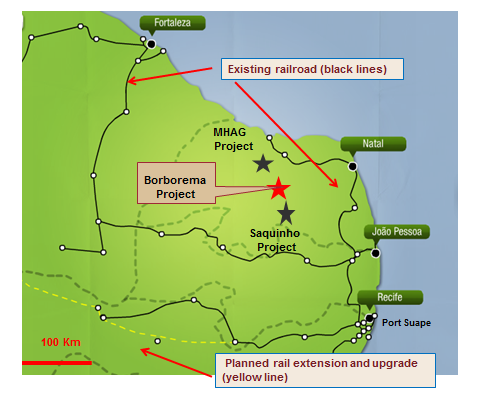


The acquisition is in line with its defined strategy of identifying iron ore projects in South America if the opportunity arose and if the project was close to port and infrastructure.

Latin considers the Borborema iron ore project in Brazil fits the bill nicely, with potential for near term production of iron ore in conjunction with a suitable joint venture partner.

The project was suggested to the company by its exploration manager, Carlos Spier, who has completed extensive due diligence on the project after conducting exploration work over a six month period in the Rio Grande do Norte State.

“If you look towards 2014 and look at where we are now at the end of 2013, we have positioned ourselves pretty well,” Gale said.

“We have funded Ilo Norte for drilling, which we anticipate commencing in January.

“We have just banked $2.5 million by selling down 30 per cent of one of our assets in Mariela.

“We are now at the point where we can move into a feasibility study for Gudalupito, which we ultimately want to move into production in the next couple of years.

“Is it any wonder I’m enthusiastic about Latin America? I don’t think so!”

Latin Resources Limited (ASX: LRS)
…The Short Story

HEAD OFFICE
Suite 2, Level 1
254 Rokeby Road
Subiaco WA 6008

Ph: +61 8 9485 0601
Fax: +61 8 9321 6666

Email: info@latinresources.com.au
Website: www.latinresources.com.au
 
DIRECTORS
David Vilensky, Chris Gale, Frankie Li, Zhongsheng Liu, Mark Rowbottam

MAJOR SHAREHOLDERS
Junefield High Value Metals Investments    20.54%
Dempsey Resources                11.13%
SRP Read Pty Ltd                     3.88%

SHARES ON ISSUE
227.5 million

MARKET CAPITALISATION
$16 million (at 5/12/13)