Raising funds across the Boards

THE FUND RAISER: The junior explorers continue to attract plenty of financial backing.

Placement of Shares

Xstate Resources (ASX: XST) has placed 20 million fully paid ordinary shares at 5 cents each to raise $1 million in working capital.

The funds have been earmarked to fund the company’s exploration activities and for working capital requirements.

“These funds will enable Xstate to purchase additional 2D seismic data and expand the scope of our joint venture leasing and prospect capture within the Sacramento Basin in California,” Xstate Resources managing director Paul Cartwright said.

$1.2M raising

Apollo Minerals (ASX: AON) has completed a $1.2 million capital raise to fund the next phase of exploration at the Titan base-precious metals project.

The project is located in the emerging iron ore copper gold (IOCG) region in South Australia’s Gawler Craton copper-gold belt, close to the Prominent Hill and Olympic Dam deposits.

The focus of Apollo’s exploration programs at the project will be the Bundi prospect, which it has identified as a high priority IOCG target with the potential to host a large scale deposit.

The capital raise was via the placement of approx. 81.6 million ordinary Apollo shares at a price of 1.5 cents per share together with one free attaching option for every two shares subscribed, with an exercise price of 3 cents per share and an expiry date of 28 February 2017.

The placement was strongly supported by existing Apollo shareholders and also new investors.


Kingsrose raises $8 Million

Kingsrose Mining (ASX: KRM) has raised $8 million via a share placement to fund ongoing development of its second mine, Talang Santo.

The proceeds will allow Kingsrose to continue mine development at Talang Santo while it awaits final approval from the Indonesian Mines Department to transition to full production.

The proceeds of the raising will be applied primarily to the ongoing mine development at Talang Santo.

“We are delighted to have received such strong support from our existing institutional shareholders,” Kingsrose managing director Scott Huffadine said.

“We undertook the placement because we wanted to ensure that the company is funded through to full production at Talang Santo.

“It also means we can continue our development work at the mine while we wait for the final approval.

“This will ensure we can ramp-up to full production as quickly as possible once the approval is granted.”


Mutiny to raise $4.15 million

Mutiny Gold (ASX: MYG) has received commitments for approx. 92.6 million at an issue price of 27 cents per share, to raise $2.5 million.

The commitment include a placement to Ausdrill (ASX: ASL), which will take a strategic shareholding in the company and be appointed as Mutiny’s preferred contractor.

The funds from the Placement will allow the company to begin drilling gold targets at its Deflector gold-copper project at Gullewa, in Western Australia’s Mid-West Region.

Mutiny also proposes a 1:10 pro rata non-renounceable entitlement offer to raise up to an additional $1.65 million.

These additional funds will be used to commence Mutiny’s 2014 drill program, which is focused on near mine extensions highlighted by Sub-Audio Magnetics (“SAM”) surveys undertaken last year.

What the Brokers Say

WHAT THE BROKERS SAY: Interesting news and views from across the Resource Analyst universe.

www.breakawayresearch.com

Sundance Resources (ASX: SDL)

Sundance Resources is a Central African iron ore developer, with high quality projects at the shovel‐ready stage that will initially produce a high‐grade, low impurity Direct Shipping Ore (DSO) product.

The company envisages a two stage production plan, with an initial phase producing 35 million tonnes per annum (Mtpa) of DSO for at least 12 years, with a 20-plus year, second stage 35Mtpa high‐grade itabirite concentrate operation starting in year 11.

Sundance Resources (ASX: SDL) is making steady progress towards development at the Mbalam‐Nabeba iron ore project in the Republic of the Congo (RoC) and Cameroon, in Central Africa.

The project is‘shovel‐ready’, with a positive Definitive Feasibility Study delivered in early 2011 and the majority of Government approvals now in place.

Tenders for the estimated $2.6 billion direct cost rail and port infrastructure have been received, with a decision on the successful bidder expected in Q2, 2014.

Negotiations are also underway concerning offtake agreements.

These are critical elements in advancing the project, enabling construction of the infrastructure that will unlock the riches of this greenfield, world‐class iron ore province.

Sundance’s project is the most advanced in this emerging iron ore province.

Development of Mbalam‐Nabeba represents an excellent ‘company making’ opportunity, while controlling regional infrastructure should create numerous secondary benefits.

The company will achieve a strong market re‐rating as it achieves funding and development milestones.

Advanced Player in a World Class Province

Sundance Resources is majority owner of the Mbalam‐Nabeba iron ore project (including the Mbarga and Nabeba groups of deposits.

The project is the most advanced project in the as yet undeveloped world class Central African iron ore province, located in Cameroon, Republic of the Congo and Gabon.

The province includes two main groups of identified deposits; one group (including Mbalam‐Nabeba) is located in the northern RoC, Gabon, and southern Cameroon. The second is located in the southern part of the RoC.

These form two distinct provinces – the northern province contains significant DSO resources in addition to itabirite, whereas the southern Mayoko‐Zanaga province is dominated by itabirite, with no significant DSO resources.

www.breakawayresearch.com

Blackham Resources (ASX: BLK)

Blackham Resources continues to make significant progress as it steadily marches toward production.

The recently acquired 1.1 million tonnes per annum processing plant represents a game changer, supporting the company’s transition from ‘explorer’ to ‘emerging producer’.

Blackham also has a substantial tenement position over highly prospective ground where ongoing drill programs provide potential for resource upgrades in the coming months.

Blackham Resources (ASX: BLK) recently agreed terms to acquire the Wiluna gold project under highly favourable terms totalling $4.6 million.

This acquisition is a major step forward for Blackham in its aspirations of becoming a near-term, self-sufficient gold producer.

The Wiluna gold project hosts a significant JORC Resource of 16.7 million tonnes at 5.3 grams per tonne gold for 2.8 million ounces of gold.

However, the game changing aspect of the acquisition for Blackham is the fully permitted 1.1Mtpa processing plant and associated infrastructure, located in the middle of its Matilda gold project.

With the acquisition of the Wiluna gold project now a formality, Blackham intends to continue drill programs designed to prove up oxide and free milling reserves as the principal feed for a refurbished and reconfigured processing plant.

Encouragingly, the nearby Williamson and Matilda deposits both host this style of mineralisation and are already within granted Mining Leases (existing haul roads also link the plant to the deposits), thus providing a relatively short time frame and low capex pathway to production.

Initial gold production is targeted in mid-2016.

Blackham is now in the enviable position of being a well-funded, emerging gold producer with a significant resource all on the door step of fully permitted processing plant.

Significant exploration potential still exists and with drilling campaigns ongoing, resource and reserve upgrades are likely.


Disclaimer: The above is intended as a guide only. The Roadhouse accepts no responsibility for investments made from this advice, successful or otherwise.

FAR Ltd strikes Block L6 farm-in deal

THE WELL SPUDDER: FAR Ltd (ASX: FAR) has received approval from the Ministry of Energy and Petroleum in Kenya for the first farm-in deal on the company’s onshore and offshore Kenya exploration permit, Block L6, located in the Lamu basin.

The farm-in deal has been struck with international petroleum logistics, marketing, trading, exploration and production company, Milio International.

Milio is based in Dubai and is looking to expand its commercial foot-print in East Africa.


Source: Company announcement


“We are pleased that the Cabinet Secretary for the Ministry of Energy and Petroleum has approved our recently announced farm out agreement for Block L6, Kenya,” FAR ltd managing director Cathy Norman said in the company’s announcement to the Australian Securities Exchange.

“We believe this deal, which FAR has secured funding for an onshore exploration well following a seismic survey, will evaluate the significant potential of the onshore part of Block L6 and unlock the potential of the wider Lamu basin in which FAR has a large acreage position.”

Under the terms of the deal FAR will be fully-funded through the drilling and testing of an onshore exploration well in Block L6, which is anticipated to spud in the first half of 2015.

FAR will also be fully-funded through the acquisition, processing and interpretation of a regional onshore 1,000 kilometre 2D seismic survey, which the company expects will confirm a number of prospects in onshore L6 as drill targets.

This seismic program is expected to commence in April 2014.

FAR retains a 24 per cent interest in the onshore part of Block L6 while preserving its 60 per cent interest in the offshore part of Block L6, which the company has estimated to contain, “substantial prospective resources”.

FAR indicated it is currently in discussions with parties to farm-in to drill an offshore well in Block L6.

“FAR has now completed three farm-out deals within the last 12 months and as a consequence is fully-funded through three high-impact exploration wells in the near future,” Norman said.

“Next month FAR expects to start drilling the first of two company making offshore wells in Senegal which are together targeting over 1.5 billion barrels of un-risked prospective resources.

“FAR’s farm in partners in Senegal are ConocoPhillips and Cairn Energy PLC.”

Email: info@far.com.au

Website: www.far.com.au

Raising funds across the Boards

THE FUND RAISER: The junior explorers continue to attract plenty of financial backing.

$4.2 million to advance flake graphite projects

Lamboo Resources (ASX:LMB) has completed a capital raising, receiving oversubscriptions for the issue of 15 million shares at 28 cents each to raise approximately $4.2 million, to sophisticated and institutional investors.

“The level of demand for our capital raising has been extraordinary and in a difficult market an affirmative vindication of the strength of our flake graphite projects in
Australia and South Korea,” Lamboo Resources managing director Richard Trevillion said.

Funds have been earmarked to accelerate the resource growth at McIntosh Australia and to contribute to the steps necessary for its planned production late 2014/early 2015.

US$5 million cash received on Senegal farm out deal

FAR Ltd (ASX: FAR) has received US$5 million from Capricorn Senegal Ltd a subsidiary of Cairn Energy  in relation to its Senegal Farm-out deal [following final approvals from the Senegal government].

FAR will be drilling two back to back wells in Senegal the first of which is expected to spud in Q1 2014.

The receipt of the US$5 million of cash proceeds strengthens the company’s cash position to $29.6 million as at 10 February 2014.

Rights Issue to raise $3.2 million

Octagonal Resources (ASX: ORS) has announced a non-renounceable rights issue to shareholders on the basis of three new shares for every five shares held at five cents each to raise approximately $3.2 million.

Funds raised will primarily be used for the development of the company’s Maldon gold operation in Victoria and the Hogan’s project in Western Australia, specifically:

Development and production mining of the Alliance South gold deposit (Vic);

Development and production mining of the Pearl Croydon gold deposit (Vic);

Exploration of the Burns copper-gold deposit (WA); and

General working capital, debt repayment purposes, and business development opportunities.

“In the last month we have achieved two major milestones that place us well for future growth,” Octagonal Resources managing director Anthony Gray said.

“Firstly we have demonstrated that the Alliance South deposit does contain high-grade gold that we believe will develop into a sizeable ore shoot and secondly we have gained all regulatory approvals to commence mining at the Pear Croydon deposit.

“The funds raised from this rights issue will be used for underground mining in the area of high-grade gold at Alliance South, open pit mining at Pearl Croydon, and for drilling at the Burns prospect in Western Australia where our previous exploration has indicated the potential for a significant copper-gold deposit.”

Intention to offer Rights Issue

Robust Resources (ASX: ROL) has announced it proposes to make a rights issue.

The company said the rights issue is a pro-rata non-renounceable entitlement issue of four new shares for every five shares held.

The issue price for each new share is 31 cents.

The offer seeks to raise $25.5 million and will result in the issue of around 82.3 million new shares by the company.

The purpose of the rights issue is to part fund the purchase of the Talas gold-copper project in Kyrgyz Republic, further exploration and development on the company’s tenements and for related purposes.

What the Brokers Say

WHAT THE BROKERS SAY: Interesting news and views from across the Resource Analyst universe.

Website: www.psl.com.au

Cradle Resources (ASX: CXX)

The recently released independent scoping study on Cradle Resources’ (ASX: CXX) Panda Hill niobium project (50 per cent owned with right to acquire balance) demonstrated a robust project at current prices.

There were several highlights which included lower capital/sustaining costs and higher grades (when compared to our estimates).

In addition, the study briefly examined a staged case whereby upfront capital costs were estimated to be c30 per cent lower compared to the base case.

On balance the base case was slightly lower than our estimates on a Net Present Value (NPV) basis due to higher operating costs and lower recoveries which have scope for improvement.

Robust Niobium Project:

Overall, the scoping study demonstrated a robust Ferroniobium project.

Encouragingly, upfront capital costs were c19 per cent lower (US$185 million) than Cradle’s initial estimates and sustaining capital was lower.

Whilst upfront capital was significantly lower this was offset by higher operating costs which were up c26 per cent from our previous estimates.

Recoveries were also slightly lower at 62 per cent LOM (PSL est. 65 per cent).

Based on the study we estimate a project NPV (at12 per cent) at US$332 million and IRR of 56 per cent.

At decision to mine our project NPV (at 12 per cent) increases to US$466 million.

PFS to Further Optimise:

Cradle plans to commence a Pre-feasibility Study (PFS) in Q2/2014 which is anticipated to be completed in Q4/2014.

The study will examine further project optimisations. The key areas highlighted for improvement include:

1) recoveries and reagent use;

2) reduced contract mining rates; and

3) power costs.

These have the potential to further reduce operating costs.

Staged Case Considered with 30 per cent Lower Capital Costs:

As part of the scoping study, a staged approach was briefly examined. Under this scenario the study estimated that capital costs would be c30 per cent lower at US$125 million.

The plant would initially process one million tonnes per annum (Mtpa) then be expanded to 2.3Mtpa after the first three years.

This lower capital option will be further examined in the PFS. The advantage is the reduced dilution with equity and/or lower debt requirements, as this expansion is funded through operating cashflows.

Further Funding:

At the end of the December Quarter, Cradle had $754,000 in cash. We anticipate that Cradle will need to raise additional capital to drive the project towards a decision to mine.

Catalysts:

1) Q3/2014: Metallurgical test work results;

2) Q3/2014: Updated resource estimate (category);

3) Q3/2014: Baseline studies for ESIA;

4) Q4/2014: PFS; and

5) Q4/2014: Commence DFS

Website: www.breakawayresearch.com

Emmerson Resources (ASX: ERM)

Emmerson is successfully applying a modern exploration strategy to its dominant tenement position in a world class mineral field.

The company has established a large JORC Resource at four deposits, with significant further exploration potential.

Emmerson also owns a fully permitted 300,000 tonnes per annum C.I.P. processing plant, providing a fast-track pathway to gold production.

With an Enterprise Value of just $9.4 million, Emmerson appears significantly undervalued.

Emmerson Resources (ASX: ERM) has a large, 100 per cent-owned tenement package covering the majority of the world class ‘Tennant Creek Mineral Field’, located in the Northern Territory.

The company has already identified significant copper-gold resources at four deposits, totalling 6.79 million tonnes at 3.6 grams per tonne gold equivalent (AuEq ) for approx. 900,000 ounces AuEq.

This JORC Resource is likely to be revised upwards in the near term with approx. one million tonnes of ‘ore grade mineralisation’ identified for near term assessment.

Of particular interest is the high-grade Chariot gold deposit (170,000 tonnes at 17.4g/t gold for 99,000 ounces gold) which is likely to be the first deposit mined and processed through the 100 per cent-owned 300,000 tonnes per annum Warrego C.I.P. processing plant, which is currently under ‘care and maintenance’.

A 1,200m RC drill program is scheduled to commence at the end of the wet season, targeting relatively shallow mineralisation (100m-200m) at Chariot East and Chariot West.

Historic ‘ore grade’ intersections in this area make it low risk-high reward program with potential to add meaningful ounces within an expanded open cut mine plan at Chariot.

Emmerson is a well-run company operating in a world renowned mineral province.

The company appears to have ‘cracked the code’ for discovery of blind deposits, and has increased its JORC Resource estimate by 70 per cent (gold) and 140 per cent (copper) in just the last quarter.

The Scoping Study currently underway is likely to provide impetus to begin feasibility work, targeting production in late 2015/early 2016.


Disclaimer: The above is intended as a guide only. The Roadhouse accepts no responsibility for investments made from this advice, successful or otherwise.

Freo the way to go for Explorers

THE CONFERENCE CALLER: Next week The Roadhouse will be one of many delegates attending the annual RIU Explorers Conference.

As always the two-day conference is being held at the Esplanade Hotel in the portside city of Fremantle kicking off on Wednesday February 19.

The RIU Explorers Conference has grown from strength to strength to become one of Australia’s most popular investment forums with a reputation as being the principal Australian forum for the junior resources sector.

“The conference provides a venue to garner investment and to meet with other resources industry professionals to discuss new options and progress their business”, Vertical Events managing director and organiser of the event Stewart McDonald said.

“The two day event features CEO’s, operations and exploration managers of the best mining and exploration companies as well as new emerging explorers.”

Delegates attending the conference will be treated to presentations from some of the industry’s leading analysts, including Simon Tonkin, Senior Resources Analyst at Patersons Securities and Justin Smirk, Senior Economist at Westpac Institutional Bank as well as more than 30 company specific presentations.

Key presenters at this year’s conference include:

Blackham Resources managing director Bryan Dixon;

PLD Corporation managing director Matthew Gauci;

Segue Resources technical director Dr Howard Carr;

Sirius Resources managing director and CEO Mark Bennett;

Centrex Minerals chief executive officer Ben Hammond;

Venturex Resources managing director Michael Mulroney;

Rox Resources managing director Ian Mullholland; and

Sundance Resources managing director and CEO Giulio Casello.

A highlight of the conference will be the announcement of the winner of the 2014 Craig Oliver Award.

The award is presented at the RIU Explorers Conference annually to a small to mid-cap Australian mining company, which has excelled in several areas of performance, including exploration, mining, community and environment.

A selection of nine small to mid-cap miners have been announced as nominees, including: Beadell Resources, BC Iron, Doray Minerals, Gindalbie Metals, Northern Star Resources, Phoenix Gold, Regis Resources, Sandfire Resources and Toro Energy

On the day before the Explorers Conference kicks off in Fremantle, the Centre for Exploration Targeting (CET) is conducting a one-day seminar, which will provide participants with real-world case studies of world class discoveries within Australia and internationally.

The CET is a research institution which focuses on a wide range of Economic Geology-related studies by combining pure science and applied research from an industry point of view.

Speakers selected for Discovery Day were key players in the discoveries made by the teams they worked with.

They will endeavour to give seminar participants a clear picture of the corporate and technical landscape before discovery, take them through the roller-coaster ride of the discovery process, and elaborate on how this experience changed their views on how successful exploration should be undertaken.

Uranium: more supply shut-downs inevitable

GAVIN WENDT: Despite the hit that the uranium business initially took with respect to sentiment in the wake of the Fukushima earthquake back in 2011, the conundrum remains the same: the world has few alternatives in terms of substantial, reliable base-load power generation.

Realistically, in a world with burgeoning populations in emerging countries and an escalating need for energy, there will be even greater demands placed on all three forms of traditional energy – coal, gas and nuclear.


The Fukushima nuclear disaster made the world take a second look at the safety of nuclear energy and many countries halted construction and plans to build nuclear reactors.

Japan shut down all but two of its 50 nuclear reactors in the wake of Fukushima.

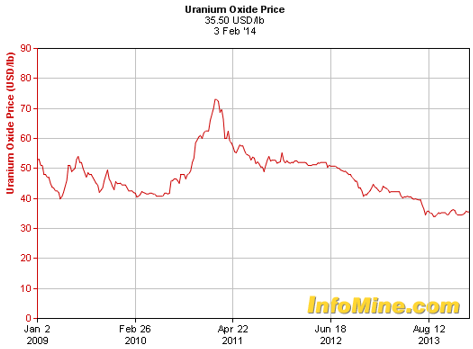
As a result, uranium prices have been in free-fall ever since. However, there are a number of strong catalysts for future uranium producers.

For starters, there are very real supply challenges being faced by the nuclear industry, driven by two very important considerations.

During 2013, the world’s 435 current nuclear power generators are expected to require 20 per cent more uranium than was currently being produced from the world’s mines.

Power generators will need more than 66,000 tons of uranium, but current global mine production is just 55,000 tons.

Over the past 20 years, the effective supply gap has been alleviated by uranium from decommissioned Soviet-era nuclear weapons.

During 1993, the United States signed an agreement with Russia called ‘Megatons to Megawatts’.

The agreement was a 20-year program where Russia down-blended the equivalent of 20,000 nuclear warheads to produce more than 14,000 metric tons of low-enriched uranium.

This uranium supplied the United States with nearly half of its nuclear generated energy over the past two decades, which is almost 10 per cent of the country’s total electric needs.

The final shipment from this program arrived in Baltimore on December 10, 2013, marking the end of the agreement.

To make up for the end of this supply of uranium coming to the US, USEC signed a 10-year agreement with Russia’s Techsnabexport (TENEX) to provide USEC with Russian enriched uranium.

However, this agreement will only supply half of the uranium previously supplied under the Megatons to Megawatts program and won’t reach that level until 2015.

This new agreement won’t come from down-blending nuclear warheads, but rather from Russia’s commercial enrichment activities.

During 2013, US nuclear plants required 19,622 metric tons of uranium.

Taking into account the end of Megatons to Megawatts and the new agreement between USEC and TENEX, there will have to be 4,000-5,000 metric tons of uranium coming from new sources during 2014 and beyond.

The Fukushima nuclear disaster in Japan has merely delayed the onset of the upcoming supply crunch, but it is entirely real and power station owners and governments will be increasingly nervous.

An additional supply challenge relates to the lack of investment in the uranium sector, which bears a direct correlation with two important factors: firstly, low uranium prices provide a disincentive to commission new uranium supplies; and secondly, depressed conditions in equity and lending markets over recent years make it extremely difficult (if not impossible) to source funding for new uranium developments.

Significantly too, even the major players in the uranium business that have the balance sheet strength to finance their own developments (without having to rely heavily on outside funding sources) are leaving new sources of supply undeveloped in most instances.

Quite simply, where is the incentive to bring new supply on stream when prices are already painfully low?

This illustrates the fundamental discrepancy within the uranium industry relating to where prices realistically should be (i.e. reflective of the looming supply shortfall) in order to stimulate profitable new levels of production, and where they currently are (i.e. trading at depressed levels and acting as a major deterrent to new project investment).

Nowhere is this more pronounced than at the smaller end of the uranium business.

At current prices there is an enormous amount of strain placed on uranium producers, to the point where the majority of existing operations would be barely breaking even around the $35 per pound mark, so prices below this level aren’t sustainable.

This is clearly evident in the fact that Paladin Energy (ASX: PDN) has announced it is suspending production at its Kayelekera mine in Malawi, placing it on care-and-maintenance to preserve the orebody until a sustained recovery in uranium prices.

Paladin blamed the continued depressed uranium price for the closure.

The silver lining in all of this is that the medium to longer-term fundamentals for uranium are strong.

New mines will be required and prices will inevitably have to rise in order to allow this to happen.

Looking ahead, uranium prices upwards of $70 per pound will be necessary in my view to justify and support investment and development of new projects.


Gavin Wendt is the founder of Minelife, publisher of the MineLife Weekly Resource Report

What the Brokers Say

WHAT THE BROKERS SAY: Interesting news and views from across the Resource Analyst universe.

www.breakawayresearch.com

Sundance Resources Limited (ASX: SDL)

Sundance Resources is a Central African iron ore developer, with high quality projects at the shovel‐ready stage that will initially produce a high grade low impurity Direct Shipping Ore (DSO) product.

The company envisages a two stage production plan, with an initial phase producing 35 million tonnes per annum of DSO for at least 12 years, with a 20-plus year, second stage 35 million tonnes per annum high‐grade itabirite concentrate operation starting in year 11.

Sundance Resources Limited (ASX: SDL) is making steady progress towards development at the Mbalam‐Nabeba iron ire project in the Republic of the Congo and Cameroon, in Central Africa.

The project is ‘shovel‐ready’, with a positive Definitive Feasibility Study delivered in early 2011 and the majority of Government approvals now in place.

Tenders for the estimated $2.6 billion direct cost rail and port infrastructure have been received, with a decision on the successful bidder expected in Q2, 2014.

Negotiations are also underway concerning offtake agreements.

These are critical elements in advancing the project, enabling construction of the infrastructure that will unlock the riches of this greenfield, world‐class iron ore province.

Sundance’s project is the most advanced in this emerging iron ore province.

Development of Mbalam‐Nabeba represents an excellent ‘company making’ opportunity, while controlling regional infrastructure should create numerous secondary benefits.

The company will achieve a strong market re‐rating as it achieves funding and development milestones.

www.beerandco.com.au

Midas Resources Limited (ASX: MDS)

New management to develop Kalman

60.8 million tonnes JORC Resource at 0.60 per cent copper equivalent to be finessed into a high-grade project

Recent drilling at Overlander, less than 10 kilometres from Kalman, has reported intercepts including:

14 metres at 2.62 per cent copper, 9m at 2.58 per cent copper, 13m at 2.15 per cent copepr.

Midas has consolidated over 1,950 square kilometres of tenements southeast of Mt Isa, including over 60km of the Pilgrim Fault.

This includes Kalman which is the basis for a copper project in northwest Queensland.

Kalman’s existing Resource will be reviewed, focussing on a smaller, higher-grade open pittable Resource, supplemented by high-grade feed from nearby deposits.

New Management – New Projects

New management was installed at Midas, after 10 years.

The new management has introduced new projects in N‐W and Central Queensland and is aggressively progressing them.

The new management has been successful in getting title to over 1,950sqkm, nearly all of which is 100 per cent Midas owned (and the balance on a clear path to 100 per cent).

Kalman development potential

Over $25 million has been spent at Kalman by previous owners, producing a JORC Resource of over 350,000 tonnes of contained copper equivalent, of which about 10 per cent is underground and the balance open‐cut.

The scoping study was based on a high volume, modest grade project, adding 6 per cent to each of global Rhenium and Molybdenum supply.

Midas’ concept is to focus on a smaller, higher grade project that relies less on by‐product credits and niche markets.

Regional Plan

Midas has over 65km of the Pilgrim Fault, which has many targets for near surface, higher grade copper, as shown by recent exploration results; these are within 10km of Kalman so they can be developed as satellite feeds to a mill of 1 to 2 million tonnes per annum at Kalman.

Other Projects

Kalman is the focus project for Midas.

Midas is farming into 320sqkm near the historic Mt Morgan and has flow a VTEM survey which has identified other prospective VMS occurrences.

Beer & Co conclusions

Beer & Co expects that the round of drilling that is to commence soon will lead to the definition of a new project, which we expect will be announced during Q2 2014.

Disclaimer: The above is intended as a guide only. The Roadhouse accepts no responsibility for investments made from this advice, successful or otherwise.

Raising funds and Tax Refunds

THE FUND RAISER: The optimistic start to the New Year continues with junior explorers attracting plenty of financial backing.

Southern Hemisphere Mining raising $3.4 million

Southern Hemisphere Mining (ASX: SUH) is carrying out a capital raising up to $3.4 million to finance the next phase of exploration, evaluation and development of its copper-gold portfolio in central Chile, South America.

The company has already raised up to $1.2 million through a placement of shares to sophisticated and professional Investors at 4.5 cents per new share.

It also intends to undertake an underwritten non-renounceable 1 for 4 entitlement issue at the same price to raise approximately $2.2 million amounting to a total capital raising of $3.4 million before costs and expenses.
 
The funds will be used primarily to meet the company’s share of upcoming drilling expenses and prospect acquisition costs at the 50/50 Los Rulos Joint Venture with Lundin Mining, as well as for general working capital.
 
The Los Rulos JV has recently acquired three highly prospective IOCG-style copper-gold prospects in central Chile as part of a growing portfolio which is in the same region as Southern Hemisphere’s Llahuin project, where it has already established a substantial copper-gold resource.

Southern Hemisphere is currently free-carried on ongoing exploration activities at the Mantos Grandes project and the Llahuin project.

 “Given the current market for junior resource companies, we are pleased with the strong support shown in both the Placement and the underwriting of the Rights Issue,” Southern Hemisphere managing director Trevor Tennant said.

“I believe this reflects the quality of our projects and the strong pipeline of news flow which we expect this year.”
 

Segue Resources completes Institutional Placement

Segue Resources (ASX: SEG) has completed a placement to Australian institutional and sophisticated investors to raise a total of $900,000 by the issue of 150 million ordinary shares at 0.6 cents per share together with a 1 for 2 attaching option exercisable at 1.8 cents per share.

The Placement was made to institutional investors including specialist microcap resources investment manager, Acorn Capital Limited, which will own approximately 8.1 per cent of the issued capital of Segue.

The proceeds from the Placement will be used to fund exploration at the Plumridge nickel project in the Fraser Range Province of Western Australia.


Kibaran completes $1.125 million Placement

Kibaran Resources (ASX: KNL) has placed 9 million fully paid ordinary shares at 12.5 cents per share, with sophisticated investors to raise $1.125 million.

Investors will receive one free attaching option for every two shares subscribed exercisable at 20 cents each and expire eighteen months from the date of issue.

The funds raised will enable the company to complete a drilling program to upgrade the Epanko resource at Mahenge, from inferred to indicated and further advance metallurgical studies in order to determine optima grind size and concentrate.

The company will also use part of the funds to advance several potential opportunities focused on the consolidation of other graphite prospects in Tanzania it is currently reviewing.

Orinoco Gold raising $4 million

Orinoco Gold (ASX: OGX) announced a capital raising of up to $4 million to underpin the next key phase of exploration and development of the company’s Faina Goldfields project in central Brazil, including plans to advance its Cascavel gold project.

The company has received firm commitments for a placement of just under 11.48 million shares at 10 cents each to raise approximately $1.14 million before costs to underpin the retention payment of US$950,000 in relation to the Curral de Pedra project.

The funds raised will be used to secure the company’s 70 per cent interest in the Curral de Pedra project by paying the cash portion of the final retention payment, being US$950,000 (due April 2014), progress the next key phase of exploration, evaluation and project development activities at the company’s Brazilian exploration projects located in the Faina Goldfields, as well as to fund the costs of the issue and for general working capital purposes.

“Despite continuing difficult market conditions for junior resource companies, we have received strong interest and support from investors, enabling us to complete this placement in a timely fashion to address our immediate funding needs,” Orinoco Gold managing director Mark Papendieck said.

“At the same time, we are offering all shareholders the opportunity to participate in this capital raising on the same terms.

“This provides our existing investors with the ability to increase their holdings on attractive terms as the company moves ahead with plans to accelerate the next stage of development of the high-grade Cascavel project, including the commencement of an exploration decline and Scoping Study and completion of a maiden JORC-compliant Mineral Resource.”

Investigator Resources identifies new epithermal field

THE DRILL SERGEANT: Investigator Resources (ASX: IVR) has been encouraged by recent worked conducted on the company’s 100 per cent-owned 343 square kilometre Uno and Morgan tenements, located west of Port Augusta in South Australia.


Location map of Investigator tenements, highlighting the Uno/Morgans project. Source: Company announcement


Investigator believes the work has demonstrated the tenements could be a likely new epithermal field with precious and base metals potential having received assays from a field campaign carried out in late-2013.

Rock chip samples were taken and epithermal and gossanous (weathered sulphides) outcrops mapped to follow up a previous detailed soil sampling program.

Investigator identified the more significant observations to be gossan outcrops at two soil targets called Hurricane and Harvest where rock chips returned maximum assays of:
 
144 grams per tonne silver, 0.41 per cent copper, 1.46 per cent lead and 0.12 per cent cobalt.

The company explained prior exploration in the 1980s and 1990s by Shell and Placer had focussed on Broken Hill-style targets saying the latest discovery of gossans and mineralised outcrops in new soil targets had added support to new geological models and exploration opportunities.

“The Paris silver resource is one of the most significant discoveries in South Australia for some time because it shows the Eyre Peninsula has epithermal and porphyry potential,” Investigator Resources managing director John Anderson said in the company’s announcement to the Australian Securities Exchange.

“The cluster of new soil targets with silver, copper, lead and cobalt mineralised outcrops at Uno/Morgans, just 85 kilometres from Paris, add further weight to those geological models.

“Such outcrops are a great find and underpin another rare exploration opportunity for investigator to chase large, shallow targets with exposed mineralisation.

“Investigator starts 2014 with a great and growing project at Paris and now Uno/Morgans is another compelling exploration project in a similar setting and we look forward to returning to the field.”

Email: info@investres.com.au

Website: www.investres.com.au