Gold, Gruyere and Toto

THE INSIDE STORY: For those unfamiliar with the journey of emerging gold miner Gold Road Resources (ASX: GOR) it is worth taking a quick look back at how the company has reached its current value.

Gold Road owns a healthy percentage of the Yamarna greenstone Belt, covering approximately 5,000 square kilometres of the Yilgarn Craton, located 150 kilometres east of Laverton in Western Australia.


The company has always considered the Yilgarn Craton to be the region most likely to become Australia’s next major gold region.

Its confidence in the region was heartened in 2010 when a report by Geological Survey of Western Australia found geology of the north eastern Yilgarn Craton – especially the Yamarna Terrane – to be similar in age and character to the Kalgoorlie Terrane.

There’s really no need to dwell on the success of Kalgoorlie as a gold producing region, except to acknowledge past gold production from the Kalgoorlie greenstone belt exceeds one hundred million ounces and continues to deliver new discoveries 130 years after its initial discovery.

Gold Road wasted little time in getting down to business at Yamarna and quickly established a JORC Mineral Resource of over 1.3 million ounces gold that subsequent studies demonstrated could be mined economically.

The company identified a pipeline of more than 100 gold prospects encountering grades up to 2,500 grams per tonne gold.

From this, six high-priority Gold Camp Targets were earmarked for prioritised exploration.

Drill testing of the first two of these Gold Camp Targets in late 2013 has resulted in four new discoveries.

In early 2013 Gold Road had entered an exploration joint venture with Sumitomo Metal Mining Oceania (a subsidiary of Sumitomo Metal Mining Co. Limited), in which Sumitomo Metal Mining can earn up to 50 per cent interest in Gold Road’s South Yamarna tenements, approximately 2,900 square kilometres.

The first Gold Camp Target Gold Road drilled tested in 2013 was the South Dorothy Hills Trend which yielded the YAM14 and the recent Gruyere gold discoveries.

The Gruyere discovery is situated some 25 kilometres north-east of the more advanced Central Bore project, and exhibits two different mineralisation styles not seen before in the Yamarna Belt.

Gold Road considers, that the results it has achieved so far at Central Bore and Gruyere confirms the potential for the Dorothy Hills Trend to host further substantial gold deposits.

It could be said the company has been almost solely responsible for keeping the resource drilling sector alive with up to seven drill rigs operating at any given time, providing a constant flow of drilling results encountering a succession of high-grade gold intersections.


Recent drilling identified a 3km long and up to 1.2km wide geochemical gold anomaly grading over 10ppb gold between the Gruyere deposit and the YAM14 prospect that is coincident with the Toto prospect area.

The anomaly sits along the trend of the Dorothy Hills Shear Zone, which hosts the Gruyere deposit that is only 2km north.

Internal to the greater anomalous zone are three parallel north‐south zones at greater than 15ppb gold of equivalent dimensions and gold intensity to the initial Gruyere discovery, which was identified using the same Interface RAB techniques.

“We have taken a great deal of confidence from the identification of this anomalism,” Gold Road Resources executive chairman Ian Murray told The Resources Roadhouse.

“It was identified during an Interface RAB program we recently carried out at the Toto prospect and it appears to be larger than both the original anomalies over Gruyere and YAM14.”

Although Toto has generated a great deal of excitement Gold Road has maintained a strong focus on working Gruyere up with the aim of announcing a maiden Mineral Resource estimate in the upcoming September quarter.

The company recently completed three deep diamond holes along strike of the deposit, which were successful in determining a south plunging orientation to the higher grade mineralisation located along the central/eastern zone of the Gruyere Tonalite.

“The holes did achieve what we had designed them to,” Murray said.

“That was to test the continuity of mineralisation along the strike of the deposit and to determine potential for deep extensions down plunge of the higher grade mineralisation we had previously identified between the North Zone of the deposit and the previous deepest intercept.”

“The exceptional grade continuity and scale of the Gruyere deposit continues to be demonstrated.”

Total mineralised intersections in these most recent diamond drill holes include:

14GYDD0012A
243.3 metres at 1.2g/t gold from 45m;

14GYDD0012B
302m at 1.31g/t gold from 139m; and

14GYDD0013B
339.9m at 1.54g/t gold from 135.1m.

All holes ended in mineralisation.

“The continued expansion of the Gruyere deposit and the recent discovery of the Toto geochemical anomaly nearby have strengthened our belief in the large potential gold endowment of the South Dorothy Hills Trend,” Murray continued.

“We look forward to releasing the Gruyere deposit maiden Mineral Resource Estimate.

“We also can’t wait to get in and drill test the new Toto anomaly.”

In order to gain a deeper understanding of the hardness and competency of the different ore types present in the Gruyere deposit, Gold Road carried out a comminution test program earlier this year.

Approximate 500 kilograms of selected drill core samples from Gruyere, including samples of whole drill core representative of Oxide, Transitional and Fresh ore types underwent Unconfined Compressive Strength (UCS) determinations.

While this was happening samples of drill core representative of Saprock, Transitional and Fresh ore types underwent a comprehensive comminution test program consisting of:

Bond Abrasion Index determination;

SAG Mill Comminution Test, including SG determination;

Bond Rod Mill Work Index determination; and

Bond Ball Mill Work Index determination.

The test results demonstrated the Gruyere mineralisation host rock (Gruyere Tonalite) possesses rock properties that are amenable to conventional crushing and grinding circuits with no considered major risk or flaws.

This was just the results Gold Road was hoping for and armed the company with further confidence to progress to a Scoping Study.

“These results confirmed our understanding of the likely behaviour of the Gruyere mineralisation under processing conditions,” Murray said.

“They will play a very important role as a vital component of the information required for the Scoping Study.”

“We are determined to develop the Gruyere deposit into a major gold producing project and we will continue to diligently work through, and publish, the essential technical details required to develop an attractive business case for the continued progress of the Gruyere project to our loyal shareholders.”

Presently there aren’t too many junior exploration companies offering as much to look forward to as Gold Road.

The company’s immediate focus is the Gruyere project and the completion of a maiden Mineral Resource estimate scheduled for the September 2014 Quarter.

Once that has been ticked off the company expects to start a detailed Scoping Study on the project, incorporating metallurgical test work, geotechnical studies, environmental studies, and mining assessments, all of which it has already commenced.

Gold Road aims to have the Gruyere Scoping Study completed by the March 2015 Quarter.

There will be scarcely time for the company to catch its breath with further regional exploration already underway within the South Dorothy Hills Camp.

Regional scale reconnaissance program have been completed over two structural trends to the south (Gruyere Corridor) and southwest (MCS) of Gruyere.

And, of course, then there is Toto…

Gold Road Resources Limited (ASX: GOR)
…The Short Story

HEAD OFFICE
22 Altona Street
West Perth WA 6005

Ph: + 61 8 9200 1600
Fax: +61 8 9481 6405

Email: perth@goldroad.com.au
Website: www.goldroad.com.au

DIRECTORS
Ian Murray, Ziggy Lubieniecki, Russell Davis, Martin Pyle

MAJOR SHAREHOLDERS

Van Eck    6%

SHARES ON ISSUE
Approx. 515.42 million

MARKET CAPITALISATION
Approx. $142 million (at 10/7/14)
 

Macfarlane launches Exploration Development Incentive

THE CONFERENCE CALLER: The Federal Government has committed to introduce an Exploration Development Incentive (EDI) to encourage investment in small exploration companies undertaking greenfields mineral exploration in Australia from 1 July 2014.

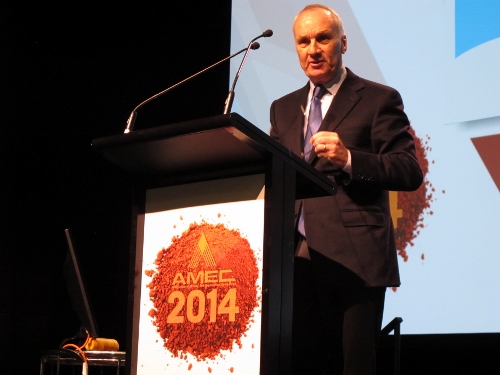
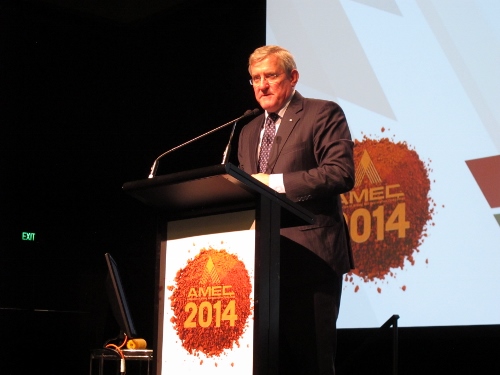
Launching the EDI at the annual Association of Mining & Exploration Companies (AMEC) conference in Perth, Minister for Industry Ian Macfarlane said the government was delivering on its election promise to introduce the scheme.

“The vital precursor to resources development is, of course, exploration,” he said.

“Resource exploration employment represents a very small portion, in fact about 0.2 of a per cent of our national employment, yet it is so critical – as I say – as a precursor to getting the industry going and seeing the massive investments and the massive exports and the 270,000 Australians employed in that industry.

“As a resources-rich nation we do face quite a dilemma.

“We have reached a position where we have capitalised on much of our easily discoverable, near-surface resources and most of our major discoveries being made nearly 20 years ago.

“To sustain this economic contribution over the medium to long term, we obviously need additional exploration, which means additional investment in exploration.”


Under the terms of the new EDI scheme companies with no taxable income in an income year will be eligible to participate in the Incentive (for that year).

To ensure the scheme is confined to junior minerals explorers, the scheme will exclude companies that have commenced resources production and companies connected or affiliated with an entity that has commenced resources production.

“The incentive will be available for disclosing entities with no taxable income and that haven’t started resources production – that is they are genuine explorers,” Macfarlane said.

“Greenfield exploration that will be eligible for the tax offset will be limited to onshore minerals exploration…it is not available for oil and gas.

“It will include expenditure on geological mapping, geophysical surveys, systematic search for areas containing minerals, except petroleum or quarry materials, and search for minerals by drilling, or other means.

Addressing a room full of junior exploration company executives, Macfarlane said they would know better than most that most of the exploration carried out within Australia – particularly the greenfield exploration – is done by junior explorers.

Be that as it may, the statistics show that although greenfields exploration and expenditure has remained relatively stable in real terms over recent years, the current reality is that it has fallen dramatically.

“We do need a strong junior sector to search for the next generation of Australian resource projects, starting with the exploration of Australia’s next mineral resource deposits,” Macfarlane said.

“Junior exploration companies find it difficult to attract the capital they need via capital markets.

“We recognise the potential impact on the overall sustainability of the resources sector as capital becomes more difficult to raise and, subsequently, greenfields exploration suffers.

“We needed to turn this around and…we realised that we had to deliver on a promise that we had made.

“We went to the 2013 election with an absolute commitment to deliver a flow-through share scheme.”

The launch of the EDI was greeted warmly by AMEC, which played a big part in its development. Simon Bennison, Association of Mining and Exploration Companies (AMEC) CEO.

“The Coalition Government should be applauded for recognising the need to develop long term investment strategies to discover the mines of tomorrow, generate future revenue streams and create jobs throughout Australia,” AMEC CEO Simon Bennison said.

“This follows the Coalition’s pre-election commitment to introduce an EDI, effective from 1 July 2014.

“The EDI was announced at the 2013 AMEC Convention as part of the Coalition’s Policy for Resources and Energy, so the first birthday of the EDI was celebrated at the 2014 AMEC Convention.

“Previous research by the University of Western Australia has indicated that the rate of depletion for existing base and precious metal mines is not being matched by new discoveries.

“The EDI should go a long way towards addressing low discovery rates of new mines.

“It should help to reverse the ongoing reduction in the global share of Australian greenfield exploration activities and the low number of Initial Public Offerings for mineral projects in Australia.”

Macfarlane said the Government’s aim in introducing the EDI is to address the challenges juniors face by facilitating their access to capital from private sector investors via a refundable tax offset.

He said the scheme had been designed utilising existing definitions and concept, which are familiar to the industry while working to ensure the legislation is simple and effective without unduly burdening small companies with excessive and increased legislation.

“The information being released today will provide junior exploration companies with certainty over what expenditure will be eligible for the incentive,” Macfarlane said.

“Companies will have the discretion to choose a number of options about how they will apply the credits.

“While the Tax Office will administer the EDI, my department will monitor greenfields exploration and the scheme’s effectiveness from commencement.

“This will feed into a review of the scheme and how it has delivered the Government’s intention, and that intention, of course, is to boost greenfield exploration by junior explorers and in turn, the discovery of new world-class mineral deposits.”

Uranium needs to be normalised

THE CONFERENCE CALLER: With the Australian Uranium Conference soon to kick off in Perth it was interesting to hear the thoughts of Michael Angwin former Australian Uranium Association CEO in regards to the issues the commodity is currently facing.

As the former CEO of the association, Angwin reminded the audience that he no longer represents anybody and that his musings are not those of the body he once represented.

“I can only tell you what the uranium industry should be doing and at the risk of looking like a well-meaning outsider at best,” he said.

“At worst, like a former industry boss, taking the opportunity to reinvigorate those things he couldn’t achieve before he became the former boss.”

Instead, Angwin set about providing an insight of the uranium industry, particularly in Australia, over the past 30 years.

“The variable growth of the nuclear industry over time and the impact of that variability on demand for uranium has meant Australia’s uranium industry has been as competitive as possible at all stages of the global and economical political cycles,” he said.

“Having the world’s largest uranium endowment is not enough, competiveness matters.”


Angwin took aim at what he described as the contradiction of the claim often made by Australia’s environmental NGOs that nuclear power is too expensive.

Despite these claims, he pointed out, nuclear power stations keep being built.

The reasons for this, Angwin outlined, are that nuclear power stations can supply reliable continuous electricity to large populations, which he said explains why China and India like nuclear power.

“They keep being built because they provide clean electricity,” he intoned.

“They keep being built because they provide an industrial base for growing economies that want to offer their citizens a route out of poverty.”

Anybody with a passing interest in the industry would identify the Fukushima disaster as a turning point in the recent fortunes of uranium.

There does, however, seem to be some growing interest in reigniting Japan’s nuclear power industry with Prime Minister Abe recently confirming nuclear energy’s importance to Japan’s energy policy mix for the next 20 years.

Japanese utilities have recently submitted applications for the re-start of around 17 facilities over the course of 2014 and 2015.

In China there are 31 reactors currently under construction – five to come on line this year, of which two have already been commissioned with 128 new reactors are anticipated by 2025.

At present some 37,000 megawatts of nuclear capacity is under construction, with planned projects slated to take that figure beyond 60,000MW.

The program is envisaged to take the country from being two per cent nuclear powered in 2015 to four per cent by 2020, eight per cent by 2025 and sixteen per cent by 2030.

“Fukushima has caused a slowdown in the growth of the nuclear industry and may mean that nuclear power may not reach the global fleet capacity it seemed headed for prior to March 2011, at least not as fast as it then seemed,” Angwin said.

“Moreover, as with any commodity, the price of uranium also varies cyclically.

“Over the last 30 years we have seen the fortunes of the world’s uranium producing countries change relatively.”

Australia hasn’t avoided those cycles, be they favourable or otherwise.

The lucky country was briefly the world’s largest producer but now sits third behind its main mining investment nemesis Canada and Kazakhstan, which has become a producer of global importance.

There is also growing production emerging from Africa and Russia.

“While we can be confident that there will be a rise in growth in nuclear capacity worldwide, there are market and political uncertainties we can do little about,” Angwin said.

“That means that for every degree of uncertainty, Australia’s uranium miners have to be as competitive as they can possibly be.

“Partly that will depend on how they run their businesses.”

Angwin said he was optimistic in regards to the public policy front facing uranium – which he insisted also affects competitiveness.

He singled out the shift in political stance towards the industry, which was marked by the change in ALP policy in 2007 in opening up new markets for Australian uranium via a treaty with India and the approval of uranium mines on merit.

“Governments have adopted a different narrative about uranium – one that is more confident and more supportive and I expect this also to continue,” he said.

“The continuing political and legislative normalisation of the industry is essential to its competitiveness.

“We are approaching the place where the policy settings for uranium are aligned with that need.”

What the Brokers Say

WHAT THE BROKERS SAY: Interesting news and views from across the Resource Analyst universe.

Breakaway Research

Website: www.breakawayresearch.com

Elysium Resources (ASX: EYM)

Elysium Resources continues to make significant progress on its 100 per cent-owned Burraga copper project in the Central West of New South Wales.

Key advancements include progress on the permitting and EIS, and exploration in the project area has returned excellent early stage results, with a number of targets now requiring drilling – we consider the Burraga tenements as highly prospective for additional gold and base metal mineralisation, with any discoveries potentially adding to the currently planned 4.4 year, 300,000 tonnes per annum operation.

Successful project implementation will allow Elysium to self-fund exploration activities over all of its prospective properties, and any exploration success should significantly drive the company’s value.

Elysium Resources is an Australian mineral exploration company whose core business is exploring for large, high-quality copper and gold deposits in the rich mineral provinces of Australia and Indonesia.

Elysium is currently focussing activities on its Burraga copper project, located south-east of Bathurst in the Central West of NSW, and centred over the historic Lloyds Mine, which produced some 470,000 tonnes of ore at over 4 per cent copper.

The strategy involves developing a 300,000 tonnes per annum operation to initially treat historic tails and slag, and then develop an open pit to mine and treat approximately one million tonnes of in-situ copper mineralisation.

Free cash flow from the envisaged 4.4 year operation will be used to fund ongoing exploration activities on the company’s exploration assets, including a number of high quality gold and copper targets in the Burraga tenements.

Other exploration tenements include Malang in the highly prospective Sunda Arc of Indonesia, and Horseshoe South in the VMS prospective Bryah Basin of Western Australia.


Disclaimer: The above is intended as a guide only. The Roadhouse accepts no responsibility for investments made from this advice, successful or otherwise.

The views, opinions or recommendations of this article do not in any way reflect the views, opinions, recommendations, of The Resources Roadhouse.

The Roadhouse makes no representation or warranty with respect to the accuracy, completeness or currency of the content. The content is for educational purposes only and does not constitute financial advice. Independent advice should be obtained from an Australian financial services licensee before making investment decisions.

Core drills high silver-lead grades at Albarta

THE DRILL SERGEANT: Core Exploration (ASX: CXO) has intersected high grade silver whilst completing a maiden drilling program at the company’s Albarta project in the Northern Territory.

Highlights from drilling at the Blueys prospect include:

1 metre at 1,070 grams per tonne silver and 8 per cent lead; and

2m at 843g/t silver and 5.9 per cent lead in a broader halo of 17m at 116g/t silver and 0.83 per cent lead.

Core also claimed discovery of high grade silver-lead mineralisation at the nearby Inkheart project with results returning:

4m at 195g/t silver, 5.24 per cent lead and 2.49 per cent zinc from 111m, including 1m at 354g/t silver, 11.13 per cent lead and 6.51 per cent zinc.


Cross-section of all RC drillholes showing significant intersections, Inkheart Prospect, NT. Source: Company announcement


The company said the results from the reverse circulation (RC) drilling program at Blueys and Inkheart have validated its belief in the prospectivity of the Albarta project as a potential new silver and base metal province.

16 out of Core’s 17 drillholes hit anomalous silver levels greater than 10g/t silver.

Core said high grade silver and lead mineralisation has been intersected in structurally controlled veins surrounded by broad lower grade mineralisation and alteration in the shales and dolomites of the Bitter Springs Formation.

It explained the drilling assays and downhole geology have also confirmed that mineralisation at Blueys and Inkheart prospects are part of the same mineralising system depositing metals in the Bitter Springs Formation, which it considers opens up tenement wide potential of the Bitter Springs Formation for the discovery of economic base-metal deposits.

Core is currently planning a second drilling program designed to test the full strike extent of the two kilometre long Inkheart prospect and its connection to high grade mineralisation at Blueys as well as to conduct regional exploration over the surrounding Bitter Springs Formation target geology.

Then next drilling program is planned to commence Q3 2014.

“The value of Core’s strong tenement position in the NT has been enhanced by the discovery of a new high grade system at Inkheart especially considering that this is the company’s first drill program at the Albarta project,” Core Exploration managing director Stephen Biggins said in the company’s announcement to the Australian Securities Exchange.

“Exceptional initial drill hits at both Blueys and Inkheart are shaping up the project as a new, potentially big system which warrants a key focus for the future.”

Email: info@coreexploration.com.au

Website: www.coreexploration.com.au

What the Brokers Say

WHAT THE BROKERS SAY: Interesting news and views from across the Resource Analyst universe.


Hartleys

Website: www.hartleys.com.au

 PAPILLON RESOURCES LIMITED (ASX: PIR)

Takeover arrives

Papillon Resources Limited has received a friendly scrip merger offer from B2Gold (BTO.tsx).

The offer is 0.661 B2Gold shares for each PIR share held. The merger represents a purchase price of $1.71/share (based on B2Gold closing price 3/06/14) and values PIR at approx. $617 million.

Before PIR went into trading halt on 26 May 2014 the proposal represented a purchase price of around $2.00/share but since this date the B2Gold share price has fallen due to a combination of gold price volatility and media speculation surrounding the transaction.

Our current valuation for PIR is $1.89/share which suggests the original proposal was around fair value, especially given our PIR valuation is not adjusted by a country risk discount.

Fair value although cash would have been better

We see the original proposal by B2Gold as appropriate although the recent share price movement has pushed the implied deal price below our PIR valuation.

We maintain our view that Fekola is one of the best undeveloped gold assets in the world and hence may attract a counter offer by a larger gold miner, particularly as we see the potential for more value in PIR through a larger development (lower cutoff, larger mill for increased production).

Not scared to develop projects in difficult jurisdictions

BTO has a portfolio of assets in the Philippines, Nicaragua, Colombia, Namibia and Uruguay.

The company has a history of developing gold projects in some of the world’s more difficult jurisdictions.

BTO is currently operating two mines in Nicaragua and one in the Philippines. The company plans a fourth mine (Okjikoto) in Namibia to be commissioned in Q4 CY14.

BTO has a cash and equivalent assets position of approx. C$150 million and unused debt capacity of C$150 million.

Second deal PIR Chairman has done with the B2Gold club

We note that this deal comes soon after the completion of the Sierra Mining Ltd (SRM) merger with RTG Mining Inc (RTG).

The PIR chairman was also the chairman of SRM, and B2Gold was a major shareholder of both SRM & RTG.

We maintain our view that Fekola is one of the world’s best undeveloped gold projects.

The offer price doesn’t include a scarcity premium or significant exploration potential, but perhaps this allows for a small country risk discount.

Due to the scarcity of deposits like Fekola and the potential value accretion we believe it is possible that there is a counter bid, although given the very long sale process it seems probable that other potential avenues have been exhausted.


Breakaway Research

Website: www.breakawayresearch.com

TNG Limited (ASX: TNG)

TNG has made significant key advancements on the Mount Peake project, with the signing of MoU’s with WOOJIN and POSCO E&C since March 2014.

These agreements cover critical aspects of project development, including offtake, financing and construction.

In the shorter term the POSCO E&C MoU covers potential funding and completion of the Definitive Feasibility Study, a critical near term step in advancing Mount Peake.

One key now will be to progress these non-binding MoU’s into binding agreements, which will add significant impetus to Mount Peake.

The key technical consideration is to prove the commercialisation of the TIVAN® hydrometallurgical process, with pilot scale work now under way.

TNG continues to work towards development of its Mount Peake V-Ti-Fe project, and commercialisation of the TIVAN® hydrometallurgical process.

It is expected that the DFS will be completed by late 2014 – timing will be dependent upon results of the pilot scale TIVAN® testwork and obtaining funding.

With the signing of the recent MoU’s TNG has moved closer to sourcing funding for the DFS and development of Mount Peake.

Recent progress increases our confidence that TNG’s development strategy for Mount Peake is on track to be executed.

Disclaimer: The above is intended as a guide only. The Roadhouse accepts no responsibility for investments made from this advice, successful or otherwise.

The views, opinions or recommendations of this article do not in any way reflect the views, opinions, recommendations, of The Resources Roadhouse.

The Roadhouse makes no representation or warranty with respect to the accuracy, completeness or currency of the content. The content is for educational purposes only and does not constitute financial advice. Independent advice should be obtained from an Australian financial services licensee before making investment decisions.

WA Minister flags Aboriginal Heritage Act reforms

IN THE LOBBY: The Western Australia Government has announced a proposal to amend parts of the Aboriginal Heritage Act, which determines how sacred places and objects should be preserved.

If it goes ahead it will be the first changes to the act since its introduction 42 year ago.

The release of the Aboriginal Heritage Amendment Bill 2014 by the WA Minister for Aboriginal Affairs Peter Collier was greeted warmly by the mining and minerals exploration industry.

“The current legislation dates back over 40 years and is well overdue for comprehensive review and improvement,” Association of Mining and Exploration Companies (AMEC) CEO Simon Bennison said.

Bennison said AMEC had been advocating changes, both legislative and administrative, within the Department of Aboriginal Affairs for some time to streamline processes and remove what the group consider to be any unnecessary regulatory burden and red tape.

“Significant progress has been made with administrative processes and with the integrity of the Sites Register,” he said.

“However, legislative changes are a crucial component of the reform agenda and need to be progressed as soon as possible.

“The Amendment Bill should provide increased clarity and certainty for all stakeholders, as well as improve compliance, efficiency and effectiveness.”

AMEC is hopeful the proposed changes to the process, which includes: the issuing of Permits and Declarations, creating a register of Declarations and Permits, strengthening the integrity of the register of Aboriginal Sites and allowing the transferability of Section 18 Permits to another party will provide certainty for all stakeholders, whilst also protecting Aboriginal heritage sites.

“The proposed amendments should also contribute towards a reduction in the timeframes that apply to the approvals process,” Bennsion stressed.

“Some surveys can take days or weeks to complete and costs are extraordinarily high for miners and junior explorers to bear with a limited budget.

“In many cases substantial delays covering several months or years have resulted.

“This timeframe and cost does not include the other approvals processes that companies still need to go through before they even start their work program.”

AMEC said it would like to see early passage of the legislation through Parliament adding it is prepared to continue to work with the Government, the Opposition and the Department of Aboriginal Affairs to implement the legislative reform and associated Regulations over the coming months and during the transition phase.

AMEC’s concerns were echoed by the Chamber of Minerals and Energy of Western Australia (CME) as it also welcomed the release of the amendments to the Aboriginal Heritage Act.

“CME has long advocated for improvements to develop additional transparency and certainty in the Aboriginal Heritage system,” CME deputy chief executive Nicole Roocke said.

“The Aboriginal Heritage Act has been in operation since 1972 and CME considers it an appropriate time to update the legislation so it remains contemporary.”

CME identified the resources sector as a key stakeholder in the heritage system, and went on to declare that like all stakeholders involved, the industry is looking for a system which is balanced and efficient while effectively protecting Aboriginal heritage sites of significance.

CME said it too would be working during the consultation period with industry members and the Department of Aboriginal Affairs to ensure the resources sector’s perspectives are taken into account.

“The resources sector is focused on ensuring the amendments result in an improved, efficient and robust system,” Roocke said.

Greens MP Robin Chapple agreed the changes would aid mining companies, but would also represent a “complete desecration” of an Act he considers to have already been watered down since its inception.

“They’ve taken away what was left of a shell of an Act and just trashed it,” Chapple was reported as saying by the ABC.

According to the ABC report Minister for Aboriginal Affairs Peter Collier said the Act only needs a bit of tweaking to ensure the state’s Aboriginal heritage continues to be protected.

“What we’re actually doing is streamlining the process of Aboriginal heritage without removing the rigour which serves to protect those sites,” he said.

Chapple said the consultation period is too short.

“For Aboriginal communities to get a hold of it, digest it, and become aware of it even, takes several weeks,” he told the ABC.

“So I don’t think we’re going to see anything in a hurry, because of the very nature of remote communities.

“I don’t think eight weeks is nearly enough. For something like this you need about six months.”

Iron Ore Continues on its Downward Slide.

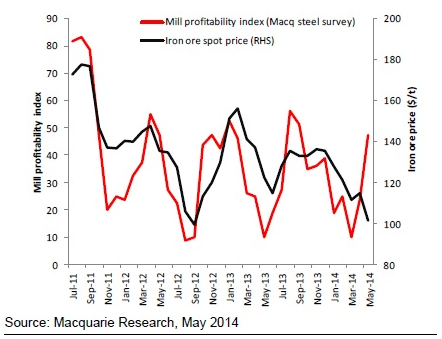
GAVIN WENDT: Iron ore prices fell for a sixth straight month during May, which represents its longest losing streak on record, with hefty supplies pushing prices to their lowest level since September 2012. During the month of May the price of iron ore fell by 13 per cent alone and is down by 32 per cent so far this year.

Some traders in China have been unloading cargoes at a loss on worries that prices could slide further, whilst Chinese steel mills are cutting back on long-term iron ore contracts in favour of cheaper spot cargoes, confident that beaten-down prices are unlikely to rebound.


It’s swings and roundabouts for the industry, because the price slide is likely to have shuttered Chinese domestic iron ore miners whose cost bases are typically above $100 per tonne.

On the other hand, seaborne supply has increased to such an extent that it has thwarted a recovery in prices. Indeed, it is this strong supply of imports that leaves the market waiting for a cut in Chinese domestic production.

Broker CLSA also highlights the fact that market rumours involving Chinese banks potentially reducing loans to steel mills by 10 per cent this year, have also weighed on iron ore prices.

In the meantime, steel mills remain cautious in raw material inventory replenishment, although prices below $100 per tonne are seeing some purchasing.

According to the latest Mysteel survey, average medium and small Chinese steel mills import iron ore inventory was 24 days last week, down from 25 days two weeks ago; whilst domestic concentrate inventory had also been lowered by 2 days to 7 days over the same period.

Major Chinese port iron ore inventory inched up by 0.7 per cent week-on-week to 111.13 million tonnes (Mt) last week, of which traders’ stock increased by 1.3 per cent week-on-week to 38.56Mt.

The market is reportedly worried that as mid-year bank loan repayments fall due, some traders may have to dump some inventory to raise liquidity.

In my view, the biggest issue impacting the iron ore price at the present time is supply.

Quite simply, the massive increase in production from the Pilbara region of WA by BHP and RIO means that the supply side is beginning to catch up with demand.

This means that prices have essentially leveled out, or indeed begun to fall.

This was always going to be the case and the market was well aware that we would eventually arrive at this particular point. So it really shouldn’t be too much of a surprise.

At the same time we have uncertainty prevailing with respect to China’s level of iron ore demand in terms of its near-term sustainability.

The market appears to be getting mixed messages out of China and there are different interpretations as to what is exactly going on.

What all of this does is emphasise how important China is to the iron ore business. China accounts for 60 per cent or the world seaborne iron ore trade, so this means that the iron ore business is unlike any other commodity. There is no other commodity business where the industry is so reliant on one particular buyer, as is the case with China and the iron ore industry.

This is a far cry from the fixed annual contract price that dominated the industry for the previous few decades.

Under those circumstances, both producers and buyers had certainty around pricing, which was both an advantage and a disadvantage, depending upon underlying market conditions.

China will go on being the world’s major steel producer and consuming huge volumes of iron ore, but we’re approaching the peak of China’s demand over the next decade or so.

This means that the world iron ore industry is going to well supplied and as a result we won’t see the high prices that we’ve seen in the past.

The international market will look closely at China and its authorities for guidance in terms of possible stimulus measures that might boost construction and overall industrial production, which could then flow through into firmer iron ore prices.

From BHP and Rio’s perspective, it’s a glass half full/half empty scenario. Although prices have fallen, sales volumes are strong, with both companies well positioned at the bottom of the iron ore cost curve.

A period of sustained lower prices could drive higher-cost competitors out of business and see BHP and RIO further entrench their position of iron ore market dominance.

The other important aspect for BHP and RIO is the issue of diversity.

They are now so heavily reliant on iron ore income that they are not really truly ‘diversified’ miners any longer.

A period of prolonged iron ore price weakness will inevitably have shareholders asking questions about the wisdom of placing all of their eggs in one basket in terms of becoming so heavily reliant on just one commodity, iron ore.

Perhaps commodities like aluminum, which Rio put so much faith back in 2007 with its $38 billion for Alcan during 2007, might represent that broadening of earnings diversity?


Gavin Wendt is the founder of MineLife, publisher of the MineLife Weekly Resource Report


Nickel shines as Rox stars

THE INSIDE STORY: Rox Resources (ASX: RXL) has timed its run nicely to discover the nickel project all other junior nickel explorers are chasing.

The nickel market has emerged from a five-year hiatus with LME nickel futures recording a 15 percent gain in April, the biggest monthly gain since September 2012.

Most analysts credit the run to price pressures caused by increasing supply tightness thanks to the implementation of Indonesia’s export ban on unprocessed ores and Russia’s activities in Ukraine.

Australia’s current nickel romance began in July 2012 when Sirius Resources (ASX: SIR) discovered its Nova and Bollinger deposits and was duly anointed as the Prince Charming of the Fraser Range region of Western Australia.

Soon every company along strike and within cooee began to flirt with the market extolling their respective virtues and demanding an invitation to the Fraser Range dance.

That’s not to say all companies in the area are to be compared to the Ugly Sisters, but there are probably too many not likely to replicate the success of the region’s hero.

Like all good stories, however, this one does have a Cinderella, it’s just that she lives some 900 kilometres to the north in the North Eastern Goldfields region and is better known as the Mt Fisher gold-nickel project of Rox Resources (ASX: RXL).

“We are really excited about where Rox, as a company, is at the moment,” Rox Resources managing director Ian Mulholland told The Resources Roadhouse.

“We have a couple of really strong projects, including the Mt Fisher project and the Reward zinc project in the Northern Territory.”

The Mt Fisher gold-nickel project is located 500km north of Kalgoorlie and covers an area of 658 square kilometres, 488sqkm of which is 100 percent-owned by Rox with the company holding an option to purchase 100 percent of the remaining 170sqkm.

Rox’s original target at Mt Fisher was gold, however its focus shifted after its discovery of nickel sulphides at the Camelwood deposit in December 2012 proved too significant to ignore.

Rox has since established a JORC 2012 Mineral Resource at Camelwood of 1.6 million tonnes at 2.2 percent nickel.

The Resource consists of an Indicated Mineral Resource of 0.6 million tonnes at 2.4 per cent nickel and an Inferred Mineral Resource of 1Mt at 2.1 percent nickel for 34,600 tonnes of contained nickel.

“Our main focus in on the Fisher East nickel project, which is really all about trying to define a big enough resource to start thinking about developing a mining operation there,” Mulholland said.

“We only discovered the nickel 18 months ago, and the first thing we did was complete the drilling that allowed us to define the mineral resource of about 35,000 tonnes of contained nickel.

“Our focus now is on increasing the amount of contained nickel at the project.

“The grade is there, we have already established that, but it is important now to establish 100,000 tonnes of contained nickel to enable us to develop this project into a mine with a ten year mine life producing 10,000 tonnes of nickel per year.

“That would entrench us firmly in the top five nickel sulphide producers in Australia, placing us aside companies such as BHP Billiton, Western Areas, Independence Group and Panoramic.”


Subsequent exploration by Rox identified the Musket and Cannonball deposits.

Early drilling at Musket has returned results including:

15 metres at 2.7 percent nickel from 264.7m, including 0.9m at 19.5 percent nickel;

17m at 2.2 percent nickel from 227m, including 8m at 3.3 percent nickel, including 2m at 8.1 percent nickel; and

16.2m at 2.8 percent nickel from 305.1m, including 0.8m at 19 percent nickel.

Recent results from a current diamond drilling program underway at the Musket nickel sulphide prospect have confirmed a coherent body of nickel sulphide mineralisation down to 300 metres depth, which the drilling has yet to close off.

Rox is confident these latest results will contribute to the estimation of a large maiden resource for Musket later this year.

“The mineralisation we are seeing at Musket is much thicker than we have encountered at Camelwood, which is only two kilometres away,” Mulholland said.

“Musket is shaping up to add significant new tonnes to our overall project resource.

“Reaching that critical mass of 100,000 tonnes of contained nickel – it will probably be bigger – will allow us to get into production and then we can fund future exploration.”

Although drilling at Fisher East has only reached 500m depth, it has indicated a mineralised system over 3km, which remains open along strike and at depth.

The mineralisation is typical of komatiite-hosted nickel sulphide deposits, similar to those found at Kambalda, with mineralisation at all three deposits occurring at the basal contact of a highly altered ultramafic lava with underlying sulphidic felsic sediments.

A series of sighter flotation tests on a number of composite drill samples achieved promising nickel concentrate grades of 11 to 15 percent nickel, at recoveries ranging from 40 to 97 percent.

Metallurgical test work is anticipated on samples from the Musket prospect in due course.

Because of the higher tenor of the Musket mineralisation compared with Camelwood, Rox believes better recoveries and concentrate grades could be achieved.

“We are completing some preliminary metallurgy test work – the results of which so far have produced good quality concentrates with no penalty elements,” Mulholland said.

“Everything looks pretty much stock standard, which has provided us with a great deal of encouragement.”

Across the border in the Northern Territory, Rox’s JV partner, Teck Australia, is planning a program of around 4,000 metres of diamond drilling at the Reward zinc project (Rox 49%, Teck 51%).

The bulk of the drilling is to be carried out at the Teena prospect where diamond drilling in 2013 defined two distinct lenses of mineralisation and encountered impressive intersections of sulphide mineralisation over a 1.5 klometre strike length.


Recent drilling at Teena intersected:

26.4m at 13.3 percent zinc and lead, including 16.2m at 17.2 percent zinc and lead, and 20.1m at 15 percent zinc and lead, including 12.5m at 19.5 percent zinc and lead.

Rox had already defined a JORC 2004 Mineral Resource of 43.6Mt at 5.04 percent zinc and lead at the Myrtle deposit, some 15km south of Teena.

Teck has earned a 51 percent interest at Reward having already spent $5 million.

It has recently opted to increase that interest to 70 percent by spending a further $10 million by 2018.

“The Teena zinc prospect is shaping up to be a world class deposit,” Mulholland said.

“When we end up with 30 percent of this project we will have 30 per cent of a world class deposit with significant value.

“We’re hopeful that by the time Teck earns its 70 percent we will have completed enough drilling to have a resource there.”

“Teena, potentially, is worth a lot more than what the Fisher East nickel project could be worth – this is our “Tropicana.”


Rox Resources Limited (ASX: RXL)
…The Short Story

HEAD OFFICE
Level 1, 30 Richardson Street
West Perth WA 6005

Ph: +61 8 9226 0044
Fax: +61 8 9322 6254

Email: admin@roxresources.com.au
Web: www.roxresources.com.au

DIRECTORS
Jeff Gresham, Ian Mulholland, Brett Dickson

MAJOR SHAREHOLDERS
National Nominees   3.7%
Rox Directors        2.8%
Ram Kangatharan 2.2%
Siat Yoon Chin     1.9%
Teck Australia      1.3%

SHARES ON OFFER
745 million

MARKET CAPITALISATION
$32.8 million (at 17/6/14)

Emmerson inks Tennant Creek JV with Evolution

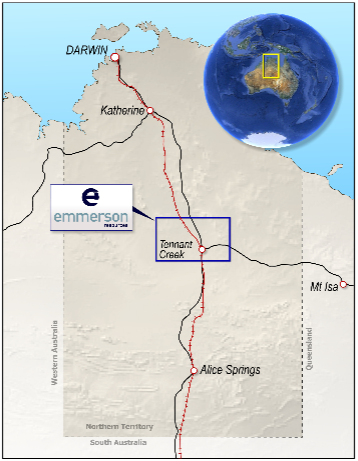
THE BOURSE WHISPERER: Emmerson Resources (ASX: ERM) has signed a binding Term Sheet with Evolution Mining (ASX: EVN) to fast-track discovery of gold and copper deposits within the company’s 100 per cent-owned tenements at Tennant Creek in the Northern Territory.


Tennant Creek location. Source: Company announcement


Evolution has agreed to work with Emmerson to advance the existing JORC resources identified by Emmerson at Tennant Creek and will drill test a number of gold-copper targets aimed specifically at a rapid resumption of mineral production.

Under the terms of the Farm-in and Joint Venture, Evolution will sole fund expenditure of $15 million on exploration over the next three years to earn a 65 per cent interest in Emmerson’s 2,500 square kilometre tenement package at Tennant Creek.

A further $10 million minimum, sole funded by Evolution over 2 years following the execution of the joint venture, will allow Evolution to earn an additional 10 per cent (total of 75 per cent of the Tennant Creek project.

Exploration and near mine drill programs are scheduled to commence soon, which include an aggressive drill commitment by Evolution.

Emmerson will manage and operate the activities whilst utilising the development and exploration expertise of Evolution via a joint Exploration Management Committee.

“This announcement is the culmination of a focussed and determined effort to introduce a partner to the Tennant Creek Mineral Field who sees the potential beyond that previously identified,” Emmerson Resources managing director Rob Bills said in the company’s announcement to the Australian Securities Exchange.

“The Joint Venture agreement with Evolution will set the scene for the discovery of major new gold-copper resources, building on Emmerson’s work in recent years which began to unlock the secrets of finding a new generation of gold-copper deposits in the Tennant Creek area.

“This agreement effectively secures the future for Emmerson by providing the funding to underpin a very significant exploration effort- to build on the existing JORC resources and to test a range of new generation gold-copper targets, which, if successful, will be fast-tracked through to development.

“We have already established an excellent working relationship with Evolution, share a very similar approach to science driven exploration and are delighted by their commitment to rapidly build a substantive resource base ahead of production.

“Both parties also recognise the importance of continuing to build strong relationships with all stakeholders including the Traditional Owners, the Central Land Council, Northern Territory Government and various communities and businesses in the Tennant Creek Township.”

Email: info@emmersonresources.com.au

Website: www.emmersonresources.com.au