


Macfarlane launches Exploration Development Incentive
THE CONFERENCE CALLER: The Federal Government has committed to introduce an Exploration Development Incentive (EDI) to encourage investment in small exploration companies undertaking greenfields mineral exploration in Australia from 1 July 2014.
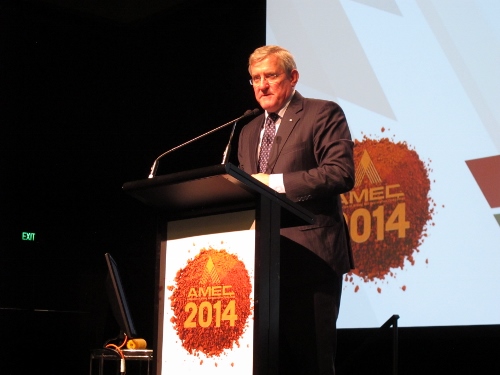
Launching the EDI at the annual Association of Mining & Exploration Companies (AMEC) conference in Perth, Minister for Industry Ian Macfarlane said the government was delivering on its election promise to introduce the scheme.
“The vital precursor to resources development is, of course, exploration,” he said.
“Resource exploration employment represents a very small portion, in fact about 0.2 of a per cent of our national employment, yet it is so critical – as I say – as a precursor to getting the industry going and seeing the massive investments and the massive exports and the 270,000 Australians employed in that industry.
“As a resources-rich nation we do face quite a dilemma.
“We have reached a position where we have capitalised on much of our easily discoverable, near-surface resources and most of our major discoveries being made nearly 20 years ago.
“To sustain this economic contribution over the medium to long term, we obviously need additional exploration, which means additional investment in exploration.”
Under the terms of the new EDI scheme companies with no taxable income in an income year will be eligible to participate in the Incentive (for that year).
To ensure the scheme is confined to junior minerals explorers, the scheme will exclude companies that have commenced resources production and companies connected or affiliated with an entity that has commenced resources production.
“The incentive will be available for disclosing entities with no taxable income and that haven’t started resources production – that is they are genuine explorers,” Macfarlane said.
“Greenfield exploration that will be eligible for the tax offset will be limited to onshore minerals exploration…it is not available for oil and gas.
“It will include expenditure on geological mapping, geophysical surveys, systematic search for areas containing minerals, except petroleum or quarry materials, and search for minerals by drilling, or other means.
Addressing a room full of junior exploration company executives, Macfarlane said they would know better than most that most of the exploration carried out within Australia – particularly the greenfield exploration – is done by junior explorers.
Be that as it may, the statistics show that although greenfields exploration and expenditure has remained relatively stable in real terms over recent years, the current reality is that it has fallen dramatically.
“We do need a strong junior sector to search for the next generation of Australian resource projects, starting with the exploration of Australia’s next mineral resource deposits,” Macfarlane said.
“Junior exploration companies find it difficult to attract the capital they need via capital markets.
“We recognise the potential impact on the overall sustainability of the resources sector as capital becomes more difficult to raise and, subsequently, greenfields exploration suffers.
“We needed to turn this around and…we realised that we had to deliver on a promise that we had made.
“We went to the 2013 election with an absolute commitment to deliver a flow-through share scheme.”
The launch of the EDI was greeted warmly by AMEC, which played a big part in its development. Simon Bennison, Association of Mining and Exploration Companies (AMEC) CEO.
“The Coalition Government should be applauded for recognising the need to develop long term investment strategies to discover the mines of tomorrow, generate future revenue streams and create jobs throughout Australia,” AMEC CEO Simon Bennison said.
“This follows the Coalition’s pre-election commitment to introduce an EDI, effective from 1 July 2014.
“The EDI was announced at the 2013 AMEC Convention as part of the Coalition’s Policy for Resources and Energy, so the first birthday of the EDI was celebrated at the 2014 AMEC Convention.
“Previous research by the University of Western Australia has indicated that the rate of depletion for existing base and precious metal mines is not being matched by new discoveries.
“The EDI should go a long way towards addressing low discovery rates of new mines.
“It should help to reverse the ongoing reduction in the global share of Australian greenfield exploration activities and the low number of Initial Public Offerings for mineral projects in Australia.”
Macfarlane said the Government’s aim in introducing the EDI is to address the challenges juniors face by facilitating their access to capital from private sector investors via a refundable tax offset.
He said the scheme had been designed utilising existing definitions and concept, which are familiar to the industry while working to ensure the legislation is simple and effective without unduly burdening small companies with excessive and increased legislation.
“The information being released today will provide junior exploration companies with certainty over what expenditure will be eligible for the incentive,” Macfarlane said.
“Companies will have the discretion to choose a number of options about how they will apply the credits.
“While the Tax Office will administer the EDI, my department will monitor greenfields exploration and the scheme’s effectiveness from commencement.
“This will feed into a review of the scheme and how it has delivered the Government’s intention, and that intention, of course, is to boost greenfield exploration by junior explorers and in turn, the discovery of new world-class mineral deposits.”