


Uranium needs to be normalised
THE CONFERENCE CALLER: With the Australian Uranium Conference soon to kick off in Perth it was interesting to hear the thoughts of Michael Angwin former Australian Uranium Association CEO in regards to the issues the commodity is currently facing.
As the former CEO of the association, Angwin reminded the audience that he no longer represents anybody and that his musings are not those of the body he once represented.
“I can only tell you what the uranium industry should be doing and at the risk of looking like a well-meaning outsider at best,” he said.
“At worst, like a former industry boss, taking the opportunity to reinvigorate those things he couldn’t achieve before he became the former boss.”
Instead, Angwin set about providing an insight of the uranium industry, particularly in Australia, over the past 30 years.
“The variable growth of the nuclear industry over time and the impact of that variability on demand for uranium has meant Australia’s uranium industry has been as competitive as possible at all stages of the global and economical political cycles,” he said.
“Having the world’s largest uranium endowment is not enough, competiveness matters.”
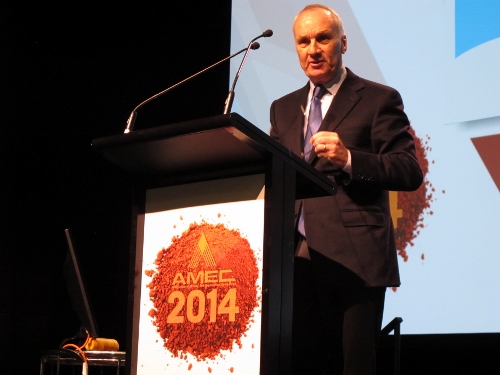
Angwin took aim at what he described as the contradiction of the claim often made by Australia’s environmental NGOs that nuclear power is too expensive.
Despite these claims, he pointed out, nuclear power stations keep being built.
The reasons for this, Angwin outlined, are that nuclear power stations can supply reliable continuous electricity to large populations, which he said explains why China and India like nuclear power.
“They keep being built because they provide clean electricity,” he intoned.
“They keep being built because they provide an industrial base for growing economies that want to offer their citizens a route out of poverty.”
Anybody with a passing interest in the industry would identify the Fukushima disaster as a turning point in the recent fortunes of uranium.
There does, however, seem to be some growing interest in reigniting Japan’s nuclear power industry with Prime Minister Abe recently confirming nuclear energy’s importance to Japan’s energy policy mix for the next 20 years.
Japanese utilities have recently submitted applications for the re-start of around 17 facilities over the course of 2014 and 2015.
In China there are 31 reactors currently under construction – five to come on line this year, of which two have already been commissioned with 128 new reactors are anticipated by 2025.
At present some 37,000 megawatts of nuclear capacity is under construction, with planned projects slated to take that figure beyond 60,000MW.
The program is envisaged to take the country from being two per cent nuclear powered in 2015 to four per cent by 2020, eight per cent by 2025 and sixteen per cent by 2030.
“Fukushima has caused a slowdown in the growth of the nuclear industry and may mean that nuclear power may not reach the global fleet capacity it seemed headed for prior to March 2011, at least not as fast as it then seemed,” Angwin said.
“Moreover, as with any commodity, the price of uranium also varies cyclically.
“Over the last 30 years we have seen the fortunes of the world’s uranium producing countries change relatively.”
Australia hasn’t avoided those cycles, be they favourable or otherwise.
The lucky country was briefly the world’s largest producer but now sits third behind its main mining investment nemesis Canada and Kazakhstan, which has become a producer of global importance.
There is also growing production emerging from Africa and Russia.
“While we can be confident that there will be a rise in growth in nuclear capacity worldwide, there are market and political uncertainties we can do little about,” Angwin said.
“That means that for every degree of uncertainty, Australia’s uranium miners have to be as competitive as they can possibly be.
“Partly that will depend on how they run their businesses.”
Angwin said he was optimistic in regards to the public policy front facing uranium – which he insisted also affects competitiveness.
He singled out the shift in political stance towards the industry, which was marked by the change in ALP policy in 2007 in opening up new markets for Australian uranium via a treaty with India and the approval of uranium mines on merit.
“Governments have adopted a different narrative about uranium – one that is more confident and more supportive and I expect this also to continue,” he said.
“The continuing political and legislative normalisation of the industry is essential to its competitiveness.
“We are approaching the place where the policy settings for uranium are aligned with that need.”