Research could help reduce carbon tax for major industries

A recent study conducted by Curtin University in Western Australia; Engineering reduced greenhouse gas production: A Remanufacturing solution – has revealed remanufactured refrigeration and air conditioning compressors produce up to 93 per cent less greenhouse gas emissions than new Original Equipment Manufactured (OEM) compressors.

The study was conducted by the university’s director of the Centre of Excellence in Cleaner Production, Associate Professor Michele Rosano and Senior Lecturer Dr Wahidul Biswas.

Curtin University Civil & Mechanical Engineering lecturer
Dr Wahidul Biswas, and Recom Engineering owner Peter Frey inspect a
remanufactured compressor at a Recom Engineering workshop in Perth.
 

After analysing the final results the university team has come to the conclusion that the research has provided a case for the market development of remanufactured compressors to be more sustainable alternatives to traditional OEMs.

The study included a life cycle assessment of each stage of the remanufacturing process, including disassembly, cleaning and washing, machining, reassembling, and testing, to determine the environmental benefits associated with the potential substitution of a new OEM compressor with a remanufactured compressor.

“Through our analysis, we determined that remanufactured compressors produce about 89 per cent to 93 per cent less greenhouse gas emissions than those associated with a new OEM compressor,” Rosano said.

“The analysis also confirmed that additional reuse and less replacement of parts with new parts could further reduce the overall carbon footprint of remanufactured compressors.”

According to Rosano the equivalent of 1,590 kilograms of carbon dioxide (CO2) emissions were emitted from the production of a new OEM compressor.

“The replacement of a new OEM compressor with a remanufactured compressor can mitigate about 1,470 kilograms of CO2 emissions, which is similar to the greenhouse gas emissions from 1.56 megawatt hours of electricity generation in Western Australia, and 1.71 megawatt hours in Queensland and New South Wales,” she said.

“This electricity generation would meet the average electricity demand of an Australian household for three-and-a-half months.”

Results from the study also highlighted the importance of remanufacturing in reducing not only the resource intensity and carbon footprint, but also the cost associated with the purchase of a compressor.

“If the carbon price was set at $50 per tonne of CO2 emissions, a new OEM compressor would cost of $79.50 and a remanufactured compressor only $5.85,” Rosano said.

“Coles Supermarkets, the second-largest supermarket chain in Australia, uses around 7500 compressors in their stores, with an average size of 27 kilowatts.

“If these compressors were completely replaced with remanufactured compressors, 19,500 tonnes of CO2 emissions could be avoided.”

The study found the replacement of OEMs pre-used parts with new parts helped to avoid the disposal of entire units and achieved a significantly higher greenhouse gas management benefit for major industries.

“Including the final disposal of compressor units into a life-cycle assessment may become an increasing reality in the industrial market as further costs and limitations are placed on the landfill disposal of industrial wastes,” Rosano said.
 
“In addition, as mining resources start to deplete, remanufacturing and recycling will increasingly become the norm for industrial machinery and componentry, both on an economic basis and with the need to increase greenhouse gas management of production activities in carbon-constrained economies.”

Rosano said achieving eco-efficient production required the recovery of resources from the waste stream at the end-of-life of a product.

“By using recovered end-of-life parts, remanufacturing should be able to reduce the environmental costs associated with both the manufacturing and disposal of heavy and material intensive industrial machinery,” she said.

“Also, by providing customers with remanufactured products, companies can provide the same level of service using fewer resources.

“In this way, remanufacturing can importantly reduce the resource intensity and increase the eco-efficiency of product systems.”

National remanufacturing company, Recom Engineering, provided financial support for the study.

Rosano said the research could assist Recom Engineering to manage the carbon footprint of its remanufacturing business and assist in the market development of remanufactured compressors as more sustainable alternatives to the traditional purchase of new OEM compressors.

Shorten tables Mining Tax Bill

The Melbourne Cup has been run and won, which can only mean one thing…its MRRT season!

The first legislation of the Minerals Resources Rent Tax was tabled in Parliament by Bill Shorten.

Treasurer Wayne Swan was acting as Prime Minister while Julia Gillard circumnavigates the globe, presumably not by flying with Qantas, for a series of international conferences before returning home to greet American President Barack Obama.

Unfortunately the erudite Queenslander had lost his voice and so the duty to introduce the Labor Party’s MRRT baby fell upon the dulcet tones of the Deputy Treasurer.

Unperturbed Swan faced the media to claim the mining tax will allow the community to share in the resources boom.

As the MRRT was hitting the pages of Hansard the mining industry continued to hit out against its introduction.

The Labor Government has introduced a package of 10 bills it hopes will ultimately establish the MRRT and allocate revenues gained from it.

The Bill and the Government still have to navigate the obstacle course that is consistently being rearranged by the independents, in particular the Member for New England Tony Windsor and the Member for Lyne Rob Oakeshotte, to be passed.

Windsor has thrown a last-minute Coal Seam Gas spanner amongst the nuts of the MRRT machine, while Oakeshott is trying to reassure his electorate that he is monitoring the situation.

Tasmanian independent Member for Denison Andrew Wilkie is more concerned about the threshold of the mining tax.

Wilkie has identified depreciation provisions within the tax framework favour three big companies, namely BHP Billiton, Rio Tinto and Xstrata, and has highlighted these perceived inequities to be a disincentive to smaller miners.


“I’m hopeful they can make some adjustment to accommodate my concerns … I want small miners to succeed and become big miners,” he told a gathering of reporters in Canberra.

The nuts and bolts of the MRRT represent a 30 per cent tax that will apply to the extraordinary profits of coal and iron ore miners from 1 July 2012.

The tax will apply to those mines that fit into the category of being the most highly-profitable after extraction.

The tax will however, allow new investment to be written off.

It will only apply to smaller miners once they have made enough profit to pay off their initial investments.

In a bold display of political table thumping Swan claimed the MRRT was a historic reform to the country’s taxation system that would add strength across the entire economy.

“Australians know how important the mining industry is, but they also know that we can only dig up and sell the resources once,” Swan said.

The Government has promised revenue from the MRRT will fund a cut in the corporate tax rate, provide tax breaks for small business, boost the savings of retirees’ savings and assist with critical infrastructure projects.

The introduction of the Bill woke the voices of industry from their recent silence on the subject with the Association of Mining and Exploration Companies chief executive officer Simon Bennison leading the pack.

“The discriminatory and anti-competitive nature of the Government’s proposed mining tax on small emerging miners continues to be ignored in the latest Minerals Resource Rent Tax legislation tabled in Parliament today,” Bennison said.

“Despite consistent requests made by AMEC, the Federal Government still chooses to ignore the significant effect the MRRT will have on small emerging Australian miners, and our many concerns and recommendations have gone unheard.

“AMEC continues to oppose the MRRT as it is ill conceived, discriminatory, punitive, complex and a short term tax grab that does not look at the effect of the proposed mining tax on Australia’s international competitiveness and sovereign risk.”
 
Bennison said a number of the body’s concerns could be addressed by an increase of the profit threshold to $500 million, which he said would represent a production level of approximately 10 million tonnes per annum.

“Many AMEC members are already experiencing problems raising capital for projects in Australia and are looking to transfer their work to overseas jurisdictions that are also resource rich,” Bennison said.

“Hopefully, the Australian Government and knowledgeable members of Parliament will recognise the damage the MRRT will cause to our Nation’s future, and remove this bad tax from the legislative agenda before it is too late.

“If these concerns cannot be addressed, and included in the legislation, it is still not too late for the Australian Parliament to reject this discriminatory, complex and bad tax.”

The association went as far as to support the exclusion of magnetite concentrate from the MRRT legislation, as this signalled some recognition of the extensive beneficiation process of low value magnetite.

Major iron ore producer Fortescue metals group chairman Andrew Forrest identified a glaring example of the unfairness of the MRRT to be that it would be paying less tax than its junior counterparts.


“We cannot have an unfair tax,” Forrest said.

“Being ill conceived, poorly negotiated by Government and finalised in a shroud of secrecy and exclusiveness with the world’s biggest mining companies, this tax is unfair and a penalty on smaller mining companies.”

Forrest said the MRRT will ensure the three biggest mining companies in the world would have an unfair disadvantage in the market place as they will be able to reduce their overall unit cost compared to the smaller miners.

“It will reduce investment in Australia,” Forrest continued.

“This will happen measurably and instantly for early stage iron ore and coal projects as investors are encouraged to invest in projects and employment opportunities away from Australia.”

Windsor CSG valve puts pressure on MRRT

As the Federal Government finalises last minute details for the introduction of its Mineral Resources Rent Tax to the House of Representatives it has been thrown a curly one by one of its supporting independent members.

The Member for New England Tony Windsor has given notice that he could put the kybosh on the legislation unless the Government takes measures to tighten the reins on the Coal Seam Gas industry.


Windsor has flagged the possibility of the sector funding millions of dollars for research into the environmental effects of coal seam gas drilling.

It’s no secret that the Government needs the support of Windsor and his independent side kick the Member for Lyne Rob Oakeshott, who is also showing signs of caving in on the MRRT, in order to have the tax passed through Parliament.


Windsor is becoming impatient with the tactics he says are being employed by CSG proponents that are conducting exploration through large areas of prime arable land in Queensland and New South Wales.

He said he said he is not totally confident of any assurances that have been offered thus far by companies that mining of CSG will not affect the water table or destroy arable land.

“This issue has really been brought to a head by the recent activity of last week by Santos, the Coal Seam gas company, on the Liverpool Plains where they have moved to put in place a pilot production well even in place of a groundwater study that they’ve part-funded in conjunction with the Commonwealth Government,” Windsor said speaking on the ABC radio AM program.

According to the ABC Prime Minister Julia Gillard has indicated she is prepared to discuss Windsor’s concerns although she has placed coal seam gas in the “predominantly a state government matter” basket.

Gillard acknowledged a number of controversial coal seam gas projects have been earmarked for Windsor’s electorate, but has determined land use, in this instance, is not a Commonwealth matter.

“Predominantly this is a state government matter, to manage land use and resources, but of course we will discuss Tony Windsor’s concerns with him,” Gillard told ABC local radio.

The issue that has placed the heat under Windsor’s collar centres on property near Spring Ridge, in northern NSW, where local farmers are attempting to prevent Oil & Gas major Santos from sinking exploratory boreholes.

Mining has a has a history in the New England area with farmers protesting against attempts by BHP Billiton and Chinese company Shenhua to carry out explorative drilling for coal on the Liverpool Plains.

Another recent CSG flavoured dispute lasted six months and Windsor seems determined to make sure locals are no longer needlessly put through the explorative ringer.

“I’ve made it clear to the Government that this sort of nonsense from some of these companies has gone on long enough,” he said.

Windsor is seeking up to $400 million per annum to be allocated from the MRRT revenue to fund bio-regional assessments that will scientifically assess all environmental fears that have arisen throughout the CSG debate.

These include looking at the impact of CSG mining on aquifers, flood plains, native vegetation, farmland and native species.

“It would look at all the spatial landscape issues from landform, soil productivity, vegetation management, threatened species, other environmental issues, including groundwater, and surface water, and how the cumulative effects of some of these industries would impact downstream on others who are nowhere near the mining or gas activity,” Windsor said.

Windsor is also asking the Government to consider introducing legislation that would establish powers bestowing upon itself the power to give final approval of mining projects to bypass any sovereignty currently held by the state governments.

Dragon drills new gold zone

THE DRILL SERGEANT: Dragon Mining has discovered a new zone of mineralisation at its Svartliden gold mine located in northern Sweden, 700 kilometres north of Stockholm.


Dragon Mining project locations. Source: Company release

The discovery came with the first three diamond drill holes the company drilled approximately 800 metres east of the open pit at Svartliden at the Far East target intersecting gold mineralisation.

The company has received assay results from the three holes, which are part of a six hole program designed to follow-up promising geology identified from earlier drilling in the Far East area.

According to Dragon Mining each of the three holes intersected material it claimed to be characteristic of the Svartliden host sequence.

The best intersection returned from the drilling so far:

–    6.0 metres at 6.69 grams per tonne gold at a vertical depth of approximately 350 metres below surface.

Results for the other holes are pending.

The Far East target was identified through an ongoing program of geological and geophysical modelling of the near mine area.

One it has completed the current campaign, Dragon’s planning of the next phase of drilling will commence with the stated objective to better define the extent and geometry of the identified mineralisation.

“The discovery of mineralisation and the strong intercept at the Far East target is extremely encouraging for the company,” Dragon Mining executive chairman Peter Cordin said in the company’s announcement to the Australian Securities Exchange.

“The Far East target is just one of a number of near mine areas to be evaluated over the coming months, as the company strives to extend the life of the Svartliden mine.”

Andrew Richards – Red Mountain Mining

ONE OFF THE WOOD: Red Mountain Mining chief executive officer Andrew Richards propped up at the front bar of The Roadhouse recently to tell us about the company’s gold adventures in China.

Not too many people may have heard of Red Mountain Mining before you listed on the Boards of the ASX in September this year.

Red Mountain Mining has been around since 2005 and we have spent most of our time focused within China.

Our management is made up of people who all have a lot of experience working in China as well as working in the mining industry.

Our listing was heavily oversubscribed and we attracted a lot of interest from investors in China and Hong Kong.

You are in a unique position, in a way, being an Australian company with an agreement to acquire an operating mine in China – which would target the Chinese market, I assume – and not being an Australian company operating a mine here targeting the same market.

That’s true, and I think it is worth noting that, where there are companies leaving China at present, we’re actually going back into the country.

I guess where we have differentiated ourselves, quite strongly, is that while we have modelled ourselves on the success of others such as Eldorado and Sino Gold, we are also cherry picking the best aspects of what they did.

So we have certain guidelines that we are following. For instance we are not greenfield explorers. We don’t get involved in State-owned assets. We don’t get involved with local bureaus and state-run authorities. We deal with private operators.

What we are looking for is projects that have undeveloped potential to which we can add value.

Simply because we have had experience with near-mine exploration, underground mining, conversion drilling and so on; so we believe we can develop that untapped potential.

So where has that experience led you so far?

We have had a look at around 30 to 40 companies and progressed relations with one particular group, with which we have binding acquisition agreements for two projects.

The main one of these is an agreement to acquire a 51 per cent stake in the Zhongqu project, which is actually an operating mine with cash flow.

The Zhongqu project includes the Xinqu mine which is an underground operation that has historically produced up to 30,000 ounces of gold per annum.

It has a Chinese classified, non-JORC compliant resource and we are targeting an initial additional resource of 400,000 tonnes to 500,000 tonnes grading between seven grams per tonne gold and 9.5 grams per tonne gold.

We are currently trying to validate the mineralisation and its continuity at depth in order to calculate a resource that we are happy with that will give some longevity to the mine.

Then we can exercise the option to complete the acquisition.

Is the approvals process in China simple to navigate?

It can be challenging if you don’t know what you are doing but we have a large pool of experience within the group.

We have also been able to avoid a significant part of that however, because the Zhongqu operation already has a mining licence so we don’t have to go through all the procedures involved in converting a greenfield project from an exploration licence to a mining licence.

This is a process though, that you are familiar with anyway having worked in China for many years previously.

I have been involved with companies working in China since around 2003 and known the people involved with the Zhongqu project for some time. The projects they currently operate are in the same vicinity where I was previously working. Geologically speaking it  is a highly prospective area with numerous small to large gold mines.

There are a number of projects in that gold belt that, with a bit of near mine exploration work and adoption of modern mining methods could be readily upgraded.

So how well are you speaking Chinese these days?

Not as well as I’d like to, but if I do get in any trouble I know how to get to my hotel.

Are you able to show off to your friends back home when you go to Chinese restaurants and order off the menu in Chinese?

No. I can’t read the language, unfortunately. I can survive speaking some but there have been a number of times when I have said something and the expressions on people’s faces have let me know that perhaps my message hasn’t got across as well as I might have hoped it would have.

How will you be processing your ore from Zhongqu?

There is already a first class CIL plant in place at the mine that is only about three years old and is capable of processing 400,000 tonnes per annum while the current production rate from the mine is only around 90,000 tonnes per annum

You’re currently doing some drilling at the project. How are the numbers coming out from that?

Our first round of drilling results has come out really well. Most of the holes that we drilled hit mineralisation and many were significant.

In addition we have also encountered a style of mineralisation that we weren’t anticipating in the hanging wall of the main zone.

So we plan to follow up the first stage drilling results and include drilling that will help us understand the hanging wall mineralisation and its geometry better.  

The main decision point for us will be in April next year; that is whether or not we decide to exercise our option to acquire 51 per cent of the operation.

If you do decide to do that, you will then be 51 per cent owners in an operating gold mine.

That’s correct. Without having to go through the process of completing a BFS we aim to access cash flow from a working mine with estimated current cash costs of between US$350 to US$420 per ounce and the opportunity to expand mine production for the currently underutilised  plant.


Keep volatility in-market

Volatility in the markets can be a good thing. The problem lately, however, is that the volatility has been on the front page of the nation’s newspapers.

When that occurs it’s usually a precursor to Armageddon for investment advisers.

Investors, particularly “mums and dads”, don’t like uncertainty and that has been confirmed both anecdotally and physically, with money being redeemed from managed funds at an exponential rate.

According to the latest report by independent research company SuperRatings, the average super fund fell a further 1.8 per cent during September, taking losses so far this financial year to almost 5 per cent.

This was the fifth consecutive monthly fall, in line with ongoing declines on the Australian Securities Exchange.

Since June 30, people with a balanced investment option have lost $5,000 for every $100,000 in their super fund according to SuperRatings.

This is usually close to the bottom of the market, as the herd mentality is a sure sign that markets are levelling out.

The usual scenario is “get me out”, at any level, then I’m not interested in the market at all, then a “bail out” or two, read the Eurozone, then the FOMO part of the cycle. Fear Of Missing Out !

We aren’t there yet, but market psychology reads that FOMO is around the corner.

Basically, any stocks with a hint of capital issues or exposure to wrong sectors are being “shorted” to the bejesus.

FMG for example is over 50 per cent short in the ASX at present.

That’s an unbelievable number, and when the market turns, or when their short term issues are solved the short covering will be worth watching.

Markets at present are very hard to read, with a couple of days of recovery leading some pundits to call the end of the bear market, just before another large sell down leads others to declare that we are on the cusp of a complete market capitulation.

Therefore, it’s safe to assume no-one knows what the future holds.


Also, it is safe to assume that the Euro debt crisis will be sorted before it gets worse, as markets are reeling from bad news emanating from Europe weekly.

Some days it’s a haemorrhage, others it’s a flat-line. But generally, world markets are not happy with the current uncertainty.

The upcoming meeting of European leaders at a summit should provide some direction.

“I think it’s a matter of details that have got to be worked out rather than the fundamentals, that’s why I think that no matter what the meeting decides on the weekend it’s not going to have a material negative impact on the market,” Michael Heffernan from Austock said.

In a joint statement France and Germany said that European leaders would discuss a global solution to the crisis on Sunday but no decisions would be adopted before a second meeting to be held by Wednesday at the latest.

The major sticking point is over how to scale up the European Financial Stability Facility, a 440 billion euro ($600 billion) fund so far used to bail out Portugal and Ireland.


IronClad moves a big step closer

South Australia-focused iron ore developer IronClad Mining (ASX:IFE) has taken one giant leap towards becoming Australia’s next iron ore mining company.

The giant leap came in the form of the regulatory step of the granting of a Mining Lease Proposal (MLP) by the South Australian Government.

The MLP effectively presented the company with the go-ahead for its flagship Wilcherry Hill iron ore project.

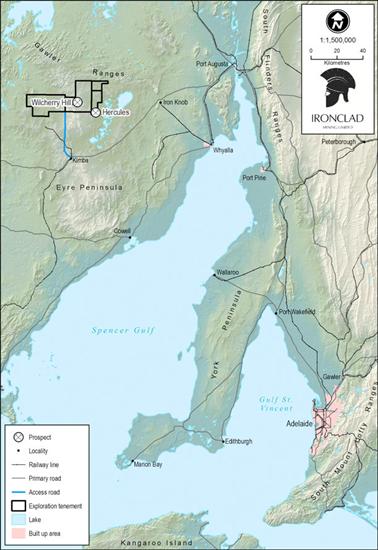
The Wilcherry Hill project is a Joint Venture between IronClad (80 per cent) and Trafford Resources (ASX:TRF) (20 per cent) located 30 kilometres north of Kimba on the Eyre Peninsula.


The project boasts a JORC-compliant Resource of 276 million tonnes of iron ore, of which 69.3 million tonnes is high-quality, low-contaminant crystalline magnetite.

 “The MLP approval is a huge boost for the company,” IronClad Mining executive chairman Ian Finch told The Inside Story.

“It is an extremely important milestone for IronClad as it signifies the start of the company’s transition from being one of many ASX-listed iron ore exploration plays to being an iron ore producer.”

Having received S.A. Government approval for Wilcherry Hill, the final box the company is waiting to be ticked is the one that says it has the necessary finances in order to fund the project.

According to Finch, negotiations for financing the start-up production phase are already well-advanced with the company receiving a great deal of interest from a number of banks, sophisticated investors and other financial institutions.

Finch said a certain amount of the project funding would most likely be raised through borrowing, which the company anticipates will be paid back from early production profits.

“We choose to do that because we want to keep the number of shares on issue in the company relatively small,” Finch explained.

“We hope that a shareholding in IronClad will come to be considered as a valuable commodity so that people who own shares in IronClad believe they own something that is really worthwhile.”

IronClad Mining has a tight shareholding with just-on 75 million shares on issue, with slightly over 27 million of these shares (approximately 36 per cent) held by Trafford Resources.

The green light from the S.A. Government follows the recent signing of an agreement between IronClad and Sea Transport Development S.A. for the development of a floating harbour located off Lucky Bay, 150 kilometres south of Wilcherry Hill, near Cowell, on South Australia’s Spencer Gulf.

IronClad initially considered the option of transporting its ore from the mine at Wilcherry Hill via road to a site near Whyalla.

From there it was to be railed to Port Adelaide where it was to have eventually been loaded onto Panamax and smaller cape-size vessels, which would have added a further 350km as well as considerable time and extra freight costs to the journey.

The company now plans to trans-ship its iron ore from a holding warehouse at the Lucky Bay port site to a floating harbour, which will be sitting some seven-to-ten kilometres offshore.

IronClad has agreed to finance and develop the floating harbour, which when finished will be capable of loading cape-sized vessels with a capacity of up to 150,000 tonnes of iron ore.

“We exercised our option with Sea Transport, the proponents of that port, and they have been fully supported as such by the South Australian Government,” Finch said.

“We took an option for the usage of the port and over fifty hectares of ground in order to secure our future at the port.
 
“The multi-user, bulk shipping port facility we are now developing will allow us to transport our initial iron ore by road from Wilcherry Hill to onshore loading facilities at Lucky Bay.

“From there it will be loaded onto customised barges for transportation to the floating harbour.

“It will then be transferred to cape size ships docked alongside the offshore facility.”

As far as iron ore mines go, IronClad’s strategic plans for future development at Wilcherry Hill are fairly straight-forward.

The company intends to rapidly expand the project in three stages as it moves to its total production target of producing over 10 million tonnes of iron ore a year.

During the first stage IronClad hopes to produce one million tonnes of ore, from which it expects to escalate production by ramping up to two million tonnes in its second year of production.

A recent feasibility study carried out for stage one of the project established that, with an average iron ore price of $135 per tonne Free On Board into China and initial operating costs of around $85 per tonne, the project would provide IronClad with strong margins of approximately $50 per tonne and an operating surplus of around $100 million a year at full production during the first stage.

The second mining stage will concentrate on the wet beneficiation of the remainder of the Wilcherry Hill low contaminant, crystalline ore.

Following a full feasibility study for this phase, IronClad expects that delivery of the increased volumes of ore to the port is likely to be via a slurry pipe.

“The floating harbour, which is the ultimate design for our export purposes, will not be in place for the first two years because it has to be built and we also have to be producing enough tonnage to justify it,” Finch explained.

“That tonnage is expected to be achieved in our third year of production.

“In our strategic plan we go from one million tonnes in our first year to two million tonnes in the second year to four million tonnes in year three.

“The third year will see the commissioning of the floating harbour to coincide with the introduction of ore from the Wilcherry Hill stage two and the company’s Hercules deposit.”

IronClad considers the exploration potential of its Hercules deposit to be great with the deposit displaying properties consistent with major Banded Iron Formation projects usually found in the Middleback Ranges and Pilbara regions.

The deposit currently has a JORC-compliant Resource of 198Mt but the company is confident it could possibly reach a target of anywhere between 1500Mt to 2000Mt.

As things currently stand on the Eyre Peninsula, the Wilcherry Hill project is on target to produce its first shipment of Direct Shipping Ore for sale to Chinese steel mills in the first quarter of the 2012 calendar year.

Having just attained the MLP and still several months away from its first ore production, Wilcherry Hill is already attracting worldwide attention.

IronClad has already been successful in attracting buyers and has already sold the first two years of production from stage one through a comprehensive sales contract and marketing agreement with Singapore based agents.
 
IronClad Mining and the SA Government are now in the final stages of finalising the full operational approvals for the mine.

The company’s extensive Program for Environmental Protection and Rehabilitation (formerly known as a Mining and Rehabilitation Program, or MARP) is due to be submitted soon for approval.

Finch said the company anticipates that process to be completed within two to three months, which would be ideal timing to meet the scheduled mine start-up, which is due early next year.

“We are highly enthusiastic about the potential of Wilcherry Hill,” Finch said.

“We are very much looking forward to developing this in-demand iron ore project.”

IronClad Mining (ASX:IFE)
…The Short Story

HEAD OFFICE
Level 2, 679 Murray Street,
West Perth, WA 6005

T: +61 (08) 9485 1040
F: +61 (08) 9485 1050

Email: admin.perth@ironcladmining.com
Web: www.ironcladmining.com

DIRECTORS
Ian Finch, Neil McKay, Peter Rowe

MAJOR SHAREHOLDERS
Trafford Resources 36.37%
HSBC Custody Nominees (Australia) 7.29%
Golden Stone Partners 5%

Cougar Energy sues Queensland Government

Cougar Energy has commenced legal proceedings against the Queensland Government and three Queensland Government officials.

The Coal Seam Gas producer is seeking more than $34 million in compensation over the government’s decision to halt the company’s development of its power plant project at Kingaroy in the State’s south east.

Cougar is suing previous Department of Environment and Resource Management (DERM) chief executives John Bradley and Terry Wall and current head James Reeves for negligence and breach of statutory duties in their administration of the Queensland Environmental Protection Act.


Cougar Energy chairman Malcolm McAully said the company had commenced the legal action following advice from its legal advisors that the closure of the Kingaroy project was unreasonable.

He said the decision was compounded by the defendants’ continued refusal to allow the re-opening of the plant despite, what the company described as “a wealth of scientific evidence that its operations posed no threat to the environment”.

“Based on our legal advice, it is the actions of the Bligh Government, these office holders, and their unreasonable decisions, that have inflicted a significant loss on the company,” McAully said in the company’s announcement to the Australian Securities Exchange.

“During more than 15 months we have attempted to resolve the forced close-down with the Government and DERM in good faith.

“However, as all of our proposals have been rejected, the company is left with no option but to seek Court intervention to redress the loss and confirm Cougar Energy’s reputation as a world leading developer of alternative energy projects.”

Mr McAully said Cougar Energy had not caused any environmental harm at Kingaroy nor polluted the Kingaroy water supplies.

He also claimed no benzene has been detected in any water bores on neighbouring properties since Cougar Energy commenced water testing in March 2010.

“The Government and DERM officials have duties to administer the Environmental Protection Act for the purpose of protecting the environment in a way that allows for ecologically sustainable development,” McAully said.

“Significantly, they have applied the inappropriate water quality guidelines in justifying its actions to close us down.”

According to Cougar on 15 July 2010 then DERM chief executive John Bradley issued a media release stating that the Kingaroy site was to remain closed.

Cougar claims that on 14 July 2010 DERM and the company had agreed to carry out further water tests after an anomalous test result, which was subsequently proven on 16 July 2010 to be false.

Bradley authorised the serving of formal orders on the company on 17 July 2010 preventing the recommencement of operations.

Cougar claims that DERM’s own test results on that day found no evidence of chemicals breaching the drinking water standards.
    

Addressing a press conference in response to Cougar’s announcement, Queensland Deputy Premier Andrew Fraser said the State Government would vigorously defend its actions in relation to Cougar Energy.


“Obviously the company [Cougar Energy] has announced today that it’s going to pursue officers of the government,” Fraser said.

“But let’s be very clear about this – we have an important environmental regime in place, which protects the interest of the environment and makes sure that industry can operate with certainty and the government will be defending this action vigorously in the courts, as you would expect.

“The issue here is one for a company that was found guilty of making environmental breaches and wasn’t able to provide assurances that those breaches wouldn’t occur into the future and cause a detriment to the environment, and therefore the decision of the government stands.”

Fraser said that Cougars actions in suing the government and the three men would not dissuade the government from discharging its responsibilities on that front.

“Ultimately this company has decided to take this action for their own reasons,” Fraser said.

“I don’t think that we want to see a situation where companies believe that they can get different decisions by merely threatening individuals with multimillion dollar law suits and that’s why the state will stand behind the decision.”

Cougar claimed that DERM and the Queensland Government have taken no significant action against Coal Seam Gas projects elsewhere in the State despite much higher detections of chemicals over the past year.

“We are confident that our Kingaroy project is safe,” McAully said.

“It presents no danger to human health, no danger to drinking water, no danger to livestock and no danger to other farming activities and Cougar Energy has been unreasonably denied the opportunity to complete its trial at Kingaroy under the permits issued by the Queensland Government.”

Luiri Gold Zambian mining licence reinstated

THE BOURSE WHSIPERER: Emerging African gold developer Luiri Gold has had its Large Scale Mining License LML 48 reinstated by the Zambian Ministry of Mines and Mineral Development.

LML 48 contains the Matala and Dunrobin gold deposits in the company’s Luiri Hill deposit.

Luiri Gold is now able to immediately recommence full-scale exploration and development activities in Zambia.

Under the terms of the settlement reached with the Government of Zambia and other agreements with relevant stakeholders a Cancellation Notice that was issued in June 2010 in respect of LML 48 has been extinguished by the Government of Zambia and Luiri has discontinued its appeal against the decision of the country’s Minister of Mines.

As a result, the Government of Zambia has confirmed that LML 48 is once again valid and effective as if the Cancellation Notice had never been issued.

A key part of the settlement was Luiri’s agreement to continue with its project development activities and to be in a position to commence construction of a mining project prior to December 31, 2013.

“The timeframe allows for two complete dry seasons in which to progress and complete field exploration,” Luiri Gold said in its ASX announcement.

“The directors of Luiri believe this provides the company with sufficient time to complete the necessary exploration activities prior to commencing possible mine development.

“The company has also made meaningful commitments to the local community with the initial funding of a community development trust and the facilitation and funding of a community development committee, each as further described below.

“The agreements are the result of extensive negotiations by the management team of Luiri with the relevant Zambian Government departments and stakeholders to resolve the various issues that had caused the Cancellation Notice.

“During the negotiations, Luiri demonstrated good faith by continuing to employ 29 full time workers and taking on additional personnel on short-term contracts to progress exploration trenching in preparation for a new drilling program.”

Luiri Gold said it considers LML 48 to be under-explored and highly prospective for mineralisation.

The company’s proposed work program negotiated in conjunction with the full reinstatement of LML 48 will entail a combination of exploration and project evaluation study work.

Additional exploration drilling will be conducted with the express objectives of increasing the resource base, and identifying high-grade ore easily mineable by open pit methods to support fast track development of mining and production.

While the exploration drilling ins underway study work will be carried out to to develop potential plans for mining and processing, to accurately evaluate costs and revenue estimates and to assemble a project implementation plan and development schedule.

During this period, Luiri said it will also be seeking all necessary permitting for project development.

The company said it would use all this work to support a definitive technical and financial evaluation that will be used as the basis for project financing.


Elvis has left the building October 14

THE BOURSE WHISPERER: The regular game of musical chairs
continues within the boardrooms across the resources industry. The
Whisperer pokes his head down the corridors of power to take a quick
look at some of the chairs to have recently been vacated and to find out
which ones have been filled:

Chairman Retirement and Appointment

Alumina Limited announced the retirement of Don Morley as chairman and a non-executive director.

John Pizzey will succeed Morley as chairman.

Pizzey joined the Alumina Board as a non-executive director in 2007 and is chairman of the Board’s audit committee.

He has held a number of directorships and is currently chairman of Iluka and a director of Amcor.

Peter Wasow will succeed Pizzey as chairman of the Alumin Board’s audit committee.

Appointment of Botswana national

A-Cap Resources has appointed Anthony Khama to the Board the company’s wholly-owned subsidiary, A-Cap Resources Botswana (Proprietary) Limited.

Khama is the son of the first President of Botswana, Sir Seretse Khama and the younger brother of the current President of Botswana, Lt. Gen. Seretse Khama Ian Khama.

He is renowned for his business achievements in Botswana and his family name holds great significance for the Botswana people.

Management Changes

Paynes Find Gold has accepted the resignation of Brian Leedman, from the role of interim managing director.

Leedman remains on the Board of the company as a non-executive director.

Appointment of Director

Fox Resources announced the appointment of a new independent non-executive director, Garry East.

East is a Western Australia-based businessman who has taken leadership roles in the agricultural industry and has been an active investor in the resources sector for many years.

He has taken a substantial holding in the company.

Board Changes

Following a Subscription Agreement with Infiniti Premium Resources, Signature Metals announced the appointment of Richard Chan as a director of the company.

Mr Chan has extensive corporate experience, most recently as CEO and director of Singapore public listed company CarrierNet Global and he is also a director of ASX-listed Millepede International.

Signature Metals also advised the market that Stuart Murray has resigned as a director of the company.

Director appointment / Resignation

Ram Resources announced the appointment of James Lumley as a non- executive director of the company.
 
Lumley has worked in the resource industry for a number of years, previously having worked at director level in the London property sector for more than 15 years, providing property investment opportunities for international institutions.

Ram also advised that non-executive director, Dr Andrew Scogings, told the Board that, due to additional commitments in his geological consulting business, he cannot continue to commit to the time required as the company’s technical director, and has resigned as a director of the company.
 
Scogongs is keen to remain involved with the Motzfeldt project and will continue to provide consulting services to Ram on an “as required” basis.

Board and Management Changes

Gulf Industrials Limited announced the resignation of Vic Fitzmaurice as a director and chief executive officer.

Mark Arnesen has been appointed acting chief executive officer and chief financial officer.

Arnesen has been an adviser to the company for the past six months and assisted with its recent capital raising.

In conjunction with the above appointment Rob Guest, who commenced with the company as manager east African operations has been appointed chief operating officer.

Board Changes

Southern Crown Resources announced that chairman Bruce Fulton decided not to stand for re-election as a director at the company’s recent Annual General Meeting.

Rhod Grivas will take over as chairman.

Managing Director Steps Down

Energia Minerals announced that Keren Paterson will step down from the position of managing director.

Energia has commenced a search process to secure a top-quality chief executive officer with strong credentials in taking projects from exploration through to development.

A new appointment is expected to be announced within 2-3 months.

Dr Leigh Bettenay, executive director, will continue to manage the ongoing exploration activities and technical studies of the company.

Non-Executive Director Resigns

Falcon Minerals announced that Graeme Cameron has resigned as non-executive director to effectively pursue his professional interests in the sector.

Conquest Appoints Chief Financial Officer

Conquest Mining announced that Tim Churcher will join the company as chief financial officer.
 
Churcher has 25 years of experience in a range of technical and financial disciplines both locally and internationally within the gold sector, most recently as chief financial officer and company secretary of Australian gold producer Unity Mining.

Appointment of Managing Director

Carabella Resources announced the appointment of experienced coal industry executive Anthony Quin as managing director.
 
Quin is a prominent member of the Queensland coal industry, having served 14 years with BHP Billiton including two years as chief development officer of its Metallurgical Coal business, the world’s largest exporter of metallurgical coal.