MRRT gets over the line

So the mining tax, the MRRT, the Mineral Resources Rent Tax, has finally made its way past the finishing post of the chamber of the House of Representatives.

The handicappers hadn’t been friendly to MRRT initially, which began the season a long way behind opening price favourite RSPT.

RSPT, having been uprooted from the Henry Tax Review by Treasurer Wayne Swan and Kevin Rudd, took the punters who had backed Mining Industry by surprise by heading the pack at the first pass of the judge’s tower.


Having not liked the odds on offer before the opening of the race they were very pleased to see it given short shrift as Mining Industry and Junior Sector worked it to the back of the field by the first turn.

Andrew Forrest parked a truck full of voices at one corner of the track to provide encouragement to Junior Sector, one of which belonged to iron ore heiress and self-imposed Greta Garbo-like exile Gina Rinehart.

Unfortunately her message was soon lost as the noise of the crowd, generated by a lot of open-ended discussion on AM Radio airwaves, grew louder.

Mining Industry and Junior Sector hopes rose, however, when K Rudd lost his way on RSPT.

Those hopes were soon dashed as Julia Gillard aboard MRRT stepped into his Prime Ministerial shoes.

Quickly she negotiated an easier passage along the rails in the form of a lower tax on iron ore and coal with the three heavyweights in the field BHP Billiton, Rio Tinto and Xstrata.

Again, the lesser fancied runners in Mining Industry and Junior Sector weren’t happy, but this time they found the going a bit more difficult and weren’t able to call the tune as they had earlier in the race.

The two miners’ favourites found an ally of sorts in Western Australia Premier Colin Barnett riding Secession, who decided the best way to head MRRT off, would be to nobble it by raising State Mining Tax Royalties.

As the field raced down the back straight MRRT began to make its move.

It seemed to have a clear enough run until given a few gentle nudges by the independents as a reminder to the Labor Government of Julia Gillard that it wouldn’t be crossing the line without their cooperation.

Tony Windsor riding New England Voter threw up a hurdle by demanding $200 million being set aside over four years for bio-regional assessments on the impact of coal seam gas extraction.

He also added a hazard by asking water to be a vital aspect in CSG approvals under amended environmental laws.

Labor acquiesced to the idea giving the commonwealth the power to override the states on coal seam gas projects.

Windsor’s final obstacle concerned a coal mining project on the Liverpool Plains where Santos has agreed to stop its plans to install a pilot gas well before an independent water study had been carried out on the project.

Rob Oakeshott drew the Steward’s attention with some rough riding on Lynne Likes Me as he raised concerns about inefficient taxation.

Oakeshott was eventually hemmed in by Antony Albanese on Filibuster but not before his requests had been given the thumbs up.

Coming to the final turn it was the chance for Andrew Wilkie as he pulled out the whip on Denison’s Pride to set the pace seeking to make the new levy less onerous for small miners.

Wilkie managed to extract the assurance from the government that it would lift the threshold at which miners become liable for the tax from $50 million to $75 million in profits.

Coming into the straight for the home turn it looked as though Gillard would coast MRRT across the finish line but she didn’t count on the old stager in Greens Leader Bob Brown putting in one final flourish to bring Plain White Envelope home for a photo finish.

The drama didn’t end there with a protest filed by the riders of Mining Industry and Junior Sector claiming Brown had allowed Gillard and MRRT to win after some backroom shenanigans.

A subsequent steward’s inquiry found that the two had in fact squared away a deal to manipulate the result.

Later it emerged the deal was no more than Brown pressing the government to find the millions lost each year due to Wilkie’s  demands by deferring an ambiguous measure involving foreign banks and interest withholding tax.

MRRT completed a victory lap on its way to the stalls to rest up before running the gambit of the Senate early next year.

Studying the developed print of the finish, Tony Abbott declared that neither runner should win and that the entire race should be re-run.

Avonlea recalculates Ondjou Resource

THE BOURSE WHISPERER: Namibia-focused explorer Avonlea Minerals has calculated a 33 per cent increase in the total JORC compliant Inferred Resource estimate at its Ondjou prospect, located in Northern Namibia.

The new Inferred Resource total is 693 million tonnes iron at a head grade of 23.7 per cent.

This increase has been drawn from a recently completed 2,500 metre diamond core drilling program and metallurgical test results.

Avonlea said the resource estimate is based on a strike length extension to an established area of mineralisation that was delineated in the company’s maiden JORC compliant resource estimate of 521 million tonnes at 24 per cent iron, which it announced in December 2010.


Inferred Resource outline, drill hole location and outcrop geology. Source: Company announcement

Avonlea has now commissioned a conceptual mine planning study for the Ondjou magnetite iron project to review the potential mine plan and pit design it considers could be achieved with the current upgraded inferred JORC geological resource.

The aim of the study will be to consider the optimisation of the current resource within a framework of mining, processing and production rates and costs to define potential mining pit shells.

The company anticipates this information will assist in a review of the current resource model and assess the requirements to upgrade the resource from an Inferred to an Indicated JORC resource category.

“Avonlea is pleased to report this uplift in the Inferred Resource estimate at our Ondjou iron ore project in Namibia,” Avonlea Minerals managing director David Riekie said in the company’s announcement to the Australian Securities Exchange.

“The deployment of our low cost exploration strategy to delineate the updated resource estimate leaves exploration upside potential as the resource remains open along strike with further metallurgical testing.”

Avonlea pointed out that it has a number of licences in application over the same geological formation to the north and south of our Ondjou prospect.

Once these have been granted, the company said it intends undertaking exploration work in order to unlock the prospectivity the Licence areas.

Gold – So true, funny how it seems.

The Gold Symposium held ay Sydney’s Luna Park launched with the enduring musical tribute to the
yellowest of metals with 1980s new-romantic supergroup Spandau Ballet supplying the soundtrack.

Tony Hadley’s vocal gymnastics reminded the gathering audience of aurum acolytes of gold’s cognisance of its impervious properties as they settled in for two days of listening to a roster of speakers who would validate their faith in it maintaining its current standing in the investment community.

Kicking off his keynote speech at the Gold Symposium at Sydney’s Luna Park, Toronto-based bullion guru Eric Sprott took a quick straw poll.


Sprott asked those in the audience who actually owned physical gold to raise their hands.

The speed of their response didn’t really allow for an accurate count but a healthy portion; say 70 per cent to 80 per cent divulged they had.

He then asked how many owned physical silver and again the response was positive.

Not as many as gold, but again well over half the audience responded in the affirmative.

Sometime into his talk Sprott queried how many of his audience had bought physical gold in 2000, before it was in fashion to do so.

This time the numbers were down with only around 10 per cent (again the accuracy of our calculations is not to be relied heavily upon) said yes.

These participants were very quick to react to this particular question almost shooting their fingers through the ceiling of the iconic park’s Crystal Palace convention room with a, ‘pick me teacher, I’m ever so smart’, enthusiasm.

Sprott left little doubt he is bullish when it comes to investing in gold rather than paper or other investment forms.

He outlined the fundamental problem facing world economies at present as being they suffer from the dilemma that five cents of capital in physical gold held by central banks is protecting one dollar of their paper assets.

“What are the odds that that dollar has not depreciated by five cents,” Sprott asked.

“We had days last week when the stock market fell three or four per cent in Eurpoe. We had bonds falling three or four per cent in a day.

“If you live in the United States, try to sell your mortgage portfolio, it’s impossible.

“If you live in Paris and you ring up the guy at BNP saying that you would like to sell off your commercial lending portfolio he would respond by saying, ‘you know what I want to sell you my portfolio.

“Because we are all trying to de-lever at the same time and there is no net-buyer.”

The more he spoke, the more palpable the investment fear in the room became.

Paper savings were no good he said and basically we should all start dragging our money out of the bank and buying gold and silver, even if there isn’t any to actually buy.

“The important thing to know about gold is that mining production has hardly gone up for ten years,” he explained.

“Most people don’t realise… the world’s resource of gold above ground is around about 165,000 tons.

“We are only adding 1.4 per cent to the pool of gold each year, that’s a very minor amount.

“My partner John Emery has been a great proponent of gold due to Fiat currency and he has been absolutely right.”

A Fiat money system is one where money is not backed by a physical commodity such as gold or silver.

What provides money with its value is its relative scarcity and the faith placed in it by the people that use it.

In a Fiat monetary system, there are no restrictions on the amount of money that can be created, which ultimately allows unlimited credit creation.

It is in these environments that rapid growth in the availability of credit can be mistaken for economic growth.

As spending and business profits grow more often than not there is a rapid growth in equity prices.

“When I started in the gold business, it was my view, and there was some phenomenal work done by others who expressed the fact, there was probably going to be a physical shortage of gold,” Sprott said.

“I bought into it because gold was at a very low price, the miners were hedging, the central banks were selling, demand would probably only go up, and yet I imagined that the supply of gold each year would stay constant, therefore this marginal change in demand would move the price higher.”

Sprott admitted that like his native Canada the banks in Australia are also theoretically strong.

However, he also said that in a worst case global economic situation, like the one he claimed we are already experiencing, money starts flying in all directions as investors the world over attempt to liquidate what money they have in banks.

He described this as a risky situation and one of the fundamental reasons why he feels investors should have their money in gold and silver.

“Never paper; I don’t recommend futures, anything to do with paper I don’t recommend,” he said.

“It is always best to have it (your investment) in your own physical possession.

According to Sprott the market, not the central bank, and not government treasuries, has already determined gold is to now be the reserve currency.

“The markets have made up their minds that gold is the reserve currency; it’s up 600 per cent versus almost every currency,” he said.

“This diatribe of stuff we have to listen to every day about the dollar versus the euro, the yen versus the dollar, the pound sterling – whatever; they’re all crap!

“It’s like – who’s the prettiest horse in the glue factory? And they’re all lucky it’s a close competition.

“If they (media outlets) started reporting that all currencies are down today against gold – imagine if you turned on your telly on Saturday and they said all currencies were down two per cent against gold on Friday.

“And they kept repeating that day after day after day, would you finally get the message?”

Allan Kelly – Doray Minerals

While at the recent Gold Symposium The Roadhouse caught up with Doray Minerals managing director Allan Kelly and discovered this geologist has another wothy string to his bow.

You have had a good steady run of news lately, in particular from your Abbotts and Andy Well deposits. Could you give us a bit of a run down on what’s happening at these projects?

Our focus is still on Andy Well because the plan is to get the Resource upgrades competed by December then put that into our feasibility study and make that either a definitive or bankable feasibility study by the first half of next year.

We should then be able to raise money for capital expenditure on top of that and be able to make the decision to mine and push forward with construction by the end of the financial year.

Andy Well is the company’s prime focus at the moment because that has the potential to be self-funding within 18 months.

There is a bit of a balance between pushing Andy Well as quickly as possible, so we can actually be self-funding, while also working out what we have on our other projects in order to demonstrate the long-term value in the company.

Has the focus has always been to move the company as quickly as possible from being an explorer to a producer?

We started as an exploration company. We believe in exploration so we have put a substantial budget into testing our other projects.

At Abbotts, Side Well and Webbs Patch we have been very fortunate where every drill program we have conducted we have received significant results.

It appears that every step you take along the way is increasing your confidence in the project and it just keeps on telling its own story.

Pretty much; remember these are the first past drilling at some of these projects and the first drilling that has been done, in a lot of cases, since around 1995.

The gold price has gone from $250 an ounce to around $1800 an ounce and there has been no work on these projects in that time.

It’s a simple concept to go and, find some good hits and see if you can turn it into something and that has been successful for us so far.

From now until the end of the year, will you slow down towards Christmas?

Not much; we have finished all the resource drilling for the new resource upgrade but we haven’t stopped drilling.

We still have a diamond rig, a RC rig and an aircore rig going at Andy Well and they will work through until Christmas.

In addition we have a second RC rig, and maybe a second aircore rig, doing work at our other exploration projects.

I would have thought you would take a break from drilling to concentrate on your other specialised skill of brewing beer to cater for the Christmas celebrations.

I haven’t done any brewing for a long time. Since I left the brewery back in 2009 I haven’t touched a brewing kit in anger.

I’ve learnt to appreciate my beer more when I can just drag it out of the fridge and drink it, rather than actually make it.

Who were you brewing for?

I had my own brewery called Tangle Head that I started down in Albany.

It was an idea I had when I was working as a geologist in North America. I was working in Canda and noticed all the micro-breweries over there.

I had a chemistry background as well as geology and I thought it would be something goo to do.

What was your specialty brew?

I made a German wheat beer called Southern White Ale. That won quite a few awards, including a gold medal at the Perth Beer Show.

Are you wasting this hidden talent running a gold company?

No, it’s a lot more rewarding developing a gold mine that starting a brewery.

At least when the mine is up and running, you will be able to make your own beer with which to celebrate.

I’ll just pull a beer out of the fridge, open that and drink it.

Potash West develops Australia’s first potash mine

The global potential of emerging Western Australian potash explorer Potash West (ASX:PWN) can’t be appreciated without learning what Potash is.

Potash – a generic term for salts of potassium used in fertilisers in the form of potassium chloride, potassium sulphate, or potassium nitrate.

Three essential fertiliser elements are needed in amounts of hundreds of kilograms of per hectare world-wide to yield good plant growth.

These are nitrogen (N), phosphorous (P) and potassium (K); together they constitute the NPK stamped on bags of fertiliser bought from garden centres every weekend.

They are not interchangeable and depending whether it is roses growing in Grandma’s garden, wheat in the fields of Western Australia or bananas in northern Queensland, the correct amount of each is vital to the cause.

The major force currently driving potash demand is world population, which between now and 2050 is predicted to grow from the current count of seven billion people to around nine billion.

At the same time the arable land quota per person will decrease from around 0.25 hectares to around 0.15 hectare per person.

This mix includes the increasing middle class in major population centres, such as India and China, all demanding higher quality foods.

Needless to say there will be a great strain on global food supplies.

The astounding statistic to emerge from all of this is that Australia doesn’t boast a domestic supply of potash.

“The world market place for potash is dominated by Canada, which produces around 45 per cent of world production, followed by Russia, Belarus and Germany,” Potash West managing director Patrick McManus told The Inside Story.

“Those four countries are responsible for 80 per cent of world potash production.

“Major global consumers of potash are India and China, accounting for just on 50 per cent of the world’s export business.

“Australia and India both have no domestic source of potash at all. All of the potash used in Australian agriculture is imported – the majority of this is from Canada.”

Potash West listed on the ASX in May following a successful and oversubscribed IPO raising $6 million.

The company has a major land holding over one of the world’s largest known potassium-rich glauconite deposits, the Dandaragan Trough situated in the Perth Basin of Western Australia.

Here it aims to define a substantial resource base and develop new technology enabling it to recover potash.

Potash West’s exploration licenses and applications cover an area of 2,900 square kilometres, a healthy amount of which has been subjected to historic exploration that has indicated glauconitic sediments are widespread along more than 200 kilometres of strike and at least 15 kilometres wide.


“We have an extensive landholding in a great area,” McManus said.

Glauconite is a potassium rich mineral that has been recognised as a potential source of potassium for many years.

In the Dandaragan trough it was deposited with quartz, producing distinctive greensand deposits characterised by high contents of iron and potassium.

In the 1960’s the Dandaragan Trough caught the attention of the West Australian government, which thought it may possibly host a number of greensand occurrences.

A wide-spread drilling operation was undertaken to evaluate the stratigraphic setting in which glauconite accumulated.

This campaign demonstrated the Dandaragan greensand beds to have a thickness of up to 200 metres in some areas, and to be present within most areas of the basin.

The units are flat lying, located on or near the surface and amenable to low cost open pit extraction in a similar style to mineral sands mining.

Potash West is focusing on two geological units of greensands identified by this historic exploration it considers may hold potential economic deposits.

These are the Molecap Greensand and the Poison Hill Greensand, both of which are widespread in the Basin.

“We have done some very detailed mapping looking at the Dandaragan Basin, which was a shallow sea 60 million years ago, when the glauconite was deposited,” Macmanus said.

“The mapping shows areas of general uplift, where the thicker Poison Hill greensands sequence is likely to be preserved.

“The company’s theory is the higher ground within our tenements hosts both greensand units and that is where we are concentrating.”

Molecap Hill located 1.4km south of Gingin was mined between 1932 and 1962 for 35,000 tonnes of greensand producing 6,510 tonnes of glauconite for use as a water softening agent.

It is not a target now however, as the upper Poison Hill sequence has been eroded away in this area.

“Where the tenement ground is higher, there will be less erosion and should therefore host the two units of greensand,” McManus said.

“Although there is a huge area there, and we are likely to be sitting on billions of tonnes of mineralisation, the challenge is to find fresh material close to surface.

“Greenstone weathers rapidly at surface, which is why you rarely see any fresh material.”

Although the 1960’s drilling was positive the price for potash was heading in the other direction so downstream processing of glauconite to yield potash was not pursued.

As time has marched on so have advances in technology and Potash West is now leading the parade as its works on developing its own potassium extraction and processing procedure.

Company director Gary Johnson has a well-documented background in hydrometallurgy.

He has previously developed a number of processes currently in use around the world for hydrometallurgical extraction of various metals.

Johnson and his team at Strategic Metallurgy are now working on the process development side of the Dandaragan Trough project.

A 2,000 kilogram bulk sample taken from the Poison Hill greensand sequence was subjected to extensive testing, evaluating a wide range of conditions and reagent regimes.

So far over 200 leaching tests have been conducted using a range of reagents and temperatures.

The company has been encouraged by the results to date, which have demonstrated potassium dissolution is achievable from the Dandaragan glauconite without resorting to extreme leaching conditions.

“When we have the process reasonably well understood is when we will be able to commence evaluating how much it will actually cost to produce a commercial-grade potassium sulphate product,” McManus explained.

The technical developments offer Potash West the opportunity to become a world leader in the field of potassium extraction.

“The fact there are a number of glauconite deposits around the world leads us to believe the technology we are developing may well become a valuable commodity in itself,” McManus explained.

“We are mindful of that, and because of that we won’t be disclosing all the processing steps we develop, basically in order to protect our intellectual property.”

The vital element to the Potash West story however, is the current situation where Australia imports all its potash fertilizer.

“Certainly, if you talk to farmers, which we have done, they feel they currently don’t use enough potash,” McManus said.

“the reason for this is simply because of the costs involved.

“By the time it reaches the farm gate it costs substantially more than when it leaves Vancouver at $500 per tonne.

“It arrives in a bag under the noses of a lot of people as an imported product – we don’t have any potash mines in Australia…at the moment.”

Potash West (ASX:PWN)
…The Short Story

HEAD OFFICE
Suite 3
23 Belgravia Street
Belmont WA 6104

Ph:     +61 8 9479 5386
Fax:    +61 8 9475 0847

Web:    www.potashwest.com.au
Email:    info@potashwest.com.au

DIRECTORS
Adrian Griffin, Patrick McManus, George Sakalidis, Gary Johnson

MAJOR SHAREHOLDERS
Elsinore Energy 16.70%
Siak Poh Yeo 2.40 %
Patrick McManus 2.30 %
Miew Leng Lee 2.00 %
Goon Eng Chua 2.00 %

SHARES ON ISSUE
43.6 MILLION

MARKET CAPITALISATION
$9.8 MILLION (at 17 November 2011)

Iron Ore for Dummies

Iron is the fourth most abundant element in the Earth’s crust and is usually found in ore deposits as an oxide.

There are many iron minerals, but the only ones of worldwide importance are hematite (Fe2O3), magnetite (Fe3O4) and limonite (FeOOH).

Other ores such as chamosite or pyrite are no longer important for iron production.

Typically, it takes 1.5 tonnes of iron ore and 450 kilograms of coke (an almost pure form of carbon processed from coking coal) to produce a tonne of pig iron – the raw iron that comes out of a blast furnace.

Pure iron is quite soft, however adding a small amount of carbon makes it significantly harder and stronger.

Western Australia dominates the Australian iron ore industry with nearly 97 per cent of total production.

The Pilbara region is particularly significant with 79.5 per cent of Australia’s total identified resources and 92.4 per cent of production. Other significant iron ore mines also operate in the Northern Territory, South Australia, Tasmania, Queensland and New South Wales.

Magnetite vs Hematite

Hematite (Fe2O3) is an iron oxide mineral that contains 70 per cent iron.

Hematite deposits vary widely in grade and until recently, most deposits needed to have an average grade of more than 60 per cent to be economic.

However, some deposits can now have iron grades of 56 per cent to 59 per cent and can still be commercially viable.

Magnetite (Fe3O4) is also an iron oxide mineral containing 72 per cent iron.

Magnetite ore however generally has a lower iron content than that of hematite and must be upgraded to make it suitable for steel making.

Processing of magnetite ore involves crushing, screening, grinding, magnetic separation, filtering and drying.

The final product is a high-iron grade magnetite concentrate (+65 per cent iron) with typically low impurities.

Further processing involves the agglomeration and thermal treatment of the concentrate to produce pellets which can be used directly in a blast furnace.

The additional processing cost for the magnetite concentrate can generally be offset by the premium price which it attracts from steel mills due to the high iron content.

Market perception of magnetite

Traditionally, Australia has associated ‘iron ore’ with Direct Shipping Ore quality hematite, which has been underpinned the development of the Pilbara region as one of the world’s great iron ore provinces.

As a result, magnetite has typically been somewhat misunderstood and undervalued by the market.

Sixty per cent of global steel production is sourced from magnetite projects which today are capable of producing high-quality concentrate grading up to 68 per cent to 69 per cent iron.

This is higher grade than many of the Pilbara hematite lump and fines ores currently being produced.

It is also well established that hematite grades are generally declining globally and impurity levels are rising while the demand for quality, premium steel from China and India is continuing to increase.

With hematite grades declining, high-grade magnetite concentrate is becoming an increasingly sought-after product.

The Outlook for Steel

About 98 per cent of world iron ore production is used to make an iron alloy in the form of steel.

Steel is the most useful metal known to man and is used 20 times more than all other metals put together.

So the direction of steel pricing and demand is important in determining iron ore demand and pricing.

The World Steel Association recently released its October 2011 Short Range Outlook for 2011 and 2012.

It forecasts steel use will increase by 6.5 per cent to 1,398 million metric tonnes (mmt) in 2011, following growth of 15.1 per cent in 2010.

In 2012, it is forecast that world steel demand will grow further by 5.4 per cent.

The Association expects to see growth performance varying widely across regions.

The recovery of steel demand in the developed world will likely be slow, whilst most of the emerging and developing world should continue to enjoy robust growth in demand.


Iron Ore Prices & Iron Ore Inventories, Source: Mysteel, TSI 

China’s apparent steel use in 2011 is expected to increase by 7.5 per cent to 643.2mmt following 8.5 per cent growth in 2010.

In 2012, steel demand is expected to maintain 6.0 per cent growth, which will bring China’s apparent steel use to 681.6mmt.

In 2011, India’s steel use is forecast to grow by 4.3 per cent to reach 67.7mmt due to economic growth.

In 2012, the growth rate is forecast to accelerate to 7.9 per cent.

Source: World Steel Association

 The WSA’s current forecast suggests that by 2012, steel use in the developed world will still be at 15 per cent below the 2007 level whereas in the emerging and developing economies, it will be 44 per cent above. In 2012, the emerging and developing economies will account for 73 per cent of world steel demand in contrast to 61 per cent in 2007.

The Outlook for Iron Ore Prices

Perhaps the most remarkable aspect of the recent dramatic decline in iron ore prices is not the actual fall in prices.

Rather, the most intriguing thing is that no-one appears to be able to offer a concrete explanation as to why it’s actually happening.

The size and scale of the recent iron ore price declines has taken everybody by surprise. We have to go back to the depths of despair reached during the GFC to find price volatility on this scale – and even then it wasn’t this bad.

Prices are fluctuating by more than US$10 per tonne on a daily basis.

There’s speculation in some quarter that prices could drop to as low as US$90/t.

The explanation seems to involved higher inventory levels within China as well as the nation’s tighter credit policy.

I wouldn’t rule out the prospect of prices drifting lower in the near-term, but the situation should correct itself fairly quickly.

The reason for iron ore price optimism is the strong inherent steel demand within China.

The current depressed iron ore price levels are irrational and unsustainable.

Don’t forget that China likes to manipulate demand and supply where it can – cast your mind to the fact China controls around 95 per cent of the rare earths market currently and you get a clear picture of the control that the country can exert.

China is such a huge market for iron ore that it can manipulate prices based on withdrawing purchases from the market.

Also remember that quarterly iron ore contract prices are currently being negotiated, so what better time for China to put downward pressure on spot iron ore prices than now – given that weak spot prices will feed into quarterly contract pricing.

What’s clear is that the current rapid pace of de-stocking in China is not in any shape or form sustainable, meaning steel mills will have to sooner or later re-establish purchasing, thus driving prices higher once again.

There’s every chance that iron ore prices will have recovered and be trading between $130/t – $150/t by the end of 2011/early 2012.

Gavin Wendt is the founder of MineLife, publisher of the MineLife Weekly Resource Report   

Guiding deeper exploration

Although mining companies operating in Australia are sometimes accused of not pumping enough money into greenfields exploration, Mark Fraser finds they are not exactly sitting on their hands when it comes to promoting the search for new ore bodies in frontier terrains.

Through the Deep Exploration Technologies Co-operative Research Centre (DET CRC), a number of miners and government agencies are making sure that sufficient funds are being channeled into research and development so the next generation of deep Australian mineral deposits can be found.


A non-profit organisation, the DET CRC has embarked on a multi-million dollar eight year program to come up with more cost effective, safer and environmentally friendly ways to target, drill and analyse mineralisation at depth.

Furthermore, the South Australia-based Centre is looking to implement a successful commercialisation strategy that will provide substantial windfalls to those in the mineral exploration sector.

According to the DET CRC professor Richard Hillis, the Centre and its mining sponsors were not planning to hold on to or cash in on any intellectual property (IP) developed during the course of the program.

Rather, they were hoping to establish commercial agreements with service companies.

“Our sponsors include the mining companies, and what they have said to us is that they don’t particularly want to own the IP – even though they are sponsoring it – nor do they want the universities or the CSIROs of the world to hold on to it and develop spin off companies because they feel that sort of slows the whole thing down,” Prof Hillis told The Resources Roadhouse.


“So what they wanted to see was that the IP developed by the DET CRC’s projects was licenced to the existing service sector.

“And I think the philosophy there is while the service sector is used to making a living out of commercialising technology, it’s also used to providing services to the mining industry, and that’s the quickest, best and most efficient way of getting the improved technologies back and available to the mining companies.

“And really that’s all they want … they are willing to put some money in to be the catalyst to develop the new technology, but they want it out in the market place so they can access it as quickly as possible.”

Hillis said the potential prize for companies within the mineral exploration service sector was enormous – particularly when compared with their petroleum counterparts, which had been at the forefront of developing and commercialising new technologies that had been so successful in expanding the petroleum search space beneath “cover” (deep water and sub salt) and, ultimately, helped grow global giants like Halliburton, Baker Hughes and Schlumberger.

“Boart Longfield is probably one of the biggest mining services companies – it’s a $2 billion company – but it is a lot smaller those in the petroleum sector and it doesn’t offer integrated services,” he said.

“It offers drilling, but it doesn’t really offer remote sensing or the analysis of data, the software for the analysis of data from holes and all those other services that are much more integrated which the oil patch service companies offer.”

Fundamental technology innovation in mineral exploration, Hillis said, required new technologies in drilling.

However, developments in this field were dependent on parallel advances in drill hole analysis as well as in geophysical/geological modeling based on that analysis.

Ultimately, the technological barriers which must be overcome arose because deeply buried deposits could only be explored by drilling. In addition, the current technology for drilling in hard rock was expensive, it had significant environmental impacts and it involved considerable manual handling with consequent safety risks.

“This is probably more applicable when dealing with highly explored terrains, so really it is a classic case of exploration risk verses sovereign risk,” Hillis said.

“It applies to counties like Canada, South Africa and Australia where a lot of the surface outcropping deposits have been discovered – there’s probably one or two more major deposits to be found, but the vast majority of the next ore bodies will be under cover.

“We are not saying this is unique to Australia.

“We are interested in it world-wide, but we are an Australian organisation, so we are particularly interested in the Australian context, which I believe is relevant to most highly explored terrains.”

Some of the mining houses backing the DET CRC include the publicly listed BHP Billiton, the Australian-Pacific arm of Barrick Gold Corporation, Newcrest Mining, Gold Fields Australia and Vale Exploration.

Meanwhile Geoscience Australia, CSIRO, the University of Adelaide, the University of Western Australia and the South Australian Government have also thrown their weight behind the initiative.

Jonathan Downes – Ironbark Zink

ONE OFF THE WOOD: The Roadhouse sat down with Ironbark Zinc managing director Jonathan Downes this week to catch up on all the company news from the northern hemisphere.

You have released some good news recently regarding a $50 million facility from Glencore.

The Glencore facility is an interesting new model for the company where we have been able to take advantage of what is currently a tough market in which to raise funds.

We now have the means to grow the company on a corporate level, like all junior companies want to be able to do, through acquisitions if and when they become available.

We hold the view that the world is going to recover one day and we want to be considered as a major mining house when that happens.

How important is that deal for Ironbark?

Glencore has been on our company register for around five years, so we do have a long relationship with them.

I like to think that we’re going to be able to grow a symbiotic company whereby, ultimately, we will be a vehicle that will end up running a number of mines, growing the company into being a large entity – while Glencore allows us access to capital that most junior companies could only dream of.

Hopefully then, they will get what they want, we will get what we want and, most importantly, our shareholders will get what they want.

We hope to be able to grow that relationship and grow a company that one day will hopefully be a household name.

What does the facility mean that Ironbark is able to do now?

It provides us with credibility as well as strength, beyond any junior company that I can think of, with a large war chest, effectively to go and build a large company.

It would be hard for other companies to do what we are doing without the support of a major company, like Glencore, because to access $50 million is hard work, especially in the current environment.

What’s happening up at the Citronen project now?

All the work that is currently happening is engineering work. We completed a lot of drilling this year so now we are just finishing off the new resource numbers and we have mining engineering firms working on the new mining schedules.

That’s all happening now because basically the exploration season in Greenland is closed for the northern winter.

That’s right; we only have an eight month exploration season there.

It’s not due to the cold temperatures but it is dark, which means we can’t get aircraft in and out of our project area because our airstrip is not lit.

When we are operating the mine however, we will have a fully equipped camp and fully lit air strip and will be working all year round.


You say you are crunching the new resource numbers. When do you anticipate being able to release that?

We hope to be able to release that to the market in about maybe six weeks’ time.

We expect that it will also have an impact on the new mining schedule, so it is shaping up to have been a very successful year for us.

Why Greendland?

From an Australian perspective it probably is difficult to grasp but it just happened to be where this giant project was located.

We acquired it in early 2007 and one of the appealing aspects about it was that it was very large but we didn’t really know how big it was.

Since we acquired it we have nearly tripled the resource and it is still open in every direction.

One year some 36 per cent of our drilling was conducted outside of the known resource and it increased by 38 per cent.

So where we drill we find more and it just gets bigger and better. That was one of the main appeals really, the scale of the project.

Have you had any encounters of the close type with any wildlife?

To celebrate one of the end of one of the seasons our technical director Adrian Byass set up a sausage sizzle, which did result in a polar bear sighting.

It appears they like the idea of a sausage sizzle just as much as an Australian geologist does.

The next time we sit down and have a chat what would you like to be telling me about Ironbark?

I would like to be able to show you, with greater clarity, where the $50 million facility will be spent and that the greater strategy for the company is starting to unfold.

I would also like to be able to tell you how we have progressed the Citronen project, and I am confident that I will have much news to report on both those fronts.

Julian Hanna to step down as Western Areas Managing Director

THE BOURSE WHISPERER: After 12 years at the helm of Australian-based nickel sulphide explorer and producer Western Areas Julian Hanna has announced he will be stepping down as managing director of the company at the end of January 2012.


Hanna was one of the founders of a small nickel exploration play in January 200 that was to become Western Areas, which is now one of Australia’s largest nickel mining companies.

Today Western Areas operates two of the highest-grade, lowest cost nickel mines in the world and boasts a sound balance sheet and a global portfolio of quality nickel projects.

The company now employs approximately 700 people as staff, consultants and contractors in a wide range of roles including exploration, mining, processing, transport, logistics and administration.

Although he may be out of sight of the Western Areas’ offices, Hanna won’t be out of mind as he has agreed to remain on the Board as a non-executive director and consultant to the company as it continues to identify and develop growth opportunities.

If that isn’t enough to keep him busy Hanna will be Western Areas’ representative on the Board of FinnAust Mining as its chairman.

FinnAust is planning to be listed on the boards of the London AIM market in early 2012.

Western Areas said it has plans to appoint a new managing director to replace Hanna.

The person in question will have some fairly big safety boots to fill but the company said it anticipates whoever it is will be able to drive the transition of Western Areas into its next major growth phase.

Such a move is obviously not one that is made overnight so Hanna and the Western Areas Board have been mulling over potential candidates and succession planning for several months.

The company has turned to the services of a specialist recruitment firm to identify a suitable replacement from a number of candidates both external and internal to the company.

An announcement is expected to be made regarding the outcome of the company’s search by the end of December.

“Julian has played a major part in growing Western Areas and in acquiring and developing the substantial assets that form the backbone of our company’s value during his twelve years in the role,” Western Areas chairman Terry Streeter said in the company’s announcement.

“Since the first days of Western Areas, Julian has put a huge effort into making this company the success it is today.

“Julian will leave us with a major ASX 200 company with a market capitalisation of over $1 billion, employment for 700 people, and a track record of profitability and dividend payments for shareholders.

“We could not ask for more from Julian after he has led the company to achieving what everyone hopes for but so few realise in this industry.

“Whilst it is difficult to wish Julian farewell from the role after his many years of sterling service, the Board looks forward to the time ahead for the company, building on the very strong platform Julian has left and pursuing the next stage of our growth.”

In response Hanna said that he has been very fortunate to work with a wonderful group of talented, hardworking, and professional people.

“I have also been fortunate in having a strong board and management team and a core group of loyal shareholders who have supported the company from its early years,” Hanna said.

“This year, I reached a milestone of 35 years as a geologist in the exploration and mining industry.

My time as managing director of Western Areas has certainly been the highlight of this career and it has been a great pleasure to see the company grow to where it is today.”


Sandfire inks DSO sale

THE BOURSE WHISPERER: Sandfire Resources has entered into a sales contract with international trading company MRI Trading AG where the latter will purchase 50 per cent of the Direct Shipping Ore to be produced from the former’s 100 per cent-owned DeGrussa copper-gold project in Western Australia.

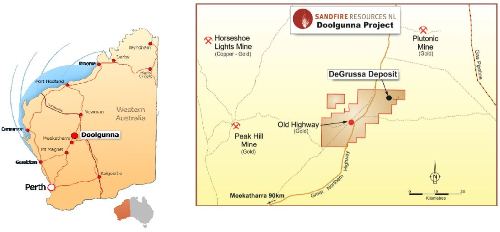
DeGrusa project location. Source: Company announcement

Swiss based MRI is a subsidiary of Singapore-listed company, CWT Ltd.

The contract entails MRI purchasing 50 per cent of DSO production from DeGrussa, up to a maximum of 75,000 dry metric tonnes of DSO, for a one-year period commencing March 2012.

This is the first product sales agreement to be concluded by Sandfire for the DeGrussa project as it moves closer to production, which is anticipated to happen early next year.

The DSO will be produced as part of the initial open pit mining operation, which is well underway.

The open pit is scheduled to extract a total of 143,000 tonnes of DSO ore reserves grading 25.6 per cent copper and 2.5 grams per tonne gold containing approximately 37,000 tonnes of copper.

Sandfire said it is currently in advanced stage discussions with other parties regarding the sale of the remaining 50 per cent of the DeGrussa DSO and that it expects to conclude further sales arrangements in the near future.

The company has also commenced marketing discussions in relation to sales agreements for the sale of its copper concentrate.

“With the shipment of our first high-grade DSO expected during the second quarter of next year, it is appropriate that we have sales arrangements in place first for this aspect of the project,” Sandfire Resources managing director Karl Simich said in the company’s announcement to the Australian Securities Exchange.

“We are very pleased to have entered into this arrangement with one of the world’s leading commodity trading houses in MRI and we are looking forward to working closely with them as we commence production of DSO next year.”