Elvis has left the building Sept 23

THE BOURSE WHISPERER: The regular game of musical chairs
continues within the boardrooms across the resources industry. The
Whisperer pokes his head down the corridors of power to take a quick
look at some of the chairs to have recently been vacated and to find out
which ones have been filled:

 

Appointment of Non-Executive Chairman

Avonlea Minerals has appointed David Macoboy as non-executive chairman.

Macoboy has over 20 years in the resources sector and joins Avonlea following roles at Board level with a range of successful ASX listed exploration and mining companies.

He is currently non-executive chairman of Vital Metals, and has held previous directorships with Ammtec, Ironclad Mining, Grange Resources, Territory Iron and Consolidated Minerals.

Roger Steinepreis will as a consequence step down as chairman, but will remain a non-executive director of the company.

Appointment of non-executive director

Exco Resources has appointed Dr Tom Whiting as a non-executive director.
Whiting has over 30 years minerals exploration industry experience both as a geophysicist and an exploration manager.

He is currently a consultant and is a non-executive director of Predictive Discovery, non-executive director of Stellar Resources and the non-executive chairman for the Deep Exploration Technologies Cooperative Research Centre.

Appointment of Chief Operating Officer

Venturex Resources  has appointed Ian Suckling as chief operating officer.

Suckling is a highly experienced mining engineer with over 30 years in the mining industry and is currently employed by Newmont Mining Corporation (Newmont) as the senior director – Underground Mine Engineering.

Board and management changes

Brockman Resources has announced a number of changes to its Board and management.

Barry Cusack has resigned as chairman and Peter Luk has been appointed a non-executive director and chairman.

Ross Ashton and David Nixon have resigned as non-executive directors.
Richard Wright and Robert Brierley have been appointed as non-executive directors of Brockman to fill the casual vacancies.

Wayne Richards has resigned as managing director of Brockman on mutually agreed terms.

Colin Paterson, previously general manager – Exploration and Resource Development and a founding executive director of Brockman, has been appointed interim chief executive officer.

He will also continue as an executive director of the company.

In addition to Colin Paterson, directors continuing in office are Ross Norgard, Warren Beckwith and Hendrianto Tee.

Arafura appoints Non-Executive Director

Rare earths company Arafura Resources has appointed Loretta Reynolds as a non-executive director.

Reynolds is a corporate lawyer specialising in complex commercial transactions and mergers and acquisitions.

Reynolds has Board experience in the areas of superannuation, arts and education. In 2011, she was awarded a Board Diversity Scholarship by the Federal Government and Australian Institute of Company Directors.

Appointment of Non-Executive Director

Norton Gold Fields has appointed of Mr Zeng Xianhui, as a non-executive director.

Xianhui has been nominated by Zijin Mining Group Co.as its representative director, in accordance with the terms agreed as part of a recently completed share placement.

Xianhui is a senior geology engineer, with professor status, and has almost 30 years industry experience.

He has worked for Zijin in a number of senior operational and technical roles since joining the company in 1995 and is currently chief geologist with accountability for group-wide exploration activities.

Resignation of Director

Sinovus Mining has advised that Jim Meehan has resigned as a director.

Appointments and Resignations of Officeholders

Blackcrest Resources announced changes to its Board.

Andrew Wild has been appointed a non-executive director.

Wild is a Mining Engineer with more than 20 years’ experience in the planning, development and delivery of infrastructure projects.

He has held director and senior management positions with Australian and multi-national firms, including Lend Lease, McDonnell Dowell, Veolia, John Holland, Thiess and Leighton Holdings.

Blackcrest also announced the resignation of Gregory Cornelsen a non-executive director.

Appointment of Director

Rex Minerals has appointed Alister Maitland as a non‐executive director.

Maitland is a former executive director of the ANZ Banking Group.

His professional experience has included global business expansion, internal and external consulting, treasury projects and international political agendas.

He has been a non‐executive director of a number of publicly listed ASX companies and Government bodies covering a wide range of activities including property services, mining, banking, asset management and health.

Maitland is a former chairman of Ballarat Goldfields and director of Lihir Gold and is currently a director of Malayan Banking Berhad (Maybank), headquarted in Kuala Lumpur.
Extracting gold without the pain

Mining without mining sounds like an abstract concept but it is actually very close to becoming a reality.

Last year CSIRO Minerals Down Under Flagship scientists released research they had carried out on the Towards the Invisible Mine project.

The scientists identified a major drawback to using the traditional in-situ leaching process of injecting leaching solution into ore deposits and then extracting the resulting ore-rich liquid.

The drawback they realised was that the solution does not always penetrate fully into the ore deposit.

“This can be due to ‘short-circuiting’ where the solution takes a path of least resistance,” said CSIRO scientist Dr Guy Metcalfe upon the release of the Flagship’s research paper.

“In addition, the mineral can dissolve into the leaching solution too slowly.

“What is needed is a way to ‘stir’ the solution while it is underground and that’s where chaos theory comes into the equation.”

The method suggested by the research involves a carefully orchestrated switching on and off of the leaching solution flow between various inlet and outlet wells.

“While the method is simple, the best solution is different for every orebody so CSIRO has developed computational methods to optimise the solution for different orebody configurations,” Metcalfe said.

“These solutions have been demonstrated to work in laboratory settings.”

The new, environmentally friendly process developed by the CSIRO scientists, to extract gold without mining, is to be the subject of first-time field testing on a South Australian gold deposit.

The breakthrough in-situ process, which has the potential to reduce the need for conventional, expensive open-cut mining techniques, is being trialled through a collaboration agreement between the CSIRO and ASX-listed minerals explorer, Minotaur Exploration.

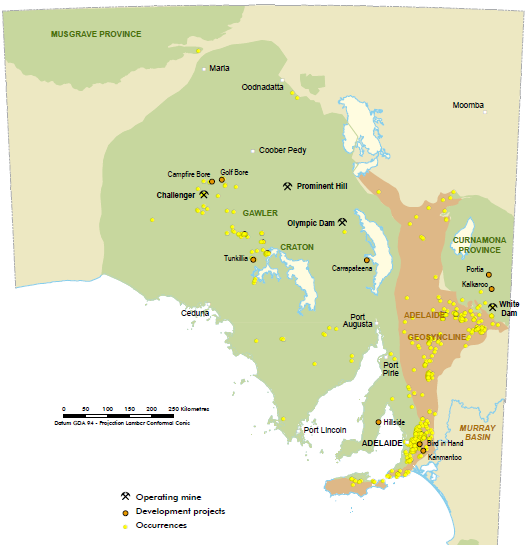
Minotaur will run a 15-month program of field trials to confirm the process concept at its Tunkillia gold deposit in the Gawler Craton, south of Tarcoola.


Gold projects in South Australia. Source: Minotaur Exploration.

“The process has the potential to revolutionise the way we normally mine near surface weathered (or ‘oxide’) gold deposits, while at the same time delivering potential massive cost savings for the owners of oxide gold resources,” Minotaur Exploration managing director Andrew Woskett, said in an announcement to the Australian Securities Exchange.

The full trial program at Tunkillia and associated exploration is expected to cost around $3 million, and is intended to lead to Proof-of-Concept for the in-situ gold extraction process.

Successful demonstration of the process at the field scale could open up the potential for any similar oxide gold deposits to be brought into production at low capital and operating costs, compared to traditional mining and processing methods.

The in-situ gold extraction process has been developed through intensive laboratory work by the CSIRO, with support from Minotaur and several other research project participants.

Minotaur said the Tunkillia oxide samples had performed well under CSIRO laboratory conditions testing the in-situ extraction process.

The company has elected to solely drive and fund the next development step for the process in the form of the field trials.

If these prove to be successful the company said it will be well positioned to take advantage of the technology’s inaugural commercial application, by implementing its use at the Tunkillia gold project.

The process involves installation of a conventional groundwater recovery bore field and injection of an appropriate solution (“lixiviant”) into the host rock.

The lixiviant dissolves the gold in the rock and the gold in solution travels through the rock mass to be recovered, to surface, via nearby extraction wells, as ‘pregnant’ solution.

This is a major departure from conventional heap leach gold operations which require the ore to be mined, crushed and stockpiled on surface, as ‘heaps’, prior to irrigation with a cyanide solution.

The CSIRO has developed a non-cyanide solution that, when injected into the host rock, is expected to cause minimal alteration to groundwater chemistry.

The field trials have been designed to focus on determining key objectives:

–    The transmission characteristics of the lixiviant through the host orebody;

–    Groundwater modification;

–    Gold recovery rates; and

–    Economic feasibility of the in-situ gold recovery process.

A range of environmentally acceptable lixiviants has been trialled in the laboratory by CSIRO, with promising results.

The most notable feature of the new process is that it negates the traditional reliance on cyanide in solution to liberate gold from ore, thereby minimising hazardous material consumption and potential site contamination.

It also circumvents the need for pre-stripping, drill and blast, open-cut mining, crushing and grinding circuits, cyanide leach systems, waste dumps and tailings dams.

The process is not dissimilar to the in-situ extraction methods successfully employed for over a decade by the uranium sector.

Until now that process has not been to be applied to gold as a non-cyanide based solvent had not been previously identified.

“Successful results from the lixiviant leach trials are expected to show that operating and capital investment costs are substantially lower, and implementation timelines much shorter, than for conventional gold mining and processing installations,” Woskett said.

“The in-situ recovery process could potentially make many low grade oxide gold deposits economic to extract.”

The day following Minotaur’s announcement its Joint Venture partner Helix resources released an announcement claiming it had not received a copy of the CSIRO report on the laboratory scale investigations.

“Helix has previously raised technical and commercial concerns regarding the potential use of in-situ leaching on the existing Tunkillia Resource with the JV Manager, Minotaur Ventures Pty Ltd,” Helix said.

“Helix has previously notified the JV Manager that it will not allow any in-situ studies to be conducted on the Tenements which have the potential to give rise to environmental liabilities and/or potential damage to the existing gold resource as a result of such studies.”

Helix also said it was not aware of Tunkillia JV approval regarding the proposed Collaborative Research Agreement with CSIRO to recover gold from the oxide zone of the Tunkillia gold deposit.

Nor was it aware of any agreement between Tunkillia JV and Minotaur Gold Solutions to complete activities as reported in the Minotaur release.

That zincing feeling

Zinc has been the Cinderella story of base metals recently but alas there hasn’t been any pumpkins arrive at its front door to take it to the ball.

Just when zinc was starting to get a few come-hither looks from world market analysts it has been hit by global financial storm and European gloom, which has sent any potential suitor look elsewhere.

If zinc does have anything going in its favour it would be the number of large mines set to close around the world causing a tightening of global stockpiles.

In a recent Metals Market Comment note BNP Parabis noted four prominent zinc mines that are about to meet the end of their run and four others that were scheduled to downsize production over the next few years.


The mines which are due to close produced over one million tonnes of zinc in 2010.

Those downsizing could possibly produce at least 300,000 tonnes less in 2014 than they did in 2010.

“As we have previously noted, however, the consequent big production losses will not begin in earnest until 2013,” BNP Parabis said.

“And meanwhile, there is plenty of scope for world mine output to continue growing, albeit not at the near eight per cent pace of 2010.”

The Global Financial Crisis of 2008 saw a number of mines cutback production, which continued throughout 2009.

Many of these closures are being reversed and as they continue it is expected global output of zinc will be given a bit of a leg-up moving into 2012.

The likely scenario we will see next year will be more of these restarts combined with a number of new, medium-sized mines are scheduled for start-up between now and 2013.

“Together with lofty lead and silver prices, the zinc price is still high enough to encourage continued production growth,” BNP Parabis said.

“Indeed, the zinc price is further up the cost curve than those of aluminium and even nickel.

“We forecast that as long as the zinc price does not fall sharply, world mine output will increase by about nine per cent between 2010 and 2012, and that it will continue to rise even in 2013.”


According to ABN AMRO Bank N.V. and VM Group London Metal Exchange warehouse stocks of zinc were sitting at 0.84 million tonnes as at 12 September, while those held by the Shanghai Futures Exchange totalled 0.41 million tonnes.

“Total zinc stocks, including those held by consumers and producers, stand at about ten weeks’ worth of global consumption, the highest since the 1990s,” the banking group said in its Metals Monthly newsletter for September 2011.

VM Group said it had been surprised by the performance of the price for zinc since the start of August, recording a rise of one per cent, to around $US2,200 per tonne.

Aluminium and tin recorded declines for the same period, while copper and nickel earned modest gains.

The only metal within the base metals group to perform better than zinc was lead.

“That said the zinc price did come under pressure in early August, falling to a low of $2,034 per tonne, only to rally later that month as risk-on risk-off sentiment based on EU and US debt and growth concerns roiled the markets,” VM Group said.

The increasing amount of zinc inventory tied up in warehouse financing term deals and a good deal of the remainder held in the LME’s New Orleans holding sheds has also been cited as a bullish factor for the metal.

This has resulted in a premium being paid for LME-grade zinc hitting premiums of $US130 per tonne, an increase of around $US10 per tonne from the beginning of the year and $US20 per tonne more than the nadirs of February and April.

“These dynamics will continue to characterise the zinc market in 2012, as trading houses and investment banks look to profit from the carry trade, while end users will at least find solace in lower zinc prices,” VM Group said predicting a short-term LME three-month zinc price of $US2,100per tonne to $US2,250 per tonne.

BNP Parabis said it expects zinc will continue to underperform into 2012 and that it is unable to be persuaded towards the bullish sentiment for zinc, especially relative to other metals.

“Zinc may be relatively cheap, but perhaps it still deserves to be,” BNP PArabis said.

“Although the longer-term bullish case remains intact, zinc has much work to do first.

“We expect zinc to continue to underperform for several months yet. And it might well be more vulnerable than most base metals, including even nickel, were economic/financial conditions to deteriorate further than expected.”

Debt, debt and more debt

That’s what is hurting world equity markets lately.

The Greeks are like Bondy, Skasey and Johnny Spalvins collectively, but on steroids.

They are in a position now where if they got a margin call, and were liquidated they’d be worth five cents in the dollar.

That’s way worse than our corporate cowboys from the 1980’s.

They would still be in business if their banks were as sympathetic as the European Central Bank.

The markets are jumping at shadows with regards to debt problems in Europe, and any rumour or innuendo is being treated as gospel before it is confirmed or denied.

Greece is the basket case, but the French and Germans are exposed through their banking system.

However, there is a ray of light. That light would come from the east, and it is the emerging giant that is China.

Oh, and there is also the prospect of money printing.

The Chinese are intimating that they are concerned by European debt.

They are no orphan.  The trouble for the Eurozone is if the Chinese are willing to buy European debt, they will want their pound of flesh.


Basically, Santorini, Mykonos and the Acropolis will end up having names in Mandarin.

And you won’t be able to get a souvlaki after a big night out; you’ll have to be happy with a takeaway Peking Duck.
Apparently, “the Greek situation could be coming to a head” according to Khiem Do, the Hong Kong based head of multi-asset strategy at BaringAsset Management, which oversees around $10 billion.

“Some hair cut might be needed for Greece if they don’t receive additional funding.

“That could create a domino effect in countries like Spain, Italy and Portugal.

“That’s what the market is fearing.”

Bill Blain, co-head of the Special Situations Group at Newedge Group, discusses the consequences of Greek default.

He argues that the markets would rally initially on any default.

I tend to agree, as the place is technically bankrupt.

Debt is like Medusa. You don’t want to be attracted to it, but you find you just can’t stop being seduced by it.

That, and not paying taxes like us poor little Aussie battlers do every quarter.

In Greece, tax evasion is a national pastime, and the Greek nationals expect the government to fully help the locals out in retirement.

Sadly, you can’t have your cake and eat it too.


Peter Hayes


Elvis has left the building Sept 15

THE BOURSE WHISPERER: The regular game of musical chairs
continues within the boardrooms across the resources industry. The
Whisperer pokes his head down the corridors of power to take a quick
look at some of the chairs to have recently been vacated and to find out
which ones have been filled:

Appointment of CEO and MD

Paramount Mining Corporation has appointed Terry Holohan to the roles of chief executive officer and managing director.

Holohan has previously held the positions of head of exploration and development, and before that, chief operating officer, at Platmin Limited.

Prior to his roles at Platmin, Holohan was senior vice president at Ivanhoe Nickel and Platinum, and has held various positions in metallurgy and operations management at Anglo American Platinum, BHP Minerals Zimbabwe, Impala Platinum and Golden Dumps.

Board Changes

Rubianna Resources advised the market of the following changes to its Board of directors.

Len Skotsch, the company’s current CEO and managing director, will be leaving the company after a three month transition period.

Alex Nutter, founding chairman of the company, has resigned from the Board for personal reasons.

Terry Smith, a director of the company, has accepted the position of non-executive chairman.

Gordon Dunbar has accepted an offer to act as a non-executive director of the company.

Appointment of new Directors

Rey Resources has appointed Brett Clark and Lex Graefe as non-executive directors with effect from 1 October, 2011.
Clark currently advises Murchison Metals on its major JV projects and has previous director or executive experience with Wembley Resources, Tethyan Copper, Ernst and Young, Snowden Group, Rio Tinto/Hamersley Iron and Western Mining.

Graefe has previously held the role of CFO/company secretary for Sphere Resources and has also held senior leadership roles with Shield Mining, Resolute Mining, Rio Tinto Indonesia and Rio Tinto India.

Graefe also held a number of management, commercial and financial roles with Hamersley Iron.

Alan Humphris, who has been a non-executive director since July 2004 and James McClements, who has been a non-executive director since August 2007 will resign from the Board on 1 October 2011.

Changes at Board level

Richard Wolanski has resigned as a non-executive director of Equator Resources.
 
The company also announced the appointment of Rhod Grivas as non-executive chairman.

Grivas has held a number of director and management positions with publicly listed mining and exploration companies including ASX and TSX listed gold miner Dioro Exploration NL prior to the Avoca takeover in early 2010.

He is also non-executive chairman of Canyon Resources and Lodestar Minerals, executive director of Southern Crown Resources and non-executive director of Coventry Resources.

Appointment of Managing Director

Legacy Iron Ore has appointed John Hebenton as managing director.

Hebenton was appointed as an executive director with immediate effect, prior to taking up his responsibilities as managing director on or before 10th October 2011.

Hebenton was managing director of Nimrodel Resources, where he was responsible for the management and development of uranium, precious metals, base metals and silicon exploration projects in Kyrgyzstan and Australia.

Management Update

Unity Mining announced that Rod Hanson, the company’s managing director & CEO, has decided to stand down from his position when an orderly transition to a new managing director & CEO can be completed.

The company said this is currently envisaged to occur by 31 December 2011.

Hanson has held the roles of managing director & CEO since early 2007 and has led Unity through a period of development, diversification and rebuilding, including the acquisition of the Henty Gold Mine in Tasmania and a significant investment in West African gold exploration through GoldStone Resources.

The company’s chief financial officer & company secretary, Tim Churcher, recently tendered his notice of resignation to pursue another opportunity.

Rod Lester, the company’s commercial finance manager, will succeed Churcher as company secretary.

New Board appointment

Gold miner Lachlan Star has appointed Scott Perry to the Board of Directors in a non-executive role.

Perry is currently the executive vice president and chief financial officer of Toronto and New York-listed Aurico Gold.

Tom Duckworth has resigned from the Board as a non-executive director in accordance with his retirement plans.

Duckworth has been a Board member since 2007.

Executive Director Mining Appointment

Citigold Corporation has appointed Dr. Brian White as executive director of mine operations.

White, currently a non-executive director, is a mining engineer with professional career covering all facets of the minerals industry.

His experience includes operational management, project development, planning, and design and consultancy in gold and base metals in both surface and underground mines in many parts of the world including the Ashanti gold reef mine in West Africa.

Marmota completes Phase 2 at Melton

THE DRILL SERGEANT: Marmota Energy has received assay results from a follow up drill program at its Melton copper-gold project on South Australia’s Yorke Peninsula.

Marmota and its joint venture partner Monax Mining completed Phase 2 reconnaissance drill testing of the Miranda target at Melton.

The program of four diamond drill holes was designed to follow up on results from the JV’s 2010 Phase 1 program at Miranda, located at the southern end of the Melton project area.
 
The company reported that all four Phase 2 drill holes intersected copper mineralisation in addition to the Phase 1 drill holes that intercepted broad zones of low grade copper at Miranda in 2010.

Marmota considers the drill hole intercepts across both Phases of drilling at Miranda to have defined an interpreted zone of copper mineralisation that extends for at least 1.3 kilometres open to the north.

Drilling completed to date has only partially tested Miranda and the JV partners have further exploration planned on the project over coming months.

Results from the latest round of drilling include:

– 9 metres at 1.03 per cent copper including 1 metre at 2.25 per cent  copper and 0.46 grams per tonne gold; and

– Significant grades of silver of up to 112.1 grams per tonne with elevated rare earths.

“Assay results from Miranda have been interpreted to have intersected a broad zone of copper mineralisation, containing a potential high grade zone encompassed in a broad lower grade halo,” Marmota Energy said in its ASX release.

“The mineralisation appears to be shallowing toward the northern end of the target area.

“The majority of the eight drill holes completed across both phases only tested the southern end of the Miranda copper target…with best intercepts achieved at what is interpreted to be a contact between the Miranda target and a larger adjoining mafic body.

Further exploration is planned at the Miranda target, which will include petrological assessment of mineralised samples from key intercepts along with reassessment of shallower intervals of drillholes for potential further assay.

Marmota said it is currently investigating options in conjunction with its Monax with respect to a Phase 3 drilling program, which will aim to more clearly delineate potential high-grade mineralised zones.

The Melton projects are located on Yorke Peninsula, less than 200km from Adelaide.

They cover the northern extension of the Pine Point Fault and contain a number of discrete magnetic and gravity features consistent with copper – gold mineralisation elsewhere along the fault.

Alcoyne set for September commissioning

THE BOURSE WHISPERER: Alcyone Resources remains on track to ramp-up silver production at its wholly-owned Texas silver & polymetallic project in south-east Queensland.

The company said it had made excellent progress in the first four weeks of wet commissioning of the upgraded Twin Hills processing facility.

Wet commissioning of the upgraded crushing circuit and heap leach processing facility commenced early August and the plant is already operating at a throughput rate of 140 tonnes per hour, which is not far off its nameplate capacity of 150 tonnes per hour .

This equates to an annualised throughput rate of one million tonnes per annum.

“The plant is performing beyond our expectations for this stage of commissioning and, when coupled with the production of over 210,000 ounces of silver to date, represents another key milestone towards achieving full-scale commercial silver production at the Texas Project,” Alcoyne Resources managing director Andrew King said in the company’s announcement to the Australian Securities Exchange.

“There couldn’t be a better time to be starting a silver mine with silver prices continuing to strengthen, providing us with an exceptional cash operating margin.

“With our life-of-mine unit cash operating costs forecast at $15 per ounce, this equates to a cash operating margin at the current spot price of around $26 per ounce – a very healthy proposition for a company entering a production ramp-up phase.

“We are looking forward to the next milestones, which include the start of mining and ramp-up to full commercial production at an annualised production rate of 1.5 million to 2 million ounces per annum by the end of this year.”

Overall silver recovery from the circuit is currently achieving recoveries from solution of more than 96 per cent, compared with the company’s targeted level, based on previous test work, of 95 per cent.

The company has produced over 210,000 ounces of bullion since it commenced trial processing in April and it is confident it can reach its original 250,000 ounce production target.

The early production has enabled Alcoyne to take advantage of strong silver prices and generate early cash flow.

The company has over 200,000 tonnes of medium to low grade ore on the Run-of-Mine stockpile that is being used for the initial wet commissioning of the plant, with a further 180,000 tonnes of higher grade ore already exposed within the open cut ready for extraction.

Because of the progress it has achieved so far with the plant commissioning, Alcyone has decided to bring forward the commencement of mining in the Twin Hills open pit to late September.

This will provide a regular ore feed to the plant and enable the company to ramp up production to the targeted annualised rate of 1.5 million to 2 million ounces per annum by the end of the year.

Empire intersects high-grade A Zone copper

THE DRILL SERGEANT: Perth-based Empire Resources has struck a seven metre wide copper intersection its A Zone prospect, located within the company’s wholly owned Yuinmery copper-gold project, in Western Australia.

The copper mineralisation was identified in a recently completed Reverse Circulation drill hole that was part of an ongoing drilling program being carried at the A Zone prospect.

The A Zone prospect lies 1.3 kilometres north of Empire’s Just Desserts prospect where the company has defined a JORC Indicated and Inferred resource of 1,070,000 tonnes at 1.82 per cent copper and 0.78 grams per tonne gold.

Using a 0.5 per cent copper cut-off the intersection which was part of a broader 25 metre zone, averaged:

– 4 metres at 4.68 per cent copper, 0.5 grams per tonne gold from 194 metres with 7 metres at 3.17 per cent copper, 0.47 grams per tonne gold from 192 metres down hole.

According to Empire the copper mineralisation was contained within the upper horizon and forms part of a 25 metre wide zone of disseminated sulphide mineralisation.

True width is estimated to be at least 80% of the drill intersection.

“This latest intersection of higher grade copper mineralisation confirms the potential of the A Zone prospect at Yuinmery,” Empire Resources managing director David Sargeant said in the company’s announcement to the Australian Securities Exchange.

“This is the deepest drill hole yet drilled into the mineralisation at less than 200 metres vertically below surface.”

Sargeant said the company had released a previous announcement referring to an earlier drill hole which had intersected 5m at 4.4% copper from 170m within 19m at 1.85% copper from 160m down hole.

“That intersection is at a vertical interval of approximately 110 metres below the surface,” Sargent continued.

“An enhanced program of drilling is planned at A Zone as well as testing a number of other promising geophysical targets in the project area.

“This initial result is consistent with our view that A Zone is part of a significant mineralised system.

“This would be tested by deeper drilling in the area. The attractive intersections of seven metres and 19 metres at good grade, together with the known mineralisation at Just Desserts, gives credence to our belief that the region has the potential to host a number of significant VMS mineralised zones.

“Many assays from other holes are still pending from this drilling program.”

The company said it expects to release a full set of analytical results in its upcoming quarterly report.

Navigator upgrades Bronzewing

THE BOURSE WHISPERER: Perth-based gold producer Navigator Resources has achieved a significant increase in the reportable Ore Reserve for the Cockburn gold deposit at the company’s the Bronzewing gold project.

The Open Pit Ore Reserve for the Cockburn gold deposit, which is part of Bronzewing, has been re-estimated following a recent upgrade in the Cockburn Open Pit Mineral Resource.

The Cockburn Open Pit Mineral Resource now consists of an Indicated Resource of 10.8 million tonnes at 1.6 grams per tonne gold containing 541,000 ounces of gold plus an Inferred Resource of 3.3 million tonnes at 1.4 grams per tonne gold containing 146,000 ounces of gold.

The Combined Mineral Resource now stands at 14.1Mt at 1.6g/t gold containing 687,000oz gold.

The new Probable Ore Reserve for Cockburn consists of 8.7Mt at 1.6g/t gold containing 438,000oz gold.

This Ore Reserve is contained within an open pit design that navigator had based on an optimised pit shell at $1,700 per ounce gold price using 100% of the Indicated and Inferred Resources.

The company also designed other optimised pit shells at $1,600, $1,800 and $2,000 per ounce to allow for gold price volatility.

Navigator opted to go with the A$1,700 per ounce pit shell as its preferred option for the construction of the ultimate pit design and associated Ore Reserve.

Navigator does not have to commit to the final pit cutback on the western side of Cockburn Pit for this new design for approximately six months.

The company said this will afford it flexibility for further optimisations and pit designs should the price of gold vary significantly.

The new Ore Reserve has already been depleted since the end of June 2011 due to the mining of approximately 55,000 tonnes at 1.5g/t gold to the end of August, as production at Cockburn ramps up to its full production capacity.

This upgrade in the Cockburn Open Pit Ore Reserve has arrived mainly due to the company being able to report tonnages and grades within a significantly higher priced pit shell that is $1,700 per ounce as opposed to its previous estimate at $1,250 per ounce.

The current gold price has allowed for the use of a lower cut-off grade of 0.5g/t gold compared to the 0.7g/t gold the company had previously applied, as well as an upgrade in the Cockburn Mineral Resource.

“Navigator has the benefit of considerable deeper drilling beneath the $1,250 per ounce Cockburn Pit design which demonstrates substantial additional mineralisation,” Navigator Resource managing director David Hatch said in the company’s announcement to the Australian Securities Exchange.

“With the recent increase in the gold price, the company has been able to move quickly to substantially increase the open pit Mineral Resource and Ore Reserve which has effectively added two years of mine life to the Bronzewing gold project based on the Indicated Resource only, or up to 2.5 years of extra mine life when including 70% of the Inferred Resource.

“We can now see the Cockburn Pit providing base load ore supply to the Bronzewing mill for around five years.”

In addition to the new Probable Ore Reserve based on the Indicated Resource, the new pit design contains an estimated 2.6Mt at 1.4g/t gold of Inferred Resource for 108,000oz of contained metal.

Navigator said that to date it had observed a 100% or better conversion rate of Inferred Resource with initial grade control programs.

However, it went on to say that it adopt a more prudent approach by applying a 70% conversion ratio to the Inferred Resource in its mine plan forecasts.

Eagle Eye turned on Mali

Two essential assets for working in West Africa are a landholding with potential to produce gold and years of experience working there; Eagle Eye Metals has both.

Earlier this year Eagle Eye Metals acquired private, West African company Birimian Gold.

By doing so it landed two advanced gold projects located in the Birimian Greenstone Belt of West Africa, a region synonymous with gold having produced over 250 million ounces from large, low cost mines.

“About ten months ago I went back to West Africa, having worked there four years previously with Resolute Mining, with the expressed purpose of acquiring the projects of private company Birimian Gold,” Eagle Eye Metals managing director Kevin Joyce told The Inside Story.

“Within about two months we had put together the projects that we were after.”

Eagle Eye now holds substantial interests in several highly prospective gold projects in West Africa.

The company’s projects in Mali include the Korindji gold project, located adjacent to both the 13 million ounce Sadiola gold mine and the 4.5 million ounce Yatela gold deposit.

In southern Mali the company picked up the Dankassa gold project, while in Liberia it also gained the Basawa gold project.

The 450 square kilometre Dankassa project consists of three exploration permits at Kourouba, Kourouba-East, and Dankassa, and two prospecting licenses at Makono and Songoria.

Eagle Eye has the right to earn a 90% interest in all five permits by making a series of instalment payments over a period of three years.

In all cases the vendors retain a 10% free-carried interest until mining concessions are granted.

The Dankassa project brought with it a history of previous exploration that had delineated extensive gold in soil geochemical anomalism.

Dankassa was subjected to some historic drilling although this was very limited and shallow RC drilling and was only carried out on the Kourouba prospect.

Historical results include 10.0 metres at 5.75 grams per tonne gold, which was enough to spark Eagle Eye into immediate action.

Having completed the original deal in February then formalising it in April the company was drilling at Dankassa in May.

“We are not happy to just pick up a project and sit on it,” Joyce explained.

“We are off and running and that is what it is all about for us. We want to move quickly to develop what we have got.”

The initial drilling program carried out at Dankassa was designed to extend drill coverage north and south of the previous ore grade drill intercepts.

Eagle Eye also used it to determine the continuity and grade of gold mineralisation within the central portion of the Kourouba prospect.

A total of 24 holes for 2,400 metres of reverse circulation drilling were completed over approximately 800 metres of strike.

The drilling did just what it was asked to do and confirmed primary gold mineralisation extends over the 800m of strike while remaining open in all directions.

Assay results from the drilling included:

– 32 metres at 0.8 grams per tonne gold from 78m;

– 12m at 1.67 g/t gold from 26m;

– 7m at 1.12 g/t gold from 16m;

– 7m at 1.00 g/t gold from 48m;

– 3m at 2.10 g/t gold from 37m;

– 3m at 1.59 g/t gold from 40m;

– 2m at 1.66 g/t gold from 73m; and

– 2m at 1.55 g/t gold from surface.

The recent drilling has combined with the drilling carried out by previous owners to highlight higher grade shoots occurring within the broader mineralised envelopes.

“We are only just scratching the surface out there as it stands at the moment,” Joyce said.

“That is a very big anomaly in a well-known anomalous project area.”

Eagle Eye has now commenced a further round of drilling to confirm the continuity of the higher grade zones.

These high-grade shoots appear to persist at depth and have encouraged the company to consider a large mineralised system to be present at the Kourouba prospect.

The company has come to this conclusion due to the character of mineralisation and widespread distribution of gold.

This suggests the project has significant lode gold potential as well as the scope for the discovery of a bulk, mineable gold resources.

Additional drilling and detailed reconnaissance is also scheduled to be undertaken within the broader Kourouba prospect area and further afield within the Dankassa gold project, where Eagle Eye says numerous other gold in soil trends remain untested.

Having gained some understanding of the ground at Dankassa, Eagle Eye is eager to pursue additional ground holdings in order to grow the business.

“That includes working on the acquisition of separate new projects as well as accreting to the land holdings that we have already got,” Joyce said.

The company is confident it can expand its footprint in Mali through its experience and connection with the country and its people.

When Joyce was employed by Resolute Mining he was based in southern Mali.

His role as exploration manager included project generation requiring travel within Mali as well as other African gold mining centres such as Burkina Faso and Cote d’Ivoire.

“Mali is one of the best jurisdictions in West Africa to work,” Joyce said.

“It is the third biggest gold producing country in Africa behind Ghana and South Africa so it is in real company in the gold producing stakes.”

With a lot of market attention focusing on other African jurisdictions it is easy for people to under-estimate how much gold is produced in Mali.

The country’s people, and more importantly, its government are extremely familiar with gold mining and production and how it should be done.

“That makes it an excellent jurisdiction in which to work,” Joyce continued.

“It is certainly one of the premier jurisdictions within West Africa for getting things done, just because they have been doing it for a very long time.

“The local expertise levels are high and it is also a place where we know how to operate.”

Joyce indicated one aspect that distinguished Eagle Eye from other gold plays operating in West Africa being that it went to Mali and dealt directly with the local vendors and the local entrepreneurs to acquire its projects.

“We put this project together ourselves and we think we have put together a pretty good landholding,” he said.

“I think that augers well for us to be able to put together more ground as we go ahead once we get these first projects off and running.”

Although Kourouba is the company’s main focus at present the Eagle Eye story is much bigger.

Having already highlighted some excellent potential at Kourouba the company is confident it can also advance the rest of its portfolio.

“We have other targets at Korindji in the west of Mali in a fabulous gold district, which is slightly more grassroots, which we will be looking at getting moving over the next three months,” Joyce said.

“Liberia is our grassroots play where we will carry out some traditional prospecting activities and we like to think we can move that towards drill targeting stage within twelve to eighteen months.”

Eagle Eye recently raised approximately $3.4 million and is now well financed to embark on an aggressive exploration program and to assess new opportunities.

Eagle Eye Metals (ASX:EYE)
…The Short Story

HEAD OFFICE
Suite 9
5 Centro Avenue
Subiaco, WA, 6008

Ph: +61 8 9286 3045
Fax: +61 8 9226 2027

Email: info@eagleeyemetals.com
Web: www.eagleeyemetals.com.au

DIRECTORS
Hugh Bresser, Kevin Joyce, Wayne Ryder, Michael Haynes, Warren Staude

MAJOR SHAREHOLDERS
Directors 30.6%
Macquarie Bank  4.4%
Citicorp Nominees  4.1%