Laconia upgrades Lennons Find Resource

THE BOURSE WHISPERER: Perth based exploration company Laconia Resources has upgraded the Mineral Resource at the company’s Lennons Find base metals project, in the eastern Pilbara region of Western Australia.


Lennons Find Resource location plan. Source: Company announcement


The total updated Mineral Resource for Lennons Find now stands at is 1.85 million tonnes at 11.4 per cent zinc equivalent (in Indicated and Inferred categories, at various zinc Equivalent cut-off grades).

According to Laconia the upgrade represents a 37 per cent increase in contained zinc metal (equivalent) from the previous Resource estimate.

It also represents a 117 per cent increase in total tonnes from the company’s previous Resource it released to the Australian Securities Exchange in March 2011.

“The Resource statement was estimated in accordance the JORC Code 2004 and incorporated results from a successful 42 hole, 1,939 metre drilling campaign conducted at the project in the latter part of 2011,” laconia Resources said in its latest ASX announcement.

“The Company is also pleased to announce a new oxide Resource at Lennons Find of 197,000 tonnes at 89 grams per tonne silver, 0.37 grams per tonne gold, 0.2 per cent copper, 1.2 per cent lead and 1.4 per cent zinc”

Laconia said it has further drilling planned at the Lennons Find project that will test for additional resources at depth at the Hammerhead deposit and to target further oxide resources within the project area.

A program of RC drilling will target a potential shallow supergene enrichment zone below the current drilling being undertaken at the Tiger and Bronze Whaler prospects and other mineralised prospects – Mako and Grey Nurse.

This drilling is also intended to investigate outcropping gossans soil anomalism within the project area.

Consider the companies getting on with ‘Business as Usual’

There There has been so much news and commentating about deteriorating world events both economically and politically that I thought it would be good to think about the companies and people that have impressed me as a private investor over the past year.

The share prices of some of these companies have been sold down with the market as the shenanigans of various financial factors have played their games, which have very little to do with individual companies.

A private investor has been an endangered species for many years and even with the power of the internet you will be at a disadvantage to the professional fraternity, so having the opportunity to meet with management of individual companies is immensely valuable when considering an investment with what is crucially your money.

Over the past year I have met the management of the companies below and would like to mention my personal views.
 
Ausdrill is an international mining services company, providing leading edge drill and blast exploration, supply and logistics services to many world mining companies in the United Kingdom, Australia and Africa.

This company has a market cap of around $850 million with a dividend yield of over 4 per cent and a full and expanding order book including contracts into the growing LNG and CSG market in Australia.

A look at its in-house magazine, ‘Ausbits’ is well worth a read to gain a real idea of good mining culture.

A few months ago I visited Sandfire Resources, which discovered the massive DeGrussa copper-gold VSM project 900 kilometres North East of Perth.
 

From the Degrussa discovery in April 2009 and completion of the Definitive Feasibility Study in June 2011, this company has been motoring along at top speed with first Direct Shipping Ore due to be shipped in the first quarter of 2012.

Rather unusually managing director Karl Simich dictated his own terms to the banks when arranging finance and already two copper off-take agreements have been put in place.

DeGrussa is expected to be a high margin project with life of mine project revenue estimated at $4.2 billion and pre-tax operating cash flow of $2.4 billion over the initial seven plus year life of mine.

There is a $25 to 30 million per year exploration budget to continue exploring the highly prospective 22km DeGrussa corridor and the rest of the company’s 400 square kilometre license.

The enthusiasm and efficiency of this team is truly impressive along with its strong shareholder base with Oz Minerals owning 18.8 per cent, POSCO 15.9 per cent and management 8 per cent.

Sandfire has several other projects elsewhere including 17.4 per cent of Whinnen Resources, a copper-gold exploration and development company operating in Northern Chile.

Two companies operating in the Republic of Congo (the peaceful one) have also made good progress with their different projects, which are equally interesting as they have proven and confident management.

The first is Elemental Minerals, which is exploring and developing the Sintukoula potash project, situated near the coast, 60km from the major West African port of Pointe Noire.

This company has identified significant sylvinite and caranalitite prospects on its 1436sqkm exploration license.

Infrastructure is straightforward, with power and gas readily available.

The company has recently acquired oil seismic data on their licence with potentially exciting upside.

The Elemental board have proved themselves with other projects in the past and have a much focussed approach to fast track potash production for 2015.

Elemental is well advanced with BFS and are funded until 2015.

Equatorial Resources is the other company, which has two iron ore projects.

Mayoko-Moussodji has a 2.3 to 3.9 billion tonne iron ore potential exploration target at 30 to 65 per cent iron.

Equatorial is aiming for DSO (direct shipping ore) on an existing bulk haulage railway line that goes directly to Pointe Noire for shipping.

The company expects to announce a maiden JORC resource in early 2012.

The company’s other project, Badondo, is in the North, adjacent to Gabon, surrounded with other world class projects being advanced by Sundance Resources, CMEC and Core Mining.

Equatorial has built a cash balance of $55 million to take it through the next phase.

Staying with iron ore, Baobab Resources is a Mozambique focussed explorer with a 620sqkm landholding in the central North of the country surrounded by coal companies such as Rio, Jindal Steel and Power, Vale, Minas de Revobue (Talbot group, Nippon Steel, Posco) and others.

Like many brownfield projects this company has had a rough ride in the market although it has recently proved up an inferred JORC resource of over 323 million tonnes at 30.1 per cent iron.

One broker has a mid-estimate of an increase for nearly 400Mt of additional resources and exploration upside.

Drilling is on-going at the company’s flagship Tete project and more results are expected over the next few months.

One of its considered aims is pig iron production which has a higher value and will broaden market options.

Additional drilling is underway at Mundouguara, for nickel,copper and gold.

Baobab has a 15 per cent JV partner in the IFC who are committed to supporting the project and other funding options should take them through to the PFS in FY14.

Hot Chili is an unusual copper exploration company operating in Chile.

Firstly it has recently raised $30M at a premium to its share price with support from strategic investors and secondly, has over time, negotiated and built relationships into a number of JV’s with powerful Chilean companies such as Codelco and CMP.

Its flagship project, Productura, produced a maiden resource of 85.1Mt at 0.60 per cent copper in September and a resource upgrade is expected in the third quarter.

Hot Chile is aggressively pursuing an expansion and drilling program and all signs are for plenty of upside.

None of us know what will happen over the next few years but following people and good management seems to be as good a strategy as any.

Happy New Year.

Susie Boeckmann is a private investor and resources blogger.

Australia may have resources but it doesn’t have enough resources

The resources Australia has in the ground are plentiful but the human resources to develop the operations to dig them up are sparse in comparison.

A new study has raised the distress flag on Australia’s ageing technical workforce and competition from other resource developing countries as key threats to the mining industry’s workforce requirements.


Resources employment news website, The Resource Channel and communications and marketing specialists, Marketforce, recently combined forces to conduct research which found most countries that usually supply Australia with such workers are themselves experiencing, or expecting to experience, significant skills shortages.

The research covered employment difficulties for the resources industry in South and Central America, Ireland, Japan, Philippines and Papua New Guinea.

The researchers came to the conclusion that if it is to remain competitive Australia needs to realise it is not the only viable destination for qualified resource industry workers.

“Not only is seven of the world’s LNG producing countries planning to double their production in the coming decade, but the mining industries of South Africa, Canada, the United States and South America also cite significant growth plans, demanding more than 250,000 new entrants to the industry globally in the next decade,” The Resource Channel director Jody Elliott said.

“In other cases, like China and India, growth plans relate more to their economies, but still look to absorb the total of their own home-grown engineering and technical skills.”

The implication for Australia is that the majority of the target countries identified as potential sourcing options, such as South Africa, Canada, United Kingdom, and the United States, become far less feasible options due to their own strategies.

According to The Resource Channel’s research, there is not one country that offers a potential strong supply of skilled labour.

The research concludes the current economic climate to anticipated growth plans for some areas may not eventuate in the short term.

It may also mean Australian organisations will need to adopt a more tactical short-term approach to engaging international candidates while affording them the opportunity to develop new skills locally.

“Not only does the Australian resource sector plan to significantly expand in the next decade, but the 5,000 or so replacements required each year to account for retirements and exits from the industry means employers will need to consider alternative sourcing options,” Elliott said.

“Essentially, it means far greater consideration needs to be placed on entry level opportunities for local labour – apprentices, graduates, trainees, and cross-skilling those from other sectors with transferable skills. Now is not the time to decrease opportunities in these areas – for any Australian resource sector employer.”

One important aspect highlighted by the research is resource producing countries in competition for the services of these professionals are experiencing or anticipating the same level growth as well as suffering the same lack of availability of skills as theier Australian counterparts.

The decrease in the number of engineering students is not only isolated to Australia.

It is also estimated that more than a quarter of technical professionals working for the energy and petroleum sector are older than 50, with the majority scheduled to retire in the next five years.

This will leave an alarming deficit of 5,000 petrotechnical staff a year.

The severity of this was demonstrated recently by the CEO of Caterpillar in the United States, who said that despite the high unemployment rate across the country, there is a desperate shortage of skilled workers, with many job vacancies going unfilled in some of the most depressed regions of the country.

There are a large number of potential sourcing channels available to Australia; however these could easily dissipate should competitor countries experience the growth being predicting.

Throw this into the mix of a global engineering skills shortage and Australian organisations will need to spend a good deal of time in front of the mirror as they work out how they can resource their operational and project needs.

“The research highlights that there is no one location that can be targeted as a total recruitment solution,” Elliott said.


Red Gum lists and drills

THE DRILL SERGEANT: Red Gum Resources has celebrated its first day of trading as an ASX-listed entity by announcing it has commenced drilling at its La Negra lead-zinc-silver project, located in northern Chile.


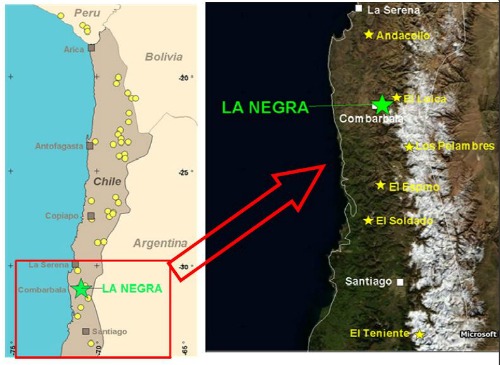
Location map of the La Negra area. Source: Company announcement

“With listing today on the ASX, it gives us great pleasure to report that drilling of Red Gum’s key La Negra project in Chile has commenced on time,” Red Gum Resources managing director Paul Pearson said in the company’s announcement to the Australian Securities Exchange.

“The company’s expertise in Latin America has expedited commencement of field activities in Chile.

“A number of parallel studies and associated geochemical, geophysical and geological projects have also been initiated which will ensure the continuous flow of new information to our shareholders.

“The drilling program is expected to take up to four months, with first results through in February.

“We look forward to reporting these results to shareholders as we progress.”

Red Gum’s La Negra project is located within Region IV in Chile, approximately 360 kilometres NNE of the capital, Santiago and approximately 10 kilometres ENE of the mining town of Combarbalá.

Red Gum has an option to acquire 100 per cent in the property, which comprises 11 separate mining and exploration concessions totalling approximately 2,600 hectares.

The company has attributed an Exploration Target of 10 million tonnes to 70 million tonnes grading 0.21 per cent to 11.75 per cent lead, 0.21 per cent to 11.55 per cent zinc, and 0.03 per cent to 1.1 per cent copper to the La Negra project.

Red Gum said it plans to drill approximately eight deep diamond drill holes designed to test the strike extent and width of the Project’s mineralised zone down to an approximate vertical depth of 400 metres, at 100-150 metre intervals.

The company said it will also drill at least one deeper hole, to test for the possible existence of a porphyry system inferred from geophysical interpretation.

Wolf receives UK government support

THE BOURSE WHISPERER: ASX and AIM-listed specialty metal exploration and development company Wolf Minerals has received formal United Kingdom Government support for the development of its Hemerdon Tungsten and Tin project in Devon, in Southwest England.


Location of the Hemerdon project. Source: Company

The support came directly from the UK Minister of State for Trade, Lord Green of Hurstpierpoint, and represents an acknowledgement of the importance of the Hemerdon project to the local community and to the UK and wider EU.

The Minister wrote to Wolf outlining his support to the company following its successful completion of planning consents for the development of the Hemerdon project.

 “This is an important project for a number of reasons; to the local community in terms of jobs and wealth creation and to the UK and wider EU in securing supplies of tungsten,” Lord Green wrote.

“I am aware that tungsten ranks highly in both the British Geological Society and EU’s critical raw materials lists and that it has unique properties that are impossible to replace in certain specialised industrial applications.”

The UK Government support for the development of Hemerdon comes after Wolf’s announcement in December 2011 that it had approved credit approval for £55 million (AUD$81.8 million) in senior debt finance facilities to fund the commercial development of the project, and that it had received all relevant planning permissions for the Hemerdon link road and had appointed contractors to construct the road.

“Support from the UK Minister of State for Trade and Investment is extremely welcome as we seek to build a new operating tungsten mine in the South West of England,” Wolf Minerals chief executive officer Humphrey Hale said in the company’s announcement to the Australian Securities Exchange.

“The £55 million debt funding Wolf is seeking to secure supports the planned construction of the Hemerdon project, based on the Definitive Feasibility Study completed in May 2011.

“The provision of the senior debt finance facilities is now subject to completion of the project finance documentation and the usual credit approvals and conditions precedent customary for a financing of this nature.

“The current timetable is for the lenders to obtain credit approval for the facilities this February.”

Wolf said it is also in discussions with potential off-take partners to provide subordinated debt.

The total debt facilities will enable Wolf to minimise the equity component of the funding package required to put the Hemerdon project into production.

Coppermoly and Barrick to form JV

THE BOURSE WHISPERER: Global gold producer Barrick Gold has notified Coppermoly that it has met the $20 million expenditure commitment under the farm-in agreement on Coppermoly’s Simuku, Nakru and Talelumas tenements on New Britain Island, located off the coast of Papua New Guinea.


Location of Coppermoly projects on the Kulu Awit copper belt. Source: Company announcement


By meeting the expenditure commitment Barrick has now earned a 72 per cent stake in each of the tenements.

“In accordance with the farm-in agreement a joint venture for the further exploration and evaluation and, if warranted, the development, of the tenements will now be formed,” Coppermoly managing director Peter Swiridiuk said in the company’s announcement to the Australian Securities Exchange.

“Coppermoly does not have to contribute funds until a feasibility study has been finalised.”

Under the terms of its agreement with Barrick, Coppermoly will retain a 28 per cent interest in the three tenements.

The company said its cash contribution up to the completion of a feasibility study will be delayed until the commencement of production, and will be repaid from Coppermoly’s share of any future production revenue.

The copper and gold projects located within the tenements are within a four hour drive from existing infrastructure.

This includes a deep water port at the provincial capital of Kimbe.

Coppermoly considers the proximity of this infrastructure enhances the potential for any future development.

“The joint venture will provide significant upside to Coppermoly shareholders through the retention of a substantial interest in these advanced projects,” Swiridiuk said.

“Coppermoly also expects to be able to undertake exploration in its own right on the new areas that Coppermoly currently has under application on New Britain Island as tenements over those areas are granted during 2012.”

Chalice confirms Koka South mineralisation

THE DRILL SERGEANT: ASX and TSX-listed Chalice Gold Mines and Zara Mining Share Company (Chalice 60 per cent, ENAMCO 40 per cent) have received the latest drilling results from the emerging Koka South discovery located on the Zara gold project in Eritrea.

Chalice said the results confirm high-grade mineralisation extending below and south of drilling that it has previously reported.
 
The company has received results for the last two holes from its 2011 drilling campaign.

Both of these holes have returned high-grade intersections, including:

–    1 metre at 138.65 grams per tonne gold from 185 metres;

–    1m at 56.38g/t gold from 195m;

–    1m at 36.97g/t gold from 199m; and

–    1m at 16.82g/t gold from 322m.

“The latest results further confirm that high-grade mineralisation at Koka South extends to depth in the south and remains open Chalice Gold said in its ASX announcement.

The widths and grades of mineralisation encountered have the potential to provide a significant underground addition to the Koka open pit resource.

“Koka South lies immediately to the south of the Koka Main deposit (Probable Mineral Reserve of 760,000 ounces at 5.1g/t gold).

“Mineralisation at Koka South has so far been delineated over a strike length of 250 metres and remains open to the south and at depth.”

Chalice said it has drilling scheduled to recommence later this month that will be targeting extensions to the Koka South deposit at depth and further to the south.

Ironbark upgrades Citronen

THE DRILL SERGEANT: Greenland-focused Ironbark Zinc has announced a resource upgrade in both grade and in the company’s confidence in its wholly-owned, Citronen base metals project.

The company said the latest resource upgrade has been based on recent drilling conducted during 2011.

Ironbark has completed over 60,000 metres of diamond drilling at Citronen.

According to the company’s ASX announcement the resource remains open in almost every direction and highlights that exploration at Citronen has resulted in resource expansion every year.

Highlights of 2012 resource include:

–    A 53 per cent increase in resources within the Indicated and Measured category;

–    An 11 per cent increase in total contained metal inventory;

–    A 10 per cent increase in zinc + lead grade; and

–    A Resource upgrade calculated using more conservative Ordinary Kriging method.

“The global resource at Citronen now stands at 13.1 billion pounds of zinc and lead,” Ironbark Zinc said in its announcement.

“This is for material reported above a 2.0 per cent zinc cutoff and represents an increase of 11 per cent on the previous reported estimate of 132.6 million tonnes at 4.0 per cent zinc and lead for 11 billion pounds of zinc and lead.”
 
Ironbark said there has been no material change in the global tonnage of material at the 2 per cent cutoff grade due to the predominantly infill nature of the drilling it has carried out during 2011.

However, greater continuity of higher grade material has resulted in a better understanding of mineralisation, resulting in an increased resource category, and honouring of higher grade material.

The company said the increase in medium grade tonnage at the 3.5 per cent zinc cutoff is a result of the positive movements in the grade-tonnage-curve.

Macphersons targets Nimbus East tailings

THE DRILL SERGEANT: MacPhersons Reward Gold has completed preliminary sampling of the Nimbus East Pit tailings storage facility (TSF) at its 100 per cent-owned Nimbus project, located near Kalgoorlie in Western Australia.


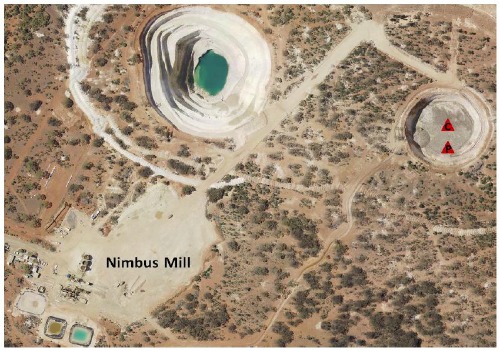
View of Nimbus Silver Mine, current mill processing site and East
Pit showing first two composited test sites labelled as “C” and “P”
representing the central and perimeter sites respectively (red
triangles). Source: Company announcement


According to the company’s ASX announcement the sampling has provided it with better results than were expected.
 
The results have encouraged MacPhersons to drill out the East Pit TSF on a 10 metre by 10 metre grid pattern to allow the company to complete a processing feasibility study during the first quarter of 2012.

Drilling of the TSF is being carried out using two rigs.

An auger rig is drilling the TSF section that is less than 20m thick, while diamond drilling is being conducted through the deeper central TSF zone, with diamond holes casing off and commencing a grade control drill out of the pit floor.
 
“The first pit floor diamond hole has been completed through 23 metres of tailings and then continued to intersect several stockwork and massive sulphide zones down to a depth of approximately 140m (approximately 120m beneath the pit floor),” Macphersons reward Gold said in its announcement.

Preliminary results from the first two composited bulk samples included:

–    Assay results of all samples ranged from 19 grams per tonne to 211 grams per tonne silver;

–    The central zone composited metallurgical head grade ranged from 147g/t to 164g/t silver;

–    The perimeter zone composited metallurgical head grade ranged from 112g/t to 127g/t silver;

–    Leach testwork on composite samples grading 113g/t to 140g/t silver had recoveries of between 88 per cent and 91 per cent; and

–    Surveying of the East Pit TSF gave a calculated tonnage of between 125,000 tonnes to 135,000 tonnes of material.

“No testwork has been commenced on the larger Nimbus TSF#1, which has an estimated 190,000 to 200,000 tonnes of tailings material at an historical grade estimate of between 20 grams per tonne to 100 grams per tonne silver,” the company said.

“The Directors believe that the Nimbus East Pit tailings represent a near-term silver production opportunity.

“The East Pit TSF testwork and a JORC mineral resource statement will be completed in Q1 2012.”

FIFO Inquiry called to task by AMA

Last year, the Federal House of Representatives Standing Committee on Regional Australia launched an inquiry into the experience of fly-in, fly-out (FIFO) and drive-in, drive-out (DIDO) workers in regional Australia.

The Minister for Regional Australia, Regional Development and Local Government, Simon Crean asked the Committee to look into a range of issues, including:

–    The extent and projected growth of FIFO/DIDO work practices;

–    The impact of FIFO/DIDO on individuals, communities and companies;

–    Long-term strategies for economic diversification in towns with large FIFO/DIDO workforces; and

–    Provision of services, infrastructure and housing availability for FIFO/DIDO employees.


“The Committee recognises that the use of fly-in/fly-out and drive-in/drive-out workforces in the mining sector raises a number of significant challenges and opportunities for individuals and their families, communities and employers,” Committee Chair Tony Windsor said on the launch of the inquiry.

“We are interested in exploring all of those issue and hope to also hear from mining companies who are utilising FIFO/DIDO for their employees.”

This week the Western Australia branch of the Australian Medical Association called for the inquiry to closely examine key issues relating to the health of workers, especially mental health, obesity and access to general practitioners.

“I note with concern that the Inquiry’s Terms of Reference emphasises economic issues but fails to properly emphasise health and socially related subjects,” AMA(WA) president associate professor David Mountain said.

“It is important and well overdue that the economic issues surrounding FIFO are examined by a Parliamentary committee, but if they don’t include health as a key part of their terms of reference, committee members are missing a significant opportunity to have a real impact on the lives of FIFO workers and their families.”

Mountain pointed to recent reports on the subject that have revealed significant health concerns for FIFO workers.

These concerns are growing in number and range from diabetes, through to obesity, mental health and heart issues.

There has also been a reported spike in Sexually Transmitted Infections (STI) amongst FIFO workers who are participating in unsafe sex with co-workers and prostitutes.

“It is important that any review involves this key area,” he said.

According to the AMA there is already plenty of data available showing that working different shifts can be very disruptive to the lives and relationships of these workers.

The doctors’ representative body claimed the mining industry to be full of stories about FIFO workers suffering general health problems, relationship breakdowns, and sometimes the abuse of drugs, especially alcohol and the marijuana substitute, Kronic.

“Medical professionals acknowledge FIFO workers face a range of special health demands and it is vital that the Parliamentary Inquiry consider these issues and propose solutions,” Mountain continued.

“Especially worrying is that, due to their unusual lifestyles, FIFO workers are often not able to develop a close relationship with a general practitioner.”

Health services for remote centres serving mining companies with FIFO workforces have become strained as the number of medical professionals leaving rural environments has increased proportionally to the demand.

“It is equally important that health services for people living in remote towns that service FIFO workers and their work sites be closely examined as well, due to the major effects increased pressure on resources and increases in local costs and rents have on medical services and local employment,” Mountain said.

The AMA(WA) said it will be making a submission to the Parliamentary Inquiry based on the personal knowledge and experience of medical professionals who have, for some years, advocated a serious inquiry into health and social issues of FIFO.

“We would also encourage Committee members to visit Western Australia and pay particular attention to the Kimberley and the Pilbara,” Mountain said.