Blackstone Minerals’ Consistent Cobalt Hits Continue to Polish Little Gem

THE INSIDE STORY: Blackstone Minerals (ASX: BSX) has made a rapid start and impressive progress since joining the competition to discover high-grade cobalt deposits.

Blackstone Minerals listed on the ASX in January 2017 and in July that year acquired 100 per cent of the Little Gem project, located in British Columbia, Canada.

Cobalt is very much a metal-of-the-moment, due mainly to its 60 per cent contribution to the makeup of lithium-ion batteries, which is the basis for 50 per cent of global demand.

Expected growing demand for electric vehicles leads the lithium-ion battery charge that is sweeping cobalt along in its wake.

As a result, cobalt is expected to have a supply deficit, especially as current global mining output is only just meeting demand.

The cobalt price has enjoyed a buoyant run over the past two years, rising from US$10 per pound (US$22,000/tonne) to US$40/lb (US$87,000/t).

Current prices are still well short of the highs of US$52/lb (US$115,000/t) experienced in 2008, which was the last time cobalt was in deficit.

Blackstone Minerals commenced a six-hole maiden diamond drilling program at Little Gem in 2017, which came up trumps from the get go.

The first drill hole intersected massive, semi-massive and disseminated mineralisation, returning:

4.3 metres at 1 per cent cobalt and 15 grams per tonne gold, including 1.1m at 3 per cent cobalt and 44g/t gold.

These results were encouraging and were consistent with high-grade historic underground drilling and adit channel sampling data results of 1.8m at 2.4 per cent cobalt and 112g/t gold and 1.8m at 4.4 per cent cobalt and 73g/t gold respectively.

The first hole only tested the upper portion of the mineralised target but was able to identify multiple zones of massive sulphide (cobalt-gold) mineralisation within a broader alteration halo.

Blackstone re-commenced its 2018 field season drilling in April and immediately revealed the Little Gem alteration halo to be much larger than the company had previously estimated.

The 2018 drilling results the company had received at the time of writing had consistently intersected a broad alteration zone, highlighting potential for a major hydrothermal system at Little Gem.

The third hole to be completed at Little Gem, LGD18-002, continued to encourage Blackstone, returning:

3.2m at 0.8 per cent cobalt and 4g/t gold, including 1m at 1.2 per cent cobalt and 5g/t gold.

“It’s very clear that the results we have achieved to date are in line with our expectations, especially with our first hole at Little Gem hitting three per cent cobalt,” Blackstone Minerals managing director Scott Williamson told The Resources Roadhouse.

“We have now followed that result with further high-grade cobalt hits of one per cent and over.

“To put that in perspective – our peers in Australia are averaging around 0.1 per cent cobalt.

“We have recorded two intersections of over one per cent cobalt, which is ten times anything our Australian peers have encountered.

“We believe we are, potentially, dealing with a major hydrothermal system, which means there is a lot of fluid flow and a broad halo around this mineralisation.”

On the back of these positive results, Blackstone initiated a geophysical survey to test for further high-grade cobalt-gold prospects within the identified plus-1.8-kilometre strike target zone at Little Gem and the nearby Jewel prospect located 1.1km north-northeast of Little Gem.
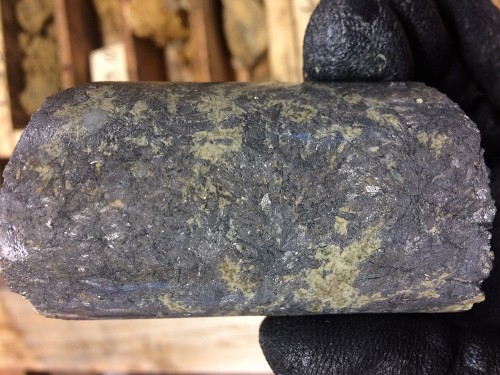
“We are now seeing a significantly larger alteration zone at Little Gem and we are also seeing that the disseminated mineralisation is carrying good widths within flat lying zones of mineralisation,” Williamson said.

“To really understand that, we need to carry out more geophysical studies, so we can unlock what is really happening within the deposit.

“Over the next three to six months we will be focused on doing just that.”

The second mineral occurrence to attract Blackstone’s attention at the Little Gem project is the historic Jewel gold prospect which supported limited gold production from 1938 to 1940.

The Jewel prospect is located only 1.1 km north-northeast of the Little Gem Mine, near the (serpentinite/ granodiorite) contact zone which is prospective for cobalt-gold mineralisation in a fashion the company considers being analogous to the world class Bou-Azzer primary cobalt district in Morocco.

The comparisons to Bou-Azzer are inevitable with the district Little Gem is situated in having been well-explored and well-understood for gold and other metals, however, Blackstone is the first to be primarily on the hunt for cobalt.

The multi-element potential of the district has been demonstrated since Blackstone began working on the Little Gem project.

The company has verified mineralisation identified historically at the Little Gem prospect as well as at the Jewel gold prospect and discovered a new high-grade gold prospect named Roxey.

The Roxey gold prospect is located 1.5km west-southwest of the Little Gem prospect and was visually identified by Blackstone during the company’s original due diligence site visit, during which it took rock chip samples that returned assays of up to 24g/t gold, 1.9 per cent copper and 24g/t silver.

This was supported by surface rock chip samples taken at the Jewel prospect, which returned up to 98g/t gold and 3.2 per cent copper.

These results confirm what Blackstone found from its investigation of historical samples.

The Little Gem Project was discovered in the 1930s by prospectors who identified a pink cobalt-bloom on weathered mineralisation that led to the development of three adits.

A total of 1,268m of underground drilling was completed at this time and detailed channel sampling was taken from the adits.

Results from this historic work generated exceptional cobalt and gold assays including:

Historic drilling
1.8m at 2.4 per cent cobalt and 112g/t gold 3.3m at 1.4 per cent cobalt and 12g/t gold; and
4.1m at 1.4 per cent cobalt and 11g/t gold.

Underground channel sampling
1.8m at 4.4 per cent cobalt and 73g/t gold; and
2m at 3.1 per cent cobalt and 76g/t gold.

Surface channel sampling
0.4m at 5.7 per cent cobalt and 1,574g/t gold; and
0.1m at 4.6 per cent cobalt and 800g/t gold.

The Little Gem deposit is mostly underlain by granite of the Coast Plutonic Complex and ultramafic rocks on what has been interpreted to be the northern extension of the Cadwallader fault zone.

These are the major geological units and structures important to the mineral deposits either as the host rocks or sources of the mineralising fluids that gave rise to the Bridge River mining camp.

This camp has 60 mineral localities including the Bralorne-Pioneer mining complex, which boast an endowment of 4.4 million ounces at 17g/t gold and is the biggest gold producer in British Columbia and the sixth largest in Canada.

Little Gem is only 15km along strike to the north of the Bralorne-Pioneer mining complex.

Incredibly, there has been very little modern-day exploration carried out at Little Gem and what has been undertaken mostly consists of airborne geophysical surveys, including magnetic, radiometric and electromagnetic (EM) surveys completed in the 1970s and a further two drill holes completed in 1986.

“Results from the first three drill holes have confirmed Little Gem has some of the world’s highest-grade cobalt-gold mineralisation,” Williamson said.

“We are looking forward to the next round of assays and results from geophysical surveys to define the full potential of the mineralised system and the extensive alteration zone discovered at Little Gem.”


Blackstone Minerals Limited (ASX: BSX)
…The Short Story

HEAD OFFICE
Suite 3, Level 3
24 Outram Street
West Perth, WA, 6005

Ph: +61 8 9425 5217

Email: admin@blackstoneminerals.com.au
Web: www.blackstoneminerals.com.au

DIRECTORS
Hamish Halliday, Scott Williamson, Andrew Radonjic, Steve Parsons, Bruce McFadzean, Michael Konnert


Alliance Resources Promoting Weednanna from Gold Prospect to Gold Region

THE INSIDE STORY: Alliance Resources (ASX: AGS) is beginning to realise the potential lying within its flagship Weednanna gold prospect and other regional targets.

As Alliance Resources progresses Weednanna towards a maiden mineral resource estimate, the company has also turned its attention to the regional gold potential surrounding the prospect.

The Weednanna gold prospect is the most advanced of the Wilcherry Project Joint Venture in the Gawler Craton of South Australia between Alliance and Tyranna Resources (ASX: TYX).

As of 31 March 2018, Alliance had increased its interest in the Wilcherry Project Joint Venture Exploration Area to 71.09 per cent.

At Weednanna, high-grade gold shoots are associated with a calc-silicate and magnetite skarn system.

Alliance has stated its objective to establish a maiden mineral resource estimate for Weednanna this year and working towards that goal includes a staged program of metallurgical work on Weednanna gold mineralisation with the aim of optimising gold recovery and culminating in process design criteria and capital and operating costs for the processing base case.

Should the outcomes of both work streams be positive, Alliance intends feeding them into a scoping study to commence in the second half 2018.

The company has already demonstrated the exploration potential at Weednanna, however historic high-grade gold intercepts at the Mawson and Ultima Dam South prospects, both within a short trucking distance to Weednanna, also have the company very excited.

The most recent work at Weednanna consisted of Alliance’s fourth RC drilling program at the prospect, returning results that included four holes assaying greater than 50 grams per tonne-metres gold (grade by thickness).

Around the same time, Alliance completed a further 22-hole RC drilling program to define the geometry of Target 4 and initial testing of Target 5.

Fifteen holes at Target 4 reported intercepts greater than 1g/t gold, including four holes returning greater than 50g/t-m gold.

After a short break in drilling at Weednanna, Alliance returned in June to conduct a further 14 holes at Weednanna Target 4 with the aim to bundle together Targets 1 – 4 and 3D modelling to establish a mineral resource estimate.

“We finished a high-resolution gravity survey at Weednanna earlier this year, because we really wanted to fully understand the targets we are drilling,” Alliance Resources managing director Steve Johnston told The Resources Roadhouse.

“They are discreet targets and most have relatively narrow extents in cross section, but have potential for continuity down plunge and, of course, there is potential for repetition.

“We are trying to throw as much at it as we can in terms of geophysics because we already possess good magnetic data sets, a good regional gravity data set and previous IP work there has lit up sulphides which are often associated with gold.”

The high-resolution gravity survey revealed several structures, including a dominant NW-SE trending set.

The Weednanna Target 1 gold shoot is located along the most prominent of these NW-SE trending structures, which continues to the south of Target 4.

Alliance will use the gravity data to assist with mapping the sub-surface geology, particularly the target corridors of calc-silicate and magnetite skarn that host high-grade gold shoots.

The data will complement the existing geophysical datasets at Weednanna and will be utilised for constrained 3D inversion modelling to assist with targeting new gold lodes.

“The idea of doing the high-res gravity survey was to get a handle on the calc-silicate target, which hosts the gold mineralisation,” Johnston explained.

“We found some really large northwest-trending structures cutting across the project, which we had a hint of from the magnetics, but they really showed up from the gravity survey.

“One of the structures goes through Target 1, which is our largest target sitting in the west of the project.

“Target 1 is quite constrained at only 130 metres of strike, but this structure that trends through it, and continues on, is about one kilometre and, historically, there hasn’t been much drilling along the length of it.

“That has really opened that area for further exploration, so we will be looking at that too.

“Once we have modelled these targets we will be able to see if there are any other localities that might provide for structural repetition.

“It could be quite a powerful model that we will have at the end of it, so the wireframing we are doing is not just for a mineral resource estimate, it is also for targeting additional mineralisation.

“I’m confident that we will identify other target areas, I don’t know how many at this stage, but we have potential to add to the number of target areas we already have at Weednanna.”

In May this year, Alliance announced the commencement of a review of regional gold prospectivity in a bid to identify prospects with potential for gold mineralisation situated within five kilometres of Weednanna.

The company compiled results from historic geochemical and drilling databases that showed gold was encountered at the Mawson, Ultima Dam South and Weednanna North prospects, with anomalous gold of greater than 0.2g/t gold at the Ultima Dam and Ultima Dam North prospects.

The Mawson prospect sits 3,600m to the northwest of Weednanna and was initially identified by calcrete sampling in in the 1990s that defined a gold-in-calcrete anomaly over the southern part of the prospect.

Drilling by Anglogold into the anomaly in 1999 intersected 29m at 0.86 per cent copper from 41m.

Trafford Resources drilled nine RC holes across Mawson in 2008, including four with diamond tails with five holes reporting intercepts greater than 1g/t gold, with a best intercept of 5m at 2.46g/t gold from 159m, including 3m at 3.3g/t gold from 161m.

The Ultima Dam South prospect, 3,200m northeast of Weednanna, was also drilled by Anglogold in 1999.

Two holes reported intercepts over 1g/t gold, with a best and shallow intercept of 1m at 4.09g/t gold from 14m.

When it released the announcement, Alliance was surprised that it seemed to fly under the radar of market watchers and analysts.

“The market doesn’t always understand the implications of such an announcement,” Johnston said.

“That announcement was really a statement of historic results within a five-kilometre radius of Weednanna that we don’t believe had been published before.

“This was work completed by previous owners and explorers that included results of five metres at close to 2.5 grams per tonne gold at the Mawson prospect, just to the northwest of Weednanna and another of one metre at four grams per tonne gold from the Ultima Dam South prospect to the east.

“What is important to note is that the drilling was not targeting gold but copper at Mawson and iron ore at Ultima Dam South.

“Serendipitously there was gold and it appears to be associated with the calc-silicates and magnetite similar to what we’re getting at Weednanna.

“We will be having a really good look at that next year with a view to doing more geophysics and drilling to try and identify some of these target areas.

“We have only just scratched the surface at Weednanna, but there seems to be potential for multiple Weednanna-style deposits at these other localities.”


Alliance Resources Limited (ASX: AGS)
…The Short Story

HEAD OFFICE
Suite 3
51 – 55 City Road
Southbank, VIC, 3006

Ph: +61 3 9697 9090

Email: info@allianceresources.com.au
Web: www.allianceresources.com.au

DIRECTORS
Ian Gandel, Tony Lethlean, Steve Johnston


S2 Resources Committed to International Portfolio

INSIDE UPDATE: S2 Resources (ASX: S2R) confirmed its commitment to its portfolio of Scandinavian and North American exploration projects by selling interests of its promising Western Australian gold project.

S2 Resources struck a deal for Westgold Resources (ASX: WGX) to acquire its interest in the Polar Bear project (100%), Eundynie Joint Venture (80%) and the Norcott project (100%).

The deal was a profitable one for S2 Resources, which received $3 million cash plus four million Westgold shares.

At the time of the deal, Westgold shares were around $1.50 per share, valuing the total consideration at approximately $9 million.

On executing the agreement, S2 indicated it was part of the company’s strategy to focus on those opportunities it considered to have the best potential to deliver a major discovery.

It also reduced the need to chase extra funding, keeping its capital structure as tight as possible so that in the event of exploration success its shareholder base would reap maximum value.

The WA asset sale strengthened S2’s balance sheet, taking it, with cash and investments, to approximately $25 million, providing the company with scope to focus its time and funds on the opportunities presented in its overseas exploration activities.

Of note, S2 retained exposure to the upside of the Polar Bear project’s nickel prospectivity, which includes the Taipan and Halls Knoll nickel prospects discovered by S2’s precursor, Sirius Resources.

“We can’t have everything and do everything,” S2 Resources managing director Mark Bennett explained to the Resources Roadhouse.

“We took a view based on an equation of how much we are going to spend versus how much we think we are going to achieve and we felt that our chances were better in Sweden, Finland and Nevada.

“Rather than the WA projects sitting there doing nothing and costing us money to hold, why not monetise them?

“That gives us more cash in the kitty and more time to focus on the international projects.”

S2 Resources has been drilling at the Storgroven target within its 100 per cent-owned Skellefte project in Sweden.

Base of till drilling identified two adjacent zones of gold/silver mineralization, with seven base of till holes ending in mineralization greater than one gram per tonne gold and 20g/t silver.

Peak end of hole assays included 2.5g/t gold and 60g/t silver in the southern zone and 2.3g/t gold and 42g/t silver in the northern zone.

Subsequent diamond drilling of the Storgroven prospect identified a VMS-prospective horizon containing lenses of massive and stringer sulphides strongly anomalous in precious metals.

First results through came from three of eight holes drilled at Storgroven, with the best intercept being 15.7 metres at 0.8g/t gold and 6g/t silver.

Historical drilling data from the Aliden prospect, located within the same prospective stratigraphy some 450m south along strike from Storgroven, has confirmed the presence of similar style mineralisation, with several gold-silver mineralized intercepts, including 23.4m at 1.5g/t gold, 41g/t silver and 1.5 per cent zinc from 57.2m drilled in 1969 beneath a VMS lens first identified by trenching in the 1930’s.

An electromagnetic (EM) survey identified two conductors immediately to the south of and subparallel to the recent drilling at Storgroven.

S2 Resources other international commitments involve three active earn-in agreements with TSXV-listed Renaissance Gold on three Carlin-style gold targets in Nevada in the United States of America.

S2 has commenced drilling on the first of two scheduled holes designed as an initial test of a blind Carlin-style gold target at the South Roberts project in central Nevada, where the company is earning a 70 per cent interest.

Previous drilling confirmed the presence of favourable stratigraphy, solution collapse breccias and anomalous gold, and also led to the inference of the presence of an anticline – an important trap site for Carlin style gold deposits.

Controlled source audio-magnetotelluric (CSAMT) surveying confirmed this interpretation, defining a north-south trending anticlinal crest hidden beneath transported gravels.

Follow up enzyme leach surface geochemical sampling, which is designed to detect mineralisation buried beneath transported material, identified several anomalous zones of gold and associated Carlin-suite elements broadly coincident with this anticline.

Each of the two initial holes is planned to be drilled to around 400m to test multiple target horizons associated with specific favourable stratigraphic units.


S2 Resources (ASX: S2R)
…The Short Story

HEAD OFFICE
North Wing, Level 2
1 Manning Street
Scarborough WA 6019

Ph: +61 8 6166 0240

Email: admin@s2resources.com.au
Web: www.s2resources.com.au

DIRECTORS
Jeff Dowling, Mark Bennett, Anna Neuling, Grey Egerton Warburton.


Rox Resources Working up Nickel and Gold Resources

INSIDE UPDATE: Rox Resources (ASX: RXL) is putting its well-funded war chest to work across its portfolio of Western Australia nickel projects.

Rox Resources is currently sitting on a healthy bank balance of approximately $12 million due to finalising sale of the Reward zinc project in the Northern Territory in 2017.

Rox recently dipped into these funds commencing a 2,500 metres diamond drilling program at the company’s Fisher East nickel project, located 500 kilometres north of Kalgoorlie in Western Australia.

Five holes are to be drilled into three highly-prospective targets at the project’s Musket and Camelwood deposits and the Corktree prospect.

The overall aim of the diamond program is to extend the Musket and Camelwood deposits by testing strong downhole EM anomalies, and to test a very strong one-kilometre long EM conductor at Corktree detected from surface, but not previously effectively drill tested.

“The downhole EM target at Musket is the strongest anomaly we’ve encountered on the project,” Rox Resources managing director Ian Mulholland said.

“Extensional drilling at Camelwood will indicate the strength of the nickel sulphide system below the current level of our defined resource.

“The target at Corktree is also very attractive, as it represents a very strong, 400 to 500 metres deep, over one-kilometre long, EM conductor detected from surface.

“At Fisher East our overall aim is to make a new game changing massive nickel sulphide discovery, while at the same time increasing resources and continuing to assess development options.”

Mulholland boasted that Rox is only one of a very few junior companies not currently in production that has defined JORC nickel sulphide resources in Western Australia.

“This puts us in a unique, and advantageous position when it comes to development opportunities in this commodity as the price continues to appreciate”, he said.

JORC Code-2012 Mineral Resources at Fisher East total 2 million tonnes at 2.5 per cent nickel for 50,000 tonnes contained nickel.

In addition, mineral resources at Collurabbie total 573,000 tonnes at 2.3 per cent nickel equivalent for 13,500 tonnes contained nickel equivalent.

Earlier this year, Rox sold its Bonya tenement interests to Thor Mining (ASX: THR) for a total of $550,000 to be received in Thor shares.

Rox, as operator of an earn-in and Joint Venture agreement with Arafura Resources, discovered copper at the Bonya Mine prospect.

The tenements are also prospective for tungsten and molybdenum.

Rox and Arafura recently restructured the JV resulting in a 40 per cent ownership for Rox of all minerals on EL29701.

In addition, EL29599, wholly-owned by Rox was included in the sale.

“Rox will retain a significant exposure to any future developments at Bonya and Molyhil through its shareholding in Thor and will allow the company to place a clear focus on its other projects in Western Australia,” Mulholland said.


Rox Resources Limited (ASX: RXL)
…The Short Story

HEAD OFFICE
Level 1, 34 Colin Street
West Perth WA 6005

Ph: +61 8 9226 0044

Email: admin@roxresources.com.au
Web: www.roxresources.com.au

DIRECTORS
Stephen Dennis, Ian Mulholland, Brett Dickson


Pioneer Resources Forging Australian Caesium Path

INSIDE UPDATE: Pioneer Resources (ASX: PIO) is moving closer to starting Australia’s first caesium mine at the company’s 100 per cent-held Pioneer Dome project in the Eastern Goldfields of Western Australia.

Pioneer Resources Pioneer Dome lithium-caesium-tantalum (LCT) project includes the Sinclair Zone caesium deposit, which currently hosts a Mineral Resource Estimate of 10,500 tonnes of the caesium ore, pollucite, with a grade of 17.1 per cent caesium oxide (Cs2O).

Pollucite is a rare mineral of caesium that forms only in extremely differentiated zones of rare-metal lithium-caesium-tantalum pegmatite systems.

It is found in commercial quantities at the Bikita Mine in Zimbabwe and the Tanco Mine in Canada, where it is mined principally for use in the manufacture of Caesium Formate, a high-density fluid used in high-temperature/high-pressure oil and gas drilling.

Caesium Formate provides several well documented benefits including, minimal damage to the hydrocarbon-bearing formation resulting in higher production rates, where it acts as a lubricant, is non-corrosive and is considered an environmentally-friendly benign chemical when compared to alternatives. Caesium in principal commercial usage is the non-radioactive isotope.

Pioneer recently completed a program of diamond-drilling at Pioneer Dome to infill five sections with the strongest caesium mineralisation – in the form of the mineral pollucite – in preparation for final open pit mine design work.

Each of the key sections returned pollucite intersections in line with earlier modelling

Caesium (pollucite) intersections included:

PDD162
11.15 metres at 17.43 per cent Cs2O from 38.2m;

PDD166
5.70m at 29.61 per cent Cs2O from 37.7m;

PDD167
2.68m at 27.11 per cent Cs2O from 40.82m and 7.18m at 16.04 per cent Cs2O from 47.88m;

PDD170
7.45m at 16.58 per cent Cs2O from 43.6m; and

PDD174
4.30m at 20.89 per cent Cs2O from 43.5m.

The program of pre-mine drilling at the Sinclair Zone caesium deposit consisted a total of 20 drill holes, producing 1,333.29m of core.

Of the 20 holes drilled, 15 holes targeted caesium or lithium mineralisation.

Four holes were completed adjacent to the proposed pit walls to provide geotechnical information, and one hole became blocked and was abandoned.

Most holes also intersected potassium (microcline).

Armed with the lithium and caesium results, Pioneer’s geological consultants from the Mitchell River Group are revising the Mineral Resource Estimate for caesium.

Potassium (microcline) samples, which require specialised processing, are currently being analysed.

The open pit design and confirmation economic study are on track to be concluded by the end of May 2018.

In addition to the targeted caesium (pollucite) mineralisation, Pioneer has encountered broad zones of a range of other alkali-metal minerals, including lithium (petalite and lepidolite) and potassium (microcline) within the Sinclair Pegmatite.

On the basis that the Board determines to proceed with mining, as the microcline, petalite and lepidolite will be ‘mined through’ to access the pollucite, the company will stockpile these minerals, and is advancing commercial opportunity discussions for each with third parties.

“The Sinclair deposit is proving to be an exciting opportunity for the company as it moves towards its first mining operation,” Pioneer Resources managing director David Crook said.

“This round of drilling confirmed the continuity of the pollucite mineralisation, significantly de-risking the project from an ore supply perspective.”

Pioneer recently completed a drilling program with its Joint Venture partner, TSXV-listed International Lithium Corp. at the Mavis Lake lithium project in the province of Ontario, Canada.

The program returned a standout intersection of:

MF18-53
55.25m at 1.04 per cent lithium oxide from 82.75m.

All nine holes intersected spodumene mineralisation, usually in the form of multiple wide zones of pegmatite.

“The Joint Venture considers the 2018 drilling program to be definitive for the project, as all nine holes intersected significant lithium mineralisation, including the most heavily mineralised hole drilled to date,” Crook said.


Pioneer Resources Ltd. (ASX: PIO)
… The Short Story

HEAD OFFICE
21 Ord Street
West Perth WA 6005

Ph: (08) 9322 6974

Email: pioneer@pioresources.com.au
Web: www.pioneerresources.com.au

DIRECTORS
Craig McGown, David Crook, Wayne Spilsbury, Allan Trench


Musgrave Minerals Testing New Drill Targets at Cue

INSIDE UPDATE: Musgrave Minerals (ASX: MGV) is conduction a drilling program designed to test ten new high priority gold targets at the company’s flagship Cue project in the Murchison district of Western Australia.

Musgrave Minerals’ Cue project contains the 3.55 million tonnes at 3.09 grams per tonne gold for 352,000 ounces of gold Moyagee gold Resource.

The main contributors to the Moyagee deposit are the Lena and Break of Day deposits, the latter of which being where Musgrave is currently focused.

Break of Day’s current contribution to the Moyagee Resources is an Indicated and Inferred Mineral Resource of 868,000 tonnes at 7.15g/t gold for 199,000 ounces of gold, which Musgrave expects to increase with further drilling.

All four holes of an extensional drilling program at Break of Day, returning intersections of:

18MODD004
16.3 metres at 1.2 grams per tonne gold from 258.7m down hole, including 0.7m at 9.9g/t gold from 258.7m; and

18MODD002
1.8m at 4.5g/t gold from 333m down hole.

In addition, the Velvet Lode was intersected by drill hole 18MODD002 returning:
2.1m at 2.6g/t gold from 362.8m down hole.

The current drilling is underway on the ten new targets that are open and untested by basement drilling.

These were identified on completion of a regional gravity survey undertaken on the company’s Cue tenements earlier this year.

Musgrave integrated the data gleaned from the gravity survey with existing aeromagnetic, geochemical and historical drilling information to define the targets along a prospective 20 kilometres long corridor.

“The integration of the new gravity data significantly improved our interpretation of the geology at Cue and provided great assistance in defining and prioritising new targets for drill testing,” Musgrave Minerals managing director Rob Waugh said.

“A number of the targets have an analogous setting to the two million-ounce Great Fingall deposit, 30 kilometres to the north.

“These are excellent targets and an opportunity for the company to make a game-changing discovery.”

Seven of the ten targets have historical broad-spaced aircore or rotary air blast (RAB) drill holes, all of which returned anomalous gold in assay results.

These historical drill holes terminated in weathered basement and did not penetrate the unweathered Archaean basement.

Predictably, a few of the targets do stand out more than the others as potentially prospective deposits, such as the Lake Austin North gold target.

Lake Austin North is a one-kilometre long regolith gold anomaly Musgrave has interpreted to be on a parallel shear to the Break of Day/Lena shear zone under lake sediments.

Historical aircore drilling from 2002 returned an intersection of 4 metres at 8.1g/t gold (MOAC153) at 87m vertical depth that remains open to the north and has not been followed up.

The target is only three kilometres north of Break of Day.

The West Island target is a 500m long gold target eight kilometres north of Break of Day that has been interpreted to also be on a parallel shear to the Break of Day/Lena shear zone under lake sediments.

Historical aircore drilling from 2006 intersected 4m at 2.7g/t gold at 107m down hole but no follow-up basement drilling has been conducted.

The 500m long Lake Austin gold target, only one kilometre north of Break of Day, has been interpreted to be sitting on the continuation of the Break of Day/Lena shear zone under shallow lake sediments.

Historical aircore drilling carried out in 1996 intersected 7m at 1g/t gold at 24m down hole but following the form of its predecessors, again no follow-up basement drilling has been conducted.

The gravity data also defined a parallel shear zone approximately 600 metres west of the Break of Day/Lena shear which has not been drill tested.

Musgrave has also planned further follow-up RC drilling that is to be undertaken at the Numbers prospect where an existing, near surface JORC 2004 Inferred Resource gold resource of 278,000 tonnes at 2.5g/t gold (22,000 ounces of gold) has been defined over a 260m strike extent.

“This drilling will test some exciting new large-scale targets in areas with very little previous exploration,” Waugh said.

“It’s a very prospective greenstone belt in a well-endowed region with good infrastructure and numerous operating gold plants.

“The focus of this drilling is to discover another high-grade gold deposit.”


Musgrave Minerals Ltd (ASX: MGV)
…The Short Story

HEAD OFFICE
Ground Floor
5 Ord Street
West Perth WA 6005

Ph: +61 8 9324 1061

Email: info@musgraveminerals.com.au
Website: www.mugraveminerals.com.au

DIRECTORS
Graham Ascough, Rob Waugh, Kelly Ross, John Percival


Middle Island Continues Ore Sorting at Two Mile Hill

INSIDE UPDATE: Middle Island Resources (ASX: MDI) is selling the company’s West African interests to concentrate on its 100 per cent-owned Sandstone gold project in Western Australia.

Middle Island Resources began a further campaign of ore sorting to verify positive results from initial testwork on the Two Mile Hill tonalite deeps deposit at the Sandstone gold project.

Previous scoping level testwork demonstrated sorting can deliver a 185 per cent to 257 per cent increase in grade, with gold recoveries in excess of 93 per cent and 64 per cent of the sorter feed material being rejected.

The new ore sorting campaign is to be more definitive and will include work based on crush size and grade range, designed to improve the original results.

Ore sorting validation is anticipated to have a positive impact on project economics, delivering reduced haulage and process operating costs, and lower tailings disposal requirements.

The Two Mile Hill tonalite deeps deposit comprises an Exploration Target of 24 million tonnes to 34 million tonnes at 1.1 gram per tonne to 1.4g/t gold for 0.9 million to 1.5 million ounces of gold.

Should it achieve a successful outcome on the Stage II ore sorting trials for the primary (underground) component of the Two Mile Hill deposit, Middle Island intends to immediately progress a staged drillout of the upper half of the Exploration Target via RC pre-collared diamond drilling.

The program is designed to infill the existing drill pattern, upgrading the upper portion of the underground Exploration Target into a Mineral Resource.

“Ore sorting offers the potential to make a significant positive impact on the economics of the Two Mile Hill tonalite deeps deposit,” Middle Island Resources managing director Rick Yeates said.

“Should the new, more definitive, ore sorting campaign replicate or improve on the initial trial results, bulk underground mining at Two Mile Hill becomes a very real opportunity that would substantially extend and enhance the envisaged project production schedule.

“While the focus of the current ore sorting campaign is very much on the deeper underground potential of the Two Mile Hill deposit…we will utilise the opportunity to also assess the response of the open pit mineralisation to ore sorting.”

Earlier this year, Middle Island announced a Heads of Agreement (HoA) had been signed with TSXV-listed Tajiri Resources relating to the divestment of the company’s 100 per cent interest in the Reo gold project in Burkina Faso, West Africa via an Option to Purchase Agreement.

Under the terms of the deal, Tajiri will pay Middle Island US$35,000 on execution of the HoA in return for a three-month exclusivity period, during which the buyer is conducting its due diligence.

Once due diligence is completed and the formal Option to Purchase Agreement signed, Tajiri will pay a further US$150,000 and issue Middle Island with 2.5 million Tajiri shares.

On its part, Middle Island will grant Tajiri an exclusive option to purchase the company’s entire interest in the Reo project.

During the subsequent 18-month Option term Tajiri will be required to pay all expenses associated with maintaining the Reo project permits in accordance with Burkinabe law.

Should Tajiri elect to exercise the Option, it will pay a further US$150,000 and issue Middle Island with a further 2.5 million Tajiri shares.

Middle Island will retain a two per cent net smelter return royalty on any minerals derived from the Reo project, although Tajiri will have the right to acquire that royalty from Middle Island for US$5 million.

If Tajiri doesn’t exercise the Option, Middle Island will retain all consideration already paid and continue to own the project.

“The transaction structure allows Middle Island shareholders to retain a significant indirect interest in the upside potential of the Reo project via the Tajiri equity and royalty components,” Yeates said on announcing the deal.

“The full equity component, which will represent some eight per cent of Tajiri’s issued capital on a fully diluted, post issue basis, also offers shareholders considerable exposure to Tajiri’s highly prospective gold project interests in Guyana, South America.

“On completion, the Reo project transaction will represent the divestment of Middle Island’s remaining gold interests in West Africa, allowing the company to fully focus on our Sandstone gold project development in Western Australia.”


Middle Island Resources Limited (ASX: MDI)
…The Short Story

HEAD OFFICE
Suite 1
2 Richardson Street
West Perth WA 6005

Ph: +61 8 9322 1430

Email: info@middleisland.com.au
Website: www.middleisland.com.au

DIRECTORS
Peter Thomas, Rick Yeates, Beau Nicholls


Impact Minerals’ Drilling Continues to Grow Silica Hill Mineralisation

INSIDE UPDATE: Impact Minerals (ASX: IPT) has been on a drilling frenzy at the company’s emerging gold-silver discovery at the Silica Hill prospect, 100 kilometres north of Orange in New South Wales.

Impact Minerals has received high-grade gold and exceptionally high-grade silver assays form the southern mineralised zone at the Silica Hill prospect.

The assays were returned from three diamond drill holes, indicating that the grades of gold and silver, especially the gold, are increasing with depth below surface.

“These results are an exciting further breakthrough for us at Silica Hill as they indicate the mineralised system is getting better at depth and to the east,” Impact Minerals managing director Dr Mike Jones said.

“The silver grades and minerals within the vein system we have discovered are exceptional and confirm the unique nature of this deposit in Australia.

“These are the highest assays returned so far at the project and they occur within robust zones of mineable width and grade. We are excited for the 2018 exploration programme.”

Assays from CMIPT077 returned an intercept of:
22.5 metres at 1.7 grams per tonne gold and 276g/t silver from 166.7m down hole, including 0.3m at 1.8g/t gold and 4200g/t (135 ounces or 0.42%) silver from 174.4m.

The intercept also included:
0.8m at 13.6g/t gold and 40g/t silver from 187.7m.

These results confirmed the southern mineralised zone to be a steeply dipping mineralised vein system trending east-west and open down dip and down plunge to the south east.

Continuity of gold and very high-grade silver mineralisation from surface was confirmed by the assays from the other two diamond drill holes drilled up dip of CMIPT077.

CMIPT074
21.8m at 0.6 g/t gold and 273g/t silver from 137.9m down hole, including 0.5m at 0.5g/t gold and 1,485g/t (48 ounces) silver from 143m and 0.4m at 1.6g/t gold and 6240g/t (200 ounces or 0.62%) silver from 148.5m.

CMIPT073
75.3m at 0.4g/t gold and 62g/t silver from 75m down hole, including 10.8m at 1.4g/t gold and 243g/t silver from 134m, which included 4.3m at 2g/t gold and 566g/t silver from 134m, including 0.3m at 6.9g/t gold and 1,485g/t silver from 136m.

Subsequent drilling provided new assays and allowed for detailed studies on core from the Silica Hill prospect, which further demonstrated the large scale and high-grade nature of the mineralised system in the area.

Hole CMIPT72 is the eastern most hole Impact has drilled at Silica Hill.

The hole intersected two zones of strong silica-sulphide alteration with anomalous gold and silver values over a combined thickness of more than 200 metres down hole including a high-grade gold and silver vein within the upper zone indicating potential for more veins nearby, mostly to the south.

The upper zone in Hole CMIPT72 returned:

46m at 0.04g/t gold and 5g/t silver from 200m down hole, including 0.4m at 2.5g/t gold and 327g/t silver from 257.2m (known as the narrow vein).

The lower zone returned 67m at 0.3g/t gold and 1g/t silver from 402m down hole.

Detailed studies carried out on the drill core demonstrated that the two east-west trending mineralised structures at Silica Hill become more north west-south east orientated to the east and that the Silica Hill rhyolite is more extensive at depth to the south than previously recognised.

“Following the discovery of high-grade gold and very high-grade silver veins at Silica Hill, these new results are a further breakthrough for Impact as it demonstrates the system extends over an area of at least 500 metres by 500 metres in dimension and to considerable depth,” Jones said.

“We are also recognising different units within the Silica Hill rhyolite that are an important control on the mineralisation and may also be the upper parts of a deep-rooted intrusion that could be mineralised over a significant vertical extent.”

Impact Minerals considers the results from drilling at Silica Hill continue to demonstrate the potential for bulk mining and to substantially increase the resources at the Commonwealth project, which currently stand at 720,000 tonnes at 2.8g/t gold, 48g/t silver, 1.5 per cent zinc and 0.6 per cent lead.

Large areas of this system still remain untested by drilling, however, the company believes this demonstrates there to be plenty of exploration upside in the area.


Impact Minerals Limited (ASX: IPT)
…The short story

HEAD OFFICE
26 Richardson Street
West Perth WA 6005

Ph: +61 (8) 6454 6666

Email: info@impactminerals.com.au
Web: www.impactminerals.com.au

DIRECTORS
Peter Unsworth, Dr Mike Jones, Paul Ingram, Markus Elsasser, Eamon Hannon

Gold Road Greenfield Drilling Focused on Discovery

INSIDE UPDATE: Leading into 2018, Gold Road Resources (ASX: GOR) concentrated on identifying targets for a prioritised greenfields exploration program.

As result, Gold Road will spend approximately $23 million drilling to test the highest‐ranked prospects across its 100 per cent owned Yamarna tenements and the Gruyere Project Joint Venture (Gruyere JV) with Gold Fields Limited.

Gold Road’s ‘Exploration Pipeline Model’ ranks the quality of identified targets within progressive milestone stages ‐ Milestone 1 being the earliest stage and Milestone 5 being the most advanced.

Recent drilling focused primarily on Milestone 3 targets including:

Diamond and RC drilling on the Wanderrie Supergroup Trend; and

Diamond and RC drilling at the Smokebush Camp.

Gold Road anticipates undertaking further diamond and RC testing of one of the highest‐ranked Milestone 3 targets, Ibanez, within the Corkwood Camp.

Two aircore rigs began drilling at Yamarna towards the end of March testing earlier stage (Milestone 1 and 2) targets.

Projects earmarked for aircore drilling in coming months include:

Tamerlane, a Milestone 2 target where drilling has commenced on the Yamarna Shear trend north of the Wanderrie Camp;

Kingston North within the Spearwood Camp that had drilling scheduled for mid‐April to infill and extend a gold geochemical anomaly identified at the end of 2017;

Smokebush Regional is a high-ranked Milestone 1 target, within the Smokebush Camp that has drilling scheduled for May to test the broader region north of the highly ranked Smokebush prospect;

The highest ranked Milestone 1 target is Bloodwood Camp where first pass drilling is scheduled for late May; and

The Milestone 1 Romano Camp target north of Gruyere is to undergo first pass drilling expected to commence mid‐year.

In February, Gold Road signed a Sale Agreement to acquire Sumitomo Metal Mining Oceania Pty Ltd’s 50 per cent interest in the South Yamarna project for $7 million in cash.

The transaction is expected to be concluded in May and will return Gold Road to 100 per cent ownership of the South Yamarna tenement package, which contains some of the highest ranked Camp Scale and bedrock drilling targets identified by Gold Road in the district.

Most of Gold Road’s 2018 exploration budget ($17 million) will be spent on the Yamarna tenements, where four drill rigs have commenced on a campaign designed to maximise the chances of discovering additional multi‐million-ounce gold deposits capable of supporting development of stand‐alone mining operations.

Construction of the Gruyere gold project is progressing, with project engineering and overall construction 84 per cent and 44 per cent complete respectively, and EPC construction 17 per cent complete at the end of March.

A review of the project cost estimate and schedule, the Definitive Estimate, indicated that recent above average rainfall is likely to hold up first gold being poured at the project and increase capital costs.

First gold production at Gruyere is now anticipated early in the June 2019 quarter.

The $6 million Gruyere JV exploration drilling program will focus on resource definition drilling on additional high‐margin satellite deposit to supplement the Gruyere mine schedule.

Gold Road updated the Yamarna Mineral Resource and Ore Reserve statement.

The Ore Reserve for Yamarna increased by 6.3 per cent to 97.35 million tonnes at 1.2 grams per tonne gold for 3.74 million ounces of gold.

This is associated largely with maiden reserve declarations for satellite deposits at Attila and Alaric, combined with a minor increase at Gruyere.

Following a Pre‐feasibility Study into developing Attila and Alaric as open pit mines to provide satellite feed to the Gruyere process plant, a combined Ore Reserve of 3.59 million tonnes at 1.55g/t gold for 179,000 ounces of gold was established for these deposits.

The Ore Reserve at Gruyere increased by 44,000 ounces of gold following modifications to the mine design submitted for the operational plan and now stands at 93.76 million tonnes at 1.18g/t gold for 3.56 million ounces of gold.

Gold Road added a third joint venture agreement in Western Australia’s South‐west Terrane with Cygnus Gold (ASX: CY5), comprising four tenement applications within the Yandina Shear, which is known to host gold mineralisation elsewhere in the South‐west Terrane.

The joint venture terms commence on a 75 per cent Gold Road and 25 per cent Cygnus ownership basis.


Gold Road Resources (ASX: GOR)
…The Short Story

HEAD OFFICE
Level 2
26 Colin Street
West Perth WA 6005

Ph: +61 8 9200 1600

Email: perth@goldroad.com.au
Website: www.goldroad.com.au

DIRECTORS
Tim Netscher, Ian Murray, Justin Osborne, Sharon Warburton, Brian Levet

Cassini Resources Flexes Exploration Muscle

INSIDE UPDATE: Cassini Resources (ASX: CZI) continues to progress the company’s West Musgrave nickel-copper project in Western Australia.

Cassini Resources, and its West Musgrave project Joint Venture partner, OZ Minerals are six months into a pre-feasibility study on the project that, according to schedule should be finished in around 12 months from now.

The JV partners have completed activities as part of the West Musgrave PFS where OZ Minerals is looking to proceeding to the next stage of its Farm-in and Joint Venture agreement, which enables OZ Minerals to earn 51 per cent of the project through an investment of approximately $19 million over a maximum of 18 months.

The PFS commenced in November 2017 and has proceeded to plan so far with recent activities including the re-opening and expansion of the exploration camp to accommodate the increased level of activity on site during the study.

Two diamond drill rigs are currently working double shift to produce samples for the next phase of metallurgical optimisation, while advanced test work has already begun on samples remaining from the 2017 program.

Test work will focus on potential nickel and copper recovery improvements identified during the Scoping Study.

Meanwhile, resource infill and extension drilling has recently commenced with two additional RC drill rigs now on-site.

Cassini anticipates the first results of the RC drilling are likely to be available from the beginning of June.

Surface moving loop (MLEM) and downhole electromagnetic (DHEM) surveys have also commenced at exploration targets One Tree Hill, Yappsu and Succoth with a third diamond drill rig arriving in early May to assist with exploration drilling.

Gravity and passive seismic surveys have been completed to assist targeting of water exploration drilling later in 2018 as de-risking of a reliable water supply for processing is a key outcome of the PFS.

With the West Musgrave JV with OZ Minerals ticking along nicely, Cassini has signalled its intentions to conduct exploration activities at its 100 per cent-owned exploration projects, including taking opportunities to add to the project portfolio when they become available.

This determination resulted in the company recently securing an option to acquire the Yarawindah Brook nickel-copper-cobalt project near New Norcia, in Western Australia.

The Yarawindah Brook project has had only limited nickel, copper and cobalt exploration despite sitting in a favourable regional setting, prospective geology and near-surface occurrences of nickel and copper.

Historic exploration focussed on a small platinum and palladium (PGEs) resource which Cassini considers a ‘path-finder’ anomaly for massive nickel – copper – cobalt sulphides.

Exploration for nickel and copper has been sporadic, however the most recent drilling in 2007 targeting surface EM anomalies, returned encouraging results, including 7 metres at 1.3 per cent nickel, 0.22 per cent copper, 0.06 per cent cobalt and 432ppb palladium from 74m.

No further follow-up drilling was conducted due to budget limitations of the previous operator during the exploration downturn post-GFC.

Elsewhere across its portfolio, Cassini is carrying out a high-resolution, helicopter-borne, Airborne Electromagnetic (AEM) survey at the company’s 100 per cent-owned West Arunta project in Western Australia.

Cassini completed a round of drilling at West Arunta in 2016 testing several zinc anomalous outcrops that had been identified through surface mapping and sampling.

From this drilling, Cassini considered there could be a chance the West Arunta has potential to host sedimentary zinc mineralisation, even though the zinc anomalous outcrops were interpreted at the time to be the result of hydromorphic dispersion in the regolith from a nearby primary source.

Cassini engaged independent contractor NRG to fly its trademarked Xcite system over the entire prospective horizon, striking over 35 kilometres, for a total of 1000 line-kilometres.

The survey is expected to assist with mapping the regolith profile and the definition of key prospective stratigraphic positions, as well as potentially directly identifying base metal mineralisation.

The long-term outlook for the zinc price is for it to remain strong due to current supply deficits.

Cassini ranks the West Arunta zinc project as a key exploration asset where it has a ‘first-mover’ advantage, due to minimal historic exploration in the region.

Cassini has taken West Arunta from conceptual model to proof-of-concept over the past few years and hopes to identify primary sedimentary zinc mineralisation at the project.


Cassini Resources Limited (ASX: CZI)
…The Short Story

HEAD OFFICE
10 Richardson Street
West Perth WA 6005

Phone: +61 8 6164 8900

Email: admin@cassiniresources.com.au
Web: www.cassiniresources.com.au

DIRECTORS
Mike Young, Richard Bevan, Dr Jon Hronsky, Phil Warren, Greg Miles