Saturn Metals Priming Apollo Hill for Lift-off

THE INSIDE STORY: Saturn Metals (ASX: STN) listed on the ASX with the purpose of giving the Apollo Hill gold project the attention its deserves and has not received.

Saturn Metals became the beneficiary of the exploration success enjoyed by Peel Mining (ASX: PEX) at its base metals projects in the Cobar Basin of New South Wales.

Peel originally acquired the Apollo Hill gold assets hoping to become a West Australian gold producer; however, its discovery of the Mallee Bull copper deposit shifted its gaze.

Peel always considered the value of Apollo Hill, but also realised that a gold project with such potential sitting idle was wasteful.

There are few newly-listed, gold exploration plays with a healthier diagnosis than Saturn Metals.

Not even six months into its ASX-existence, Saturn has a gold project totalling around 1,076 square kilometres of contiguous tenements in 23 mining, exploration and prospecting licenses, located in the heart of one of Australia’s highest producing regions.

The company raised $7 million in its IPO and at March this year it still had a healthy figure of around $6.5 million in the company coffers.

It has also been successful in applying for a grant under a recent round of the Western Australian Government’s Exploration Incentive Scheme (EIS) that will cover 50 per cent of the cost of two RC/diamond holes planned to follow up on historic and recent drilling at the project.

“Our strategic land position is right in the heart of the Eastern Goldfields of Western Australia,” Saturn Metals managing director Ian Bamborough told The Resources Roadhouse.

“If you even thought, on a very basic level, about the synchronicity of plus-one million-ounce major deposits, it becomes obvious that there is a large gap in the strongest greenstone belt of the region and it sits pretty much where we are.”

The Apollo Hill project is approximately 60 kilometres southeast of the gold mining and processing town of Leonora in a neighbourhood dotted by numerous companies currently mining multi-million-ounce gold deposits.

The project came with an established JORC code 2012-compliant Inferred Resource of 17.2 million tonnes at 0.9 grams per tonne gold for 505,000 ounces of gold using a 0.5 g/t cut-off (maximum depth of the resource at 180m below surface).

The Apollo Hill project comprises two deposits, the main Apollo Hill deposit in the north of the project area, and the smaller Ra deposit in the south.

At Apollo Hill, Peel Mining had identified two zones of mineralisation: The West (or Main) Zone and the East Zone and when it handed the project over the Resource extended for about 1,100m in strike.

Peel had tested the Apollo Hill mineralisation using 30m spaced, 45 degrees trending traverses of drill holes.

For most traverses, the upper approximately 50m was tested by holes spaced at around 20 to 30m.

Below this depth the coverage is variable, ranging from around 20m spacing on some sections to commonly greater than 60m.

The western mineralised domain has an average width of about 70m while the eastern domain has an average width of about 100m.

Metallurgical testwork by Peel demonstrated gold extraction levels of more than 60 per cent by gravity separation alone and greater than 92 per cent of gold extractable via gravity and cyanidation.

Saturn Metals was quick to declare its intentions for growing the Resources and to extend the known mineralisation.

An airborne magnetic and radiometric survey was completed in March, providing district scale gold targeting information.

This was followed by a high-resolution ground gravity survey over two highly prospective areas within the tenement package.

The company expects the results from both surveys will improve its exploration targeting ability at the regional scale.

Since listing, Saturn has completed around 4,300m of RC drilling and a 1200m program of diamond drilling and has returned the RC rig to carry out further drilling.

Saturn anticipates the drilling will achieve on a multi-pronged basis, the first being to extend and open the system, while the next is about upgrading the current Resource, which it expects to have finished by around September.

The company is confident of developing Apollo into being a two-million-ounce gold district.

“We have conducted some specific drilling targeting higher-grade plunging shoots within the Apollo Hill gold system and that is going to do a couple of things,” Bamborough explained.

“If we find a high-grade shoot within the greater system then there is potential to lift the grade of the system.

“To put that in context: a 0.1 grams per tonne uplift on a 17 million tonne Resource will provide a further 50,000 ounces.

“We want to get above that 0.9 grams per tonne hurdle and bring that grade up over the one gram per tonne mark, which will mostly likely place us in an improved position when compared to our peers.

“The higher-grade shoots – if they emerge into what we believe they could be – could develop into being ore bodies within their own right within the bigger low-grade halo.

“There is tremendous leverage for making this project better.”

Recent near-surface extensional assay results from the earlier RC drilling compared favourably with historic drill intersections from Apollo Hill.

Better results included:

AHRC0024
12 metres at 2.8 grams per tonne gold from 4m, including 3m at 8.8g/t gold from 13m;

AHRC0019
20m at 2.5g/t gold from 52m and 11m at 2.28g/t gold from 84m within, 100m at 1.01g/t Au from 7m;

AHRC0029
22m at 1.01g/t gold from 52m, including 11m at 1.49g/t gold from 52m;

AHRC0032
10m at 1.5g/t gold from 49m;

AHRC0034
6m at 2.41g/t gold from 53m; and

AHRC0028
34m at 0.45g/t gold from 76m;

Saturn moved seamlessly into its maiden diamond drilling program at Apollo Hill comprising approximately 1,200m in nine holes to follow up on the Saturn RC drilling that had further highlighted the potential for several stacked, higher grade plunging shoots.

In addition to Saturn’s new RC results, intersections from historic drilling included 2m at 69.6g/t gold from 146m and 5.3m at 10.3g/t gold from 70.7m.

“The diamond drilling that we have just finished has been very much about finding further evidence of the higher-grade architecture and about having a really good look at the entire thing as well,” Bamborough said.

“Because of the way this area has been historically approached, generally as a big low-grade deposit drilled with wide spaced holes, I think people have had the mindset that this is all it can be.

“I’ve taken that hat off and have decided to look within at these beautiful gold shoots that are sparsely drilled.

“The higher grade historic intersections and our new drilling results are telling us how and where to focus.

“If these results had been achieved at a project such as Jundee, owners of the Newmont and Northern Star ilk would have been right in there with underground drill rigs giving It a good hammering.

“My vision is to create a paradigm shift for people on the deposit.

“Yes, we can make it bigger, but this is how we are now going to make it better.

“What I can say now, is that the geology that we have seen from the diamond holes is adding weight to those theories.”


Saturn Metals Limited (ASX: STN)
… The Short Story

HEAD OFFICE
Unit 1
34 Kings Park Road
West Perth WA 6005

Ph: (08) 6424 8695

Email: info@saturnmetals.com.au
Web: www.saturnmetals.com.au

DIRECTORS
Ian Bamborough, Rob Tyson, Andrew Venn


Peel Mining Enjoying Longer Southern Nights

THE INSIDE STORY: Peel Mining is primary focus is the Wagga Tank-Southern Nights project in New South Wales.

Peel has been exploring for high-grade base metals in the Cobar Basin for around eight years, where it has made three greenfield discoveries: Mallee Bull, Wirlong, and Southern Nights.

A fourth discovery, Wagga Tank is a rediscovery as such, as it had been found before the company arrived but had been neglected for nearly three decades.

“We started calling the Cobar Basin home after making the Mallee Bull discovery,” Peel Mining managing director Rob Tyson told The Resources Roadhouse.

“We have completed over 160 kilometres of drilling since listing and in the last financial year alone, we were probably close to doing 50 kilometres of drilling.

“That has been fundamental to us making discoveries.”

Peel followed a trail of historic drilling and prospecting results into the Cobar Basin left by earlier explorers.

At Wagga Tank, a study of historical data included 42 drill holes, revealing 24 with potential economic drill intercepts.

Discovered in the 1970s, no work had been carried out on the Wagga Tank deposit since 1989.

Discoveries made by Peel in the Cobar Basin, include the advanced Mallee Bull copper-polymetallic deposit, a 50:50 Joint Venture with CBH Resources.

It contains a JORC compliant Mineral Resource Estimate of 6.76 million tonnes at 1.8 per cent copper, 31 grams per tonne silver, 0.4g/t gold, 0.6 per cent lead and 0.6 per cent zinc (2.6% copper equivalent) containing approximately 119,000 tonnes of copper, 6.6 million ounces silver, 83,000 ounces gold, 38,000 tonnes lead and 38,000 tonnes zinc (175,000t copper equivalent) (using a 1% copper equivalent cutoff).

Pre-Feasibility Study work at Mallee Bull has investigated the conceptual development of the Silver Ray lens (formerly T1) as a ‘dig and truck’ operation, where ore would be milled at CBH’s Endeavor mine approximately 150km away, where surplus milling capacity exists.

The JV partners believe staged mining development of the Mallee Bull deposit could substantially reduce total capital expenditure.

The Wirlong deposit, discovered in 2015, is part of the Cobar Superbasin Project that is subject to a Memorandum of Agreement with Japan Oil, Gas, and Metals National Corporation (JOGMEC).

Wirlong has returned many important drill results in recent times, including:

WLRC015
4.9 metres at 4.3 per cent copper, 13g/t silver from 402.1m and 22m at 1 per cent copper, 4g/t silver from 332m;

WLDD001
9m at 8 per cent copper, 17 g/t silver, 0.21g/t gold from 616m and 38m at 1.18 per cent copper, 4g/t silver from 450m;

WLRCDD024
26m at 1.21 per cent copper, 5g/t silver from 227m and 10m at 1.01 per cent copper, 4g/t silver from 288m;

WLRC026
27m at 5.3 per cent copper, 23g/t silver from 286m and 9m at 1.27 per cent copper, 4g/t silver from 255m;

WLRCDD028
9m at 1.29 per cent copper, 7g/t silver from 412m and 19m at 1.36 per cent copper, 6g/t silver from 432m;

WLRCDD043
17m at 4.59 per cent copper, 8g/t silver from 738m;

WLRC052
31m at 3.19 per cent copper, 11g/t silver from 299m; and

WLRC035
9m at 3.29 per cent copper, 18g/t silver from 70m.

“Mallee Bull sits atop our project pyramid followed by Wagga Tank/Southern Nights, then Wirlong in terms of how advanced each is,” Tyson said.

“However, our 100 per cent-owned Wagga Tank/Southern Nights has surpassed Mallee Bull in terms of importance to the company.”

Peel announced discovery of the high-grade zinc-lead-silver Southern Nights in October 2017 then followed up with a succession of strong drilling results confirming it as one of Australia’s most important zinc polymetallic discoveries.

“From historic data, we noticed a near surface oxide gold zone, beneath which there is some supergene copper, gold and silver,” Tyson said.

“But the primary mineralisation that caught our attention was the deeper zinc-lead-silver rich massive sulphide.

“At the end of an 18-hole program validating the historical results, we had around 300 metres of strike and a system defined to 350 metres below surface and open in all directions.

“The alteration and mineralisation in the drill core indicated, however, that it was likely to be a much larger system that initially thought.

“That led us to carry out further exploration, primarily geophysics conducting aeromag, surface EM, IP and gravity surveys that lead us to Southern Nights.”

Recent drilling produced high-grade mineralised intercepts at Southern Nights, and from the intervening zone between Wagga Tank and Southern Nights.

Most importantly, the drilling confirmed the Wagga Tank and Southern Nights deposits to be linked together, essentially as parts of one large mineral system.

Drillhole WTRCDD123 returned a strongly mineralised intercept confirming the link between Wagga Tank and Southern Nights of:

14.45m at 2.43 per cent copper, 2.67 grams per tonne gold, 123g/t silver, 2.58 per cent zinc, 0.87 per cent lead from 435.55m.

The copper-gold mineralisation intercepted in WTRCDD123 indicates possible metal zonation within the Wagga Tank-Southern Nights mineral system, a common feature of Cobar-style deposits.

The mineralisation remains open in all directions including up-dip.

Positive news from Southern Nights continued as drilling testing at deeper levels at Southern Nights and in the Wagga Tank-Southern Nights corridor encountered critical host stratigraphic units, with mineralisation observed in all drillholes.

Follow-up drilling at two other prospects associated with the Wagga Tank-Southern Nights corridor also returned positive results.

Drilling at the Fenceline prospect encountered mineralisation which remains open along strike and down-dip while first-pass drilling at The Bird prospect, located about 1.5km north of Fenceline, returned anomalous geochemistry confirming base metal mineralisation associated with the chargeable geophysical IP target.

Assays for Southern Nights returned:

WTRCDD075
13.1m at 5.49 per cent zinc, 1.53 per cent lead, 0.39 per cent copper, 31g/t silver, 0.5g/t gold from 259.8m;

WTRCDD106
46.4m at 3.91 per cent zinc, 1.51 per cent lead, 60g/t silver, 0.17g/t gold from 227.6m, including 18.9m at 7 per cent zinc, 2.74 per cent lead, 112g/t silver, 0.35g/t gold from 227.6m;

WTRCDD108
11.9m at 3.02 per cent zinc, 1.39 per cent lead, 203g/t silver from 240m, including 7.4m at 4.88 per cent zinc, 2.08 per cent lead, 311g/t silver from 241m; and

WTRCDD122
42.45m at 1 per cent copper, 18g/t silver, 0.35g/t gold, 0.3 per cent zinc, 0.14 per cent lead from 483.55m, including 10m at 1.94 per cent copper, 30g/t silver, 0.61g/t gold, 0.14 per cent zinc, 0.13 per cent lead from 496m.

Follow-up drilling at Fenceline returned:

TBRC029
8m at 6.29 per cent lead, 33g/t silver, 0.94g/t gold from 94m;

TBRC030
6m at 2.62 per cent lead, 18g/t silver, 1.76g/t gold from 97m; and

TBRC033
3m at 5.41 per cent zinc, 2.78 per cent lead, 0.25 per cent copper, 43g/t silver, 0.15g/t gold from 159m.

“There is now two kilometres of strike from the top of Wagga Tank to the bottom of Southern Nights,” Tyson said.

“It is open at depth, open north and south and is located on the Western side of the Cobar Basin where we believe some major structures exist that are feeding the system.

“Everything we have seen to date indicates this is a Cobar-style system, so we are hopeful it will have that long vertical planer continuation these types of systems usually display.

“More importantly, it displays camp-scale mineralisation along two-kilometres of strike, making it a large-scale system.”


Peel Mining Ltd. (ASX: PEX)
… The Short Story

HEAD OFFICE
Unit 1
34 Kings Park Road
West Perth WA 6005

Ph: (08) 9382 3955

Email: info@peelmining.com.au
Web: www.peelmining.com.au

DIRECTORS
Rob Tyson, Simon Hadfield, Graham Hardie


Exploration Key to Gold Road Resources’ Future

THE INSIDE STORY: Development of the Gruyere gold project is on schedule to promote Gold Road Resources (ASX: GOR) to be an Australian gold producer.

As exciting that is, the company is determined to maintain its reputation as an explorer for, and discoverer of, rich gold deposits.

Gold Road Resources’ Yamarna exploration tenements cover 180 kilometres of greenstone strike, making it one of Australia’s largest greenfields gold exploration projects.

To put that in perspective, the tenements cover the same distance that separates the Western Australian goldfields hubs of Kalgoorlie and Norseman.

To focus the $23 million of exploration drilling Gold Road is conducting this year, it has separated its tenements into three delineated hubs.

The 100 per cent-owned Northern Hub encapsulates the Ibanez (Corkwood) and Bloodwood targets.

The Southern Hub, also 100 per cent Gold Road-owned, includes the Smokebush, Toppin Hill, and Wanderrie targets.

“Each of these hubs is a geological target area with multiple targets within each one,” Gold Road Resources’ Executive Director – Exploration & Growth Justin Osborne told The Resources Roadhouse.

“They are close enough to each other that should we start finding deposits within a camp that may be close enough to a deposit in another we could possibly develop another mining/processing centre, into which we can feed material from multiple camps.

“We want to be a producing exploration company: we want to be a decent sized producer at 150,000 ounces per year, but we also still want to be an aggressive exploration company.”

The company’s 50 per cent interest in the Central Hub includes the Gruyere gold project, where construction is being managed by Gruyere Management Pty Ltd, a wholly-owned subsidiary of the company’s 50 per cent Joint Venture partner Gold Fields Limited.

Currently all Yamarna Mineral Resources and Ore Reserves are located within the Gruyere JV tenements.

The Ore Reserve for Yamarna was recently increased by 6.3 per cent to 97.35 million tonnes at 1.2 g/t gold for 3.74 million ounces of gold.

This included a maiden combined Ore Reserve of 3.59 million tonnes at 1.55 g/t gold for 179,000 ounces for satellite deposits at Attila and Alaric after a Pre‐feasibility Study into developing each as open pit mines to provide satellite feed to the Gruyere process plant was completed.

Modifications to the mine design operational plan increased Ore Reserves at Gruyere by 44,000 ounces following to 93.76 million tonnes at 1.18 g/t gold for 3.56 million ounces.

Six million dollars (100 per cent basis) of Gold Road’s 2018 budget will fund drilling at the Gruyere JV focusing on resource definition drilling on additional high‐margin satellite deposits.

Early this year, RC drilling to convert the existing Attila‐Alaric Trend 12.32 million tonnes at 1.5 g/t gold for 596,000 ounces Mineral Resource to Ore Reserve commenced on the Montagne Deposit, which along with the Argos deposit contributes 207,000 ounces to the above figure.

“Exploration activity we have planned for the Central Hub, within the Gruyere JV, is focused along the Golden Highway – the Attila-Alaric Trend,” Osborne explained.

“Most of that will be infill drilling, and hopefully identify some new higher-grade zones in some of the Central Hub deposits, such as Montagne and Argos.

“If we can start proving those up on closer spacing, we might establish some pockets of high-grade Reserves that can be trucked across to Gruyere.”

In February 2018 Gold Road achieved 100 per cent-ownership of the Southern Hub tenements by acquiring the 50 per cent interest of its JV partner since 2013, Sumitomo Metal Mining Oceania Pty Ltd (SMMO).

Subsequent drilling confirmed high-grade mineralisation at the Smokebush Camp and along the 14-kilometre-long Supergroup Trend in the Wanderrie Camp, starting approximately 15 kilometres north of the Smokebush Camp.

Diamond drilling at Smokebush improved understanding and continuity of high-grade dolerite hosted mineralisation, returning intersections of:

18SMDD0005
56.25 metres at 1.95g/t gold from 98.75m, including 5.41m at 4.22g/t gold from 133.65m and 7.73m at 5.45g/t gold from 144m;

15SYDD0008
6.76m at 31.13g/t gold from 167.71m, including 0.94m at 191.36g/t gold from 173.06m; and

15SYRC00034
71m at 2.95g/t gold from 123m, including 6m at 5.34g/t gold from 143m

Diamond and RC drilling results from Wanderrie also confirmed potential to define several deposits, including:

18WDRC0149
2m at 17.45g/t gold from 80m;

18WDRC0157
1m at 17.27g/t gold from 134m and 5m at 4.5g/t gold from 140m;

18WDRC0156
5m at 3.63g/t gold from 85m and 2m at 10.31g/t gold from 130m; and

18WDRC0159
5m at 3.64g/t gold from 57m.

18WDDD0021
10.53m at 4.19g/t gold from 165m

“At both of those targets we intersected high-grade mineralisation,” Osborne said.

“We believe both have potential to progress to where we would like them to be by the end of the year, which would be ready to commence Resource drilling.”

Another Southern Hub target is Toppin Hill where previous drilling encountered 12m at 4.7g/t gold and 9.1m at 3.5g/t gold.

Toppin Hill was part of the South Yamarna JV with SMMO where the company had limited opportunities to conduct follow-up drilling after the original discoveries.

Aircore drilling on the Wanderrie Supergroup Trend confirmed 11 kilometres of strike, returning mineralised intersections of:

Satriani
17WDRC0033
2m at 14.74g/t gold from 73m;

Santana
17TARC0028
1m at 17.73g/t gold from 68 metres; and

17TARC0025
5 metres at 2.03 g/t gold from 108m.

The Northern Hub has demonstrated plenty of potential and Gold Road is eager to complete current diamond and RC testing at one of its highest‐ranked targets, Ibanez, within the Corkwood Camp.

Previous results from Ibanez include:

17CWRC0037
10m at 28.67g/t gold from 240m, including 2m at 136.57g/t gold from 240m; and

17CWDD0015
8.20m at 11.63g/t gold from 229.67m, including 3.33m at 27.48g/t gold from 232.26m.

Unseasonable heavy rainfall stymied Gold Road’s plans to gain access to Ibanez and the broader Corkwood area in February, however all necessary clearances have since been approved and the access track repaired allowing drilling of Ibanez to recommence.

The company’s true exploration roots will be on show when it gets to the Romano and Bloodwood targets in the Northern Hub.

Bloodwood and Romano will be the first ‘untested’ camps that Gold Road will have drilled for more than three years.

“Romano sits north of Gruyere along the same Dorothy Hills Shear and is a target we have been trying to get to for two or three years,” Osborne enthused.

“At Bloodwood we will be drilling out an approximate 15-kilometre strike length that is completely untested between Corkwood and Attila-Alaric.

“The magnetics we have seen from Bloodwood indicate there are some interesting target zones that don’t look any different to the target zones we originally encountered along the Attila-Alaric Trend.

“There is now 600,000 ounces of Resources at Attila-Alaric so if we are able to repeat that at Bloodwood and establish substantial Resources at Romano and Corkwood, that would then become the backbone of a new processing centre.

“The same goes for the Southern Hub.

“If we were to find half a million ounces at each of Smokebush, Wanderrie and Toppin Hill – that’s 1.5 million ounces in a centre that would be enough to justify a separate project development.

“Don’t get me wrong, it would be fantastic to find a one-million-ounce deposit in its own right, but if we were to establish three half-million-ounce centres, then that’s fine too.”

Anticipation is high amongst the Western Australia gold community for the opening of the Gruyere gold project.

As Australia’s next tier one gold mine, the Gruyere gold project is an important new project for WA that is expected to produce an average of 270,000 ounces per annum over the 13-year life-of-mine and low all in sustaining costs.

To give those figures some perspective it is worth noting that Australia is the second largest producer of gold in the world with 288 tonnes of gold produced in 2016-17.

There are currently 66 operating gold mines in Australia including 14 of the world’s largest, 11 of which are in Western Australia making it the country’s major gold producer, accounting for almost 70 per cent of Australia’s total gold production.

This means that if it was a country – which many Sandgropers would prefer – Western Australia would ranks as the fifth largest gold producer in the world.

The Gruyere Gold Project was discovered by Gold Road in October 2013 on the South Dorothy Hills Trend.

Just 10 months after making the Gruyere discovery, Gold Road had defined a substantial high-grade gold deposit which has since grown to 144 million tonnes grading 1.3 grams per tonne for 5.9 million ounces of contained gold, making it one of the largest undeveloped gold deposits in Australia.

The project attracted the attention of Gold Fields Ltd, which entered a 50:50 Joint Venture with the ambitious explorer.

Construction of the 7.5 million tonnes per annum Gruyere gold project commenced at the beginning of 2017 and since then the Project team has managed to tick off several important milestones, the biggest of which is to come in the shape of the first gold pour, scheduled for the beginning of the 2019 June quarter.

The delivery from discovery to first gold of 5.5 years will represent a great achievement by Gold Road and Gold Fields.

The Project milestones achieved over the past 18 months include:

Installation and establishment of the 648 room Gruyere Village by McNally Construction which was opened by the Hon. Bill Johnston, WA Minister for Mines in August 2017;

Construction of the Anne Beadell borefield, the main water supply for the Gruyere Village and early earthworks by GR Engineering Services and Desert Sands;

Completion by MACA of the all-weather 100 seater jet capable Gruyere airstrip, Gruyere main access road, clearing and part pre-stripping of the Stage 1 Pit and the life-of-mine Tailings Storage Facility, and commencement of the Yeo borefield which will provide water for mine operations;

Over 50 per cent completion progress by the Amec Foster Wheeler Civmec Joint Venture (ACJV) on construction of the Gruyere Process Plant and other infrastructure;

Completion of the 198 kilometre Yamarna Gas Pipeline (YGP), which was installed by Nacap Australia Pty Ltd on behalf of APA Group slightly ahead of schedule. All generators and gas engines have been installed at the 45MW Gruyere Power Station. Integrity testing is in progress ahead of anticipated commissioning of the power station in the December 2018 quarter; and

Delivery of all significant plant and equipment including SAG, Ball Mills and crushing circuit to site with installation underway.

The construction is fully funded by the Gruyere Joint Venture.

Construction of mining infrastructure commenced in the March 2018 quarter and mining activities are scheduled to begin in the December 2018 quarter.

At the peak of the mining services contract, Downer expects to deploy 170 personnel at Gruyere charged with moving approximately 31 million tonnes of material per year.

The Gruyere gold project will employ a total of 350 personnel once in operation.


Gold Road Resources (ASX: GOR)
…The Short Story

HEAD OFFICE
Level 2
26 Colin Street
West Perth WA 6005

Ph: +61 8 9200 1600

Email: perth@goldroad.com.au
Website: www.goldroad.com.au

DIRECTORS
Tim Netscher, Ian Murray, Justin Osborne, Sharon Warburton, Brian Levet


Sinclair Caesium Mine: Small in Stature, Big in Value

THE INSIDE STORY: Pioneer Resources (ASX: PIO) changed the company’s focus and fortunes in 2016 following the discovery of the Sinclair Zone caesium deposit.

Up to that moment, Pioneer Resources had been one of many active exploration companies focused on pursuing lithium (and prior to that, gold and nickel) at its Pioneer Dome project, located in the Eastern goldfields of Western Australia, between Kalgoorlie and Norseman.

“Ironically we started with the Pioneer Dome when we listed and it’s where we took our name from,” Pioneer Resources managing director David Crook told The Resources Roadhouse.

“Here we are 14 years later, about to start our first mine there.

“Our progress over 14 years as an active exploration company has shown we understand our capabilities, and we’ve filtered a lot of ground.

“We are seeing the benefits of that now as interest is returning to the sector.”

Pioneer was one of the first WA-focused junior exploration companies to recognise the potential of lithium.

While others maintained a traditional, ‘this is Kalgoorlie, we must find gold or nickel’, approach, Pioneer saw lithium mineralisation potential at the Pioneer Dome project.

The revelation followed a review of historic exploration reports which recorded numerous pegmatite intersections in nickel or gold-focussed drilling completed since the 1960s.

Further work identified minerals consistent with those seen only in an extremely differentiated zone of a rare-metal lithium-ceasium-tantalum (LCT) pegmatite system.

Pioneer confirmed this mineralogy as pollucite, which indicated the company was on the trail of an extremely rare and valuable commodity, caesium.

The caesium mineral Pioneer found present at Pioneer Dome was determined as being the preferred feed material in the production of Caesium Formate, a high value, high-density fluid used in high-temperature/high-pressure oil and gas drilling.

Caesium Formate provide several benefits, including: minimal damage to hydrocarbon-bearing formations resulting in higher production rates, it acts as a lubricant, is non-corrosive and is considered a benign chemical when compared to alternatives.

Global supply is heavily constrained, and it has few genuine substitutes.

Fast-forward to the present and the Sinclair Zone caesium deposit is now a near-term mining proposition, from which Pioneer intends to extract and sell the high margin caesium mineral pollucite, and possibly potassium and lithium minerals, from the proposed Sinclair open pit mine.

Pioneer is working through the regulatory processes required prior to commencing mining operations.

The importance of the Sinclair deposit was highlighted when Pioneer announced an offtake agreement with Cabot Specialty Fluids Ltd, a wholly owned subsidiary of New York-listed Cabot Corporation (NYSE: CBT).

Cabot is a global specialty chemicals and materials giant and has long been the world’s dominant caesium formate manufacturer, producing around 8,500 barrels per annum, which equates to an annual EBITA of approximately $40 million for its Specialty Fluid’s division.

Cabot liked what is saw at Sinclair and has agreed to buy all of the caesium ore to be extracted from the proposed Sinclair mine that will mine the Sinclair Zone caesium deposit.

The Offtake Agreement also includes a US$4.8 million loan facility to fund mining operations at the proposed mine.

The Sinclair Mine will be Australia’s first ever commercial caesium ore producer.

“Signing that Offtake Agreement is a significant milestone for Pioneer and for the Sinclair Mine,” Crook said.

“We anticipate being cashflow positive from the caesium zone before Christmas and that will lead us to commercialisation of other products at the Sinclair Zone deposit that we have to mine through to get to the caesium.

“With the new-found cashflow we anticipate earning we will continue to drill the lithium aspect of the project, because it is a well-endowed lithium area and we have been discovering lepidolite – the lithium micas that most of our peers like the look of and would like to find on their ground.

“We have also been finding petalite, which is a very pure form of lithium that goes into the manufacture of ceramics and glass.

“We are also starting to see the presence of spodumene, which is the holy grail of lithium explorers.

“But, since we have discovered Australia’s first caesium deposit, for now we are in a rarefied space.

“We have been telling people all along how rare a caesium find is, let alone one of this size.

“Not only will it be Australia’s first, and only caesium deposit to be mined, it will also be the only caesium deposit to be currently mined world-wide.

“There’s got to be more out there within the project area – we hope.”

Elsewhere in the Eastern Goldfields, Pioneer has its 100 per cent Golden Ridge project, located 26 kilometres south east of Kalgoorlie.

Golden Ridge includes substantial areas prospective for lateritic cobalt, plus the suspended Blair nickel sulphide mine that was closed in 2008 during a time of depressed nickel prices, having produced 1.26 million tonnes of nickel sulphide ore at 2.62 per cent nickel.

Pioneer has drilled at four cobalt targets: Rocket, Leo’s Dam, Anomaly 13 and Anomaly 14, intersecting cobalt mineralisation across all.

The prospects are within granted mining leases and an exploration licence along the eastern flank of the Blair Dome, a geological structure within the Golden Ridge project.

“We bought the Blair mine, just outside of Kalgoorlie, for its nickel sulphide potential, it turns out that a lot of the ground has also quite a lot of cobalt associated with it,” Crook said.

“We did some drilling this year and got some very good results.”

Pioneer’s 2018 drilling corroborated the Golden Ridge project to have a well-developed lateritic cobalt mineralisation mantle at the four prospects drilled.

Earlier drilling indicated widespread cobalt mineralisation throughout the project, and Pioneer has flagged future work will be directed towards defining resources.

Upcoming work at Golden Ridge will include detailed analysis of geochemical and geophysical datasets, and integrating drilling to generate an estimated Exploration Target, precise RC drilling to generate a Mineral Resource, and bulk sampling for bench-scale extractive metallurgy which will focus initially on an ore concentration technique.

A further nickel sulphide discovery at the Leo’s Dam prospect reinforced the company’s Blair Dome exploration model and the project’s prospectivity to host nickel sulphide deposits, both near-mine and regionally.

The progression of the cobalt and nickel sulphide potential at Golden Ridge will be a strong component of the company’s focus moving forward.

Lithium remains firmly on the company radar, and Pioneer holds an option to earn up to 80 per cent of the Mavis and Raleigh lithium projects in Canada from Joint Venture partner, TSXV-listed International Lithium Corp.

The Mavis and Raleigh Llthium projects are situated 19 and 80 kilometres respectively east from the town of Dryden.

Recent work targeted the Fairservice Pegmatite 6 prospect, comprising nine diamond core holes, all of which intersected spodumene mineralisation, usually in the form of multiple wide zones of pegmatite.

“Obviously the company’s core focus is to advance the Sinclair Zone caesium deposit into production,” Crook said.

“That project on its own has the potential to be a high margin operation.

“And, we also have a number of other very good projects and knowing we can move onto the Golden Ridge area for the cobalt and nickel sulphide as well as having the Canadian spodumene project sitting in our back pocket is comforting, to say the least.”


Pioneer Resources Ltd. (ASX: PIO)
… The Short Story

HEAD OFFICE
21 Ord Street
West Perth WA 6005

Ph: (08) 9322 6974

Email: pioneer@pioresources.com.au
Web: www.pioneerresources.com.au

DIRECTORS
Craig McGown, David Crook, Wayne Spilsbury, Allan Trench


Teal Done, Goongarrie Lady to Come

THE INSIDE STORY: Intermin Resources (ASX: IRC) is a gold exploration and mining company focussed on developing and operating gold mines within the Kalgoorlie and Menzies areas of Western Australia.

Intermin Resources currently has $8.5 million in the bank, carries no debt, and has a further $1 million in investments.

Intermin’s strategy is to develop a pipeline of gold mining projects to generate cash and self-fund aggressive exploration, mine developments and further acquisitions.

A strategy that was put to effective use at the Teal gold mine, from which ore was processed at the nearby Lakewood toll milling facility.

“We started the Teal gold mine late in 2016 and poured the last gold at that operation in May 2018,” Jon Price told The Resources Roadhouse.

“Teal was forecast to produce around 18,000 to 19,000 ounces of gold but produced 21,836 ounces.

“The development and operation of the Teal mine was a perfect example of our strategy to generate cash from developing and operating mines while using third party infrastructure in the region.”

The 100 per cent-owned Goongarrie Lady gold mine 85km north of Kalgoorlie-Boulder has been designated as Intermin’s next venture.

A scoping study for Goongarrie Lady in April 2017 was followed up with infill drilling to increase geological knowledge and confidence in the project.

A Feasibility Study followed, delivering an updated JORC 2012 Mineral Resource Estimate for Goongarrie Lady of 0.31 million tonnes at 2.4 grams per tonne gold for 24,000 ounces with over 87 per cent of the Mineral Resource Estimate sitting in the Measured and Indicated categories.

A maiden Ore Reserve estimated 0.135 million tonnes at 2.94g/t gold for 12,700 ounces.

The FS included metallurgical test work on representative samples from all ore zones achieving estimated recoveries of 94 per cent.

The Goongarrie Lady FS found the project to be technically strong and financially viable with specifications including an openpit mine designed to produce 135,000 tonnes at a fully diluted grade of 2.94g/t gold for 12,700 ounces over a seven month mine life.

Third party milling at 94 per cent metallurgical recovery has been estimated to recover 11,938 ounces of gold while capex is low at $0.73 million with C1 Costs of $1,131 per ounce and All In Sustaining Costs of $1,164 per ounce.

“The Scoping Study established around 10,000 to 15,000 ounces of gold with all in costs around $1100 to $1200 delivering a profit margin of around $500 per ounce,” Price said

“Three months to first gold and then the mine will be done and dusted within seven months, depositing some five to six million dollars in the bank, based on a $1,700 per ounce gold price.”

Next up for Goongarrie Lady is completing already well-advanced statutory approvals by the September and December quarters and a review of development options and negotiations with mining and haulage contractors and third-party toll milling operators leading to anticipated Board approval for mine development in 2019.

“The Feasibility Study gave us robust economic results with strong projected cash margins and reduced geological risk for the project,” Price said.

“As with the Teal gold mine, we have taken a conservative approach at Goongarrie Lady regarding both Resource estimation and development studies with infill drilling increasing geological confidence and mine optimisation studies adopting conservative cut off grades to ensure acceptable cash margins.”

With Goongarrie Lady development progressing, Intermin is casting its discovery net wider, commencing with a Resource growth drilling program of 55,000m planned within a $4 million budget.

A combination of RC and diamond drilling is underway with the stated aim to grow Resources and Reserves to one million ounces of gold to underpin a higher production profile and support a standalone milling option.

Fifty percent of the drilling budget is allocated to new discovery drilling and 50 per cent on Resource growth to grow the current Resource base.

“We are working to grow the business to where we want to see ourselves in 18 to 24 months, holding emerging mid-tier status producing 100,000 ounces per annum, with a four to five-year mine plan,” Price said.

New discovery targets include the Blister Dam project area, Anthill east and Fire Ant and new targets within the Teal gold camp.

Resource growth drilling will focus on extensions along strike and at depth at Anthill, Teal and the new Jacques Find discovery.

“The 25,000 metres of drilling at Teal has indicated four multiple, parallel structures sitting within a six-kilometre strike window,” Price continued.

“We now know this is a very big system, from which we expect a continuous flow of drilling results and Resource updates and mine planning as we look to understand how big this system is, particularly at depth.”

“We are conducting 14,000 metres of drilling at the Ant Hill mine to extend strike from the from the 80,000 ounces of Resource we have now to over 100 metres strike,” Price said.

“We anticipate extending to over 400 metres of strike and increasing the Resource by the same multiplication factor, but we have to let the drill bit tell us that.”

Intermin’s December quarter will be all about new discoveries at Blister Dam where the company will be drilling an area not drilled since the 1990s.

“There are not a lot of drill holes below 80 metres and where we have started to put some tester holes we are already hitting some very good grades,” Price said.

Besides its gold interests, Intermin has several Joint Ventures in place across multiple commodities and regions of Australia providing exposure to vanadium, copper, PGE’s, and nickel/cobalt where the JV partners are collectively earning in to projects by spending over $20 million over five years, thus enabling the company to focus on its gold business while maintaining upside leverage.

The most advanced of these is the Richmond vanadium project in northwest Queensland with a total Mineral Resource of 2,579 million tonnes at 0.32 per cent vanadium oxide (V2O5) at a 0.29 per cent cut-off.

JV partner AXF has committed to the project’s stage 2 expenditure of $5 million over three years to March 2021 inclusive of a Feasibility Study on commercial production to qualify for a 50 per cent interest.

In late 2017, AXF collected approximately 1.2 tonnes of vanadium samples from the Lilyvale prospect area sent to two research laboratories in China: Beijing General Research Institute of Mining and Metallurgy (BGRIMM), and Hunan Research Institute for Nonferrous Metals (HRINM).

Both Institutes account for over 60 per cent of test work conducted on vanadium in China jointly developed using AXF’s in-house expertise.

Metallurgical work on Lilydale samples confirmed previous work where 90 per cent of the contained V2O5 reported to the fine size fractions below 43 microns.

Initial two-stage concentration tests resulted in a 1.1 per cent V2O5 grade in 39 per cent of the mass at a 78.4 per cent recovery.

Work is now underway to optimise the pre-concentration stages with the aim of delivering a 1.5 per cent to two per cent V2O5 feed stock at acceptable recovery for downstream processing testwork.

“Results such as these from two highly-credentialed research institutes in China was a great result for the project,” Price said.

“We are now working with AXF on the downstream processing studies and upgrading the Lilyvale resource.”


Intermin Resources Limited (ASX: IRC)
…The Short Story

HEAD OFFICE
163-167 Stirling Hwy
Nedlands WA 6009

Ph: +61 (8) 9386 9534

Email: iadmin@intermin.com.au
Website: www.intermin.com.au

DIRECTORS
Peter Bilbe, Peter Hunt, Jon Price


Alto Metals Re-invigorating Sandstone Gold Potential

THE INSIDE STORY: Alto Metals is aiming to re-establish standalone oxide and primary gold mining and milling operations at the company’s Sandstone gold project in Western Australia.

Alto Metals holds 800 square kilometres of the prospective Archaean Sandstone Goldfield in the East Murchison Mineral Field of WA.

Alto acquired the project in June 2016 and has compiled and reviewed a large legacy database leading to a series of focused exploration and drilling campaigns.

“We acquired the project in June 2016 andthe tenements were granted in September that year,” Alto Metals managing director Dermot Ryan explained to The Resources Roadhouse.

“During that 18 months we completed a detailed airborne magnetic survey, compiled a data base and made some new discoveries.

“Most of the Sandstone belt is covered by a layer of soil and sand and laterite, so airborne magnetics are needed to look to the basement rocks underneath to find favourable lithologies and structures for gold mineralisation.

“We did that, then burrowed through the Western Australia Mines Department historical soil sample and historical drilling results.

“We integrated those data sets and identified 56 targets we divided into camp-style areas, ranking them in order of potential prospectivity.”

Armed with this information, Alto aims to delineate a combined one million-ounce JORC 2012-compliant Mineral Resource, to be the basis for recommencing operations.

Work date has demonstrated this resource is likely to comprise relatively shallow gold deposits from brand new discoveries – new discoveries near known small deposits in the vicinity of Vanguard and Indomitable and expanding existing deposits such as Lord Nelson and Lord Henry.

“Oxidisation in the Sandstone region is around 50 metres deep, so drilling an angled hole to average of 41 metres depth, like many previous explorers at Sandstone, doesn’t test the primary zone,” Ryan explained.

“At targets such as Vanguard and Indomitable, we are drilling deeper, inexpensive aircore holes to get a good look in that primary zone with the view of developing these targets into open pit Resources we can mine from surface.

“For a junior company, discovering and mining a new deposit that is oxide on top and primary zone within 100 metres of surface is a better first option than drilling 200 to 300 metre holes under somebody else’s old pit.

“This deeper drilling can be funded later, or done now by others, if they have the requirement and the necessary funds.”

From a one-million-ounce start, Alto’s hopes to define over five million ounces of gold, which it considers comparable to other more intensely explored greenstone belts in the Yilgarn area.

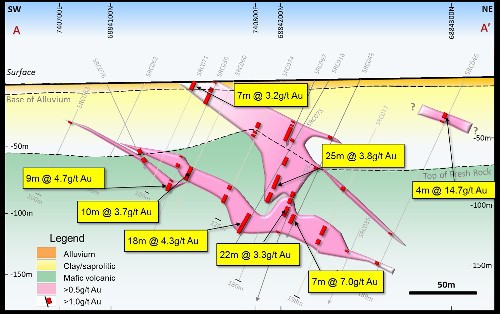
Early results from RC and AC drilling conducted at the Vanguard and Indomitable targets demonstrated the Vanguard system contains many high-grade mineralised structures.

Alto’s drilling at Vanguard discovered four new high-grade mineralised structures, in addition to the previously known structure, providing further evidence the Vanguard system is robust and open.

Assay highlights from Alto’s RC drilling of the oxide zone at Vanguard included:

SRC046
8 metres at 7.8 grams per tonne from 34m;

SRC064
29m at 2.3g/t gold from 28m; and

SRC067
33m at 2.3g/t gold from 39m.

RC drill results from the primary zone at Vanguard included:

SRC075
22m at 4.2g/t gold from 88m, including 3m at 13.3g/t from 28m;

SRC016
17m at 4.5g/t gold from 122m, including 2m at 12.2g/t gold from 133m;

SRC032
22m at 3.3g/t gold from 103m, including 1m at 15g/t gold from 109m; and

SRC048
7m at 7g/t gold from 126m, including 2m at 10.8g/t gold from 128m.

“Between May and June 2018 we drilled over 12,000 metres of aircore over ten high priority prospect areas at Sandstone,” Ryan said.

“Approximately half of these holes, and half of the metres, were drilled around Vanguard and between Vanguard and Vanguard North.”

All five mineralised structures at Vanguard plunge shallowly to the northeast and remain open at depth.

The oxidation base was encountered at approximately 50m depth with mafic volcanics being the primary host rock.

A soil sampling program early this year identified a two square kilometre gold in soil anomaly connecting Vanguard and Vanguard North.

Assays of 197 of almost 400 samples from the Hancocks Mining Centre south of the Bull Oak pits defined a coherent 30 parts per billion (ppb) gold-in-soil anomaly over 9sqkm.

Assays from 28 samples out of a total of 340 samples collected near the Edale Fault returned anomalous results of over 7ppb gold in two discrete linear zones, each between 1,000m to1,500m long.

A third target, Chance, also lies on a splay of the Edale Fault.

“Our sampling program appears extensive, but we’re not blanket covering the whole belt,” Ryan said.

“We have focused on target areas of historic work that is incomplete.

“Once there, we are conducting detailed soil sampling to see if we can expand or constrain those targets for follow-up drilling.

“Although we have already completed 12,000 metres of aircore drilling this year, we have another 8,000 metres scheduled.”

More recent soil sampling over a geophysical target approximately 12km south of Sandstone has defined a plus 7ppb gold anomaly striking southeast over 1,500m.

In keeping with the history of naming prospects at Sandstone after WW1 British battleships, the target was dubbed ‘the Superb Anomaly’, possibly due to it returning a maximum value of 228ppb gold, with a further 13 samples returning over 15ppb gold.

The area hosting the Superb Anomaly was initially identified by Barry Bourne, a consultant of Terra Resources, in 2017 after processing and interpreting the detailed aeromagnetic data mentioned above that had been flown and/or compiled by Alto over the entire Sandstone project area.

Bourne described the target as, “a break in sediment/mafic stratigraphy with proximal mineralisation”.

“The Superb Anomaly lies in an area of iron rich duricrust, or laterite, so we need to determine whether the gold is representative of a primary gold source at depth, or is alluvial in nature,” Ryan explained.

“Further soil sampling will determine the extent of this gold in soil anomaly which is open to the south east.

“We have lodged a Program of Work for Aircore drilling with the Department of Mines, Industry and Safety and are awaiting approvals to enable us to start drilling.”

At the same time as the search proceeds for the new one million ounce discovery, Alto is reviewing potential for generating early cashflow from treating 100 year old battery sands from Hacks, Oroya, Havilah and Maninga Marley prospects.

Auger sampling and metallurgical test work is underway to determine the material’s viability for being incorporated into a low-cost heap leaching operation.

“There is still a lot of gold – underground – at Oroya, and we’re currently digitising the old level plans and having a look at what might be a residual Resource that we could do something with – or somebody else might want to do something with,” Ryan said.

“Hacks is another deposit mined by the old timers to the south of Sandstone that historically produced around 206,000 ounces of gold at 28 grams per tonne gold.

“In the short term we are reviewing all the existing open pits and looking at what potential may lie beneath them.

“The deposits we are looking at all have very high-grade in the primary zone.”


Alto Metals Ltd (ASX: AME)
…The Short Story

HEAD OFFICE
Suite 9
12 – 14 Thelma Street
West Perth, WA, 6005

Ph: +61 8 9381 2808

Email: admin@altometals.com.au
Web: www.altometals.com.au

DIRECTORS
Terry Streeter, Dermot Ryan, Dr Jingbin Wang, Terry Wheeler


Rox Resources Nickel Projects Take Poll Position

THE INSIDE STORY: A shopping expedition at the start of the year reinforced the quality of Rox Resources’ (ASX: RXL) portfolio of nickel projects.

Rox Resources’ financial position is one many of its junior exploration company peers would relish.

Thanks to some judicious project divestment strategies in 2017, Rox currently boasts a war chest of around $14 million in cash and receivables.

Such a strong financial position means the company can carry out extensive exploration programs while scanning the market for suitable new asset opportunities to build shareholder value.

However, kicking the tyres on a few possible project acquisitions revealed plenty about the projects it already owned outright – that they were as good, if not better than what was on offer.

“We spent a considerable amount of time looking at projects and we looked seriously at two or three projects that didn’t come up to scratch,” Rox Resources managing director Ian Mulholland told The Resources Roadhouse.

“The question we had to ask was would we spend money on that project versus spending money on what we already had, and the answer was, no.

“That’s not to say that something fantastic may not come up in the future – there’s just nothing worthwhile around at the current point in time.

“That’s why we have decided to increase our focus on our nickel projects.”

Rox Resources has two nickel sulphide projects in the Northern Goldfields region of Western Australia.

Rox discovered the Fisher East nickel province in December 2012 and has since made further open-ended nickel sulphide discoveries.

Mineral resources have been defined over the Camelwood, Cannonball and Musket deposits totalling 2 million tonnes at 2.5 percent nickel containing 50,000 tonnes of contained nickel with Indicated Resources accounting for 95 per cent of the total resource.

The company has completed a Scoping Study on this mineral resource, which concluded the project as being low technical risk and financially viable at ‘normal’ nickel prices.

Since completion of the study the ‘normal’ nickel price has enjoyed a ‘supernormal’ run from around US$4 per pound a year ago to currently hover around US$7 per pound at time of writing.

The second project is the advanced Collurabbie nickel-gold exploration project, also located Northern Goldfields and situated just 70 kilometres due east of the Fisher East project.

The Collurabbie project hosts the Olympia nickel sulphide deposit, with a JORC 2012 Inferred Mineral Resource of 573,000 tonnes at 1.6 per cent nickel, 1.2 per cent copper, 0.08 per cent cobalt, 1.5 grams per tonne palladium, 0.85g/t platinum.

The two projects offer attractive synergies as should both projects come into production, ore from Collurabbie and Fisher East could potentially be treated at the same plant.

“We are now focusing on our two nickel projects with the goal of increasing the Resource, while the nickel price is continuing to go up, to the point where we can make a decision on commencing a Pre-Feasibility Study over the next 12 to 24 months,” Mulholland said.

Rox has launched into a program of work at both projects designed to both discover new deposits and increase existing resources.

At Fisher East 2,100m of diamond drilling has been drilled to extend the Musket and Camelwood deposits by testing previously defined strong downhole EM anomalies, and at Corktree to test a very strong one-kilometre long EM conductor, detected from surface.

Additional aircore drilling at Collurabbie (5,000m) and Fisher East (1,200m) is continuing to define geochemical trends, from which the company will target deeper drilling to discover new nickel sulphide orebodies.

“We did a diamond drilling program at Fisher East during April/May this year, with the outcome of extending two of the project ore bodies by 150m in depth, but more importantly, we demonstrated that the systems continue,” Mulholland explained.

“While we are not necessarily proposing to drill those out as Resources, because they are quite deep, it does mean that once we can get into production we have an open system, at depth, which we will be able to access from underground.

“Our focus is going to be on doubling the Resource within the top 500 metres.”

Results received from this drilling were highly encouraging, including:

MFED080 at Musket
4.3 metres at 2 per cent nickel Ni from 701.7m, including 0.3m of massive sulphides grading 8.1 per cent nickel from 701.7m;

MFED076W1 at Camelwood
2.4m at 2.4 per cent nickel from 718.3m, including 0.2m of massive sulphides grading 5.2 per cent nickel from 718.9m; and

MFED081 at Camelwood
0.3m at 7.5 per cent nickel of massive sulphides from 288.8m.

The result at Musket held some significance in that it broadened the prospective area for drilling and indicated that mineralisation extends to at least 700 metres depth.

Added to this, the two drill holes at Camelwood indicated that target’s nickel sulphide system to be more extensive than currently contained in the existing resource.

“The drilling at Fisher East moved us another step closer to our continuing overall aim of making a new game changing massive nickel sulphide discovery through exploration, while we increase resources at known deposits and continue to assess development options,” Mulholland enthused.

“We now know that the nickel sulphide systems at Musket and Camelwood are extensive and offer significant potential to develop a large resource base.”

Rox firmly stamped its nickel focus by announcing its intention to spin out its Mt Fisher gold project into a newly established, 100 per cent-owned subsidiary, Helios Gold Limited via an Initial Public Offering.

The Mt Fisher gold project is located 270km north of Leonora, adjacent to the Fisher East nickel project, and contains a mineral resource of 973,000 tonnes grading 2.75g/t gold for 86,000 ounces of gold.

Ironically, Rox originally acquired the Mt Fisher tenements in 2011 for the gold potential the project area offered, however the discovery of nickel at Fisher East since that time has made it difficult for the company to give the gold assets the proper focus they merited.

“The IPO is basically a new set of funds dedicated to that project,” Mulholland said.

“It means we can use our substantial bank balance to focus on our nickel projects while we have new funds and a new team taking the gold project in a new direction.

“Trying to do both would ultimately mean that we would not give either the full attention they both deserve.”

Mulholland believes expanding the company’s nickel presence, with the commodity trending the way it currently is, is an ideal approach for it to take, especially given the quality of the projects it already has in its portfolio.

“Further expansion of our current portfolio really depends on whether we are able to locate projects that we consider good enough to spend our money on.

“Our strategy is to increase our nickel Resources to take advantage of the nickel price upswing, to get to the point where we can be making some development decisions.

“If other opportunities emerge along the way, we’ll look at them, but they are going to have to be a lot better than the projects we currently have.”


Rox Resources Limited (ASX: RXL)
…The Short Story

HEAD OFFICE
Level 1, 34 Colin Street
West Perth WA 6005

Ph: +61 8 9226 0044

Email: admin@roxresources.com.au
Web: www.roxresources.com.au

DIRECTORS
Stephen Dennis, Ian Mulholland, Brett Dickson


Draig Resources Riding in Fast Lane to Resource Estimate

THE INSIDE STORY: Draig Resources (ASX: DRG) has changed its name to Bellevue Gold Limited (ASX: BLG).

Tha change follows Draig’s early exploration success at its Bellevue gold project that has the company  to sustain and repeat its efforts.

Late last year, Draig Resources announced discovery of the Tribune Lode at the Bellevue gold project, located 400 kilometres north west of Kalgoorlie in Western Australia.

The Bellevue gold mine was once one of Australia’s highest-grade historical gold mines producing approximately 800,000 ounces of gold at 15 grams per tonne gold over 100 years before closing in 1997.

Bellevue changed hands numerous times between some of the industry’s biggest-hitting companies yet very little modern exploration was undertaken as it never fell into their collective portfolio considerations.

Thus, Draig Resources became the first company to conduct any exploration work of note on the mine and surrounding area in the last 20 years.

After confirming historical intersections at Bellevue, Draig commenced drilling on the Tribune Lode, a Bellevue parallel structure located immediately to the west of the Highway Fault and about 300m to the west to the historic Bellevue underground mine.

The move paid off immediately making a new gold discovery with the first hole of the program.

Drillhole DRRC0024 was drilled in a relatively untested area situated mostly under the Western Mineralised Corridor shallow transported sand cover, returning assays including:

7 metres at 27.4 grams per tonne gold from 92m, including 5m at 37.5g/t gold from 92m.

Step-out extensional drilling confirmed the high-grade mineralised system to be extended to the south, at depth and down plunge.

Draig followed this result up in March and May this year with further Tribune discovery results from drilling focused on preparing the estimation of a maiden Resource, infilling to a regular 80m by 40m grid pattern over the tested 550m of strike.

Additional work, including follow up DHEM target plates from the first pass exploration holes also produced highly-encouraging results.

The drilling and subsequent DHEM work demonstrated Draig was be looking in the right area by detecting several new high-grade ore shoots, all of which lifted the overall exploration potential of the strike extensions.

Results from the follow-up drilling for the first half of this year included:

DRDD020
2.5m at 29g/t gold from 147.5m and 3.8m at 5.2g/t gold from 133m;

DRDD031
9m at 5.4g/t gold, including 2m at 15.2g/t gold from 375m (The deepest hole drilled to date at Tribune Lode showing remains open);

DRDD034
7m at 7.2g/t gold, including 2m at 17.8g/t gold from 288m (the most southern hole drilled to date at Tribune lode showing remains open);

DRDD036
2.4m at 16.6g/t gold from 102m downhole;

DRDD043
4.1m at 6g/t gold from 92.5m downhole;

DRDD057
4.4m at 13.5g/t gold from 306m downhole (NEW SHOOT POSITION identified from DHEM);

DRDD050
9.5m at 5g/t gold, including 2.6m at 12.7g/t gold from 326.5m (NEW SHOOT POSITION identified from DHEM); and

DRDD038
2.3m at 8.2g/t gold from 53.7m and 0.3m at 31.8g/t gold from 64.9m and 2m at 9.3g/t gold from 92m downhole;

Further scout drilling conducted 160m to the north of the drill grid resulted in two holes intersecting Tribune style shearing and veins.

Results for these were pending at time of writing, however while the intersections didn’t demonstrate any noteworthy sulphide mineralisation, follow up DHEM indicated highly conductive plates as off hole conductors providing Draig with new shallow and high priority drill targets.

“We announced the Tribune discovery hole in December 2017 and, taking the Christmas break in to consideration, just five months later we are looking at coming out with a maiden Resource,” Draig Resources executive director Steve Parsons told The Resources Roadhouse.

“We are also very excited with our second target – the possible extension of the historic Bellevue Lode that results indicate we may have encountered already, again with our first drill hole into this new target.”

Draig completed its first deeper drill hole at the Bellvue gold mine designed to test the area known as the ‘Gap’ targeting the offset and extension of the historic high-grade Bellevue underground mine Lode position.

The results showed the drilling had encountered a new high-grade mineralised gold zone, returning assays of:

BRDD059
4.3m at 8.8g/t gold, including 3.4m at 10.4g/t gold from 576.2m; and

A secondary zone of 0.3m at 44.4g/t gold from 584.3m downhole.

Results were similar in widths and style of mineralisation to the historical Bellevue mine, which is not so surprising as existing Bellevue underground mine development is located only 190m from the mineralised drill intercept.

“The last few months have been a pretty exciting time for us, especially since the discovery of the new high-grade Tribune lode located just west of the old Bellevue gold mine,” Parsons said.

“We had spent time preparing to drill the deeper target below the Bellevue mine looking for the offset extension of that underground mine and we would have been drilling there earlier, except for the early success we had with the Tribune discovery.

“That was a most welcome distraction, however, once we finally got to drill at Bellevue, our first hole appears to have snicked, what we believe could be, the extension to the Bellevue Lode.

“The next couple of months will all be about conducting EM work and stepping out on this new lode.

“We will also be carrying out step-out drilling to the north and to the south of the Tribune discovery.”

Draig quickly commenced that step-out drill program looking to gain a deeper understanding of what it thinks could be a potentially abundant mineralised zone.

Activity on the project area is furious with diamond drilling testing the potential offset ore positions west the of the Highway Fault, and the Tribune Lode footwall potential ore positions.

On top of a recent $8 million raising to new institutional investors from Australia, Asia and North America and existing institutions and sophisticated investors, Draig has been allocated an EIS co-funding grant of $200,000 for a single drill hole to assist in this exploration.

Draig has identified the Western Corridor as a major exploration target and has deep diamond drilling planned to be followed up with DHEM to highlight potential ore positions.

Extensional diamond drilling at the Tribune lode is testing modelled DHEM conductors to the north of the existing mineralised extent as well as to the south towards Southern Belle target area.

Reverse Circulation (RC) drilling will infill the top 50m of the Tribune Lode to 40m by 20m centres ready for future economic extraction study work.

“Geological ore bodies are always more complicated than just identifying a straight line on a map,” Parsons said.

“Having said that, we hit the mineralised zone – and the exact target, our technical team had identified.

“So, if it looks like an apple and tastes like and apple it should be an apple, but we prefer to take a conservative approach and want to drill a few more holes so that we can be certain we have hit the Bellevue Lode.

“Once we have completed the extra drilling we should have a really good handle on what is going on.

“We are well on track for releasing our maiden Resource when we said we would and at this stage it is looking at being very good high-grade and, most importantly, open so we can expect to revisit that Resource in the second half of this year.”


Draig Resources Limited (ASX: DRG)
…The Short Story

HEAD OFFICE
Suite 3, Level 3
24 Outram Street
West Perth, WA, 6005

Ph: +61 8 6424 8077

Email: admin@draigresources.com
Web: www.draigresources.com

DIRECTORS
Ray Shorrocks, Steve Parsons, Guy Robertson


Musgrave Minerals Regional Drilling Extends Cue Gold Mineralisation

THE INSIDE STORY: Throughout 2017, Musgrave Minerals (ASX: MGV) maintained a steady pace of news flow as the company advanced its flagship Cue project in the Murchison district of Western Australia.

This trend continued into 2018, when in the March quarter Musgrave completed diamond drilling at the Break of Day deposit and a reverse circulation (RC) drilling program at the Louise prospect, a discovery made by the company in the previous November, located just 750 metres south of Break of Day.

The drilling was designed to identify further mineralisation with the aim of increasing the already established Break of Day and Lena gold resources of 868,000 tonnes at 7.15 grams per tonne gold for 199,000 gold and 2.68 million tonnes at 1.77g/t gold for 153,000 ounces respectively.

Gold was intersected at depth at Break of Day and confirmed the mineralisation continues and is still open below 300m.

Musgrave decided it was time to broaden its exploration horizons, and intent on confirming the upside potential within the Cue tenements it commenced a large aircore/RC drill program to test 10 new high-priority gold targets.

The targets had been defined by integrating results from regional gravity survey with existing aeromagnetic data, historical broad spaced aircore drilling and surface geochemistry.

The drilling program of approximately 110 drill holes for 12,000m used a combination of aircore drilling with RC ‘tails’ to extend drill holes into fresh rock, down dip of gold anomalism.

All 10 occur along a 20-kilometre long prospective corridor that hosts the Break of Day and Lena gold Resources.

Seven of the targets underwent historical broad-spaced aircore or rotary air blast (RAB) drilling that returned anomalous gold results, but terminated in weathered basement and did not penetrate the unweathered Archaean below, however, they remain open and untested by basement drilling.

“The drilling results we had already achieved along the Break of Day/Lena shear provided plenty of confidence as we moved in to this next phase of exploration along the corridor,” Musgrave Minerals managing director Rob Waugh told The Resources Roadhouse.

“This drilling is testing some exciting new large-scale targets in areas that have received very little previous exploration.

“We are in a very prospective greenstone belt in a well-endowed region with good infrastructure and numerous operating gold plants.

“The focus of this drilling is to discover another high-grade Great Fingal-style gold deposit.”

Just as the drill rig operators were instructed to ‘start their engines’ Musgrave announced that a nearby neighbour in gold mill owner-operator, Westgold Resources had subscribed for 48 million ordinary shares in the company through a share placement at a 15% premium of seven cents per share.

The $3.36 million investment by Westgold presented the suitor with a holding of 15 per cent (undiluted) in Musgrave and the entities have started informal discussions regarding the possible commercialisation of Musgrave’s Cue gold deposits.

Completion of the Placement took Musgrave’s bank balance up to approximately $5.5 million in cash that will complement the co-funded drilling grant of up to $150,000 the company received under the Western Australian Government’s Exploration Incentive Scheme (EIS).

“Westgold has three operating mills in the region surrounding our Cue project and is a highly regarded professional gold miner and processor,” Waugh said.

“Welcoming a company with such pedigree to our register is a positive result for us and a strong endorsement of the work we have completed to date on our projects, gold resources and upside exploration potential.

“The strong cash position will enable Musgrave to accelerate exploration while also progressing development studies on the existing Break of Day and Lena Resources.”

It didn’t take long for the first positive results to start filtering through from aircore drilling to the north of Break of Day in an area not previously drill tested.

18MORC010 intersected:
1m at 8.3 grams per tonne gold from only 4m depth.

The intersection was encountered just 200m north of the current high-grade Break of Day gold resource and is thought to be a possible extension to the Break of Day gold mineralisation.

Mineralisation is open along strike towards more than 300m of untested, at depth, potential.

Other results came from the first drill holes at the Lake Austin North target included:

18MOAC030
21m at 0.78g/t gold from 118m to end of hole, including 6m at 2.2g/t gold from 118m;

18MOAC035
24m at 0.54g/t gold from 98m, including 6m at 1.9g/t gold from 98m;

18MOAC033
54m at 0.22g/t gold from 70m; and

18MOAC032
18m at 0.20g/t gold from 94m.

These wide zones of near-surface gold mineralisation extend over one kilometre in length that Musgrave considers may be indicative of a higher-grade gold source in fresh rock.

“These initial results identified potential extension to the high-grade gold mineralisation at Break of Day and a large regolith gold halo at Lake Austin North,” Waugh said.

“Both areas are potentially significant with the Break of Day north intersection only 200 metres from the northern edge of the current high-grade gold resource and the Lake Austin North target confirming significant thicknesses of regolith gold mineralisation over a large area in a structurally favourable position and on a favourable lithological contact.”

Good news comes in threes, and Musgrave’s first drill hole into the Joshua gold target, 18MOAC056, approximately 4.7 kiloetres south of the high-grade Break of Day deposit, intersected: 6m at 3.9g/t gold from 54m down hole.

“That’s not a bad first pass result from Joshua, which we will follow up with additional drilling,” Waugh said.

“The target is open for more than 200 metres, both north and south and is, again, on the same mineralised trend as Break of Day and Lena.”

The Cue project dust had no time to settle with further results from Lake Austin North returning thick intervals of substantial gold mineralisation in regolith over two wide zones (A Zone and B Zone).

The A Zone sits on a highly prospective sheared granodiorite-mafic contact in similar geological setting to that seen at the Granny Smith gold deposit in the Eastern Yilgarn of Western Australia.

Two parallel, mineralised gold targets returned multiple thick gold intersections including:

18MOAC075
13m at 4.3g/t gold from 120m, including 7m at 7.1g/t gold from 126m to end of hole;

18MOAC077
42m at 1g/t gold from 112m to end of hole, including, 18m at 1.9g/t gold from 130m;

18MOAC072
33m at 1.2g/t gold from 116m to end of hole, including 12m at 2.6g/t gold from 134m;

18MOAC074
60m at 0.67g/t gold from 90m, including 18m at 1.6g/t gold from 126m; and

18MOAC076
42m at 0.59g/t gold from 90m, including 6m at 2.1g/t gold from 120m.

“We could not have asked for a better start to our regional drilling program than identifying new gold mineralisation at Joshua, Lena North, Break of Day North and Lake Austin North,” Waugh said.

“It has highlighted the Cue project’s potential to host further gold deposits within this very prospective and well-endowed region with good infrastructure and numerous operating gold plants.

“It’s go, go, go, and we’re eagerly looking forward to a transformational year ahead.”


Musgrave Minerals Ltd (ASX: MGV)
…The Short Story

HEAD OFFICE
Ground Floor
5 Ord Street
West Perth WA 6005

Ph: +61 8 9324 1061

Email: info@musgraveminerals.com.au
Website: www.mugraveminerals.com.au

DIRECTORS
Graham Ascough, Rob Waugh, Kelly Ross, John Percival


Middle Island Resources has Sandstone Ore Sorted

THE INSIDE STORY: A new approach opened the potential of the Two Mile Hill tonalite deeps deposit within Middle Island Resources’ (ASX: MDI) 100 per cent-owned Sandstone gold project.

Middle Island Resources has been tracking the extension and enhancement of the proposed gold production profile at the Sandstone project with the aim of recommissioning its on-site 600,000 tonnes per annum processing plant.

The Two Mile Hill tonalite deeps deposit is located just four kilometres north of the company’s 100 per cent-owned Sandstone gold processing plant and presently comprises an Exploration Target of 24 million tonnes to 34 million tonnes at 1.1 grams per tonne to 1.4 grams per tonne gold for 0.9 million to 1.5 million ounces of gold.

Middle Island Resources has determined the deposit’s amenability to pre-concentration of gold mineralisation via an ore sorting study.

The initial study findings increase the mill feed grade, at the same time reducing the haulage and milling costs, and, importantly, the quantum of mill feed to a level compatible with the existing processing plant’s capacity.

Middle Island Resources initiated the ore sorting study in October last year after receiving encouraging results from a mineralogical assessment of material sourced from the Two Mile Hill deeps deposit.

The aims of the initial testwork, which involved the assaying of a series of hand-sorted composites of quartz vein material and un-veined tonalite, were designed to determine the relative disposition of gold within the deposit.

The mineralogical assessment suggested that over 99 per cent of the gold is hosted within the quartz veins.

Buoyed by these results, Middle Island embarked on an initial ore sorting trial, which demonstrated that ore sorting could deliver a 185 per cent to 257 per cent increase in grade.

“We have identified that 99.6 per cent of the gold occurs in the quartz veins, it is commonly coarse, and certainly free gold,” Middle Island Resources managing director Rick Yeates told The Resources Roadhouse.

“Some 60 per cent of the gold is recoverable in a gravity circuit and, at a relatively coarse grind size of 106 microns, we are getting 93 to 97 per cent leach recoveries after gravity concentration.

“The leach kinetics are also good, with about 90 per cent leach recovery in the first two hours, with low reagent consumptions and no deleterious elements.

“The recognition that 99.6 per cent of the gold occurs in the quartz veins led us to the concept of ore sorting and we have been investigating this opportunity for the past eight to nine months.

“The indicative trials we completed early this year identified that XRT and Colour sensors provide the best results, with gold recoveries over 93 per cent delivered into some 36 per cent of the mass.

“This results in a significant increase in mill feed grade and, very importantly, a significant reduction in the quantum of mill feed, potentially compatible with our existing processing plant.”

Riding the success of the initial ore sorting program, Middle Island drilled a large diameter diamond core hole, MSDD261, from surface to a depth of 284.5m to provide sufficient material for a second, more definitive ore sorting campaign.

50-gram fire assays of 1m quarter core intervals from MSDD261 returned a best intercept of 100 metres at 2.02 grams per tonne gold from 55m downhole depth, including 7m at 18.1g/t gold from 121m depth.

This intercept in MSDD261 is entirely consistent with previous diamond drilling at Two Mile Hill, variously including intersections of:

508.3m at 1.38g/t gold;
372.7m at 1.52g/t gold;
230.4m at 1.62g/t gold;
353.3m at 1.04g/t gold;
141m at 2.3g/t gold; and
156.3m at 1.14g/t gold.

“One of the characteristics of the deposit, particularly important for its amenability to ore sorting, is the highly consistent nature of the mineralisation,” Yeates said.

“They are certainly very substantial intercepts and demonstrate that the deposit is persistently mineralised.”

Drilling carried out to date at the Two Mile Hill deeps deposit has confirmed the presence of a substantial and ubiquitously mineralised system which, at surface, measures 250m in strike, up to 90m in width and is mineralised to at least 700m depth and remains open beneath this level.


Middle Island believes this latest, 100m at 2.02g/t gold intercept, combined with encouraging results derived from previous diamond drilling, metallurgical testwork, mineralogical studies and ore sorting trials, presents the potential for underground mining beneath the proposed open-pit cutback at Two Mile Hill.

“Sub-level caving is certainly the preferred mining option being assessed at this stage,” Yeates said.

“There is no question that ore sorting will be key to the project economics.

“The fall-back position for us is a more selective, open stoping, mining approach, and we have identified multiple higher-grade, sub-horizontal zones within the known 700 metre vertical extent of mineralised tonalite, on which we could focus to achieve that outcome.”

At the time of writing, more definitive ore sorting trials on bulk composites from diamond hole MSDD261 were complete, however the results of 2kg bottle roll assays of the various product fractions generated by the main trials were still pending.

These more definitive ore sorting trials include iterations around crush size and grade range, designed to refine the original ore sorting results.

The company has also recently completed Stage 1 resource definition diamond drilling, designed to bring the upper half of the Two Mile Hill tonalite deeps Exploration Target (from 140m depth, which is the base of the quantified mineralisation for the open pit, and approximately 420m depth) into at least an Inferred Resource category.

Logged vein densities and alteration intensities observed in diamond core are entirely consistent with previous diamond drilling, and multiple instances of course, visible gold have been identified.

Middle Island is confident of a successful outcome for the current, more definitive, ore sorting trials.

So much so, it is already planning to progress Stage II infill drilling, designed to bring the upper half of the deposit into the Indicated Resource category, prior to a more comprehensive economic assessment of its underground mining options.

Each drilling stage is also designed to maximise the number of possible intersections on the upper and middle banded iron formations (BIFs) that are intruded by the Two Mile Hill tonalite plug, to target additional high-grade gold mineralisation within the BIF units, peripheral to the tonalite contact.

While several such BIF intercepts have been recorded around the tonalite contacts to date, only one of these has been quantified as a Mineral Resource.

“The tonalite intrudes three BIF units,” Yeates explained.

“Immediately adjacent to the tonalite we see selective massive to semi-massive pyrite replacement of magnetite within the BIFs, with which the very high-grade intercepts are associated.

“These mineralised lenses are relatively small, so in the grand scheme of things they are not hugely material, but they are very nice sweeteners.

“We have only quantified one of these lenses to date, as a dense drilling pattern is required and can be expensive, but we have identified multiple ore positions that are marginal to the tonalite on the upper two of the three BIF units – we haven’t drilled the lower BIF at all.”


Middle Island Resources Limited (ASX: MDI)
…The Short Story

HEAD OFFICE
Suite 1
2 Richardson Street
West Perth WA 6005

Ph: +61 8 9322 1430

Email: info@middleisland.com.au
Website: www.middleisland.com.au

DIRECTORS
Peter Thomas, Rick Yeates, Beau Nicholls