Sheffield uncovers new Mineral Sands discovery

THE DRILL SERGEANT: Mineral Sands explorer Sheffield Resources has claimed discovery of a new Heavy Mineral Sands deposit after receiving the first results of a 2012 drilling campaign at the company’s Eneabba project in the Mid-West region of Western Australia.

The discovery was made at the Durack prospect which is located 20 kilometres south of the Yandanooka deposit, which boasts a 71.75 million tonnes at 2.6 per cent Heavy Minerals (HM) combined Indicated and Inferred Resource.

Location of Durack prospect within the Eneabba project. Source: Company announcement

Sheffield had a Scoping Study conducted at Eneabba earlier this year, which identified near-surface deposits, such as this recent discovery at Durack, as having the potential to improve the Eneabba project economics.

The drilling program at Durack returned results including:

– 13.5 metres at 3.66 per cent HM from 0 metres;

– 13.5m at 3.44 per cent HM from 0m, including 9m at 4.56 per cent HM from 0m;

– 10.5m at 4.28 per cent HM from 0m, including 6m at 6.24 per cent HM from 0m; and

– 12.0m at 3.69 per cent HM from 0m.

“This is a terrific start to our 2012 drilling campaign,” Sheffield Resources managing director Bruce McQuitty said in the company’s announcement to the Australian Securities Exchange.

“Sheffield continues to deliver on its strategy of targeting HMS deposits which have minimal overburden and which present as clear exploration and development opportunities.

“Durack has all the attributes of our nearby Yandanooka deposit which contains significant zircon and rutile, has little overburden and contains a core of high grade heavy mineral.
“Most importantly, the discovery at Durack is expected to make the project economics of the current Prefeasibility Study even more attractive than the robust results demonstrated by our recently completed Scoping Study.”

Royal releases Ironback maiden

THE DRILL SERGEANT: Royal Resources has announced a maiden JORC-compliant Inferred Resource at the Ironback Hill prospect, situated within the Pualco project, which is part of the company’s Razorback iron ore project north of Adelaide in South Australia.

The new Resource at Ironback stands at 677 Million tonnes at 23.6 per cent iron.

The result has increased the total Resource inventory for the Razorback project to 1,246 million tonnes at 24.4 per cent iron.


Razorback Iron Project and prospect locations. Source: Company announcement


“The maiden resource at Ironback Hill has realised Royal’s strategic plan to define two standalone magnetite deposits,” Royal Resources managing director Marcus Flis said in the company’s announcement to the Australian Securities Exchange.

“Resource definition drilling is now completed and a final global resource will be estimated once all assay results are in.

“We will then be moving on to project development as soon as a suitable partner is found.”

According to Royal Resources the maiden Inferred Resource at the Ironback Hill prospect Resource represents a drilled area of approximately nine kilometres strike length of the Braemar Iron Formation.

The Resource was calculated from 37 drill holes from a total of 61 by the company as part of resource definition it is carrying out at Ironback Hill and anticipates completing by the end of second quarter 2012.

Already completed deeper diamond drilling is still to be added into the resource estimate that Royal expects will provide substantially more tonnage.

The company is also conducting Davis Tube Recovery work in order to determine magnetite recovery with initial results producing concentrates of up to 70.85 per cent iron.

Avalon receives first results from Swedish drilling

THE DRILL SERGEANT: Avalon Minerals has received assay results for the first hole of a four-hole drill program the company is currently conducting at its Viscaria project in northern Sweden.

The drilling returned an intersection of:

–    18.6 metres at 1 per cent copper from 450.4 metres (down hole intersection), including 7.8 metres at 1.9 per cent copper from 453.2 metres.

The company said the intersection has confirmed potential to increase its copper Mineral Resources on the Viscaria project.

“This intersection shows that the high-grade copper mineralisation which occurs within the AZone Mineral Resource extends at depth, which will allow Avalon to increase the company’s copper Mineral Resources on the Viscaria project,” Avalon Minerals managing director Jeremy Read said in the company’s announcement to the Australian Securities Exchange.

“The intersection of 18.6 metres of copper mineralisation in the first completed hole is a very positive step.

“It provides us with valuable information to allow us to plan for a much larger drill program later in the year, the goal of which will be to significantly increase our high-grade copper Mineral Resources.”


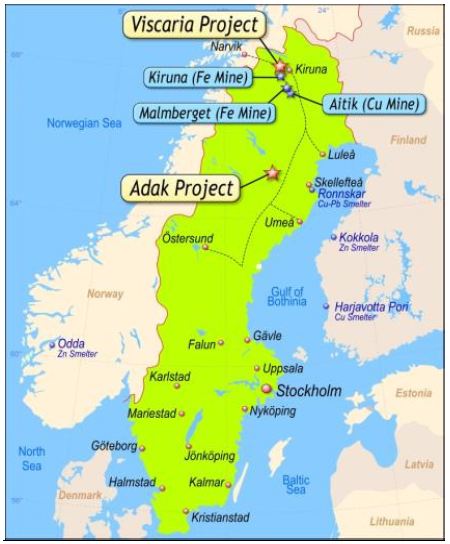
Project location. Source: Company announcement

The four hole drill program is estimated to total 2,000m of diamond drilling, which is being divided between drilling at the southern section of A-Zone, targeting the plunging high copper shoots 600m below the surface and stepping out over 50m beneath the high grade shoots of D-Zone, at the 200 to 300m depth interval.

The drill program is being undertaken by two drill rigs and is expected to be completed in late May.

Mutiny hits gold intersections up to 57.1g/t gold at Deflector

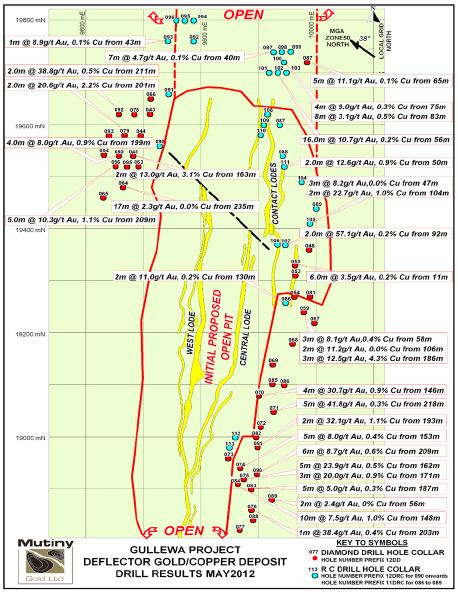
THE DRILL SERGEANT: Gold-copper resources company Mutiny Gold has received a swathe of high-grade gold intersections from drilling being conducted at both the West and Central Lodes of the company’s Deflector gold deposit in Western Australia.
 
Mutiny had designed the 15,000 metre program to target strike extensions in the Northern zone of the Deflector deposit and at depth and along strike at the Central and Contact lodes.

The program was also designed to provide further infill drilling to improve the quality of the Mineral Resources, both for the current feasibility studies the company currently has underway and for future expansion phases.

The company said the results have extended mineralisation at depth and along strike and will be incorporated into the revised resource estimation, which it has scheduled to be released in the third quarter 2012.

Mutiny also said it considers the results have strengthened its confidence in the overall prospectivity of the Blue Beard corridor, in which the Deflector deposit is hosted, showing the potential for high grade, wide zones of mineralisation.

“The consistent discovery of high-grade gold and copper mineralisation through drilling continues to increase our confidence in the robust nature of the Deflector deposit,” Mutiny Gold managing director John Greeve, said in the company’s announcement to the Australian Securities Exchange.

“We look forward to releasing a new resource model and hence a new Life of Mine production profile in the near term.

“There is excitement in the team about the strength of mineralisation in this orebody and the widths that we are intersecting at depth as well.

The distribution of the gold ounces-plus results across the entire length of Deflector shows that we really have one of the best undeveloped orebodies in Australia.”

Results include:

– 2 metres at 57.1 grams per tonne gold and 0.2 per cent copper from 92 metres;

– 5m at 41.8g/t gold and 0.3 per cent copper from 218m;

– 4m at 30.7g/t gold and 0.9 per cent copper from 146m; and

– 5m at 23.9g/t gold and 0.5 per cent copper from 162m.


Source: Company announcement


Mutiny Gold said the repetition of mineralised intersections in some of the holes it has drilled had delineated a number of parallel lodes present at depth within the deposit.

The intersection of wide zones of mineralisation in the pre-collar of one of the holes (3m at 12.5g/t gold and 4.3 per cent copper from 186m and 2m at 11.2g/t gold and 0.0 per cent copper from 106m) at shallow depths is adding tonnes to the open pit and widening the overall optimised shell.

According to the company this will provide flexibility in the mining sequence and add substantial tonnes per vertical metre to the deposit.

Convergent hits high-grade gold at Blue Vein

THE DRILL SERGEANT: Convergent Minerals received encouraging results from commenced drilling beneath the Blue Vein open cut mine at the company’s Mt Holland Goldfield, located approximately 100 kilometres south of the town of Southern Cross in Western Australia.

Recent drilling has intersected very high grade gold over substantial widths, which the company said is the best drilling result since drilling commenced in February 2012.


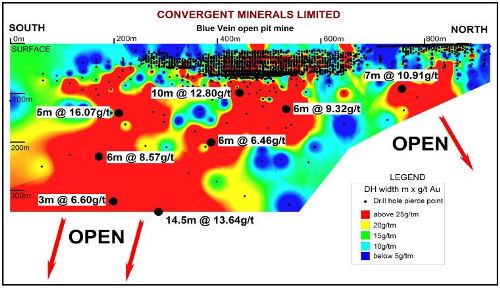
A long projection of Blue Vein. Source: Company announcement

The first diamond drill hole at Blue Vein has returned assay results including:

–    0.7 metres at 231 grams per tonne gold.

This interval appeared within a continuously-mineralised broader envelope of 4.90m at 37.82g/t gold, which occured within an even wider zone of 14.5m averaging 13.64g/t gold.

Convergent said the 14.5m of high-grade gold mineralisation starts at 426.93m down hole depth, which is 350m vertically below surface.

“The results obtained from this diamond hole demonstrate the continuing strength of the gold mineralisation at depth,” Convergent Minerals chief executive officer David Price said in the company’s announcement to the Australian Securities Exchange.

“The width of the main gold lode is above 10m true width as we progress deeper.

“The company is delighted with this result and management has decided to initiate a Resource Definition drilling program at Blue Vein.”

Convergent said its geological team is building each result into the existing geological model to work towards a re-estimation of the mineral resource at Blue Vein.

“The commencement of a Resource Definition drilling program is aimed at achieving a Measured + Indicated + Inferred resource at Blue Vein as quickly as possible,” Price said.

The Mt Holland Goldfield comprises 10 open cut gold mines where Convergent is aiming to define high-grade gold beneath the open cut mines, with a view to mining from in-pit decline underground access.

The company’s Mt Holland Goldfield includes a tenement package of 42.06 square kilometres and is focused around the old Bounty gold mine, which produced more than 1.3 million ounces of gold over a 12-year period between 1989 and 2001.

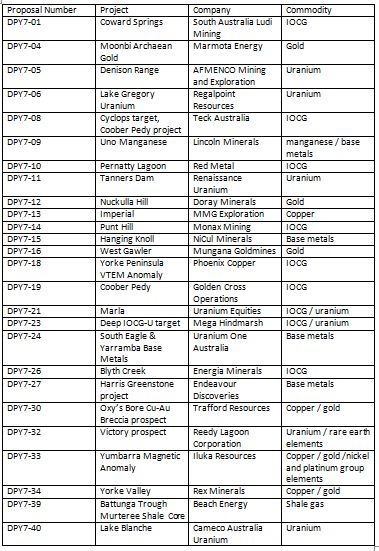
South australia awards 2012 PACE funding

THE DRILL SERGEANT: The South Australian Department for Manufacturing, Innovation, Trade, Resources and Energy (DMITRE) has completed its allocation for its PACE 2020 initiative that funds co-operative exploration drilling programs with companies undertaking resources exploration within the state.

PACE Discovery Drilling is partnership with industry to undertake drilling in areas determined by DMITRE to have economic mineral potential, but may be hampered by factors that discourage investment.

PACE Discovery Drilling 2012 aims to fund high quality, technically and economically sound projects that promote greenfields exploration targets.

Successful proposals are assessed as those containing the highest quality exploration targets based on sound technical, scientific and commercial criteria.

The successful applicants have approximately one year to complete their programs and submit reports and drilling samples.

Source:South Australian Department for Manufacturing, Innovation, Trade, Resources and Energy

Doray Minerals received funding to drill test a number of prospective targets within the company’s 100 per cent-owned Nuckulla Hill gold project.

According to the company the Nuckulla Hill gold project contains approximately 100 kilometres of strike of the mineralised Yarlbrinda Shear Zone, immediately south of the Tunkillia gold – silver deposit, along with a series of prospects identified by previous explorers during the 1990’s.

Previous work has been limited and there has been no systematic gold exploration on the project since 1997.

Historical drilling at the Sheoak and Bimba prospects resulted in a number of bedrock gold intersections similar in grade and thickness to that seen during initial exploration at Tunkillia, including:

Sheoak

8 metres at 1.00 grams per tonne gold and 22 metres at 1.08 grams per tonne gold;

34m at 0.42g/t gold, including 2m at 2.08g/t gold and 6m at 0.95g/t gold; and

24m at 0.40g/t gold.

Bimba

28m at 0.65g/t gold, including 8m at 1.25g/t gold;

36m at 0.4g/t gold, including 4m at 1.4g/t gold; and

24m at 1.14g/t gold, including 8m at 1.97g/t gold and 2m at 0.96g/t gold and 6m at 1.08g/t gold.

Doray said it plans to use the PACE funding of up to $70,000 to test for depth extensions at the Bimba prospect and a new structural target north of Bimba, identified by a recently completed detailed aeromagnetic survey.

Golden Cross Resources reviewed geophysical data in 2011 to identify six targets with similar characteristics to known IOCG prospects and deposits elsewhere in the Gawler Craton.

The company has identified a further fourteen targets in 2012.
 
Golden Cross has had funding of $75,000 approved towards the drilling costs of the 2011 targets.

Marmota Energy received the PACE nod to the tune of $65,000 for drilling of copper-gold targets at the company’s Indooroopilly project.

The project is located west of Kingsgate’s Challenger gold mine, which produces 100,000 ounces of gold per annum.

Marmota said a number of ready to drill targets have been identified on the project with strong coincident geochemical and geophysical anomalism particularly for copper and gold.

The Moonbi target has been identified as the highest priority target.

Ventnor embarks on DHEM survey at Thaduna

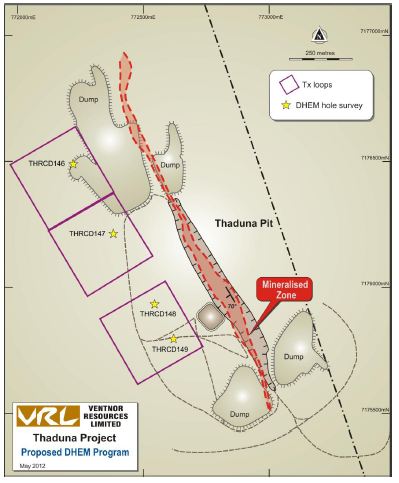
THE DRILL SERGEANT: Ventnor Resources has flagged its intention to undertake Down Hole Electromagnetic, DHEM surveys at the company’s Thaduna Green Dragon project located north of Meekatharra in Western Australia.

Ventnor recently completed four deep RC pre-collared Diamond drill holes at Thaduna for 1,772 metres of drilling.

The holes were collared over a strike length of 800 metres with a planned intersection depth of 280 – 300 metres vertically below the surface and 80 – 100 metres below the prior deepest intersections.

Ventnor had undertaken the drilling to test depth potential below the stronger zones beneath the existing Thaduna pit.


Proposed DHEM holes and Tx loops at Thaduna. Source: Company announcement


The company said it considered the mineralisation it has encountered while drilling justifies the use of an advanced in-hole geophysical technique such as Down Hole EM to project the known mineralisation to target additional drilling.

The survey will also include an existing hole at Green Dragon as well as an additional hole on the western side of the Green Dragon pit which is currently being drilled.

 “From the mineralisation we have seen in the recently drilled diamond core, we are encouraged to survey these holes with DHEM,” Ventnor Resources managing director Bruce Maluish said in the company’s announcement to the Australian Securities Exchange.

“This technique can target the search for deeper mineralisation below our current drill depth of 300 metres below the surface.”

Drilling completed so far by Ventnor has intersected mineralised structures at a vertical depth of 300 metres at Thaduna and 200 metres at Green Dragon.

The company said it expects the DHEM program will map the conductive mineralised structure in excess of 100m away from known mineralisation.

If successful, follow up drilling will be proposed to increase the known strike length and depth of the mineralisation.

The Thaduna Green Dragon project is situated in the Doolgunna district of WA 40km east of the DeGrussa project of Sandfire Resources.

Alara confirms Khnaiguiyah mineralisation

THE DRILL SERGEANT: Alara Resources has reported results from an ongoing drilling program at the company’s Khnaiguiyah zinc copper project in Saudi Arabia.

Alara said the latest results confirm the presence of additional mineralisation to the maiden Khnaiguiyah JORC Resource the company announced in February 2012 of:

–    26.4 million tonnes at 3.9 per cent zinc and 0.12 per cent copper (4.3 per cent zinc equivalent); and

–    7Mt at 8 per cent copper.

Alara said the latest results were from drilling it had conducted outside the previously defined JORC Resource area and confirm additional mineralisation in Zone 1 and Zone 2 (North extension).

The company also released results from 4 holes carried out within its Zone 3 area, which are previously drilled geotechnical holes for which analysis was carried out after completion of a related geotechnical study.

Results from all drilling included:

ZONE 1:

–    6.8 metres at 6.02 per cent zinc, 0.49 per cent copper from 24 to 30.8 metres;

–    3m at 7.51 per cent zinc, 0.95 per cent copper from 63 to 66m; and

–    8.55m at 10.91 per cent zinc, 0.19 per cent copper from 25.45 to 34m, including 2.55m at 21.80 per cent zinc, 0.34 per cent copper and 5.1m at 10.97 per cent zinc, 0.21 per cent copper from 42 to 47.1m, including 1m at 31.56 per cent zinc, 0.70 per cent copper from 25.45 to 28m.


ZONE 2:

–    5.2m at 7.15 per cent zinc, 0.14 per cent copper from 80.8 to 86m;

–    5m at 8.40 per cent zinc, 0.38 per cent copper from 157 to 162m;

–    11m at 6.42 per cent zinc, 0.12 per cent copper from 177 to 188m; and

–    10m at 10.90 per cent zinc, 0.31 per cent copper from 91 to 101m:


ZONE 2 (Copper Rich Zone):

–    4m at 1.09 per cent copper from 164 to 168m; and

–    9.6m at 1.47 per cent copper from 193.4 to 203m.

ZONE 3:

–    4m at 11.02 per cent zinc, 0.07 per cent copper from 78 to 82m;

–    22.1m at 6.87 per cent zinc, 0.14 per cent copper from 187 to 209.1m and 7m at 6.69 per cent zinc, 0.65 per cent copper from 214 to 221m; and

–    11m at 5.62 per cent zinc, 0.22 per cent copper from 20 to 31m.

Alara said the results from Zone 1 continue to confirm mineralisation at shallow depths and similar in grade as that found in Zones 2 and 3.

“These latest results confirm the presence of additional mineralisation within Zones 1 to 3 and give us further confidence surrounding the feasibility and scale of the Khnaiguiyah zinc copper project,” Alara Resources managing director Shanker Madan said in the company’s announcement to the Australian Securities Exchange.

“The Khnaiguiyah Definitive Feasibility Study (DFS) is nearing completion and is expected to be finalised by the end of June 2012.

“Once the DFS is complete, Alara will move to the design and construction phase of the Khnaiguiyah project.”

Alara is continuing infill and step-out drilling to extend mineralisation in Zone 1 and Zone 2 with a view to identifying additional mineralisation prior to the completion of the Khnaiguiyah DFS in Q2 2012.

Octagonal completes Inferred estimate at Specimen Reef

THE DRILL SERGEANT: Octagonal Resources has estimated an inaugural near-surface Inferred Mineral Resource at the Specimen Reef located near Dunolly in Central Victoria.

The Inferred Resource has come in at 114,000 tonnes grading 2.9 grams per tonne gold for 10,480 ounces of gold.

The estimation follows two phases of reverse circulation drilling, totalling 47 holes for 2,650 metres that were recently completed at the Specimen Reef.


Reverse circulation drilling at Specimen Reef. Source: Company announcement

“This Mineral Resource estimate has been calculated within 10 months of the discovery of the deposit in July 2011 and was produced to allow for the application of a mining licence,” Octagonal Resources said in its ASX announcement.

“The resource has been calculated over 440 metres strike length and to 60 vertical metres depth.”

Octagonal said substantial scope exists at Specimen Reef for it to increase the size of the resource with additional drilling as gold mineralisation remains unconstrained by drilling along strike to the north, south, and down plunge.

The company indicated it intends to complete further drilling at the Specimen Reef during the second half of 2012 while it awaits the approval of a mining licence application.

“This drilling will focus on identifying near-surface gold mineralisation that can be exploited using open pit mining techniques and transported to Maldon for processing at the company’s Porcupine Flat gold processing facility,” Octagonal said.

“Significantly, the volume of ore already defined at Specimen Reef, if economically viable to mine, represents over nine months full-time feed for the Porcupine Flat gold processing facility and would supplement ore produced from the Union Hill mine at Maldon that is currently being developed to access the Alliance South deposit.”

Centaurus logs further strong drilling results at Jambreiro

THE DRILL SERGEANT: Centaurus Metals has received encouraging results from the final batch of assays from a recently completed RC in-fill drilling campaign at the company’s Jambreiro iron ore project in Brazil.

Centaurus said the results support the quality and consistency of mineralisation at the project to underpin an imminent JORC Resource upgrade.

According to the company’s managing director Darren Gordon the latest results demonstrate the consistency of widths and grade of mineralisation at Jambreiro, underpinning a solid resource inventory to support the project’s development.

“It’s great to see all the final assays delivered in a timely fashion so that the resource upgrade work can be completed before the end of May,” Gordon said in the company’s announcement to the Australian Securities Exchange.

“We have now completed over 14,000 metres of drilling at Jambreiro which provides great confidence in the Resource base as a platform for completion of the Bankable Feasibility Study.”


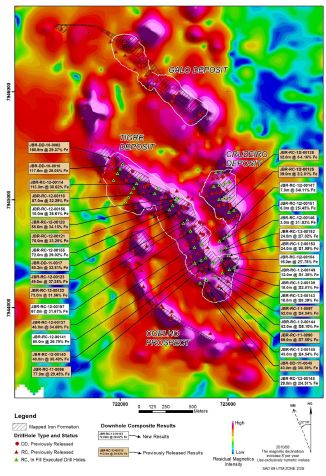
Jambreiro prospect map with recent results. Source: Company announcement


Highlights of the recent results from the Jambreiro project include the following continuous intervals:

–    62.0 metres at 31.8 per cent iron, 3.4 per cent aluminium oxide and 0.03 per cent phosphorous from 37.0 metres;

–    45.0m at 29.4 per cent iron, 3.4 per cent aluminium oxide and 0.04 per cent phosphorous from 83.0m;

–    26.0m at 28.5 per cent iron, 3.5 per cent aluminium oxide and 0.04 per cent phosphorous from 43.0m;

–    24.0m at 47.1 per cent iron, 2.5 per cent aluminium oxide and 0.03 per cent phosphorous from surface; and

–    24.0m at 32.0 per cent iron, 2.6 per cent aluminium oxide and 0.04 per cent phosphorous from 19.0m.

The company said the in-fill drilling program has strengthened its confidence in the resource inventory at Jambreiro and will lead to an upgrade of the resource (mainly in JORC classification) by the end of May.

This new resource will form the basis of the ongoing BFS and marks another milestone on the company’s journey to production, which it anticipates to occur before the end of 2013.