Integra continues good run at Imperial

THE DRILL SERGEANT: Integra Mining has received the latest results from an ongoing RC drilling program at the recently-discovered Imperial prospect, situated in the Majestic area, which is part of the company’s Randalls gold project.

The RC drilling is being conducted to test the continuity and extent of high-grade gold and copper mineralisation at Imperial.

Latest results include:

–    5 metres at 43.9 grams per tonne gold and 4.50 per cent copper, including 1 metre at 91.31 grams per tonne gold and 4.41 per cent copper;

–    6m at 10.28g/t gold and 1.13 per cent copper, including 1m at 24.59g/t gold and 2.08 per cent copper and 1m at 24.47 g/t gold and 3.13 per cent copper;

–    11m at 3.90g/t gold and 0.09 per cent copper, including 1m at 9.89g/t gold and 0.11 per cent copper; and

–    3m at 5.07g/t gold and 1.31 per cent copper.
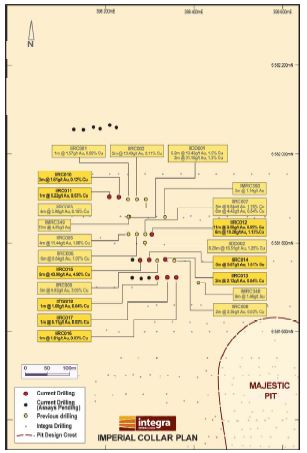
 

Imperial drill collar location plan with Majestic open pit outline. Source: Company announcement

The Imperial prospect is located approximately 500 metres northwest of the company’s Majestic gold deposit and is part of the Monger Joint Venture between Integra (85 per cent) and Newcrest Operations (15 per cent).

The recent results together with the previously reported results from drilling programs completed at Imperial in late 2011 and early 2012 indicate that the mineralisation continues for at least 190 metres strike and remains open to the north, south and down dip.

Assay results for a further 10 RC holes drilled at Imperial during the current campaign are pending, including an RC hole drilled 16 metres to the west of a previous hole that returned 5 metres at 43.9g/t gold and 4.50 per cent copper, where visual observations suggest a down-dip continuation of the mineralised zone.
Phoenix hits copper sulphides at Burra North

THE DRILL SERGEANT: Phoenix Copper has received results from a recently-drilled diamond drill hole at Burra North, situated within the company’s Burra Tenement that it claims confirm earlier reports of visual identification of disseminated copper sulphides.

Phoenix’s maiden drill program at Burra North contained five diamond holes for a total of 694.6 metres, 800m to the north-west of the historic Monster Mine on the outskirts of Burra.


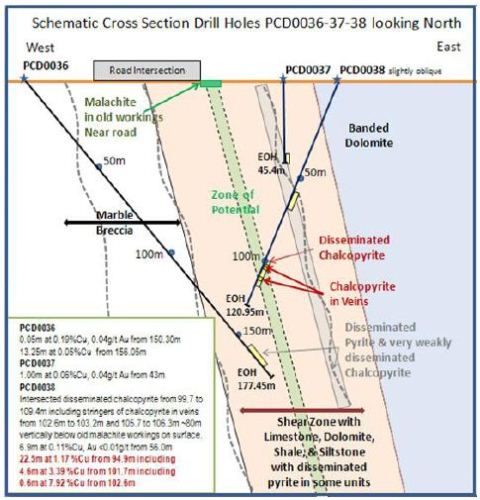
Drill hole schematic Burra North. Source: Company announcement


The company’s focus for the exploration program was to identify repetitions of the Monster Mine copper lode beyond the Reserve where mining is currently prohibited.

“Despite mining operations spanning approximately 150 years, the Burra North area remains a largely unexplored copper field that, until recent work by Phoenix Copper, had not been subjected to regional scale exploration utilising modern technology and techniques and had remained undrilled,” Phoenix Copper said in its ASX announcement.

“The excellent assay results from (drllhole) PCD0038 highlight the prospectivity for copper deposits in and around the Burra region, and provide a focal point for further exploration throughout the Adelaide Geosyncline.”

Results from drillhole PCD0038 include:

–    22.5 metres at 1.17 per cent copper from 94.9 metres including;

–    4.6m at 3.39 per cent copper from 102.6m including;

–    0.6m at 7.92 per cent copper from 102.6m.

Phoenix Copper believes the intersection of copper mineralisation in drillhole PCD0038 indicates the mineralising system responsible for the ore deposition in the Monster Mine extends from the pit edge for at least 900m to the northwest.

“This shallow, (vertical depth to the start of mineralisation is approximately 80m), sulphide rich Burra North intersection is close to known mineralisation in the Monster Mine and within the Kingston and Tinline faults, indicating continuity with the Monster Mine sequence,” the company said.

“If an economic discovery were to follow in this area, it would be in close proximity to infrastructure at Burra.”

Phoenix intends to commence a follow up program of eight reverse circulation (RC) holes in the area immediately surrounding PCD0038 subject to the required approvals and notifications being in place.

The drilling will test the potential extension of these significant intercepts to the North and South as well as at depth and is anticipated to commence prior to the end of this quarter.

Blackham extends M10 at Matilda

THE DRILL SERGEANT: Blackham Resources has received results from recent drilling carried out at the Matilda gold project, which the company said has identified further extensions to the M10 deposit.

The Matilda project is located approximately 19 kilometres south of the township of Wiluna in Western Australia within the company’s 100 per cent-controlled granted mining license.

Blackham completed 17 Reverse Circulation (RC) drill holes totalling 1,916 metres during April in a program designed to test for extensions of mineralisation both up- and down-plunge at the M10, M6 and M3 deposits at Matilda.


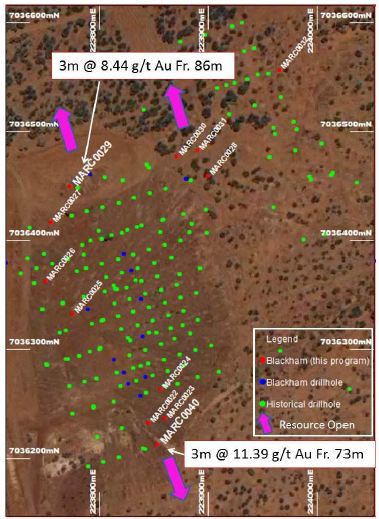
Plan view of current and historical drill hole locations at M10 and M6 deposits. Source: Company announcement


Drilling around the periphery of the M10 deposit has returned high-grade intercepts including:

–    3 metres at 11.4 grams per tonne gold from 73 metres, including 1 metre at 29.5 grams per tonne gold from 73 metres; and

–    3m at 8.44g/t gold from 86m, including 1m at 20.4g/t gold from 87m.

“These results demonstrate that mineralisation remains open to both the north and south, with both holes on the limit of drilling,” Blackham Resources said in its ASX announcement.

“Mineralisation has been intersected in new stratigraphic positions and may represent new ore shoots that will build on the existing resources at M10.

“Further, all drill holes have intersected significant mineralisation. Interpretation of the results is continuing.”

The exploration work being conducted by Blackham at Matilda is targeting extensions to previously defined deposits, which the company said are most likely to be converted to reserves in the near term.

Blackham has received assay results for the first nine holes drilled in the program with the remainder expected to follow early next month.

“Blackham management are pleased with the continuing return of positive drill results which have confirmed the potential for ore at shallow depths along trend from the known deposits at Matilda,” the company said.

MacPhersons confirms new Silver-VHMS at Nimbus

THE DRILL SERGEANT: Drilling undertaken by MacPhersons Resources on the company’s 100 per cent-owned Nimbus project, located near Kalgoorlie continues to deliver the goods with results under the East Pit and along strike of the Discovery Pit continuing to extend silver,-zinc-lead sulphide mineralisation lenses.

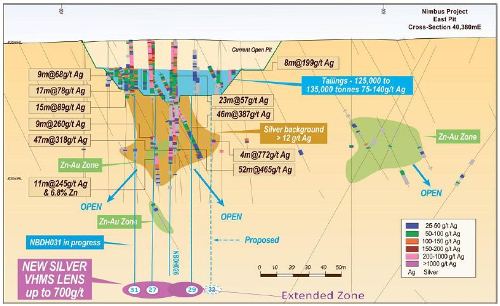
Drilling carried out to the east of the Discovery Pit returned preliminary assays extending its strike extension of VHMS zone including:

–    36.2 metres at 60 grams per tonne silver and 3.7 per cent zinc, including 6 metres at 184 grams per tonne silver and 9.1 per cent zinc; and

–    14.0m at 34g/t silver, 0.71g/t gold and 1.4 per cent zinc from 213.6m downhole depth.


New high-grade VHMS Zone under Nimbus East Pit showing silver grades. Source: Company announcement


Recent drilling of the East Pit floor has resulted in the completion of four holes with one currently underway.

All have demonstrated zones of VHMS mineralisation starting immediately in the pit floor and continuing to depths exceeding 200m below.

MacPhersons said the latest three of the completed holes have intersected a new VHMS zone from 140m to 210m downhole depth, which the company considers to indicate the presence of another stacked shoot under the East Pit.

Surface projections place the outcrop in a position with very little historical exploration, an area which the company said will be part of its focus with a new oxide silver drilling program.

MacPhersons conducted handheld XRF analyses on this zone that demonstrated sulphides to be enriched in silver-zinc-lead sulphides with grade ranges being 500 to 3600g/t silver, 6 to 32 per cent zinc and 1 to 8 per cent lead.

The company indicated that XRF analyses it has carried out on previous Nimbus massive sulphides are consistent with laboratory assays to date and that results from these drillholes are showing continuity in both sulphide mineralisation and silver-zinc-lead-gold content.

“These silver-zinc-lead mineralisation intersections extend known historical information to the east and continue to be repeated at depth (showing the zone to remain open at depth),” MacPhersons Resources said in its ASX announcement.

“These intersections are not included in the current resource classification.

“The Directors are pleased with the additional silver-rich VHMS zone and the extension of mineralisation to the south and east of the Discovery Pit and depth extensions beneath the East Pit.”

MacPhersons Resources recently released the maiden JORC-compliant mineral resource statement at the Nimbus
silver-zinc project.

Prosperity hits gold-copper-molybdenum in first hole at Pelumat South

THE DRILL SERGEANT: Prosperity Resources has completed drilling of the first hole at the South Pelumat project, situated in the company’s 80 per cent-owned BAM Joint venture area southern Aceh.

The company said it was encouraged by the results, which support the mapping and geochemistry it had undertaken in the area.

The hole returned gold-copper-molybdenum intersections including:

–    17 metres at 6.18 grams per tonne gold, including 3 metres at 13.91 grams per tonne gold and 1 metre at 60.0 grams per tonne gold from 219 metres;

–    10m at 0.97 per cent copper from 227 metres.

–    26m at 1.5g/t gold, 0.43 per cent copper, including 2m at 15.4g/t gold, 1.40 per cent copper, and 2m at 1.84g/t gold, including 1m at 2.05 per cent copper, and 1m at 2.05 per cent copper, 2m at 0.06 per cent molybdenum, an 4m at 0.06 per cent molybdenum from 254 metres; and

–    2m at 4.64g/t gold from 310 metres.

“The drill intersections achieved in our first hole at Pelumat are very exciting particularly when taken together with the encouragement we are getting from our ongoing exploration in the project area,” Prosperity Resources chairman Mo Munshi said in the company’s announcement to the Australian Securities Exchange.

“The intersections have also added significantly to our regional understanding of the controls of mineralisation in the local district and elsewhere in Aceh where we have found mineralisation and will assist with planning our drilling program regionally.”


Gold-copper intersections plotted over summary of drill hole geology. Source: Company announcement


Prosperity said the mineralisation is associated with a zone of brecciated retrograde skarn and brecciated and hydrothermally altered microdiorite and includes wide intercepts of highly gold-copper anomalous rock and local zones with significant molybdenum, which includes:

–    16.3m at 0.27g/t gold from 30.5m;

–    28.0m at 0.24g/t gold from 69.0m;

–    11.9m at 0.36 per cent copper, with 13.1m at 0.03 per cent molybdenum from 85.0m;

–    19.0m at 0.30g/t gold, 3m at 1.33 per cent copper, including 1m at 3.39 per cent copper from 178m; and

–    5.1m at 0.04 per cent molybdenum from 223.9m.

Prosperity has now commenced additional drilling to test the broad zone of what it considers to be highly-anomalous gold-copper-molybdenum values in soil and rock chip samples associated with outcropping skarns and altered microdiorite intrusives.

The company is also conducting ongoing mapping and sampling to the south where it has identified several other highly prospective targets.

Prosperity anticipates results from this new work will be released once all relevant analytical data has been received and checked and compilation is complete and been reviewed.

Hill End sees gold in first Big Nugget drill hole

THE DRILL SERGEANT: Hill End Gold has had a pleasing start to a recently-commenced drilling program at the North Big Nugget Hill and Gundowda Shear prospects situated within the company’s Hargraves project.

The drilling is being undertaken with the objective of extending the gold resource the company already has defined at Big Nugget Hill.


Drilling on site at North Big Nugget Hill prospect. Source: Company announcement


Hill End said the first drill hole of the current program in the North Big Nugget Hill prospect has intersected well-developed quartz veining over 6.4 metres from 69.9m down hole.

The company said it had been greatly encouraged to see visible gold has been observed in the core at 54.7m, 70.1m, 75.0m and 76.0m.

However, assay results are not yet available.

“Initially 1,350 metres of diamond core drilling is planned on sections spaced at approximately 50 metres to test an interpreted 400 metre northern extension of the Big Nugget Hill resource to a depth of approximately 100 metres,” Hill End Gold said in its ASX announcement.

“If initial results are encouraging, the program will be extended by a further 1,950 metres to test the prospects to a depth of 150 metres.”

Hill End has previously completed four diamond drill holes and one RC drill hole at the North Big Nugget Hill prospect with one of the diamond holes returning:

–    23.5 metres at 1.1 grams per tonne gold from 29.6 metres and 14.5 metres at 1.4 grams per tonne gold from 142.1 metres.

As part of the current program, Hill End said the adjacent Gundowda Shear prospect will be drilled near the historic Eureka Gold Mine.

The Gundowda Shear has not previously been drill tested, although nine rock chip samples of quartz veins from near the Eureka Mine returned results of up to 81.8 g/t gold.

Horseshoe commences eponymous drilling campaign

THE DRILL SERGEANT: Horseshoe Metals has commenced a diamond drilling program at the company’s 100 per cent-owned Horseshoe Lights volcanic-hosted massive sulphide (VHMS) copper gold project located in the Bryah Basin in Western Australia.

The drilling kicks off a major drilling campaign being undertaken by Horseshoe Metals over the coming months to test a variety of targets at the Horseshoe Lights project.


Project location plan. Source: Company announcement

“The diamond drilling program consists of a minimum of four deep drill holes for approximately 1,500 metres, with hole depths of up to 450 metres planned,” Horseshoe Metals said in its ASX announcement.

“Additional holes have been planned and will be drilled, subject to the results of the initial four holes and ground conditions intersected at depth.

“The additional holes may be drilled using the diamond drill rig, a Reverse Circulation Percussion drill rig or a combination of both.”

The company said its aims throughout the drilling program are to drill test a major anomaly it identified by a Dipole-Dipole Induced Polarisation survey located on Line 2 immediately south east of the existing open pit.

Horseshoe also aims to drill test a coinciding South East Shear Zone, where it said historical drilling had intersected zones of running sandy quartz hematite, which was also observed in the Main Zone during previous mining operations.

Navaho completes first Nevada drill hole

THE DRILL SERGEANT: Navaho Gold has completed drilling its first diamond drill hole at the company’s Utah Clipper project in Nevada, USA.

Navaho said the drilling encountered a strongly fractured, altered pyrite-rich dyke within a thrust zone returning results of:

–    5.9 metres at 0.12 grams per tonne gold from 1,077.5 metres (using a 0.1g/t cut off).

Navaho considered this result to be particularly significant in that the Carlin-style mineralisation associated with Nevada gold exploration is often associated with dykes of this type.


Utah Clipper project location on Cortez Trend, Nevada. Source: Company announcement

Another zone of 4.1m at 0.10g/t gold from 1,141.5m was intersected in what the company described to be strongly fractured and silicified Lower Plate rocks.

Both gold zones recorded anomalous pathfinder elements indicative of Carlin style mineralisation.

In February Navaho announced silver mineralisation had been intersected in the upper part of the hole.

It said this has now been found to extend down the entire length of the hole.

Using a 10g/t silver cut off, a further three intervals were intersected of:

–    7.6m at 14.5g/t silver from 697.4m;

–    2.7m at 15.9g/t silver from 960.1m; and

–    2.4m at 65.1g/t silver from 1,115.7m.

Navaho believes further exploration work, including a second drillhole is warranted on the property given the close proximity to world-class gold operations, a defined target with surface geochemistry potentially indicative of Carlin style mineralisation at depth and encouragement from the first hole.

Navaho Gold managing director Mark Dugmore said that although the hole was technically a difficult one to drill, it had provided the company with a good idea of the depth to the prospective Lower Plate rocks.

“This, along with the elevated levels of geochemistry (particularly silver, gold and associated pathfinder elements) gives us encouragement to review our geological interpretation of the area and, given the close proximity to Barrack’s Pipeline-Cortez operations, target a further drill hole to test one of the remaining targets,” Dugmore said in the company’s announcement to the Australian Securities Exchange.

“Consideration will be given to the use of a large capacity open-hole drilling rig for any future drilling to reduce costs and the drilling time.”

Straits hits spectacular copper intersection

THE DRILL SERGEANT: Straits Resources released a short yet fairly succinct announcement to the Australian Securities Exchange proving that in some situations words can be superfluous.

The company has received assay results from a hole recently drilled at its Avoca Tank prospect in New South Wales.

The assay results for Hole TATD017 returned:

–    84 metres at 2.86 per cent copper, 0.88 grams per tonne gold, 12 grams per tonnes silver and 0.95 per cent zinc from 395 metres downhole. (calculated using a 0.5 per cent cut-off and up to 6m internal waste).
 
This zone contained a higher grade intercept of:

–    411m to 468m: 57m at 4 per cent copper, 1.27 per cent zinc, 0.99g/t gold, 15g/t silver (0.5 per cent cut-off, max 3m internal waste)

Including:

–    423 – 440m: 17m at 5.60 per cent copper, 1.26 per cent zinc, 0.85g/t gold, 19g/t silver (5.0 per cent cut-off, max 3m internal waste); and

–    455 – 467m: 12m at 6.38 per cent copper, 1.09 per cent zinc, 1.46g/t gold, 20g/t silver (5.0 per cent cut-off, max 3m internal waste).


Long-section of the Avoca Tank prospect drilling. Source: Company announcement


The announcement of the results follows a previous release, in which the company explained it believed it had hit something big but was not yet in the position to say how big.

Hole TATD017 is the first to successfully target the main lens at depth at the Avoca Tank prospect.

“This extends the known mineralisation of the high grade lens at Avoca Tank, significantly, which now has a down plunge extent of some 400 metres,” Straits said in its earlier ASX release.

“The mineralisation remains open at depth and along strike.

“The mineralised package in TATD017 is a total of at least 60 metres wide (slightly oblique so true thickness unknown) and contains a number of high grade massive sulphide lenses containing chalcopyrite, pyrite and sphalerite.

“This latest drill hole confirms the major discovery at Avoca Tank made last year and validates that we are sitting on a major find.”

The drilling program at Avoca Tank is ongoing with Straits having a further five holes planned in the short term to test the mineralisation at depth.

South Boulder hits new potash zone in Eritrea

THE DRILL SERGEANT: Resource extension diamond drilling undertaken by Eritrea-focused potash exploration play South Boulder Mines has intersected further high-grade shallow potash situated between two existing resource zones at the company’s Colluli project.

South Boulder said the combination of the shallow nature of the additional mineralisation with its high-grade and location provides potential to boost Colluli’s economics.


The new zone of mineralisation sits between the existing Resource areas A and B. Source: Company announcement

South Boulder believes potential exists for potash to be largely continuous between the existing resources and will test that theory with ongoing drilling.

The current JORC / NI43-101-Compliant Mineral Resource Estimate at Colluli stands at 1.08 billion tonnes at 18 per cent potassium oxide for 194 million tonnes of contained potash.

This is contained within an Exploration Target of 1.25 to 1.75 billion tonnes at 18 to 20 per cent potassium oxide.

Highlights of the recent drilling include:

–    5.09 metres of high-grade sylvinite from 100.34 metres, within a total 15.86 metres potash interval;

–    6.12m of sylvinite from 68.34m, including 2.93m of high-grade sylvinite from 70.17m, within a total 16.12m potash interval;

–    2.93m of high-grade sylvinite from 88.49m in between Area A and B, within a total 13.34m potash interval; and

–    2.02m of high-grade sylvinite from 53.89m in between Area A and B, within a total 16.17m potash interval.

The company is of the opinion that the recent sylvinite drilling results demonstrate correlation with previous drilling and have potential to further improve the economics of the project.

“The new discovery is likely to make a material improvement to the already-robust Stage 1 production schedule and mining costs of the world’s first open pit potash mine,” South Boulder managing director Lorry Hughes said in the company’s announcement to the Australian Securities Exchange.

“The shallow depth of the resource is the key difference between Colluli and other potash resources currently being mined.

“Most existing mine production is from depths of greater than 500 metres and to depths of up to 1,500 metres below surface.

“We expect to convert a large portion of our resources to mineable reserves because we can utilise open pit mining as opposed to low-conversion underground or solution-mining methods.
 
“The operating and capital cost structures are completely different to all other potash projects in the world and this is a major advantage for Colluli.”