Coppermoly kicks of Esk Trough drilling

THE DRILL SERGEANT: Queensland-based copper explorer Coppermoly has commenced a program of approximately 1675 metres of reverse circulation (RC) drilling on the company’s farm-in venture at Esk Trough in Queensland.

The drilling program has been designed to test for extensions to copper and gold grades near surface at the Kakapo and White Horse prospects within the Booubyjan tenement.

Coppermoly has a farm-in agreement with ActivEx at the Esk Trough project, which consists of five exploration permits in south-east Queensland.
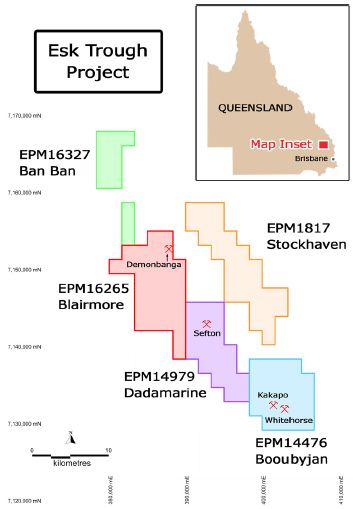


Location of the Esk Trough project, Queensland. Source: Company announcement

ActivEx is managing the first stage of the exploration program while Coppermoly can earn a 51 per cent interest in the project by spending $3 million over three years and can further elect to advance its interest to 70 per cent.

Drilling at the Kakapo prospect will follow up on extensions and continuity of historical drilling results, such as 88 metres at 0.47 per cent copper and 0.49 grams per tonne gold; and 1.8 metres at 2.12 per cent copper.

“The drilling program at Kakapo follows the successful three-dimensional Induced Polarisation (3DIP) geophysical program, completed in April, covering a 700 metre by 600 metre gold-in-soils anomaly,” Coppermoly said in its ASX announcement.

“This survey identified particular zones where copper mineralisation occur, including within the near-surface ‘blue’ conductivity image which shows possible extensions of mineralisation.

“Further analysis of the geophysical data will be undertaken once the additional drilling has been completed.”
Altura enhances Pilgangoora

THE DRILL SERGEANT: Altura Mining is in the midst of ongoing Reverse Circulation (RC) drilling and metallurgical studies at the company’s 100 per cent-owned Pilgangoora lithium project.

The company claims the drilling is supporting its views on the robustness of the projects with results to date leading it to consider spodumene bearing pegmatite at Pilgangoora to be of world class in size and quality.

Altura is drilling with the aim to extend the area of the pegmatite resources to enable it to provide an increased Mineral Resource estimate update late this quarter or early next quarter.

“Of note is that the extent and boundaries of the Pilgangoora lithium project mineralised area have not yet been determined and it is anticipated that drilling will continue concurrently with the predevelopment studies,” Altura Mining said in its ASX announcement.

“The current drilling is being undertaken in areas that require more earthworks to establish drill pads as the holes are located on the steep hill that separates the C1 and S1 areas where previous drilling has been completed.”

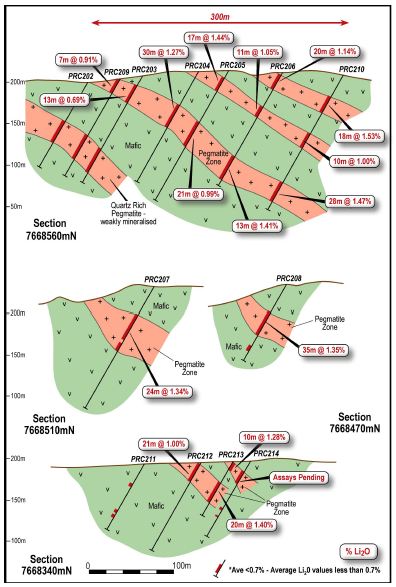
The drilling at Pilgangoora has encountered intercepts of spodumene mineralised pegmatites with one of the best intersections recording 35 metres averaging 1.35 per cent lithium oxide.


Drill sections at Pilgangoora lithium project

The current program has expanded the mineralised pegmatites an additional 250 metres south from the C1 Zone towards the S1 Zone.

Altura said it anticipates the drilling will increase its current spodumene pegmatite resources of 13.3 million tonnes at 1.21 per cent lithium oxide.

Castle defines new Pole gold anomalies

THE DRILL SERGEANT: Castle Minerals has completed a round of auger geochemical drilling at the Pole prospect situated within the company’s Wa project in Ghana.

Castle has six projects in Ghana covering more than 11,000 square kilometres, including the Wa project, which holds an Indicated and Inferred resource of 163,700 ounces of gold, where it has defined a number of gold anomalies.

“This is a significant new gold target with our auger sampling successfully defining a number of large high tenor gold anomalies in an attractive geological setting along the eastern margin of the Wa‐Lawra greenstone belt,” Castle Minerals managing director Mike Ivey said in the company’s announcement to the Australian Securities Exchange.

“Our exploration strategy continues to successfully generate greenfield targets of considerable scale and provides much encouragement that the rocks within our larger Wa project are capable of hosting world class gold deposits.”


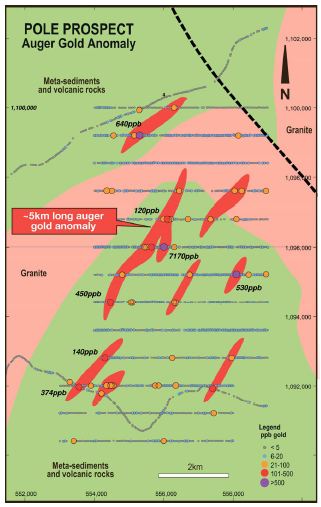
Auger geochemistry results and interpreted geology for the Pole prospect. Source: Company announcement

The auger drilling campaign followed regional soil sampling conducted by Castle on four kilometre spaced lines that generated a 230 parts per billion gold soil results on what now forms the southern part of the Pole prospect within the Wa project.

The company tested a 10km long area by carrying out auger drilling on 800m by 50m centres, which it said had generated some substantial anomalies.

 The largest of these anomalies is 5km long (at plus-50 ppb gold) and includes a peak auger sample reporting 7,170ppb gold.

Castle is now conducting field mapping and site inspection in preparation for RAB drilling.

West African kicks off deep drilling at Moktedu

THE DRILL SERGEANT: West African Resources has commenced a 5,000 metre Reverse Circulation (RC) drilling program on the company’s Boulsa gold project in Burkina Faso.

The drilling has been designed to test high-grade gold mineralisation at up to 150m depth at the Moktedu prospect, which is part the Boulsa project.

The deeper drilling is following up results the company received from recent aircore, RC and diamond drilling at Moktedu and will initially focus on 20 holes, drilled to depths of up to 150m, over the central 1.5 kilometres of strike at Moktedu.

Previous results included:

–    8 metres at 1.71 grams per tonne gold from surface;

–    4m at 8.39g/t gold from 4m;

–    6m at 8.36g/t gold from surface, including 1m at 42.95g/t gold;

–    3m at 7.64g/t gold from 33m, including 1m at 20.93g/t gold;

–    21m at 1.13g/t gold from 121m, including 1m at 10.96g/t gold; and

–    6m at 5.78g/t gold from 74m, including 1m at 28.40g/t gold.

RC drilling will also be completed at the company’s Meguet and Sartenga prospects during the course of the program.

In the company’s announcement to the ASX, managing director Richard Hyde said the deep RC program at Moktedu was designed to accelerate the development one of West African’s highest priority project areas.

Currently, West African Resources is drilling more than 15,000m per month using Company owned and operated rigs, however, as many companies are finding in Burkina Faso at present,  assay turnaround continues to be an issue with local laboratories, which in turn impacts exploration forward planning.

The company said it is targeting its first resource estimate in late 2012.

Emmerson hits more copper at Tennant Creek

THE DRILL SERGEANT: New drilling being conducted by Emmerson Resources on the Goanna copper/gold discovery at the company’s Tennant Creek project has hit more, high-grade copper.

Drilling within the Southern shear zone at the Goanna project has produced intersections including:

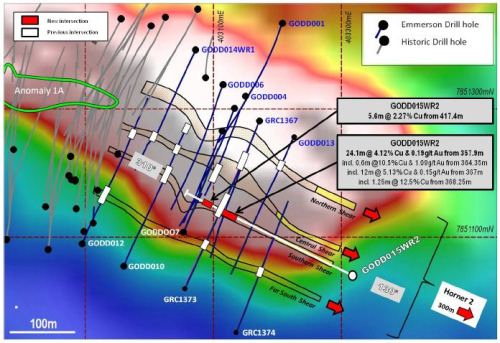
24.1 metres at 4.12 per cent copper and 0.19 grams per tonne gold, from 357.9 metres, including 1.25 metres at 12.5 per cent copper, 0.18 grams per tonne gold and 29.8 per cent iron, from 368.25 metres.

And a further lower zone of:

5.6m at 2.27 per cent copper, from 417.4m; and

0.75m at 0.97 per cent bismuth, from 436.25m.


Plan view of the drill holes and recent mineralization at Goanna on a
background of the HeliTEM geophysics. Source: Company announcement

Emmerson said the high bismuth grade and a change in drill rig orientation has taken the project towards locating an expected high-grade gold zone in addition to the high-grade copper zone closer to the surface.

“Information drawn from this year’s program of extending the existing Reverse Circulation (RC) drill holes with diamond tails has provided a new understanding of the geometry of this ore body,” Emmerson Resources managing director Rob Bills said in the company’s announcement to the Australian Securities Exchange.

“The high grades found in hole GODD0015 represent, what we now believe, is a true-width intersection of the ore body (i.e. the drill hole has intersected the mineralisation perpendicular to the interpreted plunge).

“This is a vital step in gaining a proper understanding of the ore body.

“This hole has revealed that, not only is this mineralisation open up and down plunge, but, given the previous intersections in the other three shear zones nearby, is likely to be repeated.

“Importantly, for the future discovery of high grade gold ore at Goanna, bismuth veins were intersected in the lower most zone (the footwall of the copper mineralisation) of drill hole GODD0015.

“The presence of bismuth in ore zones at Tennant Creek is typically a good pathfinder for gold and suggests great potential for bonanza gold in the vicinity.”

Emmerson considers the latest drilling continues to provide strong encouragement that the emerging Goanna and Monitor discoveries, combined with the updated resource calculation from the nearby Gecko mine, form the basis for a future, high grade resource base, for resumption of mining and subsequent copper and gold production from its 100 per cent-owned Emmerson mill.

White Rock tunes into new silver at Mozart

THE DRILL SERGEANT: White Rock Minerals has received impressive silver‐gold assays from initial drilling being conducted at a new prospect situated within close proximity of its existing 730,000 ounces of gold‐equivalent Resource base on the Mt Carrington gold‐silver project near Drake in northern New South Wales.

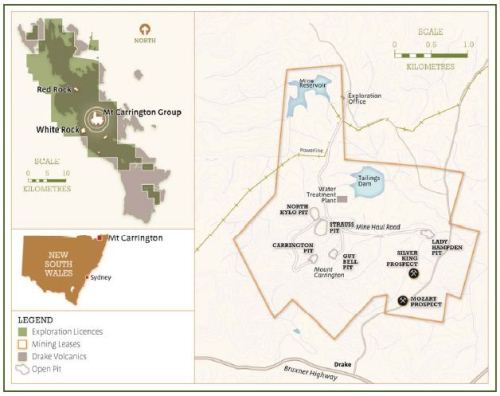
The drilling is being undertaken at the Mozart prospect, 250 metres from Silver King and 800 metres from the Lady Hampden silver-gold deposits.


Mt Carrington mining leases: Location of Silver King and Mozart prospects. Source: Company announcement


White Rock has received an intersection of:

33 metres at 97 grams per tonne silver Ag from 154.5 metres, including 10 metres at 248 grams per tonne silver from 159 metres.

White Rock has identified Mozart to be one of 10 priority near‐mine and regional exploration targets which will be drilled in 2012, within a portfolio of over 70 targets the company has assembled over the past 18 months.

“The potential of the Mt Carrington project to yield significant new and shallow deposits is only just beginning to be unlocked,” White Rock Minerals managing director Geoffrey Lowe said in the company’s announcement to the Australian Securities Exchange.

“After successfully building the gold – silver Resource base to 730,000 ounces gold equivalent over the past 12 months, it is very pleasing to discover a potential new high grade silver deposit at Mozart so close to the existing Resources.

White Rock said it will be undertaking further drilling at Mozart this quarter with a further two to four holes planned.

As part of the regional exploration program drilling has also commenced at the high‐grade and historically mined Red Rock gold-silver-copper prospect located 15 kilometres north of the central Mt Carrington leases.

“The drilling at Red Rock is also very exciting, confirming an extensive and largely untested alteration system within the regional volcanic caldera setting,” Lowe said.

“Drilling to date at both Mozart and Red Rock highlights how well‐endowed and under‐explored the Mt Carrington region is, and the exciting new phase of exploration that lies ahead.”

Endeavour expands drill program at Nzema

THE DRILL SERGEANT: Endeavour Mining has expanded the sulphide drilling program currently underway at the company’s 90 per cent-owned Nzema gold mine in south-western Ghana.

The expansion to the drilling program follows a review of drilling results the company has received to date, the delivery of the Conceptual Trade-off Study by AMEC Minproc and initial metallurgical testwork completed by SGS Australia Mineral Services.

Endeavour said recent drilling has confirmed the presence of several sulphide ore shoots below the principal oxide pits at the Salman Trend.


Plan map of the Salman Trend showing areas of Nzema sulphide drilling program. Source: Company announcement


Highlights include:

Teberu

–    9 metres at 4.91 grams per tonne gold from 109 metres;

–    14m at 4.13 g/t gold from 104m;

–    14m at 3.15 g/t gold from 124m;

–    10m at 3.84 g/t gold from 72m; and

–    14m at 2.48 g/t gold from 30m.

Salman North

–    3m at11.52 g/t gold from 79m; and

–    12m at 9.67 g/t gold from 38m.

Nugget Hill

–    10m at 3.75 g/t gold from 108m; and

–    16m at 2.04 g/t gold from 62m.

Salman South

–    14m at 1.94 g/t gold from 63m; and

–    8m at 1.67 g/t gold from 88m.

“On the basis of these encouraging results the Nzema exploration program was expanded to include a larger sulphide drilling program, metallurgical testwork, and completion of a preliminary economic assessment by the end of 2012,” Endeavour Mining said in its ASX announcement.

“At Teberu, Salman North and Salman South drilling results demonstrate the existence of wide zones of higher grade mineralization that represent ore shoots plunging shallowly to the south. Closer-spaced drilling has commenced at the locations of the ore shoots (50 metre by 50 metre grid) to assess continuity and to provide sufficient data for the generation of an inferred resource.”

Endeavour said it considers the sulphide gold zones at Salman represent a target with potential to increase production at Nzema.

The company will use the upcoming testwork to examine process alternatives currently being employed to treat refractory sulphide mineralisation within West Africa.

Endeavour increased the budget for the program from US$2.4 million to US$6.4 million for 2012 in order to accelerate the drilling and achieve its study objectives.

A total of 40 holes totalling 5,174 m have been completed thus far in the 2012 drilling campaign.

Exterra reports early high-grade drilling results

THE DRILL SERGEANT: Gold-focused exploration and development company, Exterra Resources has received some impressive high-grade assay results from the first two holes of an eight hole program of diamond drilling being carried out at the Second Fortune mine situated within the company’s Linden gold project in Western Australia.

Exterra has completed three holes so far and is waiting on results from the third.

Highlights from the results received for the main lode are:

–    0.8 metres at 31.68 grams per tonne gold; and

–    0.6m at 43.50 g/t gold.

The company said the three completed holes all contained visible gold, and is of the opinion that the results have confirmed the continuity of the high-grade Second Fortune main lode system at depth below the current resource.

“The program totals approximately 2,600 metres of HQ/NQ coring and is expected to be completed during May 2012,” Exterra Resources said in its ASX announcement.

“It is aimed at testing the continuity of the high grade lode system below and along strike of the deepest drilling completed to date at approximately 250 vertical metres.


Second Fortune Long Section. Source: Company announcement


“Holes planned will test the lode system to 300 vertical metres and, subject to results, are expected to provide a basis for upgrading the current Resource and commencement of a Feasibility Study into developing the Second Fortune underground mine.”

Exterra completed an earlier round of drilling in 2011 that confirmed the high-grade nature of the Second Fortune lode system.

This resulted in the company reporting a maiden JORC Code-compliant Inferred Resource of 207,000 tonnes at 7.9 grams per tonne gold for 52,270 ounces.

“The results received so far confirm the robust high grade continuity of the Second Fortune vein system,” Exterra said.

“The full program of eight diamond drill holes is expected to form the basis for an upgrade of the current Resource at depth, subject to further positive results.”

West African extends Moktedu by 10km

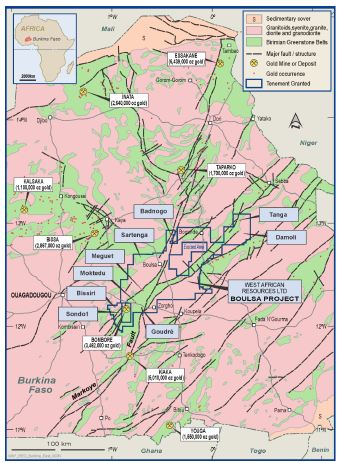
THE DRILL SERGEANT: West African Resources has received all results from a program of auger drilling conducted on the Zam Sud, Sondo and Sondo Sud permits situated on the company’s 100 per cent-owned gold projects in Burkina Faso, West Africa.

The company has interpreted the results to have has extended its Moktedu prospect by 3.2 kilometres to a total strike length of 10 kilometres.


West African Resources’ permits in Burkina Faso. Source: Company announcement


The new zones incorporating the extension to Moktedu will be tested by aircore drilling in June 2012.

West African has so far tested the central portion of the anomaly by RAB and aircore drilling over approximately 3km strike, which has identified the anomaly remains to be tested to the northeast.

The central 500 metres of the prospect has been drilled with wide-spaced RC and diamond drilling, and has returned high-grade results including:

– 21 metres at 1.13 grams per tonne gold from 121 metres, including 1 metre at 10.96 grams per tonne gold;

– 6m at 5.78g/t gold from 74m, including 1m at 28.40g/t gold;

– 4m at 8.39g/t gold from 4m;

– 6m at 8.36g/t gold from surface, including 1m at 42.95g/t gold; and

– 3m at 7.64g/t gold from 33m, including 1m at 20.93g/t gold.

West African said the drilling  had also identified three new zones south of the 3.5 million ounce gold Bomboré deposit on the Sondo and Sondo Sud Permits.

“The new targets will be in-filled auger drilled on 200 metre by 50 metre grids following the completion of the current auger programs on the Goudre permit and will be systematically tested with either RAB or aircore drilling later in 2012,” West Africa Resources said in its ASX announcement.
 
“Three high tenor zones remain to be tested on the Bissiri permit, located to the west of the Bomboré deposit.

“RAB drilling programs have been planned for these targets this field season.”

West African Resources said it is drilling approximately 15,000m per month, however like most of its contemporaries it is having difficulties with assay turnaround, which continues to be an issue with Burkina Faso laboratories.

Gascoyne widens high-grade gold at Zone 126

THE DRILL SERGEANT: Gascoyne Resources has received assay results from a further 4 diamond core holes targeting extensions to high-grade mineralisation at the Zone 126 deposit, situated within the company’s 100 per cent-owned Glenburgh gold project in Western Australia.

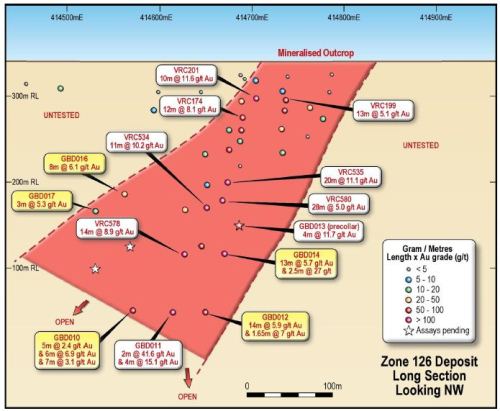
Gascoyne said the drilling has continued to extend the mineralisation both along strike, down plunge and down section, which has resulted in a major reinterpretation of the geometry and size of the deposit.


Zone 126 Long Section. Source: Company announcement


Better intersections returned include:

–    6 metres at 6.9 grams per tonne gold from 284.5 metres;

–    13m at 5.7g/t gold from 196m and 2.5m at 27g/t gold from 222.5m;

–    8m at 6.1g/t gold from 178m, including 4m at 11.6g/t gold; and

–    4m at 11.7g/t gold from precollar of diamond hole.

“The significance of these results should not be underestimated,” Gascoyne Resources chairman Graham Riley said in the company’s announcement to the Australian Securities Exchange.

“With the grades and thicknesses of Zone 126 being so consistent and the deposit widening at depth, the potential for this high grade shoot to underpin a profitable underground operation is high.

“With the known shallow open pittable resources and now the potential for a substantial underground development there is potential for the Glenburgh project to support a 100,000 ounce per annum gold operation.

“We anticipate another significant upgrade to our 700,000 ounce gold resource base at the completion of this drill phase.”

Gascoyne said the latest drilling has resulted in the interpreted plunge of the deposit shallowing to approximately 40 degrees and indicates the deposit is widening at depth, with the strike of the deposit now measuring over 200 metres.

The company expects this to significantly increase the ounces per vertical contained, which it said is a key input into any underground evaluation of a gold deposit.

Results from a further three diamond drill holes from Zone 126 are pending.
 
The company currently has a diamond drill rig drilling large diameter metallurgical and geotechnical core holes for a feasibility study.

Once these have been completed, additional drilling will be undertaken to test the depth extensions to the mineralisation at Zone 126.