Northern Star extends Voyager and increases Paulsens mine life

THE DRILL SERGEANT: Northern Star Resources has given the market a heads-up in regards to a possible increase in margins and mine life at its Paulsens gold mine in Western Australia.

The announcement came on the back of drilling at the main Voyager 1 lode, which returned results that indicated the extension zone in the current Voyager 1 Resource is set to run at an average grade of about 14 grams per tonne gold compared with Voyager 1’s life to date head grade of about 8gpt.

Results from Voyager 1 drilling include (uncut):

–    33.0 metres at 24.8 grams per tonne gold (true width 4.0m) from 455 metres;

–    2m at 101.1g/t gold (true width 2.0m) from 380m;

–    0.7m at 121.0g/t gold (true width 0.7m) from 411m;

–    1m at 43.7g/t gold (true width 0.6m) from 440m; and

–    6.3m at 40.4g/t gold (true width 1.5m) from 431m.

Northern Star said it expects mining to intersect this extension zone in the December Quarter, 2012, meaning the sharply higher-grade ore will boost the project’s cash margins.

As a result of the drilling intersections it has received since last December’s resource estimate, Northern Star indicated it is planning a mid-year resource upgrade which will take into account the in-fill and resource definition drilling in the high-grade Voyager 1 extension zone.
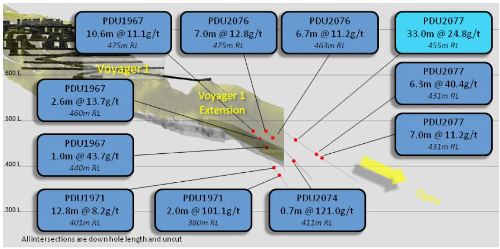
 

Long section view of drill results for Voyager 1 extension. Source: Company announcement


The revised resource estimate will also include the results released to date from the Voyager 2 lode at Paulsens.

“These high-grade results will translate directly to increased cash margins, cashflow and mine life,” Northern Star Resources managing director Bill Beament said in the company’s announcement to the Australian Securities Exchange.

“It means we are set to make more money from Paulsens due to the production increase to 100,000 ounces per annum and the rise in the head grade on the back of the Voyager 1 extension zone.

“In the process, we will increase the mine life and will continue to drill the extension zone at depth and down plunge.”

Northern Star is currently increasing production at Paulsens from approximately 80,000ozpa to around 100,000ozpa, with the higher rate expected to kick-in at the end of 2012.

The Voyager 1 lode is currently the main ore source at Paulsens and has produced 150,000 ounces over the past two years.

This is the fourth time in three years that the company has extended the down plunge extent of this lode.

The Voyager 1 lode continues to be open down plunge and the company believes this lode will continue to grow and be the mainstay for production for a number of years.
Corazon Mining defines new nickel zone at Lynn Lake

THE DRILL SERGEANT: Corazon Mining has received assay results from exploration drilling at the EL Deposit within the company’s Lynn Lake project in Canada.

The results stem from a hole the company announced in April that had intersected sulphide mineralisation and have returned:

–    51 metres at 0.8 per cent nickel, 0.5 per cent copper and 0.02 per cent cobalt.

Mineralisation was intersected at 670 metres down-hole, located at a shallower level and approximately 50 metres to the east of the strong sulphide mineralisation the company discovered in 2011.


That discovery has been the target of the latest round of drilling.

Corazon said the mineralisation identified by the recent drilling is fault bounded and has now opened up the southeast margin of the intrusion as a prospective exploration target.

Individual results returned range up to 3.5 per cent (1m) nickel and 6.3 per cent (0.6m) copper.

Higher grade zones of both primary and remobilized massive sulphide included:

–    4m at 1.8 per cent nickel, 0.7 per cent copper and 0.05 per cent cobalt from 679m;
 
–    2.8m at 1.7 per cent nickel, 2.0 per cent copper and 0.05 per cent cobalt from 687m; and

–    2.0m at 2.5 per cent nickel, 1.1 per cent copper and 0.06 per cent cobalt from 728m.

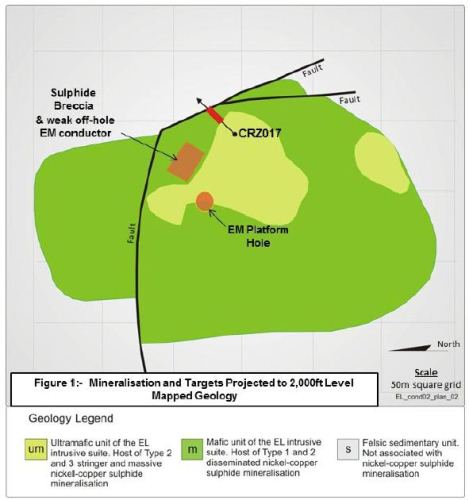
This was the first hole Corazon has drilled into the eastern margin of the EL Plug, an area that was recently highlighted as prospective by electromagnetic (EM) geophysics.


Source: Company announcement


“It is extremely encouraging that this hole has intersected such a broad zone of mineralisation proximal to a strong geophysical anomaly,” Corazon Mining said in its ASX announcement.

“The discovery provides the Company with an additional sulphide target within the EL Deposit.”

Corazon said it considers the EL Deposit has good potential at depth, with the deepest mineralised drill intercept to date within the main breccia zone returning:

–    44.8m at 1.6 per cent nickel, 0.7 per cent copper and 0.04 per cent cobalt from 773.9m.

“This mineralisation displays some of the strongest sulphide breccia textures drilled to date,” the company said.

Higher grade zones include:

–    3.9m at 2.8 per cent nickel, 0.2 per cent copper and 0.07 per cent cobalt from 773.9m;

–    11.0m at 2.3 per cent nickel, 1.0 per cent copper and 0.06 per cent cobalt from 784.9m; and

–    11.5m at 2.4 per cent nickel, 0.8 per cent copper and 0.06 per cent cobalt from 807.2m.

Taruga Gold confirms Kossa mineralisation

THE DRILL SERGEANT: Taruga Gold has released results from the first 14 holes completed at the Borobon prospect of a recently completed reverse circulation (RC) drilling program at the company’s Kossa project in Niger, West Africa.

The maiden RC drilling campaign consisted of 72 drill holes and targeted gold mineralisation at the Borobon, Kossa, Kole and Fatatako prospects, all part of the Kossa Project.


Kossa project:  Borobon prospect with new drill results, pending RC and gold mineralised trends. Source: Company announcement

Taruga said the prospects were identified for immediate drill testing on the basis of extensive artisanal workings, geochemical anomalism and gold mineralisation indicated by previous wide‐spaced reconnaissance drilling.

Highlights of the results received so far include:

–    12 metres at 3.40 grams per tonne gold from 8 metres;

–    4m at 2.19g/t gold from 48m and 4m at 4.68g/t gold from 64m; and

–    16m at 1.52g/t gold from 12m and 8m at 1.30g/t gold from 44m.

Taruga said the drilling had confirmed shallow, high‐grade gold mineralisation in a gold mineralised trend that remains open at depth and along strike.

“These initial results are very exciting with the majority of the initial drill holes returning gold mineralised intersections and confirming the prospectivity of the Borobon prospect,” Taruga Gold executive chairman Bernard Aylward said in the company’s announcement to the Australian Securities Exchange.

“We are eagerly anticipating assay results for the remaining 58 drill holes of this maiden RC drilling program with results expected during June and July.

“Given the success of these first results a second‐phase RC drilling program is being planned to define and extend this gold mineralised zone.”

Taruga is continuing its exploration program with an aircore drill rig on site completing the first phase drill testing of multiple target zones.

In addition, the company has two auger drill rigs targeting regional structures, artisanal workings and extensions to the defined mineralised zones.

Integra Mining scores Imperial gold and copper

THE DRILL SERGEANT: Integra Mining has hit a number of high-grade gold and copper intersections during the latest drilling being conducted on the Imperial prospect at the company’s Randalls gold project in Western Australia.

The Imperial prospect is situated approximately 500m north-west of the Majestic gold deposit at the Randalls gold project.

The latest round of RC drilling was conducted to test the continuity and extent of mineralisation intercepted in RC and diamond drilling the company completed in late 2011 and early 2012.


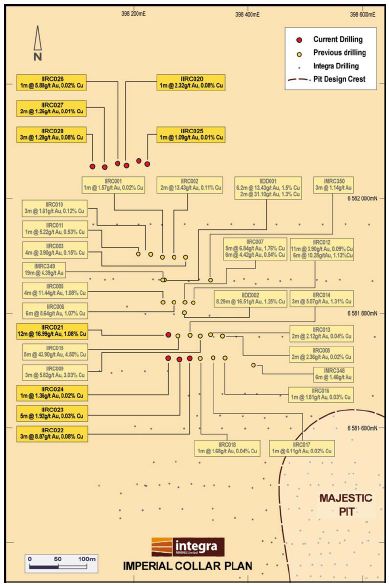
Imperial drill collar location plan with Majestic open pit outline. Source: Company announcement


This drilling returned 5m at 43.9 g/t gold and 1.25% copper.

Other results include:

–    12 metres at 16.99 grams per tonne gold and 1.08 per cent copper, including 1m at 25.44g/t gold and 0.87 per cent copper, and 2m at 52.27g/t gold and 3.42 per cent copper, and 1m at 60.36 g/t gold and 3.94 per cent copper; (this result immediately down-dip of the 5m at 43.9 g/t gold and 1.25 per cent copper intercept)

–    3m at 8.87g/t gold and 0.08 per cent copper, including 1m at 23.35g/t gold and 0.17 per cent copper; and

–    1m at 12.07g/t gold and 0.02 per cent copper.

The Imperial prospect is part of the Monger Joint Venture between Integra (85 per cent) and Newcrest (15 per cent).

“The recent results together with the previously reported results indicate that the mineralisation continues for at least 340 metres along strike and remains open to the north and south and down dip,” Integra Mining said in its ASX announcement.

“At the end of April, Imperial was handed over from the exploration team to the project development team for further advancement of the prospect.

“Resource definition drilling commenced in early May.

“A Sub-Audio Magnetic (SAM) geophysical survey is currently underway to test for mineralisation in unexplored areas of the Majestic region.”

Integra said it expects the geophysical surveys to provide cost-effective target definition within the larger Majestic gold / copper anomaly.

The company has interpreted the greater Majestic to be part of a larger intrusive-related or porphyry-style high-grade gold / copper mineralised system of a style previously unknown in the Eastern Goldfields.

Pioneer Resources completes Western Mt Jewell sale

THE DRILL SERGEANT: Pioneer Resources has pumped up its coffers following the completion of the sale of the Western Mt Jewell project to Carrick Gold.

The company has received the first instalment of $4.5 million, which means it now has cash reserves exceeding $7 million and no debt.

Pioneer’s bank balance will benefit from an additional $3.5 million that it is due in scheduled instalments to be received over the next three years.

“The completion of the sale of the Western Mt Jewell project puts Pioneer in a very strong financial position and underpins our exploration activities in a difficult global financial market,” Pioneer Resources managing director David Crook said in the company’s announcement to the Australian Securities Exchange.

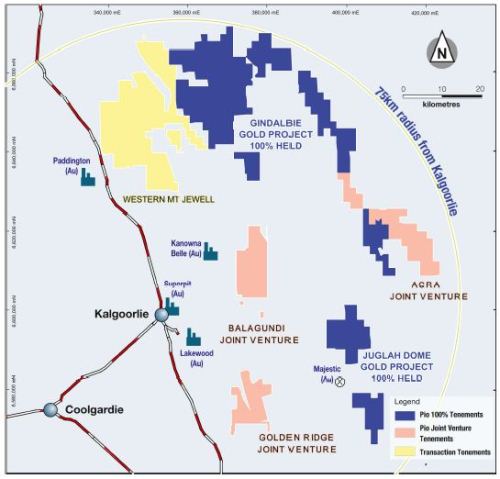
Pioneer said it will now be focussing its attention on the company’s Gindalbie and Juglah Dome projects, located near Kalgoorlie in Western Australia.


Pioneer’s tenement portfolio near Kalgoorlie, Western Australia. Source Company announcement


During May and early June the company completed a program of 280 RAB drill holes for 12,000m testing new gold targets.

Approximately 4,000 samples from this drilling are currently with a Perth laboratory and Pioneer said it expects to receive gold assay results later this month.

“The company is focussed, funded and active, and looks forward to providing the market with steady news flow in the near term and on an on-going basis,” Crook said.

Crusader Resources continues Brazil drilling success

THE DRILL SERGEANT: Crusader Resources has completed a round of Resource infill drilling at the company’s 100 per cent-owned Borborema gold project in Brazil.

The company said it has an updated Mineral Resource estimate on track for the September quarter as a pre-cursor to the completion of a Bankable Feasibility Study (BFS) later this year.


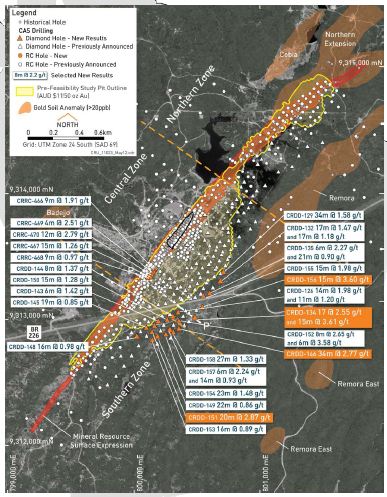
Selected drill results – May 2012. Source: Company announcement


The latest results have been received from diamond drilling in the Central and Southern zones of the project including:

–    34 metres at 2.77 grams per tonne gold from 287 metres;

–    20m at 2.87g/t gold from 194m;

–    17m at 2.55g/t gold from 304m and 15m at 3.61g/t gold from 327m (a combined interval of 38m at 2.60g/t Au from 304m);

–    34m at 1.58g/t gold from 279m;

–    27m at 1.33g/t gold from 279m;

–    23m at 1.48g/t gold from 258m;

–    15m at 3.60g/t gold from 307m; and

–    12m at 2.79g/t gold from 12m.

“The continuing excellent infill drilling results are really encouraging as we begin the next Mineral Resource update with its focus to convert the current Inferred Resources into Indicated Resources,” Crusader Resources managing director Rob Smakman said in the company’s announcement to the Australian Securities Exchange.

“3D modelling of the mineralisation is now underway, and the new Mineral Resource is expected to be completed in coming weeks.

“This will then be used for pit optimisations and a subsequent mine plan as a precursor to a Reserve statement early in the third quarter, and the completion of the BFS later in the year.”

The current JORC-compliant Mineral Resource estimate for the Borborema project stands at 68 million tonnes at 1.06g/t for 2.31 million ounces of gold, of which approximately half is classified as Inferred Resources and half as Indicated Resources.

A Pre-Feasibility Study conducted last year highlighted the robust economics of a three million tonnes per annum open-pit mine.

Crusader said the continuing increases in Mineral Resources results in the BFS assuming a greater run-of-mine production rate for a 4Mtpa plant.

With the current round of resource drilling now completed, the company said it is now focused on targets generated by the new resource model and soil sampling, with the aim of further expanding resources as well as discovering new sources of mineralisation near Borborema.

Avalon Minerals hits thick Swedish copper

THE DRILL SERGEANT: Avalon Minerals has completed the third hole, of a four-hole drill program, currently underway at the company’s Viscaria project in northern Sweden.

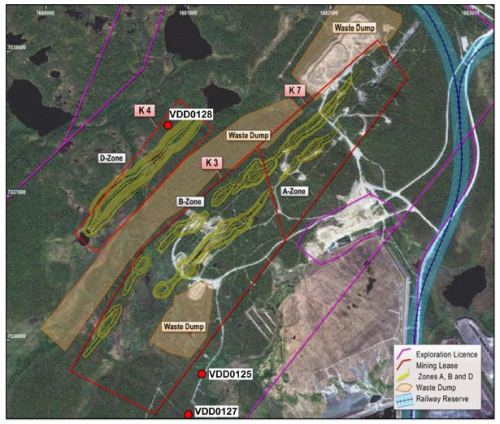
The drilling is testing for extensions of high-grade copper mineralisation at the project’s A and D Zone Mineral Resources.


Location of Drill Hole VDD0127, as well as previously drilled VDD0125 and VDD0128. Source: Company announcement

“All three drill holes completed to date have intersected mineralised intervals from 15 metres to 55 metres down hole thickness and within those broad intervals, zones of high-grade copper also occur,” Avalon Minerals managing director Jeremy Read said in the company’s announcement to the Australian Securities Exchange.

“The results from these three drill holes have greatly increased our confidence in being able to follow the higher grade zones of copper mineralisation at depth.”

“Drill hole VDD0127 intersected a zone of 21.4 metres (down hole width) of copper mineralisation, which is another very positive result.”

Avalon said it expected geochemical assay data for hole VDD0127 to be available in approximately four weeks’ time.

The hole intersected copper mineralisation over 21.4m down-hole, with the best copper mineralised intervals extending from 766.9m to 770.4m and 782.7m to 786.0m down-hole as follows:

–    766.9m – 770.4m (5.2m down-hole width) – Massive to moderately abundant disseminated chalcopyrite, blebs, veinlets and stringers.

–    782.7m – 786.0m (3.3m down-hole width) – moderately abundant disseminated chalcopyrite, blebs, veinlets and stringers.

This hole was drilled outside of the currently defined Mineral Resource envelope at the A Zone prospect.

The current Mineral Resource for A Zone comprises 21.6 million tonnes at 1.5 per cent copper and is classified as having 14.4 million tonnes at 1.7 per cent copper Measured, 4.7 million tonnes at 1.2 per cent copper Indicated and 2.5 million tonnes at 1 per cent copper Inferred.

The four hole drill program at the Viscaria project is targeting plunging high-grade copper shoots 600m below the surface and stepping out approximately 30m to 50m beneath high-grade shoots at the 200m to 300m depth interval.

Drilling of the final hole is currently in progress at D Zone, which the company anticipates will be completed by mid-June 2012.

Riedel commences Burkina Faso drilling

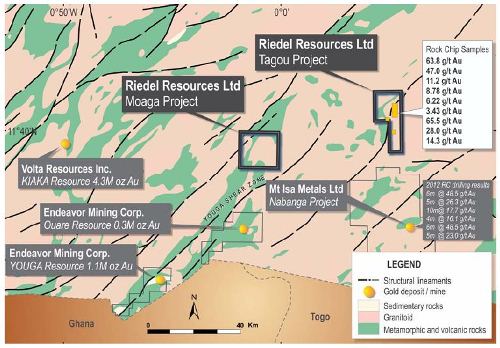
THE DRILL SERGEANT: Riedel Resources has commenced a program of RC drilling at the company’s Tagou project in Burkina Faso.

The drilling is targeting a quartz vein set characterised by very high grade rock chip gold assay results that occur within a 30 to 50 metre wide structural corridor at least 4 kilometres in length.

The drilling follows a series of field exploration program conducted by Riedel at the Tagou project in April immediately after it had acquired it, along with four other permits.


Geology and tenement map showing Riedel’s Tagou and Moaga projects. Source: Company announcement

In this time Riedel has carried out rock-chip sampling (91 samples), geological mapping and surface soil geochemical sampling (3,645 samples) within the Tagou project area.

Rock-chip results from veins up to 5m wide include:

–    65.5 grams per tonne gold, 63.8 g/t gold, 47g/t gold, 28g/t gold,11.2g/t gold and 8.78g/t gold.

The strength of the assays it received resulted in the company delineating numerous high-priority drilling targets.

The company said the results also provided confidence that its decision to explore for large-scale gold deposits in West Africa has a chance of success.

The RC drilling has now kicked off at Tagou with the aim of testing the tenor, width and depth potential of vein-hosted gold in two high-priority target areas.

 “Securing suitable equipment to commence RC drilling in just over a month since completion of the projects acquisition is an excellent outcome,” Riedel Resources managing director Jeffrey Moore said in the company’s announcement to the Australian Securities Exchange.

“The rapid turn-around of assay results from recent rock-chip sampling greatly assisted with target ranking at Tagou and enabled us to confidently define high-order gold targets so that RC drilling could be accelerated and completed prior to the onset of the wet season.

“Being able to capitalise on the present weather window to deliver and evaluate drilling results also gives us a great opportunity to plan follow-up RC and diamond drilling which can commence as soon as the weather permits.”

Riedel has approximately 2,000m of drilling, in drill holes up to 150m deep planned to target mineralised quartz veins in structural corridors ranging from 30m to 50m in width within a key four kilometre long target zone.

There has not been any previous drilling carried out in the Tagou Permit area.

The company said it intends using the results of this drilling program in planning future drilling program over other, similar target corridors which have already been outlined within the Tagou Permit, as well as planning follow-up and infill drilling over those areas which return the best gold results.

Sihayo Gold updates Sambung Resource

THE DRILL SERGEANT: Sihayo Gold has upgraded the Sihayo‐Sambung JORC-Compliant Resource, within the company’s Sihayo Pungkut gold project in Indonesia.

The Sihayo‐Sambung Resource now stands at 16.4 million tonnes at 2.7 grams per tonne gold containing 1,427,400 ounces of gold.

“The robustness of our Sihayo‐Sambung Resource has been further strengthened,” Sihayo Gold chief executive officer Paul Willis said in the company’s announcement to the Australian Securities Exchange.

“In many cases, contained gold ounces decrease when converting lower confidence inferred resources to the higher confidence indicated category.

“We are very pleased with the combination of increased geological confidence and increased ounces within the Sambung Resource.

“We will be seeking to add to our resource inventory adjacent to our current resources as geological confidence increases through well planned future diamond drilling programs.”

The Resource update came as a result of an infill drilling program recently completed by Sihayo Gold at the Sambung Resource consisting of 56 holes.

The purpose of the drilling was to upgrade the previous Sambung JORC-Compliant Inferred Resource of 1.7 million tonnes at 2.2g/t gold containing 123,200 ounces to the higher Indicated Category.

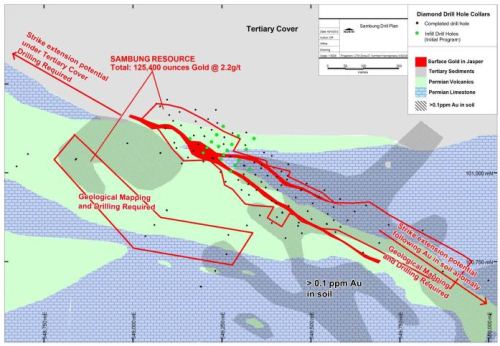
As a result Sambung now boasts a JORC-Compliant Resource of 1.8 million tonnes at 2.2g/t gold containing 125,400 ounces, comprising 1.0Mt at 2.3g/t gold for 72,500 ounces in the Indicated Category and 0.8Mt at 2.1g/t gold for 52,900 ounces in the Inferred Category.

In order to include all the Sambung Resource into its Definitive Feasibility Study, Sihayo said a further 18 diamond drill holes will be completed as soon as possible.


Sambung Drill Plan (planned drill collars highlighted in green). Source: Company announcement


Upon completion of these additional infill holes, the company will target the potential Sambung Resource extension areas.

The company said initial metallurgical testwork for the Sambung mineralisation indicates average recoveries will significantly exceed those of the main Sihayo Resource.

Talisman kicks off diamond drilling at Halloween

THE DRILL SERGEANT: Talisman Mining has commenced a program of follow-up diamond drilling at the company’s Halloween project, located in Western Australia.

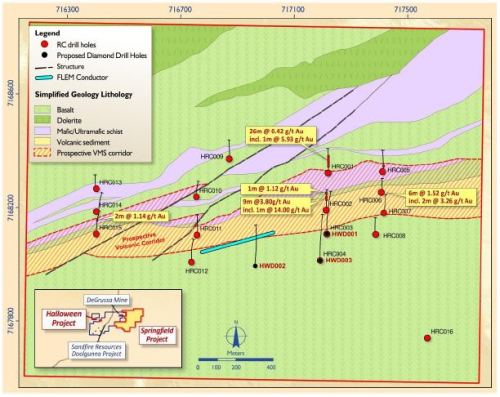
The drilling program is designed to test for VMS mineralisation associated with encouraging high-grade gold intercepts the company recently encountered during maiden Reverse Circulation (RC) drilling at Halloween.

The RC drilling was completed in March with 16 holes providing the first definitive test of the Halloween project.

The project performed reasonably well with gold assay results returned from four holes along three out of four wide-spaced drill traverses.


Simplified geological plan with drill hole locations showing significant gold intercepts. Source: Company announcement

“The mineralised volcanics intersected in the RC drill holes also show pervasive magnetite development and strong manganese enrichment, together with elevated zinc-lead-silver geochemistry,” Talisman Mining said in its ASX announcement.

“These are key pathfinders which are potentially indicative of a VMS-related exhalative mineralising system.

“The gold intersections in three of the four drill traverses, along with the important geochemical support, are very encouraging and demonstrate the excellent VMS exploration potential at Halloween.”

The company has now designed two diamond drill holes to test the prospective mineralised horizon for VMS copper-gold mineralisation immediately down-dip from the peak gold results, which included:

–    9 metres at 3.80 grams per tonne gold from 84 metres, including 4 metres at 7.37 grams per tonne gold from 84 metres and 1 metre at 14 grams per tonne gold from 86 metres.

The drilling will also be used to set up a platform for further down-hole electromagnetic surveying in order to detect any potential conductive bodies beneath the current drilling.

Following the results achieved during the initial RC drill program, Talisman has recently completed a detailed Fixed Loop Electro-Magnetic (FLEM) survey over the prospective volcanic corridor at Halloween with the aim of defining conductors that might be associated with massive sulphides along strike and down-dip from the better RC gold drill results.

This FLEM survey has identified a late-time electro-magnetic conductor sitting along the prospective volcano-sedimentary corridor in the centre of the project, which will also be drill tested as part of the current diamond drilling campaign.