Doray identifies new gold zone at Andy Well

THE DRILL SERGEANT: Doray Minerals has claimed recent drilling conducted at the company’s 80 per cent-owned Andy Well gold project north of Meekatharra in Western Australia has confirmed potential for a second high-grade gold deposit within the “Judy Zone”, south of the high-grade Wilber Lode deposit.

The drilling was undertaken to follow up on previously recorded intersections with a single diamond hole and a number of RC holes drilled to test the potential for a second high grade quartz lode approximately 300 metres south of and parallel to the Wilber Lode.
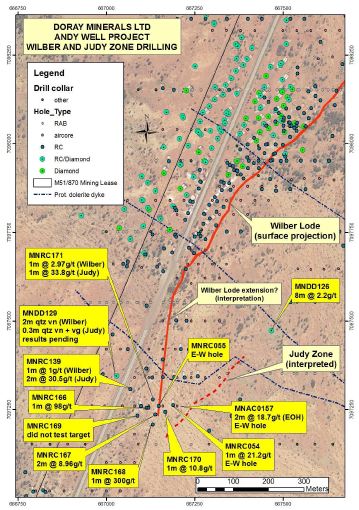
 

Drill status plan for part of Andy Well gold project showing
location of Judy Zone drilling in comparison to Wilber Lode deposit.
Source: Company announcement


Doray said the drilling had intersected the Judy Zone mineralisation on three drill sections that confirmed dip and strike continuity of the mineralised quartz lode.

The company has encountered visible gold observed in all but one of the holes drilled at Judy so far.

“We have always thought that the Andy Well project had the potential for a substantial new gold camp with multiple deposits,” Doray minerals managing director Allan Kelly said in the company’s announcement to the Australian Securities Exchange.

“These new results from Judy, in close proximity to the soon to be developed Wilber Lode deposit, appear to indicate the presence of a second, very high grade quartz lode.

“Our initial interpretation that this zone trended north-south has proven to be incorrect and we now believe the Judy Zone is instead parallel to the Wilber Lode.

“The apparently simple geometry and very high grade gold mineralisation highlight the significant potential of this rapidly developing new target.”
 
Latest drilling results from the Judy Zone include:

–    1 metre at 98 grams per tonne gold from 149 metres to 150 metres;

–    2m at 8.96g/t gold from 102m to 104m, including 1m at 16.6g/t gold;

–    1m at 300g/t gold from 88m to 89m;

–    1m at 10.8g/t gold from 87m to 88m; and

–    1m at 33.8g/t gold from 156m to 157m.

Doray said the latest results had encouraged it to plan a series of follow up RC holes to test for further depth and strike extensions to the high-grade Judy Zone.
Syrah intersects graphite from go to whoa at Balama

THE DRILL SERGEANT: Syrah Resources has intersected graphite mineralisation along the entire length of the second (BMDD0002) and third (BMDD0003) holes drilled at the company’s 100 per cent-owned Balama graphite project in Mozambique.

The two holes have behaved similarly to the first hole (BMDD0001) drilled in the current campaign with graphite mineralisation starting at surface and ending in mineralisation.


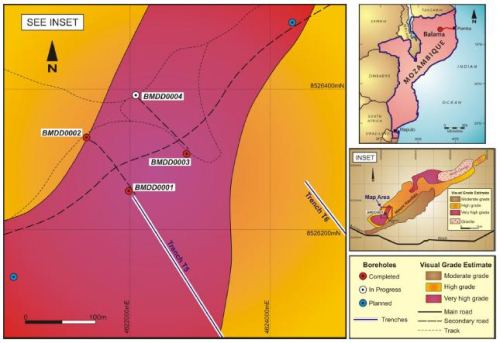
Locations of drill holes BMDD0001 – BMDD0004. Source: Company announcement


BMDD0002 intersected 251.5 metres of graphite mineralisation and was drilled 100m to the northwest of BMDD0001.

After visual inspection of the core and logging, Syrah said graphite content of BMDD0002 appears to be similar to that encountered in BMDD0001 and Trench T5, which averaged 12.7 per cent total graphitic carbon (TGC) along its entire length.

The graphite flakes appear to be predominately coarse to very coarse in size.
Drill hole BMDD0003 intersected 287.5m of graphite mineralisation and was drilled 100m along strike of BMDD001.

Syrah said visual inspection of the core demonstrated the graphite grade appears to be noticeably higher grade than BMDD0001.

“This is the first drilling ever conducted on the Balama graphite deposit,” Syrah Resources said in its ASX announcement.

“The initial holes are designed to test continuity and consistency of the graphite mineralisation in this western section of the Balama graphite deposit.

“Although there are variations in grade and flake size, the mineral assemblage is consistent with mostly graphite and quartz along with some green accessory minerals thought to be pyroxenes and amphiboles.

“It is likely that we will be able to step out the holes to 200 metres as drilling progresses.

“Should this be the case, it will mean that we can calculate an initial resource sooner than anticipated.”

Drilling of hole BMDD0004 has commenced and Syrah said it anticipates most of the holes in the drill program currently underway on this first western area will start and end in mineralisation.

Azimuth Resources releases West Omai maiden resource

THE DRILL SERGEANT: Azimuth Resources has announced a maiden JORC-code and National Instrument 43-101 compliant gold resource estimate for the Smarts and Hicks deposits at the company’s West Omai gold project in Guyana.

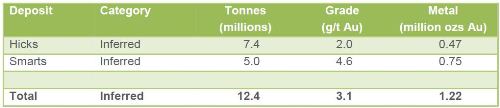
The overall Inferred Mineral Resource estimate at West Omai for both the Smarts and Hicks deposits has come in at:

–    12.4 million tonnes at 3.1 grams per tonne gold for total contained ounces of 1.22 million ounces.

The Inferred Mineral Resource estimate for the Smarts deposit is:

–    5 million tonnes at 4.6g/t goldu for 748,000 ounces contained gold.

The resource estimate was compiled from results of a drilling campaign the company completed to mid-April 2012.


Mineral Resources – West Omai Projects, Guyana – minimum 0.5g/t gold cut-off grade. Source: Company announcement

“Both deposits remain open at depth, while along strike, structures which host both deposits remain open in both directions albeit with low grade to sub economic mineralisation but with potential to host as yet unknown higher grade pods and shoots,” Azimuth Resources said in its ASX announcement.

“The resource estimate represents a major milestone for Azimuth and the estimation took into account a total of 94,410 metres of drilling and trenching across both the Hicks and Smarts deposits.

“The high grade of the overall resource and in particular the Smarts deposit combined with the clean metallurgy and near surface position of the deposits represent a solid foundation for the company’s goal of building a large resource inventory of high quality gold deposits for development.”

Azimuth said it intends continuing with an aggressive four rig drilling program.

This will entail two rigs operating at Smarts, with which it will target resource extensions while the other rigs will be working up numerous new prospects at West Omai.

The company has a further air core rig currently scout drilling more regional targets, in particular focussing on under-cover extensions of the interpreted Smarts structure.

Phoenix Gold receives Blue Funnel feasibility results

THE DRILL SERGEANT: Phoenix Gold has received the results of a recently-completed mining study of the company’s 95 per cent-owned Blue Funnel gold project in the Eastern Goldfields region of Western Australia.

The Blue Funnel project has a current Resource of 453,000 tonnes at 2.91 grams per tonne gold 42,480 ounces comprising 28,032 ounces (280kt at 3.11g/t) in the Indicated category and 14,448 ounces (172kt at 2.6g/t) in the Inferred category.


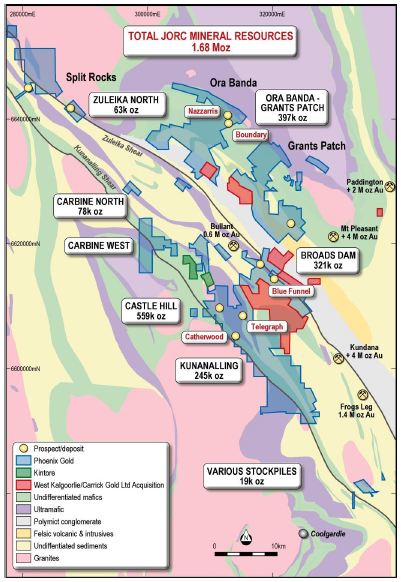
Blue Funnel mine location and company leases. Source: Company announcement

A mine optimisation/evaluation and design study for the Blue Funnel Resource was recently completed focused on the economic evaluation of mining the remaining Resource in the Blue Funnel Pit and completing a small cutback to the south.

Assumptions used in the study included:

–    Ore would be treated by a third party mill through a toll treatment agreement;

–    A gold price of $A1,600 per ounce;

–    Mining dilution of 10 per cent and mining recovery of 95 per cent;

–    Average metallurgical recovery of 94 per cent (assuming conventional processing); and

–    Mining costs derived from mining, drill and blast and haulage contractor quotes.

Phoenix said the study determined Blue Funnel could deliver $8.908 million in free cash flow, assuming a gold price of A$1,600/oz, from the treatment of 150,316t of ore at 3.49g/t gold for 16,877 ounces mined and 15,865 ounces recovered generating a total cash cost of $1,089 per recovered ounce including all royalties, capital, toll treatment and operating costs.

“The Blue Funnel project now joins Catherwood as the first two small scale mines to be developed by Phoenix to generate cash and grow the Resource base and work toward a larger scale longer term production profile,” Phoenix Gold managing director Jon Price said in the company’s announcement to the Australian Securities Exchange.

“Both mines have robust economics, even when factoring in contract mining rates and toll treatment costs, and have very low start-up capital requirements.”

Phoenix Gold also completed additional drilling to improve the potential of the southern cutback In April this year comprising 850 metres of RC drilling immediately to the south of the existing pit.

Results from this program included:
 
–    5 metres at 4.45 grams per tonne gold from 32 metres;

–    3m at 4.91g/t gold from 22m;

–    5m at 2.41g/t gold from 24m; and

–    4m at 2.25g/t gold from 23m.

The company said it had interpreted these results to represent the intersection of a splay off the Zuleika Shear, which hosts the Blue Funnel pit mineralisation.

It said further drilling across the mineralised corridor and depth is required to test this interpretation and if correct may define several new mineralised zones in and around Blue Funnel.

Gascoyne continues Apollo and Icon run

THE DRILL SERGEANT: Gascoyne Resources has continued its successful run of infill drilling results from the Apollo and Icon deposits at the company’s 100 per cent-owned Glenburgh gold project in Western Australia.

The Glenburgh project has a JORC-compliant resource of over 700,000 ounces of gold.


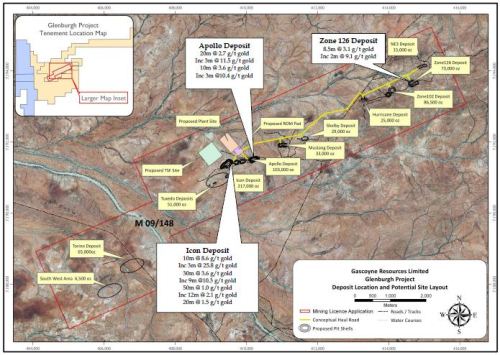
Glenburgh project deposit overview and recent drill intersections. Source: Company announcement


The company said the results it has received so far, from both deposit areas continue to exceed the expected grades and thicknesses expected from their respective resource models.

Infill drilling results from the western portion of Apollo included:

–    20 metres at 2.7 grams per tonne gold including 3 metres at 11.5 grams per tonne gold; and

–    10m at 3.6 g/t gold, including 3m at 10.4 g/t gold.

“Given the continued success of the infill drilling three deep diamond drill holes have been planned below the Apollo deposit, to test depth potential,” Gascoyne Resources said in its ASX announcement.

Results from the first half of the infill drilling program at the immediately adjacent Icon deposit have also been received.

Results from the eastern portion of Icon Deposit include:

–    10m at 8.6g/t gold, including 3m at 25.8g/t gold;

–    30m at 3.6g/t gold, including 9m at 10.3g/t gold;

–    20m at 1.5g/t gold;

–    50m at 1.1g/t gold;

–    6m at 3.1g/t gold; and

–    3m at 5.1g/t gold.

Gascoyne is awaiting results for a further 35 infill holes at Icon.

“As a result of the identification of a number of high grade pods (up to 45g/t gold) within the Icon deposit, four diamond holes have been planned to test the continuity of the deposit at depth,” Gascoyne said.

The company has also received results from the last two diamond holes completed at Zone 126, which it said confirm the revised interpretation of the plunging shoot of mineralisation, as the lode was intersected in both holes.

Results from Zone 126 included:

–    8.5m at 3.1g/t gold, including 2m at 9.1g/t gold, from 216.5m downhole; and

–    4.1m at 1.1g/t gold from 209.9m.

“A further 6 diamond holes have been planned to test the down plunge continuation of the high grade shoot at Zone 126,” Gascoyne said.

“RC and diamond drilling is continuing, with the two rigs undertaking further infill and extensional drilling in the Icon, Apollo, Zone 102 and 126 deposit areas.”

Bulletin encouraged by Wagtail drilling

THE DRILL SERGEANT: Bulletin Resources has completed a round of infill RC drilling within the northern portion of the planned Wagtail North open pit, situated within the company’s Lamboo gold project in the Kimberley Region of Western Australia.

 The company said the results from the drilling suggest the Inferred resource mineralisation to be more extensive and continuous than it had previously interpreted.

Highlights from the drilling include:

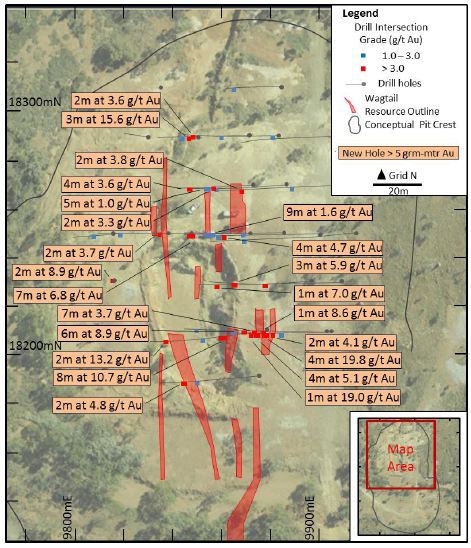
–    8 metres at 10.7 grams per tonne gold from 30 metres, including 4 metres at 19.7 grams per tonne gold from 32m, and 2 metres at 13.2 grams per tonne gold from 75 metres;

–    7m at 3.7g/t gold from 52m, and 6m at 8.9g/t gold from 62m, including 2m at 23.1g/t gold from 64m;
 
–    4m at 19.8g/t gold from 64m, including 2m at 33.1g/t gold from 64m, and 4m at 5.1g/t gold from 72m, and 1m at 19.0g/t gold from 81m;

–    7m at 6.8g/t gold from 43m, including 1m at 36.3g/t gold from 44m; and

–    3m at 15.6g/t gold from 7m, including 1m at 40.6g/t gold from 8m.

“The positive drilling results to date are increasing our confidence in the continuity of the Wagtail North mineralised lodes both along strike and at depth,” Bulletin Resources managing director Martin Phillips said in the company’s announcement to the Australian Securities Exchange.

“Subject to receipt of the balance of the assay results, we remain optimistic of converting the Wagtail Inferred resource to the Indicated category and ultimately add to the project’s Ore Reserve base.”


Drill hole location plan of Wagtail North showing infill drill
intersections above 1g/t Au, significant drilling results above 5
gram-metres and the conceptual open pit outline. Source: Company
announcement


Bulletin completed a feasibility study at Lamboo (formerly Nicolson’s project) in April based on a low-risk open pit start up strategy transitioning to underground.

The study recommended an upgrade of the existing processing facility to 200,000 tonnes per annum to support a five year mine life targeting a nominal production rate of 30,000 ounces of gold per annum.

The project has since progressed into the Final Authorisation stage.

Bulletin said the main objective of the current 8,000m drilling campaign is to infill the Inferred resource areas contained within the Wagtail North, Wagtail South and Rowdies open pit designs, advancing them to the Indicated category to augment the current project Ore Reserve.

Malagasy JV partner scores goods hits on graphite prospect

THE DRILL SERGEANT: Malagasy Minerals’ Joint Venture partner and operator in the Madagascar graphite project, TSX-listed Energizer Resources has reported drilling results from the project’s Molo prospect.

Energizer announced the Toronto market it had received the remaining phase of results from drilling conducted in November 2011 at Molo.


The graphite trends identified to date by Energizer include: Berenty,
Bemelo, Mahasoa, Bepeha, Besavoa, Fondrana, Mainty, Manga, Molo, Bevaro,
Jaky, Fotsy, Rano, Seta, Tanantsoa, Vavy, Ampanihy. Red Outline-
Energizer ground: Green Outline- EGZ-MGY Joint Venture Area. Source:
Company announcement

The results concluded the intersection of graphite mineralisation with composite grades of between 7.3 per cent and 11.17 per cent carbon.

Energizer said the assays “support the company’s intention” to delineate a formal resource estimate for Molo and as a result, it “has selected the Molo Deposit to be brought to mine development”.

The results reported by Energizer included a drill hole from the central core of the Molo deposit, which intersected 106 metres of graphite mineralisation at 8.44 per cent carbon, including a higher-grade interval of 37m at 11.17 per cent carbon.

Another drill hole intersected 27m of graphite mineralisation at 7.25 per cent carbon.

In its release to the ASX Malagasy let Energizer do the talking.

“These latest assay results confirm that this surficially exposed graphitic ridge (which extends for a minimum of 12 kilometres in strike length), extends to a vertical depth of at least 108 metres,” Energizer Resources said in its announcement to the Toronto Stock Exchange.

“The company intends to expedite this (mine development) process and is targeting 2014-2015 for production.”

In its ASX release Malagasy noted Energizer’s evaluation included metallurgical analysis, which confirmed that jumbo flake (plus-50 mesh) graphite at an average purity of 93 per cent carbon can be easily liberated through simple crushing of the Molo graphite.
The Australian company explained jumbo flake graphite is considered among the most valuable due to its use in industrial applications such as batteries for electric cars and as a result attracts a premium price.

Malagasy holds a 25 per cent stake of the Madagascar Joint Venture as well as owning 7.5 million Energizer shares worth approximately C$2 million.

Malagasy’s interest is free-carried until the completion of a Bankable Feasibility Study.

Kentor Gold continues drilling run at Murchison

THE DRILL SERGEANT: Kentor Gold has intersected high-grade gold during RC drilling being conducted at the NOA 7&8 pits at the company’s Murchison gold project in Western Australia.

Drilling intercepts at NOA 7&8 include:

– 8 metres at 9.9 grams per tonne gold from 176 metres, including 1 metre at 40.8 grams per tonne gold;

– 3m at 13.9g/t gold from 247m, including 1m at 36.1g/t gold; and

– 1m at 35.2g/t gold from 226m, and 6m at 8.3g/t gold from 247m.

“These results at NOA7&8 present a further expansionary and cost reduction opportunity for the Murchison project,” Kentor Gold managing director Simon Milroy said in the company’s announcement to the Australian Securities Exchange.

“We are planning to restart the NOA2 underground mine later this year and great results like this will add to future underground mining potential.”


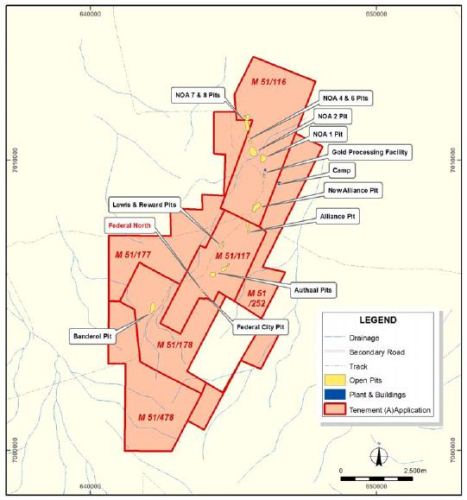
Burnakura tenement plan. Source: Company announcement


The NOA 7&8 deposit is the most northerly of Kentor’s known Burnakura deposits, situated 800 metres from NOA 2.

Kentor Gold said NOA 7&8 has similar mineralisation confined to a brittle fracture zone characterised by brecciation and stockwork veining within the Burnakura Thrust Zone and has been traced over a strike length of 560m.

The host rocks are mostly sediments or felsic volcaniclastics, although some of the mineralisation at the northern end of NOA 8 is hosted within a carbonaceous siltstone, which the company indicated may be subject to lower recoveries.

Previous test work carried out on this material has demonstrated good recoveries can still be achieved in a CIL plant.

Kentor has scheduled production to commence at Burnakura at a rate of 24,000 ounces of gold per annum from mid-2012, with planning for an expansion next year already underway.

Initial production will come from the Lewis and Reward pits at Burnakura.

Exterra encouraged by continued success at Second Fortune

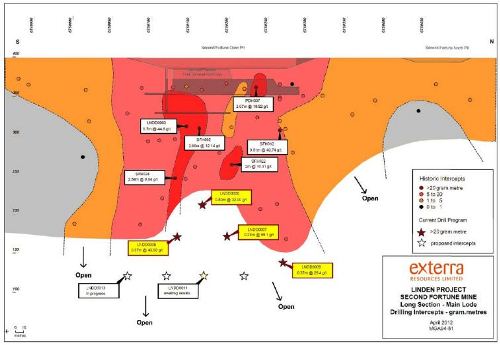
THE DRILL SERGEANT: Exterra Resources has received further high-grade assay results from the third and fourth holes of an eight hole program of diamond drilling the company is conducting at the Second Fortune mine, situated within its Linden gold project in Western Australia.

All of the first four holes completed contained visible gold, and the company claims the results confirm the continuity of the high-grade Second Fortune main lode system at depth below the current resource.

New results received for the main lode include:

– 0.3 metres at 65.10 grams per tonne gold; and

– 0.4m at 25.40g/t gold.

The program consists of eight diamond drill holes totalling approximately 2,600m of HQ/NQ coring and is expected to be completed during May 2012.


Second Fortune long section. Source: Company announcement

Exterra is carrying out the drilling of the high-grade Second Fortune main lode in order to test the continuity of the system below and along strike of the deepest drilling completed to date at approximately 250 vertical metres.

The program has been designed to test the lode system to 300 vertical metres and, subject to results, the company said it expect it will provide a basis for upgrading the current Resource and commencement of a Feasibility Study into developing the Second Fortune underground mine.

“The results received so far confirm the robust high grade continuity of the Second Fortune vein system,” Exterra Resources said in its ASX announcement.

“The full program of eight diamond drill holes is expected to form the basis for an upgrade of the current Resource at depth, subject to further positive results.”

Riedel rock chips return remarkable results

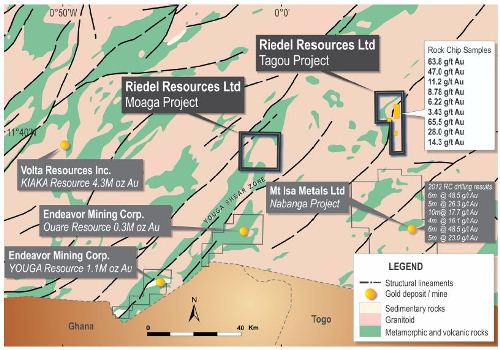
THE DRILL SERGEANT: Riedel Resources has received high-grade gold assay results from recent rock chip sampling carried out at the company’s Tagou project in Burkina Faso.

The company collected ninety-one rock chip samples over a four week period, mostly from quartz veins, during detailed sampling and geological mapping programs.


Geology and tenement map – Tagou and Moaga projects. Source: Company announcement


There has been 62 of the rock chip samples submitted to date for fire assay in Ouagadougou.

Riedel said nine of these samples returned values greater than 1 gram per tonne gold, including high-grade results of:

63.8 grams per tonne gold;

47.0 grams per tonne gold;

11.2 grams per tonne gold;

8.78 grams per tonne gold;

6.22 grams per tonne gold; and

3.43 grams per tonne gold.

In its announcement to the ASX, Riedel said its initial exploration work has clearly demonstrated that the geological and structural setting at Tagou has strong similarities to Mt Isa Metals’ high-grade gold Nabanga Prospect, located 40 kilometres to the south.

The company has indicated plans to further test the potential for the discovery of significant gold deposits at Tagou by way of testing the vein set width, depth and grade at numerous locations with a 2,000m program of RC drilling, commencing in early June 2012.

There has been no previous drilling within this tenement.

Riedel also announced the receipt of gold geochemical sample results from an auger drilling program conducted at the Gonsin project, which it said has outlined new mineralised zones that also represent new drilling targets.

Gold assay results from initial batch of auger geochemical drilling samples from the Gonsin project include 498 parts per billion gold and 394 parts per billion gold.