Peak encounters highest intersections so far at Ngualla

THE DRILL SERGEANT: Peak Resources (ASX: PEK) has received assay results from 25 new infill drill holes carried out within the central bastnaesite core of the Southern Rare Earth Zone (SREZ) at the company’s 100 per cent-owned Ngualla rare earth project in Tanzania.

The company said the results are the highest it has achieved to date at Ngualla and reconfirm the excellent grades it has previously identified at the project.

The results include the longest plus five per cent total rare earth oxide (REO) interval Peak has encountered at the Ngualla project so far of:

–    160 metres at 5.25 per cent REO from surface to end of hole.

The new drilling has reportedly intersected several continuous high-grade zones above seven  per cent REO, including:

–    24m at 7.15 per cent REO from 76m and 20m at 7.27 per cent REO from 108m;

–    12m at 7.13 per cent REO from 4m;

–    18m at 7.21 per cent REO from 8m; and

–    30m at 7.14per cent REO from 48m.

The latest round of drilling has also identified the deepest developed weathered zone of high-grade mineralisation to date, with mineralisation remaining open at a depth of 160m below surface:

–    66m at 3.06 per cent REO from surface and 36m at 3.87 per cent REO from 72m and 73m at 4.51 per cent REO from 112m to end of hole.

“Results from the infill drilling program demonstrate the continuity and consistency of high grade rare earth mineralisation from surface over substantial widths within deeply weathered carbonatite in this portion of the resource targeted for initial development,” Peak Resources said in its ASX announcement.

“The current infill drilling program in progress at Ngualla will provide the detailed data required to support feasibility studies focusing on the highest grade, near surface portion of the SREZ mineralisation targeted for first production.”

According to Peak the latest assay results have demonstrated the continued robustness of the deposit in terms of the continuity, grade and extent of the rare earth mineralisation.


Plan of new rare earth intersection highlights (new results hole
numbers labelled) and drilling completed to date coloured by maximum
down hole REO percentage, holes drilled and awaiting results and Ngualla
Mineral Resource block model (+3% REO). Source: Company announcement


Drilling is ongoing with one RC (reverse circulation) and one diamond drill rig in operation.

As of September the company had completed a total of 78 holes within the Southern Rare Earth Zone, from which there are 27 holes yet to have assays completed.

The drilling program will take several more months to complete.

Peak indicated it will calculate an updated JORC Code-compliant resource estimate once all results have been received.

MacPhersons polishes Nimbus silver lenses

THE DRILL SERGEANT: MacPhersons Resources (ASX:MRP) has continued to drill good news at the company’s 100 per cent-owned Nimbus silver-zinc-gold project located east of Kalgoorlie’s super pit gold mine.

Progressive drilling results achieved by MacPhersons has indicated both silver oxide and silver sulphide mineralisation continues between the Nimbus Discovery and East Pits.

Recent sulphide intercepts include:

–    29 metres at 202 grams per tonne silver equivalent (139g/t silver plus credits) from 176 metres, including 9 metres at 328 grams per tonne silver and 7.9 per cent zinc from 177m, including 5 metres at 164 grams per tonne silver from 200 metres;

–    7m at 561g/t silver equivalent (400g/t silver plus credits) from 196m, including 7m at 400g/t silver and 8.7 per cent zinc from 196m; and

–    4m at 110g/t silver from 190m.
 
Recent shallow oxide intercepts include:

–    9m at 302g/t silver equivalent (258g/t silver plus credits) from 81m;

–    6m at 120g/t silver from 27m; and

–    8m at 82g/t silver from 51m.

MacPhersons said these latest results show extensions to the New Lens No. 4, which the company announced last month in conjunction with a new gold zone of 2m at 54g/t gold.

There are currently two drill rigs in operation at the project, with a new diamond rig scheduled to start this week on a Geotech drillout program to determine the slope design for the proposed silver superpit.


Proposed Nimbus silver superpit. Source: Company announcement


The company said it was encouraged by the progressive results that continue to demonstrate silver mineralisation extending between and beneath both pits.

“The additional $12.6 million funding underwritten by international metal merchant, RK Mine Finance announced this week will allow MRP to extend its aggressive drilling program and order the long lead items for the three-fold gold and silver mill expansion preparations underway,” MacPhersons Resources managing director Morrie Goodz said in the company’s announcement to the Australian Securities Exchange.

Never too far away from the action, the company’s chairman Ashok Parekh pointed out that, “It is the first equity investment by RK Mine Finance (part of the Red Kite group) in an ASX-listed company, although they are a major international player in the mining and metals trade arena.”

The Nimbus silver mine originally operated from 2003 to 2007, producing 3.6 million ounces of silver at an average grade of 352g/t silver.

KBL confirms new copper-gold at Mineral Hill

THE DRILL SERGEANT: KBL Mining (ASX:KBL) has received further drilling results that it claims to confirm a new copper-gold lode directly below the current development level of its underground mining operations at Mineral Hill Mine in New South Wales.

The latest results come from an ongoing underground diamond drilling program the company is conducting with the aim of extending mining reserves below the lowest development level at 1190mRL (120 metres from surface).

The new results include:

–    3.75 metres at 7.3 per cent copper and 2 grams per tonne gold; and

–    4.45m at 8 per cent copper and 3g/t gold.

These follow previously released results that included:

–    16.1m at 3.8 per cent copper and 9g/t gold.

The company said it previously considered the Parkers Hill ore body at Mineral Hill Mine, which is currently being mined, to be restricted at depth by a shallowly west east dipping 1225 thrust.

However, it know considers the latest results to have established that the new copper-gold lode continues more than 30 metres below the current development level at 1190mRL and remains open along strike to the northeast and southwest.

This has been interpreted as a separate gold-rich style of copper mineralisation located below the 1225 thrust compared to the copper-silver rich (plus lead and zinc) Parkers Hill Resources.


Cross section showing the location of significant mineralised intervals. Source: Company announcement


“The high copper and gold grades of these intersections, directly below current mining operations, add substantial value to Mineral Hill,” KBL Mining chief executive officer Trangie Johnston said in the company’s announcement to the Australian Securities Exchange.

“Accessing this new lode is possible using current equipment and personnel at minimal additional cost and quickly.

“These results also highlight the high copper and gold prospectivity of Mineral Hill at depth.”

The on-going drilling program is aimed at depth extensions and strike extensions to the southwest.

KBL said it considers the continuity of mineralisation to the south of the recent drill intersections to be highly likely with grades of plus 10 per cent copper and plus 20g/t gold already identified from sampling in the southernmost development drive on 1190mRL.

An initial Resource will be estimated for the copper-gold lodes after completion of the drilling program.

Sheffield claims heavy mineral sands discovery at Dampier

THE DRILL SERGEANT: Mineral sands exploration play Sheffield Resources (ASX:SFX) has claimed a new discovery has been identified by drilling at the company’s Dampier heavy mineral sand (HMS) project near Derby in the Kimberley Region of Western Australia.

Labelled the Thunderbird discovery it was the first target to be drilled by Sheffield within the Dampier HMS project area.

“Few mineral sand deposits in the world can boast the width and grade of mineralisation that we are seeing in these first drill results from Thunderbird,” Sheffield Resources managing director Bruce McQuitty said in the company’s announcement to the Australian Securities Exchange.

“It’s early days, but these results confirm the potential of what appears to be a very large and high-grade heavy mineral sands deposit.”

Results from the first 24 holes ( which accounts for approximately 14 per cent of Sheffield’s first drilling program) have returned high-grade mineralised intervals of up to 42 metres in width, including:

–    33 metres at 6.3 per cent heavy minerals (HM) from surface, including 21m at 8.9 per cent HM from surface;

–    31.5m at 5.3 per cent HM from surface, including 12m at 9 per cent HM from surface;

–    28.5m at 6.1 per cent HM from 1.5m, including 16.5m at 8.7 per cent HM from 3m;

–    30m at 7.2 per cent HM from 3m, including 18m at 10.1 per cent HM from 13.5m;

–    42m at 6 per cent HM from 6m, including 25.5m at 8.2 per cent HM from 12m;

–    40.5m at 6.5 per cent HM from 13.5m, including 25.5m at 8.6 per cent HM from 19.5m; and

–    20.5m at 9.5 per cent HM from 24m.

Sheffield said this is the first major heavy mineral sands discovery to be made within the Canning Basin, and as such has claimed it to have established it as a new, under-explored mineral sands province.

The Canning Basin has recently been the subject of a pegging rush by mineral sands industry participants, with Sheffield and Iluka Resources (ASX:ILU) applying for the largest areas.


Sheffield’s tenements and those of other mineral sands explorers in the Canning Basin. Source: Company announcement


Sheffield’s landholding in the Canning Basin now totals over 2,500 square kilometres in area.

The company’s planned drilling program at Thunderbird comprises approximately 170 drill-holes for 8,000m and is scheduled to be completed by mid-September.

The stated objectives for the program are to allow estimation of a Mineral Resource and provide material for metallurgical testwork.

Sheffield also pointed to the existence of exploration upside beyond its current program at Thunderbird, saying several kilometres of strike potential have yet to be tested.

The company identified the Argo prospect, located 12km west of Thunderbird, to represent another high-priority prospect that it intends to drill in 2013.

Mineralisation at Argo was originally defined by a single scout aircore drilling traverse conducted by a previous explorer, which obtained best intersections of 12m at 3.49 per cent HM from 42m depth and 7.5m at 3.44 per cent HM from 27m depth.

Emmerson drilling reveals potential to double Goanna

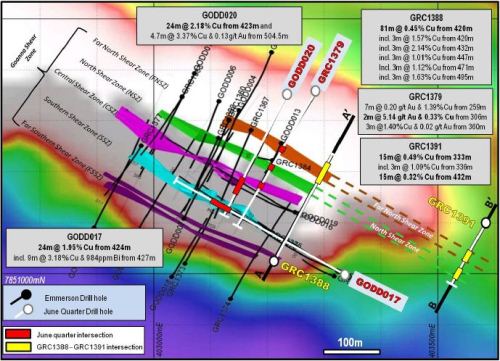
THE DRILL SERGEANT: Recent drilling completed by Emmerson Resources at the company’s 100 per cent-owned Goanna discovery has revealed two new, thick, copper intersections.

Emmerson said it considers the results demonstrate Goanna’s potential to double the strike extent of the already defined copper zones.

The company said further drilling is required to confirm the continuity of the ore body but the new holes, which were drilled 100 metres east from previous drilling now indicate a total strike extent of over 600m for the Goanna discovery.

Initial three metre composite assays from Reverse Circulation drill hole GRC1388 at Goanna East has produced intersections of:

–    81 metres at 0.45 per cent copper from 420 metres (approx. 300m below the surface), including 3 metres at 1.57 per cent copper from 420 metres and 3 metres at 2.14 per cent copper from 432 metres.

Initial 3m composite assays (table 1) from Reverse Circulation drill hole GRC1391 at the new Horner 3 prospect has produced:

–    15m at 0.49 per cent copper from 333m; and

–    15m at 0.32 per cent copper from 432m.


Goanna discovery with latest drill holes and interpreted strike potential. Source: Company announcement


“This latest drilling has the potential to add significant tonnes to the Goanna Resource,” Emmerson Resources managing director Rob Bills said in the company’s announcement to the Australian Securities Exchange.

“We remain on track to update our previously announced resource (2.46 million tonnes at 2.1 per cent copper equivalent or 5 grams per tonne gold equivalent) by first quarter in 2013.

“We believe there is excellent potential to define high-grade copper and gold ore zones as we increase the drilling density throughout the remainder of this year.

“These extensions add to the overall size of the Monitor-Gecko-Goanna complex, which now represents the largest mineralised system encountered in the Tennant Creek Mineral Field.

“We have succeeded in “cracking the code” on this new style of mineralisation that was blind to previous explorers by applying state of the art detection technology such as HeliTEM combined with an innovative exploration model.

“As such, we remain confident that further discoveries will be made and not just in the immediate Monitor-Gecko-Goanna mine environment but also further afield in the green field areas.”

Renaissance encounters high-grade drilling intercept

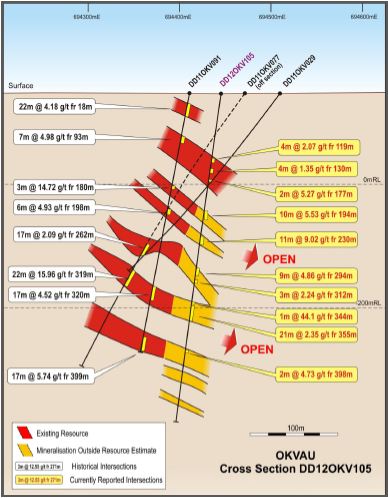
THE DRILL SERGEANT: Renaissance Minerals has received more encouraging drill results from an ongoing diamond drilling program being carried out at the company’s Okvau gold deposit in Cambodia.

The company is conducting the current drilling program to focus on step-out drilling targeting additional gold mineralisation to increase the existing Okvau gold resource estimate.

An independent JORC-compliant indicated and inferred resource estimate has already been defined at the Okvau gold deposit of 12.6 million tonnes at 1.8 grams per tonne gold for 729,000 ounces of gold.

A single diamond drill hole was drilled as a 50 metre step-out hole to the south-east of the existing resource.

Best intercepts from the single hole include:

–    2 metres at 5.27 grams per tonne gold from 177 metres;

–     10m at 5.53g/t gold from 194m;

–    11m at 9.02g/t gold from 230m;

–     9m at 4.86g/t gold from 294m;

–    1m at 44.10g/t gold from 344m; and

–    21m at 2.35g/t gold from 355m.

 “The amount of gold in this single drill hole is extremely pleasing,” Renaissance Minerals managing director Justin Tremain said in the company’s announcement to the Australian Securities Exchange.

“The existing resource estimate at Okvau already contains over 2,500 ounces of gold per vertical metre from surface to 250 metres.

“This bodes well for a modest waste-to-ore ratio.”


Okvau gold deposit cross section – DD12OKV105. Source: Company announcement


Renaissance Minerals said it considers the drill results it has released to the market to date confirm the potential its Cambodia gold project to host world class mineralisation.

It is confident the step-out drilling it has undertaken to the south-east of the Okvau gold deposit is confirming the already large gold system it has identified remains completely open at depth.

Over the coming months the company will continue working at the Cambodian project by targeting a number of satellite targets across its 1,100 square kilometres land holding.

With the onset of the wet season Renaissance will undertake a comprehensive surface geochemistry program (stream sediment sampling and soil sampling) to prepare for an aggressive drilling program testing satellite targets during the dry season.

Liontown roars into new drill program

THE DRILL SERGEANT: Liontown Resources has commenced a new program at the company’s Jubilee Reef gold project in Northern Tanzania.

The current program was undertaken on the back of results the company received from a drilling program conducted on the project in June-July this year.

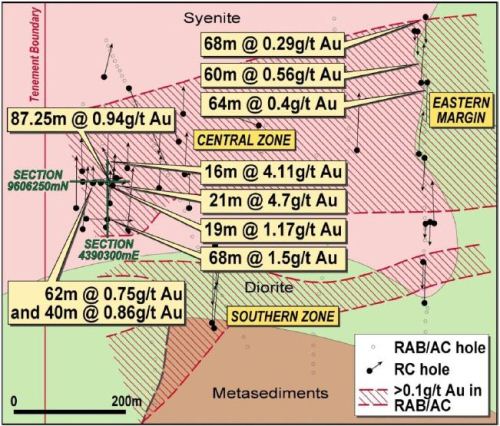
Liontown has received results from a series of ‘cross-holes’ it drilled at 90 degrees to the original drill lines in the Central Zone at the Masabi Hill prospect.

These were designed to confirm the orientation of previously reported mineralised intersections.

Results from this drilling include:

–    Up to 21 metres at 1.24 grams per tonne gold from 35 metres;

–    13m at 1.43g/t gold from 110m within broad lower grade envelopes of 62m at 0.75g/t gold from 1m; and

–    40m at 0.86g/t gold from 110m.

Liontown said the recently-drilled cross holes suggest the Central Zone mineralisation forms a pipe like structure with a steep easterly dip and a steep southerly plunge.


Masabi Hill Prospect – Drill hole plan and significant drill results. Source: Company announcement


Drilling in the Central Zone has previously defined a zone of mineralisation including:

–    27m at 2.76g/t gold from 42m (drilled in 2011);

–    21m at 4.66g/t gold from 70m (this program); and

–    68m at 1.5g/t gold from 132m (this program).

“Further work is required to resolve the variation in grade between the diamond drill holes and neighbouring RC holes, including further drilling to constrain geological and orientation factors,” Liontown Resources said in its ASX announcement.

“The results of the initial 2012 drill program suggest that, within the Central Zone syenite and marginal diorite, a gold mineralised envelope is defined over an area of 600 metres by 350 metres, which remains open to the east and north under transported cover.

“Within the Southern Zone intersections…suggest a mineralised zone that is open over 400 metres of strike, with only two drill lines testing this zone.

“Liontown is encouraged by these latest drilling results, which support previous conclusions that the Jubilee Reef project has potential to host significant widths and grades of gold mineralisation.

“A follow-up 14,000 metre drilling program has commenced, with an aircore drill rig starting on 25 August, and an RC rig expected in early September.”

Latest drilling provides Sartenga confidence for West African Resources

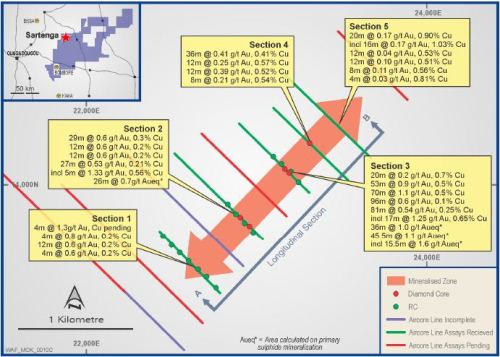
THE DRILL SERGEANT: West African Resources has reported the interception of further gold-copper mineralisation from two drill holes carried out on sections 2 and 3 at the company’s 100 per cent-owned Sartenga copper-gold discovery, which is part of the Boulsa project, located in Burkina Faso.

“SDH004 and SDH005 have confirmed a sub-vertical southeast dip for high-grade gold-copper mineralisation at Sartenga, with the high-grade mineralisation returning results over three grams per tonne gold and 1.6 per cent copper,” West African Resources managing director Richard Hyde said in the company’s announcement to the Australian Securities Exchange.

“This information is critical for targeting sulphide (primary) mineralisation in drilling beneath the oxides over 1.2 kilometres of strike commencing next month.”

According to West African diamond core hole SDH004 was drilled on Section 3 and intercepted multiple zones of gold-copper mineralisation including:

–    81 metres at 0.54 grams per tonne gold and 0.25 per cent copper from 54 metres, drilling through the oxide, transition and sulphide (fresh) zones.

This intercept included higher grade zones grading:

–    17m at 1.25g/t gold and 0.65 per cent copper from 62m and 9m at 0.72g/t gold and 0.27 per cent copper from 92m.

Diamond core hole SDH005 on Section 2, 400m southwest of SDH004, intercepted:

–    27m at 0.53g/t gold and 0.21 per cent copper from 42m, drilling through the oxide and transition zones.

This intercept included a higher grade zone of:

–    5m at 1.33g/t gold and 0.56 per cent copper from 50m.


Sartenga discovery exploration summary plan. Source: Company announcement


West African asserts the results from these two drill holes have confirmed broad zones of gold-copper mineralisation at Sartenga that are sub-vertical and that it considers this information to be critical for planning deeper drilling to target sulphide (primary) mineralisation over 1.2km strike starting next month.

The company indicated it intends fast-tracking the Sartenga discovery to resource status by end of 2012, in parallel with its Moktedu discovery.

West African also has a round of aircore drilling planned to commence in late October that will result in the completion of testing a three kilometre- plus high-tenor portion of a gold-insaprolite anomaly which remains open to the west, southwest and northeast.

The company said it anticipated this program would generate further sulphide targets.

Apollo Consolidated surfs big gold at Bombora

THE DRILL SERGEANT: Apollo Consolidated has received preliminary assays results returned from a recently-completed eight hole reverse circulation (RC) drilling program at the Bombora prospect, situated on the company’s Rebecca project, located 150 kilometres east of Kalgoorlie.

The company claims the results have confirmed potential exists for high-grade gold mineralisation at the prospect with the first five RC drillholes all intersecting wide zones of disseminated pyrite alteration in altered granodiorite and gneiss.

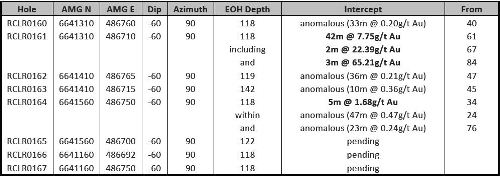
The highlight of the drilling results was an intersection received from drillhole RCLR161 of:

–    42 metres at 7.75 grams per tonne gold from 61 metres;

The intersection included two high-grade segments of:

–    2m at 22.39g/t gold from 67m; and

–    3m at 65.21g/t gold from 84m.


Bombora drillhole and intercept details. Source: Company announcement


The remaining drillholes intersected wide zones of anomalous gold typical of the Rebecca project prospects.

“The intercept in RCLR161 supports the company’s opinion that the zones of gold anomalism present within the strongly metamorphosed rocks at Rebecca are prospective for high-grade mineralised shoots,” Apollo Consolidated said in its ASX announcement.

“Whilst the drilling is too broad-spaced to allow geological interpretation the results so far demand additional drilling to define lode continuity and orientation, and are an excellent start to the Apollo’s exploration at the prospect.

“Results from the remaining holes are expected during the coming week, and planning for follow-up drilling around the RCLR161 intercept is underway.”

Castle hits further graphite at Kambale

THE DRILL SERGEANT: Drilling carried out by Ghana-focused Castle Minerals along strike of the company’s Kambale graphite deposit has intersected further high‐grade graphite.

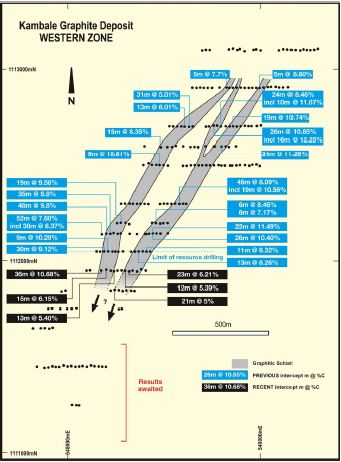
Drill intercepts from the latest round of drilling include:

–    23 metres at 6.21 per cent graphitic carbon from 5 metres;

–    12m at 5.39 per cent graphitic carbon from 10m;

–    13m at 5.40 per cent graphitic carbon from 10m;

–    15m at 6.15 per cent graphitic carbon from surface; and

–    36m at 10.68 per cent graphitic carbon from 5m.

“These are the first batch of results for drilling testing a 600 metre long zone south of the current resource and clearly extend the known graphite schist horizons,” Castle  Minerals managing director Mike Ivey said in the company’s announcement to the Australian Securities Exchange.

“It is our expectation that the Kambale resource will be materially increased as exploration continues.”

Drill hole location plan of Kambale graphite deposit with significant
graphite intercepts. Results in blue were used in the July 2012 resource
estimate whilst those in black are from new drilling testing the
southern strike extension. Source: Company announcement

Castle is conducting this current phase of drilling using its own drill rig.

Rotary air blast (RAB) samples generated from the program are being composited over 5m intervals for graphitic carbon analysis.

Upon definition of the graphite horizons RC drilling will then be carried out in order to prepare an updated resource calculation.

Castle announced a maiden Mineral Resource Estimate for Kambale of 14.4 million tonnes at 7.2 per cent graphitic carbon for 1.03 million tonnes of contained graphite, including 6 million tonnes at 8.6 per cent graphitic carbon for 0.52 million tonnes contained graphite.

Kambale ranks as one of the world’s larger global graphite deposits.

“As well as expanding the Kambale deposit, we also remain committed to the company’s core focus of building on the gold exploration successes achieved to date on our highly prospective and proven licences,” Ivey said.