Aziana commences graphite search in Madagascar

THE DRILL SERGEANT: Madagascar-focused exploration play Aziana Limited (ASX: AZK) has commenced exploration on graphite exploration licenses situated with the company’s Belanitra graphite project in the Fisoroana-Belanitra district.

The exploration permit (TN20187) comprises five tenement squares covering an area of 31.25 square kilometres.

The licensed area is held by Aziana’s wholly-owned Madagascar subsidiary, Tanety Lava, and has an environmental permit that allows for exploration to start immediately.
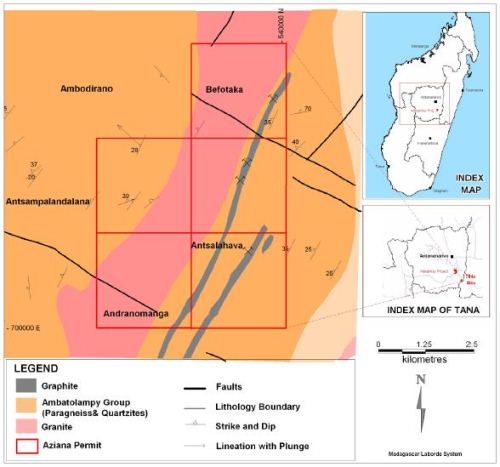
 

Geological map showing the Aziana graphite license TN20187. Source: Company announcement


According to Aziana the license lies within a region of Madagascar with a known history for mining of high quality flake graphite.

Aziana explained that Government geological reports from 1912 and 1974 described four historic graphite mines within the license area, in which the graphite is described as containing a high proportion of large flake material.

The two mines of most importance to Aziana are located on opposite limbs of a syncline.

The first of these is the Befotaka mine, which is located on the western limb in the north of the license in a sequence of weathered dipping micaschists with an original working face up to 40 metres high.

“A 150 metre-wide face has exposed four seams of graphite between 1.5 metres and 2 metres thick over a 15 metre interval each assaying approximately 30 per cent carbon,” Aziana Said in its ASX announcement.

“The schists between these high-grade seams assay between 2 per cent to 6 per cent carbon and also contain large-flake graphite.”

The second mine is the Antsahalava mine, which is located on the eastern limb in the south of the license area.

Here the graphite occurs in a dipping mica schist sequence and Aziana said geological reports describe a 7m thick graphite seam under a cover of about 8m overburden.

“The immediate exploration program has the objective of confirming the extent and quality of the graphite seams by mapping and trench sampling,” Aziana continued.

“This will be followed up by shallow diamond drilling using the company’s own GT80 rig to confirm the depth of the saprolite zone.”

Aziana shares were up 5.68 per cent to 9.3 cents in morning trade.
Axiom Mining intersects copper and gold at Cardross

THE DRILL SERGEANT: Axiom Mining (ASX: AVQ) has received assays from 99 air track percussion holes drilled by Solomons Copper Australia on the company’s 100 per cent-owned Cardross Mining Lease in North Queensland.

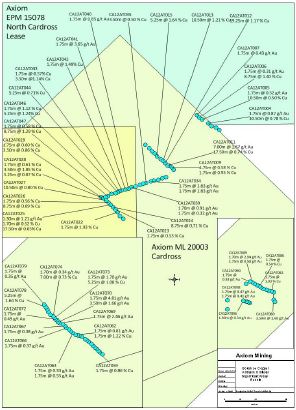
According to Axiom the drilling encountered gold and copper within shallow oxide mineralisation zone overlying massive sulphide zones the company recently discovered during a 2012 drilling program.

Copper highlights from the recent drilling include:

–    19 metres at 1.17 per cent copper from 3 metres;

–     18m at 0.74 per cent copper from 6.5m; and

–    11m at 1.21 per cent copper from 4.75m.
 
Gold highlights include:

–    7m at 1.67 grams per tonne gold from 6.5m;

–    2m at 4.81g/t gold from 3m;

–    4m at 1.60g/t gold from 13.5m; and

–    4m at 1.66g/t gold from 6.5m.

Axiom said 51 of the 99 shallow airtrack drill holes conducted by Solomon Copper had returned mineralised copper-gold intersects.


Cardross ML 20003 – Solomons Copper’s significant intersections – Drill collar locations. Source: Company announcement

“These results complement Axiom’s 2012 drilling and the information gained through geological logging will add to a maiden Resource Estimate expected this year on the Cardross Mining Lease,” Axiom Mining said in its ASX announcement.

Axiom’s current agreement with Solomons Copper is restricted to mining of the oxide zone of the Cardross Lease.

However, Axiom considers recent activity has demonstrated evidence of substantial value deeper in the massive sulphide zone as well as on some of the company’s other prospects including the Mountain Maid Resource.

The company indicated it is now in further negotiations with Solomons Copper regarding possible future mining operations on Cardross and Axiom’s other prospects.

“Solomons Copper Australia has requested to amend the agreement to provide for a greater area of the project,” Axiom said.

“This is to enable greater resources allocated to accelerate assessment of the viability of a satellite mining operation.

“Axiom has agreed to a time extension to negotiate amending the agreement. Currently no mining is occurring until an amended agreement is reached.”

Rox Resources launches EM Survey at Fisher East

THE DRILL SERGEANT: Rox Resources (ASX: RXL) has commenced an electro-magnetic (EM) survey at the Fisher East nickel sulphide discovery.

Fisher East forms part of the company’s Mt Fisher project, located north of Kalgoorlie in Western Australia.

The company conducted Reverse Circulation (RC) drilling in December 2012.

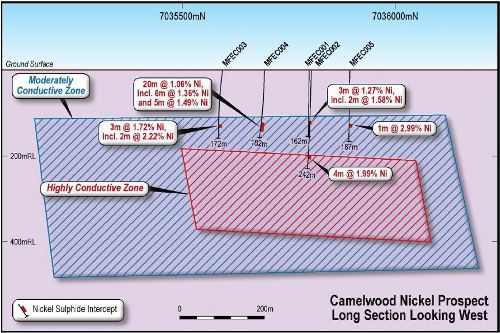
This program included five holes drilled at the Camelwood prospect, all of which the company said intersected semi-massive and disseminated nickel sulphide mineralisation covering a strike length of 300 metres and up to 200 metres vertical depth.


RC long section – Camelwood prospect. Source: Company announcement


Rox also claimed assays it released last week confirmed earlier portable XRF analyses while identifying Camelwood as a new nickel sulphide discovery.

“We are applying a disciplined and systematic approach to define these nickel sulphide targets and identify new conductors on our tenements,” Rox Resources managing director Ian Mulholland said in the company’s announcement to the Australian Securities Exchange.

“We are highly encouraged by the results from Camelwood, and believe Fisher East has the potential to host a very large mineralised system.”

The new ground EM survey is using a fixed loop configuration to map out what Rox considers to be a prospective nickel-sulphide bearing horizon along eight kilometres of strike.

This includes the Corktree and MFA_01 VTEM anomalies, which lie along strike from Camelwood.

The company said it expects to commence further drilling in mid-February.

Taruga Gold extends Kossa project

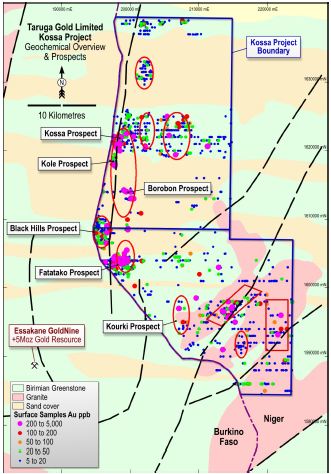
THE DRILL SERGEANT: Taruga Gold (ASX: TAR) has encountered further near-surface gold mineralised intersections at the Borobon prospect, located within the company’s Kossa project in Niger, West Africa.

The latest results are from a reverse circulation (RC) drilling campaign targeting the Kossa-Borobon gold mineralised trend.

Taruga said the drilling is part of an ongoing exploration campaign at the Kossa project, which is targeting the Borobon prospect with the aim of continuing to define extensions to zones of gold mineralisation.

Taruga completed 35 RC drill holes in November and December 2012.

Results from this drilling include:

–    5 metres at 3.16 grams per tonne gold from 2 metres;

–     9m at 1.74g/t gold from 26m;

–    4m at 2.26g/t gold from 106m;

–    8m at 1.21g/t gold from 76m; and

–    5m at 1.01g/t gold from 141m;

Taruga said the results confirm gold mineralisation at Borobon where its maiden drilling campaign returned results including:

–    12m at 3.35g/t gold from 9m;

–    12m at 2.23g/t gold from 15m;

–    10m at 1.13g/t gold from 29m; and

–    2m at 19.97g/t gold from 84m.


Kossa project location and historic geochemical samples highlighting gold anomalous zones. Source: Company announcement


“Taruga continues to achieve success with each exploration program at our exciting Kossa project in Niger,” Taruga Gold executive chairman Bernard Aylward said in the company’s announcement to the Australian Securities Exchange.

“We have maintained a busy exploration program during our first year of listing (February 2012) – including an exhaustive campaign in the past three months of RC and aircore drilling at the Borobon prospect and an extensive aeromagnetic survey covering the entire project.

“We will now continue to maintain our aggressive exploration program with the aim of completing a maiden Mineral Resource estimate for the Borobon and Kossa prospects in the first half of 2013.

“The new results highlight the extensive gold mineralised system at Borobon, with multiple mineralised lodes that remain open along strike and at depth.

“Drilling is still wide-spaced at this early stage and we continue to expand the system.

“We will re-commence RC drilling in January focusing on defining the extent of the gold mineralisation and targeting additional mineralisation structures highlighted by our exploration work.”

Taruga said gold mineralisation has been confirmed for a strike length exceeding 2.5 kilometres.

The company indicated additional drilling is required to define the extent of the system.

The re-commencement of RC drilling at Borobon in January will entail a program designed to extend structures, target depth extensions and determine continuity of mineralisation.

This work will be conducted in preparation for a maiden resource estimate the company anticipates to be completed in the first half of 2013.

Riedel Resources encounters wide copper anomalies in first pass drilling

THE DRILL SERGEANT: Riedel Resources (ASX: RIE) has encountered wide, anomalous copper intercepts over broad areas from first-pass drilling within high-priority geochemical targets at the company’s Marymia project.

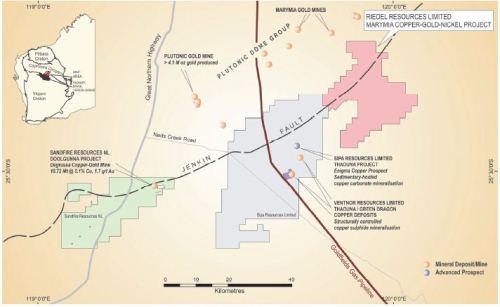
The Marymia project is located east of Barrick’s 4.7 million ounce Plutonic gold mine, north-east of Sandfire Resources’ (ASX: SFR) DeGrussa copper-gold mine and east-north-east of Ventnor Resources’ (ASX: VRX) Green Dragon and Thaduna copper deposits in the Mid-West region of Western Australia.


Marymia project – location map. Source: Company announcement


The company said it had received a number of elevated assay results for copper and associated minerals (silver, molybdenum and lead) situated either beneath or near large, previously identified surface geochemical anomalies from four targets in the southwest and eastern portions of the project area.

Highlights of the drilling program include:

–    Elevated assay results for copper in 29 of 47 holes drilled within targets 12, 13 and 16;

Drilling at Target 12 returned:

–    30 metres at 228 parts per million copper from 5 metres, including 5 metres at 589 parts per million copper;

–    29m at 143ppm copper from 10m to end of hole, including 5m at 5.31 grams per tonne silver; and

–    25m at 264ppm copper from 10m, including 5m at 534 ppm copper.

Target 13 results included:

–    15m at 108ppm copper from 55m to end of hole, including 7m at 18.2ppm molybdenum, 1.64g/t silver to end of hole;

–    4m at 125ppm copper, 23ppm molybdenum, 1.14 g/t silver from 130m to end of hole; and

–    25m at 141ppm copper from 125m to end of hole.

Target 16 yielded:

–    35m at 125ppm copper from 55m;

–    18m at 151ppm copper from 30m to end of hole; and

–    20m at 132ppm copper from surface and 10m at 209ppm copper from 80m to end of hole.

“These first-pass drilling results are considered to be very promising and clearly validate the geochemical “pathfinder” sampling methodology previously adopted by the company,” Riedel Resources said in its ASX announcement.

“The targets were identified by ranking numerous multi-element soil geochemical pathfinder anomalies and tested by first-pass, mostly shallow RAB and aircore blade drilling.

“These results strongly imply that the surface geochemical target areas are indicative of subsurface alteration systems, probably due to the circulation of metalliferous hydrothermal fluids.”

Riedel pointed out that many of the most promising intercepts it encountered for copper, molybdenum, silver and lead are open-ended and were limited at depth only by the blade drilling technique being unable to penetrate hard rock bands or fresh rock.

The company indicated it now considers follow-up exploration work, including electromagnetic geophysical surveys and deep RC drilling is warranted to accurately define structural trends and primary mineralised conductors, which it hopes may indicate the presence of significant, proximal precious/base metals mineral deposits.

Aphrodite Gold confirms new gold potential

THE DRILL SERGEANT: Aphrodite Gold (ASX: AQQ) has been encouraged by gold results it has received from maiden exploration drilling programs being conducted over the Stubby Tail and Blue Tongue prospects located close to the company’s Aphrodite gold deposit, north of Kalgoorlie in the Eastern Goldfields of Western Australia.

A Pre-Feasibility Study is currently underway at the Aphrodite deposit.

Both Stubby Tail and Blue Tongue lie within the Scotia project tenements which Aphrodite farmed into with Breakaway Resources (ASX: BRW) in June 2011.

Under the terms of the JV Agreement Aphrodite Gold can earn up to 80 per cent of the gold rights in the Scotia tenements – so far it has earned a 51 per cent interest.

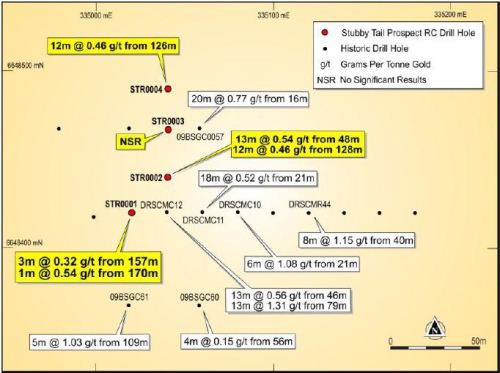
Four Reverse Circulation (RC) were recently completed at the Stubby Tail prospect.

Gold intercepts from this drilling included:

–    13 metres at 0.54 grams per tonne gold from 48 metres;

–    12m at 0.46g/t gold from 128 metres; and

–    12m at 0.46g/t gold from 126m.

“The most recent and historic drill results at Stubby Tail are significant in that they confirm the presence of a well-developed zone of bedrock gold mineralisation and associated alteration over a considerable area,” Aphrodite Gold said in its ASX announcement.


Stubby Tail gold prospect – drill hole locations and results. Source: Company announcement


Three RC holes conducted at the Blue Tongue gold prospect returned intersections including:

–    4m at 1.85g/t gold from 138m and 6m at 0.81g/t from 113 metres.
 
“Drill results indicate that gold mineralisation is related to pyrite alteration within a broad shear zone,” Aphrodite said.

Aphrodite said the recent and historic drilling it has undertaken to date demonstrates potential to delineate moderate grade gold mineralisation within structurally controlled positions.

To this end the company indicated it has further exploration work planned over both the Stubby Tail and Blue Tongue prospects, as well as other gold targets within the Scotia tenements, following further review and interpretation of results.

Metals X extends Renison ore system

THE DRILL SERGEANT: Underground exploration activity being conducted by Metals X (ASX: MLX) at the company’s 50 per cent-owned Renison tin mine in Tasmania has defined new zones of high-grade tin mineralisation beyond the boundaries of the current resource.

Metals X said the ongoing work has also highlighted opportunities above existing development, which were unrecognised by previous operators.

The company considers the latest developments provide it with the opportunity for rapid conversion to reserve.

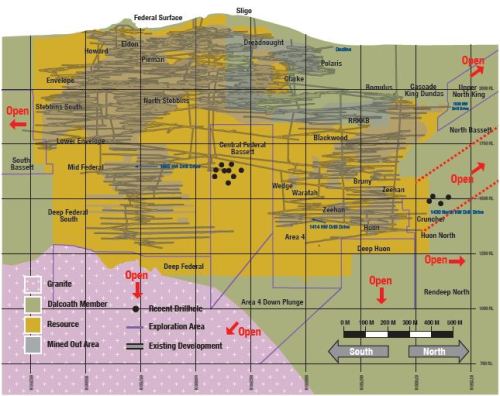
In the North Renison area an extensional program targeting additions to the Huon North Zone intercepted mineralisation up to 90 metres along-strike from the current resource boundary.

The best result achieved was:

–    10.53 metres at 5.24 per cent tin.

Huon North remains open both along-strike and up-plunge.

In the Central Federal Bassett (CFB) area, Metals X indicated resource definition drilling has continued to return strong results including:

–    4.18m at 5.26 per cent tin.

The company said this result had reinforced its belief a new, independent production area, located 20 metres from existing decline infrastructure will be delineated with ongoing work.


Renison overview showing location of recent drilling. Source: Company announcement


“These results follow-on from the announcement of October 25, 2012 which detailed the definition of strong stratabound skarn style mineralisation on the down-thrown hangingwall of the Federal Bassett Fault to the north of, and outside of the known mineral resource,” Metals X said in its ASX announcement.

“This ongoing exploration success clearly demonstrates the significant upside potential at Renison, which remains Australia’s only world class tin deposit and is Australia’s only tin producer.”

Kibaran receives confidence boost from Epanko drilling

THE DRILL SERGEANT: Kibaran Resources (ASX: KNL) has released assay results from four Reverse Circulation (RC) drill holes recently-completed at the Epanko prospect within the company’s Mahenge graphite project in Tanzania.

The company said the assay results have confirmed all four holes intercepted additional high-grade graphite intersections.

Noteworthy intersections include:

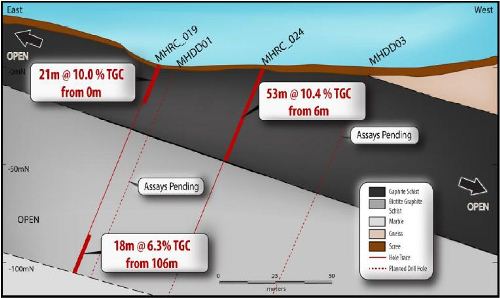
–    14 metres at 10.2 per cent Total Graphitic Carbon (TGC) from 1 metre within 189 metre at 5.1 per cent TGC from surface (note: 15m to 20m Pending);

–    9m at 10.0 per cent TGC from 11m within 156m at 4.8 per cent TGC from 3m;

–    17m at 7.3 per cent TGC from 81m and 8m at 11.6 per cent TGC from 103m within 144m at 5.1 per cent TGC from 39m; and

–    37m at 7.2 per cent TGC from 107m and 33m at 8.0 per cent TGC from 135m within 164m at 5.1 per cent TGC from 61m.

Kibaran said the new assay results complement data the company has previously reported for the Epanko project area.


Epanko prospect – Geological interpretation showing high-grade graphite intersections at surface. Source: Company announcement


“The consistency of high-grade assay results confirms the continuity and extent of high-grade graphite mineralisation in the Epanko project area,” Kibaran Resources said in its ASX announcement.

“The mineralisation remains open in all directions.”

Kibaran has commenced a further six hole diamond drilling program , which includes Epanko and the Ndololo prospect.

Three of these holes planned for Epanko have already been completed and assay results are pending.

Kibaran indicated graphite mineralisation has been encountered in all three holes.

AusAmerican confirms copper mineralisation in Arizona

THE DRILL SERGEANT: Australian-American Mining Corporation (ASX: AIW) kicked off its first exploration program over the company’s recently-acquired Bluebell and De Soto VMS projects located in Arizona, United States of America.

After acquiring the projects in August 2012 AusAmerican commenced work in October, which included geological mapping, channel sampling, the purchase of a data package, and the staking of new ground.

 The October 2012 sampling program included 15 channel samples, which the company said outlined surface mineralisation in the Yavapai Schist which is host to the Bluebell mine.

The sampling returned zones of gold and silver mineralisation as well as copper mineralisation the company anticipated to see.

The best intercepts included:

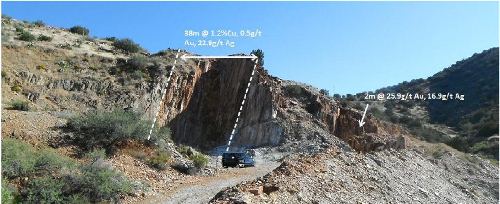
–    38 metres at 1.2 per cent copper, 0.51 grams per tonne gold, and 22.9 grams per tonne silver;

–    22m at 0.45 per cent copper and 2.9g/t silver; and

–    13m at 0.86 per cent copper and 4.6g/t silver.


38m wide outcrop of copper/gold/silver mineralisation at Bluebell. Source: Company announcement


The company also purchased a data package containing maps, reports, and cross sections of previous work in October 2012, which included a good deal of information for the projects, including:

–    83 drill holes for 3747.8m (75 underground and 8 regional);

–    Underground mine plans and sampling information;

–    799 soil samples;

–    Ground magnetic surveys;

–    EM profiles and interpretations; and

–    Geological mapping.

“To be able to access this amount of data, much of it over 80 years old, is quite rare with resource projects in the USA and has provided invaluable information to our technical team as they review the material,” AusAmerican Mining said in its ASX announcement.

“The review continues to greatly assist the company in planning the initial drilling program.”

AusAmerican indicated it has been able to identify a new copper VMS target from the data package on the ground it has recently staked one kilometre north of the Bluebell mine.

The soil samples show a 700m long anomaly of over 100 patrs per million copper.

The average copper grade within the anomaly is 413ppm with a highest value of 1,262ppm and the anomaly is open towards the south.

The company’s 2013 program will follow-up on the results of the 2012 surface exploration with 5,000m of RC drilling planned to test the stock work zones of the Bluebell mine.

The drilling contract has been signed and the drill rig is expected to arrive on site late January.

Stonehenge Metals receives drilling approval in Korea

THE DRILL SERGEANT: Stonehenge Metals (ASX: SHE) has received approval from the East District of Daejon Metropolitan City Council in Korea to create access roads for the purpose of commencing an initial 12 hole diamond drill program at the company’s Daejon project.

In July 2012 the company announced it had secured land access agreements for the project.


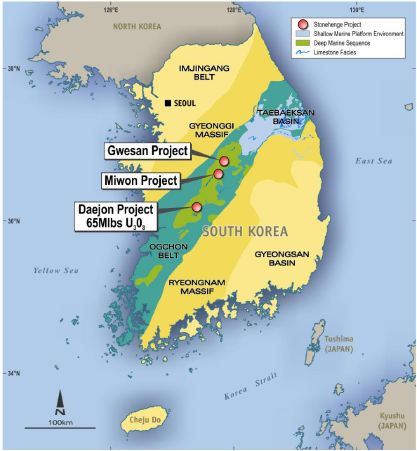
South Korean project locations. Source: Company announcement


Stonehenge said the recent approval from the East District means it can now finalise details for an upcoming drill program.

The company intends conducting the drilling to confirm historical uranium drill results it already has access to by twinning previus drill holes.

It also expects it will be able to upgrade the resource at Daejon to the next category while also establishing a maiden vanadium resource.

“There have been a number of administrative hurdles to overcome in securing this approval,” Stonehenge Metals chairman Richard Henning said in the company’s announcement to the Australian Securities Exchange.

“However, we are pleased that we can now work on the Daejon project with the support of the local Government, and we look forward to accelerating our progress.”