


Riedel Resources encounters wide copper anomalies in first pass drilling
THE DRILL SERGEANT: Riedel Resources (ASX: RIE) has encountered wide, anomalous copper intercepts over broad areas from first-pass drilling within high-priority geochemical targets at the company’s Marymia project.
The Marymia project is located east of Barrick’s 4.7 million ounce Plutonic gold mine, north-east of Sandfire Resources’ (ASX: SFR) DeGrussa copper-gold mine and east-north-east of Ventnor Resources’ (ASX: VRX) Green Dragon and Thaduna copper deposits in the Mid-West region of Western Australia.
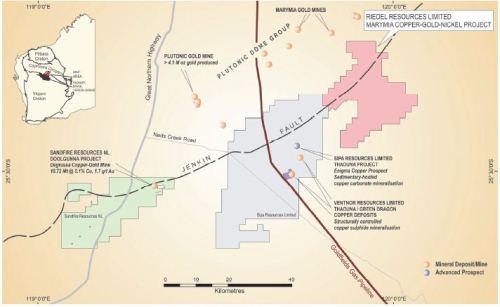
Marymia project – location map. Source: Company announcement
The company said it had received a number of elevated assay results for copper and associated minerals (silver, molybdenum and lead) situated either beneath or near large, previously identified surface geochemical anomalies from four targets in the southwest and eastern portions of the project area.
Highlights of the drilling program include:
– Elevated assay results for copper in 29 of 47 holes drilled within targets 12, 13 and 16;
Drilling at Target 12 returned:
– 30 metres at 228 parts per million copper from 5 metres, including 5 metres at 589 parts per million copper;
– 29m at 143ppm copper from 10m to end of hole, including 5m at 5.31 grams per tonne silver; and
– 25m at 264ppm copper from 10m, including 5m at 534 ppm copper.
Target 13 results included:
– 15m at 108ppm copper from 55m to end of hole, including 7m at 18.2ppm molybdenum, 1.64g/t silver to end of hole;
– 4m at 125ppm copper, 23ppm molybdenum, 1.14 g/t silver from 130m to end of hole; and
– 25m at 141ppm copper from 125m to end of hole.
Target 16 yielded:
– 35m at 125ppm copper from 55m;
– 18m at 151ppm copper from 30m to end of hole; and
– 20m at 132ppm copper from surface and 10m at 209ppm copper from 80m to end of hole.
“These first-pass drilling results are considered to be very promising and clearly validate the geochemical “pathfinder” sampling methodology previously adopted by the company,” Riedel Resources said in its ASX announcement.
“The targets were identified by ranking numerous multi-element soil geochemical pathfinder anomalies and tested by first-pass, mostly shallow RAB and aircore blade drilling.
“These results strongly imply that the surface geochemical target areas are indicative of subsurface alteration systems, probably due to the circulation of metalliferous hydrothermal fluids.”
Riedel pointed out that many of the most promising intercepts it encountered for copper, molybdenum, silver and lead are open-ended and were limited at depth only by the blade drilling technique being unable to penetrate hard rock bands or fresh rock.
The company indicated it now considers follow-up exploration work, including electromagnetic geophysical surveys and deep RC drilling is warranted to accurately define structural trends and primary mineralised conductors, which it hopes may indicate the presence of significant, proximal precious/base metals mineral deposits.