First drilling by Genesis Minerals highlights Argentina gold potential

THE DRILL SERGEANT: Genesis Minerals (ASX: GMD) has claimed the first drilling campaign conducted at the company’s Las Opeñas project in Argentina has discovered wide zones of gold mineralisation with silver, lead and zinc.

The company said the results support its conviction Las Opeñas could potentially host a multi-million-ounce gold deposit in a large epithermal system.

Genesis also indicated it considers recent rock chip samples and mapping confirm potential for narrow, high-grade veins within this system.

These veins, which Genesis said will be drill tested as part of an exploration program to be carried out in the New Year, would boost the economics of a bulk-tonnage operation.
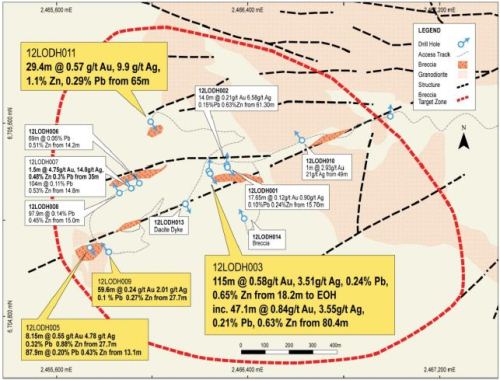
 

Las Opeñas drill hole locations and results. Source: Company announcement


In the recently-completed first drilling program, a wide zone of gold mineralisation was intersected, with analytical results including:

–    115m at 0.58g/t gold, 3.5g/t silver, 0.24 per cent lead and 0.65 per cent zinc from 18m to end of hole, including 47.1m at 0.84g/t gold, 3.5g/t silver, 0.21 per cent lead and 0.63 per cent zinc from 80.4m.

A further hole intersected:

–    29.4m at 0.57g/t gold, 9.9g/t silver, 0.29 per cent lead and 1.1 per cent zinc from 65m.

“Our first program of drilling at Las Opeñas confirmed the excellent potential of this project,” Genesis Minerals managing director Michael Fowler said in the company’s announcement to the Australian Securities Exchange.

“This potential is demonstrated by the wide zones of gold mineralisation returned in the limited drilling completed so far, as well as the numerous high-grade structural targets that are untested at Las Opeñas.”

Genesis mentioned exploration planned for next year will be targeted at rapidly and systematically testing the breccia and high–grade vein systems at Las Opeñas with the aim of confirming the significance of the epithermal mineralisation at the project.
Silver Lake targets Mount monger increase from Lorna Doone and Spinifex deposits.

THE DRILL SERGEANT: Silver Lake Resources (ASX: SLR) has received assay results from ongoing exploration being carried out at the company’s Mount Monger Operations.

The latest activity has taken place at the Lorna Doone and Spinifex deposits, which are located approximately two kilometres south east of the Daisy Milano mine.

According to Silver Lake, the Lorna Doone and Spinifex deposits were both mined as separate open pit deposits in 1993 with combined production of 24,800 ounces at 2.52 grams per tonne gold.


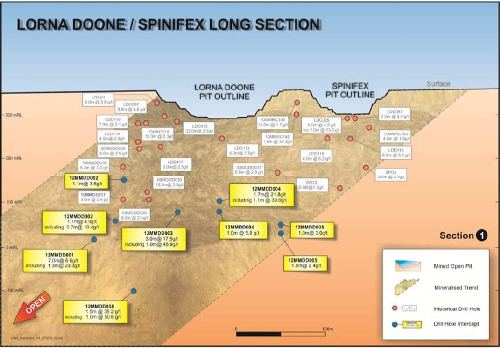
Schematic long section of Lorna Doone and Spinifex showing
current and historic drilling below the previously mined open pits.
Source: Company announcement


Silver Lake has received assay results from six diamond drill holes, which targeting the extension zones.

The drilling intercepted high-grade gold mineralisation with the deepest hole to date intersecting:

1.5 metres at 36.2 grams per tonne gold, including 1 metre at 50.6 grams per tonne gold at a vertical depth of around 400 metres below the previously mined open pits.

These drill holes are outside of the current resource at Lorna Doone.
Silver Lake is targeting to increase production from the Mount Monger Operations to 200,000 ounces per annum by 2014 via mining from multiple underground and open pit ore sources.

The company’s Mount Monger Operations have a current JORC resource of 7.1 million tonnes at 7.4g/t gold for 1.7 million ounces of gold.

Horseshoe Metals extends Kumarina mineralisation

THE DRILL SERGEANT: Horseshoe Metals (ASX: HOR) has completed its latest phase of Reverse Circulation percussion drilling at the company’s 100 per cent-owned Kumarina copper project in Western Australia.

The latest round of drilling at Kumarina was completed on 2 December 2012 and focused on in-fill and step-out holes at the Rinaldi Prospect with 27 holes drilled.


Rinaldi drill hole location plan. Source: Company announcement


KRC120 was drilled as an in-fill hole to test for copper mineralisation near the historic Rinaldi shaft.

The hole intersected a 5three metre wide void at 22m to 25m down hole depth from the historical mining with copper mineralisation encountered either side of the void including:

–     1 metre at 5.9 per cent copper (21m -22m) and 6 metres at 2.5 per cent copper (25m – 31m), including 3 metres at 4.8 per cent copper.

Further south KRC118 was drilled through the fault zone intersecting a 23 metre zone of intermittent copper mineralisation.

The best interval in this hole was:

–    5m at 1.9 per cent copper (30m – 35m), including 2m at 4.1 per cent copper and 6m at 3.5 per cent copper (42m – 48m), including 2m at 9.1 per cent copper.

Approximately 120 metres to the south of the Rinaldi shaft, hole KRC051 – which was drilled in 2011 – was extended from 71m to 137m depth, testing for a southerly extension of copper mineralisation.

The KRC051 extension intersected some low grade copper mineralisation, including:

–    1m at 0.5 per cent copper (113m – 114m).

A further hole, KRC116 was drilled below KRC051, intersecting:

–    4m at 2.2 per cent copper (106m – 10m), including 1m at 4 per cent copper.

“The intersecting of copper mineralisation in KRC116 is significant in demonstrating that copper mineralisation continues to the south within the fault zone,” Horseshoe Metals said in its ASX announcement.

“The ground below KRC116 remains untested for further copper mineralisation.”

The company indicated it had recorded intervals of copper in three of the seven remaining holes drilled in the immediate Rinaldi prospect area.

The samples from the remaining sixteen holes (KRC126 – KRC141) are anticipated to be available for release shortly.

Horseshoe Metals declared a JORC compliant mineral resource estimation of the Rinaldi prospect will be completed once all laboratory analysis work is completed.

Robust Resources intersects high-grade manganese on Romang Island

THE DRILL SERGEANT: Robust Resources (ASX: ROL) has continued to encounter high-grade manganese mineralisation near surface at its Romang Island project in eastern Indonesia.

The company has received results for three recent holes, which it specifically drilled to target manganese mineralisation.

Each of these holes intersected significant widths and grades of manganese including high-grade zones over significant widths, such as:

–    26.7 metres at 40.5 per cent manganese from surface, including 2.5 metres at 56.9 per cent manganese from 5.9 metres, 9.5 metres at 56.6 per cent manganese from 12.9 metres, and 2 metres at 59 per cent manganese from 16.9 metres.

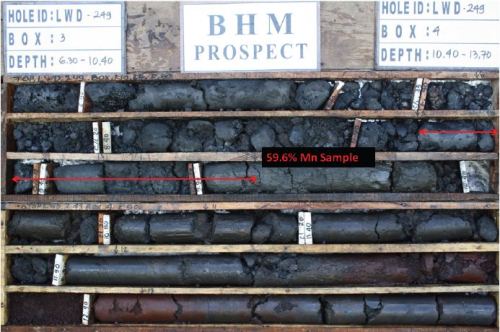
–    14.2m at 48.0 per cent manganese from surface, including 6m at 56.4 per cent manganese from 6m, including 1m at 59.6 per cent manganese from 9m; and

–    21.1m at 37.5 per cent manganese from surface, including 9.2m at 48.6 per cent manganese from 11.9m, including 5.1m at 53.1 per cent manganese from 11.9m.

Robust said the mineralisation in the Manganese Valley remains open in three directions with evident consistency of manganese mineralisation from hole to hole.

The company is now waiting on assays from a further 11 holes, many of which it claims showed visible manganese mineralisation in the drill core.


Core tray containing high-grade manganese assay. Source: Company announcement


A drilling program of shallow holes is ongoing to test the extent of the manganese mineralisation.

“While our primary focus is on expanding our gold, silver and base metals resource on Romang Island through ongoing exploration, the strong results from our exploration efforts at Manganese Valley present Robust with a new opportunity,” Robust Resources managing director Gary Lewis said in the company’s announcement to the Australian Securities Exchange.

“Given the very strong assay results, and the success from previous exploration efforts focused on manganese, we have now designed an exploration program specifically to target manganese mineralisation.

“The results for the first 3 holes in this new program are very encouraging and have produced some very high-grade assays.

“The theoretical maximum manganese content for pure manganese dioxide is 63 per cent and our peak assay of 59.6 per cent manganese approaches that purity.

“This gives us every confidence that we have a high-grade deposit at Manganese Valley.

“These results are a further indication of the prolific mineralisation on Romang Island, and given our very strong funding position of more than $26 million of cash and receivables, we have the financial flexibility to fast-track our manganese exploration efforts on Romang in 2013.”

IronClad claims new DSO discoveries at Wilcherry Hill

THE DRILL SERGEANT: Ironclad Mining (ASX: IFE) is currently drilling two, previously untested, prospects situated adjacent to the company’s Wilcherry Hill project in South Australia.

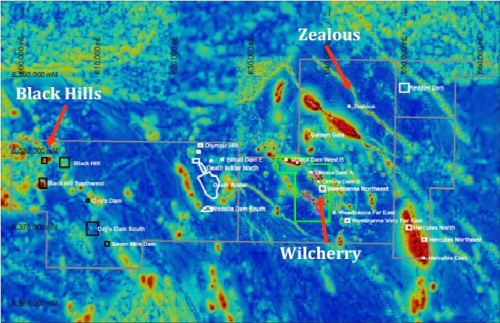
The company said it has encountered continuous near surface Direct Shipping Ore (DSO) Goethite/Hematite at the Zealous and Black Hills West prospects.

Both Prospects are located within the Joint Venture exploration licence between Ironclad 80 per cent and Trafford Resources (ASX: TRF) 20 per cent.


Locality of Zealous and Black Hills West to Wilcherry Hill. Source: Company announcement


IronClad kicked off the drilling program in November with the intent of identifying additional, near surface DSO in order to reduce mining and processing costs.

The Zealous and Black Hills West prospects were previously identified within the Wilcherry Hill project area as containing outcropping material suitable for DSO – but remained untested by drilling.

They have now been collectively subjected to 1122m of drilling in 26 holes.

“We are very pleased with the drilling results received, to date, from the Zealous and Black Hills West prospects as we previously identified these targets to host mineralisation suitable for DSO,” Ironclad mining acting CEO Robert Mencel said in the company’s announcement to the Australian Securities Exchange.

“These results validate not only our corporate strategy to build on our existing near surface resource but also the prospectivity of the Wilcherry Hill project area in general.

“This is an exciting time for IronClad, as we build our DSO base, and we are looking forward to updating the market frequently as we progress forward.”
IronClad is now waiting to receive further results to enable it to plan additional drilling programs for Zealous and Black Hills West to delineate the size and extent of the mineralisation.”

Ironclad will also be undertaking an additional exploration drilling program at the Hercules project, which is located approximately 15km from the Wilcherry Hill project.

The company explained Hercules is known to host large iron ore mineralisation in considers to be conducive to DSO with a historic target of 193.9 million tonnes at 27.11 per cent iron.

To further define and potentially increase the known DSO resource at the Hercules project Ironclad will conduct an additional 2,000m drilling program.

Ventnor Resources hits best intersection to date at Thaduna/Green Dragon

THE DRILL SERGEANT: Ventnor Resources (ASX: VRX) has received drill results it claims has confirmed the highest grade intersection it has achieved to-date at the company’s Thaduna/Green Dragon copper project in Western Australia.

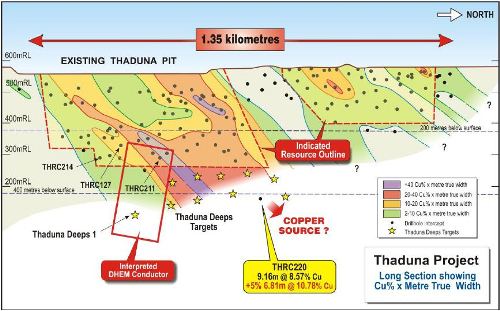
The company said the results support visual indications it reported from a deep drilling program in November while confirming an intersection of strong bornite mineralisation over 11 metres.

Ventnor is currently conducting a program of deep drilling at the project, which is aimed at producing a copper resource below the current open pit models.

Source: Company announcement

The Thaduna / Green Dragon project is located in the Doolgunna district, 170km north of Meekatharra and 40km east of Sandfire Resources’ (ASX: SFR) DeGrussa project.

Managing Director Bruce Maluish said the latest assay results confirm the best diamond core intersections from the project, including the single highest grade received to date.

“This intersection confirms that we now have continuous copper mineralisation from surface to approximately 440 vertical metres below surface, and supports our understanding of the mineralisation profile and structural controls of this typical hydrothermal copper mineralised system,” Ventnor Resources managing director Bruce Maluish said in the company’s announcement to the Australian Securities Exchange.

“We don’t believe this is an isolated intersection and expect this style of mineralisation to continue down plunge.

“Drilling is still underway into this zone and these drill results will underpin a resource below the expected open cut pit, to be accessed by underground mining.”

Ventnor indicated it will be suspending drilling at the project for the Christmas break in mid-December 2012 and recommence mid-January 2013 when a further six holes have been planned to be drilled into the high grade shoot.


Orinoco Gold confirms Brazilian mineralisation

THE DRILL SERGEANT: Orinoco Gold (ASX: OGX) has received the first assay results from a maiden diamond drilling program currently underway at the company’s Curral de Pedra gold project in central Brazil, which it claims have confirmed the continuity of mineralisation over 620 metres down dip.

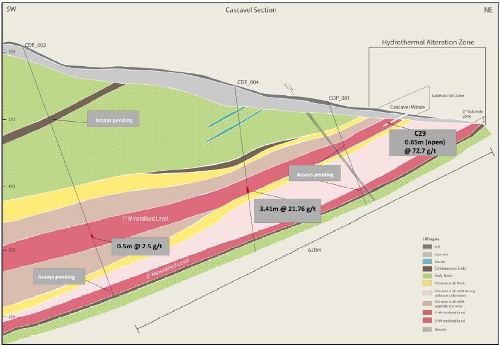
Orinoco indicated the assays it has received to date from the first three holes cover only one of three known mineralised zones at Curral de Pedra’s Cascavel target, which is known as the First Mineralised Level.


Section showing reported channel and drill results. Source: Company announcement


Assays from the other zones are pending.

Intersections from this zone include 3.41 metres at 21.76 grams per tonne gold, including 0.66 metres at 193.69 grams per tonne gold.

Previous channel samples from historic workings on this level returned samples of 0.65m at 72.7g/t gold.

“While we are delighted to have an intersection of more than three metres grading over 21 grams per tonne gold in one of our first ever holes at the project, the key message from these results is that the scale of the mineralisation at Cascavel is shaping up to be very substantial,” Orinoco Gold managing director Mark Papendieck said in the company’s announcement to the Australian Securities Exchange.

“It is early days in this exploration program, but all the results received to date support our over‐arching belief that Cascavel has the potential to be an extremely large gold system characterised by structurally controlled quartz veins hosting high‐grade mineralisation.”

Orinoco explained its primary objective for the ongoing drilling program has been to establish the continuity of the mineralisation over the 620m down dip extent of the structure, which it claims has now been achieved, and along its 500m strike length.

The company said it intends its next report of assay results will occur once it has received a more representative number of results, which it anticipates happening by late January 2013.

The ongoing drilling program aims to achieve three objectives:

–     First, to ‘infill’ drill within the currently known 500m by 620m zone encompassing the First and Second Mineralised Levels;

–     Second, to establish the continuity of mineralisation within additional sulphide zones intersected in recent drilling above the First Mineralised Level; and

–    Third, to test the interpreted 1.5 kilometre strike extension to all three structures.

Papillon encounters further high-grade gold at Fekola

THE DRILL SERGEANT: Papillon Resources (ASX: PIR) has received the latest results from a 2011/2012 drilling program undertaken at the company’s Fekola project, located in south western Mali.

The Project currently hosts a Mineral Resource Estimate comprising 40.1 million tonnes at 2.4 grams per tonne gold for a contained 3.14 million ounces of gold at a lower cut-off grade of 1.0 grams per tonne gold.


Regional geology, gold deposits and Papillon tenements. Source: Company announcement


Papillon has received the results of an additional 59 diamond drill holes, which it considers to have further demonstrated the continuity of gold mineralisation, in terms of thickness and grade, between the previous broader spaced holes within the resource area.

Thick zones of high grade mineralisation have been recorded in this drilling with better intersections including:

–    66 metres at 8.06 grams per tonne gold;

–    105m at 4.88g/t gold;

–     107m at 3.84g/t gold; and

–    64m at 5.12g/t gold;

The company outlined the results of this drilling program are to now be incorporated into a revised MRE with a view to upgrading the resource classification of the current, predominantly Inferred MRE to the higher confidence categories.

The revised MRE is anticipated to be completed in the first quarter of 2013 and will form the basis for the Project’s Pre-Feasibility Study.

“The 2012/2013 drilling program is now underway, with three diamond drill rigs currently in operation, and a further rig due to arrive on site this week,” Papillion Resources explained in its ASX announcement.

“This program will be focussed on aggressively expanding the MRE (extending the mineralisation along strike and at depth) and testing numerous priority targets within the Fekola Corridor.”

Papillion recently recieived positive results for a Scoping Study, which demonstrated the Fekola project can support an average annual production profile of 231,000 ounces over a minimum eleven year mine life with operating cost estimates averaging US$596 per ounce over the life of mine.

The company said it will continue to focus on rapidly advancing the exploration, appraisal and potential development of the Fekola project.

Discovery Metals intersects 54m of copper in Botswana

THE DRILL SERGEANT: Discovery Metals (ASX: DML) has reported assay results from 15 diamond drill holes at the Zeta NE deposit, located within the company’s 100 per cent-owned prospecting licences in the Kalahari Copperbelt in north-west Botswana.

Discovery said the In-fill drilling at Zeta NE has intersected copper-silver mineralisation thicker than what it expected.

Diamond drill hole results include:

–    54.6 metres at 1.4 per cent copper and 10 grams per tonne silver, including 18.7 metres at 2 per cent copper and 13 grams per tonne silver;

–    26m at 1.7 per cent copper and 22g/t silver;

–    13.5m at 1.7 per cent copper and 48g/t silver;

–    12m at 1.9 per cent copper and 44g/t silver;

–    6m at 3.3 per cent copper and 38g/t silver; and

–    17.7m at 1.1 per cent copper and 112g/t silver.

“These are outstanding results that demonstrate significant upside on the current Mineral Resources at Zeta NE,” Discovery Metals managing director Brad Sampson said in the company’s announcement to the Australian Securities Exchange.

“Furthermore, they support one of the major value propositions contained in our recently released Target’s Statement, namely that the Mineral Resources at Boseto are expected to continue to grow over time and support mining activities well beyond those defined in our current mine plans.”

The 15 diamond drill holes were drilled on five sections 100m apart, over a strike length of approximately 400m.

Discovery said the drill hole logs indicate the top of the sulphide zone to be at about 40m vertical depth with the depth of Kalahari sands covering the mineralisation approximately five metres in this area.


Zeta NE drillhole cross section. Source: Company announcement


Discovery Metals is continuing to progress with studies into expanding capacity and extending the mine life of the Boseto operations and it indicated it anticipates these latest results from Zeta NE to add to the attractiveness of incorporating Zeta NE into those longer term plans.

Additional drilling is currently underway at Zeta NE with the objective of intersecting copper-silver mineralisation at depths between 500m and 600m below surface within the dip projection of a high-grade zone, which the company believes to have potential for underground mining.

These drill holes are planned as the first step towards defining underground Mineral Resources at Zeta NE and first assay results are anticipated in December 2012.

TNG confirms copper from old drill core

THE DRILL SERGEANT: TNG Limited (ASX: TNG) has reported new results from re-sampling and assaying of historic diamond drill core from the Mount Hardy ‘Mine’ prospect at the company’s 100 per cent-owned Mount Hardy copper project in the Northern Territory.

The company considers the latest results provide evidence of widespread copper mineralisation at Mount Hardy contains, and enhances the prospectivity of the area while confirming the potential of the Project as an important asset for TNG in 2013.

The results come for seven diamond drill holes were drilled into the ‘Mine’ prospect in 1968 by the Bureau of Mineral Resources (BMR) over a restricted strike length of just 150 metres.

The company located the BMR drill core at the Department of Resources core storage facility in Alice Springs, where it had been well preserved.

The core was logged, cut and dispatched for laboratory assay.

Results from the rock sampling identified a single zone, which returned 6 metres at 3.39 per cent copper from 39 to 45 metres.

Another two zones were outlined returning 8m at 0.51 per cent copper from 21 to 29m, and 12m at 2 per cent copper from 39 to 51m, remaining open to the south.

Results from soil sampling confirmed the copper anomalism extended to the west for approximately 500m and this remains untested at depth.
 
TNG said the results of the BMR core samples have confirmed the extension of the surface mineralisation at depth over a minimum strike length of 150m and that soil and rock geochemical sample results show the surface anomaly for copper extends for at least 500m.

This was not tested by the BMR drilling, however, TNG consider this provides a future target at this prospect.

The company indicated it will conduct a new geophysical program including Induced Polarisation (IP) for detection of disseminated sulphides and detailed gravity for accurate mapping structures at Mount Hardy in Q1 of 2013.

A down-hole electromagnetic (DHEM) survey has also been prepared and will be completed prior to year end subject to crew availability.

All remaining RC results have also now been received and are currently being assessed in conjunction with the geophysics. These will be reported separately.

“We now have clear evidence of potentially significant widths and grades of copper mineralisation, including native copper from historic drilling at the Mount Hardy ‘Mine’ Prospect, which is just one of several target areas at Mount Hardy which we intend to test further in the coming weeks and months,” TNG Limited managing director Paul Burton said in the company’s announcement to the Australian Securities Exchange.