Avalon plans March-April drilling in Sweden

THE DRILL SERGEANT: Avalon Minerals (ASX: AVI) has advanced the two most prospective copper-gold regional exploration prospects, Tjarro and Tjavelk, on the company’s Viscaria project in northern Sweden to drill-ready status.

The promotion follows the receipt of results from a helicopter electromagnetic/magnetic survey completed by Avalon of its regional exploration tenements in mid-2012.

The company has designed 3D modelling of these results, from which drill holes have been planned to test the source of the combined EM/magnetic anomalies.
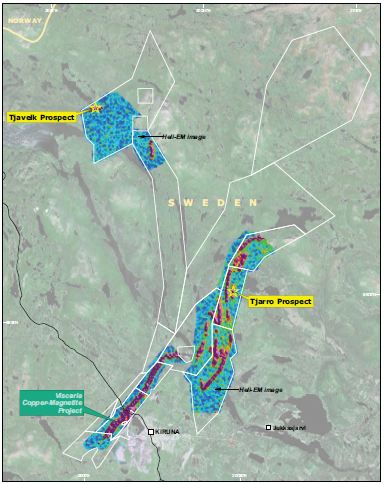
 

Location of Avalon’s regional prospects. Source: Company announcement


“The Tjarro and Tjavelk targets generated from the Heli-EM/Mag survey data are high quality regional exploration targets being coherent and coincident electromagnetic and magnetic anomalies which are very clearly anomalous from the surrounding geology,” Avalon Minerals managing director Jeremy Read said in the company’s announcement to the Australian Securities Exchange.

“The coincidence of the magnetic and EM anomalies with highly anomalous copper and gold surface geochemistry and historic drilling results adds to their prospectivity and is extremely encouraging.

“This has been the result of three years of successful exploration work which we remain very excited about and has significant potential.”

Avalon said it anticipates this drilling will be completed in late March-April this year, following consultation with stakeholders and gaining approval of the drill program by the various Swedish regulatory bodies.

The company outlined the aim of this upcoming drill program will be to intersect new bodies of copper-gold or copper-magnetite mineralisation.

Avalon intends prioritising prospects it considers could possibly be mined and trucked to the processing plant it is planning to build at the A Zone and D Zone prospects in the south-west corner of its Viscaria project tenement package.
Red Mountain Mining completes new Resource estimates

THE DRILL SERGEANT: Red Mountain Mining (ASX: RMX) has released new Mineral Resource Estimates at much higher-grades across the company’s wholly-owned Batangas gold project, located south of Manila in the Philippines.

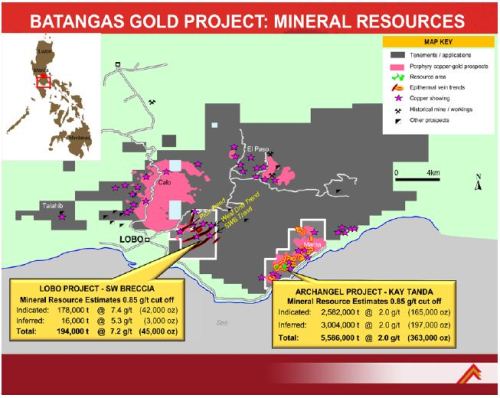
The new Mineral Resource Estimates of total Inferred and Indicated Resources of 5.78 million tonnes at an average grade of 2.2 grams per tonne gold containing 408,000 ounces are based on the results of fresh drilling Red Mountain has conducted at Batangas since August 2012.


Source: Company announcement


The new Mineral Resource Estimates have been produced following a complete revision and interpretation of historical data and parameters, as well as the inclusion of results from a 10 diamond drillhole program Red Mountain completed at Archangel in late 2012 and further surface trenching results at South West Breccia, Lobo.

Red Mountain said it considers the results directly reflect the company’s strategy to transition Batangas’ historic low grade bulk gold tonnages to higher grade resources, which has been supported by a focus on proving up and developing the project’s known high-grade targets.

The company indicated the upgraded Mineral Resource Estimates have been achievd by using a higher grade gold cut-off (0.85g/t gold) for the Indicated and Inferred Mineral Resource Estimates for both the Archangel and South West Breccia (Lobo) gold mineralisation within the Batangas project area.

“Since we acquired the gold project in October 2012, our focus has been to ‘high-grade’ the existing known large tonnage low grade resources and explore for new higher grade prospects,” Red Mountain Mining executive chairman Neil Warburton said in the company’s announcement to the Australian Securities Exchange.

“We are very pleased with the significant increase in grade of the Batangas gold project Mineral Resource Estimates based on using a 0.85 grams per tonne gold cut-off grade and including results from the additional drilling conducted at Archangel last year.

“The company will now focus on expanding the higher grade gold resource base with drilling in progress testing epithermal lode structures at Lobo to replicate the South West Breccia resource grade of plus seven grams per tonne gold.

“The company is very confident that further additional high grade gold resources can be added to the new resource inventory announced today based on our initial drilling results at West Drift, Lobo and other recent results obtained from surface trenching.”

Balamara Resources updates Monty Resource

THE DRILL SERGEANT: Balamara Resources (ASX: BMB) has released an updated JORC Mineral Resource for its 100 per cent-owned Montenegro base metals project (Monty) in Central Europe.

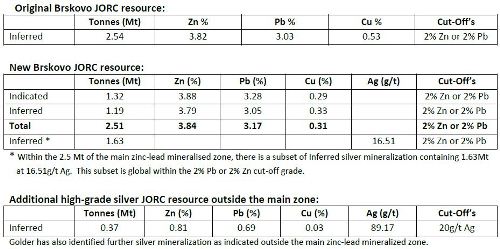
The revised JORC report for the Brskovo deposit is summarised below:


Source: Company announcement


Balamara explained the Resource has incorporated the results of in-fill diamond drilling undertaken by the company last year, which included the results from 10 holes drilled at the Brskovo deposit, as well as at a newly discovered silver zone.

Balamara said the final seven holes from the Brskovo drilling program have pretty much been completed, with remaining drilling or assaying to be completed during 2013.

The company’s drilling in 2012 mainly focused on the main Brskovo deposit with only limited drilling undertaken to date at the nearby Visnjica deposit.

This resource upgrade is therefore based entirely on Brskovo, with further drilling planned during 2013 at the Visnjica and Zuta Prla deposits, which Balamara indicated may lead to a potential upgrade of the JORC resource estimates for these two deposits.

The company said its 2012 drilling program had exceeded expectations by upgrading a significant portion of the Brskovo resource from the Inferred into the Indicated category, and by providing valuable information on the deposit and highlighting the value of the higher grade silver zone – which has been incorporated into the resource for the first time.

“This is a solid result from a fairly limited program of 10 diamond holes, with a further seven holes still to be added Balamara Resources managing director Mike Ralston said in the company’s announcement to the Australian Securities Exchange.

“We are confident we will continue to enhance the value of the Monty project as we further develop this asset.

“We are also considering geophysical survey work in 2013 to identify new exploration targets, we have feasibility work underway including metallurgical samples to determine concentrate recoveries, and we have a further in-fill drilling program designed that will move to the other two Monty deposits, Visnjica and Zuta Prla, during 2013.”

Transol Corporation claims gold find at Johnnies Reward

THE DRILL SERGEANT: Transol Corporation (ASX: TNC) has claimed discovery of a large anomalous zone of gold-copper mineralisation immediately north of the main Johnnies Reward prospect at the company’s Johnnies Reward gold project, located north-east of Alice Springs in the Northern Territory.

Transol has already earmarked the gold-copper anomaly as a priority target for follow-up exploration in 2013.

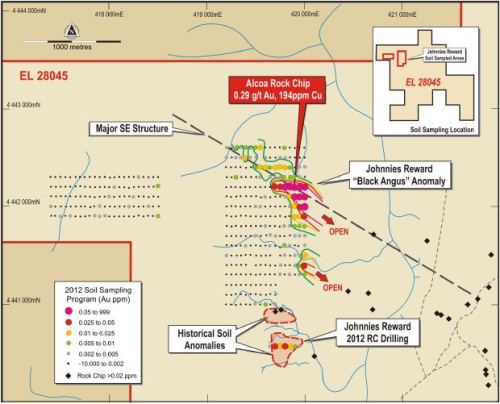
The discovery resulted from an extensive soil sampling program Transol completed during November last year, during which a soil samples were collected north of the Johnnies Reward prospect with the aim of extending the original Alcoa soil grid.


Soil program showing major SE structure and associated gold/copper anomaly. Source: Company announcement


The sampling program was designed to cover the area of higher magnetic response outlined by a regional magnetic survey.

Transol said the results had highlighted an anomalous northwest – southeast trending corridor of plus-50 parts per billion (ppb) gold and plus-25ppm copper 1.5 kilometres north of Johnnies Reward.

The main anomaly has been named the Black Angus prospect.

Black Angus measures 300 metres long and 180 metres wide and occurs on the eastern edge of the grid with a peak value of 84ppb gold, which compares favourably to a background value of less than 10 ppb gold.

“Black Angus is open to the south-east and is coincident with a south-east trending fault zone, which may be an important transfer structure for migrating mineralised fluids between the Pinnacles line and the Johnnies Reward corridor,” Transol Corporation said in its ASX announcement.

“Investigation of the historical database for the project has identified a rock chip of 0.29 grams per tonne gold and 194ppm copper on the southern edge of this anomaly.

“Follow-up rock chip samples have been collected with results pending.”

Transol has since completed a single line of sampling, comprising seven samples over the Johnnies Reward prospect for orientation and reference.

The Johnnies Reward gold results ranged from 1ppb to a peak of 18ppb gold, with an associated copper high of 586ppm.

“Considering that significant gold mineralisation has been identified at Johnnies Reward from both diamond and RC drilling, the Black Angus anomaly, with a peak gold-in-soils value of 84ppb gold, is a very interesting discovery which will now be the focus of additional sampling and mapping prior to reconnaissance drilling later this year,” Transol said.

Canadian financer boosts Mutiny Gold share register

THE DRILL SERGEANT: Mutiny Gold (ASX: MYG) has welcomed Canadian-based Sandstorm Gold to the company’s share register.

Mutiny has issued Sandstorm 22 million shares in respect of a USD$2 million converting loan provided to the company in November last year.

Mutiny Gold said the issue of shares recognised a critical milestone in the development of the Deflector gold-copper project in Western Australia.

“At a time when global financial markets were facing historically difficult times and project funding had almost dried up for small miners, to have put together this deal with Sandstorm Gold Ltd was a major success story for Mutiny Gold and its supporters,” Mutiny Gold managing director John Greeve said in the company’s announcement the Australian Securities Exchange.

Mutiny Gold was able to reach agreement with Sandstorm Gold for the Canadian company’s first Metals Purchase Agreement (‘MPA’) in Australia.

According to Mutiny Gold the US$43 million ($41 million) MPA with Sandstorm will fund a significant portion of the Deflector capital costs.

This will, in turn, allow Mutiny to instigate a number of key financing aspects for Deflector’s development as well as providing additional certainty to the company’s bankers.

Mutiny’s principal lender Credit Suisse, which has an existing $11 million loan facility, is currently concluding the provision of approximately A$50 million in funding.

This funding will result in Credit Suisse providing debt finance of $25 million, with the remainder to be provided by a leading Australian bank as part of the proposed total $102 million Deflector funding package.

“Tied in with the quality drilling results we achieved last year, the subsequent significant increase to our JORC figures, the very robust outcomes of the Deflector Definitive Feasibility Study (DFS), Mutiny Gold is well on track to achieve a number of major goals this year on the way to commercialising what is a very valuable asset at Deflector and then stepping up our plan to become a major new mining house with a number of nearby developments,” Greeve said.

Alloy Resources claims new Crack of Dawn gold discovery

THE DRILL SERGEANT: The completion of a 42 hole air-core drill program has led Alloy Resources (ASX: AYR) to claim a new greenfileds gold discovery.

The drilling was carried out on the Crack of Dawn and Dusk til Dawn prospects at the company’s Horse Well project in Western Australia during mid-December 2012.

The program tested two drill anomalies that had originally been defined by Eagle Mining in the mid-1990’s.

The historical results included an intersection of 11 metres at 3.45 grams per tonne gold from 44 to 55 metres depth at the end of hole, yet had never been followed up.

Alloy said its drill program has confirmed the discovery of a large gold mineralised system.

“This discovery of a large greenfields gold mineralisation system is very exciting,” Alloy Resources managing director Andy Viner said in the company’s announcement to the Australian Securities Exchange.

“Whilst grades at this stage are anomalous rather than economic, we are drilling beneath spinifex covered sand plain and there appears to be strong leaching of the gold down to the limit of air-core drilling.

“In effect we are skipping over the top of a large alteration system and getting a small sample at the bottom of holes.

“So to get these results is very encouraging.”


Crack of Dawn prospect regional geology with drilling and alteration zones. Source: Company announcement


At the Crack of Dawn prospect drilling intersected what Alloy has interpreted to be a 250 metre long and 30 metre wide, open-ended mineralised alteration zone traversing the location of the historical drill hole.

The recent drilling encountered intersections of:

–    12 metres at 0.6 grams per tonne gold from 56 to 68 metres (end of hole); and

–    11.5m at 1.60g/t gold from 52 to 65.5m (end of hole).

Alloy explained that historical vertical air-core drilling at the Dusk til Dawn prospect returned some anomalous intersections in the area of the contact between a granite and metasediments.

The company conducted north-south and east-west lines of angled air-core drilling at 80m spacing in this area, which it said has defined two zones of sheared and altered granite and metasediments, up to 1 kilometre long and 200 metres wide.

Alloy did point out, however, that the recent drilling was still quite widely spaced.

Despite this it indicated there are indications mineralisation is leached to the base of weathering.

The company considers it is likely that gold mineralisation intersected by drilling has not adequately tested these zones.

One intersection that did pique the interest of the company returned:

–    12m at 1.11g/t gold from 28 to 36m.

Alloy said it is now reviewing the results in a geological context.

The company anticipates its next stage of exploration will require a geophysical survey method to define alteration zones and targets for deeper drilling.

Northern Star scores new gold hits beyond Paulsens

THE DRILL SERGEANT: Northern Star Resources (ASX: NST) is beginning to reap the benefits of an ongoing $20 million exploration program being conducted on the company’s7000 square kilometre landholding in the Ashburton region of Western Australia.

Results of a round of drilling last year, which returned 9m at 12.7g/t gold, motivated Northern Star to design an RC/diamond drill program designed to target mineralisation open down plunge and along strike.

According to the company the latest program is returning encouraging results that are confirming the potential area.

In particular drilling at the Belvedere has returned pleasing results including:

–    8 metres at 14.7 grams per tonne gold and 47 grams per tonne silver from 68 metres, including 4 metres at 29 grams per tonne gold and 91 grams per tonne silver from 69 metres; and

–    9m at 8.7g/t gold and 21g/t silver from 107m, including 5m at 12.4g/t gold and 25g/t silver from 107m.

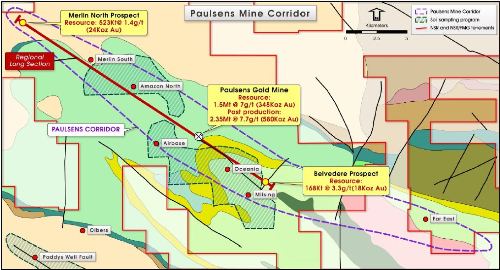
Northern Star explained Belvedere is situated eight kilometres from the company’s Paulsens gold mine on a 25km-long mineralised structure.

The Belvedere prospect is located within what the company has designated to be, the “Paulsens Mine Corridor”.


Plan view of the newly-defined 25km “Paulsens Mine Corridor”. Source: Company announcement

“The Belvedere results strongly support the company’s belief in the prospectivity of the 25 kilometre structure containing Paulsens,” Northern Star Resources managing director Bill Beament said in the company’s announcement to the Australian Securities Exchange.

“We believe we have some of the most promising yet barely explored gold ground in Australia.

“There is growing evidence of the potential for Paulsens look-alikes on the 25 kilometre structure as well as significant upside elsewhere on our 200 kiometre-long corridor.”

Last year Northern Star re-assessed historical data and defined a maiden resource of 18,000 ounces of gold at 3.3 grams per tonne.

The company considers Belvedere to possess similarities to the Paulsens orebody, where gold is also contained within a plunging quartz vein system.

Geological similarities are high gold grades, quartz vein-sulphide host, location near the Wyloo Dome fold hinge and proximity to key structures.

Ventnor kicks off 2013 drilling at Thaduna/Green Dragon

THE DRILL SERGEANT: Ventnor Resources (ASX: VRX) has resumed drilling at the company’s Thaduna/Green Dragon copper project in Western Australia following the break over Christmas.

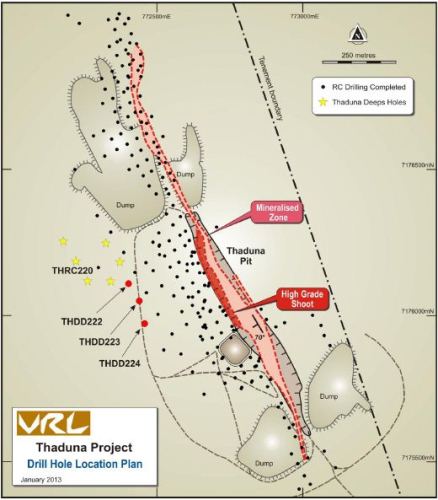
The company has drilling planned for the first seven holes, from which it anticipates to intersect a high-grade shoot it identified in drilling before the break.

The company said the drill program will follow up high-grade results it reported to the market last year.


Thaduna drill hole location plan. Source: Company announcement


“We are able to confidently plan these holes now based on our understanding of the structural controls identified in the drilling to date,” Ventnor Resources managing director Bruce Maluish said in the company’s announcement to the Australian Securities Exchange.

“Our expectations are for a continuation of the high grade shoot down plunge.

“Drilling has recommenced with an initial seven-hole program which may be extended subject to the mineralisation we intersect.”

In December Ventnor announced it had commenced work on an updated resource model for the Thaduna deposit.

At this stage the assays results are still with the laboratory, however the company said it anticipates the updated Resource will be completed early Q1 2013.

Ventnor shares had risen 4.55% to 46 cents during today’s trading.

Sirius Resources continues good Nova news

THE DRILL SERGEANT: The good news keeps coming for Sirius Resources (ASX: SIR) with ongoing drilling at the company’s Nova project confirming the continuity and grade of the deposit.

Sirius indicated it is currently on schedule for maiden JORC mineral resource estimate around the end of March with five drill rigs currently deployed on Nova.

Recently-completed infill drilling at Nova has intersected further broad zones of mineralisation consistent with what Sirius has encountered to date.


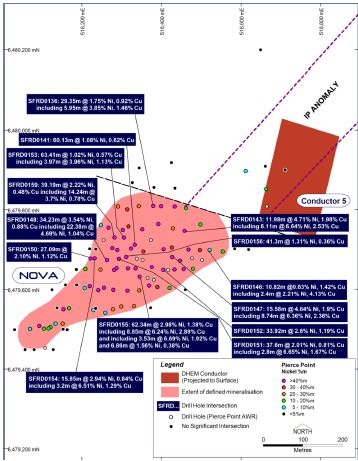
Detailed plan projection of Nova, showing location of new drillholes and assayed intersections. Source: Company announcement


The company has received assays for holes drilled prior to the Christmas break, which it claims has confirmed this continuity.

Intersections include:

625N Line:

–    62.34 metres at 2.98 per cent nickel and 1.38 per cent copper from 336.33 metres.

675N Line:

–    15.58m at 4.64 per cent nickel and 1.9 per cent copper from 417m;

–    34.23m at 3.54 per cent nickel and 0.88 per cent copper from 305.56m;
 
–    27.09m at 2.1 per cent nickel and 1.12 per cent copper from 214.77m; and

–    37.6m at 2.01 per cent nickel and 0.81 per cent copper from 330.65m.

725N Line:

–    33.92m at 2.6 per cent nickel and 1.19 per cent copper from 396.53m.

750N Line:

–    11.98m at 4.71 per cent nickel and 1.98 per cent copper from 396.76m.

The company demonstrated its confidence in the project by declaring in its ASX announcement that due to the large amount of drilling information it is now generating, it will no longer report visual intersections.

All drilling will now be reported once assays have been received.

Sirius has a second stage of metallurgical test work underway, which is also scheduled for completion by the end of March.

Drilling along strike from Nova is proceeding with two rigs testing a large area of what the company considers to be potentially mineralised contact.

“One of the holes drilled at the Tethys prospect, intersected two narrow zones of nickel sulphide mineralisation, attesting to the fertility of this contact,” Sirius said.

“The intersections comprise 1.18 metres at 1.44 per cent nickel and 0.31 per cent copper from 212.57 metres and 0.29 metres at 2.84 per cent nickel and 1.06 per cent copper.

“The first hole drilled to test conductor 3 did not hit the target.

“A follow up hole will commence once a downhole electromagnetic (DHEM) survey has been undertaken to guide this.”

Sirius shares dropped 3.11% to $2.18 during afternoon trading

Orinoco Gold triples Cascavel strike length

THE DRILL SERGEANT: Recently completed drilling by Orinoco Gold (ASX: OGX) has extended the size of a gold-bearing quartz carbonate vein system at the Cascavel target, situated within the company’s 70 per cent-owned Curral de Pedra project, located in the central Brazilian state of Goiás.

Orinoco said the drilling has more than tripled the known strike length of the structure from 500 metres to 1.6 kilometres.

The Cascavel target is the first on the Curral de Pedra tenement package Orinoco has evaluated.

The company is currently conducting a program of diamond drilling at Curral de Pedra, as it works towards defining the geological continuity of a large gold-bearing shear zone-hosted quartz carbonate vein system.

This system has already been intersected on a consistent basis by the company by drilling over 620m down-dip and 500m along strike.

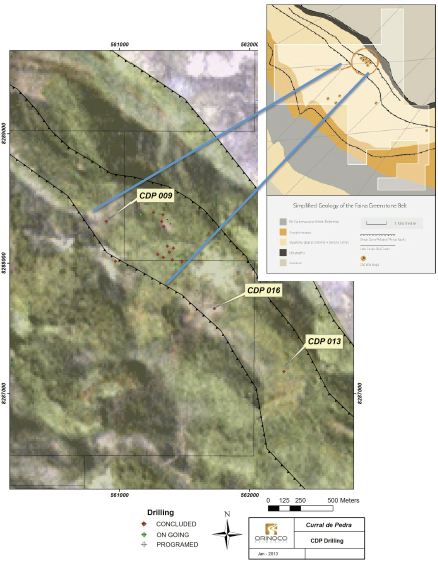
Two diamond holes (CDP013 & CDP016) have been completed to the south of the previously-defined 500m of strike length.

Orinoco claims both holes intersected the structure that hosts the gold at the Cascavel target.


Plan view showing completed holes. Source: Company announcement


The company hydrothermally altered the intersected quartz carbonate veins, which it said resulted in them visually appearing to contain minerals known to be associated with gold mineralisation at Cascavel.

Hole CDP016 was drilled approximately 400m south-east of the previously defined zone and hole CDP013 drilled approximately 1.1km south-east.

Orionoca said t was now awaiting assays from these holes and from rock chip sampling of the Cascavel target strike extension.

Having defined both down-dip and along strike extensions to the structurally controlled system at Cascavel, Orino said it intends focusing the remainder of the drilling in the current program on defining the controls on the high-grade ore shoots.

“The step-out drilling has clearly demonstrated the potential size of the Cascavel target, with the hosting structure and gold-bearing zones now intersected consistently over an extensive area of some 1.6 kilometres by 620 metres,” Orinoco Gold managing director Mark Papendieck said in the company’s announcement to the Australian Securities Exchange.

“For drilling to consistently intersect the altered stacked quartz vein package over 1.6 kilometres of strike shows the geological continuity of what appears to be a large hydrothermally altered system.”

Orinoco shares had jumped 7.14 per cent to 30 cents.