Red Mountain intersects big gold in the Philippines

THE DRILL SERGEANT: Red Mountain Mining (ASX: RMX) has completed drilling at the Lobo prospect within the company’s Batangas gold project, in the Philippines.

The company said new drilling intersections encountered on the West Drift epithermal lode system have continued to define a high-grade gold shoot at Lobo.


West Drift longitudinal projection with potential extent of gold system. Source: Company announcement


Red Mountain released three new drilling intersections from West Drift including:

–    6.3 metres at 8.03 grams per tonne gold from 197.8 metres downhole (estimated true width 5.6m), including 4 metres at 11.18 grams per tonne gold.
 
The company indicated this to be the deepest high-grade intersection it has hit on West Drift to date, and that it considers it to be further confirmation of the trend of increasing gold grade with depth.

Other drilling results included:

–    4.9m at 4.47g/t gold from 177.5m downhole (est. true width 3.8m), including 1.55m at 7.37g/t gold; and

–    1.5m at 499.4g/t silver, including 0.5m at 1,488g/t silver from 43.4m down hole independent of the gold lode.

Red Mountain described the new silver lode as shallow dipping and has now mapped it at surface and is open along strike.

Sampling of the silver lode at surface and in other drillholes intersecting the lode has been completed and results are expected shortly.

“The high-grade gold and low copper intersection in LB-70 at West Drift, Lobo, is very significant as the results indicate the transition to a low sulphidation zone generally associated with higher-grade gold deposits,” Red Mountain executive chairman Neil Warburton said in the company’s announcement to the Australian Securities Exchange.

“The new drilling is defining a high-grade gold-shoot that is open at depth, and to the east and west.

“Drilling will continue with two rigs to test what is now a greater than 500 metres long zone that appears to plunge shallowly to the west, as the company continues to focus on growing and increasing the grade of its resource inventory at Batangas.

“The intersection of high-grade silver at shallow levels is an exciting bonus that will be followed up over the coming months with further sampling and drilling.”
MacPhersons Gives go-ahead for Nimbus Superpit

THE DRILL SERGEANT: MacPhersons Resources (ASX:MRP) has decided it has advanced pit optimisation studies to the stage where it has now released mining contracting tender documentation at its 100 per cent owned Nimbus silver-zinc-gold project located east of Kalgoorlie’s Super Pit gold mine.

MacPhersons recently announced 46 per cent upgrade in the JORC classified Mineral Resource at Nimbus to 4.4 million tonnes at 129 grams per tonne silver equivalent for 18.3 million ounces.

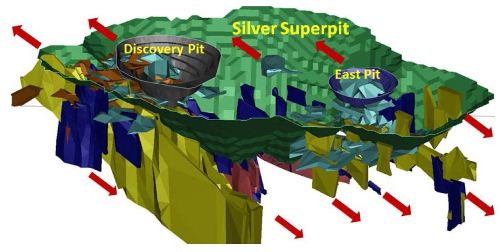
The company has conducted pit optimisation studies, which it claims have confirmed the original two open pits at Nimbus can be merged into a single Silver Superpit.

“The pit optimisation studies all support a single superpit model, which is what we predicted when the new mineralisation zone at Lens 3 was intersected,” MacPhersons Resources managing director Morrie Goodz said in the company’s announcement to the Australian Securities Exchange.

“The drilling results, resource upgrade, and new pit model support the Directors decision to approve the plant expansion and the new Merrill-Crowe plant scheduled for delivery in October 2013.”

MacPhersons is still considering a number of various optimisation scenarios that are still being modelled, however all of the options have the new proposed operation being a single superpit of approximately 900m length by 500m width and 205m depth.


Longsection view of insitu mineralisation blocks showing the new
proposed Silver Superpit and the existing Discovery and East Pits. The
key point illustrated is that the edge of the proposed superpit boundary
is limited by existing drilling and remains open to expansion in
further modelling. Source: Company announcement


Measured and Indicated resources continue along strike and beneath the pits and are anticipated to support further extensions to the Silver Superpit in future mine planning scenarios.

The pit cutback in Year 1 will have four shallow pits to focus on the oxide ore and the new gold zone and Lens 4, and then in Year 2 will commence the merging of the pits as the primary ore is developed.

Gold Road Resources drilling reinforces Central Bore continuity

THE DRILL SERGEANT: Gold Road Resources has started 2013 on a happy note by intersecting 185 grams per tonne from its first drill hole of the year at the company’s Central Bore project located on its wholly-owned Yamarna Belt in Western Australia.

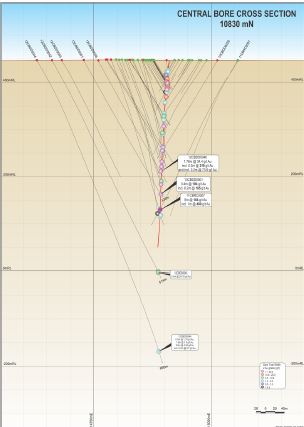
The drillhole was completed in late January 2013, and is the seventh hole of the eight-hole deeper diamond drill program the company has designed to:

–    Increase its confidence in the deeper sections of the resource;

–    Expand the mine life; and

–    Establish ore shoot geometry at depth.


Central Bore drilling. Source: Company announcement


“We are extremely pleased with this high-grade assay that further reinforces the continuity of the high-grade Imperial Shoot at depths beyond 250 metres,” Gold Road Resources chairman Ian Murray said in the company’s announcement to the Australian Securities Exchange.

“There is a sharp and distinctive visible contact between the lode and the waste.

“The high-grade gold zone located in the hanging wall is associated with the presence of elevated molybdenite which is easily identified visually and quantified using a hand-held XRF Analyser.

“This drill hole together with the ones previously reported in January 2013 show the success of this eight-hole deeper drilling program (deeper than 250 metres).”

Drilling throughout the current program has intercepted:

–    1.76m at 34.4 grams per tonne gold from 270 metres, including 0.2 metres at 219.1 grams per tonne gold and 0.2 metres at 73.6 grams per tonne gold;

–    0.4m at 104g/t gold from 328.6m, including 0.2m at 185.2g/t gold;

–    3.2m at 26.9g/t gold from 483m, including 1.23m at 50.6g/t gold and 0.2m at 110.2g/t gold; and

–    0.5m at 24.3g/t gold from 501m.

Gold Road also indicated it had encountered a further intercept at 616m where the Imperial Shoot lode continues to be visible in the diamond core.

The company has taken confidence from this and considers this system continues below the 600m mark.

IMX Resources extends potential mineralisation at Ntaka Hill project

THE DRILL SERGEANT: IMX Resources (ASX: IXR) has received results from a recently completed gravity survey campaign in the Ntaka Hill-Lionja trend, within its Nachingwea land package, in Tanzania.

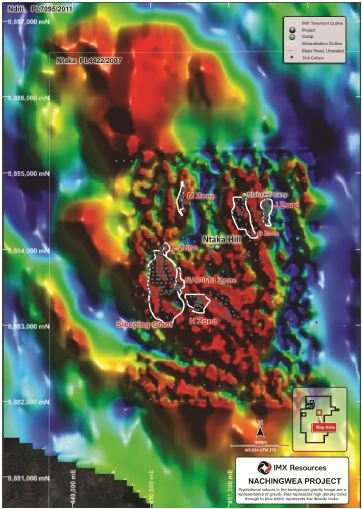
IMX said the results of the gravity survey indicate the presence of a larger area of ultramafic rocks associated with the company’s Ntaka Hill nickel sulphide project that have the potential to be mineralised.

According to IMX the gravity survey highlighted the extent of ultramafic rocks, which host the nickel mineralisation at Ntaka Hill, within the dense ultramafic rocks surrounded by less dense altered sedimentary rocks or para-gneisses.

The image of the gravity survey clearly outlines the more dense rocks surrounded by less dense ‘country’ rock.


Ntaka Hill gravity image. Source: Company announcement


IMX considers the extent of the newly-interpreted ultramafic rocks away from the existing areas of known mineralisation at Ntaka Hill provide a larger area for the company to target its exploration aimed at extending the known nickel sulphide Resource.

“We are very encouraged by the results of the gravity survey, highlighting the potential increase in the extent of ultramafic rocks and mineralisation at Ntaka Hill and remain confident that there are further zones of mineralisation to be discovered,” IMX Resources managing director Neil Meadows said in the company’s announcement to the Australian Securities Exchange.

“Enhancing our understanding of the area of mineralisation and therefore the potential size of the resource is a priority for the 2013 drilling program, the results of which will be central to the company’s decisions on development of the project.”

IMSX indicated it has preparations for a 2013 drilling program well underway and on track for commencement after the Tanzanian wet season.

Renaissance Minerals encouraged by recent Okvau exploration results

THE DRILL SERGEANT: Renaissance Minerals (ASX: RNS) has been encouraged by the receipt of further results from ongoing work, including  regional soil geochemical sampling and a recently-commenced RC drilling program, being carried out on the company’s Okvau gold deposit in Cambodia.

Renaissance has been undertaking a regional soil geochemical program targeting large areas of the Okvau and adjoining O’Chhung license areas that have previously been unexplored.

Both licenses are 100 per cent-owned by the company.

The soil program is currently around 75 per cent complete and consists of over 10,000 sample locations, which more than doubles the area that has been subject to historical geochemical sampling.

“The soil sampling program continues to define further areas of significant gold anomalism,” Renaissance Minerals said in its announcement to the ASX.

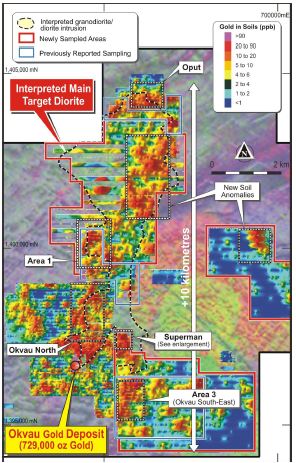
Renaissance has completed soil sampling through a corridor of over 10 kilometres to the north of Okvau, which it said had returned strongly anomalous gold in soils.


Okvau North prospective corridor. Source: Company announcement


“This 10 kilometre corridor is positioned in a favourable geological setting along the western margin of the large diorite intrusion that hosts the Okvau deposit,” the company said.

“The size of this anomalous area indicates the potential for very large mineralised systems.”

The company has defined a new copper-gold anomaly to the east of the Okvau gold deposit called the Superman prospect.

Renaissance considers Superman to display a new style of mineralisation it has not previously seen within the project area.

The prospect has returned high-grade rocks including:

–    8.38 grams per tonne gold and 9.28 per cent copper;

–    5.07g/t gold and 0.39 per cent copper;

–    1g/t gold and 1.13 per cent copper; and

–    0.85g/t gold and 2.3 per cent copper.

Initial RC drilling has been undertaken approximately 500m to the north-west and north of the Okvau gold deposit to test for primary gold mineralisation beneath anomalous gold in soils and where the company had previously encountered 9m at 6.6g/t from surface from diamond drilling.

Results include:
 
–    20m at 2.05g/t gold from 38m;

–    3m at 3.97g/t gold from 21m;
 
–    2m at 4.70g/t gold from 33m; and
 
–    3m at 2.07g/t gold from 80m.

Drilling is now shifting to the south, south-east of Okvau and the large Area 6 multi-element supported gold in soil anomaly located approximately 12 kilometres to the west of Okvau.

Additional diamond drilling is also being planned on the Okvau gold deposit to test for further extensions to the mineralisation.

Renaissance has commenced working on a new upgraded independent JORC resource estimate for the Okvau gold deposit, which it expects will be available around March/April 2013.

Gold Anomaly kicks off testwork at Crater Mountain

THE DRILL SERGEANT: Gold Anomaly (ASX: GOA) has commenced testwork aimed at the early development of the High Grade Zone (HGZ) at the company’s Crater Mountain gold project in Papua New Guinea with a view to starting a small scale operation by the end of 2014.

The HGZ is an area close to the Top Camp at Crater Mountain’s Nevera prospect where previous drilling intersected gold including 46 metres at 5.9 grams per tonne gold, including 2 metres at 98.2 grasm per tonne gold.

According to Gold Anomaly the HGZ has been a popular spot for local miners, who have historically mined the area.

Around 15,000 ounces of gold are estimated to have been mined from shallow underground workings in a steep spur between 2005 and 2012, applying very simple mining and gravity processing methods.

Gold Anomoly pointed out little drilling has undertaken on the HGZ to date as the company’s focus has been on the Mixing Zone and its perceived deep porphyry-related lead-zinc-gold and copper-gold potential.

“The beauty of owning an asset such as Crater Mountain is that the project has both the potential for near term, low cost production as well as large scale, bulk tonnage, long term development,” Gold Anomaly executive chairman Greg Starr said in the company’s announcement to the Australian Securities Exchange.

“With markets still displaying volatility for the junior end, the company can focus on generating near term cash flows and capitalising on buoyant gold prices.”

Gold Anomaly also announced the appointment of Richard Johnson as general manager PNG Operations, which it said was in keeping with its strategy to target shallow, near term gold production at Crater Mountain.

Mr Johnson is a mining engineer with experience running small and large scale projects such as DRDGold’s high-grade underground Tolukuma gold mine in PNG’s Central Province.

Aside from his time at DRDGold Johnson has been a senior executive and director of a number of listed companies that operate in the PNG and Pacific region, including Allied Gold.

“We are pleased that we have been able to attract someone of the calibre and experience of Richard Johnson,” Starr said.

“With the improvement in company finances, refocus of strategy and appointment of an experienced manager, we look forward to the return of Gold Anomaly’s Crater Mountain project as one of the most exciting and fastest growing gold projects in PNG in the near term.”

Antipa Minerals claims new copper-gold discovery at Calibre

THE DRILL SERGEANT: Antipa Minerals (ASX: AZY) has claimed assay results have confirmed the Calibre discovery at the company’s Citadel project in the Paterson Province of Western Australia to be a major new gold-copper deposit.
 
Antipa has completed only two diamond drillholes at Calibre prospect, however both of these have returned 270 to 350 metre intersections of semi-continuous precious and base metal sulphide mineralisation.

Standout intersections from drillhole 12AMD0032 include:

–    75.70 metres at 0.73 grams per gold, 0.42 per cent copper, 1.35 grams per tonne silver and 0.04 per cent tungsten for a gold equivalent grade of 1.59 grams per tonne or a copper equivalent grade of 1.05 per cent.

This intersection occurred within a 225.6m intersection at 0.5g/t gold, 0.22 per cent copper, 0.67g/t silver and 0.02 per cent tungsten for a gold equivalent grade of 0.95g/t or a copper equivalent grade of 0.62 per cent.

Antipa claimed the grade of mineralisation it encountered increased with depth and to the north.

“Over a geologically comparable 226 metre interval, grades for gold, copper, silver and tungsten increased by factors of 2.4, 3.0, 2.8 and 1.5 respectively from 12AMD0029 to 12AMD0032,” Antipa Minerals said in its ASX announcement.

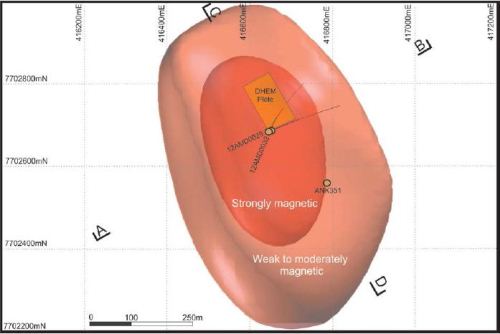
“The very substantial increase in the amount of veining, alteration, brecciation and mineralisation in 12AMD0032 compared to 12AMD0029 confirms that the mineralising system is intensifying toward the stronger magnetic and DHEM anomalies, both of which remain essentially untested at this stage.”

The two drillholes were completed on the central, upper extremities of the approximately 800m long by 600m wide by 350m thick Calibre magnetic anomaly, which the company originally identified using aeromagnetics.


Calibre prospect plan projection showing drillholes, 3D magnetic
inversion models and DHEM plate (off-hole conductor generated from
12AMD0029).Magnetic anomaly is 800m long. Source: Company announcement


Antipa has subsequently identified a downhole electromagnetic anomaly (DHEM) from a downhole survey carried out on 12AMD0029.

This target is yet to be tested and remains open.

“It is believed that the mineralisation discovered to date is not sufficient to explain both the DHEM and magnetic anomalies,” Antipa explained.

“As such, an increase in mineralisation is interpreted to be likely as drilling is continued across the target area and this is supported by the increased veining, alteration, brecciation and mineralisation found in 12AMD0032 when compared to 12AMD0029.
 
“The other important aspect is the continuity of mineralisation over extremely significant thicknesses, which confirms the sheer size of the mineralised system.”

Antipa said it believes its initial diamond drilling at Calibre has provided an understanding of key mineralisation controls and relationships to various geophysical anomalies, which has given it confidence of ongoing exploration success.

The company indicated this exploration potential will be its initial focus for its 2013 exploration program.

Antipa’s outlined its objective will now be to increase the mineral endowment and development opportunity of the Magnum Dome mineral camp.

At this stage the Company envisages undertaking geophysical surveys, including DHEM in 12AMD0032 and fixed-loop surface EM, during February and potentially commencing drilling as early as March 2013.

Pioneer Resources outlines 2013 exploration strategy

THE DRILL SERGEANT: Pioneer Resources (ASX: PIO) has outlined the company’s exploration strategy for 2013.

The company said it is embarking on an aggressive exploration campaign aimed at unlocking the potential it believes sits within its portfolio of Western Australian projects.

Pioneer acquired the remainder of the Golden Ridge nickel and gold project (PIO 100 per cent), and the Acra project (PIO 100 per cent) in 2012 following its sale of the Mt Jewell West gold project for $8 million.

The company indicated the Acra project, located 60 kilometres north east of Kalgoorlie, has emerged as its main priority, with drilling planned to target the Jubilee East prospect.

Target confirmation aircore drilling is scheduled to resume at Acra during February 2013 with the objective to identify targets for a subsequent program of RC drilling.

“We will be the first company to systematically explore the Acra tenements for gold using modern-day exploration technologies and methods,” Pioneer Resources managing director David Crook said in the company’s announcement to the Australian Securities Exchange.

“The Acra gold project, particularly the Jubilee East prospect, has long been recognised for its potential to host nickel sulphide mineralisation.

“Because of that focus most of the earlier exploration undertaken at Acra predominantly concentrated on the discovery of nickel.

“Many of the earlier holes were not even assayed for gold, however, where gold was assayed, a number of holes were noted to have made significant intersections – including at the Kalpini South, Jubilee and Jubilee East prospects.”

A detailed EM survey has been booked to commence at the company’s 100 per cent-owned Golden Ridge project, 30km south east of Kalgoorlie in February.

The survey is following up results from a campaign conducted in July 2012, which detected conductors Pioneer consider may include nickel sulphides at Duplex Hill, Anomaly 11 and Blair South prospects.

Depending upon results achieved from the upcoming survey, Pioneer said it could move to drilling selected targets during an RC drilling campaign it has pencilled in for April 2013.

“When it became obvious we were selling the Mt Jewell West Gold Project, our major objective became finding worthwhile Projects to replace it,” Crook said.

“We believe we have successfully put together a portfolio that has achieved this objective through the acquisition of the remainder of the Golden Ridge Nickel and Gold Project, and gold rights for the Acra Project.”

The Company has also secured the highly-prospective Fairwater Gold and Nickel project, located in the Albany-Fraser Province.

Pioneer has already generated new gold and nickel anomalies since securing the Project.

“Pioneer Resources’ operational objective for 2013 is to turn one, maybe more, of these significant exploration opportunities into our next discovery,” Crook said.

Southern Hemisphere identifies commercial potential at Llahuin project

THE DRILL SERGEANT: Southern Hemisphere Mining (ASX: SUH, TSX-V: SH) has received encouraging drilling results from the company’s Llahuin copper/gold project in central Chile.

The company is currently conducting an accelerated drilling at the Llahuin project, results from which so far have highlighted potential to grow the current resource inventory.


Location map showing the Llahuin project exploitation licenses. Source: Company announcement


Southern Hemisphere has also carried out preliminary metallurgical test work, which the company said has supported its plans to progress development of the Llahuin project under a recently established joint venture with North American mining group, Lundin Mining Corporation.

The latest drilling results include some broad intersections of copper/gold mineralisation, including:

Cerro de Oro Zone:

–    88 metres at 0.53 per cent copper equivalent from 40 metres;

Central Porphyry Zone:

–    314m at 0.41 per cent copper equivalent from 2m, including 28m at 0.49 per cent copper equivalent from 32m, 26m at 0.48 per cent copper equivalent from 74m, 40m at 0.50 per cent copper equivalent from 154m; and

–    350m at 0.41 per cent copper equivalent from 0m, including 44m at 0.61 per cent copper equivalent from 0m, 20m at 0.57 per cent copper equivalent from 82m, 48m at 0.52 per cent copper equivalent from 208m.

Ferrocarril Zone:

–    22m at 0.63 per cent copper equivalent from 182m; and

–    16m at 0.87 per cent copper equivalent from 100m.

The company considers the results from its preliminary metallurgical test work indicate the Llahuin project mineralization is amenable to a conventional flotation process, with a low unit energy requirement expected for crushing/grinding to achieve anticipated copper recoveries of up to 91 per cent.

Southern Hemisphere said these characteristics, together with the ability to produce a concentrate grading 28 to 32 per cent copper with low levels of deleterious materials in concentrate, support the commercial development potential of the Llahuin project.

Commenting on the latest developments, “We have started the New Year very strongly with an accelerated drill campaign at the Llahuin project under the work plan agreed with our joint venture partner, Lundin Mining Corporation,” Southern Hemisphere Mining managing director Trevor Tennant said in the company’s announcement to the Australian Securities Exchange.

“The latest results from drilling are excellent and continue to highlight the significant upside potential within the key zones of mineralisation.

“In addition, the early stage results from metallurgical test work, which will be improved upon with optimization in the next stage of metallurgical test work, indicate the comparative advantages of low unit energy requirements, high copper recoveries and commercially attractive concentrate grades.

“We are looking forward to what should be a defining year for Southern Hemisphere and the Llahuin project, which we expect to continue to develop as one of the more significant emerging mid-tier copper-gold opportunities in Chile.”

Stratum Metals identifies nickel prospects on East Menzies Goldfield

THE DRILL SERGEANT: Stratum Metals (ASX: SXT) has completed a review of recent broad-spaced geochemical sampling on data from to completed in 2001 on part of the company’s East Menzies Goldfield project in Western Australia.

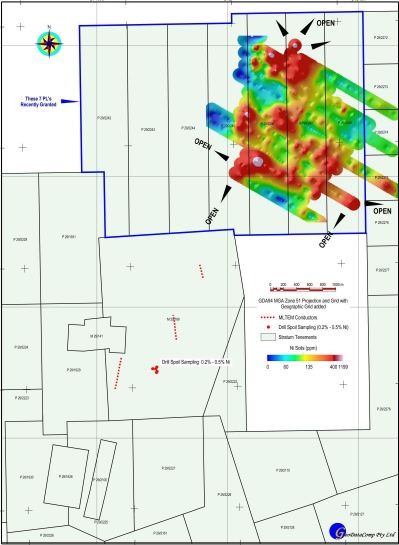
According to Stratum the review has delineated the presence of several high-order, large scale nickel soil anomalies within a mineralised corridor.

Gold anomalism is also noted within the same data set.

“I am very excited to have identified these further targets,” Stratum Metals managing director Martin Holland said in the company’s announcement to the Australian Securities Exchange.

“The fact the highest grade result is significantly higher than the soil anomaly associated with the Sirius Nova deposit is very encouraging and we plan to fast track exploration in the area.”


East Menzies project nickel soil sampling results. Source: Company announcement


The anomalies are located over parts of seven Prospecting Licences which have recently been granted to Stratum’s subsidiary Riqo Pty Ltd by the WA Department of Mines & Petroleum, increasing the area of Stratum’s East Menzies Goldfield project available for immediate exploration by 1392 hectares.

The company indicated the nickel soil anomalies remain open in various directions, noting they are currently only partially defined due to the limited soil sampling program that was undertaken.

Stratum is continuing to review past exploration reports, but is yet to identify follow up work such as drill testing of these anomalies.

The tenements adjoin a Mining Lease on which Avalon recently announced Electromagnetic (EM) conductors.

The company is also continuing to compile and review information associated with past exploration while also considering its best approach to furthering exploration in this area.

Short term work programs are expected to include additional soil sampling and EM survey programs.