Crusader moves to iron ore producer in Brazil

THE DRILL SERGEANT: Crusader Resources (ASX: CAS) has commenced plant commissioning of direct shipping iron ore at the company’s 100 per cent-owned Posse iron ore project in Brazil, with first sales and revenue expected in March.

Crusader started construction work on access roads, weighbridge, stockpile areas and office infrastructure in December 2012, all of which is nearing completion.

The company has also stockpiled ore in readiness for processing, which it anticipates will be starting in two weeks’ time.
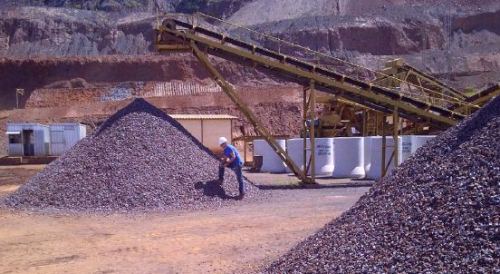
 

Product stockpile- Posse iron project. Source: Company announcement


Crusader said it has signed three sales letters of intent with domestic smelters, the demand from which is in excess of Posse’s projected production.

“The start of mining at Posse and the generation of our first revenue will transform Crusader,” Crusader Resources managing director Rob Smakman said in the company’s announcement to the Australian Securities Exchange.

“Plant commissioning is well underway with several minor issues identified.

“These are being rectified and present no impediment to start-up.

“The construction of the last few items necessary to start mining is progressing well and the drilling program underway will help ensure we continue to optimise our mine planning for the project.”

The Posse iron ore project is located 30km from Belo Horizonte in the “Iron Quadrilateral” region of Minas Gerais state, Brazil.

Crusader describes the project as being a low capital cost project, close to infrastructure and features simple logistics.

Posse contains an Indicated and Inferred Mineral Resource of 36 million tonnes at 43.5 per cent iron.

Crusader has now commenced a drilling program with the intention of better defining the high-grade, DSO haematite ore distribution within the resource.

The drilling will aim to expand the resource along strike and down dip.

Deep Yellow reports positive results from Namibian drill campaign

THE DRILL SERGEANT: Deep Yellow Limited (ASX: DYL) has released Fusion XRF chemical assay results from recent resource drilling conducted at the Ongolo Alaskite deposit in Namibia.

The drilling was carried out by the company’s wholly-owned subsidiary company Reptile Uranium Namibia.


Resource outlines and drilling – Omahola project area. Source: Company announcement


Deep Yellow said the drill program had been designed to increase both the size and confidence levels of the resource.

Results from the drilling include:

–     5 metres at 480 parts per million uranium from 49 metres and 9 metres at 3,158 parts per million uranium from 96 metres;

–    6m at 849ppm uranium from 70m;

–    17m at 677ppm uranium from 101m;

–    35m at 402ppm uranium from 147m;

–    25m at 542ppm uranium from 149m; and

–    12m at 2,214ppm uranium from 207m.

Deep Yellow claim chemical assay results have confirmed equivalent uranium (eU) results the company achieved during drilling operations, which were subsequently used in a recent resource update of the Ongolo deposit.

“We are cautious in our approach to using eU numbers in resource estimation but these results demonstrate once again that at Ongolo this information is reliable which may in future allow us to reduce our reliance on chemical assays,” Deep Yellow Limited managing director Greg Cochran said in the company’s announcement to the Australian Securities Exchange.

“With the completion of the Ongolo program we are now drilling in the Ongolo South area whilst we review all available information in our exploration database as we look to generate new high-grade targets to rapidly grow the Omahola project resource base.”

The new Ongolo JORC resource, as at 4 February, totals 29.6 million tonnes at 384ppm uranium for 25.1 million pounds of uranium at a 250ppm uranium cut-off.

Contained uranium increased by 39 per cent (7.1 million pounds) with 58 per cent of the resource being classified as Measured and Indicated.

Cullen Resources follows Rox example

THE DRILL SERGEANT: Cullen Resources (ASX: CUL) has followed the lead of its neighbour Rox Resources (ASX: RXL) to carry out digitizing and statistical analysis of historical lag and shallow drill sampling data for the company’s Mt Eureka project.

The company claims the exercise has revealed a number of notable nickel anomalies in the area adjacent to and along strike from Rox’s recent Camelwood nickel sulphide discovery at Fisher East.


Source: Company announcement


Cullen said the results of its compilation demonstrates two large nickel anomalies along the western ultramafic sequence as well as smaller nickel anomalies along the eastern ultramafic sequence in the southern part of the Mt Eureka project area.

“One anomaly is located along trend from the Silverbark VTEM conductor that was identified by Rox on the boundary between Rox’s property and Cullen’s ELA53/1637,” Cullen Resources said in its ASX announcement.

“It is notable that geochemical coverage is incomplete and much of the area in Cullen’s ground along trend from the Camelwood discovery remains untested by geochemistry.”

Cullen said it considers the existing geochemical results indicate the prospectivity of its property for nickel sulphide mineralisation.

The company indicated none of the nickel geochemical anomalies in the southern part of the Mt Eureka project area are yet to have been investigated using airborne EM, which was used by Rox when making the discovery of Camelwood.

“Cullen believes that both geological and geochemical evidence indicates that outstanding potential exists to locate massive sulphide bodies similar to Camelwood in the Mt Eureka project area,” the company said.

“Consequently, Cullen plans to commence a VTEM geophysical survey within the next fortnight.

“Coincident VTEM and geochemical anomalies will represent prime drill targets.”

Millennium Minerals declares commercial production at Nullagine

THE DRILL SERGEANT: Millennium Minerals (ASX: MOY) has declared Commercial Production at the company’s Nullagine gold project in the East Pilbara District of Western Australia, signalling the completion of commissioning and operational ramp‐up of the mine and processing plant.

The company stated the overall performance of the mine since November 2012 has demonstrated the mine is capable of operating above its design throughput.

The company also pointed out its operating costs are within its previously released estimates.

Millennium was keen to share data of January 2013 production, which shows its pit mining operations established a new monthly record for total volume mined and hauled at 212,000 billion cubic metres.

Gold poured in January 2013 amounted to 7,200 ounces, which is also a new gold output record for the project.

Millennium is now targeting an expansion from the present design throughput of 1.5 million tonnes per annum (Mtpa) to at least 1.7Mtpa for the FY2013.

“To achieve this will require a modest increase in throughput from 189 tonnes per hour to approximately 200 tonnes per hour,” the company explained in its ASX announcement.

“The evaluation process for this production increase has two important components: (i) the project’s viability of sustaining output at this higher level and (ii) assessing the combination of throughput and head grade that will yield the highest economic margin – translating into making best use of our production assets.

“This Future production, cost and cash flow guidance in respect of the 2013 financial year (ending 31 December 2013) will be given at the end of the current quarter.”

Millennium has commenced a drill program with the aim of increasing the Mineral Resource and Ore Reserve base across its tenement portfolio.


Nullagine deposit location plan. Source: Company announcement


RC drilling has commenced at Golden Gate and Golden Eagle and is targeting strike and depth extensions as well as a large number of geochemical anomalies.

At the end of January 2013, 47 reverse circulation drill holes had been completed.

Drilling has been targeting strike extensions at Falcon, G‐Reef, ABCD Reef, Condor and Crow, collectively known as Golden Gate.

Millennium indicated it expected to start receiving assay results soon.

Azure Minerals intersects 70m of Mexican copper

THE DRILL SERGEANT: Azure Minerals (ASX: AZS) has received all assay results from recently-completed drilling at the company’s Promontorio project, located in the Mexican state of Chihuahua.

The results include a 70 metre intersection of copper mineralisation at Cascada as well as copper intersections at a newly identified prospect – Risco Dorado.


Promontorio project area. Source: Company announcement


The 70m intersect at the Cascada prospect came from the last hole of the program, situated about 200m of the Promontorio deposit where historic exploration had predominantly focused on testing for gold and silver, ignoring copper.

Azure’s drill hole was designed to follow historical drilling that returned moderate gold grades, and to test for copper potential at depth.

In the first 40m of the hole, two zones returned gold intersections of:

–    6.95 metres at 0.6 grams per tonne gold and 12 metres at 1.1 grams per tonne gold with a highest grade of 3.6 grams per tonne gold.
 
At a depth of 41.9m, the hole entered a zone of copper sulphide mineralisation, which extended over a downhole length of 70m hosting disseminated, veined and massive copper sulphide mineralisation in varying amounts throughout the entire mineralised interval.

This zone returned mineralised intercepts at various cut-off grades:

At 0.2 per cent copper cut-off grade

–    70.0m at 2.7 per cent copper equivalent (1.6 per cent copper, 0.9g/t gold and 35g/t silver) from 41.9m;

At 0.5 per cent copper cut-off grade

–    35.9m at 4.8 per cent copper equivalent (2.9 per cent copper, 1.5g/t gold and 65g/t silver) from 76.0m; and

At 1 per cent copper cut-off grade

–    11.25m at 10.5 per cent copper equivalent (7 per cent copper, 2.3g/t gold and 147g/t silver) from 80.65m; and

–    7.25m at 3.8 per cent copper equivalent (2 per cent copper, 1.9g/t gold and 32g/t silver) from 101.75m

Azure said this drill intercept was an exciting development  as it opens up the possibility of another copper deposit located within a short distance of Promontorio.

“Good widths of high-grade copper, gold and silver mineralisation from areas untested by previous exploration confirm potential to increase the project’s resource base,” Azure Minerals managing director Tony Rovira said in the company’s announcement to the Australian Securities Exchange.

“The highlights of the drilling are the intersections we made as part of the wider exploration program.

“The exceptional copper intercept at Cascada is Azure’s best to date within the whole project area, and indicates strong potential for another significant body of copper mineralisation adjacent to Promontorio.

“Furthermore, drill intercepts at the newly named Risco Dorado (Golden Cliff) prospect are promising and augur well for further exploration successes in that area.”

Queensland Mining intersects more gold at Greenmount

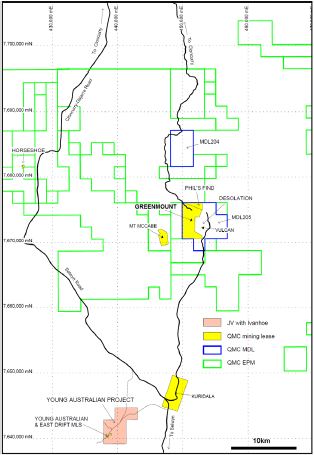
THE DRILL SERGEANT: Queensland Mining Corporation (ASX: QMN) has received assays from the first of four diamond drill holes completed at Greenmount during the December Quarter of 2012.

Greenmount is part of the company’s 100 per cent-owned White Range copper and gold project, located south of Cloncurry in the Mt Isa Fold Belt in Queensland.

The White Range project currently has three principle resources, Greenmount, Kuridala and Young Australian, which contain 180,000 tonnes of copper and 165,000 ounces of gold and a number of satellite deposits, which contain a further 97,000 tonnes of copper and 38,000 ounces of gold.


Regional location plan. Source: Company announcement


Queensland Mining said the recent drill hole had intersected a broad zone of high-grade copper and gold which assayed:

–    18 metres at 5.7 per cent copper, 2.3 grams per tonne gold from 156 metres depth, including 3 metres at 13.1 per cent copper, 4.9 grams per tonne gold from 158 metres depth.

The intersection is located approximately 50 metres to the north along strike from previous drilling, which intersected:

–    72m at 2.4 per cent copper and 0.92g/t gold, including 16m at 6.5 per cent copper and 2.3g/t gold.

The company considers the latest results confirm the continuity of the high-grade copper and gold transitional mineralisation below the oxide between 60 and 180 metres vertical depth.

“Again these excellent results by QMN continue to enhance the copper and gold grades at Greenmount and will have a significant positive impact on the White Range project economics,” Queensland Mining Corporation chief executive officer Tony Martin said in the company’s announcement to the Australian Securities Exchange.

Queensland Mining said it anticipates receiving results of the final three diamond drill holes over the coming weeks, which it expects will assist in understanding the depth and strike potential of the high-grade transitional mineralisation.

Kentor Gold drilling extends Murchison gold mine mineralisation

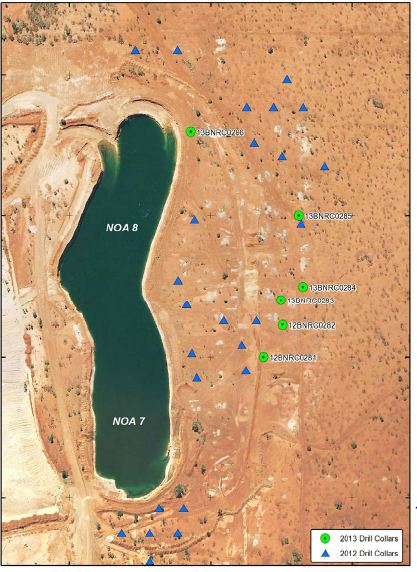
THE DRILL SERGEANT: Recent drilling conducted by Kentor Gold (ASX: KGL) has extended the high-grade mineralisation at the NOA 7/8 deposit at the company’s Murchison gold mine in Western Australia.

“This is an outstanding outcome with all six RC holes indicating extensions of gold mineralisation beyond the NOA 7/8 orebody,” Kentor Gold managing director Simon Milroy said in the company’s announcement to the Australian Securities Exchange.

“In the last four months we have announced increased mineral Resources at Murchison – at both the NOA 7/8 and Alliance deposits.

“These latest results highlight the potential to further increase high grade Resources at NOA 7/8.

“Proposed underground mining of high grade ore at NOA 7/8 commencing in 2014 is a key to the company’s plan to increase production and lower costs at Murchison.”

Results from the RC drill holes at NOA 7/8 include:

–    22 metres at 2.13 grams per tonne gold from 181 metres, including 3m at 4.18g/t gold from 181 metres, 2m at 5.00g/t gold from 195m, 2m at 5.20g/t gold from 200m;

–    18m at 2.4g/t gold from 191m, including 3m at 4.13g/t gold from195m, 4m at 4.19g/t gold from 202m; and

–    6m at 5.78g/t gold from 233m, including 2m at 14.10g/t gold from 233m.

Kentor said the new drilling broadens the high-grade central core of the resource that remains open to the south.

The company highlighted the intersection of 6m at 5.78g/t gold incl. 2m at14.1g/t gold to be of some significance as it considers this may suggest previous drilling has not closed off the mineralisation as it had previously interpreted.


NOA7&8 plan of RC drilling completed by Kentor Gold in 2012‐13. Source: Company announcement


A further hole was drilled below the northern end of the NOA7/8 pit and above the defined north plunging shoot in an area that has been poorly drilled in the past.

The company explained the ore zones within the pit are offset from the mineralisation at depth by a fault that gives the appearance mineralisation is cut off.

Kentor is hopeful the mineralisation it has intersected in this recent hole is part of a continuous zone with a minor offset as it feels this could open up potential for shallow mineralisation within the oxide zone at the north end of the pit.

The company indicated additional drilling will now be required to test for extensions to the ore zones the recent drilling has identified.

Although the shallow north plunge was evident from drilling completed in mid- 2012, the company has now earmarked extensions down dip and along strike to the north within the oxide zone as priority targets.

A Scoping Study on NOA7/8 completed last year identified several areas of Inferred Resources Kentor said could potentially be added to the mining schedule if the resources were upgraded.

These areas will also be the target of a future drilling program.

Gold Road Resources hits mark with Central Bore drilling

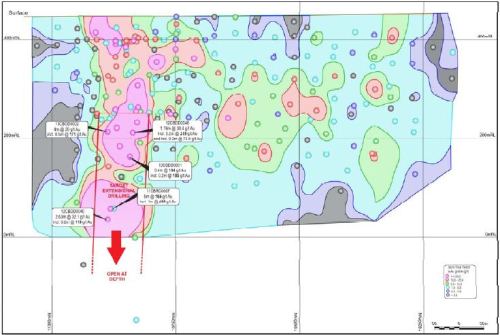
THE DRILL SERGEANT: Gold Road Resources (ASX: GOR) has received assays of up to 171 grams per tonne gold from the second drill hole of an eight-hole deeper diamond drill program completed at the Central Bore project located on the company’s wholly-owned Yamarna Belt in Western Australia.

The hole returned encouraging intersections, including:

–    4 metres at 29 grams per tonne gold from 267 metres including 0.5 metres at 171 grams per tonne gold.

Gold Road conducted the eight hole diamond program to increase its confidence in the deeper sections of the resource ( over 250 metres below surface), expand the current mine life, and establish ore shoot geometry at depth.


Central Bore long section showing intercepts from current diamond
drilling program at Imperial Shoot. Source: Company announcement


“The last drill hole intersected not only high-grade gold, but also showed a thickening of the lode in this position which is very encouraging,” Gold Road executive chairman Ian Murray said in the company’s announcement to the Australian Securities Exchange.

Other results from across the eight hole program include:

–    4m at 29.03g/t gold from 267m, including 0.5m at 171.15g/t gold;

–     1.76m at 34.4g/t gold from 270m, including 0.2m at 219.1g/t gold and 0.2m at 73.6g/t gold;

–    0.4m at 104g/t gold from 328.6m, including 0.2m at 185.2g/t gold;

–    3.2m at 26.9g/t gold from 483m, including 1.2m at 50.6g/t gold and 0.2m at 110.2g/t gold; and

–    0.5m at 24.3g/t gold from 501m.

Gold Road said it is currently evaluating and interpreting all the recent drill data and plans to update the Central Bore resource for inclusion in its Pre-Feasibility Study, which is due for completion in the second quarter 2013.

Rox Resources intersects massive sulphides with first Camelwood drill hole

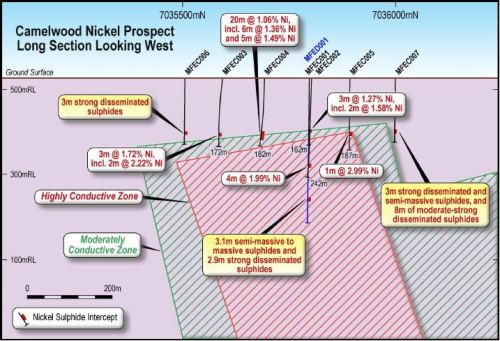
THE DRILL SERGEANT: Rox Resources (ASX: RXL)  has intersected massive to semi-massive and disseminated sulphides with the first diamond hole drilled at the company’s Fisher East nickel sulphide project, located north of Kalgoorlie in Western Australia.

The first diamond drill hole at the Camelwood prospect was drilled and intersected six metres of sulphide mineralisation comprising 3.1 metres of massive to semi-massive sulphide mineralisation (from 282.8m to 285.9m) followed by 2.9 metres of strongly disseminated sulphide mineralisation (from 285.9 to 288.8m).

“This is a very positive and significant result,” Rox Resources managing director Ian Mulholland said in the company’s announcement to the Australian Securities Exchange.

“To date we have drilled 7 RC holes and now one diamond hole at Camelwood with all hitting sulphide mineralisation.

“It confirms that the Camelwood discovery represents significant nickel-bearing sulphide mineralisation down to at least 300 metres vertical below surface and at least 500 metres along strike.

“This indicates a large body of mineralisation that is still open at depth and along strike.”


Camelwood prospect long section. Source: Company announcement


Rox said it anticipates laboratory analyses will be available in about four weeks once core logging and cutting are carried out.

Drilling is continuing at Fisher East with an RC drilling rig testing strike extensions to Camelwood and other EM anomalies in the area, and a diamond drilling rig testing an EM conductor and depth extensions at Camelwood.

Drake Resources confirms high-grade nickel at Granmuren

THE DRILL SERGEANT: Drake Resources (ASX: DRK) has received laboratory analyses for a hole recently drilled at the company’s Granmuren copper-nickel discovery in central Sweden.

The hole intersected massive and disseminated sulphide mineralisation down to 250 metres vertical depth with results demonstrating the presence of higher grade nickel-copper mineralisation down dip from previously intersected mineralisation.

Intersections include:

–    7.8 metres at 1.14 per cent nickel, 0.20 per cent copper;

–    24.5m at 0.41 per cent nickel, 0.39 per cent copper, including 4.5m at 0.80 per cent nickel, 0.7 per cent copper;

–    21.2m at 0.4 per cent nickel, 0.51 per cent copper, including 5m at 0.6 per cent nickel, 0.90 per cent copper; and

–    24.5m at 0.33 per cent nickel, 0.33 per cent copper.

Drake explained mineralisation at Granmuren is associated with pyroxenitic ultramafic rocks and high magnesium mafic rocks.

The received drill intersections are interpreted as being near actual thickness.


Section through Holes TS006 and TS007 with intersections greater
than 0.1 per cent nickel and logged geology. Source: Company
announcement


“Granmuren continues to reveal encouraging results given the mineralisation is at potential open pit depths and at grades comparable to producing open pit nickel mines in Scandinavia,” Drake Resources chief executive officer Jason Stirbinskis said in the company’s announcement to the Australian Securities Exchange.
 
“These results demonstrate that the mineralisation continues for an additional 50 metres below hole TS006 and the potential for higher grade mineralisation within the Granmuren prospect.

“Our surveys are yet to define the base of this system.

“We expect the surface and downhole geophysics to be completed this month.

“The prospect’s excellent location near infrastructure including power, rail and port, in one of the lowest risk mining jurisdictions in the world, further enhances the potential of Granmuren to ultimately evolve into a low cost development opportunity.”