Trafford Resources makes DSO hematite discovery

THE DRILL SERGEANT: Trafford Resources (TRF: ASX ) has claimed a high-grade direct shipping ore (DSO) hematite discovery on receipt of assay results from the first four drill holes of a drilling program on the company’s Twin Peak iron ore project northeast of Geraldton, Western Australia.

The company claimed it had encountered extensive widths of DSO hematite at the Woolbung Peak prospect, which is one of 15 prospects Trafford is targeting with the current drill program.

Initial results from first four holes include:

31 metres at 63.5 per cent iron, including 5 metres at 68.1 per cent iron;

17m at 64.3 per cent iron, including 6m at 67.7 per cent iron; and

22m at 59.6 per cent iron including 15m at 63.4 per cent iron.

“Geological mapping initially delineated the geometry of a faulted fold nose closure area of high-grade outcropping hematite rich zones,” Trafford Resources said in its ASX announcement.

 “Significant down hole hematite widths were intersected in all the four holes reported to date.

“Importantly the drilling has proven that the high-grade outcrop discovered by Trafford extends to a minimum depth of 80 metres and remains open beyond that depth.

“All high grade intercepts show low impurities with very low levels of sulphur, phosphorus and silica, which will be attractive to steel mills around the globe.”

Hot Chili close to doubling Productora copper resource

THE DRILL SERGEANT: Hot Chili (ASX: HCH) has almost doubled the resource at the company’s Productora copper project in Chile.

The resource at Productora now stands at 165.2 million tonnes at 0.6 per cent copper, 0.1 grams per tonne gold and 132 grams per tonne molybdenum for 920,000 tonnes of copper, 590,000 ounces of gold and 22,000 tonnes of molybdenum.

Hot Chili pointed to the high-grade, shallow resources, which it said have grown to 53 million tonnes at 0.8 per cent copper and 0.2g/t gold following the definition of a second major zone of high-grade material located within the project’s planned central pit development.

A substantial drilling program is currently underway, which Hot Chili expects will result in a further resource increase at Productora later this year.

“The project continues to deliver strong growth and the company is on track to establishing Productora as one of the leading large-scale copper developments in Chile’s coastal range,” Hot Chili chairman Murray Black said in the company’s announcement to the Australian Securities Exchange.

“Our focus now is to deliver a second major resource upgrade in parallel with the completion of a Pre-feasibility study to be released in the second half 2013.”

The current drilling program at Productora is utilising four multi-purpose diamond and reverse circulation  drilling rigs.

The company hopes the program will achieve:

A second major up-grade to the Productora copper-gold-molybdenum resource;

A maiden iron ore resource estimation for the parallel and western magnetite zones; and

Completion of metallurgical, hydrogeological and geotechnical drilling programs.

Monax Mining drill program to focus on EM defined graphite targets

THE DRILL SERGEANT: Monax Mining (ASX: MOX) is kicking off a 70-hole drill program this week at the company’s 100 per cent-owned Waddikee graphite project on the Eyre Peninsula of South Australia.

The drilling will focus on four target areas Monax identified during a recent ground electromagnetic (EM) survey.

Monax recently completed ground EM surveys over the Wilclo South, Francis, Argent and Lacroma prospects in order to define conductive targets and allow for accurate positioning of drill holes.


Location of the Waddikee project, central Eyre Peninsula,
highlighting other graphite and iron projects within the region. Source:
Company announcement


“The ground EM survey provided confirmed the location and intensity of regional airborne EM conductors, using both moving loop and slingram techniques to provide detailed data to define the location and dip of the conductive units,” Monax Mining said in its ASX announcement.

“The data for the Wilclo South prospect has been modelled and shows a continuous conductive zone over a strike length of two kilometres, which remains open at both ends.

“Drilling at Wilclo South by Monax last year corresponds strongly with the modelled conductive units, providing confidence that the newly acquired EM data will greatly assist in locating drill holes.”

Monax indicated the upcoming drilling program will commence in an area of outcropping graphite, which previously assayed 22.9 per cent total graphitic carbon.

The ground EM survey also defined strong conductive anomalies at the Francis and Argent prospects.

“Field plots show good correlation with regional airborne EM data, providing greater resolution on the location and dip of these conductive features,” Monax explained.

“Data for these two areas is still being processed and these prospects will drill tested after Wilclo South.”

Monax said the majority of the drilling will be undertaken at the Wilclo South prospect with the objective of gathering sufficient information for the company to produce an inferred resource by mid-2013.

Tungsten Mining phase 1 drilling provides encouragement for more

THE DRILL SERGEANT: Recently-listed Tungsten Mining (ASX: TGN) has been encouraged by positive results it has received from the final analysis of the first eight holes of a Phase 1 drilling program, at the company’s Kilba tungsten project in the Gascoyne Region of Western Australia.

Tungsten Mining commenced diamond drilling in November 2012 to confirm the presence of high-grade tungsten mineralisation, which had been indicated by the project’s previous owners Union Carbide in the 1970s and 1980s.


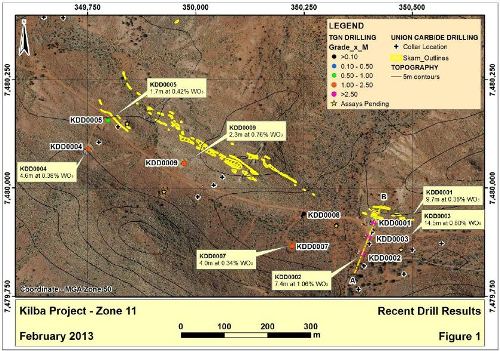
Plan showing location of stronger zones of mineralisation
intersected by recent drilling, skarn outcrops and historic Union
Carbide drill holes. Source: Company announcement


The current drilling is targeting an area known as Zone 11, which is located on the company’s 100 per cent-owned, granted Mining Lease 08/314.

Highlights from the recent drilling include:

–    14.5 metres at 0.80 per cent tungsten oxide from 42.5 metres; and

–    7.4m at 1.06 per cent tungsten oxide from 82.8m.

“The final analytical results from the first eight holes confirm the high-grade nature of coarse grained scheelite mineralisation present,” Tungsten Mining said in its ASX announcement.

“Given the excellent grades received to date, the company has commenced the Phases II and III drilling program, which are planned for completion by the end of the first quarter of 2013.

“Phase II will consist of reverse circulation and diamond drilling on 80 metre spaced section lines over 800 metres of strike at Zone 11.

“Phase III will feature further in-fill drilling on selected section lines, at 40 metre intervals.”

Tungsten Mining indicated this current activity is the first, and a major component of, studies that are being executed with the intention, and the anticipation of positive results, to become the basis for a full Feasibility Study.

The company said it intends to carry out a Feasibility Study over the next 8 to 12 months to determine the commercial viability of a mine at Kilba.

Azimuth Resources increases West Omai gold resource

THE DRILL SERGEANT: Azimuth Resources (ASX: AZH) has announced a 35 per cent increase in the JORC code-compliant gold resource estimate for the Smarts and Hicks deposits at the company’s West Omai gold project in Guyana.

The Inferred Mineral Resource estimate at West Omai for the Smarts and Hicks deposits at a cut off of 1 gram per tonne gold is now:

–    16.7 million tonnes at 3.06g/t gold for total contained gold ounces of 1.65 million ounces.

The Inferred Mineral Resource estimate for the higher grade Smarts deposit at a cut off of 1g/t gold is now:

–    8.1 million tonnes at 4.15g/t gold for total contained gold ounces of 1.08 million ounces.


Mineral Resources – West Omai projects, Guyana – shown for 0.5g/t
gold, 1g/t gold and 2g/t gold cut-off grades. Source: Company
announcement


“This resource estimate has resulted from the interpretation of results of drilling completed to November 2012,” Azimuth Resources said in its ASX announcement.

“Both the Smarts and Hicks deposits remain open at depth and along strike.”

Azimuth said it was continuing its exploration program which is targeting resource extensions, as well as the Larken prospect and other prospective targets in its landholding at West Omai.

Cauldron Energy triples Bennet Well uranium resource

THE DRILL SERGEANT: Cauldron Energy (ASX: CXU) has released a 300 per cent upgrade to the resource on the Bennet Well prospect, situated within the company’s Yanrey uranium project in Western Australia.

Independent consultants, Ravensgate Resources have calculated a JORC-compliant resource for the Bennet Well region.

The new total uranium resource has increased from 4.8 million pounds at 300 parts per million uranium to 15.7 million pounds at 270 parts per million uranium.

Cauldron said economic studies have demonstrated grades above 250ppm uranium (over one metre) to be economic for a potential in-situ leach style mining operation at the Yanrey project.

“It is pleasing to have achieved such a significant resource upgrade, and in the process confirmed a substantial new high grade in-situ leach uranium district at Yanrey,” Cauldron Energy head of operations Simon Youds said in the company’s announcement to the Australian Securities Exchange.

“The majority of this large region, prospective for uranium deposits, is controlled by Cauldron.

“This, and the fact that the strike extensions of what we have defined have yet to be tested, points to a unique opportunity to add significant value to the company and its shareholders through additional exploration activities.”


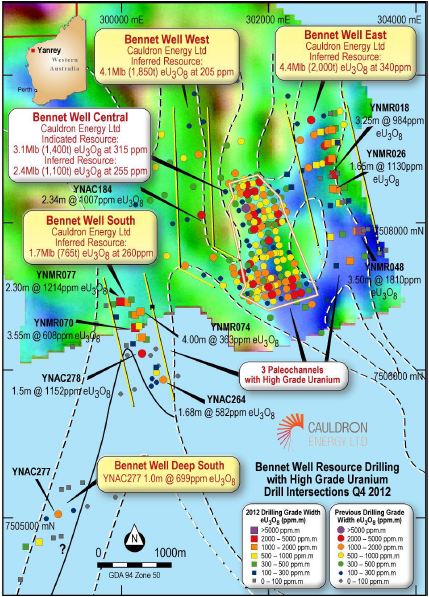
Bennet Well prospect locations and drill results. Source: Company announcement


Cauldron identified two new inferred uranium resources during a drilling campaign it conducted at Yanrey in 2012.

The Bennet Well East and Bennet Well South resources are based on widespread drilling with 200 to 400 metres between drill lines.

Both inferred resources are open at both ends and Cauldron considers further drilling in the near future is warranted as it could lead to a further resource increase.

“Bennet Well South in particular is currently a small uranium resource, but the very northern drill line saw both an increase in grade and width, suggesting that a large resource extension could exist to the north of where drilling ended,” Youds said.
 
The Bennet Well East deposit was identified following drilling that was completed by Cauldron after the 2008 inferred Bennet Well Resource was released.

Recent work completed by the company has upgraded this prospect to resource status.

Cauldron has completed a review of existing in-situ leach style uranium mines in Australia to determine the likely economic cut-off for uranium resources identified at the Yanrey project area.

The company has reviewed all data currently available for the Yanrey project, such as depth to mineralisation, size of the resources and physical factors like porosity and permeability as part of this process.

Northern Star plans Resource upgrade for Ashburton project

THE DRILL SERGEANT: Northern Star Resources (ASX: NST) is gearing up for the release of, what the company described as, a significant resource upgrade at its Ashburton gold project in Western Australia.

The upgrade is expected after the company received a recent raft of drilling results it says support its plan to make the Ashburton project its second 100,000 ounce per annum stand-alone operation.

Recent drilling results have returned:

–    48 metres at 6.0 grams per tonne gold, including 24 metres at 8.6 grams per tonne gold;

–    18.5m at 8.5g/t gold, including 10.7m at 11.9g/t gold;

–    19.9m at 7.2g/t gold, including 10.5m at 7.2g/t gold;

–    18.8m at 5.4g/t gold;

–    20m at 4.9g/t gold;

–    13.1m at 7.0g/t gold; and

–    6.4m at 14.1g/t gold, including 2m at 40.8 g/t gold.

The results from the Mt Olympus deposit, situated within the Ashburton project.


Mt Olympus Surface drilling, plan view. Source: Company announcement


Northern Star will include these in the resource upgrade currently being calculated and anticipated for release this quarter.

“These intersections show that the Ashburton inventory is growing virtually by the drill hole and is set to increase substantially from the already-significant level of one million ounces,” Northern Star managing director Bill Beament said in the company’s announcement to the Australian Securities Exchange.

“The results also highlight the significant prospectivity of our extensive land holding, which now boasts two key parallel structures, each of which is 200 kilometres long.”

The Ashburton project has a current resource of one million ounces, including 689,000 ounces in the sulphide deposits.

Metallurgical testwork of the sulphide mineralisation last year generated total gold recoveries of 80 to 90 per cent.

A recently-completed plant upgrade at Northern Star’s Paulsens gold project lifted production to plus-100,000 ounces per annum.

Northern Star said the inclusion of the Ashburton project stands to double the company’s gold output.

“With the plant upgrade at Paulsens complete and the cashflow from that project running strongly, we are confident that the rewards of our $20 million exploration/drilling program will be rich in 2013,” Beament said.

Northern Star recently announced a deal to acquire the non-iron ore mineral rights over key tracts of highly prospective acreage around Paulsens from Fortescue Metals Group (ASX: FMG).

The deal gives Northern Star a 7000square kilometre tenement package of land stretching from Paulsens to the Mt Olympus deposit, approx. 200km away.

Northern Star now has approx. 400km of strike along two parallel structures with Paulsens and Mt Olympus situated at either end.

Many of the Fortescue tenements on this structure sit immediately along strike to the known mineralisation at Paulsens, Mt Olympus and Electric Dingo.

Discovery metals receives first drilling results from Aphrodite prospect

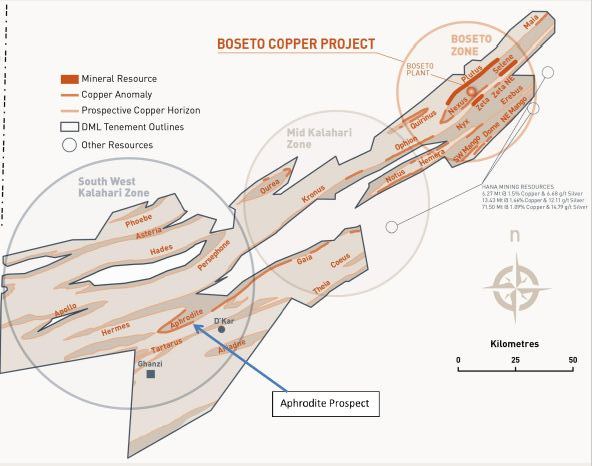
THE DRILL SERGEANT: Discovery Metals (ASX: DML) has encountered copper-silver mineralisation at the Aphrodite prospect, situated within the company’s 100 per cent-owned prospecting licences in the Kalahari Copperbelt , 170 kilometres south west of its Boseto copper project in Botswana.

The company recently completed a 14 hole drill program in the Aphrodite area, comprising 11 Reverse Circulation holes and three diamond core holes.


Kalahari Copperbelt exploration targets. Source: Company announcement


The initial target for the drilling program was a copper-in-soil anomalism, along a contact between two formations (the D’kar Formation and the Ngwako Pan Formation), around the Aphrodite Anticline.

Discovery considers this contact is the host of copper-silver mineralisation at the Boseto copper project.

One of the reported drill holes targeted copper-in-soil anomalism located approximately 200 metres south of the contact between the D’kar Formation and Ngwako Pan Formation.

This hole returned 19 metres at 1 per cent copper and 13 grams per tonne silver, including 4 metres at 2.6 per cent copper and 40 grams per tonne silver.

Discovery Metals explained the copper-silver mineralistion encountered by this hole is in a different geological setting from the Boseto style mineralisation found on the D’kar-Ngwako contact.

“Other holes drilled at Aphrodite targeted the base of the D’kar Formation, which is the main host to the mineralisation at Boseto,” Discovery Metals said in its ASX announcement.

“These have identified weak, narrow copper-silver mineralisation in host rocks that have similar lithologies and structures to those hosting the Boseto mineralisation.

“Although these drill holes have not intersected significant grades of copper-silver mineralisation, they do demonstrate that there is potential for the discovery of more Boseto style copper-silver mineralisation in the SW Kalahari Zone.”

Discovery has exploration planned to be undertaken during the first quarter of 2013 to focus on mapping the Aphrodite area.

Other work will involve geochemical soil sampling to identify the strike length and width of the shear zone prior to the commencement of further drilling, which is planned for the second quarter of 2013.

Elsewhere within the SW Kalahari Zone, exploration is planned to continue to target both the base of the D’kar Formation and also to identify and test additional shear zones the company considers may be mineralised.

Platina Resources to drill Owendale in March

THE DRILL SERGEANT: Platina Resources (ASX: PGM) has a new program of RC drilling on the company’s 100 per cent-owned Owendale platinum & scandium project in central New South Wales scheduled to commence in March.

Platina claims the Owendale project as Australia’s newest platinum discovery and the world’s most high-grade scandium deposit.


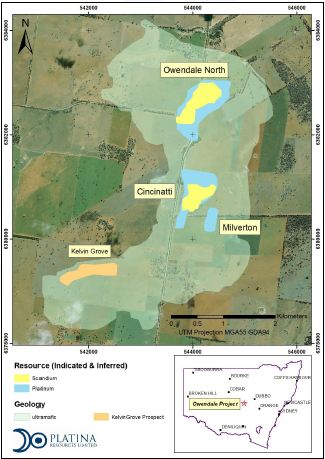
Location map – Owendale project, New South Wales. Source: Company announcement


The March drilling program has been primarily designed to enable Platina to increase the Indicated and Inferred Mineral Resource for platinum at Owendale, which is currently estimated at 12.7 million tonnes at 0.7 grams per tonne platinum for approx. 287,000 ounces (using a cut-off of 0.4g/t platinum).

Platina explained Owendale’s platinum resources are concurrent with an Inferred and Indicated Mineral Resource for scandium of 10.1 million tonnes at 340g/t scandium (3,400 scandium tonnes) using a 200g/t scandium cut-off.

 “We have already established a sizeable JORC-compliant Mineral Resource of approx. 287,000 ounces of platinum at the Owendale project, but we aim to significantly improve on that number during this program,” Platina Resources managing director Rob Mosig said in the company’s announcement to the Australian Securities Exchange.

“With regards to scandium, we already have a very large resource, sufficient to satisfy world demands for many years to come.

“Whilst we are increasing our platinum ounces with new drilling, we will continue our aggressive scandium marketing and other evaluation programs.

“I look forward to updating the market on this exciting new initiative as it continues to progress.”

The upcoming exploration drill program will test a number of targets outside the existing resource including immediate lateral extensions of the deposit where platinum has been recorded in historic drilling.

The 5,000m drill program is expected to take approximately two months to complete, subject to weather conditions, with final results expected to be reported in the June 2013 quarter.

Peninsula releases maiden Karoo Mineral Resource

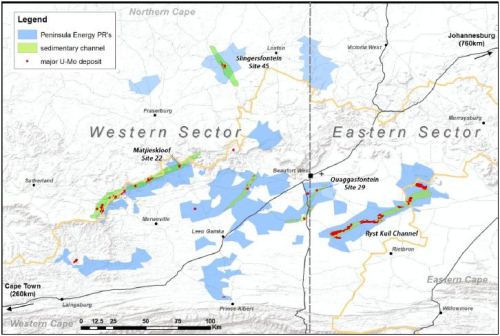
THE DRILL SERGEANT: Peninsula Energy (ASX: PEN) has announced an initial JORC Code-compliant Mineral Resource estimate of 50.1 million pounds uranium at the company’s Karoo projects located in the Cape Provinces of South Africa.

The estimate includes an indicated resource of 15.7 million pounds grading 1,020 parts per million uranium, above a cut off of 600ppm uranium.
 
Peninsula explained the estimate has been based on a historical database comprising 7,163 holes and an additional 1,245 holes the company has either probed or drilled since 2011, including 16 diamond holes and 730 reverse circulation holes.

“The Board is excited about the Karoo projects maiden resource and drilling is now underway to convert some of the other areas of historic mineralisation to JORC status,” Peninsula Energy executive chairman Gus Simpson said in the company’s announcement to the Australian Securities Exchange.

“A scoping study has commenced and the company intends to quickly progress the projects to feasibility.”


Karoo projects location map. Source: Company announcement


Previous exploration conducted by Esso Minerals Africa, JCI and Union Carbide at the Karoo projects in the 1970s included 1.6 million metres of drilling together with trial open-cut and trial decline mining programs.

Based on the results of these programs, the previous explorers estimated approximately 99 million pounds uranium and 61 million pounds molybdenum.

Peninsula has focussed on bringing approximately half of this total, for which drilling data is available, to a standard suitable for reporting under JORC Code 2012 guidelines.

The remainder, comprising up to 48 million pounds uranium in historical estimates, for which drilling data is not available, will be targeted in on-going exploration with the objective of converting as much as possible to JORC Code-compliant resources.