Apollo Minerals identifies large high-density body at Titan project

THE DRILL SERGEANT: Apollo Minerals (ASX: AON) has received the results from a recently-completed ground gravity survey at Acacia East, which is part of the company’s Titan base-precious metals project in South Australia.

According to Apollo the survey has demonstrated Acacia East to hold geophysical characteristics common to high-quality IOCGU deposits in South Australia.

Apollo said the Acacia East ground gravity survey had delineated a large, dense body covering an area approximately 4.2 kilometres by 1.6 kilometres in size at its widest points.


Overview of residual gravity response from the Acacia East
ground gravity survey showing modelled EM conductor and likely magnetite
alteration halo.


The company believes this dense body may have a vertical extent of over 2,500 metres while displaying ‘classic IOCGU alteration’ patterns in profile.

“The success of the gravity survey at Acacia East achieves another important milestone for increasing our confidence that this target has the potential to be an important discovery,” Apollo Minerals chief operating officer Dominic Tisdell said in the company’s announcement to the Australian Securities Exchange.

“While by no means definitive, the combination of the classic alteration patterns we’re seeing in the geophysics and the strong EM conductors are everything you would want to see at this early stage of exploration.

“The next step is to understand what our recent surface geochemistry programme tells us once results are in. We expect drilling to quickly follow.”

3D inversion modelling of the gravity data has implied the presence of near-surface, ultra-high density zones, which Apollo feels can be interpreted as an indication of supergene enrichment and a potential high grade cap.

The Acacia East target is centred on a discrete 2km by 2km zone of magnetite destruction, which has been assumed as being likely to be associated with a large-scale hydrothermal system located immediately alongside a regionally significant structure, The Coorabie Fault.

The company believes this setting could be ideal for the discovery of major base metals deposits similar to other uranium-rich iron-oxide-copper-gold (IOCGU) deposits of South Australia such as Olympic Dam.

Apollo said it considers Acacia East to be a high priority drill target, and the company plans to commence its first phase drilling at the prospect this quarter.
Sirius Resources identifies more Nova nickel

THE DRILL SERGEANT: Sirius Resources (ASX: SIR) has completed infill resource drilling at Nova around the margins of the deposit, from which the company claims to have encountered better than expected mineralisation, including an eastern extension it considers may be a mineralised feeder zone.

The company said further drilling will now focus on exploring this and additional targets within the Eye, while its maiden JORC mineral resource estimate remains on schedule for the end of March.

New intersections of note include the following (all estimated to be true width):

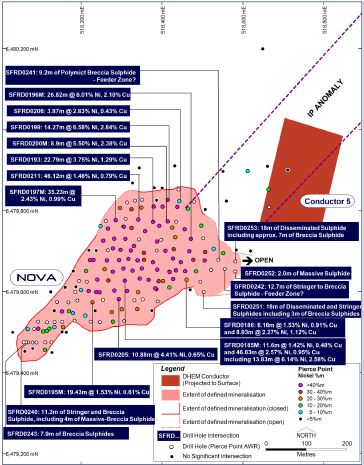
– 26.82 metres at 6.01 per cent nickel and 2.1 per cent copper from 396.83 metres, towards the eastern edge of the deposit;

– 14.27m at 6.58 per cent nickel and 2.84 per cent copper from 383.8m, on the northern edge of the deposit;

– 35.23m at 2.43 per cent nickel and 0.99 per cent copper from 299.23m, on the western edge of the deposit;

– 8.93m at 2.27 per cent nickel and 1.12 per cent copper from 409.24m, on the south-eastern edge of the deposit and

– 46.63m at 2.57 per cent nickel and 0.95 per cent copper from 316.58m, including 13.83m at 6.14 per cent nickel and 2.58 per cent copper from 334.01m, internal to the deposit.

Sirius indicated extensional drilling at the extreme south-western tip of the deposit on the 475N line (to the south of the discovery line) also encountered better than expected mineralisation relatively close to surface.

This mineralisation is not yet closed off and the company has interpreted it may extend further upwards towards the surface.


Plan projection of Nova, showing location of new infill drill holes
(with assayed intersections) and additional drill intersections around
the edges of the deposit. Source: Company announcement


Extensional drilling at the eastern edge, and deepest point, of the deposit also intersected more mineralisation than expected, in the form of a sulphide breccia zone, extending the known mineralisation more than 60m to the southeast on a 100m wide front from the previous boundary.

Siruis said the Nova resource infill program had improved its understanding of the geology.

The company is set to recommence exploration drilling on various targets within the Eye.

“I am proud of our team for executing the drillout like clockwork – in record time and without incident,” Sirius Resources managing director Mark Bennett said in the company’s announcement to the Australian Securities Exchange.

“With the completion of this and the development of a solid geological model we now know Nova is an exceptional, robust deposit and we can now use what we’ve learned to start the hunt for more.

“The discovery of the eastern breccia zone further demonstrates the potential scale of this system and bodes well for the discovery of more nickel mineralisation adjacent to Nova, in the Eye and beyond.”

Indochine Mining scores positive results from Mt Kare

THE DRILL SERGEANT: Indochine Mining (ASX: IDC) has received assay results from six drill holes totalling 706 metres from an ongoing 1,300 metre drilling program at the company’s Mt Kare precious metals project in Papua New Guinea.

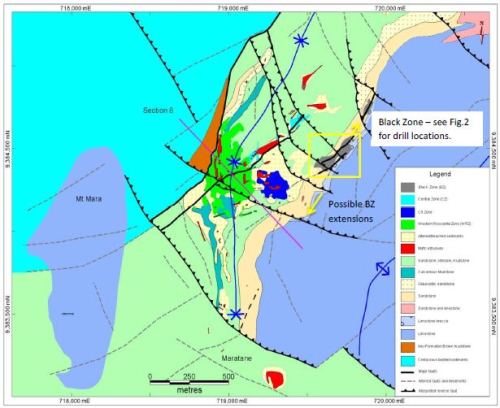
Indochine said the drilling has confirmed the targets host bonanza type mineralisation, with the results being the first it has received from what has been designated as the Black Zone.


Mt Kare geological map, showing the location of the Black Zone. Source: Company announcement


“These are very encouraging drilling results and confirm the fact that there is significant unlocked value in the previously identified bonanza zones at Mt Kare,” Indochine Mining non‐executive chairman Ian Ross said in the company’s announcement to the Australian Securities Exchange.

“Importantly, these results confirm the technical findings and interpretations of our highly experienced consulting geologist, Tony Burgess, who for 10 years was the Senior Resource geologist at the nearby world‐class Porgera gold mine owned by Barrick Gold.

“Particularly noteworthy is the fact that Mr. Burgess is very encouraged about the potential to discover more high grade gold, beneath the known mineralisation.

“This provides Indochine with further confidence that Mt. Kare is shaping up to be world‐class deposit.”

According to Indochine the drilling has confirmed bonanza type mineralisation, which had been previously intersected by earlier drilling conducted by the company.

Recent holes were drilled to test the extent of mineralisation to the NE and for extensions to the SW of the bonanza grades.

Other holes targeted the zone between the two bonanza grade intersections.

Best results from the recent work include:

–    49 metres at 22.3 grams per tonne gold, 71 grams per tonne silver from 63 metres downhole, including 21 metres at 33.8 grams per tonne gold, 64 grams per tonne silver, 8 metres 73 grams per tonne gold and 75 grams per tonne silver, including 5 metres at 105 grams per tonne gold, greater than 100 grams per tonne silver;

–    21m at 13.6g/t gold, 144g/t silver from 61 m downhole, within 29.9m at 9.6g/t gold, 55g/t silver from 61m downhole, including 7m at 35.2g/t gold, 83g/t silver; and

–    21m at 5.8g/t gold, 70g/t silver from 64m downhole, including 8m at 10.4g/t gold, and 54g/t sliver, including 1m at 22.8g/t gold, 26g/t silver.

“The Black Zone bonanza holes have returned some excellent intersections, as well as solid intervals of four to five grams per tonne gold mineralisation,” Indochine Mining chief executive officer Stephen Promnitz added to the announcement.

“Collectively, these results underpin the robust nature of the Mt Kare project.

“It is important to note that these results are from only one of the bonanza zone targets identified by the company.”

Wild Acre Metals announces maiden Resource at Mt Ida

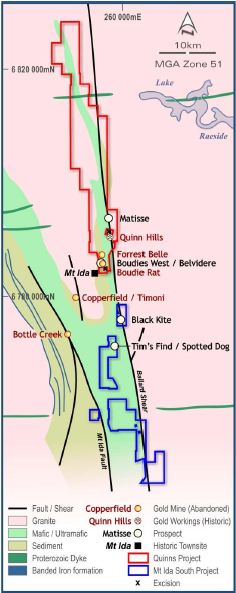
THE DRILL SERGEANT: Wild Acre Metals has announced a JORC-compliant maiden Mineral Resource estimate for a number of prospects at the company’s 100 per cent-owned Mt Ida project, located near Kalgoorlie in the Eastern Goldfields of Western Australia.

The maiden JORC-compliant Mineral Resource at the Quinns and Mt Ida South projects using a 1 gram per tonne gold cut‐off has been estimated at 1.23 million tonnes at 2.46 grams per tonne gold for 97,037 ounces gold.

The Mineral Resource estimate includes the Matisse,Quinn Hills, Western lodes, Boudie Rat and Forrest Belle depsoits of the Quinns project as well as the Spotted Dog (North and South) and Tim’s Find deposits from the Mt Ida South Project.


Location of resource prospects at the Quinns and Mt Ida South projects. Source: Company announcement


Over half (53%) of the resource has been catalogued in the Indicated category.

In addition to the maiden Mineral Resource Wild Acre indicated an Exploration Target of 250,000 to 500,000 tonnes at between 1.25 and 2.5g/t gold has been identified at the Black Kite prospect.

Recently conducted drilling at Black Kite returned anomalous intersections over 800m of strike including:

–    12 metres at 1.51g/t gold, 5 metres at 8.27g/t gold and 2 metres at 5.21g/t gold.

“The establishment of a maiden JORC resource at the company’s Mt Ida projects confirms the immediate value of the main prospects at the Quinns and Mt Ida South projects with excellent exploration potential remaining along almost 39 kilometres of the Ballard / Zuleika Shear under
Wild Acre ownership which to date has received only modest exploration drilling,” Wild Acre Metals said in the company’s ASX announcement.

“The Mineral Resource has been estimated within the different Mineral Resource categories, which when based on the estimated ounces are broken down as the Measured Mineral Resource = 10 per cent, Indicated Mineral Resource = 53 per cent and Inferred Mineral Resource = 37 per cent.”

Phoenix Gold encouraged by first drilling at Red Dam

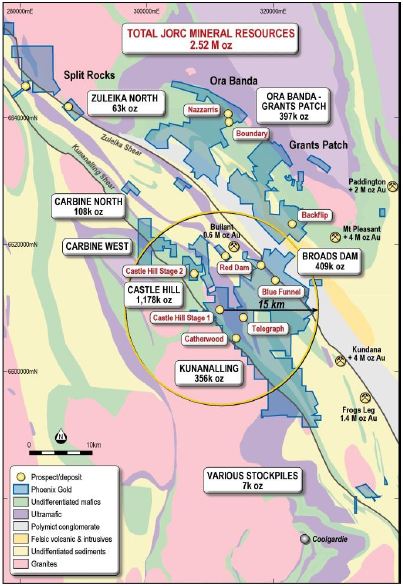
THE DRILL SERGEANT: Phoenix Gold (ASX: PXG) has been encouraged by the first results out of a drilling program conducted at the Red Dam gold project, which is part of the company’s Broads Dam project area.

Red Dam is located on the Zuleika shear zone in the Western Australian Goldfields, less than 40 kilometres from Kalgoorlie.


Castle Hill – Phoenix tenements and Red Dam project location. Source: Company announcement


The current Resource at Red Dam stands at 3.4 million tonnes at 2.1 grams per tonne gold for 229,000 ounces.

Phoenix commenced its first drilling program at Red Dam in January with phase 1 comprising 44 Reverse Circulation drill holes for 6,649m using two drill rigs.

The aim of the program is to extend mineralisation both along strike and at depth outside the current resource envelope, validate historic drilling data and to infill drill areas to enable the company to convert present resources into Indicated category for inclusion in a Definitive Feasibility Study.

Results from the drilling at Red Dam so far include:

–    10 metres at 9 grams per tonne gold from 39 metres;

–    3m at 17.3g/t gold from 42m;

–    12m at 4.0g/t gold from 42m;

–    10m at 4.6g/t gold from 127m;

–    18m at 2.1g/t gold from 52m; and

–    13m at 1.7g/t gold from 44m.

“Red Dam has clearly been our priority project within the Broads Dam project area with over 24,000 metres of drilling planned,” Phoenix Gold managing director Jon Price said in the company’s announcement to the Australian Securities Exchange.

“So far we have drilled about a quarter of these planned metres.

“To intersect such spectacular alteration and veining outside the current resource envelope is very exciting.

“I am very much looking forward to seeing further results from this drilling program and believe Red Dam will become a significant high grade contributor to our mine plan being developed as part of the Definitive Feasibility Study.”

Phoenix Gold said it had now recommenced drilling at its Castle Hill gold project, with one rig at Stage 1 following up recent intercepts and one rig at Stage 2 continuing extension and infill drilling.

The company is staggering drilling programs around its different projects so it can determine each round of results to optimise each subsequent round of drilling.

Phoenix indicated it will also be commencing diamond drilling at Castle Hill next week.

Core Exploration extends uranium mineralisation at Fitton

THE DRILL SERGEANT: Core Exploration (ASX: CXO) insists the company’s wholly-owned Fitton project in South Australia has been enhanced by new assay results from a recent round of rock chip sampling.

The latest results include new surface mineralisation above 1,000 parts per million uranium, 300 metres from the nearest drillhole on the Scott Lee prospect discovery within the Fitton project.


Core’s 100 per cent-owned Fitton project. Source: Company announcement


“The assay results…from Core’s recently completed program of follow-up rock chips sampled in the area around the Scott Lee discovery have extended the area of known significant uranium mineralisation,” Core Exploration managing director Stephen Biggins said in the company’s announcement to the Australian Securities Exchange.
 
“These new findings open the scope for mineralisation to be not only focussed east-west within mafic schist as drilled at Scott Lee, but also north easterly in shear zones within the surrounding host-rock granites.

“Core is planning to commence drilling in March to test this new area of significant mineralisation and to follow up the high-grade discovery at Scott Lee.”

Core completed detailed infill soil sampling in early February across the Scott Lee and Hamilton prospects to identify new zones of surface mineralisation.

The company expects results from this activity in early March.

Aboriginal Heritage clearances and government approvals for drilling are in process, from which Core expects to soon be able to undertake further drilling around the Scott Lee and Hamilton mineralisation.

Follow-up RC drilling is planned at Scott Lee and the new western extension to Scott Lee and Hamilton during March once land access is approved.

Argent Minerals identifies potential Kempfield feeder zones

THE DRILL SERGEANT: Argent Minerals (ASX: ARD) has received the results of an independent review it recently commissioned for the company’s Kempfield silver project in New South Wales.

The review was conducted by VMS expert Professor Ross Large, who was charged to evaluate the project’s potential for rich Volcanic‐Hosted Massive Sulphide feeder zones in the Kempfield Silver project deposit, and to advise on an appropriate exploration strategy for their location.

Argent reported that Large identified a number of high-priority drill targets in close proximity to the Kempfield deposit as potential test sites of polymetallic high‐grade VMS feeder zones.


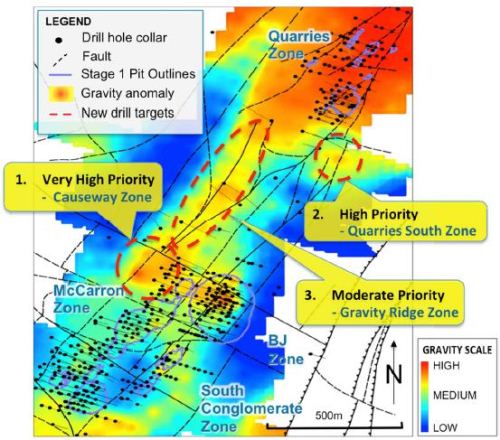
Kempfield gravity anomalies and the new drill targets. Source: Company announcement


“The new targets (Causeway Zone, Quarries South and Gravity Ridge) represent potentially significant future upside for the Kempfield silver project, in addition to the company’s development plans to bring the project into production as a significant silver mining operation,” Argent Minerals said in its ASX announcement.

Details of the new drill targets are as follows:

Very High Priority

The Causeway Zone anomaly (coincident gravity/Induced Polarisation [“IP”] chargeability).

The Causeway Zone is said to display intense silicified and sericitised rhyolitic agglomerate, which the company considers to represent an alteration assemblage similar to that of the footwall at the Que River deposit.

Argent said this could be a feeder zone of the Kempfield deposit.

The Causeway Zone anomaly has not been tested.

High Priority

The Quarries South anomaly (coincident gravity/IP chargeability).

Quarries South was partially tested by one drill hole, which intersected lead‐zinc mineralisation and silver mineralisation and a large halo of variable sericite/chlorite alteration.

Argent explained that it was unable to immediately follow‐up with a Down‐Hole Electromagnetic due to an immediate collapse of the hole.

The company does however consider the high‐grade base metals intersection indicates the proximity of a higher depositional temperature and hydrothermal vent.

There is still a significant southern portion of the Quarries South anomaly yet to be tested.

Moderate Priority

Gravity Ridge is a large elongated gravity/VTEM conductivity anomaly in the northwest of the Kempfield deposit.

The company’s current interpretation is that it probably represents a major basement structure – a growth fault with sporadic occurrences of barite lenses indicating the potential for additional mineralisation.

Two historical holes drilled in the Gravity Ridge returned high‐grade base metal intersections and intense chlorite/sericite alteration assemblages.

These holes only partially tested the shallow portion of the anomaly to 100 metres to 150 metres below the surface.

Mineralisation remains open at depth and to the Northwest.

Centaurus Metals encouraged by convivial drill results from Canavial project

THE DRILL SERGEANT: Centaurus Metals (ASX: CTM) has received encouraging drilling results from the company’s 100 per cent-owned Canavial iron ore project, located 10 kilometres from its Jambreiro iron ore project in Minas Gerais, Brazil.

The company said the results have supported the positive initial results it achieved from its maiden drilling program in 2011 while laying the foundations for a maiden JORC resource estimate.
 
Centaurus said the latest drilling had also added to the emerging potential the Canavial project has displayed as an additional source of friable itabirite feed for the Jambreiro project, where development is scheduled to commence later this year.

Centaurus is now aiming to complete a maiden JORC resource for Canavial by May this year.
 
Highlights of the recent RC drilling results include:

–    37 metres at 41.9 per cent iron, 7.2 per cent aluminium oxide and 0.05 per cent phosphorous from surface;

–    23m at 42 per cent iron, 10.2 per cent aluminium oxide and 0.07 per cent phosphorous from surface;

–    12m at 40.3 per cent iron, 5.5 per cent aluminium oxide and 0.06 per cent phosphorous from 17m; and

–    19m at 29.0 per cent iron, 4.6 per cent aluminium oxide and 0.07 per cent phosphorous from 69m.


Canavial iron ore project – schematic cross section. Source: Company announcement


“We are pleased with these early drill results from the Canavial project,” Centaurus Metals managing director Darren Gordon said in the company’s announcement to the Australian Securities Exchange.

“To have a potential source of additional friable itabirite feed only 10 kilometres from the Jambreiro plant site has obvious advantages to the company as we look to grow the business.

“We are committed to steady but continuous exploration and development of the region, and to increasing our resource base to underpin extensions to the current 9-year friable ore mine life of the Jambreiro project.”

Centaurus indicated the nature of the mineralisation it has identified at surface and in RC chips at the Canavial project is, for the most part, the same as that at Jambreiro.

Because of this the company said it anticipates the Canavial mineralisation will be amenable to beneficiation to produce a high-grade, low impurity product in a similar way to Jambreiro.
 
Beneficiation test work using the Jambreiro flowsheet design is underway.
 
Centaurus delivered a positive Bankable Feasibility Study on the Jambreiro project in November 2012, outlining a robust 2 million tonnes per annum project capable of generating revenues of $836 million and EBITDA of $545 million over an initial nine-year life.
 
The company has since commenced initial development activities and is progressing appropriate licensing process in line with the established schedule to enable site works to commence in Q2 2013.
 

Apollo Minerals identifies EM conductors at Titan project

THE DRILL SERGEANT: Apollo Minerals (ASX: AON) has completed a moving loop transient electromagnetic (MLTEM) survey over the Acacia East base metals prospect, which the company claims has identified strong electromagnetic (EM) conductors.

Acacia East is located on Apollo’s 100 per cent-owned tenements, and forms part of the company’s Titan base-precious metals project in South Australia.


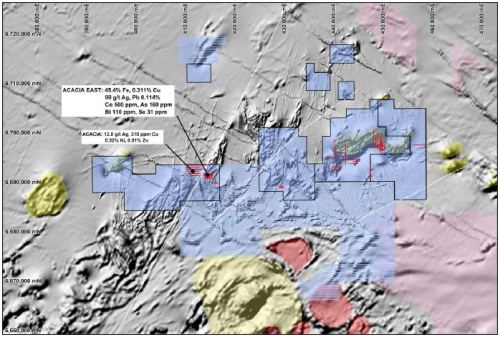
Location of Apollo’s Titan base-precious metals project area and Acacia East prospect. Source: Company announcement


According to Apollo the recently-completed MLTEM surveys delineated large high-strength EM conductors at Acacia East.

These have been measured at approximately 1,200 metres along strike and 800 metres across with a vertical extent of over 1,500 metres.

The company considers the response received by the survey indicates massive sulphide mineralisation, which may be host to significant nickel-copper-platinum group elements or IOCGU mineralisation.

Field XRF analysis carried out on limited outcrop exposures immediately west of the EM responses at Acacia East returned grades of up to:

–    45.4 per cent iron, 0.31 per cent copper, 99 grams per tonne gold, 0.11 per cent lead, 500 parts per million cobalt, 160ppm arsenic, 110ppm bismuth and 31ppm selenium.

Apollo pointed out the presence of selenium is often regarded as a reliable indicator of copper-sulphide based mineralisation.

“Early stage base metals exploration results of this calibre are rare and highly prized,” Apollo Minerals chief operating officer Dominic Tisdell said in the company’s announcement to the Australian Securities Exchange.

“While we’ve still got a great deal more work to do to have a definitive answer to the source of these responses, we’re highly encouraged by what we’ve found so far.

“We’ll be pushing to build the confidence required to drill this promising target as soon as possible.”

The Acacia East prospect is situated approximately three kilometres east of the previously shallowly-drilled Acacia prospect where drilling returned results of up to:

–    12 grams per tonne silver, 0.32 per cent nickel, 310ppm copper and 0.21 per cent zinc.
 
Acacia East has not been subject to any previous drilling and has had very little geochemical sampling done on it prior to Apollo’s recent program.

In an effort to better understand the thickness and relationship dynamics between the various conductors, Apollo completed a detailed ground gravity survey in February 2013.

Final results from the gravity survey are expected shortly and will be used to more accurately determine the exact mineralisation system-style and to help with drill hole planning.

Maiden drilling at Blue Bell delivers for AusAmerican Mining

THE DRILL SERGEANT: Australian-American Mining Corporation (ASX: AIW) is conducting its maiden drilling program at the company’s Blue Bell project in Arizona.

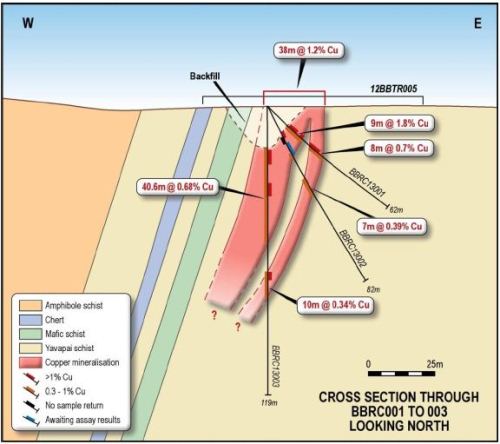
The company has reported drilling so far has returned wide zones of copper-gold-silver mineralisation.

AusAmerican has received the results from the first three holes of the 30 drill hole program with assays from another six holes expected to be received by the end of February.

Results include:

–    9 metres at 2.2 per cent copper equivalent (CuEq) (1.8 per cent copper, 0.3 grams per tonne gold and 19.6 grams per tonne silver) from 8 metres;

–     8m at 0.8 per cent CuEq (0.7 per cent copper, 0.1g/t gold and 3.3g/t silver) from 21m; and

–    40.4m at 0.8 per cent CuEq (0.7 per cent copper, 0.1g/t gold and 5.5g/t silver) from 14m.
 
Zones of mineralisation also included high-grade components of:

–    1m at 12.8 per cent CuEq (11.2 per cent copper, 0.6g/t gold and 93.2g/t silver) from 11m;

–    4.5m at 2.3 per cent CuEq (2 per cent copper, 0.3g/t gold and 7g/t silver) from 16m; and

–    3m at 1.9 per cent CuEq (1.4 per cent copper, 0.3g/t gold and 19.8g/t silver) from 31m.

“We are encouraged by the results of the first three holes,” AusAmerican managing director Richard Holmes said in the company’s announcement to the Australian Securities Exchange.

“In particular we are pleased with the widths and grades returned so far.

“If these results can be repeated over the remaining holes, it will give us more confidence that a resource can be identified by Q3 2013.

“At this stage, although we are growing in confidence at the prospectivity of the project, it is early days yet and we are determined to use a conservative outlook when reporting to shareholders.

“We will let the project prove that it has potential on the back of the assay results that we will report to the market over the next 6-8 weeks.”


Blue Bell cross section showing recent drill intercepts. Source: Company announcement


AusAmerican said all three holes were collared in an area which appears to be a small, backfilled open pit.

Mineralisation starts immediately below the open pit fill where the company has assumed a portion of the ore body has been removed by previous small scale mining activity.

AusAmerican considers the results further validate its exploration model of a lower grade stock work mineralisation surrounding higher grade massive sulphide lenses.

It also believes the results support its previously released exploration target for the project.