Lincoln Minerals announces Kookaburra Gully graphite Resource

THE DRILL SERGEANT: Lincoln Minerals (ASX: LML) has announced a maiden high-grade JORC Code-compliant Indicated and Inferred Mineral Resources for the company’s wholly-owned Kookaburra Gully graphite project, located on South Australia’s Eyre Peninsula.

The total Indicated and Inferred Mineral Resources for Kookaburra Gully project have been calculated at 2.25 million tonnes grading 15 per cent total graphitic carbon (TGC) with 338,000 tonnes of contained graphite at a nominal cut-off grade of 5 per cent TGC.

“The maiden JORC Code-compliant Mineral Resources at Kookaburra Gully reinforce Lincoln’s confidence in being able to quickly progress the company’s graphite resources on southern Eyre Peninsula into a high-quality, long-life graphite mining and processing operation,” Lincoln Minerals managing director Dr John Parker said in the company’s announcement to the Australian Securities Exchange.

“Drilling the Kookaburra Gully graphite project and defining over two million tonnes of mineralisation at 15 per cent TGC in this timeframe has been a fantastic result for Lincoln.”

Lincoln Minerals provided a comparison of the Kookaburra Gully project to northern hemisphere graphite projects, which it said report resources at a grade of around 2 per cent TGC saying the company resource excludes material below that grade.

The company previously announced a total Exploration Target for graphite prospects in the Kookaburra Gully following an EM survey area, which included extending Kookaburra Gully and the historic Koppio graphite mine.
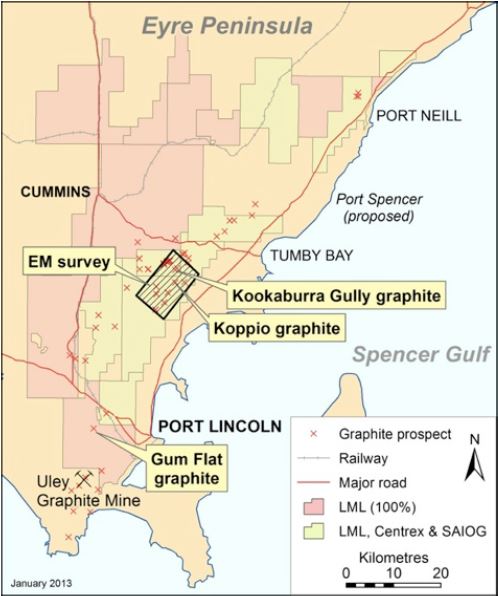
 

Project location. Source: Company announcement


The Exploration Target was estimated to be between about 14.2 million tonnes to 42.6 million tonnes and was based on an estimated average grade in the range of 7 to 15 per cent TGC.

Lincoln explained the estimate was based on a depth extent of only 50m, however a drilling campaign carried out in January 2013 at the Kookaburra Gully site demonstrated this is likely to be a conservative estimate of what the company could be sitting on.

The company displayed its confidence in the project by claiming it to be ranked in the top 10 graphite deposits in the world in terms of the average grade of its in situ graphitic carbon content.

“The Kookaburra Gully graphite resource we have defined today is important because it only reflects information taken from 500 metres of strike,” Parker said.

“We have not drilled further south yet. Lincoln is very optimistic that drilling planned for Kookaburra Gully Extended this year will define further graphite resources.”

Lincoln Minerals has completed preliminary metallurgical studies and a scoping study for Kookaburra Gully, the results of which indicate the company will be able to produce high-quality flake graphite (greater than 95 per cent TGC).

The company anticipates its graphite mining and processing program will be globally competitive as the resource can be mined from a small open pit mine or quarry with low strip ratios.

“We are on track for a pilot-scale operation by the end of 2013, subject to finance and approvals, and we are planning to pursue full mining, production and processing of graphite through 2014,” Parker said.
KalNorth Gold Mines establishes Mt Jewell Reserve

THE DRILL SERGEANT: KalNorth Gold Mines (ASX: KGM) has calculated an initial Probable Reserve of 2.74 million tonnes at 1.36 grams per tonne gold for 119,800 ounces of gold for the company’s Mt Jewell Field.

Metallurgical test work completed by the company has confirmed Mt Jewell to have free milling ore, with good recoveries.

KalNorth considers Mt Jewell to have Resource growth potential as mineralisation remains open in most directions.

The company has further drilling planned for the next quarter to target additional ore.

The addition of the Mt Jewell Reserve boosts KalNorth’s total Probable Reserve by 78 per cent, to: 5.06 million tonnes at 1.7g/t for 272,770 ounces of gold.

The total Indicated and Inferred Resource for KalNorth is 1.2 million ounces of gold.

KalNorth explained the maiden Reserve for Mt Jewell is based on an optimised $1500 per ounce shell and onsite ore processing through a nominal 1 million tonne per annum plant.

The company indicated it was confident enough to have already commenced pit design studies with the expectation of additional resource/reserves leading to advanced pit design and mine planning.


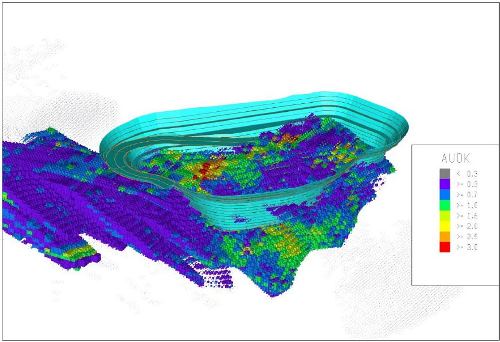
Isometric image of proposed Hughes pit including the orebody block model. Source: Company announcement


“Mt Jewell is proving to be an outstanding acquisition for KalNorth,” KalNorth Gold Mines managing director John McKinstry said in the company’s announcement to the Australian Securities Exchange.

“With a Total Probable Reserve of over a quarter million ounces now established across the KalNorth Field, we are advancing our plans for another open pit mining operation at Mt Jewell.

“With Reserves now firmed up for our four key gold fields, our focus has turned to aggressively grow the Resource base.

“We believe there is potential for Resource growth across all projects and we intend to tap into that potential in the near-term.”

Doray Minerals completes Judy Lode maiden resource

THE DRILL SERGEANT: Doray Minerals (ASX: DRM) has announced a maiden, high-grade JORC-compliant gold resource for the Judy Lode, situated adjacent to the current Wilber Lode mining operations within the company’s Andy Well gold project in Western Australia.

The new Judy Lode resource follows a recent RC drilling campaign and is the second high-grade gold resource to be defined within the Andy Well project by Doray.


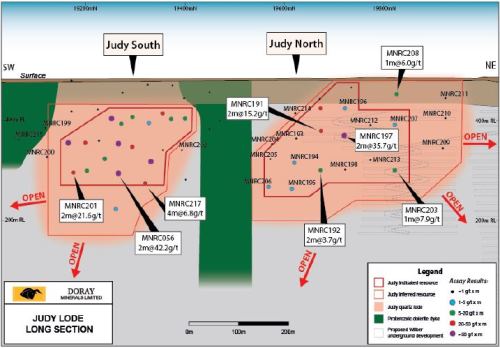
Long section of Judy Lode, showing the resource outline and highlighting recent drilling results. Source: Company announcement


The Judy Lode resources measures 225,000 tonnes at 9.7 grams per tonne gold for 70,000 ounces in the indicated catergory, 168,000 tonne at 6.7g/t gold for 36,000  ounces in the inferred category for a total of 393,000 tonnes at 8.4g/t gold for 106,000 ounces of gold.

Doray said the total resource includes the Judy South zone (137,000t at 19.3g/t gold for 85,000 ounces), which makes up approximately 80 per cent of the total contained ounces.

“This new high-grade Judy Lode resource, in close proximity to the future underground Wilber Lode mining operations, has the potential to add to the initial 3.7 year mine life indicated by the Bankable Feasibility Study completed in the middle of 2012,” Doray Minerals managing director Allan Kelly said in the company’s announcement to the Australian Securities Exchange.

“Before we have commenced underground mining of the Wilber Lode, we have been able to discover and drill out a second high-grade gold resource from surface.

“Importantly, based on our experience so far and, given the nature of the Judy Lode mineralisation, we believe we should be able to again achieve a high conversion rate from resource to reserve at Judy.

“This should then translate into an increased mine life at Andy Well to almost five years.”

The estimation of the Judy Lode resource increases the total Andy Well resource to 1.22 million tonnes at 11.3g/t gold for 444,000 contained ounces.

Kelly also indicated the recent drilling had provided evidence to the company for further extensions to the Wilber Lode deposit.

Between December 2012 and February 2013, Doray completed RC drilling across the Judy structure, which the company said highlighted a southerly plunge to the mineralisation, which remains open at depth and along strike south of the Judy South zone.

The company indicated other drilling conducted in the Judy South area intersected the interpreted southern extension of the Wilber Lode.

Results from this drilling include:

–    2 metres at 15.9g/t gold from 53m; and

–    1m at 13.4g/t gold from 52m.

These results extend the known Wilber mineralisation by a further 300m south of the currently defined Wilber Lode Resource area.

Doray said the latest drilling results point to the probability of a second underground mining operation at Judy.

This area is now considered by the company to be a priority exploration target for further drilling.

Tanami Gold continues to identify gold mineralisation

THE DRILL SERGEANT: Tanami Gold (ASX: TAM) has recorded further encouraging drilling results at the company’s 100 per cent-owned Coyote gold mine in Western Australia.

Recent results have been received from drilling within the Kavanagh target area, which the company indicated are to be incorporated into a Maiden Resource scheduled to be completed by early April 2013.

Recent infill drilling results include:

–    2.4 metres at 216.9 grams per tonne gold;

–    1.8m at 124g/t gold;

–     0.3m at 178.0g/t gold;

–    4.2m at 8.0g/t gold;

–    0.3m at 75.0g/t gold;

–    0.5m at 33.6g/t gold; and

–    0.5m at 26.5g/t gold.

“These results represent some of the highest grades intersected to date from within Kavanagh,” Tanami Gold acting CEO Peter Cordin said in the company’s announcement to the Australian Securities Exchange.

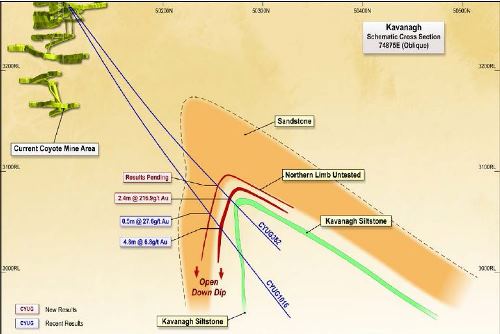
“Of significance, CYUG362 (2.4m at 216.9g/t Au) has extended the mineralisation to the west, closer to the active Coyote mine area.

“The company’s geologists have been pleased at the high success rate of the drilling.

“Their geological understanding has grown and the mine sequence and the mineral occurrence are now well understood.”


Kavanagh oblique schematic cross section. Source: Company announcement


Tanami said drilling to date has identified two main ore horizons within Kavanagh that are defined on both the northern and southern limbs.

They are continuous over a strike length of 250 metres and remain open in all directions.

These mineralised surfaces are referred to as the K1 and K2 lodes and the company claims they have an average true width of 1 metre with an average grade to date of 16.7g/t gold and 32.4g/t gold respectively.

Tanami considers the exploration potential of these lodes to be high with both CYUG362 (2.4m at 216.9g/t gold) and CYUG646 (0.3m at 178g/t gold) remaining open down plunge and along strike.

Tanami is currently using three company-owned underground diamond rigs as part of its ongoing exploration on Kavanagh.

Phosphate Australia extends Tuckanarra gold mineralisation

THE DRILL SERGEANT: Phosphate Australia (ASX: POZ) has extended gold mineralisation at the company’s 100 per cent-owned Tuckanarra gold project in Western Australia.

The extensions to gold mineralisation at Tuckanarra come via the company’s latest Phase 4 aircore drilling program, which it anticipates will further add to the resource base at the Cable-Bollard area.

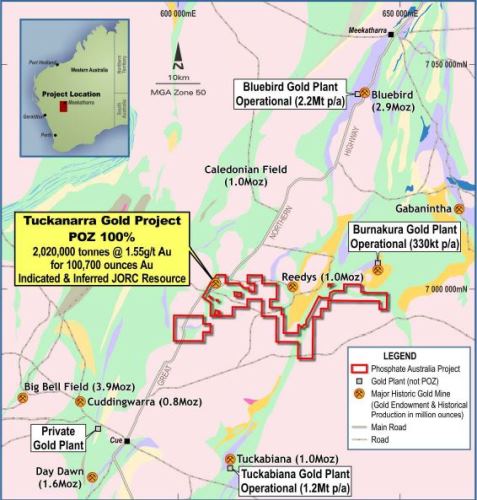
Phosphate Australia recently defined a maiden Indicated and Inferred JORC resource at Tuckanarra of 2.02 million tonnes at 1.55 grams per tonne gold for 100,700 ounces of gold.

“The Board believes the Tuckanarra gold project has considerable potential for development given its shallow mineralisation, excellent metallurgical recoveries potential amenability for heap leaching and proximity to third party gold mills in the region,” Phosphate Australia said in its ASX announcement.


Tuckanarra gold project location, tenements and gold plants. Source: Company announcement


The Phase 4 drilling program was conducted with the intention of: testing extensions to the known laterite resources at Cable and at Bollard; Infill drilling at various prospects; and to test for on-strike, unmined extensions to the hard rock mineralisation at Bottle Dump.

The company indicated the drilling had increased the areas of known laterite mineralisation at Cable and Bollard, while the drilling of the Bottle Dump extension did not find any significant mineralisation.

“The Board believes the best way to add value to the Tuckanarra Project is to continue to progress the planning and permitting for a future gold mine,” Phospahte Australia said.

“With this in mind, the resource model is being updated to include the new Phase 4 drilling results with pit design to commence thereafter.

“Concurrently with this, permitting is being prepared in order to apply for a mining lease over the project.

“The Board is keen to advance and commercialise Tuckanarra as soon as possible.”

Rox Resources continues drilling success at Camelwood

THE DRILL SERGEANT: Rox Resources (ASX: RXL) has received more assays from drilling being carried out at the company’s Camelwood nickel sulphide prospect at Fisher East, 450 kilometres north of Kalgoorlie.
 
Diamond drilling at Camelwood has returned:

16.3 metres at 1.8 per cent nickel, including 6.3 metres at 2.5 per cent nickel from 211.7 metres, including 0.47 metres at 5.4 per cent nickel from 212 metres (semi-massive sulphide); and

7.5m at 1.2 per cent nickel, including 0.4m at 3.8 per cent nickel from 178.3m (semi-massive sulphide).

Rox said one of the RC holes returned the best visual estimates seen to date of up to 30m of mineralisation from 144m, including 4m of massive sulphides, 4m of semi-massive sulphides and 25m of disseminated sulphides.

“This RC result is particularly pleasing being the thickest and most near-surface massive sulphide intersection to date,” Rox Resources managing director Ian Mulholland said in the company’s announcement to the Australian Securities Exchange.

Rox indicated diamond drilling is continuing at Camelwood where it will move soon to test the Camelwood North EM conductor located approximately 500m north of Camelwood.

The company has determined this conductor appears to be a down faulted offset from the main Camelwood EM conductor.

RC drilling is continuing on 50m infill sections along the 700m strike length of Camelwood, plus testing extensions to the north.

Drill assays and the share price conundrum

THE DRILL SERGEANT: Many exploration companies become frustrated when the market either misses or ignores releases of drilling results, especially if they’re good.

It’s easy to dismiss such announcements as noise produced by companies designed to let their shareholders know that their investments are being spent wisely, however they can tell a studious investor so much more.

Recent research released by IntierraRMG has demonstrated an interesting correlation between good drill results and a subsequent rise in share prices.

“Despite the sharp reduction in drilling activity (as reported) during the [December 2012] quarter just ended, there have been some remarkable intersections during the past few months,” IntierraRMG said in its State of the Market Report.

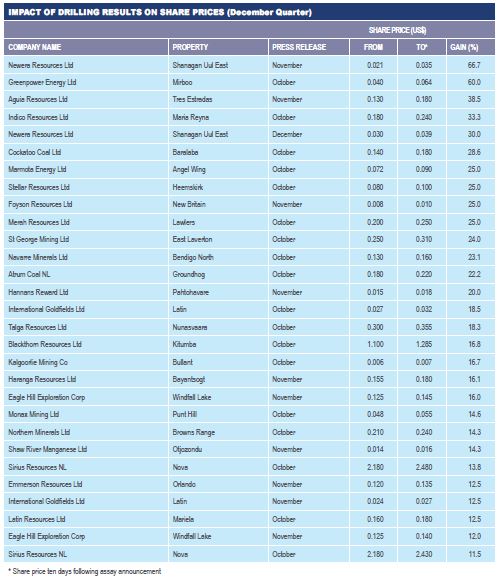
IntierraRMG found some of the intersections announced during the December 2012 quarter had a significant effect on the share price of the project owners.

Ten day share-price gains of over 60 per cent were recorded by Newera Resources (ASX: NRU) and Greenpower Energy (ASX: GPP) after each company had announced encouraging drilling hits from their projects at Shanagan Uul and Mirboo, respectively.

The share prices of another eight companies jumped by more than 25 per cent in the ten days following a positive drilling announcement.

Source: intierraRMG

“Indicative of the mooted exploration activity (and markets) in the final weeks of the year [2012], only one of the 28 instances of share prices rising over 12 per cent (measured ten days after an exploration announcement) was in December,” IntierraRMG found.

“There were 17 such share-price rises in October and 10 in November.

“Indeed, even this one exploration share-price spike in December was by Newera, which had set the quarter’s record price gain during the previous month.

“Despite a share-price retreat between the two drilling reports, Newera’s share price doubled; demonstrating the abiding appeal of junior stocks.”

In his 2010 tome A Shareholder’s Guide to Investing in the Australian Mining Boom, perennial junior resources company director Allan Trench provided advice regarding the effect of drilling results, or lack of, upon an investment.

“Know when to fold,” Trench said.

“Ask yourself how wrong you are prepared to be.

“If the drilling program comes and goes, and the shares fail to rise, or worse still, fall, know when to call it quits.

“Invest on anticipation that a specific trigger will ignite interest in the shares.

“If that interest does not eventuate, exit.”

Coming in at number one for copper intersections for the December quarter last year was hole drilled by OZ Minerals (ASX: OZL) on its Carrapateena project, which returned 0.90 per cent copper over 1,492m (at a depth of 609m).

In second place was Blackthorn Resources (ASX: BTR) with an assay from its Kitumba project in Zambia of 3.02 per cent copper over 220m (at 206m).

Gold is never far from the end of the driller’s bit and the best result to come in for the shiniest commodity was from Pilot Gold with its 193 grams per tonne gold, over 12m (at a depth of almost 118m) on its TV Tower project in Turkey (for a grade-intersection value of 2,316m.g/t).

In second place during the quarter was 44 grams per tonne gold over 42m by ABM Resources at the Old Pirate project in Australia, which IntierraRMG said was noteworthy due to the fact it was from surface.


Robust Resources confirms manganese horizon on Romang Island

THE DRILL SERGEANT: Robust Resources (ASX: ROL) has received assay results from eight drill holes completed at the company’s Manganese Valley prospect on Romang Island, Indonesia.

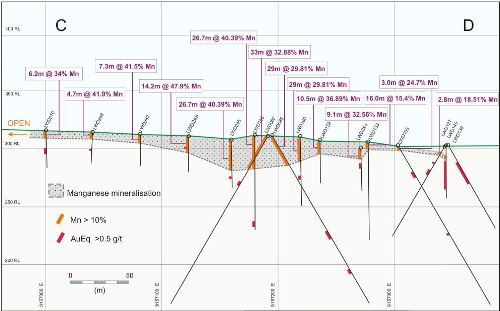
Robust said the drilling had confirmed mineralisation at the Manganese Valley prospect forms a continuous horizon of manganese mineralisation over 350 metres.


Manganese Valley prospect cross section showing a 350+ metre zone of
near-surface manganese mineralisation that remains open to the south.
Source: Company announcement


The results have provided Robust with the impetus to accelerate feasibility and commercialisation studies, which it has now commenced.

The company foresees a low-CAPEX start-up operation may be able to fund the future development of its gold-silver and polymetallic deposits.

These latest results include a number of high-grade intersections including:

–    9.1 metres at 32.6 per cent manganese from surface, including: 4.8 metres at 47.1 per cent manganese from 3.7 metres;

–    25.4m at 23 per cent manganese from surface, including 6m at 42.1 per cent manganese from surface and 5.4m at 35 per cent manganese from 20m;

–    7.3m at 41.5 per cent manganese from surface;

–    5.4m at 50.1 per cent manganese from surface; and

–    4.7m at 41.9 per cent manganese from 1.3m.

“This is a significant development for the company, as further success in our manganese drilling program is a catalyst for Robust to accelerate commercialisation of a low CAPEX manganese mining operation, which may in turn provide a cash-flow to fund development of our other mineral discoveries on Romang,” Robust Resources managing director Gary Lewis said in the company’s announcement to the Australian Securities Exchange.

“Conceptually, the development of Romang could commence with a very low capital manganese mine which should provide capital funding for the construction of the oxide gold silver heap leach operation followed by a larger polymetallic mine.

“At each stage there is an opportunity to re-use infrastructure, thereby engendering substantial capital savings, high efficiency and a large mitigation of risk.

“As well as progressing ore beneficiation and marketing studies, further drilling of the manganese mineralisation is now the key priority for the company.”

Robust Resources said drilling of the manganese targets is an ongoing high-priority for the company in order to determine the size and quality of the project’s emerging manganese resource.

Castle Minerals intercepts new gold zone

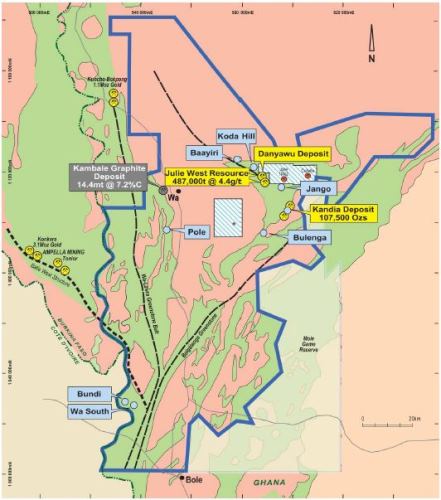
THE DRILL SERGEANT: Castle Minerals (ASX: CDT) has reported a new zone of bedrock gold within Birimian sediments via drilling recently conducted on the company’s Wa project in north‐west Ghana.

The company undertook wide-spaced reconnaissance RAB drilling four kilometres south of recently announced Bundi gold mineralisation.

The drilling returned a best result of:

–    3 metres at 2.02 grams per tonne gold from 20 metres to end of hole.

Castle said the mineralisation appears similar to Bundi being hosted by altered quartz‐sericite schists.

“Our Wa South prospect has again produced a significant grass roots exploration intercept that justifies immediate follow up and confirms that this previously unexplored alluvial covered area is highly prospective,” Castle Minerals managing director Mike Ivey said in the company’s announcement to the Australian Securities Exchange.

“We will shortly recommence RAB drilling to fully define the target dimensions before undertaking RC drilling.”


Castle’s Wa Project in north‐west Ghana. Source: Company announcement


The drilling campaign was conducted using Castle’s own RAB drill rig.

The company now has the rig working in  other areas within its Wa gold project with a program testing 26 of more than 60 gold targets identified within the larger Wa project area.

Canyon Resources extends Tao mineralisation

THE DRILL SERGEANT: Canyon Resources (ASX: CAY) has received results from a recently completed RAB (Rotary Air Blast) drilling campaign on the company’s Tao project in north eastern Burkina Faso, which it claims has extended gold mineralisation.

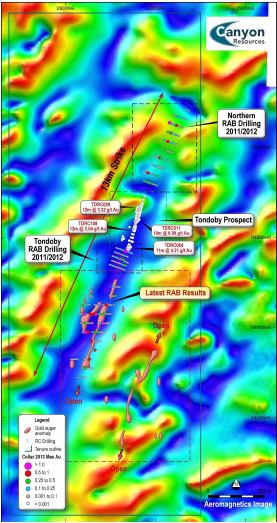
Canyon carried out the 168 hole RAB drilling program south of the Tondoby prospect.


Tao project drill hole location plan. Source: Company announcement


“The results from the RAB drilling campaign have confirmed the extension of mineralisation to more than 13 kilometres of strike,” Canyon Resources managing director Phillip Gallagher said in the company’s announcement to the Australian Securities Exchange.

“Pleasingly, the mineralisation appears to continue further south through the Tao permit boundary and into the permit area that we have under application.”

Best results from the drilling included:

–    8m at 1.24 grams per tonne gold from 26 metres;

–    2m at 2.28g/t gold from 30m;

–    2m at 1.32g/t gold from 26m; and

–    6m at 0.73g/t gold from 4m.

Canyon is finalising its next phase for the current exploration season on the project.

This is scheduled to include an airborne magnetic geophysical survey to assist in targeting RC drilling.

Auger geochemistry previously conducted by Canyon highlighted a number of anomalous zones, which the company says has been validated by the RAB drilling results and geological logging.

The company has concluded two separate mineralised zones are evident: the first being the western zone, which it considers to be geologically equivalent to the Tondoby prospect, with mineralisation located at the sheared contact between diorite and metaschist (sedimentary derived); and, the eastern zone, which is located in an altered arkosic sediment (dirty sandstone).
 
“Over the past two years, Canyon’s RC drilling has been focused on the Tao project’s Tondoby prospect and this has consistently yielded zones of high-grade, shallow gold mineralisation that we believe may be repeated along strike,” Gallagher said.

“Subject to the results of the planned magnetic survey, we are proposing to step out our drilling to focus on targeting new zones along strike of the Tondoby prospect.”
 
Canyon indicated it is fully-funded to carry out its current work program at Tao as well as its Pinarello gold project having completed a placement and share purchase plan to raise approximately $1.83 million.