Ramelius Resources completes Water Tank Hill resource estimate

THE DRILL SERGEANT: Ramelius Resources (ASX: RMS) has completed a Mineral Resource Estimate for the Water Tank Hill deposit situated alongside the company’s Mt Magnet gold mine in central Western Australia.

The new estimate for the Water Tank Hill satellite deposit has come in at 63,000 ounces of gold.

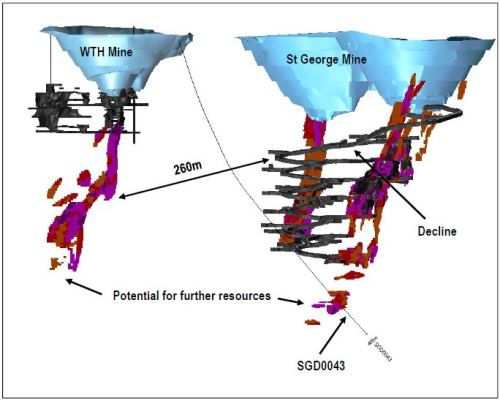
Ramelius indicated the Water Tank Hill Resource combined with the St George underground operation Resource to provide total Resources of 125,000 ounces at a grade of 5.2 grams per tonne gold that can potentially be accessed from the St George decline.


Water Tank Hill and St George deposits showing pits, underground
workings and resource models. The St George decline extends to 290m
below surface. Source: Company announcement


“Ramelius believes that there are now sufficient Resources within close proximity of the St George decline to justify commencing a mining study to demonstrate the economic viability of a mining operation,” Ramelius Resources said in its ASX announcement

“External mining consultants have been engaged to complete a mining study for the Water Tank Hill / St George Resources which is expected to be completed in the June 2013 quarter.

“The mineralisation at Water Tank Hill and St George also appears to be open down plunge and potential exists to increase Resources from future underground drilling.”

Red Mountain Mining claims new god discovery at Lobo

THE DRILL SERGEANT: Red Mountain Mining (ASX: RMX) has claimed discovery of a new high-grade epithermal gold vein at the Lobo prospect, situated within the company’s Batangas gold project, located 100 kilometres south of Manila in the Philippines.

The company said it had identified a continuous 19 metre surface channel of 1 metre spaced samples along the strike of an exposed epithermal quartz-barite vein, which produced an intersection of:

–    19 metres at 9.77 grams per tonne gold including 7 metres at 23.58 grams per tonne gold and including 0.8 metres at 94.78 grams per tonne gold.

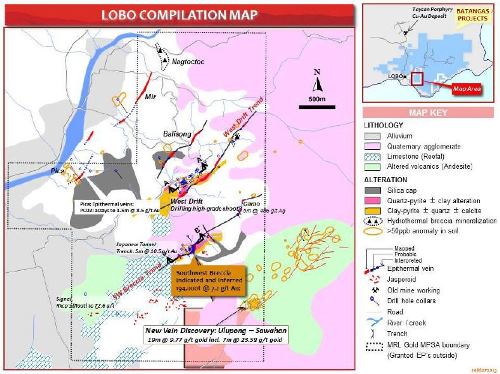
According to Red Mountain the vein is at the western end of an extensive zone of anomalous gold soil geochemistry at Ulupong-Sawahan it says extends for more than two kilometres in a northeast-southwest direction.

This runs sub parallel to the South West Breccia and West Drift epithermal gold vein systems that host high-grade gold resources and targets.


Plan of Lobo epithermal gold structures. Source: Company announcement


“The new high-grade gold vein discovery at Ulupong, within the Lobo gold project at Batangas is a very exciting result which opens up potential for the discovery of high-grade shoots on a completely new system,” Red Mountain executive chairman Neil Warburton said in the company’s announcement to the Australian securities Exchange.

“Extensive surface mapping and trenching will continue in this area with follow up drilling planned in the near future.

“This new discovery along with extensions at Pica has extended the total strike length of the Lobo epithermal veins from 10 kilometres to more than 15 kilometres.”

The new discoveries take to five the number of major epithermal vein systems Red Mountain has identified at Lobo, for a total strike length of more than 15 kilometres.

Systematic drilling conducted by the company has only tested a 500m strike length of the systems to relatively shallow depth (200 metre vertically at West Drift, 120 metre vertically at South West Breccia).

The company has interpreted a zone of high gold grades at West Drift and on the South West Breccia structure, where it says upper levels on the structures are characterised by high copper-silver grades and the high grade gold zones occur at lower elevations.

Octagonal Resources checks old drilling and scores copper

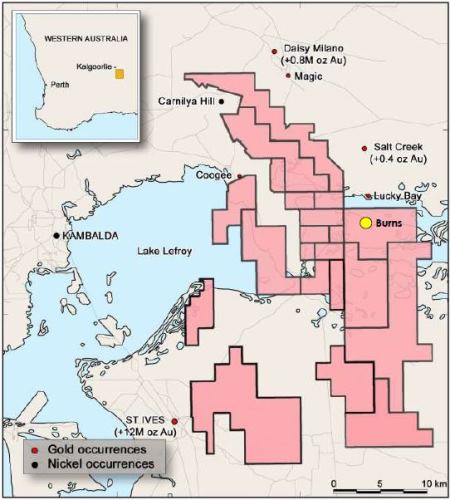
THE DRILL SERGEANT: Octagonal Resources (ASX: ORS) has received results from copper analysis of aircore drill holes completed at the Burns prospect, within the company’s Hogans project in Western Australia.

During 2011 aircore drilling was conducted the Burns prospect to test for an Archaean-style lode-gold deposit, with samples analysed for gold only.

A subsequent drilling campaign in 2012 discovered potentially economic gold, copper, and silver, which led the company to have all samples collected from the initial 2011 aircore drilling programs re-analysed for copper.

“When we first started exploration out at Burns we felt, given the structural setting of the area, that we had the potential to discover a major gold deposit, and as a result we only analysed our drill holes for gold,” Octagonal Resources managing director Anthony Gray said in the company’s announcement to the Australian Securities Exchange.

“Now that we’ve discovered significant gold and copper in RC drilling it was a no-brainer to go back and re-analyse the earlier aircore holes for copper.”


Hogan’s project: Tenement location plan. Source: Company announcement


Octagonal has now identified thick zones of copper anomalism in drill holes the company claims to define a two kilometre long anomaly which is between 80 and 350 metres wideand not constrained by drilling along its southeast margin.

A second anomaly was also identified that extends over 700 metres and is not constrained by drilling to the northwest.

“The results of this work have surprised us,” Gray continued.

“There are broad zones of copper that do not directly correlate with gold and as a result our target area has expanded.

“What we’ve found is that the copper overlies both magnetic and gravity trends and provides us with a very discrete target for surface geophysical testing.

“The distribution of copper is in line with what you would expect for a large deposit and our next step is to use surface geophysics to identify copper sulphide targets for testing with our first diamond drilling program that the West Australian Government is supporting with a $150,000 co-funded drilling grant.”

Renaissance Minerals announces 1.2M ounce gold resource

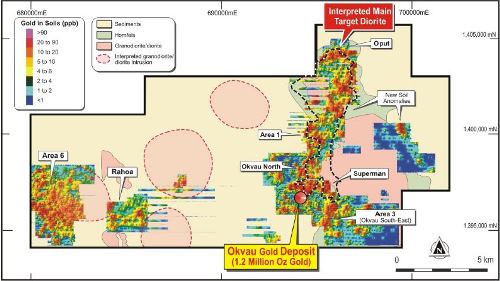
THE DRILL SERGEANT: Renaissance Minerals (ASX: RNS) has announced a JORC-compliant gold Indicated and Inferred resource estimate for the company’s 100 per cent-owned Okvau gold deposit in Cambodia, of 15.6 million tonnes at 2.4 grams per tonne gold for 1.2 million ounces.

The resource estimate comprises 15.2 million tonnes at 2.3g/t gold for 1.11 million ounces of gold classified into the Indicated resource category plus 0.5 million tonnes at 5.9g/t gold for 0.1 million ounces of gold classified into the Inferred resource category.

“Renaissance acquired the project less than 12 months ago and its initial drilling program completed in 2012 has already resulted in a major resource increase of 65 per cent and a 33 per cent improved gold grade to 2.4 grams per tonne,” Renaissance Minerals managing director Justin Tremain said in the company’s announcement to the Australian Securities Exchange.
 
“The project is proving to be a very attractive high grade project with significant scale.

“The Okvau deposit covers only a small part of the project area and demonstrates the prospectivity of this unexplored region of Cambodia.

“Results achieved to date vindicate our belief that the eastern region of Cambodia will evolve into a major new gold province in an emerging country with a stable democratic Government.”


Okvau Exploration License area. Source: Company announcement


The resource estimate includes drilling completed by Renaissance on the Okvau gold deposit during 2012.

Renaissance is currently undertaking a 25,000 metre RC drilling program targeting high priority prospects within close proximity of the Okvau gold deposit.

The company has two RC rigs drilling and has just completed a surface geochemical sampling program that generated multiple targets to drill test over the current exploration field season.

All of these targets are situated within 15 kilometres of the Okvau gold deposit.

The company’s current drilling program is targeting further resource growth at the Okvau deposit.

Castle Minerals increases Julie West resource

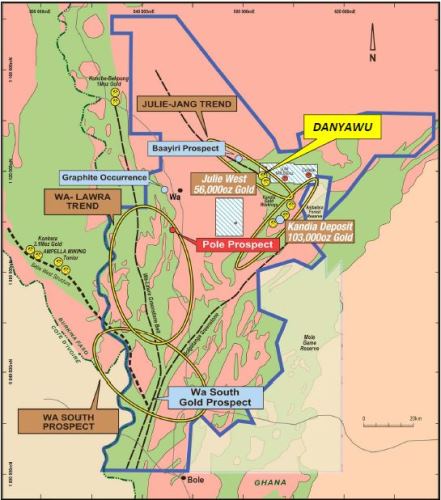
THE DRILL SERGEANT: Castle Minerals (ASX: CDT) has increased the total gold resource for the Julie West prospect in Ghana by 24 per cent to 487,100 tonnes at 4.4 grams per tonne gold for 69,000 ounces.

The increase at Julie West comes from a maiden resource estimate the company has completed for the high-grade Danyawu deposit that contains 72,100 tonnes at 5.5g/t gold.

The company indicated 85 per cent of these high grade ounces to be contained within 50m of the surface.


Wa project geology and prospect locations. Source: Company announcement


“Danyawu is the second high grade vein deposit discovered at Julie West by Castle,” Castle Minerals managing director Mike Ivey said in the company’s announcement to the Australian Securities Exchange.

“These are high value ounces being so close to surface and we have a number of other vein targets currently being investigated in the area.”

Castle explained the gold mineralisation at Danyawu remains open down plunge and occurs within a laminated quartz reef that has intruded granodiorite and mafic host rocks.

The company is continuing its RAB drilling campaign within its Wa gold project in north‐west Ghana.

Castle is operating its own drill rig to complete a drilling program of over 40,000m to test 26 of the more than 60 gold targets it has identified within the larger Wa project area.

Core Exploration sampling highlights mineralisation at Blueys

THE DRILL SERGEANT: Core Exploration (ASX: CXO) has completed its first reconnaissance mapping and surface rock-chip sampling foray at the Blueys prospect, situated within the company’s Albarta project in the Northern Territory.

Core said the recently-conducted sampling program had confirmed high-grade silver and high-grade copper at surface at Blueys.

The Albarta project covers over 2,000 square kilometres of the newly-recognised IOCG Aileron Province, located 100km northeast of Alice Springs.
 
Core’s tenements include a number of significant copper, gold, silver, uranium and rare earth element (REE) mineral occurrences.

“The company believes that the existing evidence of mineralisation and recently confirmed IOCG prospectivity by Geoscience Australia verifies the strategy that the company has pursued to take an early position in an area it believes will be Australia’s new copper IOCG exploration hot-spot,” Core Exploration said in its ASX announcement.

Core described the samples taken from Blueys as intensely altered, granitic textured host rock with secondary copper mineral veins containing malachite and azurite.

According to the company silver assays taken on the samples have come in over the maximum level (1,500g/t silver) able to be measured by the standard assay technique that was used.

Core has now sent these high-grade silver samples from Blueys to undergo a specialised analytical technique in order to have the silver grades assayed more accurately.

Blueys has been subjected to some previous exploration activity, which focused on very shallow mineralisation.

This work consisted of surface and soil geochemistry, ground and airborne geophysics and shallow drilling.

Core said the previous shallow RC drilling was undertaken in 2001 to a maximum depth of 52m and confirmed the presence of a surficial high-grade copper, silver and lead supergene mineralisation.

“Mineralisation sampled by Core appears to occur in the basement in brecciated and carbonate-silica altered granite,” the company said.

“Core therefore believes that Bluey’s prospect is related to Meso-Proterozoic basement as opposed to the previously interpreted target in the overlying Neo-Proterozoic (younger) Bitter Springs Formation.

“This greatly increases the prospectivity for a much larger scale mineralising system at Blueys.

“Other evidence for an extensive mineralising system at play in the region includes a number of occurrences of copper mineralisation and gossans in the surrounding area, indications of primary mineralisation in basement and sizeable radiometric and magnetic anomalies coincident with Blueys.”

White Rock strikes more gold and silver at Red Rock

THE DRILL SERGEANT: White Rock Minerals (ASX: WRM) has been encouraged by further shallow gold results from a recently completed drilling program undertaken on its Red Rock prospect.

The company considers the latest results have strengthened the potential for the Red Rock prospect to be incorporated as a new resource in an expanded mine plan at the company’s 100 per cent-owned Mt Carrington gold and silver project, which is located less than 15 km away.


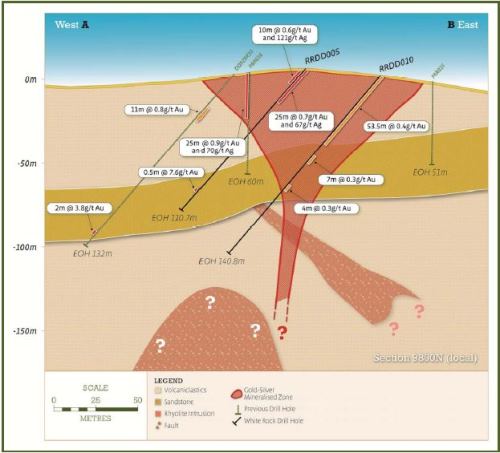
Cross section displaying Red rock drill results. Source: Company announcement


White Rock has reported thirteen diamond drill holes from the campaign so far, nine of which have intersected shallow gold and silver mineralisation.

Assays are pending for three further holes.

Highlights from the latest results include:

–    88 metres at 0.9 grams per tonne gold from surface, including 4m at 1.6g/t gold and 34g/t silver from 7m and 17m at 2.8g/t gold from 45m;

–    1m at 6.3g/t gold from 52m;

–    1m at 6.0g/t gold from 55m;

–    1m at 6.6g/t gold from 59m; and

–    53.5m at 0.4g/t gold and 15g/t silver from 2m.

“These results highlight the exciting discovery and evolution of a new gold system on the Mt Carrington project,” White Rock Minerals managing director Geoffrey Lowe said in the company’s announcement to the Australian Securities Exchange.

“The majority of holes we have completed at Red Rock have encountered significant gold and silver mineralisation.

“The near-surface nature of the mineralisation combined with the indications of discrete high-grade gold and silver-bearing veins underpins our confidence in a potential new Resource at Red Rock.

“We are now undertaking a similar drilling program at the Mozart silver prospect, and will return to Red Rock for further drilling in April with the aim of estimating a maiden Resource mid-year as part of our plans for an expanded Mt Carrington Resource base for development.”

RNI records further results at Jacques discovery

THE DRILL SERGEANT: Resource and Investment (ASX: RNI) has received assay results recently completed drilling programs at the Jacques gold discovery.

The Jacques prospect (RNI 80 per cent) is part of the Morck’s Well group of tenements within the company’s Grosvenor gold and base metals project near Meekatharra in Western Australia.

The assay results from 3-metre composite samples from a second phase RC drilling program at Jacques include:

–    3 metres at 8.69 grams per tonne gold from 51m;

–    3m at 7.17g/t gold from 30m; and

–    3m at 2.21g/t gold from 111m.

The company said it had been encouraged by the results from the 26-hole second phase drilling program, especially as it was conducted to follow up on results achieved during the first phase drilling program, which produced high-grade intersections including:

–    3m at 11.65g/t gold from 72m, including 1m at 37.70g/t gold from 74m and 1m at 6.75g/t gold from 76m.

RNI explained the drilling programs at Jacques were designed to target two gold and multi-element geochemical north-south trending anomalies with strike lengths of approximately 1,000m and 700m.


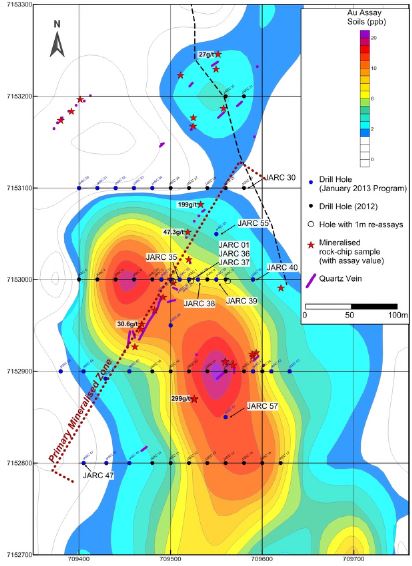
RC drilling at Jacques gold target – Morck’s Well. Source: Company announcement


“Drilling has demonstrated the gold mineralisation broadly has the same orientation with, but is not directly co-incident with, the quartz veins mapped at the surface, over a distance of 350 metres,” Resources and Investment said in its ASX announcement.

“It is also likely that more than one mineralised lode (vein) is present.

“The scout drilling phase was executed on a 100 metre by 20 metre grid to define shallow trends in the mineralisation evident from surface geochemistry.

“Thus far, a significant lode gold target has been defined with typical variable and high grade that will require infill drilling along strike and down dip.”

Morck’s Well is located next door to Sandfire Resources’ Doolgunna project, which hosts the DeGrussa copper-gold discoveries.

Azure Minerals survey confirms porphyry target

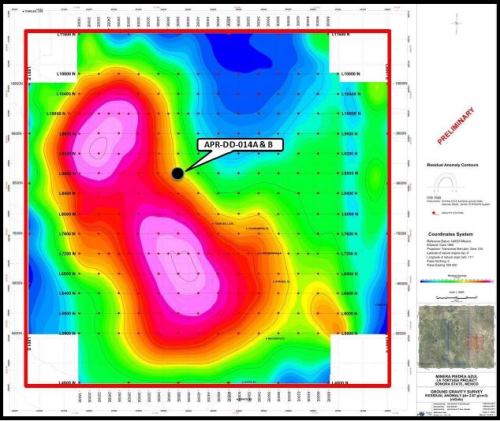
THE DRILL SERGEANT: Azure Minerals (ASX: AZS) has completed a ground gravity survey, which has delineated two large, dense bodies at the company’s 100 per cent-owned La Tortuga project in Mexico.

Azure has measured the larger of the two bodies to cover an area of 2,400 metres by 1,200 metres at its widest point, while the smaller, northern gravity high measures 1,600m by 1,200m.

Both bodies overlap a strong ovoid-shaped aeromagnetic anomaly.


Image showing two strong gravity highs within survey area (red box)
and location of Azure’s two drill holes. Source: Company announcement


“We’re very pleased that the gravity survey has identified two high density bodies coinciding with the strong aeromagnetic anomaly at La Tortuga,” Azure Minerals managing director Tony Rovira said in the company’s announcement to the Australian Securities Exchange.

“These latest results provide the company with further confidence that La Tortuga demonstrates the potential to host a porphyry copper deposit.

“As a result, Azure and Joint Venture partner JOGMEC have elected to proceed to the next stage of exploration which will involve diamond drill testing to 1,000 metres.”

Azure has carried out data modelling, which it said indicates both gravity bodies commence approximately 600m below surface.

This coincides with the modelled depths of the magnetic and MT anomalies, which the company said had also been confirmed by two previous drill holes that intersected the targeted basement rocks at depths of 635m and 595m.

The drill holes were aimed at the core of the aeromagnetic anomaly with both penetrating into the upper part of the target zone intersecting altered intrusive rocks to return anomalous precious metal and base metal assays.

Following a review of these exploration results, Azure and its Japanese government JV partner JOGMEC have agreed to proceed to the next stage of exploration.

This will consist of diamond drill testing of these anomalies to a target depth of 1,000m.

Sirius Resources drilling indicates Bollinger potential

THE DRILL SERGEANT: Sirius Resources (ASX: SIR) has followed up the initial Bollinger discovery hole with an intercept of over 40 metres of massive and breccia sulphides, which the company claims to be an indication the substantive nature of the Bollinger deposit.

Sirius said drilling has also confirmed its Nova deposit is connected to Bollinger via a mineralised feeder zone.

The company has completed four follow up holes so far to follow up the Bollinger discovery hole.

The new intersections include:

–    55 metres of sulphide mineralisation from 423.2 metres, including 41.6 metres of massive and breccia sulphide from 436.9 metres, located 60 metres west of the Bollinger discovery hole on the 700N line;

–    118.2m of trace to stringer sulphide from 343m, including 30.2m of disseminated to stringer sulphide from 431m, located 100m east of the Bollinger discovery hole on the 700N line;

–    32.1m of breccia and stringer sulphide from 383.15m, in the feeder zone between Nova and Bollinger on the 675N line; and

–    21.5m of stringer and disseminated sulphide from 356.8m and 2.5m of massive sulphide from 403.5m, in the feeder zone between Nova and Bollinger on the 675N line.


Cross section on line 700N showing Nova (left), feeder zone (centre)
and Bollinger (right) drilling. Source: Company announcement


“The first follow up holes to the Bollinger discovery hole have confirmed the significance of Bollinger and its connectivity with Nova and also potentially with conductor 5 to the north,” Sirius Resources managing director Mark Bennett said in the company’s announcement to the Australian Securities Exchange.

“The strong EM conductor identified southeast of these holes suggests we may have yet to drill the sweet spot.

“Our plan of finishing the Nova drillout and immediately going hard on exploration whilst the Nova project team completes the first resource estimate is paying immediate dividends, and six rigs have now begun an intensive drilling campaign at Bollinger and adjacent targets within the Eye.”

While all this has been happening, Sirius received assays received for Nova infill holes, which included a number of healthy intersections at the edges of the deposit, as follows:
 
–    37.38m at 2.05 per cent nickel and 0.41 per cent copper from 282m, located at the extreme northwestern edge of Nova;

–    18.75m at 2.82 per cent nickel and 0.68 per cent copper from 50.85m, located close to surface at the extreme southwestern tip of Nova; and

–    21.74m at 4.37 per cent nickel and 1.15 per cent copper from 361.26m, located towards the southeastern margin of Nova.

Sirius said it remained on track to complete the maiden JORC resource estimate for Nova in March.

The company said it was confident Nova and Bollinger are part of a significant mineralised system.

A further exploration drilling program has commenced.