Corazon Mining increases size of TUR anomaly

THE DRILL SERGEANT: Corazon Mining (ASX: CZN) has completed a detailed ground gravity survey at the company’s Top Up Rise project in Western Australia, which has confirmed the TUR gravity feature as a significant geophysical anomaly.

The defined size of the anomaly has increased, to now cover an area measuring 10 kilometres by 6 kilometres under sand cover on the edge of the Gibson Desert.

Corazon said its interpretation of the geophysical data suggests:

–    The gravity anomaly appears fault bounded and structurally controlled;

–    There is no correlation between gravity highs and magnetic trends. Gravity highs may both conform to or cross-cut geological features interpreted from the magnetics;

–    The gravity anomaly extends to the west and overlaps a major magnetic feature;

–    The highest residual gravity anomalies are located in magnetic lows and/or interpreted faults; and

–    Target depths are variable; it is expected both shallow (immediately under the cover of sand-dunes) and deeper drill targets will be tested.
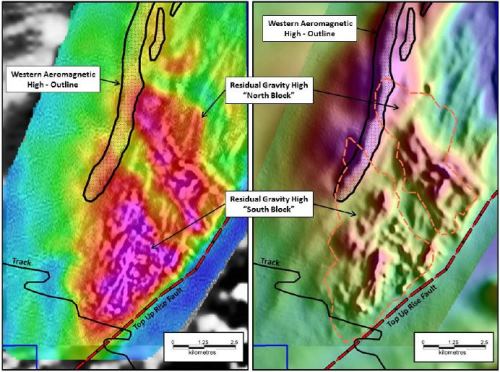
 

Left – Residual bouguer gravity image over aeromagnetic shadow. Right – Aeromagnetic image. Source: Company announcement


“We are extremely happy with the results of the detailed gravity survey,” Corazon Mining managing director Brett Smith said in the company’s announcement to the Australian Securities Exchange.

“It’s added significant definition to a large featureless geophysical anomaly.

“Amplitudes of this magnitude are seldom seen, and we’re excited to be drilling this large target next month.

“The fact that parts of the anomaly can be tested quite easily, with inexpensive drilling techniques, is an enormous bonus.”

Corazon is currently preparing for the inaugural drilling program at Top Up Rise with heritage and work program clearances in progress.

Site access and the re-establishment of old exploration tracks have been initiated by the traditional owners, the Tjamu Tjamu Aboriginal Corporation.

The company has secured a drilling rig with the capacity for aircore (shallow soft-sediment drilling), reverse circulation (to 300m) and core drilling (to 1,100m).

All three methods of drilling are expected to be utilized during the drilling program, which is scheduled to commence in May.
Hot Chili hits wide copper result at Productora

THE DRILL SERGEANT: Hot Chili (ASX: HCH) has recorded its widest high-grade drill result to date at the company’s Productora copper project in Chile.

The drill result from the eastern flank of the central resource area at Productora returned:

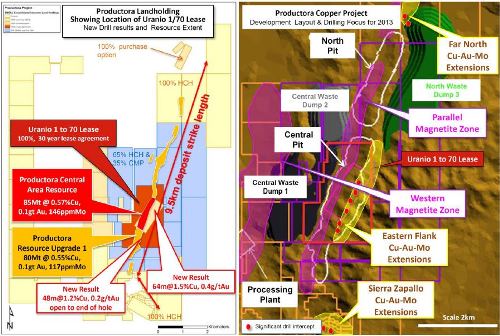
–    64m at 1.9 per cent Copper Equivalent (1.5 per cent copper, 0.4 grams per tonne gold, 147 parts per million molybdenum) from 124m down-hole.

Hot Chili is currently undertaking a drilling program aimed at delivering a second resource upgrade to Productora in the second half of 2013.

The company said the first results it had received from this year’s drilling campaign had demonstrated the component of shallow, high grade, copper and gold mineralisation at Productora is continuing to grow.

Resources at Productora currently stand at 165.2 million tonnes at 0.6 per cent copper, 0.1 grams per tonne gold and 132 grams per tonne molybdenum containing 920,000 tonnes of copper, 590,000 ounces of gold and 22,000 tonnes of molybdenum.

The high-grade, shallow resources at Productora currently stand at 53 million tonnes at 0.8 per cent copper and 0.2g/t gold, which the company considers to enhance the overall economics of the project.

Other results from the recent drilling program include:

–    48m at 1.4 per cent Copper Equivalent (1.2 per cent copper, 0.2g/t gold, 65ppm molybdenum) from 42m down-hole, including 25m at 2.2 per cent Copper Equivalent (1.9 per cent copper, 0.2g/t gold and 117ppm molybdenum). Hole finishes in mineralisation (1.3 per cent copper, 0.5g/t gold); and

–    76m grading 0.9% Copper Equivalent (0.7 per cent copper, 0.2g/t gold, 103ppm molybdenum) from 44m down-hole, including 12m grading 2.1 per cent Copper Equivalent (1.6 per cent copper, 0.5g/t gold and 200ppm molybdenum). Hole finishes in mineralisation (1 per cent copper, 0.2g/t gold).

Recent drilling at Productora has focused on the definition of potential additional resources from an identified two kilometre zone along the eastern flank of planned central pit development.

The zone was previously considered as waste in the company’s recently announced positive scoping study.

Hot Chili said the results attained from the first extensional drilling directed towards this area highlights the potential for further growth in shallow high-grade material within the planned central pit development at Productora.


New drilling intersections in relation to the planned central pit design at Productora. Source: Company announcement


“The definition of additional resources from this zone has the potential to positively impact the economics of the company’s on-going Pre-Feasibility Study through significant strip ratio reductions,” Hot Chili said in its ASX announcement.

“Further drilling results are expected in the coming weeks and months ahead as the company advances towards the delivery of a second major resource upgrade to Productora in the second half of 2013.”

A first pass RC and DD drilling program is nearing completion at Hot Chili’s second growth project Frontera, located 70 kilometres south of Productora.

The company said it expects to mobilise the drill rig from Frontera to Productora in the coming week once all planned drill holes are complete.

Investigator Resources identifies new Eyre Peninsula targets

THE DRILL SERGEANT: Investigator Resources (ASX: IVR) has defined new silver targets near the company’s Paris silver prospect, located on the Eyre Peninsula, South Australia.

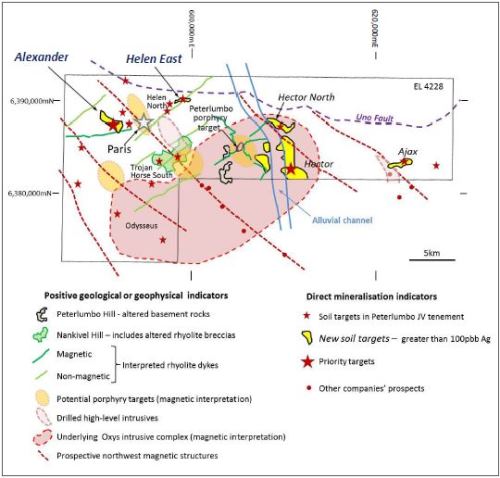
The most encouraging of these is described by the company as ‘The large Alexander target’ (2.5km x 400m).

Investigator consider Alexander to be a likely offset extension of the nearby Paris silver prospect, which is currently being drilled for inclusion of a pending resource estimation.

The Alexander target is situated two kilometres west of the Paris silver prospect and is about three times larger in area than the same signature for Paris.

According to Investigator it has a similar shape, northwest orientation and silver-in-soil levels as the Paris soil target as well as possessing strong support from other anomalous metals giving it potential to be a genuine bedrock target.

The company has also identified the Helen East target, which it explained to be an extension of the Helen prospect where scout drilling intersected silver and lead mineralisation early in 2012.

The Paris silver prospect and the new silver targets are within the Peterlumbo Joint Venture tenement (75 per cent Investigator).

Geological framework and target plan, Peterlumbo field showing the
locations of the new targets at Alexander and Helen East. Source:
Company announcement


“Investigator’s soil sampling approach continues to produce outstanding new silver targets across the Eyre Peninsula,” Investigator Resources managing director John Anderson said in the company’s announcement to the Australian Securities Exchange.

“These are building on the initial Paris silver discovery in 2011.

“The new Alexander target is an excellent addition adjacent to Paris and joins the recent Hector target as showing potential to be larger silver targets than Paris.

“These are prioritised as our ‘Paris-Plus’ targets.

“The new results are extremely pleasing for our team as these indicate Investigator’s real potential to capitalise and expand on our early successes.

“We look forward to drilling the new targets at the first opportunity later in 2013.”

Winmar Resources releases Hamersley assay results

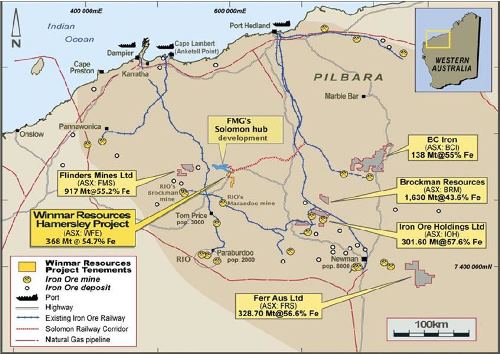
THE DRILL SERGEANT: Winmar Resources (ASX: WFE) has released more high-grade intersections of iron mineralisation from the latest phase of drilling completed at the company’s Hamersley iron project in the Pilbara region of Western Australia.

Winmar completed a 13 hole RC drilling program at the Hamersley project in November 2012 and has now received all assay results, which include encouraging shallow high-grade intercepts of:

–    64 metres at 58.12 per cent iron (59.33 per cent Calcined iron) from 28 metres, within a broader Channel Iron Deposit (CID) zone of 116 metres at 56.33 iron;
 
–    46m at 59.05 per cent iron (60.28 per cent Calcined iron) from 28m; and

–    26m at 59.95 per cent iron (61.11 per cent Calcined iron) from 26m.

In addition, CID intercepts were returned from seven of the remaining 10 target depth holes.

These included:

–    142m at 52.46 per cent iron (54.77 per cent Calcined irone) from 26m; and

–    34m at 57.33 per cent iron (58.58 per cent Calcined iron) from 26m.

Winmar explained that the zone of CID and high grade detrital material in the south west of the project area will be the initial focus of development, which the company considers may provide an early pathway to Direct Shipping Ore (DSO) and production of beneficiated material.


Location of Winmar’s Hamersley iron ore project. Source: Company announcement


“The most recent phase of drilling was designed to define the full extent of shallow high-grade mineralisation in the south western area of the deposit,” Winmar Resources said in its ASX announcement.

“This area was targeted based on results from the previous phase of drilling, June 2012, which included highlight results of an outstanding high grade intercept of: 74 metres at 59.15 per cent iron (60.47 per cent Calcined iron) from 28m within a CID zone of 102 metres thickness.

“Average depth of drilling was approximately 100 metres with initial drill spacing 100 metres by 125 metres.

“Interpretation and assessment of all assay results from this phase of drilling is now complete, and work has commenced on the resource evaluation.”

Winmar said it intends to use the assay results to remodel the project’s current JORC Inferred Resource of 368.4 million tonnes at 54.7 per cent iron (which includes a main CID zone of 343.3Mt at 55.3 per cent iron).

The company anticipates this will facilitate conversion of a portion of the current Resource at the Hamersley iron project to an Indicated Mineral Resource estimate (according to JORC Guidelines) and reinforce the project’s 350 to 400Mt at 54 to 56 per cent iron exploration target.

Tungsten Mining hits high-grade mineralisation at Kilba project

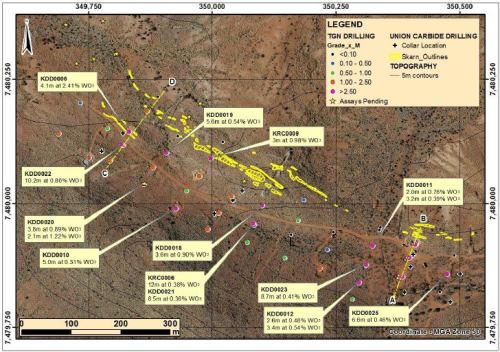
THE DRILL SERGEANT: Drilling being conducted by recently-listed Tungsten Mining (ASX: TGN) continues to intersect high-grade tungsten mineralisation at the company’s Kilba project in the Gascoyne Region of Western Australia.

To date the company has drilled 24 diamond holes and 43 reverse circulation (RC) holes for intersections including:

–    4 metres at 2.41 per cent tungsten from 54 metres;

–    1.5m at 1.8 per cent tungsten from 36.3m;

–     10.2m at 0.86 per cent tungsten from 48.8m; and

–    8.7m at 0.41 per cent tungsten from 76.5m.


Plan showing location of stronger zones of mineralisation intersected by recent drilling. Source: Company announcement


Tungsten Mining commenced drilling at the Kilba project in November 2012 with the aim of confirming the presence of high-grade tungsten mineralisation, which had been identified by historic drilling completed by Union Carbide Corporation in the 1970s and 1980s.

Current drilling being carried out by the company is targeting Zone 11 located on its 100 per cent-owned and granted Mining Lease.

Exploration has completed an 80m by 40m spaced drill pattern over the main 900m of outcropping mineralisation at Zone 11.

Broader spaced drilling has also tested strike extensions on 80m to 160m spaced sections, for a further 300m.
 
“The excellent high-grade results received from the drilling confirms the company’s belief in the Kilba project and justifies its focus on the rapid evaluation and development of the Kilba project,” Tungsten Mining managing director Paul Berndt said in the company’s announcement to the Australian Securiteis Exchange.

“To this end the company has engaged CSA Global to model mineralisation present at Zone 11 with the objective of producing a JORC-compliant Resource by May.”

“We are on target to create significant project value at Kilba, by completing a feasibility study within a year.”

Azure Minerals identifies high-grade gold at Panchita project

THE DRILL SERGEANT: Azure Minerals (ASX: AZS) has completed a Stage 1 reconnaissance exploration program on the company’s recently-acquired, 100 per cent-owned Panchita gold project in Mexico.

Surface sampling conducted by Azure returned high-grade gold assays – some containing visible gold – including:

–    44.9 grams per tonne gold and 33 grams per tonne silver;

–     37.8g/t gold and 71g/t silver;

–    28.7g/t gold and 124g/t silver;

–    23.8g/t gold and 3 g/t silver;

–    23.8g/t gold and 5 g/t silver; and

–    20.7g/t gold and 13g/t silver.

Azure said 50 per cent of the samples returned grades greater than 0.5g/t gold, while the company was also able to identify a number of mineralised zones, ranging from 300 metres to 500 metres strike length.

“We’re very pleased with these strong results from our first exploration program at Panchita, especially considering we acquired the project less than a month ago,” Azure Minerals managing director Tony Rovira said in the company’s announcement to the Australian Securities Exchange.

“I believe we have already added significant value and anticipate that this will continue in the coming months.

“Panchita is situated within the hottest gold mining district in Mexico and our on-ground exploration has already confirmed the area is highly prospective for significant gold mineralisation.

“It not only has potential to host mineralisation of the style currently being exploited nearby by major gold mining companies like Newmont, but it is now evident that Panchita could also host high-grade gold deposits.”


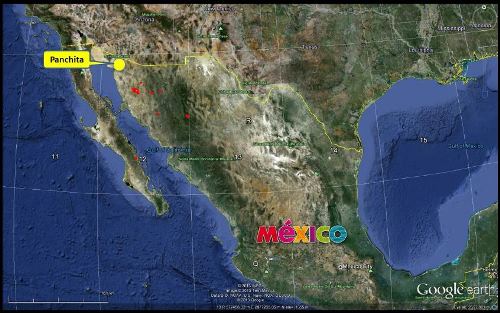
Panchita project location. Source: Company announcement


The Panchita project comprises two mineral concessions covering an area of 136 hectares, located approximately 350 kilometres northwest of Hermosillo, the capital city of the Mexican state of Sonora.

The project is situated within the northwest region of Sonora and is considered by Azure to be prospective for shear-hosted bulk tonnage and vein-hosted high grade gold deposits.

The company explained its confidence by indicating gold mineralisation is widespread in the district with several major gold mines nearby.

Follow-up exploration has commenced, with the current work program comprising additional detailed sampling and geological mapping in preparation for drill testing.

Image Resources extends Boonanarring heavy mineral Resource

THE DRILL SERGEANT: Image Resources (ASX: IMA) has delivered a higher grade resource extension at the Boonanarring heavy mineral (HM) deposit, located 90km north of Perth, which forms part of the company’s North Perth Basin mineral sands project.
 
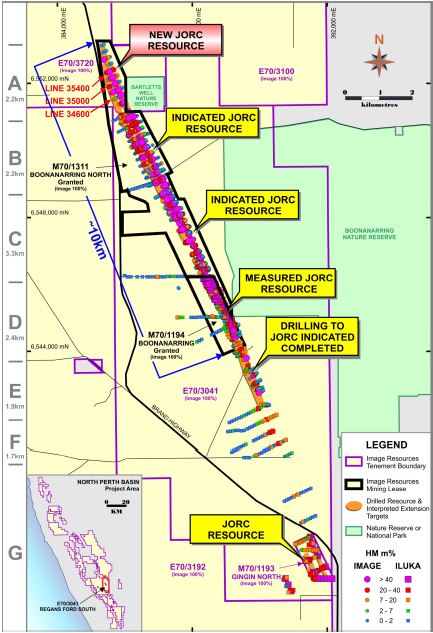
Image said recent drilling has confirmed an extension of the Boonanarring deposit resulting in an additional JORC Indicated Resource at Block A of:

–    1.36 million tonnes at 18.2 per cent HM , containing 243,000 tonnes of HM at a 2.5 per cent HM cut-off.

An additional Inferred Resource of 750,000 tonnes at 10.6 per cent HM containing 79,000 tonnes of HM has also been defined.

Image indicated that at 15.4 per cent HM, the overall resource in Block A is double the HM grade of the previously released resources for Blocks B, C and D, which average 7.5 per cent HM at the same cut-off.

The company claims grades for Blocks B, C and D are already higher than most mineral sand deposits.

Image said Block A also has encouraging zircon credits, with zircon grade averaging 25.9 per cent of the HM, compared to an average of 19.6 per cent for Blocks B, C and D.


Boonanarring exploration targets and drilling April 2013. Source: Company announcement


“Given Image’s track record to date in converting early ground magnetics results into high-grade mineral sands JORC resources, this result is not unexpected,” Image Resources managing director Peter Davies said in the company’s announcement to the Australian Securities Exchange.

However, the grade of the JORC resources in Block A is far higher than we predicted and this adds further to our confidence in the potential of the Boonanarring project. ”

This discovery brings the currently defined Boonanarring total JORC Resources to:

–    20.9 million tonnes at 8.3 per cent HM containing 1.7 million tonnes of HM at a 2.5 per cent HM cut-off.

The company considers the average 85 per cent Valuable Heavy Mineral (VHM) content of the HM to be a highly-positive attribute for the resource, as it increases the overall Boonanarring VHM content to 79 per cent of the HM.

“It is also encouraging to see the expansion of the exploration efforts into areas of Bidaminna and north of Boonanarring which have potential to add significantly to the company’s resources portfolio” Davies said.

Triton Minerals defines outcropping graphite

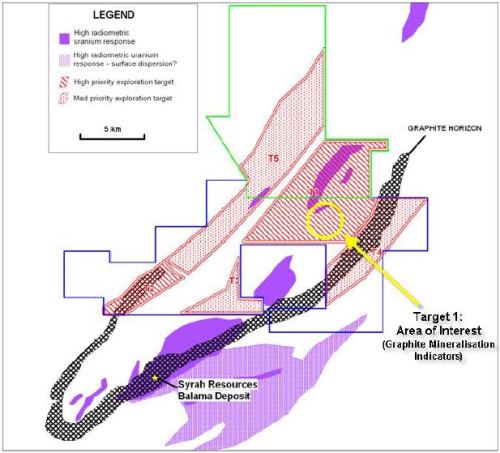
THE DRILL SERGEANT: Current exploration work being undertaken by Triton Minerals (ASX: TON) has located graphitic mineralisation outcropping, with a strike length of approximately 3.75 kilometres within the company’s Target 1 area at the Balama North project in Mozambique.

The company said an initial mapping program conducted on the key Balama License had identified graphite mineralisation in the Target 1 Area OF Interest (AOI).

Triton considers this to suggest graphite mineralisation has developed along the same sub-structure, which extends in a north-east direction from the Balama East graphite deposit held by Syrah Resources (ASX: SYR).


Exploration priority targets defined for the Balama North project licenses. Source: Company announcement


Triton said the work it has completed to date indicates of the graphite mineralisation in the AOI is under cover of alluvial soils.

Further work will be required to test the depth of the cover and the Company aims to undertake this work in the next exploration program.

The company indicated graphite-rich rock is outcropping in a north easterly direction for approximately 3.75 kilometres before descending beneath cover.

“The company is excited with the discovery of the substantial graphite outcropping,” Triton Minerals managing director Brad Boyle said in the comppany’s announcement to the Australian Securities Exchange.

“This initial small exploration program was about a proof of concept and the outcropping has confirmed our original analysis that the graphite mineralisation extended, under cover, north east from the Syrah Resources deposits.

“The outcropping zone now provides the company very clear and large drilling targets.

“Triton has scheduled to commence the drilling stage of the exploration program as soon as possible.

“The information contained within this announcement relates to only a relatively small area of the total license areas held by Triton and the company is greatly encouraged by the results so far and we are hopeful of further positive results in the near future.”

Hannans Reward encouraged by historic Swedish drilling assays

THE DRILL SERGEANT: Hannans Reward (ASX: HNR) has received assay results from the last of the historic copper-gold intercepts from profiles 2 and 3 from the Central Orebody at the company’s 100 per cent-owned Pahtohavare project located in northern Sweden.

Hannans initial data interpretation has been focused on the Central Orebody, one of three orebodies within the Pahtohavare project.

Results included:

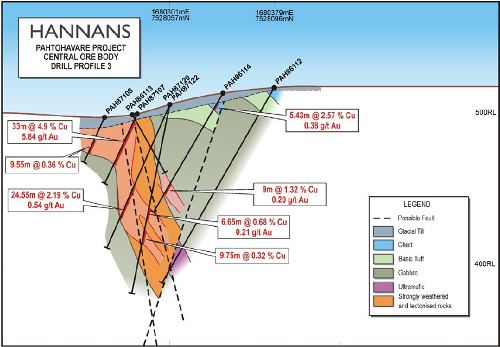
–    33 metres at 4.99 per cent copper and 5.84 grams per tonne gold from 6 metres, including 14.3 metres at 10.4 per cent copper and 13.3 grams per tonne gold;

–    23.6m at 3.8 per cent copper from 3.5m, including 2.95m at 26.9 per cent copper and 6.2 g/t gold; and

–    24.55m at 2.19 per cent copper and 0.54g/t gold from 62.45m, including 4.07m at 7.4 per cent copper and 1.2g/t gold.

According to the company the recently-analysed drill intercepts have highlighted broad, shallow zones of copper-gold mineralisation.


Historic drilling intercepts at Central Orebody. Source: Company announcement


Hannans has now validated all eight drill profiles from the Central Orebody, from which it says it has gained a much better understanding of the geology and controls on mineralisation, although the company also admitted further work is still required to fully understand the complexities of Pahtohavare project.

Drill planning and permitting is now underway for the Central Orebody where drilling will consist of both RC percussion drilling and diamond drilling.

Hannans said its focus would now shift to the data interpretation and validation from historical works at both the Southern and South-Eastern orebodies as well as the Eastern Zone where some 201 holes were drilled.

The Pahtohavare project is located eight kilometres south-west of Kiruna in northern Sweden, approximately 1,200 kilometres north Stockholm.

Copper mineralisation was first discovered at Pahtohavare in 1984 by the state-owned exploration company Swedish Geological AB and later mined by Finnish mining company, Outokumpu in 1984.

Three deposits were defined at Pahtohavare:

–    Central (oxide, carbonate and sulphide ore);

–    Southern (sulphide ore); and

–    South-Eastern (sulphide ore).

The combined JORC exploration target for Pahtohavare – incorporating the Central, Southern, South-Eastern and Eastern Zones is 4.8 to 6.2 million tonnes at 2 to 2.78 per cent copper and 1.23 to 2.23 grams per tonne gold.

Tanami Gold announces 100,000 ounce resource at Coyote

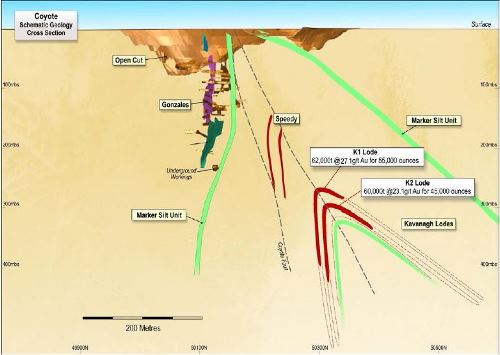
THE DRILL SERGEANT: Tanami Gold (ASX: TAM) has announced a Maiden Resource Estimate of 122,000 tonnes at a grade of 25.2 grams per tonne gold for 100,000 ounces of gold for the Kavanagh mineralisation at the company’s operating Coyote gold mine in Western Australia.

The estimate follows a drilling campaign conducted by Tanami over the last several months, which has defined mineralisation within two main lodes – the K1 and K2 lodes – which are folded over an east-west striking regional anticline.

Intercepts from the recent drilling include:

–    1.3 metres at 53.6 grams per tonne gold;

–    0.3m at 151.4g/t gold; and

–    1m at 27.1g/t gold.

Tanami explained these lodes have been defined over a strike of 300 metres and height of 100 metres to date and remain open in multiple directions.


Coyote schematic cross section. Source: Company announcement


“This Maiden Resource is pleasing as it demonstrates the potential for the Kavanagh system to deliver significant Resource ounces at good grade,” Tanami Gold acting chief executive officer Peter Cordin said in the company’s announcement to the Australian Securities Exchange.

“The Kavanagh mineralisation is open in multiple directions and therefore the potential to grow the Resource remains strong.

“Importantly, the Kavanagh Resource has a strike length of 300 metres with a total defined strike length for the Kavanagh Target Area of over 600 metres.

“The depth of the system is yet to be defined.

“The original exploration target remains valid and the company continues to drill for additional ounces.

“Outside of the exploration effort, a project team is assessing the technical and financial aspects of any future mining event which will be reviewed by the Board when complete.”