Laconia Resources records high-grade Peruvian copper hits

THE DRILL SERGEANT: Laconia Resources (ASX: LCR) has identified high-grade copper-gold-silver in historical diamond drilling and surface channel sampling at its newly-optioned Fortuna prospect, located within the company’s Rasuhuilca project in Peru.

Although the company indicated the results represent early-stage exploration work, it also said it considers them to be of some significance for two reasons.

First, they suggest high-grade copper discovered at the adjacent Española prospect at Rasuhuilca continues into Fortuna, presenting potential for further increases in the project’s total resource inventory.

Second, they support Laconia’s growing belief the shallow high-grade copper-gold-silver mineralisation sits as a cap over an extensive copper porphyry system at Rasuhuilca.

“The company is extremely encouraged by the identification of further strong copper-gold-silver grades from our flagship Peruvian project,” Laconia Resources managing director Ian Stuart said in the company’s announcement to the Australian Securities Exchange.

“Our knowledge of the wider Rasuhuilca Volcanic system continues to grow through the systematic processing and follow up of the excellent historical data.”

The copper in the cap, combined with knowledge of the geology, mineralisation and alteration, supports Laconia’s view that the porphyry may be an “El-Indio style” gold and copper porphyry system.

Fortuna is contained within a package of 11 tenements, over which Laconia recently acquired an option and is one of several targets at Rasuhuilca, including Española.
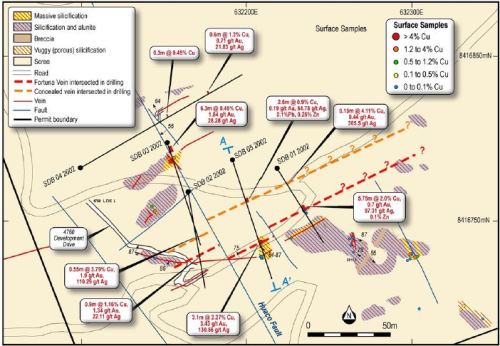
 

Plan View of the Fortuna Prospect, showing surface sample locations
(coloured by copper content) and the drill hole locations. Source:
Company announcement


Laconia intends conducting further sampling work over coming months at all targets, as well as Fortuna, with a view to undertaking an extensive drilling program across the project in the second half of this calendar year.

“The presence of significant copper, in conjunction with the gold and silver epithermal veins already identified, adds significantly to the potential of the entire Rasuhuilca project,” Stuart said.

“We are looking forward to starting our preliminary 2,000 metre drilling program to upgrade and grow the Rasuhuilca resource.”

This program, which is subject to regulatory approval, will be aimed at both upgrading the existing JORC resource of 360,000 tonnes at 1.97g/t gold and 179g/t silver and growing it by including mineralisation from these other targets.

The company is working on permitting and community agreements utilising the Declaración de Impacto Ambiental (“DIA”) process of the Peruvian regulatory system, to obtain approval for the drilling program to commence.
Altona Mining updates Outokumpu Resource and Reserve estimates

THE DRILL SERGEANT: Altona Mining (ASX: AOH) has updated the Mineral Resource and Ore Reserve Estimates for the 100 per cent-owned Kylylahti underground mine at the company’s Outokumpu project in Finland.

The December 2012 Resource Estimate for the Kylylahti mine is 7.9 million tonnes at 1.25 per cent copper, 0.69 grams per tonne gold and 0.56 per cent zinc for 99,050 tonnes of copper, 175,750 ounces of gold and 44,250 tonnes of zinc.

Mining depleted the Resource by 0.38 million tonnes at a grade of 1.51 per cent copper.

However, the company explained infill drilling of a new hangingwall parallel and gold-rich zone successfully defined new disseminated resources which have been incorporated into the model.

The December 2012 Ore Reserves Estimate for the Kylylahti mine is 3.6 million tonnes at 1.69 per cent copper, 0.66g/t gold and 0.67 per cent zinc for 60,500 tonnes of copper, 76,100 ounces of gold, 24,000 tonnes of zinc.

A 0.6 million tonnage reduction has resulted due to the 0.38 million tonnes of mining depletion plus a reduction in disseminated tonnes in the upper Wallaby zone.

Ore Reserves for Wallaby have reduced in tonnage but this has been almost completely offset by an improvement in copper grade.

Overall, copper metal in the Wallaby Ore Reserve after mining depletion has decreased by 9 per cent compared to June 2012 estimates.


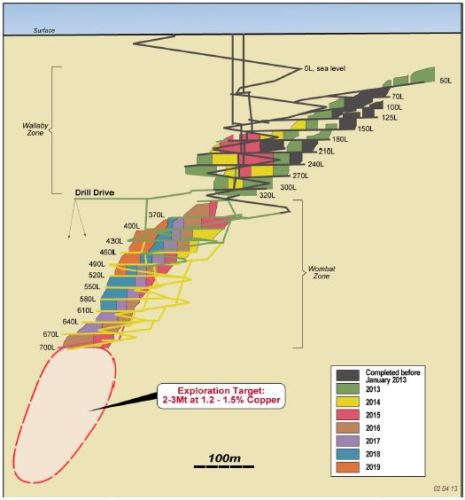
Longitudinal section of the Kylylahti mine showing the mine plan,
drill drive and zone targeted for additional resources. Source: Company
announcement

“So far, the copper grade of ore produced at the Kylylahti mine has consistently outperformed predictions,” Altona Mining said in its ASX announcement.

“New geological mapping, mining information and underground drilling since the start of production in February 2012, together with prior drilling data demonstrates sufficient geological and grade continuity has permitted the estimation of a new Resource and Reserve Estimate for the upper Wallaby zone, and thus global resources and reserves for the Kylylahti Mine.”

Altona also mentioned the lower Wombat Zone where it indicated mineralisation is open at depth with the deepest drillhole intersecting 72metres at 1.8 per cent copper of typical Outokumpu style of mineralisation.

Altona has commenced underground development to provide a platform to drill test possible extensions of the Kylylahti mine at depth and to infill the upper and central parts of the Wombat orebody.

The company said yypical Wombat geometry at typical Wombat grades would provide an exploration target of approximately 2-3 million tonnes at 1.3-1.5 per cent copper.

The target is inferred from characteristics and continuity demonstrated by other major deposits in the area.

Mithril Resources identifies new gold zone at Spargos Reward

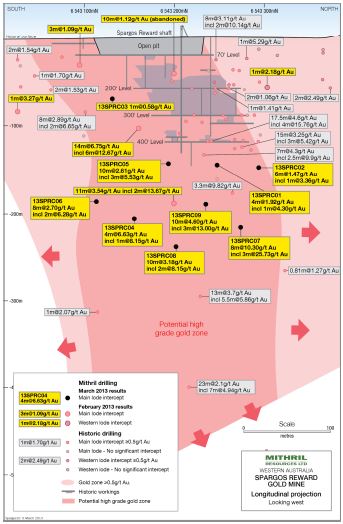
THE DRILL SERGEANT: Mithril Resources (ASX: MTH) has received positive results from a recently completed drilling program conducted at the company’s wholly-owned Spargos Reward gold mine, located approximately 30 kilometres west of Kambalda in Western Australia.

Mithril said the latest drilling has identified a new gold zone – named the Evans prospect – immediately south of the mine.

The company drilled three reverse circulation holes on two adjacent 100-metre spaced sections to test the significance of two historical drill intercepts beneath a 700-metre north-south trending surface anomaly 3.3 kilometres south of Spargos Reward.

On both sections, the drilling intersected a steeply dipping zone; the company considers being visually identical to Spargos Reward.

The zone is gold bearing with better results including (down hole widths):

–    3 metres at 0.95 grams per tonne gold from 46 metres;

–    1m at 1.03g/t gold from 70m and 3m at 0.95g/t gold from 99m; and

–    1m at 1.99g/t gold from 30m.

Mithril Resources managing director David Hutton said he was encouraged by the new results as they reinforce the potential of the broader Spargos Reward area.

“Our geological team has done a great job to identify new target areas outside of the mine and we look forward to further success at the Evans prospect,” he said.


Spargos Reward gold mine long section. Source: Company announcement


Mithril considers the results to be of some significance as they are equivalent to others it has achieved within 100m of high-grade gold mineralisation at Spargos Reward.

Because the prospect has undergone limited drilling so far, Mithril is of the opinion potential exists to find new occurrences of higher grade gold at Evans.

The company is currently working on a resource for the Spargos Reward gold mine, which it anticipates to be ready by the September Quarter 2013.

It is concurrently working to generate further targets surrounding the mine area.

These targets along with the newly-identified Evans prospect will be further assessed through ground follow-up and prioritised for the company’s next phase of drill testing.

Musgrave Minerals strikes new zinc-silver-gold at Tank Hill

THE DRILL SERGEANT: Musgrave Minerals (ASX: MGV) has claimed to have intersected a new zone of zinc, silver and gold mineralisation at the Tank Hill target at the company’s Menninnie Dam project, located in the southern Gawler Craton region of South Australia.
 
Musgrave has carried out broad-spaced reverse circulation (RC) drilling at Tank Hill, which has returned results including:

–    30 metres at 1.9 per cent zinc, 21 grams per tonne silver, 0.27 grams per tonne gold, from 132 metres, including 6 metres at 4.9 per cent zinc, 62 grams per tonne silver, and 1.2 grams per tonne gold from 133 metres.

Musgrave explained this is the first drill hole to intersect the mineralisation so it is yet to determine the true width of the intersections.

The company said the newly-identified mineralisation is open in all directions with the closest existing drill hole approximately 700m to the west-north-west, from which results are yet to be received.

The discovery is only five kilometres north-east of the existing Menninnie Central and Viper deposits at Menninnie Dam, which boast an inferred mineral resource of 7.7 million tonnes at 27g/t silver, 3.1 per cent zinc, 2.6 per cent lead.


Location of the Menninnie Dam project, South Australia. Source: Company announcement


The Menninnie Dam project comprises five Exploration Licences covering 2,471 square kilometres 20km east of Investigator Resources’ (ASX: IVR) recent Paris silver discovery.

“This is the first ever drilling at Tank Hill and it’s a very exciting result for us,” Musgrave Minerals managing director Rob Waugh said in the company’s announcement to the Australian Securities Exchange.

“The presence of gold in the system is particularly encouraging.

“We look forward to recommencing drilling as soon as possible to follow-up this excellent early result.”

Musgrave drilled eight RC holes in March this year focused on two exploration licences, and on three target areas, Tank Hill, Nonning, and Mannequin North.

Results from the remaining seven holes have not yet been received.

Musgrave said once it had received analytical results from the further seven RC drill holes it intends undertaking additional drilling to determine the extent, orientation and potential true thickness of the mineralisation at Tank Hill.

The company is scheduled to commence additional follow-up drilling, which is most likely to consist of a combination of aircore and RC drilling in May 2013.

Horseshoe Metals to restart diamond drilling at Horseshoe Lights

THE DRILL SERGEANT: Horseshoe Metals (ASX: HOR) is set to re-commence diamond drilling on the company’s 100 per cent-owned Horseshoe Lights copper-gold project, located in the Peak Hill Mineral Field of Western Australia.

The company outlined the aims of its 2013 drilling programs at Horseshoe Lights will be to test for high grade copper-gold zones, potentially located down dip of the Main Zone, of sufficient grade to potentially support underground mining; and to test exploration targets outside of the immediate pit area which have not been adequately tested by previous exploration efforts.

A minimum of two diamond drill holes are planned to test for high-grade copper-gold zones down dip of the Main Zone, and will be collared on the west side of the existing open pit.

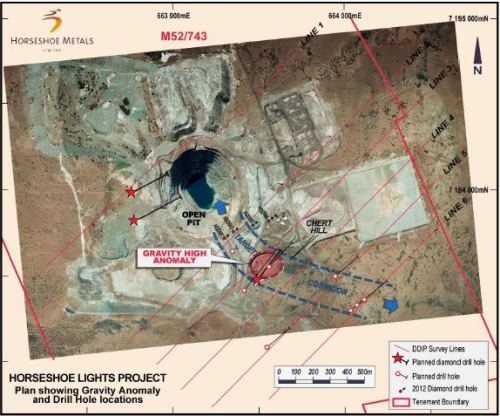
Horseshoe Metals has previously announced the identification of a high-priority volcanogenic-hosted massive sulphide (VHMS) target located about 400 metres south east from the Main Zone of the existing Horseshoe Lights Mine and just to the west of the topographic feature known as Chert Hill.


Plan showing gravity anomaly and planned drill hole locations. Source: Company announcement


This Chert Hill target is one of several sites the company anticipates will be drilled this year within a target corridor extending 800 metres to the south east of the existing open pit.

The Chert Hill target will be tested initially with one diamond drill hole, with follow-up drill holes planned to further test this target area once the results of the initial diamond hole have been received.

“The company is pleased to be recommencing exploration at the Horseshoe Lights project and in particular to be drill testing these high priority exploration targets,” Horseshoe Metals said in its ASX announcement.

These diamond drill holes will be the first to be drilled under the Main Zone since mining operations were suspended in 1994.

Previous deep diamond drilling by Barrack Mines in 1988-1989 identified zones of copper mineralisation down dip of the Main Zone below the open pit including 13m (318-331m) at 3.5 per cent copper including 5m at 7.2 per cent copper.

This copper mineralisation remains open down dip and will be the target zone for testing in this diamond drilling program.

Drilling at Matilda provides happy grades for Blackham Resources

THE DRILL SERGEANT: Blackham Resources (ASX: BLK) has released the first results achieved from recent drilling carried out at the M4 deposit at the company’s Matilda gold project in Western Australia.

Blackham is currently drilling at the Matilda Mining Centre focussing on the M1, M2, M3 and M4 deposits.


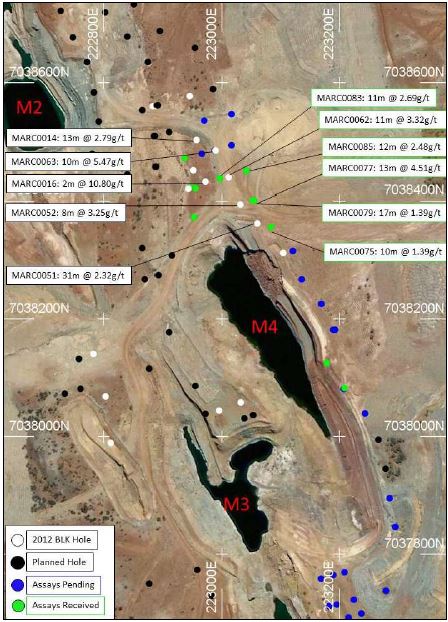
Drill hole location plan. Source: Company announcement


The company has fingered the M4 deposit as a priority area to recommence mining operations at the Matilda Mining Centre and has designed the drilling program to test for extensions of mineralisation beneath the existing resource and to identify high-grade shoots within the broader lodes.

Latest results from this drilling include:

–    13 metres at 4.51 grams per tonne gold from 119 metres, including 2 metres at 14 grams per tonne from 128 metres;

–    12m at 2.48g/t from 158m; and

–    11m at 3.32g/t from 134m.

“This new program has continued to extend the thick mineralisation outside the existing M4 pit,” Blackham Resources said in its ASX announcement.

“Results are generally thicker and higher tenor than intercepted by previous explorers closer to surface, possibly indicating depletion zones in the weathered profile.

“Further drilling is planned along strike to the north of the M4 pit where previous drilling appears to have been ineffective.”

Blackham has also received results from several holes drilled at the M1 South, which it said have returned results in line with its expectations.

These include:

–    4m at 6.04g/t from 110m.

The company said the results will assist in converting Inferred resources to the higher Indicated category.

Blackham’s resource inventory at the Matilda gold project is currently 25 million tonnes at 1.9g/t for 1.5 million ounces of gold, which includes 14 million tonnes at 1.8g/t for 784,000 ounces of gold at the Matilda Mining Centre.

Mamba Minerals strikes new Canadian hematite

THE DRILL SERGEANT: Mamba Minerals (ASX: MAB) has claimed discovery of a new hematite discovery via diamond drilling currently underway at the company’s Snelgrove Lake iron project in Canada.

Mamba said the discovery hole, which still is being drilled, intersected 275 metres of hematite ore.

At current down-hole depth, geotechnical assessment has confirmed that the deposit is at least 218m deep and at least 90m wide based on the main ore body dipping at approximately 70 degrees from surface.

The company explained the hole is still drilling and is currently intersecting massive hematite.

Mamba expects the true dimensions of the deposit to be better determined in immediate subsequent drilling.


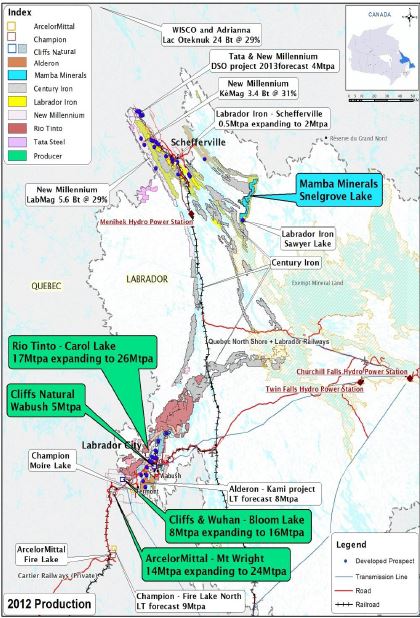
Project location map. Source: Company announcement


“The hematite intersection is particularly exciting given that it started only 10 metres below the surface and is located just 60 kilometres from the existing railway, which runs to existing and expanding port capacity,” Mamba Chairman Greg Burns said in the company’s announcement to the Australian Securities Exchange.

“There is also access to cheap hydro-electric power.

“The combination of the length of this intersection and the size of the Direct Shipping Ore targets shows that this project could be substantial.

“In light of this, Mamba is now placing the emphasis on drilling its four hematite targets.”

Mamba is now preparing a second drill pad, from which it intends testing the same DSO target, with the azimuth reversed to drill perpendicular to the known hematite mineralisation dip to better test width.

The company indicated it will also commence drilling of at least two more drill holes in this winter program targeting DSO.

KBL Mining expands Red Terror deposit

THE DRILL SERGEANT: KBL Mining (ASX: KBL) has identified additional copper-gold mineralisation via recent diamond drilling undertaken on the Red Terror deposit at the company’s Mineral Hill mine in central New South Wales.

Results from the recent drilling at Red Terror include:

–    7m at 3.3 per cent copper and 0.5 grams per tonne gold (3.6 per cent copper equivalent [CuEq]);

–    15.1m at 4.5 per cent copper and 0.5g/t gold (4.8 per cent CuEq);

–    12m at 3.1 per cent copper and 0.4g/t gold (3.3 per cent CuEq);

–    4.2m at 4.5 per cent copper and 0.4g/t gold (4.7 per cent CuEq);

–    4.2m at 5.2 per cent copper and 5.6g/t gold (7.8 per cent CuEq); and

–    17.1m at 0.8 per cent copper and 6.4g/t gold (3.8 per cent CuEq).


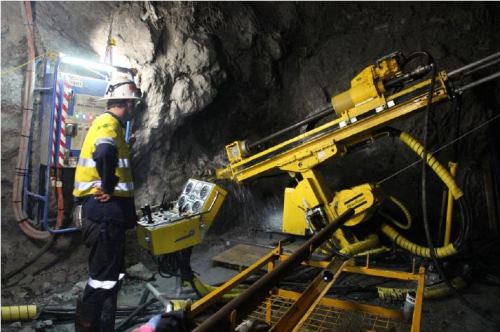
Underground drilling at Red Terror. Source: Company announcement


“The Red Terror deposit continues to grow in size, with this latest set of drill results uncovering new copper-gold mineralisation along strike of the previously defined boundaries,” KBL Mining chief executive officer Trangie Johnston said in the company’s announcement to the Australian Securities Exchange.

“With these new intersections now delineated, we have a better understanding of the scale of the deposit and the significant resource potential it holds.

“The next step involves calculation of a JORC Resource that includes the expanded system.”

KBL said two additional drill holes had expanded the north-south extent of the DDD Lode.

The JORC-compliant Resource for the Red Terror deposit currently only comprises the Southwest Lode.

With expansion of the Red Terror copper-gold system, KBL anticipates a new JORC-compliant Resource estimate will be calculated over the next month.

This will include the Central and DDD Red Terror lodes.

The company said it considers scope exists for further exploration upside at Red Terror as the underground copper-gold deposit remains open along strike and at depth towards the east.

Renaissance Minerals extends mineralisation at Okvau deposit

THE DRILL SERGEANT: Renaissance Minerals (ASX: RNS) has completed a program of shallow RC drilling to test for gold mineralisation to the north and north-east of the Okvau deposit, part of the company’s 100 per cent-owned Cambodian gold project.

Renaissance explained the main lodes of mineralisation at Okvau strike to the north-east.

The company had identified anomalous soil geochemistry surrounding the deposit it considered to demonstrate potential for extensions to the currently defined strike area.

Results from the drilling include:

–    3 metres at 1.9 grams per tonne gold from 96 metres;

–    2m at 2.5g/t gold from 45m;

–     8m at 7.3g/t gold from 6m;

–     2m at 5.8g/t gold from 42m;

–    9m at 9.3g/t gold from 37m;

–    10m at 2.5g/t gold from 29m; and

–    2m at 3.8g/t gold from 52m.

“We are extremely pleased with these drill results which demonstrate the Okvau deposit has significant scope for growth,” Renaissance Minerals managing director Justin Tremain said in the company’s announcement to the Australian Securities Exchange.

“With a resource estimate of 1.2 million ounces of gold already defined, the Okvau deposit is shaping up to be a large scale gold deposit within a new frontier of unexplored prospective terrain in Cambodia.

“We are looking forward to further drill results from new regional targets in the coming weeks.”

Renaissance said the results had confirmed mineralisation remains open along strike and has the potential to add further shallow gold ounces to the Okvau deposit.


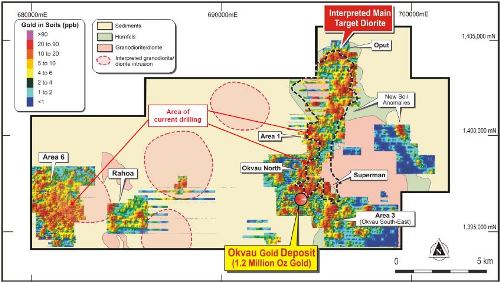
Okvau Exploration License area – soil geochemistry over geology. Source: Company announcment


The company is currently conducting a program of regional drilling with two RC rigs at the ‘Area 6’ prospect, which is located approximately 12 kilometres to the west of the Okvau deposit and along the Okvau ‘northern corridor’, which also includes the ‘Area 1’ and ‘Okvau North’ prospects.

Renaissance recently announced an independent JORC Code-compliant resource estimate for the Okvau gold deposit of 15.6 million tonnes at 2.4g/t for 1.2 million ounces of gold.

Southern Hemisphere extends Llahuin high-grade core

THE DRILL SERGEANT: Southern Hemisphere Mining (ASX: SUH) is to commence work on an updated resource estimate for the company’s Llahuin copper-gold project in central Chile.

The company said work on the estimate will kick off in early April as drilling continues to expand and enhance the Llahuin project.

The impetus behind the decision stemmed from recent diamond drill results, which have extended the higher grade core within the project’s Central Porphyry Zone.

Recent diamond drill holes at the Central Porphyry Zone include:
 
–    314 metres at 0.47 per cent copper equivalent (CuEq) from surface, including 36 metres at 1 per cent CuEq from 6 metres;
 
–    312m at 0.44 per cent CuEq from surface, including 94m at 0.55 per cent CuEq from surface;

–    146m at 0.46 per cent CuEq from 2m, including 32m at 0.62 per cent CuEq from 6m;

–    34m at 1.49 per cent CuEq from 416m; and

–    208m at 0.42 per cent CuEq from 116m, including 116m at 0.53 per cent CuEq from 116m.

Southern Hemisphere recently completed a review of the results received to date, which it determined highlights the potential of the higher grade core to provide higher grade feed during the initial stages of production.

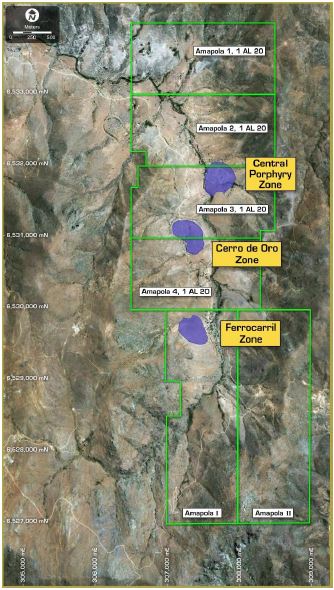
The recent drilling has also highlighted the Ferrocarril Zone, which is located approximately 2km south of the Central Porphyry Zone, with results confirming the presence of a dioritic porphyry similar to the Central Porphyry Zone.

Source: Company announcement

The majority of drilling to date has been in the Central Porphyry Zone, but further drilling is also being undertaken by the Llahuin Joint Venture between Southern Hemisphere and North American base metals miner, Lundin Mining Corporation.

This drilling has included the Ferrocarril Zone and Cerro de Oro Zone; which is located approximately 1km south of the Central Porphyry Zone.

“The Llahuin Joint Venture is progressing well with several key project milestones achieved in the past four months, since the completion of the Joint Venture, in addition to the excellent results from the accelerated drill campaign,” Southern Hemisphere Mining managing director Trevor Tennant said in the company’s announcement to the Australian Securities Exchange.

“Llahuin continues to emerge as a large-scale porphyry copper project.

“Other key project milestones achieved recently have included a 30-year easement agreement with the local Llahuin community and completion of Llahuin Amapola concession ownership, which had been held under option arrangements.

“Also, further detailed IP and ground magnetic surveys have been completed as well as first pass metallurgical testwork that gave excellent results in terms of copper recoveries, concentrate grade and low work index.”

The company’s last resource estimate update included a higher grade core Measured Resource of 51 million tonnes at 0.5 per cent CuEq being 51 million tonnes t at 0.38 per cent copper, 0.12 grams per tonne gold and 0.007 per cent molybdenum using an 0.36 per cent  CuEq cut off.