Phoenix Gold encounters high-grade gold at Red Dam

THE DRILL SERGEANT: Phoenix Gold (ASX: PXG) has encountered high-grade gold intersections from a drill program being carried out on the Red Dam gold project, part of the company’s Broads Dam project area.

The project is located in the Western Australian Goldfields, less than 40 kilometres from Kalgoorlie and approximately 12 km, by existing haulage road, from Phoenix’s Castle Hill project.
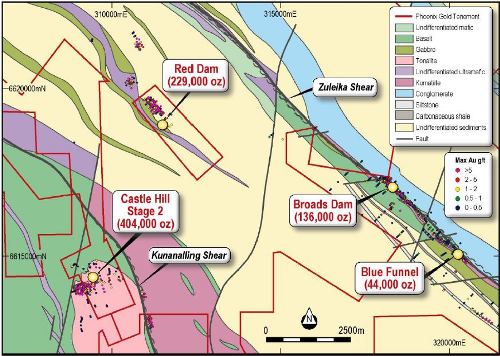
 

Red Dam project location and regional geology. Source: Company announcement.


The Red Dam Resource currently stands at 3.4 million tonnes at 2.1 g/t gold for 229,000 ounces.

Phoenix said it expects to announce a resource update in the June Quarter.

Mineralisation intercepted by recent drilling included:

–    6 metres at 97.5 grams per tonne gold from 256 metres;
 
–    7m at 12.7g/t gold from 42m;

–    3m at 17.3g/t gold from 42m;

–    12m at 4g/t gold from 42m;

–    3m at 14.8g/t gold from 134m; and

–    4m at 9g/t gold from 124m.

“These latest results from our Red Dam project clearly demonstrate the potential of this recent discovery to be a significant contributor to our eight to ten year mine plan being developed as part of our Definitive Feasibility Study due for completion in December this year,” Phoenix Gold managing director Jon Price said in the company’s announcement to the Australian Securities Exchange.

“We have two core development assets in Castle Hill and Red Dam in a safe jurisdiction, close to major infrastructure and only a 30 minute drive from Kalgoorlie-Boulder.

“I am extremely encouraged by these latest exciting high grade gold intersections which further confirm that Phoenix is progressing into a significant new gold business in the goldfields region.”

Chesser Resources identifies new mineralised Turkish delights

THE DRILL SERGEANT: Step-out drilling being conducted by Chesser Resources (ASX: CHZ) at the company’s Kestanelik gold project in Turkey has identified further extensions to gold bearing vein systems and new gold zones, in areas outside of the project’s current JORC Mineral Resource.

Chesser has received results for a further 34 holes from the current 15,000 metre drill program.

Results include:

Diamond drilling at the new 300 metre-long A3C zone returned intercepts of:

–    1.4 metres at 10.2 grams per tonne gold;

–    1.4m at 3.6g/t gold; and

–    1.1m at 29.5g/t gold in the KS vein from a zone at the margin of the maiden JORC resource.

Step out drilling on the Karakovan 3 (KK3) zone outside the area of the existing resource included:

–    3.2m at 3.66g/t gold;

–    4.6m at 6.42g/t gold, including 1.5m at 19g/t gold; and

–    2.9m at 5.03g/t gold.

Step out drilling on the Karakovan 1 (KK1) zone outside the area of the existing resource included:

–    3.5m at 2.91g/t gold.

Further zones of near-surface gold mineralisation outside the maiden JORC resource at the junction area at the eastern end of K3, KS, K4 and Topyurt veins including:

–    20.8m at 1.73g/t gold from surface; and

–    13m at 1.5g/t gold from surface.

Chesser has now completed 12,500m of 15,000m program, with results released from the first 65 holes totalling 10,000m.

The company said 48 of the 65 holes it has completed date in this campaign have intercepted veins with gold mineralisation.


Locations of new drillholes within main drilling area. Source: Company announcement


Chesser said it was pleased with the results the campaign has delivered so far, which it suggested would lead to an increase in the JORC-compliant Mineral Resource at Kestanelik once the campaign has been completed.

“This drilling has confirmed that the mineralised zones at Kestanelik extend well beyond the existing resource,” Chesser Resources managing director Dr Rick Valenta said in the company’s announcement to the Australian Securities Exchange.

“We are continuing to explore a major, new high-grade extension to the Karakovan zone in the north west of the field, which remains open to the north-east and the south-west.

“The drilling continues to add confidence in the potential to expand the resource in preparation for the forthcoming pre-feasibility study.

“We are also finding further wide intercepts of near-surface mineralisation at the junction of the K3 East, KS, K4 and Topyurt veins beyond the eastern edge of the current resource boundary.”

Chesser indicated it anticipates results of the drilling campaign to continue to be released into the first half of 2013, in support of a JORC resource update it expects to be completed by the end of the June quarter of 2013.

The company is now preparing for a Pre-Feasibility study at Kestanelik, which is scheduled to commence during the second quarter of 2013.

Chesser said it accelerated the pre-feasibility on the back of positive results from its recently announced Scoping Study.

Blue Bell keeps ringing for AusAmerican Mining

THE DRILL SERGEANT: Drilling being conducted by Australian-American Mining Corporation (ASX: AIW) at the company’s Blue Bell project in Arizona is continuing to deliver good news in the form of further copper-gold-silver massive sulphide intersections.

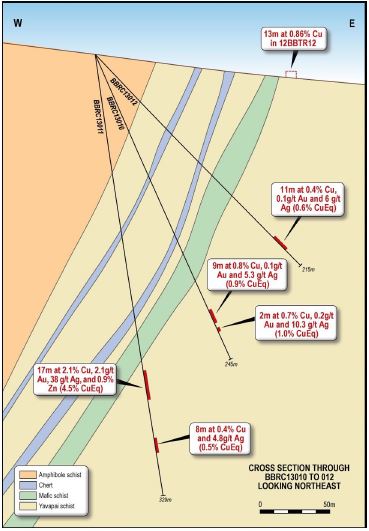
Latest results from drilling at Blue Bell have included:

–     9 metres at 0.9 per cent Copper Equivalent (0.8 per cent copper, 0.1 grams per tonne gold and 5.3 grams per tonne silver) from 195 metres;
 
–     2m at 1 per cent Copper Equivalent (0.7 per cent copper, 0.2g/t gold and 10.3g/t silver) from 208m; and
 
–    11m at 0.6 per cent Copper Equivalent (0.4 per cent copper, 0.1g/t gold and 6.0g/t silver) from 179m.

Mineralisation open at depth and along strike.


Blue Bell drilling cross section. Source: Company announcement


AusAmerican is of the opinion the latest holes demonstrate VMS mineralisation at Blue Bell has continuity from the surface to 300m below ground level.

The company has now received assays for nine completed drill holes, eight of which have demonstrated extensive mineralisation.

 “It is very pleasing to see that the mineralisation is present from the surface to depths of at least 300 metres, which gives the company confidence in its view that the project has the potential to be mined by open pit methods,” AusAmerican managing director Richard Holmes said in the company’s announcement to the Australian Securities Exchange.

AusAmerican indicated it anticipates finishing the current drilling program by the end of March/ early April.

It is expecting to receive further assay results within the next two weeks.

Trafford Resources identifies new hematite prospect at Twin Peaks

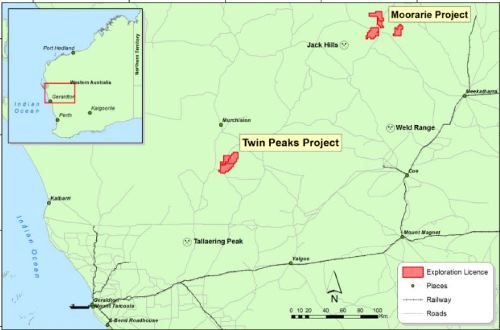
THE DRILL SERGEANT: Trafford Resources (TRF: ASX) has received all results for a recently-completed maiden drilling program at the company’s Twin Peaks project, located in the Murchison Region of, Western Australia.

The Twin Peaks project is a Joint Venture between Trafford and Independence Group (ASX: IGO), in which Trafford may earn up to an 80 per cent equity in the iron ore rights by expending $5 million over five years.


Location of Twin Peaks project areas. Source: Company announcement


The latest results have returned further high-grade Direct Shipping Ore (DSO) hematite intersections from the Woolbung Peak prospect, where continuous DSO hematite has been proven from surface to a depth of 145 metres.

“All DSO intersections contain very low impurities and indicate a deposit capable of producing a premium product,” Trafford Resources aid in its ASX announcement.

“The style of mineralisation and continuous nature of the DSO hematite intersected at Woolbung Peak is similar to Mt Gibson’s Tallering Peak operation located just 60 kilometres south of Twin Peaks.”

Recently received assays from Woolbung Peak returned impressive hematite intersections including:

–    22 metres at 65.35 per cent iron from 62 metres, including 6 metres at 68.2 per cent iron;

–     10m at 50.67 per cent iron from 80m and 3m at 64.85 per cent iron from 100m; and

–    6m at 55.11 per cent iron from 58m and 2m at 56 per cent iron from 118m.

Trafford said iron was intersected at all other prospects to be drilled within the larger Twin Peaks project area.

The company considers the drilling to have demonstrated a variety of iron ore occurrences and styles, including the high-grade DSO hematite, to be capable of supporting a low strip ratio, open cut mine at Woolbung Peak.

“The CID prospects also indicate the potential for shallow, low cost, open cut extraction,” Trafford said.

Additional open cut potential also exists at the prospects where limonite and magnetite ores were intersected.”

The completed drilling program consisted of 52 Reverse Circulation (RC) drill holes for 5076m and tested nine of 15 iron ore prospects Trafford has identified within the Twin Peaks project area.

Other results from the Big Lunch and Pleiades prospects included:

–    18m at 47.2 per cent iron from 5m, including 5m at 51.05 per cent;

–     24m at 49.72 per cent iron from 12m, including 16m at 54.51 per cent iron;

–     21m at 44.78 per cent iron from 123m; and

–    47m at 35.24 per cent magnetite iron from 72m, including 6m at 43.79 per cent iron.

Most of the prospect target areas drilled in the first pass program remain open in most directions.

Trafford indicated all iron ore prospects at Twin Peaks will now be priority rated and further drill tested, once all statutory approvals have been obtained.

Sipa Resources updates Enigma exploration target

THE DRILL SERGEANT: Sipa Resources (ASX: SRI) has had the Exploration Target for the Enigma copper prospect updated by Cube Consulting.

The Enigma copper prospect is situated within the company’s 100 per cent-owned Thaduna copper project in the Gascoyne Region of Western Australia.

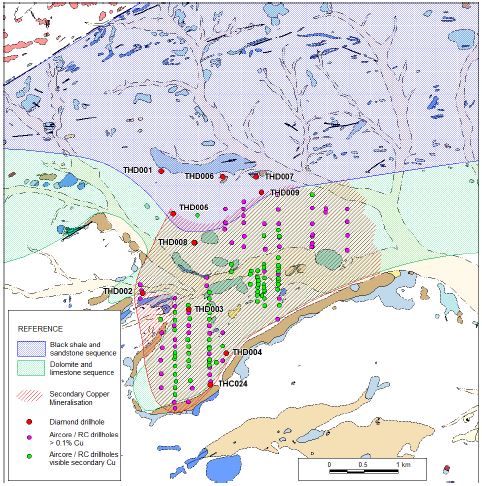
Cube has estimated the contained copper metal at Enigma to be in the region of 84,000 to 210,000 tonnes, within 42 to 69 million tonnes of mineralisation grading between 0.2 per cent and 0.3 per cent copper at a 0.1 per cent copper cut‐off.


Enigma secondary copper blanket and drillholes. Source: Company announcement


“The major significance of the Exploration Target is that it quantifies the amount of copper metal within what is a very large geochemical anomaly, which is at least four kilometres long by 1.5 kilometres wide – and which is presently not constrained by drilling to the northeast and west,” Sipa Resources said in its ASX announcement.

“Within the Target there are 16 drill holes with greater than 10 per cent ‐ metres of copper –  that is, intersections like 9 metres at 4 per cent copper and 12 metres at 1 per cent copper.

“Some of these intersections are within gossans, interpreted as representing oxidized semimassive to massive sulphides, including copper sulphides.”

Sipa indicated it considers these intersections indicate potential for zones within the exploration target to host bodies of secondary mineralisation.

It does not however, consider this to be the real significance of the amount of copper in the Target.

The company has said it has interpreted the amount of secondary copper to indicate proximity to a large source, or sources, of primary copper sulphide mineralisation.

A drill program has been scheduled to commence later this month and some 25,000m of Aircore, 10,000m of RC and 2,500m of diamond core is to be conducted at a cost of around $3 million.

The company expects the program will take around three to five 5 months to complete.

The Aircore is designed to better define the controlling structures to secondary copper, and gossan mineralisation as well as explore to a greater depth in the 10 kilometre long corridor of ‘Enigma Host Rocks’ easterly and westerly of the Enigma Exploration Target boundaries.

The RC and diamond core drilling will test at depth the mineralised structures and gossans.

Ironbark Zinc encouraged by New South Wales drilling results

THE DRILL SERGEANT: Ironbark Zinc (ASX: IBG) has intercepted zones of mineralisation during drilling at the Jerangle prospect, part of the Captains Flat project, located south of Canberra in New South Wales.

The latest drilling encountered broad sulphide mineralisation down dip from previous drilling with intercepts including:

–    2.6 metres at 10 grams per tonne silver, 0.2 per cent copper and 6 per cent lead and zinc;

–    5m at 4.2g/t silver, 0.13 per cent copper and 4.6 per cent lead and zinc; and

–    9.9m at 5.7g/t silver and 0.45 per cent copper.

Ironbark explained the drilling commenced at Jerangle in early January 2013 to test an electromagnetic (EM) conductor identified by its Joint Venture partner, NSW Base Metals; a subsidiary of Glencore International AG.

The current and previous drilling results are currently being reviewed and modelled to target higher grade zones of mineralisation and to determine the relationship with historic areas of drilling.

The Captains Flat base metal project covers a strike length of 39 kilometres of a Volcanic Massive Sulphide (VMS) horizon that hosts numerous historic mineral occurrences and mines, including the Lake George Mine that produced 4 million tonnes of high-grade ore until closure in 1962 and was at one time Australia’s second largest producer of copper.

Within the project area prospects also include the Lake George, Vanderbilt Hill and Anembo prospects where previous explorers have returned high grade copper and zinc drill intercepts.

The high-grade Lake George Mine produced approximately 4 million tonnes of ore at 10 per cent zinc, 6 per cent lead, 0.7 per cent copper, 1.8 g/t gold and 55 g/t silver and remains prospective for additional ore. Diamond drill results beneath historical workings indicate mineralisation over a strike length of at least 300m and include 1.22m at 12.4 per cent zinc, 5.4 per cent lead. Mineralisation is open at depth and may represent possible repeats of the historically mined areas.

The Vanderbilt Hill prospect is located to the east of the Lake George Mine and drilling has returned results such as 3.9m at 10 per cent zinc, 5.3 per cent lead. The prospect is considered to be prospective with open ended historic high-grade drill results yet to be followed up.

The Anembo prospect lies 12km north of Jerangle and historic drilling returned a best intercept of 3m at 6.9 per cent zinc, 5.5 per cent lead, 21g/t silver and 2g/t gold from 163m.

Kentor Gold combines new and historic drill data at Murchison mine

THE DRILL SERGEANT: Kentor Gold (ASX: KGL) has claimed discovery of a new high-grade zone of mineralisation through drilling on the NOA2 deposit at the company’s Murchison gold mine in Western Australia.

The NOA2 deposit is already the source of ore to the Murchison processing plant, following the reopening of the underground mine in December 2012.

The drilling at NOA2, completed late last year, entailed three Reverse Circulation holes, one of which the company said intersected a narrow, high-grade zone of mineralisation.

Best results from the drilling include:

12BNRC267:
1 metre at 3.67g/t gold from 167 metres; and

1m at 5.5g/t gold from 245m;

12BNRC279:
1m at 1.59g/t gold from 220m; and

12BNRC280:

3m at 51.5/t gold from 180m, including 1m at 149g/t gold from 181m;

1m at 1.72g/t gold from 210m; and

1m at 3.34g/t gold from 219m.


NOA2 pit looking west showing underground development and planned
stopes with ATW’s 2009 drill holes. Source: Company announcement


Kentor explained the recent drilling was conducted to follow up an intersection of 12m at 6.1g/t gold from 213m the company achieved in April 2012.

The company considered that particular intersection important as it was encountered between two existing lodes and was not part of the project’s existing resource.

Kentor also recently conducted a validation of previous data from 21 diamond holes drilled by the previous owner of the Burnakura project, ATW Gold Corporation Australia in 2009, which were not entered into the database or included in the resource estimate.

“Data for these holes has been validated with check analyses at an accredited laboratory and then added to the database,” Kentor Gold explained in its ASX announcement.

“This additional data has significantly improved drill coverage on several of the planned stopes at NOA2, providing greater confidence in the interpretations of the mineralised trends.

“Reinterpretation of the ore outlines is in progress in prelude to a resource update that includes all the new data from ATW and the recent Kentor drill programs.”

Kantor has designed additional drilling, to be conducted using an underground drill rig, to increase confidence in existing lodes prior to mining and to test for extensions at depth.

A resource update for NOA2 incorporating this additional drilling has commenced and is expected to be completed in Q2 2013.

Hannans Reward uncovers copper-gold in historic drilling

THE DRILL SERGEANT: Hannans Reward (ASX: HNR) has completed a review of recently uncovered historic copper-gold drilling results from the company’s 100 per cent-owned Pahtohavare project, located in northern Sweden.

Highlights of the review include:

–    9.18 metres at 5.25 per cent copper and 0.23 grams per tonne gold from 115 metres;

–    46m at 1.1 per cent copper and 0.63g/t gold from 67.4m, including 13.95m at 2.2 per cent copper and 0.9g/t gold from 85.79m;

–    2.15m at 15.9 per cent copper and 7.7g/t gold from 117.69m; and

–    1.39m at 8.8 per cent copper and 4g/t gold from 128.4m.

Hannans explained its initial focus at Pahtohavare has been on the Central orebody, one of three orebodies situated within the project.


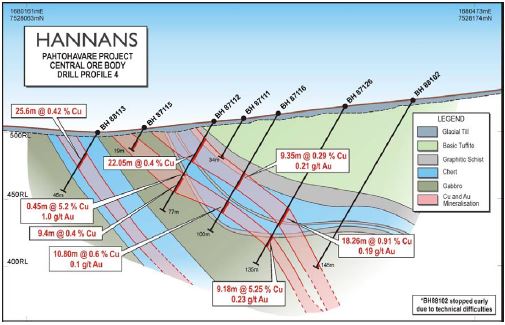
Drill profile 4 at the Central orebody of Pahtohavare. Source: Company announcement


“The significant historic drill intercepts demonstrated in drill profiles 4 and 5 confirm the shallow, high-grade copper-gold mineralisation at the Central orebody,” Hannans Reward said in its ASX announcement.

“The profiles also highlight areas of ineffective historic drilling close to surface and the potential for extensions of primary copper-gold mineralisation at depth.”

Hannans said it has validated 13 holes so far and is in the process of validating the remaining 37 holes at the Central orebody.

Once it has completed the Central orebody review, the company indicated its focus will move to reviewing the historic underground mining operations and potential for additional mineralisation at both the previously announced Southern and South Eastern orebodies.

Hannans Reward is aiming to combine the historic information with new data from its own exploration programs to generate drill targets for testing during 2013 and to aid in conversion of the existing JORC Exploration Target into a JORC Mineral Resource.

Rox Resources receives more good news from Camelwood

THE DRILL SERGEANT: Rox Resources (ASX: RXL) has received further assays from the company’s Camelwood nickel sulphide prospect at Fisher East, north of Kalgoorlie in Western Australia.

Assays results for RC drilling at Camelwood (above a 1 per cent nickel cut-off) included:

Hole MFEC010: 22 metres at 1.42 per cent nickel from 118 metres, including 9 metres at 2.04 per cent nickel from 119 metres.
 
Rox has drilled a ninth RC hole, MFEC012, 100m north of the above hole, which intersected 1m semi-massive and 9m disseminated sulphide mineralisation from 153m.

The company said this extends the strike length of mineralisation at Camelwood to at least 700m. Further RC drilling to the north is ongoing.

Diamond drilling was conducted to follow up previous results and intersected 0.55m of massive sulphide followed by 2m of disseminated sulphide before being truncated by a fault encountered by previous drilling.

A further hole intersected 0.7m of massive and 0.3m of semi-massive sulphides from 388.6m before also being truncated by a fault, which the company has assumed is a different fault than the previously encountered one.

Other drilling intersected 1.7m of massive sulphides followed by 1m of disseminated sulphides from 350.5m.


Camelwood drill long section. Source: Company announcement


“We still have a 100 per cent success rate in hitting nickel sulphide mineralisation in all holes drilled so far,” Rox Resources managing director Ian Mulholland said in the company’s announcement to the Australian Securities Exchange.

“These drill holes continue to show the continuity of the nickel sulphide mineralisation at Camelwood, although the thickness of the massive zone is quite variable.

“We are finding that the disseminated zone immediately adjacent to the massive sulphide zone is also carrying grades greater than 2 per cent nickel…so it is not just the massive sulphide thickness that is important.

“We are drilling on quite a wide hole spacing for this type of deposit, and we have now started to close in to a 50 metre spacing in certain areas.

“In addition, the situation is complicated by fault off-sets that we are still trying to interpret.”

Dacian Gold collects further encouragement from drilling at Mt Morgans

THE DRILL SERGEANT: Dacian Gold (ASX: DCN) has received results from an ongoing broad spaced diamond drilling program testing for resource extensions at the south end of the Westralia BIF hosted gold deposit.

The Westralia deposit is located within the company’s 100 per cent-owned Mt Morgans gold project in Western Australia.

Results include:

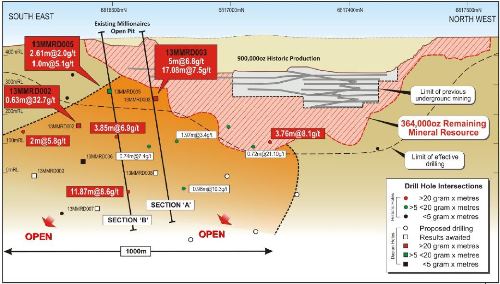
–     A new intersection of 17.08 metres at 7.5 grams per tonne gold from 218.7 metres from drill hole 13MMRD003. A previously reported result from the same hole returned 5m at 6.8g/t gold from 202m;

–    Drill hole 13MMRD002 intersected 0.63m at 32.7g/t gold from 375.6m at the targeted BIF horizon testing in between two 300m spaced historic holes that previously intersected 3.85m at 6.9g/t and 2m at 5.8g/t gold; and

–     Drill hole 13MMRD005 tested the BIF target zone 150m along strike and to the south of 13MMRD003 and 170m up-dip of the historic 3.85m at 6.9g/t, and returned 2.61m at 2g/t from 204.4m and 1m at 5.1g/t from 219m.


Westralia long section showing historical intersections and Dacian drill holes. Source: Company announcement


Dacian Gold claimed the drilling has confirmed the existence of high-grade gold mineralisation in excess of 450m below the existing resource boundary at Westralia, and remains open at depth.

“These very broad spaced diamond drill intersections confirm our view that Westralia is not only a very large mineralised position, but that it also has the potential to host substantial high-grade shoots close to existing underground development,” Dacian Gold managing director Paul Payne said in the company’s announcement to the Australian Securities Exchange.

“We have commenced planning selected infill holes to define the shoot extent.

“This will be done in parallel with further first pass testing of the target horizon to the north of our initial drilling.”

Dacian is currently completing the final two holes of its initial seven hole program at Westralia and has commenced planning for selected infill drilling around the recent high-grade intersections.

This drilling is anticipated to recommence in April.

The company indicated that should results from the infill drilling confirm the continuity of mineralisation, Mineral Resource upgrade studies will commence later in 2013.

In addition to the planned infill drilling, first pass broad spaced diamond drilling will commence below the central part of the Westralia deposit in April-May.

Dacian explained its exploration strategy at Mt Morgans is aimed at delivering on the objective of defining at least 500,000 ounces of Ore Reserves.

Dacian considers mining an Ore Reserve of at least 500,000 ounces of gold is reasonably likely to provide sufficient returns to justify the investment capital required to construct an ore processing facility at Mt Morgans.