Liontown Resources to acquire 100 per cent of Jubilee Reef gold project

THE DRILL SERGEANT: Liontown Resources (ASX: LTR) is to acquire the remaining 34 per cent interest in the Jubilee Reef gold project in Tanzania, East Africa from its joint venture partner Currie Rose Resources.

The deal will result in Liontown holding 100 per cent ownership of the project.

“The opportunity to acquire 100 per cent ownership of the Jubilee Reef project and renegotiate the royalty was extremely attractive to Liontown and represents a good outcome for shareholders,” Liontown Resources chairman Tim Goyder said in the company’s announcement to the Australian Securities Exchange.

“Having the opportunity to consolidate ownership of the project will provide shareholders with exposure to 100 per cent of its substantial exploration potential and will be an important factor in being able to manage future exploration as effectively as possible.”

Liontown said it has completed a total of 22,296 metres of RC, diamond and aircore drilling since work commenced on the Jubilee Reef project in mid-2011.

The drilling has encountered broad intersections at the Masabi Hill, Panapendesa and Chela prospects with better intersections recorded at Masabi Hill in particular, including:

–    50 metres at 1.8 grams per tonne gold from 40 metres, including 27 metres at 2.8g/t gold from 42 metres;

–    62m at 2.4g/t gold from 70m, including 21m at 4.7g/t gold from 70m;

–    68m at 1.5g/t gold from 132m, including 28m at 1.9 g/t gold from 133m; and

–    86m at 1.7g/t gold from 9m, including 44m at 3g/t gold from 24m.

Liontown said it is currently reviewing all data from Jubilee Reef and is planning field work to be undertaken following the cessation of the northern Tanzanian wet season.
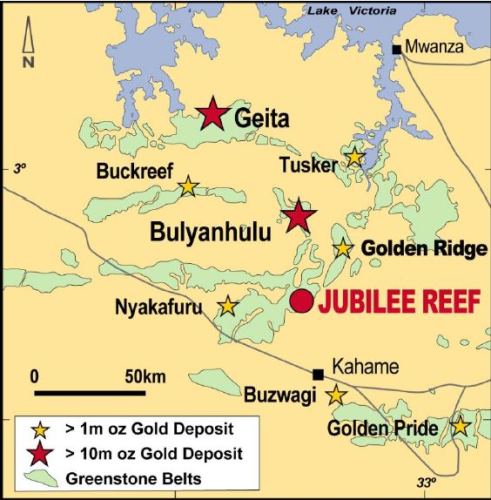
 

Jubilee Reef – location plan. Source: Company announcement


In consideration for increasing its interest in the Jubilee Reef Project to 100 per cent, Liontown will issue 12 million shares to Currie Rose and make a payment of up to US$120,000 for any transaction costs.

Under the terms of the existing Jubilee Reef Joint Venture Agreement, Currie Rose had a right to receive a 3 per cent net smelter royalty upon its interest being diluted to 5 per cent.

As part of the agreement to acquire the remaining interest, Currie Rose will now receive a 2 per cent net smelter royalty on future gold production from the Jubilee Reef project.

Liontown will have the option to purchase the 2 per cent net smelter royalty in the event that a Preliminary Economic Assessment is completed for a resource in excess of 250,000 ounces of gold (or gold equivalent).
Gascoyne Resources increases gold grade and resource at Glenburgh

THE DRILL SERGEANT: Gascoyne Resources (ASX: GCY) has released a remodelled resource estimate for the company’s 100 per cent-owned Glenburgh gold project in the Gascoyne province of Western Australia.

The combined Indicated and Inferred Resource at Glenburgh now stands at 21.1 million tonnes at 1.5 grams per tonne gold for 1 million ounces of gold (using a 0.5 g/t cut-off).

Highlights from the re-defined resource include:

–    A 25 per cent increase in the overall Resource grade to1.5 g/t gold;

–    The Indicated resource grade up by 34 per cent to 1.73g/t gold, Inferred Resource grade up by 19 per cent to 1.3g/t gold;

–    Resource tonnage decreased by 22 per cent;

–    Total contained ounces remain relatively unchanged (down 3 per cent); and
 
–    A higher grade ‘core’ of the resources contains 12.3 million tonnes at 2g/t gold for 791,000 ounces (at a 1g/t cut-off).

“The remodelling of the resource has highlighted a number of significant high grade zones within the overall Glenburgh system,” Gascoyne Resources managing director Michael Dunbar said in the company’s announcement to the Australian Securities Exchange.

“The separation of these higher grade zones from the lower grade alteration halo has resulted in a substantial increase in overall grade, while total contained ounces, remain virtually unchanged.

“This has a significant ‘knock on’ effect to the potential profitability of the material.”


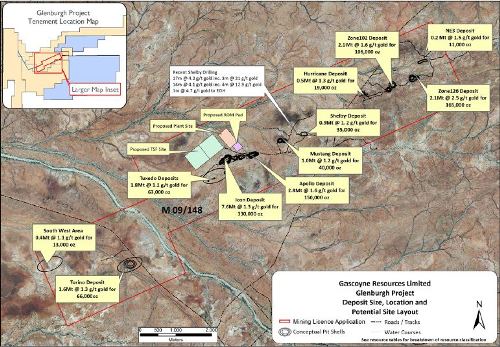
Deposit location, resources and conceptual site-layout. Source: Company announcement


High-grade zones defined by recent work include:

–    523,000 tonnes at 6.3g/t gold for 107,000 ounces (within the Zone 126 deposit);

–    139,000 tonnes at 7.9g/t gold for 35,000 ounces (within the Apollo deposit);

–    521,000 tonnes at 2.8g/t gold for 47,000 ounces (within the Zone 102 deposit); and

–    2.6 million tonnes at 1.6g/t gold for 136,000 ounces (within the Icon deposit).

“In addition to the overall resource refinements, detailed modelling at the Zone 126 deposit has identified a high-grade zone, which not only has the consistency, but also the grade and ounces per vertical metre required to sustain an underground development,” Dunbar said.

“This development could be undertaken in conjunction with the open cut development currently the focus of the Feasibility Study.”

Glenburgh said the Feasibility study is well advanced, with new resource modelling being evaluated with pit optimisations and mine designs.

In addition to the technical aspects of the study, a number of enquiries for second hand plant and equipment are being made, which the company considers could reduce the capital cost of the processing plant from the current new plant cost of approx. $67 million.

The company has current exploration activities continuing with approx. 60 shallow RC drill holes awaiting analysis in Perth and a second phase of drilling expected to commence within the next two weeks.

Indochine Mining encounters more gold at Mt Kare deposit

THE DRILL SERGEANT: Indochine Mining (ASX: IDC) has intersected further high-grade gold mineralisation while drilling the Western Roscoelite Bonanza Zone (WRZ) at the company’s 1.8 million ounce Mt Kare gold-silver project in Papua New Guinea.

According to Indochine the WRZ contains two of three Bonanza Zones the company is exploring via diamond drilling at the project.

The company indicated it had received high-grade assay results from the first four drill holes, which it claims has demonstrated the potential of the Bonanza Zones.


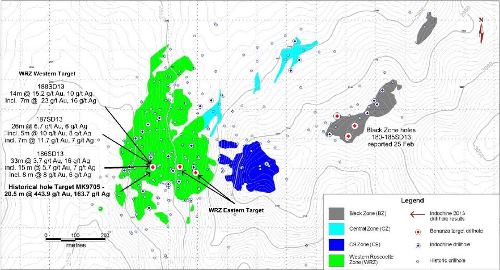
Mt Kare resource plan with the locations of the WRZ bonanza drill holes. Source: Company announcement


Best results from the recent drilling include:

–    14 metres at 15.3 grams per tonne gold, 9 grams per tonne silver from 36 metres down hole, including 7m at 22.9g/t gold and 14g/t silver, including 1 m at 57.7g/t gold and 19g/t silver;

–    26m at 6.7g/t gold, 5g/t silver from 25m down hole, including 5m at 10g/t gold and 8g/t silver, including 7m at 11.7g/t gold, 7g/t silver; and

–    15m at 5.7g/t gold, 7g/t silver from 20m down hole, within 33m at 3.7g/t gold, 16g/t silver from 2m down hole, including 8m at 8g/t gold, 6g/t silver, including 7m at 11.7g/t gold, 7g/t silver.

“These results are pleasing and will help to improve the overall grade of the Mt Kare project, thus improving the overall economics of the project,” Indochine Mining chief executive officer Stephen Promnitz said in the company’s announcement to the Australian Securities Exchange.

“Our priority at this time is to continue drilling in the Bonanza Zones before defining a larger mineral resource later in the year.”

Indochine said the results were encouraging as they will assist it in targeting new drill holes at the possible location of the feeder zones to more bonanza targets.

The company considers the results also indicate more potential along strike, on the interpreted intersection with another known mineralised fault, possibly with an associated ‘feeder’ zone.

This target is currently being drill tested.

Hot Chili confident new copper means new project

THE DRILL SERGEANT: Hot Chili (ASX: HCH) has moved closer to its stated goal of establishing a multi-project copper production hub in Chile, by claiming the discovery of a copper-gold porphyry at Frontera, situated 70 kilometres from the company’s Productora project.
 
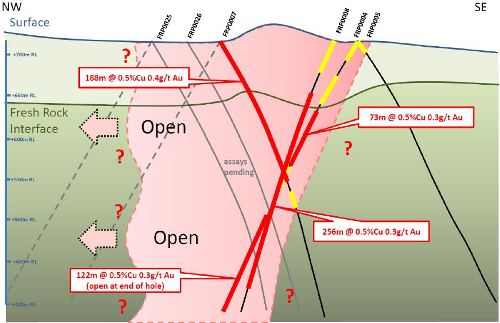
The company’s first round of drilling at Frontera has returned wide copper and gold intersections, including:

– 256 metres at 0.5 per cent copper and 0.3 grams per tonne gold from 72m down-hole;

– 188m at 0.5 per cent copper and 0.4g/t gold from surface;

– 122m at 0.5 per cent copper and 0.3g/t gold from 244m down-hole – hole finishes in mineralisation; and

– 73m at 0.5 per cent copper and 0.3g/t gold from 96m down-hole.

“These outstanding results show Frontera is set to be the company’s second major copper-gold project,” Hot Chili managing director Christian Easterday said in the company’s announcement toteh Australian Securities Exchange.

“These results highlight Frontera’s potential to double Hot Chili’s production profile, while its close proximity to Productora will enable the project to capitalise on existing infrastructure.”


Cross-section of Frontera copper project displaying first significant drilling intersections. Source: Company announcement

Hot Chili is now in the final stages of its maiden reverse circulation and diamond drilling program at Frontera.

At the same time, Hot Chili is continuing an extensive drilling program at Productora as part of its strategy to release a second major resource upgrade and deliver a Pre-feasibility Study in the second-half of this calendar year.

The company aims to make a decision to mine at Productora in late 2014.

Bulletin Resources hits new lode at Wagtail South

THE DRILL SERGEANT: Bulletin Resources (ASX: BNR) has received results from a reverse circulation (RC) drilling program currently underway at the company’s 100 per cent-owned Lamboo and Golden Crown projects located near Halls Creek in the East Kimberley region of Western Australia.
 
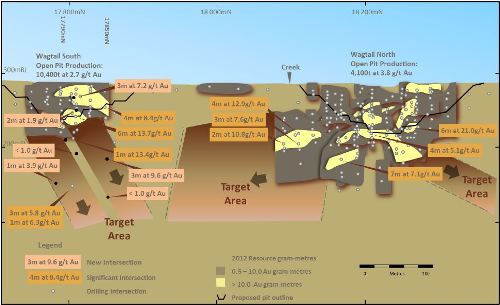
The company said three exploratory RC drill holes testing the down-plunge potential of Wagtail South had intersected high-grade mineralisation and a new hanging-wall lode.

Best results include:

–    3 metres at 9.6 grams per tonne gold; and

–    3m at 7.2g/t gold (composite assay).

Bulletin considers the results from all three holes have confirmed down-plunge continuity of the Wagtail South mineralisation below the current resource of 79,000 tonnes at 5g/t gold.

The company said the indication of a new near-surface mineralised lode in the hanging-wall to the immediate east of the planned open pit has encouraged it to grow the resource.


Wagtail North and Wagtail South long section showing new drill holes results. Source: Company announcement


“These new results from Lamboo are providing additional confidence in the understanding to the controls of the high grade Wagtail South mineralisation at depth” Bulletin Resources managing director Martin Phillips said in the company’s announcement to the Australian Securities Exchange.

“The high-grade lodes typically have a strike extent of less than 80 metres so it is particularly pleasing that we are continuing to hit good grades in these wide spaced exploratory holes.

“Drilling is nearing completion at the Golden Crown and Faugh-a-Ballagh gold deposits following which a detailed assessment of all assay results will be completed.”

Bulletin also completed a third deep hole at Nicolson’s Find targeting the footwall lode and a further exploratory hole, both of which failed to intersect any significant gold mineralisation.

The company still has additional drilling planned for Nicolson’s Find, which will focus on the re-emerging, high grade Main Lode announced in April.

Bulletin indicated future drilling at Nicolson’s North will be subject to the completion of a geophysical survey to assist in the understanding of the structural controls of the mineralisation the company has previously intersected in this area.

Gascoyne Resources extends Glenburgh mineralisation

THE DRILL SERGEANT: Gascoyne Resources (ASX: GCY) has recorded high-grade gold intersections while conducting extensional RC drilling between conceptual pit designs for the Shelby and Mustang deposits at the company’s 100 per cent-owned Glenburgh gold project in Western Australia.

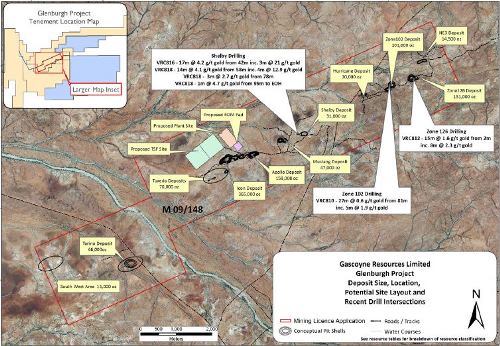
Gascoyne said the drilling identified a high-grade zone of mineralisation west of the conceptual Shelby open pit in the central zone of the Glenburgh gold system.


 Glenburgh project deposit overview and recent drill intersections. Source: Company announcement


Results from four RC drill holes drilled at Shelby indicate potential for the deposit to extend towards the Mustang deposit.

Intersections include:

–    17 metres at 4.2 grams per tonne gold from 42 metres, including 3 metres at 21 grams per tonne gold;

–    14m at 4.1g/t gold from 55m, including 4m at 12.9g/t gold, 3m at 2.7g/t gold from 78m and 1m at 4.7g/t gold from 99m at the end of hole; and

–    8m at 1.0g/t gold from 45m.

“This drilling has identified a continuous zone of mineralisation that extends for over 150 metres and remains open to the west towards the Mustang deposit,” Gascoyne Resources said in its ASX announcement.

“Further drilling is being planned to further evaluate this high grade zone.”

Other drilling included three holes to test below a soil anomaly within the conceptual open pit at Zone 126, one of which identified a zone of mineralisation grading:

–    15m at 1.6g/t gold, including 8m at 2.3g/t gold from 2m down hole.

“While the grade is slightly lower than the average for the Zone 126 deposit (2.4Mt at 2g/t gold for 151,000 ounces), the area of this new gold zone had previously been interpreted as waste,” Gascoyne explained.

“This new near surface zone of mineralisation is expected to positively impact the open pit development of the Zone 126 deposit.”

Fifteen RC holes were drilled north and east of the known mineralisation at Zone 102, which the company said had intersected a number of narrow low grade intersections including:

–    5m at 0.7g/t gold from 100m.

One hole was drilled to confirm the interpretation of the mineralisation within the Zone 102 resource.

This hole intersected a broad low grade zone of 27m at 0.6g/t gold from 81m, containing higher grade core of 5m at 1.9g/t gold from 85m.
 
Gascoyne indicated the recent drilling had completed stage one of its 2013 Glenburgh drill program.

A second phase of shallow RC and aircore drilling is expected to commence in the next three weeks testing extensions to the recent high grades discovered west of the Shelby conceptual pit.

Additional drilling is also planned for the Tuxedo, Icon, Apollo and Mustang deposits as well as exploration in the south west target area.

Birimian Gold raises $2M at 30 per cent premium

THE DRILL SERGEANT: Birimian Gold (ASX: BGS) has placed 95.2 million ordinary shares with Sprott Global Resource Investments at an issue price of 2.1 cents per share, a 30 per cent premium to the current market share price, to raise $2 million.

Sprott is a US-based broking and funds management firm with a track record of identifying and funding successful early stage resource companies.

Birimian claimed Sprott’s readiness to take such a strong position in the company – at a 30 per cent premium – is indicative of the long-term potential of the company’s Massigui project in southern Mali and an endorsement of its management.

The company indicated it now intends to use the net proceeds from the placement to:

–    Advance its new gold discovery at the Ntiola prospect, situated within the Massigui project;

–    Compile and evaluate recently-acquired Randgold exploration data to generate new high quality drill targets;

–    Explore the broader Massigui project; and

–    Continue to pursue additional growth opportunities.

“This Placement represents a strong endorsement and support from a major resource investment group, Sprott,” Birimian Gold managing director Kevin Joyce said in the company’s announcement to the Australian Securities Exchange.

“This clearly validates the company’s strategic position in West Africa and the prospectivity of the Massigui project.”

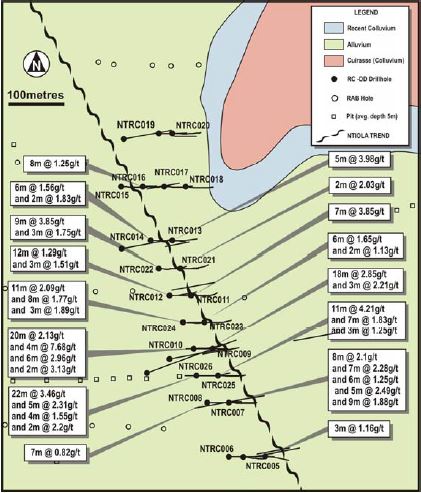
Birimian is currently conducting a second phase reverse circulation and diamond drill program at the Ntiola prospect, which is testing for further high-grade gold mineralisation beneath, and along strike from, the currently defined shallow mineralised zone.


Ntiola prospect previously reported drill hole locations and results. Source: Company announcement


Better reported intersections from recent drilling so far include:

–    11 metres at 4.21 grams per tonne gold from 33 metres;

–    22m at 3.46g/t gold from 78m;

–    18m at 2.85g/t gold from 3m; and

–    4m at 7.68g/t gold from 45m.

Birimian Gold said it anticipates first analytical results from this RC and diamond drilling program to be available towards the end of May.

Monax Mining encounters graphite at Francis prospect

THE DRILL SERGEANT: Monax Mining (ASX: MOX) has described recent drilling results from the Francis graphite prospect as “impressive”.

The Francis prospect forms part of the company’s Waddikee graphite project located on South Australia’s Eyre Peninsula.

The company said the results confirm the Waddikee project contains a second high-grade prospect along with the Wilclo South prospect.


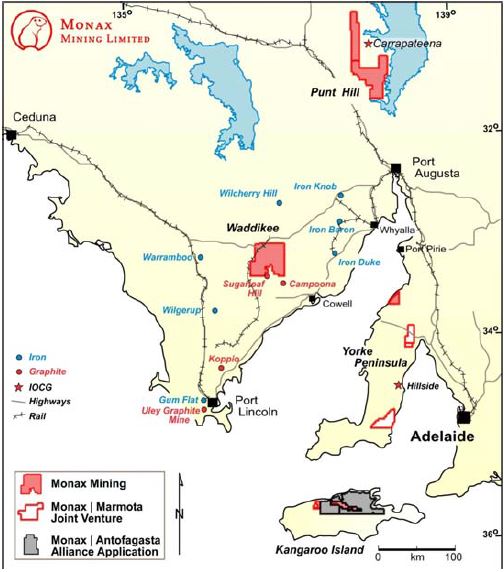
Location of the Waddikee project, central Eyre Peninsula. Source: Company announcement


Seven reverse circulation (RC) holes were completed at the Francis graphite prospect to test an electromagnetic (EM) anomaly.

The Francis prospect drilling was part of Monax’s wider 2013 graphite resource drilling campaign for the Waddikee project, which also included 77 RC drill holes at the Wilclo South prospect.

Graphite up to a maximum of 38.1 per cent total graphitic carbon (TGC) was reported over 1 metre with 5 one metre samples reporting greater than 30 per cent TGC.

The best results from the Francis prospect include:

15 metres at 20.7 per cent TGC;

12m at 21.9 per cent TGC;

3m at 22.2 per cent TGC;

2m at 25.1 per cent TGC;

2m at 16.2 per cent TGC; and

3m at 10 per cent TGC.

(Note: all lengths are downhole lengths; true width unknown).

The company considers the recent high-grade graphite encountered at the Francis prospect provides further encouragement that the Francis prospect trend is the result of a large geological fold structure, which appears to have produced a repetition of the Wilclo South geology.

“Monax is excited by the high-grade graphite reported at the Francis prospect and is now looking forward to receiving the upcoming results from the larger scale Wilclo South drilling program,” Monax Mining said in its ASX announcement.

“Monax is now confident following the drilling program at the Francis prospect that further zones of graphite are present at the Waddikee project.

“Results from the Wilclo South drilling are expected to be returned in the next 4-6 weeks and Monax will then proceed down the path of defining a JORC Resource for the Wilclo South prospect.

“This is expected to take about 4-6 weeks after receipt of the laboratory results.”

St George prepares Cambridge drill program

THE DRILL SERGEANT: St George Mining (ASX: SGQ) is gearing up for a 2013 drilling program to be carried out at the company’s 100 per cent-owned Cambridge nickel prospect in Western Australia.

The 2013 drill program is designed to test priority nickel sulphide targets at the Cambridge nickel prospect and at new sites along the Stella Range ultramafic belt to the north and south of the main Cambridge prospect area.

The new targets, Cambridge South and Cambridge North, are situated on tenements the company recently acquired and have not been previously explored for nickel sulphide mineralisation.


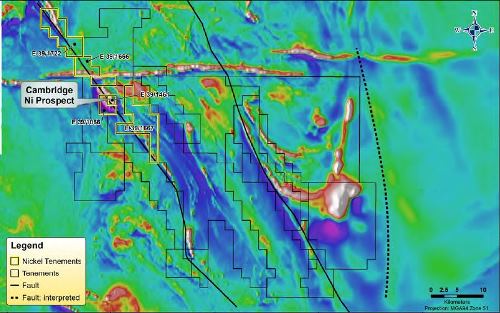
St George nickel tenements overlaying aeromagnetics. Source: Company announcement


St George indicated final drill targets will be announced once site preparation is completed.

The company said the drilling program will test for nickel sulphide mineralisation and is aimed at attaining new information regarding the composition of, and structural controls on, the ultramafic rocks.

This will assist in selecting the most favourable areas along the ultramafic belt for further targeted drilling.

“There is a compelling technical case for additional exploration on St George’s nickel tenements, which are situated on the highly prospective Stella Range ultramafic belt,” St George Mining Technical Director Tim Hronsky said in the company’s announcement to the Australian Securities Exchange.

“Previous exploration has demonstrated the presence of high magnesium oxide (MgO) ultramafic rocks that host nickel sulphides in both disseminated and more massive forms.

“We have reached this advanced stage of nickel exploration at East Laverton over a very short period of time and are now set to test numerous promising nickel targets over all of our 100 per cent-owned tenements along the Stella Range belt.”


Disclaimer: The Roadhouse holds shares in St George Mining

Greenpower Energy to commence drilling

THE DRILL SERGEANT: Greenpower Energy (ASX: GPP) has commenced geothermal drilling at the company’s Mt Ridley project in Western Australia.

The first hole, Mt Ridley 1, has a planned total depth of 400 metres and is being drilled to test a radiogenic granite for hot dry rock (HDR) geothermal energy generation.

”This is the first HDR exploration in Western Australia and the first deep drilling to take place in this part of the Albany-Fraser province,” Greenpower Energy chief executive officer John Watts said in the company’s announcement to the Australian Securities Exchange.
 
The company said it has two drill holes planned to be drilled on its geothermal exploration tenements in the Esperance Region of Western Australia.

These tenements extend from the coast at Esperance northward to Salmon Gums.

The Greenpower said preliminary qualitative analysis of the tenements suggests at least one granite body with strong thermal potential.

The company has interpreted available imagery, which it said indicates a granite body in the Mt Ridley area with a north east to south west strike and a north westerly dip.

In June 2012 Greenpower received a government co-funded drilling grant of $120,000 for the two planned holes at the Mt Ridley geothermal project.