Clancy Exploration extends Meritilga with gold and silver hits

THE DRILL SERGEANT: Clancy Exploration (ASX: CLY)  has received results from reverse circulation (RC) drilling conducted at the company’s 100 per cent-owned Condobolin project in central New South Wales.

Results have now been received from all RC holes Clancy has drilled at the Meritilga and Bluebell prospects in April and May 2013.

The drilling intersected gold and silver intercepts, which Clancy said have extended the Meritilga lode at depth including:

–     10m at 5.78 grams per tonne gold and 26.79 grams per tonne silver from 80 metres, including 4m at 14.16g/t gold and 61.7g/t gilver from 83m; and

–     15m at 2.76g/t gold and 8.78g/t silver from 90m, including 5m at 7.89g/t gold and 22.28g/t silver from 99m.

Drilling also extended the Meritilga lode up-dip intersecting silver and gold within wide mineralised halos of:

–     23m at 0.36g/t gold and 46.15g/t silver from 24m, including 4m at 0.83g/t gold and 226.93g/t silver from 42m; and

–    28m at 0.76g/t gold and 3.99g/t silver from 26m, including 6m at 2.87g/t gold and 15.54g/t silver from 45m.

According to Clancy Exploration managing director Gordon Barnes, the recent assay results have confirmed the existence of a fertile epithermal-style system at the Meritilga prospect.

“The high-grade zone at Meritilga, which we discovered through RC drilling early last year, has been extended up and down dip, as well as along strike,” Barnes said in the company’s announcement to the Australian Securities Exchange.
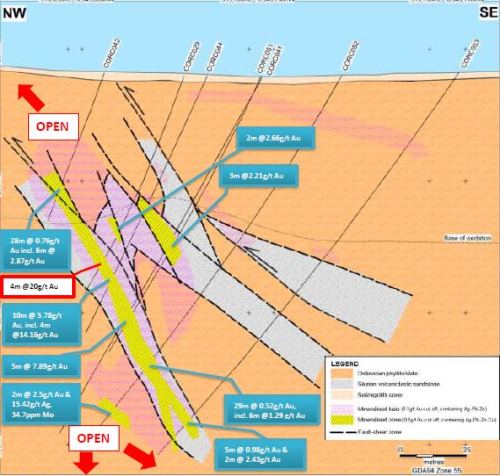
 

Meritilga prospect cross-section – High-grade zone. Current
intercepts denoted in blue boxes, 2012 intercepts denoted in red boxes.
Source: Company announcement


“It’s got some variability of gold grade within the zone, which is to be expected in these types of systems, but overall it’s reasonably consistent.

“The strike extent of this lode has been constrained, but it remains open up and down dip.

“This round of drilling has also identified a correlation between gold and molybdenum suggesting we may have a deeper magmatic source for the mineralisation.

“Indications are that there may be another lens at around 130 vertical metres depth and we believe there is potential to define further mineralisation beyond that.”

The latest round of drilling also further tested intercepts Clancy had previously achieved at the Bluebell prospect.

Bluebell is a gold-copper prospect, which the company considered to warrant follow up drilling as it is thought to sit along the same structural trend as the Meritilga prospect.

Drilling at the Bluebell prospect followed intersections from drilling in 2012, which included: 4m at 0.51g/t gold, 1.24 per cent copper, 10.4g/t silver from 105m.

Recent drilling intersected further shoot-style gold and copper, with the addition of silver and molybdenum, not previously seen:

–    1m at 0.41g/t gold, 4.8 per cent copper, 39.7g/t silver and 4.37ppm molybdenum from 100m;

–    1m at 0.35g/t gold, 1.34 per cent copper, 15.95g/t silver and 8.29ppm molybdenum from 81m; and

–    2m at 1.4g/t gold, 0.14 per cent copper, 2.31g/t silver and 3.96ppm molybdenum from 70m.
Shaw River Resources identifies new manganese zone in Namibia

THE DRILL SERGEANT: Shaw River Manganese (ASX: SRR) has identified new zones of manganese-in-soils while conducting a low-cost exploration program at the company’s Otjozondu manganese project (Otjo) in Namibia.

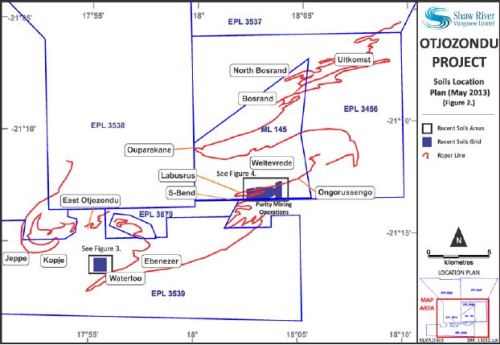
New zones of manganese-in-soils have been identified between the Ongorussengo and the Labusrus deposits at Otjo and during in-fill soil sampling north of the Waterloo deposit.

Recent manganese soil sampling areas at Otjo project. Source: Company announcement

“These results provide confirmation of this exploration technique and increase Shaw River’s understanding of the controls of mineralisation at Otjo as it continues to progressively unlock the full potential of the Roper Line,” Shaw River managing director Peter Benjamin said in the company’s announcement to the Australian Securities Exchange.

“Shaw River is continuing its program of low cost exploration techniques to identify new areas of manganese mineralisation at the Otjo project.

“We have still only drilled less than 13 per cent of the 144 kilometre Roper Line strike, so we are very encouraged by the success we are having in identifying prospective new drill targets to expand our already substantial resource base.”

In 2012, Shaw River commenced soil sampling as a technique to test and identify new target areas of manganese mineralisation under the shallow Kalahari Sands cover that exists at Otjo.

This program, in conjunction with mapping and follow up trenching to expose outcrop and detrital manganese, has been successful in identifying new areas of manganese mineralisation under Kalahari Sands cover along the historical Roper Line.

Follow-up drilling of these areas has resulted in new mineral resources, often associated with high-grade manganese intercepts.

Apollo Minerals encouraged by Titan drilling

THE DRILL SERGEANT:  Apollo Minerals (ASX: AON) has received encouraging assay results from a Phase 1 cored drilling program at the company’s 100 per cent-owned Acacia East prospect on the Titan base-precious metals project in South Australia.

The drilling intersected intervals of disseminated, stringer and massive sulphides while targeting a coincident high-density gravity anomaly and highly conductive EM anomaly within a demagnetised zone.

According to Apollo, the Acacia East prospect is favourably located adjacent to major regional scale fault and large magnetic anomaly, which also exhibits an anomalous surface geochemical halo for copper, gold, cobalt, silver and platinum.

The company explained these elements to be typical pathfinder elements to IOCG style mineralisation.


Acacia East prospect location plan for Titan base-precious metals project. Source: Company announcement


The assay results from this phase of drilling compare well against the pre-discovery drilling of the Prominent Hill IOCGU deposit, located east of Apollo’s Titan project.

Apollo strongly believes its work at Acacia East further validates its exploration model at the Titan project and justifies additional exploration at Acacia East and other high-priority targets including its Bundi and Wirrida prospects.

“Apollo is highly encouraged by these initial drilling results from our Acacia East IOCG prospect,” Apollo Minerals chief operating officer Dominic Tisdell said in the company’s announcement to the Australian Securities Exchange.

“These results are significant not only to Acacia East but other high priority targets at Titan, including Bundi and Wirrida, in that they demonstrate elements of the required geology and enrichment of the metals needed to define a world-class IOCG, most importantly copper.

“As drilling during the discovery of the Prominent Hill IOCG showed, discoveries can occur in very close proximity to the site of encouraging initial drilling.”

Investigator Resources makes geological breakthrough at Paris

THE DRILL SERGEANT: Investigator Resources (ASX: IVR) has increased its understanding  in the geological understanding of the Paris silver prospect, located within the company’s Peterlumbo Joint Venture tenement (75 per cent IVR) in South Australia.

Recent drilling completed by Investigator has intersected extensive mineralised breccias, which the company considers to have explained its prior uncertainty about the Paris geology.

Investigator said it has also added to the project’s silver potential due to subvolcanic vent breccias underlying and reworking the earlier flat-lying silver deposits in the basal volcanics.

The company is of the opinion its improved geological model enhances the potential for more vent-related silver deposits within Paris, and for epithermal and vent breccia deposits at the surrounding larger targets of Alexander and Hector; as well as for the porphyry copper gold target under obscuring gravel cover at Peterlumbo Hill.

“The new intersections and upgraded target model are a great credit to the Investigator team that has persisted with the difficult geology and drilling conditions at the Paris silver prospect,” Investigator Resources managing director John Anderson said in the company’s announcement to the Australian Securities Exchange.

“The three diamond rigs currently at the Paris silver project are now producing good core recoveries at a reasonable production rate.

“This has enabled the geological breakthrough that we have been waiting for that shows Paris is in a large multiphase minerals complex with a lot of potential upside for more discoveries of silver and copper.”

Investigator has adjusted its on-going drilling program to fit the improved target model with infill drilling expected to be completed by mid-July to enable a maiden resource estimate to be completed by late in the September quarter.

The company said the revised geological setting at Paris provides further support to the idea that the larger northwest trending Alexander silver target as being associated with an offset of the same northwest vent structure.

The upgraded target model also gives further credence for favourable basal volcanic and subvolcanic setting elsewhere in the Peterlumbo field at the very large Hector silver target and associated Peterlumbo porphyry copper target.

Eastern Iron upgrades Nowa Nowa Resource

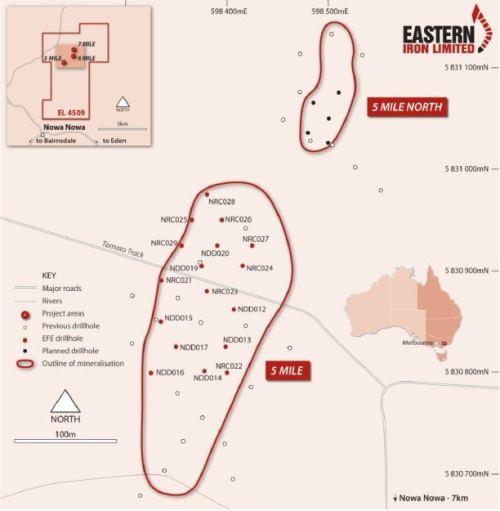
THE DRILL SERGEANT: Eastern Iron (ASX: EFE) has announced an upgrade in the resource estimate for the Five Mile Iron deposit at the company’s wholly-owned Nowa Nowa iron project, located near Bairnsdale in East Gippsland, Victoria.

The upgrade is the result of recent drilling, which has provided Eastern Iron with further definition of the resource.


Five Mile prospect – drillhole locations. Source: Company announcement


This has resulted in partial conversion of existing Indicated and Inferred resources to a Measured category.

Eastern Iron said recent resource drilling it has carried out at Five Mile has upgraded its confidence level of the existing resource at Five Mile with the addition of 2.1 million tonnes of Measured Resource.

The total Resource for Five Mile has been estimated at 9.6 million tonnes at 50 per cent iron at a lower cut-off grade of 40 per cent total iron.

“This is a pleasing result and increased confidence in the resource model will assist in mine planning and production scheduling studies that form part of the ongoing feasibility study into the development of the Five Mile deposit,” Eastern Iron managing director Greg De Ross said in the company’s announcement to the Australian Securities Exchange.

Eastern Iron is now carrying out a feasibility study into the potential mining of magnetite-rich iron ore at the Five Mile deposit.

The company has proposed iron ore would be mined at Five Mile then processed into saleable product at site and trucked to an export port at Two Fold Bay south of Eden in southern New South Wales.

Cassini Resources gets heritage approvals to drill West Musgrave project

THE DRILL SERGEANT: Cassini Resources (ASX: CZI) has received all of the required heritage approvals from the Nygaanyatjarra Land Council for a planned maiden Reverse Circulation (RC) drilling program.

The drilling is to be conducted at the Pandora nickel‐copper sulphide target at the company’s 100 per cent-owned West Musgrave project in Western Australia.

The first phase of the program is anticipated to consist of 1,800 metres of RC drilling, which will is anticipated to be carried out within a time frame of approximately two weeks.

VTEM survey image. Source: Company announcement

“It is pleasing to be in a position to provide some good news against a backdrop of generally dour market sentiment,” Cassini Resources chairman Mike Young said in the company’s announcement to the Australian Securities Exchange.

“A focus on exploration at this time positions the company to take advantage of stronger commodity prices and market conditions in the future.

“Notwithstanding the general market environment, we continue to receive considerable interest in the company and the West Musgrave project.”

Cassini has lodged a Program of Work summary with the Western Australia Department of Mines and Petroleum, which it indicated was the only remaining milestone to be satisfied prior to the commencement of drilling.

The company expects the approval process to be completed before the end of July 2013, which will allow for drilling to commence by mid‐August 2013.

PMI intersects high-grade gold at Dynamite Hill prospect

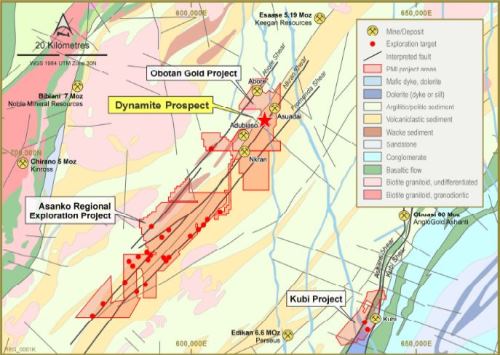
THE DRILL SERGEANT: PMI Gold Corporation (ASX: PVM) has received results from a first pass Reverse Circulation (RC) exploration drilling program at the newly discovered Dynamite Hill prospect.

The drilling has intersected shallow gold mineralisation within the limits of the company’s 100 per cent-owned Obotan gold project in the southwest of Ghana.

PMI has drilled a total of 2,796 metres from 28 holes and has received assay results for 26 of these.

Results of greater than 0.5 grams per tonne gold include:

–    10 metres at 13.65g/t gold from 50 metres, including 1 metre at 102.72g/t gold from 55 metres;

–    23m at 4.89g/t gold from 42m, including 2m at 18.91g/t gold from 55m and 3m at 8.96g/t gold from 60m;

–    16m at 2.14g/t gold from 36m, including 1m at 16.91g/t gold from 37m; and

–    11m at 9.19g/t gold from 132m, including 4m at18.22g/t gold from 133m.

True widths are estimated between 60 to 70 per cent of the stated drill intercept.

The Dynamite Hill prospect is located between the Nkran and Asuadai deposits, 7km northeast of the proposed processing facility at Nkran, within the Adubea Mining Lease.


Location of the Dynamite Hill prospect within PMI’s tenements. Source: Company announcement


Together with the Adubiaso and Abore deposits, the four deposits which comprise the Obotan Gold Project have a JORC-compliant Mineral Resource estimate of: Measured Resources of 15.57 million tonnes at a grade of 2.47g/t gold for 1.23 million ounces, Indicated Resources of 29.2 million tonnes at a grade of 2g/t gold for 1.88 million ounces and Inferred Resources of 21.91 million tonnes at a grade of 1.99g/t gold for 1.4 million ounces.

“We are genuinely excited with the results from the first phase of drilling at our newly discovered Dynamite Hill prospect,” PMI Gold managing director and CEO Collin Ellison said in the company’s announcement to the Australian Securities Exchange.

“Dynamite Hill provides the potential for an oxide resource which is within PMI’s existing mining lease and within easy trucking distance of the future Obotan processing plant.

“In addition, it offers the opportunity to provide an alternative ore feed to the Obotan project, which may assist in deferring some or all of the capitalised pre-stripping required in the early stage of the project’s development.”

Buxton Resources kicks off Widowmaker drilling

THE DRILL SERGEANT: Buxton Resources (ASX: BUX) has commenced an RC drilling program at the company’s Widowmaker nickel-copper project in Western Australia.

“Our team now has safe access to the Widowmaker nickel-copper project, and drilling has commenced,” Buxton Resources managing director Anthony Maslin said in the company’s announcement to the Australian Securities Exchange.

“We have some excellent nickel-copper targets at Widowmaker, which provide our company with great opportunities to potentially discover a new nickel sulphide deposit.”

Buxton has contracted a 3,000 metre initial RC program to test eight moderate to highly conductive targets that it considers could represent bedrock massive or disseminated sulphide bodies.


Ground EM conductors over magnetic image – Widowmaker nickel-copper project. Source: Company announcement


The Widowmaker nickel-copper project is located approximately 22 kilometres along strike from Sirius Resources’ (ASX: SIR) Nova-Bollinger nickel-copper discovery in the emerging Fraser Range Nickel Province.

The project covers an area of 225 square kilometres, and over 20km of potential strike of the gneiss units that host ‘the Eye’ mafic – ultramafic intrusive that contains Sirius’ Nova- Bollinger deposit.

Dart Mining deep drilling scores high-grade molybdenum hits

THE DRILL SERGEANT: Dart Mining (DTM: ASX) has reported on a deep drilling program it currently has underway at the company’s Unicorn molybdenum-copper-silver deposit in Victoria.

Dart said the deep drilling program was designed to test the continuity of Unicorn’s mineralisation beyond the boundaries of the current JORC Resource.

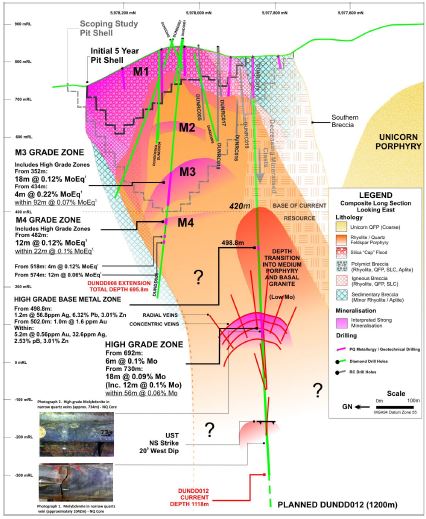
The deep drilling has intersected several zones of high-grade molybdenum mineralisation including discrete zones of base metals and, for the first time at Unicorn, indications of gold.

Dart explained its preliminary interpretation of the results had confirmed Unicorn to be similar to the Climax model of multiple high grade stacked mineral horizons.

Assay highlights include:

–    5.2 metres at 0.56 grams per tonne gold, 32.6 grams per tonne silver, 2.53 per cent lead and 3.01 per cent zinc, including up to 1m at 6.32 per cent lead and 6.47 per cent zinc from 498.9m, including 1m at 1.6g/t gold from 502m;

–    1.2m at 671g/t silver and 0.53 per cent tungsten from 620.8m; and

–    2m at 267g/t silver and 0.08 per cent tungsten from 654m.

“Whilst this single deep drill hole within the Unicorn system has not, as yet, seen another high-grade pulse below 750 metres, the intersection of porphyry to a current depth of 1100 metres indicates the system is very large at depth and still shows molybdenum mineralisation within low density quartz veining,” Dart Mining managing director Lindsay Ward said in the company’s announcement to the Australian Securities Exchange.

“The intersection of previously unknown high grade base metals sulphide veining, including anomalous gold, within the system is further evidence of a multi-phased intrusive centre with the potential for a future underground mine at Unicorn.

“The UST’s intersected at 990 metres indicate a new porphyry pulse with potentially additional high grade Mo pulses to the east of the current drill hole, which may suggest DUNDD012 is located to the west of the next series of stacked high grade molybdenum horizons.

“This is not unexpected given we have only drilled a single hole within what is a very large mineralised porphyry system – it is not unusual for porphyry’s of this nature to have had 60 kilometres of drilling completed to prove up an underground resource.

“The deep drilling at Unicorn is still in the very early stages for Dart Mining, with DUNDD012 being the solitary hole below 700 metres.”


Composite long section looking east showing geological
interpretation, DUNDD008, completed metallurgical/geotechnical drilling
and the second assay results of the second deep drill hole (DUNDD012
–underway). Source: Company announcement


The data also revealed indications of multiple intrusive pulses at Unicorn, which the company has interpreted to confirm the possibility of a large target resource base at depth.

Previous drilling carried out by Dart at Unicorn below 700 metres, had confirmed the continuation of high-grade molybdenum horizons at depth.

Drilling was delayed for approximately five weeks due to a drill rig mechanical breakdown.

The drilling has now recommenced and progressed to a depth of approximately 1100m, with a target depth of 1200m.

The earlier drill sample results between 690m and 750m confirmed the presence of a new high-grade molybdenum horizon from 730m.

This zone sits below what the company has interpreted to be a single porphyritic pulse that shows minor visible molybdenum.

Dart has now systematically sampled this low-grade pulse and has highlighted high-grade base metal veins at a depth of approximately 500m showing significant lead, zinc and silver, and the company’s first intersection of anomalous gold mineralisation.

Mamba Minerals extends CLC deposit with third hematite hit

THE DRILL SERGEANT: Mamba Minerals (ASX: MAB) drilled a wider than expected intersection from the CLC hematite iron ore discovery at the company’s Snelgrove Lake project in Canada’s Labrador Trough.

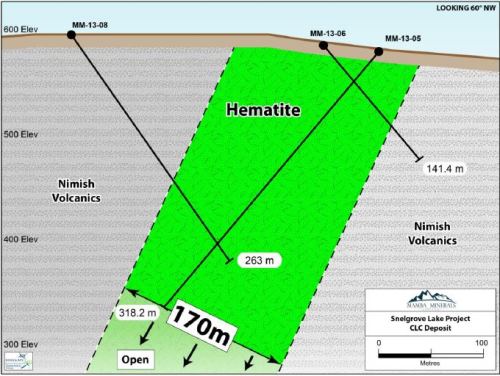
A third diamond drill hole at CLC has returned a 90 metre hematite intersection.

The hole remained in hematite when drilling was stopped due to difficult conditions at a down-hole depth of 260m.
 
Mamba now estimates CLC to have increased 36 per cent from 125m to an estimated a true width of 170m.

Hematite has been intersected from just 15m below the surface to a vertical depth of 235m, where it remains open.

The company said it had estimated the strike length of the deposit to be approx. 2km based on gravity and magnetic data.


The third diamond drill hole at CLC (MM-13-08) has returned a 90m hematite intersection. Source: Company announcement


“This latest result provides more strong evidence that CLC is a substantial hematite deposit,” Mamba Minerals chairman Greg Burns said in the company’s announcement to the Australian Securities Exchange.

“And given that the mineralisation remains open at depth and along strike, there is clearly potential to expand on known boundaries.”

Mamba intends testing the dimensions of the CLC deposit as part of the company’s summer drilling program, which will see the first of some 15 holes drilled in July.

This drilling program will be supported by results of a ground gravity survey to be conducted over CLC, as well as the Blaire and Bryman targets and an infill airborne gravity and magnetic survey over most of the Direct Shipping Ore targets of the project.

Airborne gravity and magnetic surveys have previously been conducted at 200m spacing.

These two new programs will infill to 100m spacing, which Mamba expects will provide clearer outlines of the target boundaries and drilling priorities.

Assays have also confirmed the deposit contains very low aluminum (0.5 per cent) and low levels of phosphorus (0.053 per cent), which Mamba considers would potentially increase the price paid for the final product because it could be blended with high-aluminum iron ore fines from the Pilbara.

Metallurgical test work is being undertaken to confirm the ability to upgrade Snelgrove hematite ore using conventional mechanical processes.