


Stonehenge Metals records best Daejon drill result so far
THE DRILL SERGEANT: Stonehenge Metals (ASX: SHE) has announced chemical assay results from hole 5 of a 12 hole diamond drilling program currently underway at the company’s Daejon uranium and vanadium project in South Korea.
Stonehenge claims the results confirm a new mineralised zone of vanadium, as well as confirming previously reported uranium.
Highlights from the latest results include:
– Intercepts of 52 metres true width respectively of mineralised zone of uranium and vanadium using 200 parts per million and 2,000ppm cut-off grade;
– Chemical assay results continue to be consistent and comparable to stand-alone uranium and vanadium projects;
– The Daejon mineralised system now is defined over six kilometres with consistent high-grade mineralisation throughout the Black Shales; and
– High-grade mineralised zones may allow for selective mining subject to the continuity and distribution of these zones. This will be determined by further drilling.
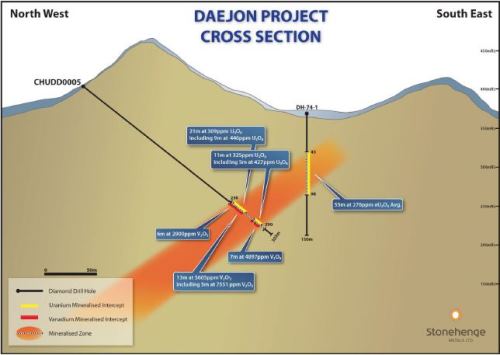
Daejon project cross section CHUDD0005. Source: Company announcement
The results from the latest hole are similar to previous reports from Stonehenge in that the mineralisation remains open down dip and along strike.
The company anticipates additional drilling will increase the known dimensions of this zone.
“This hole has probably given us the best results to date with two distinct high-grade zones that contain both uranium and vanadium,” Stonehenge Metals managing director Richard Henning said in the company’s announcement to the Australian Securities Exchange.
“This will be of enormous benefit when it comes to modelling the operation and should have a strong impact on the economics of the project.
“I am really pleased that this short drilling campaign has shown vanadium grades comparable to stand alone vanadium operations, and as we work towards our maiden vanadium resource alongside uranium grades of plus-400 parts per million, as we have seen in this hole, together with proven co-extraction of both commodities – the future could be very rewarding.”