Arunta Resources kicks off Hatches Creek tungsten exploration

THE DRILL SERGEANT: Arunta Resources (ASX: AJR) has signalled the commencement of a program of field-based exploration activities at the company’s 100 per cent-owned Hatches Creek tungsten project.

Hatches Creek is located 360 kilometres north-east of Alice Springs in the Davenport Mineral Province of the Northern Territory and encompasses the historical Hatches Creek tungsten field, which formed part of the Northern Territory mineral portfolio Arunta acquired last year.


Hatches Creek location map. Source: Company announcement


The company has reassessed and upgraded its confidence in the potential of Hatches Creek due to recent upswings in the tungsten market – with concentrates currently in strong demand and attracting historically high prices.

Arunta has indicated it intends to fast-track exploration activities at Hatches Creek with a view to establishing a JORC 2012 compliant resource in the near-term while investigating opportunities to bring the project into production next year.

The company has reviewed an extensive bank of historical data for the project and has an eye on opportunities emerging in the tungsten sector.

“Because it has been mined extensively last century, there is a vast amount of information available which will enable Arunta to fast-track the project towards a JORC resource and possible development,” Arunta Resources chairman Neil Biddle said in the company’s announcement to the Australian Securities Exchange.

“With extensive high-grade mineralisation located close to surface, a project such as this could be brought back into production quickly and with very low capital outlay.

“That makes it an attractive asset for Arunta, which we intend to progress as quickly as possible alongside the Southern Cross Bore (SXB) project – where we have recently completed an extensive airborne EM survey for which final results are awaited.

“With the current equity market environment presenting significant challenges for junior explorers, we believe it is important to progress projects with greater potential for near-term production and cash flow – without diminishing our appetite and enthusiasm for exciting exploration opportunities such as we have at the SXB project.”

Email:
info@aruntaresources.com.au

Website:
www.aruntaresources.com.au

Azure Minerals drilling Cascada porphyry targets

THE DRILL SERGEANT: Azure Minerals (ASX: AZS) is drilling again at the Cascada copper prospect, located within the company’s main Promontorio project in the state of Chihuahua, Mexico.

Azure said the first holes of the program will target extensions to the Cascada zone of high-grade copper-gold-silver mineralisation.

Previous drilling by Azure has identified a central mineralised zone with true widths up to 40m averaging +5% Copper Equivalent and peak grades of +40% Copper, surrounded by a lower grade copper-mineralised envelope.


Copper mineralised drill intercepts at Cascada deposit. Source: Company announcement


A recently completed Induced Polarisation (IP) geophysical survey identified two strong IP anomalies.

“Following on from the recent successful capital raising, we have recommenced drilling at Cascada where our most recent program returned exceptional copper, gold and silver intercepts,” Azure Minerals managing director Tony Rovira said in the company’s announcement to the Australian Securities Exchange.

“The areas around and beneath Cascada and the neighbouring Promontorio deposit are the centre of our exploration focus.

“We believe there is strong potential for a high-grade copper deposit at Cascada, and in addition the recent identification of porphyry copper targets by an IP survey gives us the possibility of large copper bodies at depth.”

A near-surface anomaly is situated adjacent to and beneath the Cascada mineralisation and a large, deeper anomaly lies beneath both Cascada and the Promontorio deposit.

Azure explained the Induced Polarisation (IP) geophysical survey had identified a shallow IP anomaly adjacent to Cascada extends from surface to join with the deeper anomaly at about 300m below surface.

The deeper IP anomaly is believed to represent a porphyry body which to date is completely untested by drilling.

The survey’s resistivity responses indicate the presence of several highly-resistive zones which are likely to represent areas of intense silicification.

Azure has designed the upcoming drilling to test around and beneath the known mineralisation at Cascada with the aim of expanding the mineralised zone and enable a Mineral Resource to be estimated for this deposit

It also hopes to interpret a feeder zone connecting Cascada and the buried porphyry body.

Email:
admin@azureminerals.com.au

Website:
www.azureminerals.com.au

Rox Resources hits Cannonball with new drilling program

THE DRILL SERGEANT: Rox Resources (ASX: RXL) has commenced a program of Reverse Circulation (RC) drilling at the company’s Fisher East nickel sulphide project, located north of Kalgoorlie in Western Australia.

The 15 hole program has been is designed to test targets the company generated by during a program of aircore drilling, the results of which it announced to the market in November.

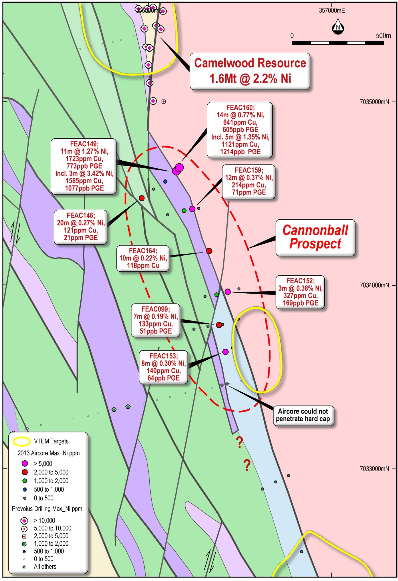
These targets included the new Cannonball prospect where the recently-conducted aircore drillining encountered an intercept of 3 metres at 3.42 per cent nickel.


Cannonball prospect trend, aircore drilling highlights over interpreted geology. Source: Company announcement


“We’re excited to be able to be in a position to test these new nickel sulphide targets with RC drilling so soon after they were identified,” Rox Resources managing director Ian Mulholland said in the company’s announcement to the Australian securities Exchange.
 
“The Cannonball prospect, where we recently intersected massive nickel sulphides, is a particularly exciting target.

“In addition to Cannonball we’ll also be evaluating prospects at Emu Bush and Twinleaf, where elevated levels of nickel, copper, platinum, palladium and gold were found.”

Rox considers the high levels of copper, platinum, palladium and gold to be indicative of a magmatic sulphide source for the nickel, as opposed to a lateritic source.

The company explained the target mineralisation style is similar to what it has discovered nearby at Camelwood, which is of the Archaean Greenstone Komatiite-hosted (Kambalda) type.

Email:
admin@roxresources.com.au

Website:
www.roxresources.com.au

Predictive Discovery intersects thick gold grades at Bongou

THE DRILL SERGEANT: Predictive Discovery (ASX: PDI) has received assay results from recently-completed drilling at the company’s Bongou gold prospect in Eastern Burkina Faso, West Africa.

“We are very pleased with these excellent new drill results as they confirm the strength and consistency of the Bongou mineralised system,” Predictive Discovery managing director Paul Roberts said in the company’s announcement to the Australian Securities Exchange.


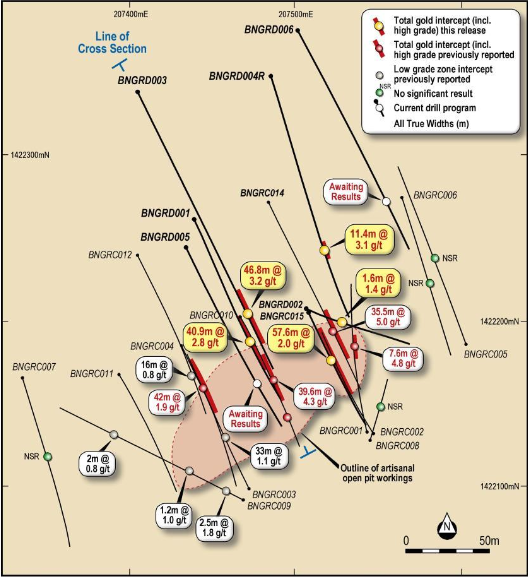
Drill hole locality plan, Bongou prospect. Gold intercepts are
all shown as estimated true widths. “Total” intercepts were calculated
across the width of gold mineralised altered granite, irrespective of
the width of internal waste zones at a cut-off grade of 0.5g/t gold.
Source: Company announcement


Predictive said it had carried out the drilling in order to identify extensions to the Bongou mineralisation and to obtain infill intercepts to improve its understanding of the mineralisation’s continuity and grade variability.

The company indicated all holes intersected intensely silicified and pyrite-bearing altered granite.

Assaying of the first five holes returned the following drill intercepts:

BNGRC015:
64 metres (57.6m true width) at 2 grams per tonne gold from 14 metres, including 5m (4.5m true width) at 7.3g/t gold from 14m;

BNGRD001:
48.7m (40.9m true width) at 2.8g/t gold from 144.3m, including 5.9m (5m true width) at 7.8g/t gold from 144.3m, 7.9m (6.6m true width) at 4.5g/t gold from 169.1m;

BNGRD002:
3.3m (approximately 1.6m true width) at 1.44g/t gold from 40m;

BNGRD003:
55m (46.8m true width) at 3.2 g/t gold from 215m, including 24.5m at 4.9 g/t gold; and

BNGRD004R:
15m (11.4m true width) at 3.1g/t gold from 166m, including 4.8m at 5.3 g/t gold.

“All of these drill holes intersected intensely altered, gold mineralised granite, mostly over large widths,” Roberts said.

“Assays received so far have given very good overall grades and confirmed a consistent, substantial high-grade component in the hanging wall position.

“We are also seeing some evidence that the strike of the gold mineralised zone could increase at depth, thereby expanding the prospect’s tonnage potential.

“These drill results have taken us a big step closer to making a large, transformative and high-grade gold discovery in Burkina Faso.

“We have already discovered two gold geochemical anomalies, suggestive of more granite-hosted gold mineralisation, within a few hundred metres of the Bongou drilling and we have multiple untested targets within a few kilometres along strike from the prospect.

“We will now focus our next efforts on discovering more Bongou-style gold mineralisation, both in extensions to the known gold deposit and in the immediate surrounding area.”

Website:
www.predictivedisovery.com

Artemis Resources achieves maiden Resource at Eastern Hills

THE DRILL SERGEANT: Artemis Resources (ASX: ARV) has released a maiden JORC-compliant Mineral Resource for the company’s Eastern Hills antimony-lead project located in the Ashburton region of Western Australia.

The calculation of the Resource follows the identification of the project by Artemis early this year and the completion of a reverse circulation drilling program in October.

Artemis said the combined Indicated and Inferred resource had exceeded its size expectations by comprising 1.3 million tonnes at 1.7 per cent antinomy and 2.5 per cent lead.


Eastern Hills Mineral Resource estimate based on a 1.0% antinomy cut-off grade. Source: Company announcement


The company emphasised the higher confidence Indicated resource category returned higher grades than expected in antimony (2%), lead (3.1%) and gold (0.41 grams per tonne) compared to the Exploration Target it had estimated earlier this year.

This resource estimate only includes mineralisation from the Taipan Zone, with drill testing of the recently identified high-grade Dugite Zone (up to 35.7% antimony, 29% lead, 1335g/t silver and 3.36g/t gold), scheduled for the 2014 field season.


Eastern Hills Mineral Resource, antimony zones and drillhole locations. Source: Company announcement


“The Artemis team is to be commended on the progress of the emerging Eastern Hills antimony-lead project during 2013, culminating in a maiden JORC-compliant resource,” Artemis Resources general manager-exploration Trevor Woolfe said in the company’s announcement to the Australian Securities Exchange.

“We now look forward to building on this strong foundation in 2014, with a focus on drill testing the very high rock chip grades recently reported on the adjacent Dugite Zone.”

Email:
info@artemisresources.com.au

Website:
www.artemisresources.com.au

Pioneer Resources releases Blair nickel mine maiden Resource

THE DRILL SERGEANT: Pioneer Resources (ASX: PIO) has announced a maiden Mineral Resource estimate at the Blair Nickel Mine, situated within the company’s 100 per cent-owned Golden Ridge project in the Eastern Goldfields of Western Australia.

The Mineral Resource estimate stands at:
 

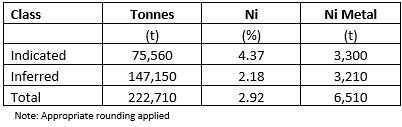
222,710 tonnes of nickel sulphide ore at 2.92 per cent nickel.


Blair nickel mine Minerals Resource summary by Category. Source: Company announcement


Pioneer said it has exploration programs planned for the Resource area, which will be designed to search for extensions to the current mineralisation close to the underground infrastructure.

The company has identified three priority areas it considers to warrant further exploration, and each has drilling records which show the presence of nickel sulphide mineralisation.

Pioneer believes surface drilling, modern down-hole EM and ground EM surveys may identify further potentially economic mineralisation.

“We are pleased to provide details of the company’s initial Mineral Resource for the Blair nickel mine, which provides an excellent basis from which to grow,” Pioneer Resources managing director David Crook said in the company’s announcement to the Australian Securities Exchange.

“The company is aware that a number of commodity forecasters are predicting an improvement to the nickel price within the next few years, and Pioneer is looking to develop a robust production scenario, and therefore be ideally leveraged for a return to higher nickel prices.”

Email:
pioneer@pioresources.com.au

Website:
www.pioneerresources.com.au

Kidman Resources continues copper run at Home of Bullion

THE DRILL SERGEANT: Kidman Resources (ASX: KDR) has claimed to have confirmed the down dip continuity of copper mineralisation on the Main Lode at the company’s Home of Bullion (HOB) project in the Northern Territory.

Kidman achieved the result while conducting a round of deeper diamond drilling at the project.

Results include:

9.1 metres at 2.16 per cent copper, 0.91 per cent lead, 1.84 per cent zinc, 42.6 grams per tonne silver, 0.53g/t gold from 492 metres, including 4.1m at 4.33 per cent copper, 1.27 per cent lead, 1.84 per cent zinc, 42.6g/t silver, 0.72g/t gold from 497m (6.52 per cent copper equivalent); and

4.5m at 1.89 per cent copper, 0.17 per cent lead, 0.43 per cent zinc, 8.86g/t silver, from 606m.

Kidman said it was still waiting to receive further results for another three 3 drillholes.


Main Lode long-section showing recent drill intercepts.
Shaded area showing high-grade copper shell greater than 2% copper,
which remains open in all directions. Source: Company announcement


“The Home of Bullion deep diamond drilling program has confirmed that mineralisation now extends to a depth of approximately 600 metres on the Main lode and 500 metres on the Southern Lode, with both remaining open,” Kidman Resources managing director Shane Mele said in the company’s announcement to the Australian Securities Exchange.

“The 2013 drilling program has again improved continuity of both lodes and contributes significantly to our aim of defining a high grade resource at Home of Bullion.

“Drilling has identified strong down-hole electromagnetic (DHEM) conductors indicating the potential to add further tonnage in future phases of drilling.

“DHEM conductors at nearby Prospect D remain untested where previous drilling defined high-grade copper-nickel zones.

“We are in a strong cash position for the commencement of the 2014 field season and are well positioned to advance the Home of Bullion project.”

Email:
info@kidmanresources.com.au

Website:
www.kidmanresources.com.au


Chariot fires up for Emmerson Resources

THE DRILL SERGEANT: Emmerson Resources (ASX: ERM) has announced a new Mineral Resource Estimation for the company’s Tennant Creek project in the Northern Territory.

Emmerson has calculated a new JORC gold Resource for its Chariot gold mine of 17.4 grams per tonne gold for 99,000 ounces of gold.

This takes the global mineral resources to 6.79 million tonnes at 3.6 grams per tonne gold equivalent for 900,000 gold equivalent ounces, which the company considers provides it with an early source of high-grade ore for processing at its 100 per cent-owned Warrego CIP mill.

Emmerson outlined its plans for the Chariot mine, which consist of an enlarged open pit, which is anticipated to extract over 40,000 ounces of gold at a grade of 17.7g/t.

The plan then involves the possible reconnecting to the existing underground development to extract a further 58,000 ounces at a grade of 17.2g/t gold.

The company is confident potential remains to expand both open pit and underground resources, as both remain open in most directions.

Emmerson has its next drill program planned for early 2014 – immediately after the wet season – which will focus on the Chariot East and West Targets where it plans to drill approximately 1,200m of RC drilling to test for shallow high-grade supergene gold.

Emmerson believes this program has the potential to again rapidly expand the resources and add to the high-grade ounces within an even larger open pit.


Chariot 3D view showing 2013 Optimized pit outline, open pit
resource (orange), underground (dark blue) and additional Chariot
targets (East, West & Gap). Source: Company announcement


“This latest resource upgrade caps a very successful year where our strategy of undertaking near mine and brownfields exploration has provided an ever expanding global JORC resource ahead of eventual production,” Emmerson Resources managing director Rob Bills said in the company’s announcement to the Australian Securities Exchange.

“We have a pipeline of exciting near mine and brownfields projects ready for drill testing in early 2014 and anticipate rapidly adding to these global resources.

“In addition we have made two new discoveries within our Tennant Creek project (Goanna and Monitor) utilising new technology and concepts – the first new discoveries in Tennant Creek for over a decade!

“Having regained 100 per cent ownership of the entire project, Emmerson plan to capitalise on our proprietary exploration techniques to make further discoveries within the more regional greenfields environment.

“I have just returned from a trip as part of the Northern Territory Trade delegation to Japan, South Korea and China and can report very strong interest in our project.

“Already we have a number of confidentiality agreements in place and data reviews underway, but more on this later.”

Email:
admin@emmersonresources.com.au

Website:
www.emmersonresources.com.au

Troy Resources drills further good news at Smarts

THE DRILL SERGEANT: Troy Resources (ASX: TRY) has received results from an ongoing drilling program being conducted at the Smarts deposit within the company’s West Omai project in Guyana.

Recent infill Reverse Circulation drilling has been targeting the 1.7 kilometre Indicated Resource at the Main Zone within the 2.7km Smarts Inferred Resource, which Troy claims has continued to yield encouraging high-grade assay results.

Highlights include:

11 metres at 25.08 grams per tonne gold from 51 metres, including 8 metres at 34.05g/t gold from 51m;

4m at 43.35g/t gold from 93m;

3m at 24.84g/t gold from 48m;

3m at 21.93g/t gold from 86m;

4m at 17.66g/t gold from 67m;

12m at 5.48g/t gold from 46m;

5m at 15.94g/t gold from 47m; and

3m at 11.51g/t gold from 73m.

Troy currently has two Diamond Core rigs and one Reverse Circulation rig in operation focussed on infill Resource drilling at Smarts as well as drilling required for geotechnical and metallurgical studies.

Troy has completed 4372m (48 holes) out of a planned 5765m (61 holes) infill Resource drilling program at Smarts.


Smarts deposit – Infill Drilling significant results November 2013. Source: Company announcement


The company said the drilling has provided further confirmation as to the continuity of gold mineralisation within the existing Resource model.

“These drill results are from the Stage 3 Infill Program at the West Omai project in Guyana,” Troy Resources chief executive officer Paul Benson said in the company’s announcement to the Australian Securities Exchange.

“The aim of this program is simply to increase drill density in the Smarts deposit.

“As such, it is not intended to increase the number of ounces in the Resource, but improve our understanding of the mineralisation and increase the confidence levels of the Resource estimation.

“Having said that, it is obviously very exciting to see such high grades in the results so far.”

The company’s geologists, in conjunction with specialist consultants, have commenced a detailed study in order to improve understanding of the structural controls within the Smarts deposit.

Drilling is ongoing and a significant number of assay results are pending.

“Because the drill rigs are also undertaking project sterilisation and metallurgical test work, we don’t expect to complete the program, and a corresponding update to the Resource model, until the first quarter of 2014,” Benson said.

Email:
troy@troyres.com.au

Website:
www.troyres.com.au

Black Range Ablation technology exceeds expectations

THE DRILL SERGEANT: Black Range Minerals (ASX: BLR) is pleased with the progress it is making with the commercialisation of the proprietary Ablation technology.

Black Range holds a 50 per cent interest in the application of Ablation at mineral deposits, globally, through a 50:50 joint venture with Ablation Technologies LLC (Ablation JV).

The JV anticipates Ablation will have a positive effect on the economics of developing not only Black Range’s 100 per cent-owned 90.9 million pound mineral resource Hansen/Taylor Ranch uranium project in the USA, but also many other sandstone-hosted uranium deposits around the world.

The Ablation JV completed initial tests with ore from the October stockpile in western Colorado in a semi-commercial scale Ablation Unit it has been constructing in Casper, Wyoming, which has nominal capacity of 5 tonnes per hour.


The 5tph Unit during tests in Casper, Wyoming, USA. Source: Company announcement


Black Range said all preliminary analytical test results have indicated greater than 90 per cent (and up to 94.5 per cent) of the uranium in the ore has been separated into the finest size fractions following Ablation.

The company indicated the test suggest recoveries can be further improved, potentially to 97 to 98 per cent, with secondary separation.

“This bodes extremely well for commercial scale Ablation operations,” Black Range Minerals said in its ASX announcement.

“Furthermore, this achievement is even more encouraging because the residence time to achieve these results is considerably less than anticipated.

“Indeed, the Ablation process is taking place so effectively in the 5tph Unit that only one of the three available Ablation modules has been needed to achieve greater than 90 per cent recoveries (the other two Ablation modules are being bypassed).

“This indicates that, as expected, the higher energy of the 5tph Unit (compared to that available in the pilot plant) is dramatically improving the efficiencies of the Ablation process.

“As such it is probable that throughputs in excess of the nominal target of 5 tonnes per hour can be achieved with the ‘5tph Unit’.

“Furthermore it provides the Ablation JV further confidence that it should be possible to commercialise Ablation in the near-term.”

Black Range said the Ablation JV intends continuing to refine the design and operation of the 5tph Unit and undertaking further tests on October ore.

It will also undertake detailed analysis of recoveries and probable metallurgical properties.

Email:
info@blackrangeminerals.com

Website:
www.blackrangeminerals.com