IMX Resources claims new nickel zone discovery

THE DRILL SERGEANT: IMX Resources (ASX: IXR) has received the latest drilling results from the company’s Ntaka Hill nickel sulphide project in south-eastern Tanzania.

IMX claims the results have confirmed the discovery of a new zone of nickel sulphide mineralisation immediately adjacent to the current resources.

The new zone, referred to as “P Zone”, lies approximately 400 metres east of the existing Zeppelin and Sleeping Giant deposits, which host the current resources at Ntaka Hill, and 700m south of ‘G’ and ‘J’ Zones.


Ntaka Hill – location of P Zone relative to current resources. Source: Company announcement


Results include:

11.4 metres at 0.51 per cent nickel and 0.15 per cent copper from 211 metres down-hole (NAD13-369);

2m at 1.1 per cent nickel from 266m and 3.4m at 1.2 per cent nickel from 272.4m down-hole (NAD13-375);

3m at 0.4 per cent nickel from 186m down-hole (NAD13-376); and

17m at 0.4 per cent nickel from 223m and 9.3m at 0.4 per cent nickel from 272.7m down-hole (NAD13-377).

Recent drilling at Ntaka Hill has been designed to test potential extensions to the
J, G, M, and P Zones to establish the broader scale and potential of the project to host a nickel sulphide system.

IMX said modelling of P Zone indicates it is potentially an up-dip extension of the mineralisation at Zeppelin and Sleeping Giant to the west and south-west.

Based on this interpretation, the joint venture believes there is potential to increase the size of the Sleeping Giant and Zeppelin resources with further drilling.

“We are particularly encouraged by the discovery of a significant new area of mineralisation at P Zone which appears to be the up-dip extension of the main deposits,” IMX Resources acting managing director John Nitschke said in the company’s announcement to the Australian Securities Exchange.

“This confirms that Ntaka Hill hosts multiple zones of mineralisation that appear to be linked and clearly have the potential to form part of a very sizeable, single deposit.

“Our work suggests that this system is approximately 1.5 kilomteres wide and remains open to the south and east.

“More drilling will be required to define the broader extent of this very large system and also to help us to vector in on higher grade zones of mineralisation within it.

“Extensive programs of ‘deep-looking’ geophysical surveys are also underway to test the broader potential of the Ntaka Hill-Lionja corridor.

“Results from this work should be available early in the New Year, providing drill targets for the 2014 drilling season.”

Exploration at Ntaka Hill is being managed and sole funded by IMX’s joint venture partner, MMG Exploration Holdings, under a US$60 million earn-in joint venture.

Email:
info@imxresources.com.au

Website:
www.imxresources.com.au
Kogi Iron increases Agbaja iron Resource

THE DRILL SERGEANT: Kogi Iron (ASX: KFE) has increased the estimated Mineral Resources for the company’s 100 per cent-owned Agbaja iron ore project located in Kogi State, Republic of Nigeria, West Africa.

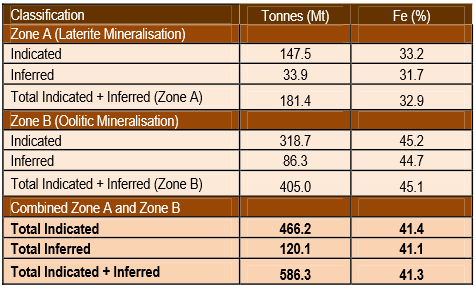
Kogi has increased the global Mineral Resource for the Agbaja project 20 per cent from the previous estimate of 488 million tonnes to 586 million tonnes with an in-situ iron grade of 41.3 per cent.

The Updated Mineral Resource includes for the first time, Indicated Mineral Resources of 466 million tonnes at 41.4 per cent iron, with the balance of the Mineral Resources classified as Inferred (120 million tonnes at 41.1 per cent iron).


Summary grade tonnage for Laterite (Zone A) and Oolitic (Zone B)
Horizons (20% iron lower cutoff is applied). Source: Company
announcement


“The Updated Mineral Resource is an important milestone in Kogi’s vision to be an African iron ore producer,” Kogi Iron managing director Iggy Tan said in the company’s announcement to the Australian Securities Exchange.

“Of significance is the classification of 466 million tonnes of resources as Indicated.

“Not only does this demonstrate an increased level of geological confidence in the Agbaja deposit, but it provides a solid platform upon which the company can continue to advance the current Scoping Study that is assessing the technical and economic viability of potentially producing 5 million tonnes per annum of iron ore concentrate at Agbaja.”

According to Kogi Iron a 466 million tonne Indicated Mineral Resource has the potential to provide sufficient material for more than 35 years of production at the 5 million tonnes per annum rate.
 
The company has drilled only 20 per cent of the area it considers to be prospective for channel iron mineralisation within EL12124 on the Agbaja Plateau.

“The potential scale of the iron mineralisation on the plateau should not be underestimated,” Tan said.

“The Indicated Mineral Resource, as it currently stands, clearly has potential to support an operation producing in excess of the 5 million tonnes per annum scenario being contemplated in the Scoping Study.

“The average iron grade of 41.4 per cent ranks Agbaja as one of the highest grade, beneficiable iron ore deposits in West Africa which we believe sets it apart from other projects.”

Email:
info@kogiiron.com

Website:
www.kogiiron.com

Northern Star drilling confirms Titan potential

THE DRILL SERGEANT: Northern Star Resources (ASX: NST) has achieved some impressive drilling results from the recent Titan gold discovery at the company’s Paulsens project in Western Australia.

Northern Star said the results have highlighted Titan’s potential to be a high-grade deposit.

Drilling results from Titan include (uncut):

0.2 metres at 687 grams per tonne gold from 488 metres;

0.4m at 103g/t gold from 436m;

3m at 12.6g/t gold from 380m;

2.4m at 8g/t gold from 396m; and

1m at 7.7g/t gold from 370m.

Northern Star is particularly keen on the Titan results due to its location – just 100m from Paulsens, which means it could be accessed from the existing underground mine.

The company has commissioned a third drilling rig at Titan with a view to further defining the extremities of the quartz rock.

The drilling will then seek to locate the mineralisation within the quartz.

Other drilling at Paulsens has extended the known mineralisation at the Voyager 1 lode by 150m down-plunge from the current resource.


Long section view (looking North) of significant drill results for Voyager 1. Source: Company announcement


According to Northern Star the high-grade mineralisation remains open at depth and will be included in future resource upgrades, potentially extending Paulsens’ mine life.

Results achieved from the Voyager 2 lode include grades up to 132g/t gold, which Northern Star claims continue to show the potential of this lode, which the company announced in May extends down-plunge by 200m.

This high-grade mineralisation, which remains open at depth, will be included in future resource estimates.

Ore development is underway at Voyager 2 as part of the company’s strategy to mine the Voyager lodes in parallel.

“The results from both Titan and the Voyager lodes all point to the ability to continue extending Paulsens’ life well beyond the current reserve and resource estimates,” Northern Star Resources managing director Bill Beament said in the company’s announcement to the Australian Securities Exchange.

“Drilling at Titan is still in its early days but we are extremely encouraged by the outstanding grades received so far.

“At the Voyager lodes, we continue to extend the limits of the known mineralisation with high-grade results.

“With a tight lid on our costs and drilling continuing to intersect new mineralisation, we have every reason to be confident about Northern Star’s production and financial outlook.”

Email:
info@nsrltd.com

Website:
www.nsrltd.com

Navarre Minerals starts summer series

THE DRILL SERGEANT: Navarre Minerals (ASX: NML) has kicked off its 2013 summer field season with an Induced Polarisation geophysics (IP) survey to be carried out over the Eclipse copper-gold porphyry prospect, located in the Miga Arc region in western Victoria.

According to Navarre the aim of the survey is to delineate copper and gold mineralisation associated with a predicted porphyry occurrence beneath a surface footprint measuring 1,000 metres by 500 metres.

The IP survey follows up alterations Navarre intersected whilst conducting its initial drilling program at Eclipse.


Location of Navarre’s Victorian mineral projects. Source: Company announcement


“Assay results from our initial drill hole on the Eclipse prospect in 2010 were highly encouraging,” Navarre Minerals managing director Geoff McDermott said in the company’s announcement to the Australian Securities Exchange.

“Diamond drill hole DD10BR001 encountered significant hydrothermal alteration assaying 276.1 metres at 0.3 per cent zinc and 0.1 grams per tonne gold from 1.3 metres to end of hole, which we interpret as an outer halo to a potential porphyry copper and gold deposit.”

The Eclipse prospect is one of four porphyry targets Navarre has identified within its 100 per cent-owned Western Victoria copper project.

Navarre explained the IP survey is expected to help determine the extent, geometry and trend of the sub-surface mineralisation.

The results of the IP survey will inform target selection for the company’s next phase of drilling, which it has planned to commence in the first quarter of 2014.

Email:
info@navarre.com.au

Website:
www.navarre.com.au

Carpentaria Exploration adds to NSW gold portfolio

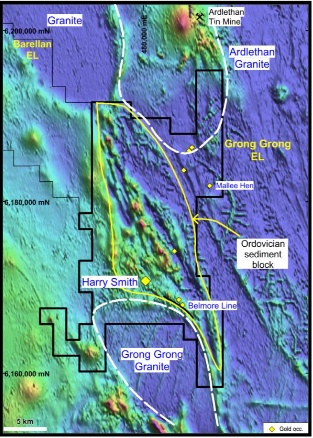
THE DRILL SERGEANT: Carpentaria Exploration (ASX: CAP) has expanded its gold portfolio in the Lachlan Fold Belt, having been granted the Grong Grong licence (EL 8189) near Narrandera in New South Wales.

Grong Grong adjoins Carpentaria’s Barellan tenement for a combined area of 702 square kilometres, which the company considers to be prospective for intrusion related gold systems (IRGS) and orogenic sulphide fault replacement hosted deposits.


Grong Grong EL over regional RTP aeromagnetic image. Source: Company announcement


The Grong Grong project also includes the Harry Smith prospect, where historical drilling identified a coherent gold mineralised structure.

Carpentaria said historical drill hole intersections on the same section, open down dip and along strike, provide it with a promising immediate target for drilling.

The company indicated it is focused on quickly advancing the latest addition to its gold portfolio and has field reconnaissance planned to begin before the end of the year.

“Grong Grong is a highly attractive prospect, due to its prospectivity for IRGS-style gold deposits and it also has the benefit of an existing drill target,” Carpentaria Exploration managing director Quentin Hill said in the company’s announcement to the Australian Securities Exchange.

“When combined with the encouraging recent results at our Advene gold project and existing prospects at Barellan and Temora, Carpentaria has assembled a strategic gold portfolio with great potential for discovery.

“It is rare to find such prospects with existing untested near economic drill hole intersections available on open ground at no acquisition cost.”

“Carpentaria will continue to exploit these opportunities and explore for gold during this down turn in market sentiment.

“However some recent market commentary has suggested that only five per cent of gold companies would be making money at current gold prices, and if this is even partly true, supply will contract and prices will likely rebound.”

Carpentaria’s wholly-owned gold project portfolio now totals 1800sqkm across four projects within the Lachlan Fold Belt.

The company believes its portfolio has potential for discovery of significant IRGS and Fosterville style deposits at its Advene, Barellan and Grong Grong projects, as well as epithermal and/or large porphyry copper gold deposits at its Temora and Glen Isla projects.

Email:
info@capex.net.au

Website:
www.capex.net.au

Phoenix Gold drills deep results at Castle Hill

THE DRILL SERGEANT: Phoenix Gold (ASX: PXG) has received results from an infill and depth extension drilling program at Stage 1 of the company’s Castle Hill gold project located in the Western Australian Goldfields, less than 50 kilometres from Kalgoorlie.

The Stage 1 Resource (JORC 2012) currently stands at 21.8 million tonnes at 1.6 grams per tonne gold for 1,137,000 ounces.

The total Castle Hill Resource stands at 30.9 million tonnes at 1.6g/t gold for 1,616,000 ounces.

Recently-received results from drilling include:

109 metres at 1.8g/t gold from 7 metres;

82m at 1.4g/t gold from 140m;

24m at 4.8g/t gold from 120m;

112m at 1.0g/t gold from surface;

28m at 2.4g/t gold from 236m;

21m at 3.0g/t gold from 187m;

16m at 3.3g/t gold from 102m; and

7m at 5.7g/t gold from 213m.

Phoenix explained the aim of the program was to test the mineralisation below the current resource envelope from 200m depth to 500m.


Castle Hill Stage 1 cross section 2-2. Source: Company announcement


“Phoenix was the first to drill below 80 metres in this area and we have now drilled down to 500 metres with the results continuing to demonstrate the scale of this very large gold system,” Phoenix Gold managing director Jon Price said in the company’s announcement to the Australian Securities Exchange.

“This entire area within the WA Goldfields has had surprisingly little modern exploration and we continue to be encouraged by the results.

“The resource continues to grow along strike and at depth of Stage 1, Stage 2 and beyond, and the updated geological models are now the subject of an independent open pit reserve study.

“This will ensure the delivery of an updated reserve position, mining schedule and development plan as part of the definitive feasibility study due for final completion in early 2014.”

Phoenix said the results had demonstrated mineralisation extends in excess of 200m below previous drilling.

Vein intensity, mineralogy and tonalite composition all indicate the mineralisation continues to remain open at depth.

The shallower infill results provide further confirmation of the robust nature of the resource from surface.

In addition, the results indicate grades increasing with depth.

Email:
info@phoenixgold.com.au

Website:
www.phoenixgold.com.au

Core Exploration identifies new Albarta drill targets

THE DRILL SERGEANT: Core Exploration (ASX: CXO) recently completed an Induced Polarisation (IP) geophysical survey, which identified drill targets at both the Blueys and Inkheart prospects within the company’s Albarta project in the Northern Territory.

Core believes these new IP targets combine with high silver in soil and high-grade rock chip results to be a strong indicator of mineralisation at depth.


Location of IP lines, all rock chip samples with samples over
100ppm silver highlighted and silver in soil displayed, Blueys and
Inkheart prospects. Source: Company announcement

Core has already commenced processes to enable drilling at Blueys and Inkheart as early as possible in 2014.

“The bulk of the chargeable IP targets appear to be between 75 to 150 metres depth and are underlying silver (± copper ± lead) soil anomalism and mineralised rocks at surface,” Core Exploration said in its ASX announcement.

“Drilling has never been conducted to these depths at Blueys so these targets are untested.

“Previous mapping and rock chip sampling at Blueys has identified a broad zone of pervasive stock-work veining associated with malachite and azurite (copper) and argentiferous galena (lead/silver) minerals at surface.”

Rock chip samples Core took from Blueys graded up to 4,065 grams per tonne silver, 8 per cent copper and 25 per cent Lead.

Core said its recent soil results also defined a high core of silver anomalism at both the Blueys and Inkheart prospects.

Core’s recent soil results also confirmed a strong correlation between lead and copper in soils and the high silver anomalism that characterise Blueys and Inkheart.  

Core indicated it is planning to commence an RC drilling program as early as possible in 2014, subject to having required approvals.

The company has commenced the process of securing land access approvals to enable the drilling program to proceed.

Core is currently undertaking further modelling of the IP data and drilling, which it anticipates will further define the depth, dimension and intensity of the chargeable features of the two prospects.

Email:
info@coreexploration.com.au

Website:
www.coreexploration.com.au


Laconia Resources confirms copper potential in Peru

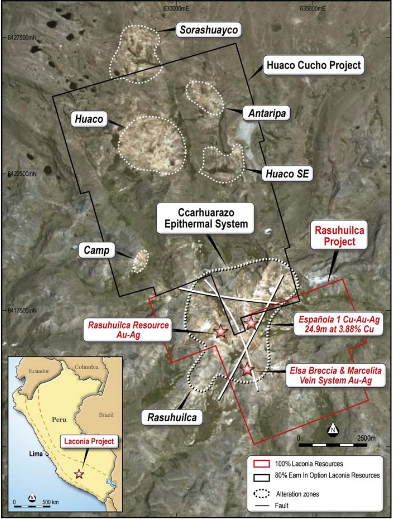
THE DRILL SERGEANT: Laconia Resources (ASX: LCR) has received results of field reconnaissance undertaken by its consultant geologist Stephen McCaughey at the Huaco Cucho project, north of the company’s epithermal copper-gold-silver Rasuhuilca prospects.

Laconia said the field reconnaissance has confirmed geology and alteration assemblages with strong affinities to Porphyry Copper systems, adding the exposed alteration is indicative of deeper levels of typical Porphyry volcanic profiles.
 

The Huaco Cucho project is located within 10 kilometres to the north of Laconia’s 100 per cent-owned Rasuhuilca project and is within the area of a seven year option held by the company to acquire an indirect 80 per cent interest over 11 additional exploration licences.


Rasuhuilca and Huaco Cucho Projects, with the areas of 100%
Laconia concessions and the 80% Earn in Option concessions shown.
Source: Company announcement


According to Laconia’a ASX announcement, the Huaco Cucho project consists of four further distinct alteration zones.

These were previously recognised by Buenaventura Ingenieros SA, who were earlier explorers in the area and conducted limited work conducted at the Huaco Cucho project.

Laconia has plans to commence its first phase of diamond drilling at the Rasuhuilca project as soon as it has re4ceived the necessary exploration permitting approval.

The company explained the process of formal approval to undertake exploration drilling in Peru follows the completion of a DIA, which includes environmental considerations and community consultation and approval.

Once the approvals have been given, Laconia will undertake an initial phase of diamond drilling at the Rasuhuilca deposit.

This round of drilling will be aimed at providing infill information between levels, to upgrade the JORC resource to Indicated category.

The Rasuhuilca project drilling is planned to investigate new copper targets involving Española 1 and Fortuna, plus at the known gold and silver targets the company has identified.

Laconia is confident there is potential to grow the resource base outside of its current boundaries through further detailed exploration.

A further four drill platforms at the Huaco Cucho project anomalies are also designed for inclusion in the DIA to be submitted in coming weeks, which the company says will afford it the flexibility to drill test the new porphyry copper targets as soon as surface mapping and geochemical sampling is complete and interpreted.

All exploration field work and timeframes are dependent on the timing of community and government approvals.

Email:
info@laconia.com.au

Website:
www.laconia.com.au

Horseshoe Metals intersects copper zone

THE DRILL SERGEANT: Horseshoe Metals (ASX: HOR) has intersected copper mineralisation while conducting its latest phase of drilling at the company’s 100 per cent-owned Horseshoe Lights copper-gold project in the Peak Hill Mineral Field of Western Australia.

The Horseshoe Lights project is located, 75 kilometres west-northwest of Sandfire Resources’ (ASX: SFR) DeGrussa copper/gold project.

Horseshoe Metals has taken receipt of the full laboratory analysis results from the recently-completed eight hole, 1,818 metre Reverse Circulation drilling program at the Horseshoe Lights project.


Drill Section through RC358 (+/- 100m) looking northwest
overlain with DDIP Line 6 Inverted Chargeability image. Source: Company
announcement


Latest results include Drill hole RC358, which was originally drilled in 1987 to a down hole depth of 120m.

Horseshoe Metals extended the drill hole to test a chargeability anomaly identified from a ground based Dipole-Dipole Induced Polarisation (DDIP) survey it completed in 2011.

A zone of low-grade copper mineralisation on the inner DDIP contour was intersected between 218-224m and included 1 metre (218-219m) at 0.05 per cent copper and 1m (223–224m) at 0.22 per cent copper.

The company considers the information it has gleaned from this drill hole, combined with other geological information provides evidence the DDIP anomaly sits at depth in the Narracoota Formation, within the nose of an interpreted fold.

“The copper mineralisation in hole RC358 is encouraging as it suggests there is potential for further copper mineralisation at depth, and additional drilling is warranted to determine the source of the DDIP anomaly,” Horseshoe Metals said in its ASX announcement.

The latest results come after the company released results from the first two holes of the drill program in October 2013, which reported high-grade copper intersections including:

32m at 1.8 per cent copper, including 12m at 2.8 per cent copper and 0.2 grams per tonne gold, which included a peak interval of 2m (199-201m) at 5.5 per cent copper and 0.3g/t gold.

“The intersection of copper mineralisation in RC358 is encouraging as it suggests there is potential for further copper mineralisation at depth,” Horseshoe Metals said.

“RC 358 was not drilled deep enough to fully test the DDIP anomaly, therefore additional drilling is considered to be warranted to determine the source of the DDIP anomaly.”

Email:
info@horseshoemetals.com.au

Website:
www.horseshoemetals.com.au

Gateway Mining gets pleasant drilling surprise

THE DRILL SERGEANT: Gateway Mining (ASX: GML) received a surprise while conducting a Reverse Circulation (RC) drilling program at the company’s project tenements, located in the Archaean Yilgarn Craton on the Gum Creek Greenstone Belt in Gidgee, Western Australia.

Gateway drilled nine holes on tenement M57/633, which is subject to a joint venture agreement with Panoramic Resources with the intention to develop further understanding of and test for extensions to The Cup VMS copper system.

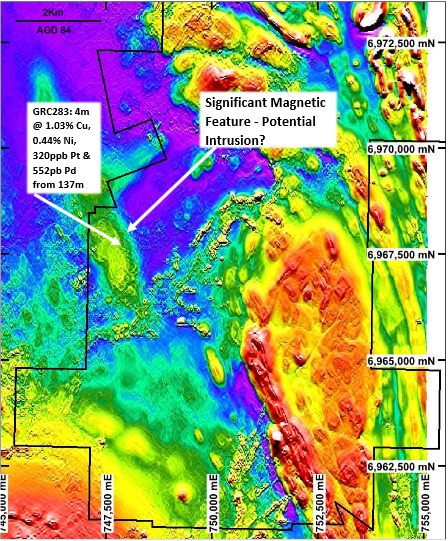
One of these holes, GRC283, unexpectedly intersected copper-nickel sulphides in ultramafic host rock, which Gateway said represents a new style of mineralisation for The Cup area.

“In light of the strong copper-nickel massive sulphide mineralisation intersected in GRC283, pulps were sent for assaying in platinum and palladium to test for a potential nickel-copper-PGE style of mineralisation,” Gateway Mining said in its ASX announcement.


Magnetic Survey of southern portion of tenement package. Source: Company announcement


Gateway has been encouraged by what it has seen with the intersection returning: 4 metres at 0.32 grams per tonne platinum and 0.55g/t palladium.

This contributed to the full result for the intersection of:

GRC283:
4m at 1.03 per cent copper, 0.44 per cent nickel, 0.32g/t platinum and 0.55g/t palladium from 137m.

“Most nickel-copper-PGE mineralisation in the Yilgarn is komatiitic ‘Kambalda type’ mineralisation,” Gateway explained.

“However, the intersection in GRC283 is much more supportive of an intrusive related nickel-copper-PGE style of mineralisation.

“This intersection occurred in rocks of ultramafic geochemical composition with significant massive sulphide content.

“This is the first time ultramafic rocks have been intersected in The Cup area (previously it was thought the stratigraphic sequence was dominantly felsic to intermediate volcaniclastic).”

Gateway completed a MLTEM survey in August/September, which identified a new conductor beneath The Cup horizon extending further to the south, away from The Cup VMS copper mineralisation.

The company originally considered the conductor to be unrelated to The Cup, which was why it was not the immediate choice for Gateway’s first drilling on the joint venture tenement.

“In light of the potential nickel-copper-PGE intrusive style of mineralisation, however, this conductor takes on new significance,” Gateway said.

“The intersection in GRC283 lies proximal to but above this new conductor.

“Further work is required to understand the geometry and nature of the mineralisation.”

Gateway indicated it is about to commence a fixed loop survey, which it hopes will provide a better definition of the conductor.

The company’s preliminary analysis suggests the conductor is approximately 800m in length and lies approximately 180m beneath the surface.

Email:
info@gatewaymining.com.au

Website:
www.gatewaymining.com.au