Midas Resources claims Overlander copper discovery

THE DRILL SERGEANT: Midas Resources (ASX: MDS) has claimed discovery of a new copper zone after encountering new copper intersections at the Overlander North prospect within the company’s 100 per cent-owned Mount Isa project in Northwest Queensland.

Midas has received assay results from the first two holes of a current reverse circulation (RC) drilling program.

Highlights so far include:

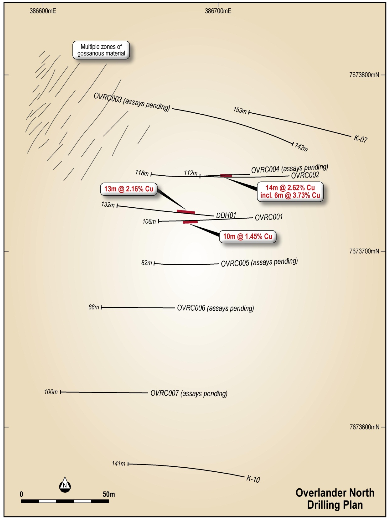
14 metres at 2.62 per cent copper, 0.12 grams per tonne gold and 575ppm cobalt from 76m, including 6m at 3.73 per cent copper, 0.13g/t gold and 262ppm cobalt from 80m in hole OVRC002; and

10m at 1.45 per cent copper, 0.11g/t gold and 473ppm cobalt from 63m in hole OVRC001.


Overlander North drill plan. Source: Company announcement


Midas said the drilling is continuing at Overlander North to determine the extent of the mineralised zone.

The Overlander prospect is located six kilometres west of Midas’s Kalman copper gold molybdenum rhenium deposit, and has been interpreted by the company to form part of a mineralised structural zone extending northwards for six kilometres from the known Andy’s Hill iron oxide copper gold (IOCG) prospect in the south, through the Overlander South prospect to Overlander North.

“Midas is encouraged by the initial drilling results from the first prospect drilled as part of the current drilling program,” Midas Resources executive director Alex Hewlett said in the company’s announcement to the Australian Securities Exchange.

“Overlander North is shaping up as holding potential for open pittable mineralisation as well as potential for larger deposits of the IOCG type.”

Midas explained the current drilling program is expected to finish in late December and will restart following the wet season.

The company expects to receive further assay results early in the New Year.

Email:
info@midasresources.com.au

Website:
www.midasresources.com.au

Plymouth Minerals commences Morille metallurgical testwork

THE DRILL SERGEANT: Plymouth Minerals (ASX: PLH) has wasted no time in getting to work at the company’s Morille tungsten-tin project in Spain.

Plymouth has commenced metallurgical testwork on a bulk sample of Run of Mine (ROM) mineralisation from the project.

The company has selected approximately 20 tonnes of mineralised material previously mined from the Alegria mine, the largest historical mine within the Morille project area, which will now be transported to Perth, where it will undergo process testwork.


ROM material being taken from Alegria stockpile. Source: Company announcement


From the 20 tonnes of material 18t was crushed using a secondary crusher prior to shipment and 2t was left uncrushed.

The test work will be conducted to confirm the optimum operating conditions for each stage of the process,” Plymouth Minerals said in its ASX announcement.

“This will include a comminuition circuit to achieve the particle size required for downstream processing.”

The company explained the process will also investigate a range of traditional gravity concentration techniques including:

Dense media separation, spiral classifiers, cyclones and circular jigs; and

Froth flotation cells, magnetic separation and dewatering testwork will be also completed to enable the design of the most efficient cost effective process available.

“This is advanced stage work given the recent acquisition of the project and shows the benefits of a brownfields project,” Plymouth said.

The company indicated it also plans to take additional samples for tin process testwork from an upcoming diamond drilling program it has scheduled to commence for Q2 2014.

Email:
admin@plymouthminerals.com

Website:
www.plymouthminerals.com

Northern Minerals winds up 2013 with Wolverine results

THE DRILL SERGEANT: Northern Minerals (ASX: NTU) has received the final assays from a recently completed program of resource extension drilling at its Wolverine deposit.

The company said the drilling had returned some of the best heavy rare earth (HRE) intersections it has received to date.

The results include a number of high-grade HRE intersections across encouraging widths–including:

28.6 metres at 4.06 per cent total rare earth oxide (TREO).


Wolverine Prospect Long section. Source: Company announcement


Northern Minerals said results such as this further confirm the zone of HRE mineralisation below and to the west of the current Wolverine resource, which remains open at depth.

The results also add further to the company’s confidence in the revised exploration targets at the Browns Range project announced last month.

They will contribute to an additional resource upgrade Northern Minerals has planned for March next year.

“These intersections include some of the best we have received, and really top off what has been an outstanding follow-up drill campaign at Wolverine,” Northern Minerals managing director George Bauk said in the company’s announcement to the Australian Securities Exchange.

“It provides an increasing level of confidence in our resource target, and that we can deliver another significant resource upgrade early next year,” he said.

Northern Minerals emphasised the final results mark the completion of what it considers to have been a defining exploration program across Browns Range in 2013.

During the year the company completed more than 46,000m of exploration drilling, with more than 15,000 samples assayed.

Results from this program have already delivered a 165 per cent increase in JORC resources in October, with a further upgrade planned for March next year.

“Our exploration success during 2013 has really taken Browns Range a major step forward,” Bauk said.

“We have now established a significant mineral inventory for a start-up mining operation, with a pipeline of additional prospects and targets for future growth.”

Email:
info@northernminerals.com.au

Website:
www.northernminerals.com.au

Hot Chili adds to Habanero zone

THE DRILL SERGEANT: Hot Chili (ASX: HCH) has received a further set of strong results from drilling being carried out on the company’s Productora copper project in Chile.

The company believes the results have highlighted the growing potential for the higher-grade Habanero zone within the Productora project to make a substantial impact on the economics of the project.


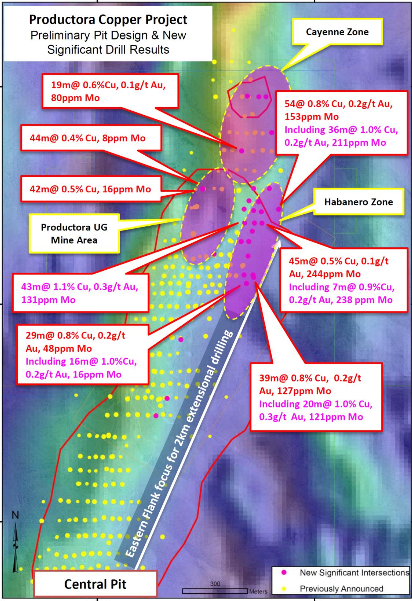
New significant drilling intersections in relation to the
planned central pit design at Productora. The figure displays the three
current focus areas for extensional drilling. Source: Company
announcement


The latest results extended the strike length of the known mineralisation at Habanero to greater than 600m, while continuing to deliver encouraging grades over wide intersections.

This included an intersection of:

43 metres at 1.1 per cent copper and 0.3 grams per tonne gold from a down-hole depth of 196m.

“Much of the mineralisation defined to date lies within the extents of the planned entrance pit at Productora and will form part of the impending major resource upgrade for the project,” Hot Chili said in its ASX announcement.

The company highlighted another intersection, which returned:

36m at 1 per cent copper and 0.2g/t gold within a broader intersection of 54m at 0.8 per cent copper and 0.2g/t gold from a down-hole depth of 126m.

Hot Chili said the significance of this particular intersection was that it was returned from the most northern drill hole at Habanero.

“This particular result highlights the potential for further extensions to Habanero,” the company explained.

“Outside of the planned central pit and into an area where there is currently no drilling coverage.”

Hot Chili expects to complete all drilling for 2013 in the coming days.

It anticipates receiving results for approximately 60 additional drill holes over coming weeks for incorporation into the forthcoming Productora resource upgrade, which is expected in early 2014.

Email:
admin@hotchili.net.au

Website:
www.hotchili.net.au

Mithril Resources identifies new gold targets

THE DRILL SERGEANT: Mithril Resources (ASX: MTH) recently completed a round of auger geochemical sampling at the company’s West Kambalda project, located approximately 30 kilometres west of Kambalda in Western Australia.

The company said the sampling had been successful in delineating new gold targets, which it considers to reinforce the prospectivity of the project area. Mithril collected a total of 857 auger samples during the recent program.


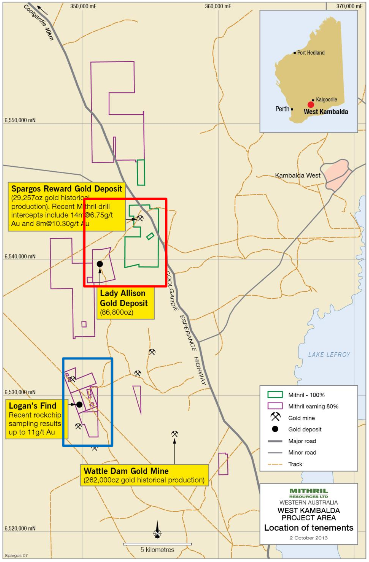
West Kambalda project area showing location of key targets, local infrastructure. Source: Company announcement


The company has combined the recent samples with historic auger sampling, which it claims provides complete surface geochemical coverage across all of the gold prospective areas to be identified over the project to date.

Four key target areas have emerged: Spargos Reward; Spargos South; Lady Allison; and Logan’s Find.

Mithril claims each of these targets contain multiple geochemical anomalies that either highlight existing bedrock gold mineralisation, or are new anomalies that have never been drill tested.

The strongest results were received from the Logan’s Find target where Mithril has extended an existing 1.5 kilometre-long anomaly along strike to over 4km in length.

“The anomaly (defined as above 50ppb gold with a maximum value of 219ppb gold) overlies a north-northwest trending belt of sheared and veined mafic-ultra mafic rocks, the central part of which is characterised at the surface by a series of shallow historic shafts and workings,” Mithril Resources said in its ASX announcement.

Mithril explained the new extensions to the anomaly are yet to be drill tested.

A series of 16 shallow (none below 50 metres) wide spaced holes were drilled in 1987 and 2004 throughout the central part of the anomaly.

Highlights from these programs included:

6 metres at 1.65 grams per tonne gold from 30 metres in 04HFRC005, including 2 metres at 3.08g/t gold from 32 metres;

3m at 2.81g/t gold from 20m in HFP-4, including 1m at 4.75g/t gold from 22m; and

3m at 2.7g/t gold from 41m in HFP-5, including 1m at 4.94g/t gold from 41m.

Mithril also conducted rock chip sampling within the central part of the anomaly – which it announced in October – returning results up to 11.1g/t gold.

The Logan’s Find target is situated within the Spargoville gold project which is subject to a Farm-in and Joint Venture Agreement with KalNorth Gold Mines (ASX: KGM).

Under the terms of the JV agreement Mithril can to earn up to an 80 per cent interest by completing expenditure of $2 million over 4 years.

Mithril said it is now reviewing each of the target areas in detail to determine its next steps, which it predicted may include further auger sampling, geological mapping and RAB / aircore drilling in 2014.

Email:
admin@mithrilresources.com.au

Website:
www.mithrilresources.com.au

Dacian Gold confirms high-grade shoot at Westralia

THE DRILL SERGEANT: Dacian Gold (ASX: DCN) recently completed broadly-spaced diamond drilling at the Westralia deposit, part of the company’s Morgans gold project, located in the Laverton District of Western Australia.

According to Dacian the drilling intersected additional high-grade gold mineralisation within the interpreted Millionaires Shoot.

Three holes were completed and results include:

13MMRD021
4 metres at 21.9 grams per tonne gold from 490 metres, including 1 metre at 48.8g/t gold from 493 metrs;

13MMRD020
4.6m at 4.2g/t gold from 519m; and

13MMRD022

5m at 1.8g/t gold from 468.8m.


Westralia deposit showing mine workings, target horizon and Dacian intersections. Source: Company announcement


The company explained the intersections lie directly down plunge of and correlate with high-grade mineralisation it had intersected and reported earlier this year.

Dacian consider the results to have confirmed the continuity of a high-grade shoot developed immediately below the south end of the Westralia pit over a vertical distance of approximately 500m and a strike length of approximately 200m.

The new shoot is additional to the current 364,000 ounce Mineral Resource reported at the deposit.

A revised Mineral Resource estimate for the Westralia deposit is currently being prepared, which Dacian anticipates to be reported before the end of the year.

“These latest high grade results from Westralia add to our confidence that we have defined a substantial new lode position at Westralia,” Dacian Gold managing director Paul Payne said in the company’s announcement to the Australian Securities Exchange.

“We anticipate a major upgrade to the Mineral Resource at Westralia which will form the basis for a preliminary mining study at the deposit commencing in 2014.”

Three historic holes had been drilled into the shoot up to 300m beneath the Dacian drilling.

The deepest of those intersected 11.87m at 8.6g/t gold from 568.9m or approximately 530m vertical depth.

It was interpreted that the high grade in that hole represented the depth extension of the Millionaires Shoot.

To test for continuity of the shoot extension, Dacian completed the recent drilling of a further three drill holes, all of which intersected the target BIF horizon and two of the holes returned the high-grade gold intersections mentioned above.

The company believes the results in 13MMRD020 and 13MMRD021 confirm the main part of the shoot displays continuity of high-grade gold mineralisation within a highly continuous BIF sequence.

The third intersection, in 13MMRD022, has been interpreted to be near or at the northern margin of the shoot, with a lower tenor of mineralisation.

The extension of the shoot defined by the Dacian drilling is south of the limit of historic mining and lies outside of the existing 364,000 ounce Mineral Resource.

Email:
info@daciangold.com.au

Website:
www.daciangold.com.au

Chesser Resources expands gold zones at Kestanelik

THE DRILL SERGEANT: Chesser Resources (ASX: CHZ) has taken receipt of the first drill results from a recently-commenced drill program at the company’s Kestanelik gold project in Turkey.

Results have come in from the first six holes out of the 70 drill holes to have been completed to date.

KED-258, an infill hole completed on the KK1 and KK2 vein zones returned an intercept of 8.1 metres of 12 grams per tonne gold on the KK1 zone.


Cross section showing KED-258. Source: Company announcement


Chesser said this was achieved in an area where the resource model estimate was approximately 4.5m at 0.9g/t gold and that it indicates the extent of the high-grade shoot area on the KK1 vein may be much larger than currently modelled.

An intersection on the KK2 zone in the same hole had a best intercept of 2m at 5.1g/t gold.

“The new program is delivering the results required to expand the indicated resource for Kestanelik, as well as to expand the overall resource.” Chesser Resources managing director Dr Rick Valenta said in the company’s announcement to the Australian Securities Exchange.

“This drilling has shown that in some areas the grades and thicknesses of gold mineralisation are higher than those in the August 2013 JORC resource estimate.

“We are very encouraged that early drilling has highlighted such areas, and look forward to continuing to build on those high-grade zones as the infill and step-out drilling continues.

“We are making good progress toward completion of the drill program, the PFS and the EIA permitting process, which are three of the key milestones in the process of de-risking Kestanelik and advancing toward production.”

Other drilling included KERC-140, which intersected the K1 zone with an intercept of 3m at 6.6g/t gold in an area where the resource estimate was approximately 3m at 1.1g/t gold.

KERC-141 tested an area of the K2K1 zone where the resource grade was estimated at approximately 0.8g/t gold over a width of approximately 5m.

Assays from this zone include: 2m at 3.2g/t gold and 2m at 2.7g/t gold within a broader interval of 22m at 0.91g/t gold.

Chesser indicated the results from the drilling will be used to complete a JORC resource update in early 2014, with timing dependent on the receipt of assays and subsequent modelling.

A further phase of drilling is planned contingent on the receipt of additional drill permits from the Turkish General Directorate of Forestry.

Email:
info@chesserresources.com.au

Website:
www.chesserresources.com.au

Mining Group encounters high-grade copper and gold

THE DRILL SERGEANT: Mining Group (ASX: MNE) has taken delivery of results from the first four holes drilled on the Descubridora vein at the company’s El Roble copper project in Chile.

According to Mining Group three of the four holes drilled intersected high-grade copper and gold mineralisation associated with silver, molybdenum, cobalt and iron.


Project overview showing location of the first drill targets,
Descubridora, Veta Gruesa, Bellavista and Panga in white circles and the
large scale nature of the El Roble copper system. Source: Company
announcement


“These results are exceptional and provide the best evidence yet that the El Roble copper-gold vein system has the potential to contain numerous high-grade ore bodies,” Mining Group managing director Zeffron Reeves said in the company’s announcement to the Australian Securities Exchange.

“The four holes targeted down dip and along strike of the currently operating Descubridora mine and demonstrate at least 100 metres of continuity in all directions of the high-grade mineralisation, which remains open in all directions.

“We are also encouraged by the wide, mineralised alteration zone we have intercepted around the veins, particularly in drill hole RCPDH00002, where we hit nearly one ounce per tonne gold over a metre.

“These first four holes have only tested 100 metres of strike and 100 metres down dip and with over 20 kilometres cumulative strike of mapped veins to explore we are really excited about the total potential of the project.”

Mining Group reported drill hole RCPDH00002 intercepted a wide zone of intense potassic alteration and associated mineralisation grading:

15.9 metres at 0.79 per cent copper, 2.14 grams per tonne gold, 2.17g/t silver, 95.91ppm molybdenum and 281.13ppm cobalt from 128m.

Within this wide alteration zone, two high-grade ore shoots were encountered:

Upper ore shoot – 2.9m at 2.43 per cent copper, 0.34g/t gold, 4.14g/t silver, 324.14ppm molybdenum, 762.07ppm cobalt from 133m, including 1m at 4.74 per cent copper, 0.73g/t gold, 5g/t silver, 830ppm molybdenum, 1510ppm cobalt from 133.9m.

Lower ore shoot- consists of a gold rich zone which returned 4m at 0.6 per cent copper, 7.96g/t gold, 2.75g/t silver, 70ppm molybdenum, 290ppm cobalt from 139.9m, including 1m at 0.1 per cent copper, 30g/t gold, 4g/t silver, 10ppm molybdenum, 500ppm cobalt from 141.9m.

RCPDH00001 intersected the crosscutting dyke between 66.83m and 84.2m, which Mining Group has interpreted to coincide with the interpreted projection of the mineralised vein below the Descubridora mine.

A narrow weakly mineralised secondary structure was intercepted between 125.55m and 132.m.

The company indicated a review of its initial interpretation of hole RCPDH00003 hole determined it may have been terminated before the intended vein target.

RCPDH00004 also intercepted a well-developed zone of mineralised potassic alteration around the main high-grade vein returning:

7.6m at 1.47 per cent copper, 0.14g/t gold, 7.44g/t silver, 17.5ppm molybdenum, 233.75ppm cobalt from 145.4m.

This included 2.55m at 3.64 per cent copper, 0.37g/t gold, 20.12g/t silver, 26.08ppm molybdenum, 275.69ppm cobalt from 145.5m; and

0.95m at 6.24 per cent copper, 0.79g/t gold, 39g/t silver, 475ppm molybdenum, 330ppm cobalt.

Descubridora is the first of four targets to be drilled in the current drilling program. The other drill targets include Veta Gruesa, Bellavista and the Panga mine area.

Drilling is scheduled to be completed by the end of the year.

“Given these initial results, we are very excited about our future drill targets,” Reeves said.

“The fact that we have achieved success so early in our exploration campaign confirms the potential of El Roble, and considering there is so much of the property unexplored, we are looking forward to completing more work on the ground to unlock El Roble’s potential.”

Email:
admin@mininggroup.net.au

Website:
www.mininggroup.net.au

MGT Resources completes Summer Hills Phase Three drilling

THE DRILL SERGEANT: MGT Resources (ASX: MGS) has received results from Phase Three of its 2013 Summer Hills drilling program.

Summer Hills is the main tenement on the company’s Mt Garnet tin project in Queensland.
MGT said the drilling program was carried out to expand and upgrade tin resources at Summer Hills in order to provide feed for the Mt Veteran tin processing plant.

The Phase Three drilling was conducted entirely at the Dalcouth prospect, which lies approximately 500 metres from the plant.


Plan of Dalcouth showing Phase Three drill holes over topographic contours. Source: Company announcement 

Highlights from the Phase Three drilling include:

8 metres at 0.47 per cent tin from 39 metres, including 1 metre at 1.33 per cent (DAL119);

15m at 0.38 per cent tin from 41m, including 1m at 1.16 per cent (DAL121);

14m at 0.67 per cent tin from 59m, including 5m at 1.2 per cent (DAL121);

4m at 0.89 per cent tin from 29m, including 1m at 2.54 per cent (DAL124);

10m at 0.51 per cent tin from 25m, including 2m at 1.27 per cent (DAL136); and

3m at 2.28 per cent tin from 29m, including 1m at 5.54 per cent (DAL137);

“This is the third and most successful phase so far of the drilling programs at Dalcouth this year, and sets us up as per plan to provide a JORC resource update following the completion of Phase Four which is currently underway,” MGT Resources executive chairman and managing director Jonathan Back said in the company’s announcement to the Australian Securities Exchange.

“The close proximity of Dalcouth to our processing plant and the shallow tin mineralisation are stand-out features of this project.

“Dalcouth is just one of many highly-prospective targets within our Summer Hills Mining Lease 20547 and nearby Nymbool EPM 16948.”

MGT said the results from the Summer Hills Phase Three drilling program had confirmed extension of a mineralised zone to the northwest.

It also further developed a northeast parallel zone and extended mineralisation at depth.

A fourth phase of RC drilling is currently being conducted with 54-56 holes and 8 re-entries on existing holes proposed.

Email:
info@mgt.net.au

Website:
www.mgt.net.au

Impact Minerals receives more good news from Mulga Tank

THE DRILL SERGEANT: Impact Minerals (ASX: IPT) continues to enjoy an early Christmas delivered by results from an on-going maiden drill program being conducted at the company’s Mulga Tank project JV near Kalgoorlie in Western Australia.

The drilling has now identified three mineralised zones, Impact said extend for at least 300 metres of strike along the west side of the Mulga Tank Dunite within E39/988 [Impact 20 per cent and earning 70 per cent from Golden Cross Resources (ASX: GCR)].


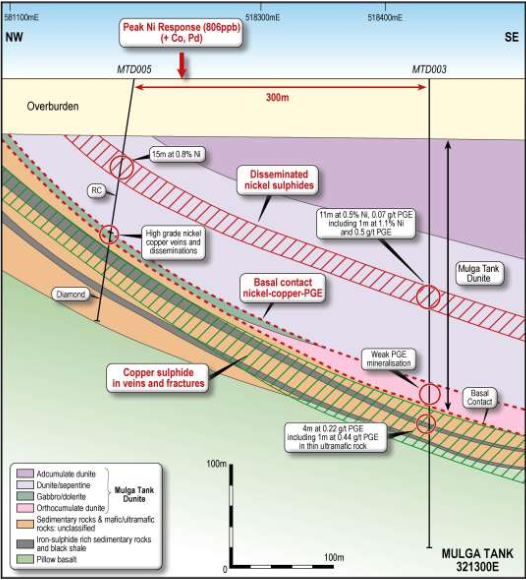
Cross section looking north east between MTD005 and MTD003. Source: Company announcement


The zones have been identified in Hole MTD005, which was drilled by Impact to test Conductor 2, which the company claims can be correlated with similar zones encountered in Hole MTD003 drilled 300m to the south east by a previous explorer.

The company explained the three zones, together with the discovery of nickel-copper sulphides over 150m of strike at Conductor 1 close to the north east part of the Dunite, further confirm the presence of a very large mineralised system associated with the Mulga Tank Dunite announced earlier this month.

“On the west side, two of the zones occur within the Dunite and the third occurs in the immediate footwall to the Dunite,” Impact Minerals said in its ASX announcement.

“Several narrow steeply south dipping veins of high tenor (grade) nickel and copper sulphides occur over several metres within the basal contact zone of the Mulga Tank Dunite in Hole MTD005.

“This zone can be correlated with weak PGE and nickel mineralisation at the base of the dunite in Hole MTD003.”

Impact anticipates this to be the first indication of high tenor mineralisation at the base of the dunite where a massive sulphide deposit may be expected to form.

The veins are sub-parallel to the drill hole, which accordingly was not oriented optimally to intersect them.
 
In addition the veins have a similar orientation to the high tenor (grade) veins identified three kilometres away in MTD004 at Conductor 1.

A 10m to 15m thick zone of disseminated nickel sulphides occurs about 100m above the base of the Dunite.

Impact has taken readings with a portable XRF analyser on RC chips from Hole MTD005, which returned an intercept of 15m at 0.8 per cent nickel from 80 m depth.

The company considers this zone is able to be correlated with Hole MTD003 where previous assays returned an intercept of 11m at 0.4 per cent nickel, including 1m at 1.1 per cent nickel and 0.5g/t PGE.

The drilling has also identified a zone of weak copper sulphide mineralisation up to 50m thick in the immediate footwall of the dunite.

The copper sulphide (chalcopyrite) occurs as disseminations and in veinlets and fractures.

Assay results from Hole MTD005 are expected in a few weeks.

Email:
info@impactminerals.com.au

Website:
www.impactminerals.com.au