Tiger Resources announces Judeira maiden Resource

THE DRILL SERGEANT: Tiger Resources (ASX: TGS) has announced a maiden Inferred Mineral Resource at the Judeira deposit, located within the company’s Kipoi copper project mining lease area in the Democratic Republic of Congo.

The Inferred Resource has been calculated at 6.1 million tonnes at 1.2 per cent copper containing 71,000 tonnes of copper.

The company indicated potential exists for material from Judeira deposit to be processed at the Kipoi Stage 2 solvent-extraction and electro-winning (SXEW) plant, which is just 6 kilometres away.

Tiger said the maiden Mineral Resource estimate is based on 13 diamond drill holes totalling 2,045.2m and 60 reverse circulation (RC) holes totalling 5,886m.


Long section of the Judeira deposit. Source: Company announcement


An additional 70 air core holes totalling 2,932m and 24 trenches were also completed, however these data were not used for the grade estimation.

The company did say they still provide a guide to the interpretation of the trend for copper mineralisation.

“The maiden resource estimate for Judeira is an important step in increasing the resources available to process at our SXEW plant at Kipoi, with Judeira located only six kilometres from the Kipoi SXEW plant,” Tiger Resources managing director Brad Marwood said in the company’s announcement to the Australian Securities Exchange.

“We have always been confident of adding to our primary resource at Kipoi Central, and the addition of a maiden Inferred Mineral Resource at Judeira adds to those we have already delineated at Kipoi North and Kileba, and at the Sase Central deposit at our 100 per cent-owned Lupoto project.”

The Judeira deposit extends over 2,200m with strong surface mineralisation.

Tiger said the resource estimate only addresses 1,600m of the mineralised trend.

“We believe there is further scope to add to this resource and will undertake further drilling at Judeira to increase confidence and move resources into the Indicated category,” Marwood said.

 
Email:
tiger@tigerez.com

Website:
www.tigerresources.com.au

Metallica Minerals claims new minerals sand discovery

THE DRILL SERGEANT: Metallica Minerals (ASX: MLM) has claimed the discovery, of what the company describes to be, “potentially substantial zircon-rich heavy mineral sand (HMS) mineralisation”, located on the western side of the far north area of Queensland’s Cape York Peninsula.

Metallica made the discovery while conducting a maiden regional reconnaissance drilling program on EPM 15371, a tenement the company holds 100 per cent through its wholly-owned subsidiary company, Oresome Australia Pty Ltd.

Metallica explained the drilling was aimed at further defining the mineralisation it had previously identified via a recent helicopter reconnaissance surface sample, which recorded from laboratory analysis 2.9 per cent heavy mineral (HM), comprising 54 per cent zircon and 35 per cent titanium minerals.

This initial drill program consisted of 36 shallow auger holes covering an approximate 1.8 kilometres long by 0.8km wide area along the south-eastern edge of a regional Exploration Target called T16.

According to Metallica, T16 is a low-lying vegetated sand dune with a length of approximately 14km in a north-south orientation and over 200-300m wide, situated 3km inland from the shoreline.


Aerial view over the middle of the T16 target area looking south
toward the 1.8km by 0.8km area drilled along the southeast edge of the
T16 target. Source: Company announcement


The company has submitted a total of 152 samples to a laboratory in Brisbane for HM grade analysis and a breakdown of zircon, titanium, iron oxide and other minerals, the results from which it anticipates to receive in the next few weeks.

Samples from this drilling program will also be set aside for preliminary metallurgical testwork and zircon, titanium minerals (i.e. rutile, ilmenite) quality analysis.

“This is a positive outcome on new work in this new large target area and gives confidence about potential further discoveries across Metallica‟s nearly 300 kilometre length of mostly sandy, near coastal tenements on Cape York, particularly given the lack generally of systematic heavy mineral sands exploration to date in the region,” Metallica Minerals managing director Andrew Gilles said in the company’s announcement to the Australian Securities Exchange.

“T16 is our first target to be drill tested on our regional tenement portfolio and we have at least 10 other priority regional targets in our Cape York holdings.

“Given our Urquhart Point zircon-rutile deposit and now T16 results to date, it is fair to say the region is highly prospective for mineral sands, particularly zircon and rutile.”

 
Email:
admin@metallicaminerals.com.au

Website:
www.metallicaminerals.com.au

Altona Mining drills big results at Kylylahti

THE DRILL SERGEANT: Altona Mining (ASX: AOH) has received results from the first four drillholes of a program designed to test for extensions to the Kylylahti mine, which is part of the company’s Outokumpu project in south-east Finland.

Altona explained that prior drilling at the bottom of the deposit is sparse and resource and reserve tonnes decline quickly below a vertical depth of 650 metres.

The company intimated thie latest drilling had extended resources by 50-100 metres vertically to 850 metres deep, not only extending mineralisation at depth but has the potential to increase the grade, width and confidence in the poorly-defined resource model below 650 metres depth.

Highlights of the drilling include:

KU 902:
108 metres at 2.4 per cent copper, 1 grams per tonne gold, 0.8 per cent zinc, including 58 metres at 4.2 per cent copper, 1.2g/t gold, 1.0 per cent zinc;

KU 901:
107m at 1 per cent copper, 1.4g/t gold, 0.4 per cent zinc, including 34m at 2 per cent copper, 0.7g/t gold, 0.6 per cent zinc;

KU 900:
87m at 1.1 per cent copper, 0.8g/t gold, 0.6 per cent zinc, including 15m at 1.8 per cent copper, 0.4g/t gold, 1.0 per cent zinc; and

KE 1:

102m at 0.8 per cent copper, 1.0g/t gold, 0.2 per cent zinc, including 12m at 2 per cent copper, 2.6g/t gold, 0.7 per cent zinc.


Longitudinal projection of the Kylylahti deposit showing the location of the drilling. Source: Company announcement


“Kylylahti is a great orebody and it is a delight to report the best drillhole yet from the deposit since its discovery by Outokumpu in 1984,” Altona Mining managing director Dr Alistair Cowden said in the company’s announcement to the Australian Securities Exchange.

“The drilling is spectacular providing a clear demonstration of high grades persisting at depth.

“These results provide the support to consider expanding production to 700,000 tonnes per annum, some 27 per cent higher than the Feasibility Study design.

“Revised guidance will be issued when mine planning is completed and upon receipt of a revised resource and reserve estimate which will be released in conjunction with half year reporting early in 2014.”

Altona described the deposit as structurally complex, however, it also acknowledged mining at the deposit and detailed underground drilling has provided a better understanding of structure, which it expects will result in a reasonable interpretation of geometry at depth.

In addition to the extensional drilling at depth, Altona has also completed extensive definition drilling in the Wombat zone from depths between 410m and 470m below surface.

This has further clarified structure, confirmed continuity of high grade zones and defined gold-rich zones in the hanging wall.

Best results from Wombat include: 33m at 3.2 per cent copper and 1g/t gold and 35m at 2.1 per cent copper and 1.1g/t gold.

Email:
altona@altonamining.com

Website:
www.altonamining.com

Sheffield Resources hits best grades yet at Thunderbird

THE DRILL SERGEANT: Sheffield Resources (ASX:SFX) has announced the best drill results it has achieved so far from the company’s Thunderbird heavy mineral sand (HMS) deposit, located near Derby in the Canning Basin region of Western Australia.

The results were part of the third batch of assay results to be reported from the 2013 aircore drilling program.

The results relate to 63 infill and extension drill holes, which returned thick, high-grade intervals, including: (using a greater than 2 per cent HM cut-off, including greater than 7.5 per cent HM cut-off).

–    55.5 metres at 10 per cent heavy minerals (HM) from 4.5 metres (THAC352), including 19.5 metres at 21 per cent HM from 12 metres;

–    46m at 12.4 per cent HM from 30.5m (THAC404), including 28m at 17.9 per cent HM from 32m;

–    52.5m at 8.37 per cent HM from 9m (THAC348), including 18m at 17.2 per cent HM from 16.5m;

–    40.5m at 11.7 per cent HM from 24m (THAC403), including 24m at 16.1 per cent HM from 25.5m;

–    58m at 9.61 per cent HM from 27.5m (THAC400), including 32.5m at 14.5 per cent HM from 29m;

–    46.5m at 9.73 per cent HM from 3m (THAC370), including 27m at 14.3 per cent HM from 12m; and

–    62.5m at 9.14 per cent HM from 33.5m (THAC401), including 29.5m at 13.3 per cent HM from 36.5m.

Sheffield said the latest results confirm the presence of a thick continuous zone of high-grade mineralisation (greater than 7.5 per cent HM) trending in a north-south direction through the deposit, which is considered to be at least 6km long and 2.5km wide.


Thunderbird collar plan with HM grade by thickness contours, using a 7.5 per cent HM cut off. Source: Company announcement


“The Thunderbird drill results continue to significantly exceed our expectation, which is highly-encouraging for our scoping study and further exploration work,” Sheffield Resources managing director Bruce McQuitty said in the company’s announcement to the Australian Securities Exchange.

“These results delineate a large, thick accumulation of high-grade mineralisation, which is a pleasing new development from this year’s drilling.

“The Thunderbird deposit currently extends over an area of seven kilometres by four kilometres.

“The broad high-grade zone is now defined over an area of six kilometres by 2.5 kilometres and contains some extremely high-grade material.

“Our scoping study will focus on optimising this substantial zone of high-grade mineralisation during the early production years.”

Email:
info@sheffieldresources.com.au

Website:
www.sheffieldresources.com.au

Sirius Resources identifies new Fraser Range anomalies

THE DRILL SERGEANT: Sirius Resources (ASX: SIR) claims to have identified an number of soil anomalies over one of its new nickel targets within the company’s 70 per cent-owned Fraser Range Joint Venture.

Sirius said each of the anomalies within the new prospect area, known as Crux, measures between 400 metres and 800 metres in length and peaks at over 1,000ppm nickel (up to 1980ppm), between 100ppm and 286ppm copper, and between 100ppm and 195ppm cobalt.

The company said these are the strongest soil anomalies it has identified since its discovery of the original Nova soil anomaly.


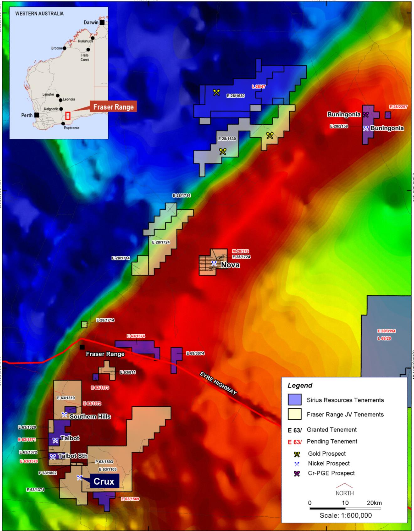
Map showing location of the Crux area soil anomalies
superimposed on colour gravity image which highlights the location of
Sirius’ targets and tenements. Source: Company announcement


“The Crux anomalies form a cluster within a magnetic low measuring approximately 5 kilometres long by 2 kilometres wide, which may represent an intrusion similar to that at the Eye,” Sirius Resources said in its ASX announcement.

“The anomalies, and the interpreted intrusion, are located 70 kilometres southwest of the Nova deposit at the southern end of the gravity anomaly that defines the nickel prospective area of the geological belt known as the Fraser Complex.”

Sirius indicated it has further follow up soil sampling and ground electromagnetic (EM) surveys planned to prioritise these new targets.

Email:
admin@siriusresources.com.au

Website:

www.siriusresources.com.au


Kaboko Mining confirms Zambian mineralisation extensions

THE DRILL SERGEANT: Kaboko Mining (ASX: KAB) has completed a program of exploration drilling at the company’s Mansa, Northern Zambian manganese project.

The company said initial results have identified the best exploration results it has achieved at Mansa to date with visible intersections wider than previous results.

The drilling was carried out in two phases consisting of a total of 32 holes for 2,760 metres with a total of 748 samples collected and dispatched for laboratory analyses.

The initial drill target (Phase 1) was based on detail mapping of excavated trenches.

Kaboko said this mapping had identified three reefs: the Main, the Middle and the Northern Reef extending in an east-south-easterly direction.

During the drilling of Phase 1, Kaboko tested this model and although the Northern Reef and Middle reef continued further south-east as predicted by the mapping, drilling continued in the northern part of the pit as the company considers the reef is more lucrative there with wider intersections.

Phase 2 drilling was designed to test the reef alongside the northern boundary of the Open Pit.

Source: Company announcement

During this drilling of Phase 2, Kaboko focused on the intersection of the reef at depth and along the northern border of the pit as the reef was much thicker in this area.

The company claimed the completed drilling program intersected manganese at depth and has proven the downward extension of the mineralization.

Kaboko will now use these drilling results in conjunction with a recently-completed scoping study to prepare a JORC-compliant resource statement at the Mansa project, which it expects to complete this quarter.

“These drilling results are an exciting conclusion to the drilling program, which adds significant support to existing mining operations and the preparation of the maiden JORC-compliant resource statement,” Kaboko Mining CEO Tokkas Van Heerden said in the company’s announcement to the Australian Securities Exchange.

Email:
info@kabokomining.com

Website:
www.kabokomining.com

Apollo Minerals increases Exploration Target in Gabon

THE DRILL SERGEANT: Apollo Minerals (ASX: AON) has upgraded the Exploration Target at the company’s Kango North iron project in Gabon.

The company said the upgrade was the result of a detailed review of exploration results achieved at the project.

The upgrade has taken the Exploration Target for the project to 2 to 3.5 billion tonnes at 30 to 40 per cent iron (up from a previous estimate of 200 to 300 million tonnes at 30 to 45 per cent iron), including a higher grade exploration target zone of 75 to 150 million tonnes at 45 to 60 per cent iron.

“Evaluation of modelled magnetic bodies against surface rock samples, with the inclusion of data from near-by cored drilling results and similar scale projects in the region, has led to revision of key assumptions in the exploration target,” Apollo Minerals said in its ASX announcement.

“The revised Exploration Target initially focusses on the south-eastern part of the project area (anomalies 3.8 to 3.15) that relates to an approx. 10 kilometre portion of the cumulative 17 kilometre strike length of magnetic anomalism identified from re-processing of airborne magnetic data from the project area.

“Modelling in the southeast has identified a series of parallel northeast trending mineralised iron bodies which have been substantiated through review of historical Government data, and an Apollo surface rock chip sampling programme conducted in 2012.”

Apollo has a 70 per cent interest in the Kango North iron project, which covers around 400 square kilometres in the north‐western Estauire Province in Gabon, which is located some 70km east from the Country’s capital, Libreville.

In determining the range for exploration target tonnages, Apollo examined the magnetic bodies (anomalies 3.8 to 3.15) situated in the southeast of the project, which it had identified to have suitable volume and grade comprising 582 million cubic metres at 34 per cent iron.

At an assumed average density of 3.3 tonnes per cubic metre Apollo said a confirmed upper limit Exploration Target of 1,920 million tonnes at 34 per cent iron can be estimated, including 161 million tonnes at 60 per cent iron from Anomaly 3.8.


Estimated Exploration Target assuming average density of 3.3 tonnes per cubic metre. Source: Company announcement


Apollo said all the modelled bodies at the project (Anomalies 3.7 to 3.15) cumulatively provide an upper limit estimate for the Exploration Target of 3.5 billion tonnes 30 per cent iron.

From this the company has regarded its Exploration Target estimate for the Kango North iron project to be reasonable.

Apollo is currently undertaking exploration activities, which include planning of a drilling program suitable to estimate a JORC code-compliant mineral resource.

The company has further project development appraisals in the planning stage, including environmental, sociological, transport, logistics and power generation studies to support the progression towards further metallurgical test work and pre-feasibility study.

Email:
info@apollominerals.com.au

Website:
www.apollominerals.com.au

Cape Lambert lodges Marampa Mining Licence application

THE DRILL SERGEANT: Cape Lambert Resources (ASX: CFE) has lodge an application for a Large Scale Mining Licence for the company’s 100 per cent-owned Marampa iron ore project located in Sierra Leone, West Africa.

The Marampa project comprises two granted exploration licences held by Marampa Iron Ore Limited (MIOL), which indirectly, is a wholly-owned subsidiary of Cape Lambert.

Marampa has a total JORC Mineral Resource of 681 million tonnes at 28.2 per cent iron (above a cut-off grade of 15 per cent iron) covering four deposits (Gafal, Matukia, Mafuri and Rotret).


Marampa project location. Source: Company announcement


A 15 million tonnes per annum Scoping Study Update, to incorporate pumping of concentrate to a Marampa-owned trans-shipping port at Tagrin, using a simplified process flow sheet, was completed in May 2013.

In April 2013, Marampa was issued an Environmental Licence for the Marampa project, which marked the first key step in the permitting process.

Subsequent to the Environmental Licence being granted, Marampa has been preparing its Mining Licence application, which has now been lodged with the authorities.

The granting of the Mining Licence, which the company anticipates will occur in early Q2 2014, is the final key step in the permitting process for the Marampa project.

The grant of the Mining Licence de-risks the Marampa project and adds value from a potential investor’s perspective by paving the way for the development of the project.

“The granting of the Mining Licence is the last key hurdle for progressing the Marampa project to eventually become Sierra Leone’s third iron ore producer,” Cape Lambert Resources executive chairman Tony Sage said in the company’s announcement to the Australian Securities Exchange.

“Marampa has been demonstrated to be a financially robust project and gaining the necessary governmental approvals will significantly enhance the assets appeal to potential investors, in turn adding significant value for our shareholders.”

Email:
info@capelam.com.au

Website:
www.capelam.com.au

KGL Resources intersects massive sulphides at Jervois

THE DRILL SERGEANT: KGL Resources (ASX: KGL) has commenced drilling of diamond tails at the Marshall-Reward and Bellbird deposits at the company’s Jervois project in the Northern Territory.

The diamond drilling is part of a resource extension program the company commenced in September with the aim of increasing the global resource as part of a pre-feasibility study.

According to KGL the diamond drilling at Marshall has intersected a greater than 10 metre wide zone of massive and semi-massive sulphide containing visible copper, lead and zinc sulphide mineralisation in hole KJCD048.

The company explained this intersection sits below an existing Inferred resource boundary in an area previously untested.

Drilling along strike both north and south of this location is planned to be completed before the end of December.

“We are delighted with the discovery of visible copper, lead and zinc sulphide below the existing inferred resource at Marshall that supports the potential scale of the Jervois project,” KGL Resources managing director Simon Milroy said in the company’s announcement to the Australian Securities Exchange.

“The Rockface discovery of copper mineralisation 400m to the west and along strike from the Rockface prospect illustrates the prospectivity of the Jervois project and the potential to add additional high-value, shallow resources that can be mined from an open pit.”


IP chargeability anomalies on southern Jervois prospects. Source: Company announcement


KGL has received approval for a 13 hole drill program on the north (down dip) side of the Rockface prospect with the aim of testing the Rockface IP anomaly and carry out infill drilling along an untested 400m zone that extends between historical Rockface intersections to those recently announced by the company from holes KJC033 and KJC035, including:

9 metres at 1.21 per cent copper, 4.1 grams per tonne silver, 0.03 grams per tonne gold from 105m; and (Hole KJC033)

24m at 1.47 per cent copper, 3.5g/t silver, 0.04g/t gold from 160m. (Hole: KJC035)

KGL has mobilised an additional track-mounted diamond rig to site, which will initially target the centre of the Rockface IP anomaly and then move to infill the untested areas between the two zones of copper mineralisation.

KGL will now have three rigs drilling at Jervois up until the Christmas break.

Email:
info@kglresources.com.au

Website:
www.kglresources.com.au

Syndicated Metals encounters thick copper-gold at Barbara

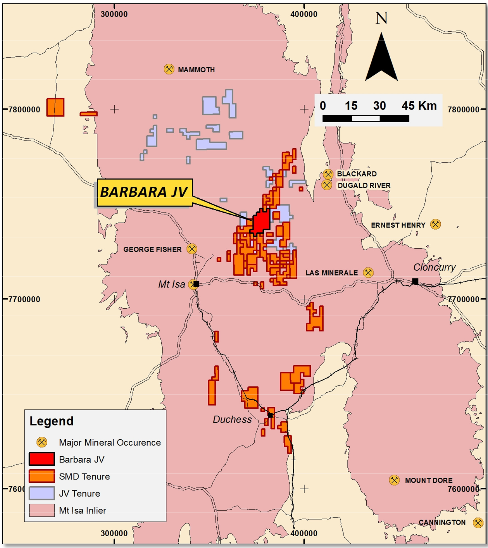
THE DRILL SERGEANT: Syndicated Metals (ASX: SMD) has been encouraged by in-fill resource drilling being conducted as part of the Feasibility Study on the company’s Barbara Joint Venture copper-gold project in North Queensland.

The Barbara JV is a 50/50 joint venture with North Queensland copper producer CopperChem Limited, which is funding the Feasibility Study as part of its earn-in requirements to the JV.


Project location plan. Source: Company announcement


So far 17 Reverse Circulation (RC) drill-holes have been completed within the current conceptual Barbara open pit, with assays so far received for 9 holes.

Syndicate Metals said the results it has received have confirmed high-grade copper mineralisation identified by previous drilling and further in-filled areas where resource confidence was low.

Intersections received to date include:

BARC076:
28 metres at 1.5 per cent copper from surface, including 9 metres at 3.04 per cent copper from surface;

BARC080:
10m at 1.86 per cent copper from 134m down-hole;

BARC082:
19m at 1.65 per cent copper from 77m down-hole, including 5m at 3.68 per cent copper from 77m down-hole; and

BARC083:
42m at 1.57 per cent copper from 75m down-hole, including 9m at 3.36 per cent copper from 75m down-hole.

 “The drilling completed to date has already significantly de-risked the project development, confirming both the high grade nature of the hanging wall mineralisation and the significant widths of near-surface, ore grade mineralisation we see at the central region of the pit,” Syndicated Metals managing director Andrew Munckton said in the company’s announcement to the Australian Securities Exchange.

“We are particularly pleased with the width of the intersections encountered within the central part of the pit, which has confirmed the interpretation of the ore zone with a high-grade (+2.5 per cent copper) lode of copper mineralisation sitting on the hangingwall contact, supported by significant widths of generally lower grade (0.7 per cent to 1.5 per cent copper) in the footwall of the high-grade lode.

“Further drilling – in particular drill holes targeted below the base of the preliminary pit design are designed to further test this interpretation of high-grade hanging wall mineralisation sitting upon lower grade footwall mineralisation.

“The wide zones of near-surface, copper mineralisation encountered augurs well for low-cost mining techniques to be considered in this part of the open pit during the Feasibility Study.

“The drilling program is now moving into the southern and northern ends of the proposed pit shell where we believe potential extensions to the mineralisation may exist at depth and along strike.

“Near-surface mineralisation in this area is also being targeted.”

Syndicated Metals explained the program has been designed to in-fill and upgrade the current Indicated and Inferred Mineral Resource of 5.3 million tonnes at 1.4 per cent copper and 0.1ppm gold.

It is also testing for zones of high-grade mineralisation that could potentially extend outside of the existing mineralisation boundaries.

Drilling is continuing within the proposed pit area, which Syndicated said is helping to improve its understanding of the deposit with additional step-out holes targeting extensions of the Mineral Resource to the south-east.

Email:
info@syndicatedmetals.com.au

Website:
www.syndicatedmetals.com.au