Trafford to buy into Challenger JV

THE BOURSE WHISPERER: Southern Gold has signed a Letter of Intent with Trafford Resources that will result in the latter purchasing the former’s 51 per cent interest in the Western Gawler Craton JV with Dominion Gold Operations (a 100 per cent owned subsidiary of Kingsgate Consolidated) and its 100 per cent-owned Challenger West tenement.

“Trafford is very well placed to take advantage of the exploration boom in South Australia,” Trafford Resources managing director Ian Finch said in the announcement of the deal to the Australian Securities Exchange.

“Together with its 2,692 square kilometre Wilcherry Hill project on the Eyre Peninsula and this Western Gawler Craton project Trafford now has greater than 8,300 square kilometres of Gawler Craton to define and develop targets.

“The Gawler Craton has produced a number of world class deposits such as Olympic Dam, Prominent Hill and Challenger Gold Mine and there is no reason why it cannot be repeated.”


Map of Trafford’s Western Gawler Craton project. Total area covered is 5,653Kmsqkm. Source Southern Gold announcement

Under the sale terms Trafford will pay $500,000 cash for the Challenger project plus three million Trafford shares, which will be subject to a 12 month voluntary escrow period.

Once a decision is made to conduct a feasibility study on a JORC resource of over 500,000 ounces of gold, Trafford will issue a further $1 million worth of its shares to Southern Gold or its nominee.

“Entering into this Agreement is consistent with Southern Gold’s intention to focus on exploration, evaluation and development at the Bulong Gold project, Western Australia, where recent results show continued high grade gold hits,” Southern Gold Managing Director Nanette Anderson said.

“Southern Gold looks to undertake this Agreement to release value from the sale of this asset and by reducing its operating cost while maintaining exposure to potential upside at the Challenger project.”

Gascoyne acquires new gold project

THE BOURSE WHISPERER: Gascoyne Resources has entered into a binding agreement to purchase the Dalgaranga gold project and surrounding exploration tenements from private tenement holders.

The Dalgaranga project is located northwest of Mt Magnet in the Murchison region of Western Australia.

The project contains JORC gold resources of:

7.5 million tonnes at 1.58 grams per tonne gold for 382,000 ounces in the Measured and Indicated categories.

There has been very limited recent exploration conducted at Dalgaranga.

Gascoyne said it has identified potential at the project for resource growth, including a number of prospects with significant high grade gold intersections.

These include:

22 metres at 6g/t gold and 6 metres at 10.2 g/t gold and 7 metres at 10.8 g/t gold that have not been followed up and are yet to be included in the resource base.


Location of Dalgaranga gold project. Source: Company announcement


“This is a significant acquisition by the company that fits our exploration model of seeking large tenement holdings with known free milling gold and the potential to host plus one million ounce deposits, where there has been little exploration using modern techniques,” Gascoyne Resources chairman Graham Riley said in the company’s announcement to the Austyralian Securities Exchange.

“Both Glenburgh and Dalgaranga independently hold this potential, and together already boast a JORC compliant resource in excess of 1.08 million ounces.

“At the 100 per cent-owned Glenburgh project, where the company is completing a 40,000 metre drill program, this approach has already resulted in an increased and fast growing resource of over 500,000 ounces during the past year, and highlights the growth potential this strategy can deliver.

“Whilst Glenburgh is more advanced and retains priority, preparations for a significant exploration program at Dalgaranga have already commenced, requiring the compilation of all historical data, (including the mapping of various high grade intersections which have yet to be followed up), and the recalculation of the existing gold resource.

“The acquisition of Dalgaranga represents an important step in the execution of the Company’s growth strategy, and I look forward to the commencement of the exploration programme in the coming weeks.”

Gascoyne will acquire an 80 per cent interest in the Dalgaranga project by issuing a total of seven million shares and payment of $150,000 cash upon formal documentation.

Gascoyne may move to 100 per cent ownership of the project at development should the vendors elect to exchange their 20 per cent interest for a 2 per cent Net Smelter Return royalty.

Excelsior upgrades Kalgoorlie North resource

THE BOURSE WHISPERER: Excelsior Gold has increased the total Measured, Indicated and Inferred gold resources at the company’s 100 per cent- owned Kalgoorlie North gold project.

Total resources for the project now stand at:

16.7 million tonnes at 1.61 grams per tonne gold for 868,500 ounces (at 0.6g/t and 3.0g/t gold lower cut-offs).

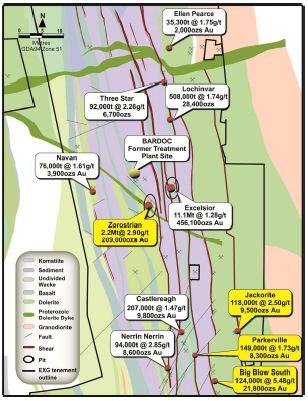
“The new resource represents a 13 per cent increase in total project contain gold ounces and it is predominately driven by a major expansion of the potentially open pittable resources at the Zoroastrian deposit supplemented by a new maiden resource at the Parkerville prospect and an almost threefold increase in the resources at Big Blow South,” Excelsior Gold explained in its ASX announcement.


Kalgoorlie North project – Central Resource area geological plan
(showing updated resource areas in yellow). Source: Company announcement

According to Excelsior drilling results from a thirty-five hole reverse circulation drilling program conducted at Zoroastrian in June and July delineated gold mineralisation on the Birthday Dream, Royal Mint and associated structures on the western margin of the Zoroastrian Dolerite.

The drilling also intersected the high grade structures extending below and to the
south of the pit in the Zoroastrian South area.

Total resources at Zoroastrian are:

2,243,800 tonnes at 2.9g/t gold for 209,000 ounces.

The Jackorite prospect is located approximately 3.1km south west of the Excelsior deposit, and contributed to the new resource model with an increase of 18 per cent in the total resource ounces.

Indicated and Inferred resources for Jakorite are:

117,850 tonnes at 2.50g/t gold for 9,470 ounces (at 0.6g/t gold lower cut-off)

Big Blow South is located 3.7km south of the Excelsior deposit and hosts high-grade gold mineralisation within a porphyry unit intruded on the contact between the Big Blow Chert and underlying ultramafics.

The total Big Blow South gold resource is:

123,900 tonnes at 5.48g/t gold for 21,825 ounces (at 3.0g/t gold lower cut-off)
The Parkerville prospect is located approximately 3.1km south of the Zoroastrian deposit.

Excelsior considers Parkerville to represent one of the many prospects at Kalgoorlie North that contain significant gold intercepts requiring further assessment.

Recent drilling confirmed the results from historical drilling which had intersected shallow
(less than 20m vertical depth) supergene gold mineralisation over approximately 300m of strike.

The calculated maiden total Parkerville resource is:
149,340 tonnes at 1.73g/t gold for 8,330 ounces (at 0.6g/t gold lower cut-off)

Northern Star revels in tripartite tremble

THE BOURSE WHISPERER: Western Australian gold miner Northern Star Resources announced a triple play consisting of a predicted cash surplus for next year, payment of a maiden dividend, and a Resource upgrade.

The company said it expects to generate surplus cash of $65 to $85 million next calendar year on the back of higher production and lower costs assuming the gold price remains hovering around the A$1,550 per ounce mark.

Northern Star recently completed its budget for 2013, which it said shows the company is set to produce between 100,000 to 115,000 ounces of gold for the year at cash costs ranging $610 to $690 per ounce (inclusive of $40/oz royalty).

This compares favourably with Northern Star’s forecast for the current year of 75,000 to 80,000oz at $650/oz.

The company confirmed recently it is on track to meet this guidance.

According to Northern Star the increased production next year will result due to a rise in average milled head grade from the current rate of around 7gpt to 8 to 9gpt.

The higher grade is due to the recently discovered extension zone at the Voyager 1 lode at Paulsens, which has a resource grade of 25gpt.

The company’s directors are also preparing for a bought of RSI as they prepare to sign a lot of cheques to pay a fully franked maiden dividend of 2.5c a share, which represents a 3 per cent yield based on a share price of 85c.

The dividend payout will total $10 million, however the company insists it will still keep plenty of its powder dry to take advantage of any acquisition opportunities which may arise.

The dividend will be declared to all shareholders on the register at 05 September 2012 and is expected to be paid on 12 September 2012.


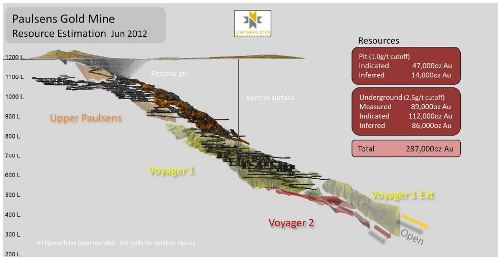
Long section of Paulsens Mine Open Pit and Underground Mineral Resource and Reserves. Source: Company announcement

To top all this off Northern Star increased the JORC-compliant resource estimate at its Paulsens gold mine in WA to 2.4 million tonnes at 5.0 grams per tonne gold for 403,000oz.

This compares with the previous estimate of 318,000oz and comes after 32,000oz was mined in the intervening period.

The increased inventory is a rise of 25 per cent and is sufficient to underpin a mine life of at least 5 years at Paulsens.

“These forecasts show Northern Star is poised for a bonanza year marked by superb cash generation, significantly higher production and some of the lowest costs in the Australian gold mining industry,” Northern Star Managing Director Bill Beament said in the company’s announcement to the Australian Securities Exchange.

“Our commitment to exploration at Paulsens is being repaid in spades, with the mine now having at least five years’ worth of resources.

“And we have discovered significant areas of additional mineralisation which further strengthen our belief that Paulsens has a long profitable future beyond current resources.

“In addition, we are continuing to drill on the other side of the gabbro unit surrounding Paulsens and remain hopeful of identifying repeats of the Paulsens orebody.”

A quiet achiever aiming to be a great achiever

THE BOURSE WHISPERER: The ambiguous science of Nearology could transform this ambitious gold exploration play into a sizeable blip on the markets’ collective radar screens.

Last week a little known area in Far East Western Australia became the talk of the mining world when Sirius Resources announced the discovery of a major nickel-copper discovery at its 70 per cent-owned Fraser Range project.

But in contrast to this hype and excitement, it seems the stockbrokers, investors and even learned mining industry analysts and professionals had all chosen to ignore a quiet achiever with the potential to be a great achiever until last week.

With a number of listed plays all rushing to inform the bourse of their location and proximity to Sirius’ tenements and the Fraser Range project, it would seem the company best-placed to make such claims is ASX-aspirant Boadicea Resources.


Map showing Boadicea Resources proximity to the discovery of Sirius Resources. Source: Boadicea Resources


Boadicea Resources has been vainly trying to list on the Australian Stock Exchange this year and is currently attempting to achieve the 400 name spread to meet ASX listing rules.

The company’s main project is the Symons Hill project.

The name Symons Hill may not mean much to many people at present, but as the lease right next door to Fraser range, it is one most likely to be on the lips of many investors very soon.

Boadicea Resources managing director Clarke Dudley and a core group of dedicated believers and investors in the project have struggled in difficult market conditions to find any interest among brokers and investors to part with $2000 each for a parcel of 10,000 shares at 20 cents each to raise $800,000 and list on the ASX.

Boadicea has a core group of dedicated investors who have raised $2 million, including Dudley himself who has pitched in some $700,000, in seed money that is needed to get the company’s assets mobilized.

The biggest obstacle until now has been to find 400 investors wanting to part with $2000 each and invest in Boadicea at the IPO level.

After Sirius Resources announced the Nova deposit discovery last week the company’s shares jumped almost 1000 per cent from 5.7 cents to as high as 56.5 cents at close on the day after the announcement.

The stock had another good run on Wednesday closing at 73.5c.

The discovery hit intersected 4metres at 3.8 per cent nickel and 1.4 per cent copper in the predicted Electro Magnetic area and a step-out hole 55 metres away also returned similar mineralisation.

Furthermore, AngloGoldAshanti’s world-class six million ounce Tropicana project is only 250km away from the Symons Hill project site.

Boadicea is aiming to list on the Australian Securities Exchange in late September with the IPO offering closing on September 24.

As a result of the Sirius Resources’ announcement, the issue is likely to close much earlier.
 
“We are needing another 160 investors at $2000 each to complete our ASX 400 shareholder requirement,” Dudley said.

“Once Boadicea Resources has received 400 plus shareholders at $2000, consideration will be given to accepting amounts greater than $2000 from a select number of investors.

The Boadicea Resources company information and prospectuses can be downloaded at www.boadicearesources.com.au or more information can be obtained by contacting Yolanda Torrisi yolandat@bigpond.net.au or phone +61 412 261 870.

Discovery releases first Inferred Resource at Zeta NE

THE BOURSE WHISPERER: Discovery Metals has completed the first Mineral Resources estimate for the Zeta NE deposit.

The Zeta NE prospect is located in the Boseto Zone of the Kalahari Copperbelt in north western Botswana approximately 11 kilometres from the company’s 100 per cent-owned Boseto copper project concentrator.

This is the first estimate of Mineral Resources at Zeta NE and is based on drilling Discovery conducted on 14 drill sections spaced approximately 400 to 800 metres apart.


Kalahari Copperbelt exploration targets. Source: Company announcement


Two copper-silver mineralised zones have been delineated – a main footwall zone and a smaller, higher copper grade, hangingwall zone.

The estimate of Inferred Mineral Resources in each of these domains is reported for mineralisation below the base of oxidation.

The Zeta NE Inferred Mineral Resources are:

–    Footwall Mineralised Domain 11.1 million tonnes at 1.2 per cent copper and 23 grams per tonne silver; and
 
–    Hangingwall Mineralised Domain 1.8Mt at 1.5 per cent copper and 20.0g/t silver.
 
This provides total Inferred Mineral Resources of 12.9Mt at 1.3 per cent copper and 22g/t silver (Mineral Resources reported above a cut-off grade of 0.6 per cent).

“This first Mineral Resources estimate for Zeta NE represents another step towards increasing the life and the scale of the Boseto copper project,” Discovery Metals managing director Brad Sampson said in the company’s announcement to the Australian Securities Exchange.

“Further evaluation of the open pit potential at Zeta NE is planned for the current half year to determine the best positioning of Zeta NE in the Boseto mining schedule.

“Further drilling is planned to assess underground potential at Zeta NE in early 2013.”

Discovery has interpreted the main footwall domain to have a strike length of approximately 5km that has been intersected by drilling at depths between 10 metres and 230 metres below surface.

A discrete area containing copper grades in excess of 1.5 per cent copper exists within the footwall zone and remains open at depth.

At the hangingwall domain the company has interpreted strike length of approximately one kilometre it has intersected between 10m and 70m below surface.

Discovery said the drilling results and subsequent Mineral Resources estimate suggest economic open pit mining should be possible at Zeta NE.

Further evaluation of this potential will be undertaken in fourth quarter of this year.

White Rock gets thumbs up at Mt Carrington

THE BOURSE WHISPERER: White Rock Minerals has completed a scoping study on the Mt Carrington gold-silver project in northern New South Wales.

The company said the results of the study have confirmed the potential for a medium‐scale low cost production profile of 40,000 ounces of gold equivalent per annum with strong financial returns.

This is based on an estimated capital expenditure of $24 million and short payback timeframe of less than 18 months.

White Rock consider the results support its vision of accelerating the development of a gold‐silver operation at Mt Carrington in the next 18 months, subject to continued positive results from feasibility studies.

 “We are extremely pleased with the results of the Scoping Study for Mt Carrington, and it provides confidence that we have the right ingredients for an attractive and financially robust silver‐gold project,” White Rock Minerals managing director Geoff Lowe said in the company’s announcement to the Australian Securities Exchange.

“We have the advantages of mining leases with infrastructure already in place which underpins a modest capital expenditure estimate.

“The current Resource base is amenable to open pit mining, and sighter metallurgical test work has provided a number of viable processing routes.

“We will now look to undertake a definitive feasibility study next year, and subject to further positive results, press the button on development during 2013 with the aim of production in early 2014.”


Mt Carrington Resource summary. Source: Company announcement


Highlights of the study include:

–    Proposed initial development – 40,000 ounces of gold equivalent per year at $869 per ounce cash cost;

–    Capital Costs of $24 million (processing plant and mine infrastructure);

–    Undiscounted project value of $68M ($97M pre‐tax);

–     $40M Net Present Value at a 10 per cent discount rate ($60M NPV pre‐tax);

–    Internal Rate of Return of 67 per cent (92 per cent pre‐tax);

–    Capital payback within 18 months;

–    Six year open pit mining operation with production of 107,000 ounces gold and 6.9 million ounces silver;

–    0.8 million tonnes per annum floatation and CIL circuit to produce silver‐gold concentrate and bullion;

–    Overall 85 per cent recovery for all deposits; and

–    Average open pit strip ratio of 2.4 : 1.

“The Scoping Study results provide a very healthy starting point for a new operation, but we believe it is just that – the starting point,” Lowe continued.

“The Drake Volcanic Caldera represents one of the most under‐explored volcanic belts in Eastern Australia and we will look to accelerate the district exploration program to build a Resource base that supports a sustainable, long term 100,000 ounce per annum gold equivalent production profile.

“The recent drilling success reported at the Mozart, Red Rock and Junction prospects highlights the quality of the target portfolio and increases the likelihood of future Resource additions.”

Venture Minerals upgrades entire DSO Resource

THE BOURSE WHISPERER: Venture Minerals has upgraded its entire Direct Shipping Ore resource base from the JORC inferred category to that of indicated.

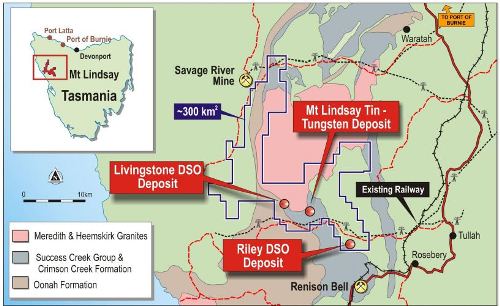
The company has also received a combined, independent maiden ore reserve of 4 million tonnes of DSO from the Riley and Livingstone hematite deposits in Tasmania.


Location map for Mt Lindsay tin/tungsten deposit and the Riley and Livingstone DSO projects. Source: Company announcement


Venture has been busy over recent months on its DSO projects conducting additional infill drilling and pitting in order to define a new combined indicated resource of 4.4 million tonnes at 57 per cent iron, which represents a 100 per cent conversion from the inferred to the indicated category.

The company said the high conversion rate indicates the consistent nature of both deposits.

Having completed the new resource, Venture has had an independent ore reserve estimated by mine engineering consultants at Rock Team.

This resulted in a 90 per cent conversion of resources to reserves, which Venture again attributed to the consistent and near surface nature of both the Livingstone and Riley Deposits.

“We have been working hard to advance our DSO projects to production as soon as possible, so the receipt of an independent maiden reserve for both the Riley and Livingstone projects represents a major milestone for us,” Venture Minerals managing director Hamish Halliday said in the company’s announcement to the Australian Securities Exchange.

“The Company is particularly pleased with the high conversion rate of resources to reserves delivering us over four million tonnes of probable reserves.”
 
Having completed the reserve statement Venture said it will now look to finalise off-take and ore transport agreements, as well as advance all necessary development approvals.

The company has previously stated that it is able to bring its Tasmanian DSO projects into production with a minimal capital outlay of only $7 million.

A major contributing factor is the proximity of infrastructure to the Riley and Livingstone deposits, both of which are located within two kilometres of a sealed road accessing existing rail and port facilities, all of which have spare capacity.

Rubianna completes Ruby Well estimation

THE BOURSE WHISPERER: Rubianna Resources has completed Mineral Resource estimates for the Ruby Well project, situated within the company’s 100 per cent-owned Murchison tenements, northeast of Meekatharra, Western Australia.

Each of the resources is JORC code-compliant and classified as an Inferred Mineral Resource.

The estimates comprise:

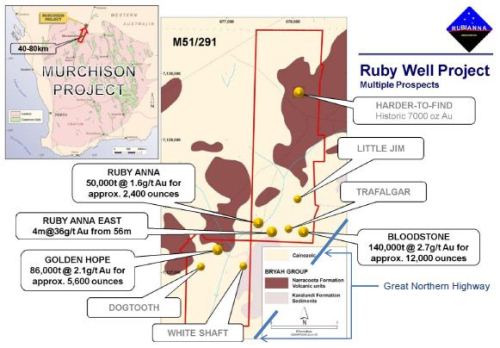
–    Bloodstone prospect: 140,000 tonnes at 2.7 grams per tonne gold for approximately 12,000 ounces;

–    Golden Hope prospect: 86,000t at 2.1g/t gold for approximately 5,600 ounces; and

–    Ruby Anna prospect: 50,000t at 1.6g/t gold for approximately 2,400 ounces.


Location map for the Ruby Well project showing the multiple prospects. Source: Company announcement

Rubianna explained the Bloodstone resource is currently defined to approximately 80 metres below surface, while the Golden Hope and Ruby Anna resources are defined to approximately 60 metres below surface, with all remaining open at depth and down plunge.

“The initial resource estimates may be modest, but they all remain open at depth and down plunge,” Rubianna’s Resources managing director Dr Steve Batty said in the company’s announcement to the Australian Securities Exchange.

“In addition the area provides plenty of potential to add additional ounces to the resource inventory, especially the Ruby Anna East prospect, where recent drilling intersected 4 metres at 36 grams per tonne gold from 56 metres, which remains open at depth.

“The significant factors that all these deposits have in common are; that they are shallow (from surface); have a high-grade component; occur on an existing Mining Lease; and are as close as 500m from the Great Northern Highway.

“We are currently assessing our options to exploit these resources to generate the maximum return for the company.”

Batty outlined the company’s short-term objective is to monetise its gold assets so it will be able to self-fund future exploration program.

These will focus on extending existing resources, advancing the company’s copper-gold and base-metal prospects while making in-roads with exploration activities over its tenement holding in WA.
 
An initial scoping level pit optimisation study is currently underway for each prospect, with results expected to be announced early next week.

Graphite – The New Black

THE BOURSE WHISPERER: The steady rise in the popularity of graphite as the new must-have commodity for mining companies shouldn’t really be any great surprise.

One of the main reasons graphite is experiencing a surge in popularity at present is its use in lithium-ion batteries.

If you’re not overly familiar with the lithium battery take a quick inventory around your house to see if you have any of these items.

–    Television remote control – any remote control for that matter;

–    Digital camera;

–    Computer – let’s use this as an umbrella term for all hand held screen-based devices as well;

–    Telephones – the ones your teenage children have to teach you to use because they don’t come with instruction booklets; and

–    Basically anything powered by batteries, which are recharged by plugging them into an electric socket.

All these devices multiplied by the number of your friends, neighbours and relatives with similar stockpiles of 21st century devices we must have to make our lives simpler results in an answer that represents a lot of batteries.

Electric / hybrid cars are also tipped to have a large impact to the global demand for graphite.

Although there already seems to be plenty of these machines buzzing along our freeways it is suggested that only two per cent of all new vehicles sold currently are gas-electric hybrids, plug-in hybrids or battery-only full-electric drive.

Ironically, the technology in most of these vehicles has yet to catch up with itself and most are manufactured with nickel-metal hydride batteries.

Sales of these vehicles are projected to move quickly and by 2020 are expected to account for anywhere between five to 18 per cent of all sales and, importantly will be almost exclusively powered by lithium-ion batteries.

If the global investment community loves anything it is a trend.

Just mention rare earths to people and their ears prick up. Not that they understand what rare earths are or what they do or where they come from but they’re interesting at the moment, other people are investing in them and we all want to be in early.

Hell, look what happened to gold. Remember when it was $500 an ounce?

This probably explains why we are seeing a sudden graphite rush on the market with each day presenting more companies that have suddenly realised they have recorded an intersection of graphite somewhere on their tenements.

Iron ore was popular as long as China wanted to build things and gold still holds a glistening appeal to those of us with mattresses too small to cope with large wads of cash.

Recent graphite movements

Kibaran Resources has prospective graphite and nickel projects located in Tanzania.

The company recently acquired the rights to the Mahenge and Merelani-Arusha projects, which it considers to be highly prospective for commercial graphite.

The company announced this week preliminary testwork has revealed strong graphite potential at Mahenge and Merelani-Arusha.

Results at both locations identified the presence of coarse graphite flakes.

As the company explained this is a desirable attribute of commercial importance as the larger the graphite flakes, the more valuable the graphite product becomes.


Source: Company announcement

“These solid results from preliminary metallurgical testwork are very encouraging,” Kibaran Resources chairman Simon O’Loughlin said in the company’s announcement to the Asutralian Securities Exchange

“The relatively high grade results and evidence of coarse graphite flakes indicate the commercial potential of our graphite projects.”

Kibaran Resources has commenced a three month drilling campaign at both projects.

The company said it has a six month exploration and development plan in place with the aim of proving up of a JORC Mineral Resource.

Castle Minerals announced a Maiden Resource for its Kambale graphite deposit in north-west Ghana of 14.4 million tonnes at 7.2 per cent graphitic carbon for 1.03 million tonnes of contained graphite.

The Resource includes six million tonnes at 8.6 per cent graphitic carbon for 0.52 million tonnes of contained graphite.

Castle Minerals managing director Mike Ivey said the maiden resource had confirmed Kambale as a major graphite deposit.

“We drilled our first hole in March this year and it is a great result to announce a maiden resource within four months,” Ivey said in the company’s ASX announcement.

“Kambale ranks as one of the largest graphite deposits in the world. Our initial metallurgical test work reports up to 69 per cent occurring as fine to coarse graphite providing excellent potential for a high value product to be produced.

“With less than 20 per cent of the graphitic schist horizon tested we clearly have potential to materially add to the current resource.”

Castle said it had on-strike drilling underway and will continue this along with further metallurgical test work to determine flake recoveries towards completing a prefeasibility study as soon as possible.

Gold Anomaly announced a graphite deposit located within the company’s Golden Gate project at Croydon, North Queensland.

The Golden Gate deposit contains 20 million tonnes at 5.5 per cent graphite, including a high-grade zone of six million tonnes grading 10 per cent graphite.
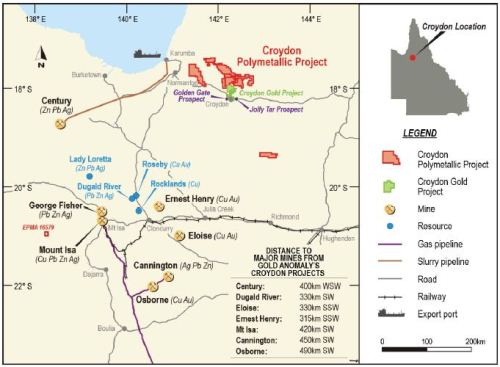
 

Location Map of the Golden Gate and Jolly Tar Graphite deposits
and their relationship to regional infrastructure and major mining
operations. Source: Company announcement

The company explained these estimates are historical results reported by Central Coast Exploration (CCE) that require substantiation by further drilling, assaying and metallurgical testwork.

“The company has certainly been active in identifying the graphite potential of our Croydon prospects and nearby areas, and now has the opportunity to add further value to our Croydon project assets,” Gold Anomaly executive chairman Greg Starr said in the company’s ASX announcement.

Cullen Resources has applied for ground over six known graphite prospects in Finland.

The company said a number of the prospects include airborne EM anomalies and reported historical drill intersections, such as:

–    7.6 metres at 34.8 per cent graphitic carbon and 99.55 metres at 12.1 per cent graphitic carbon for further investigation.

Cullen has now lodged three Ore Prospecting Licence applications (Exploration Licence equivalents) and four Claim Reservation applications over six graphite prospects in the name of its wholly-owned, Finnish-registered subsidiary company.
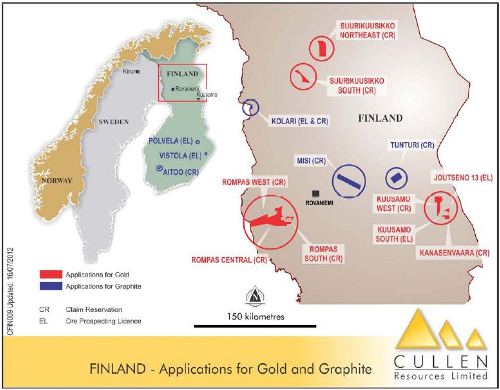
 

Source: Company announcement

These prospects have previously been explored for graphite and/or base metals by the Geological Survey of Finland (Geologian tutkimuskeskus or GTK) and companies, mostly in the period 1970-2000.

The historic work done by GTK was aimed at the potential of graphite as a fuel source.

Graphite’s metallurgical characteristics for other industrial uses were not, or only partly, investigated.

Existing databases for these graphite prospects include aerial and ground geophysical surveys, geological maps and diamond drill cores stored at the Geological Survey of Finland.