BC Iron and Cleveland strike Brazil JV agreement

THE BOURSE WHISPERER: Pilbara iron ore producer BC Iron has entered into an Iron Ore Strategic Alliance with Brazil-focused iron ore development company Cleveland Mining Company.

Under the terms of the Alliance, BC Iron will take a five per cent equity stake in Cleveland at 64 cents a share, spending approximately $6 million.

As part of the placement, and subject to it maintaining its five per cent holding and regulatory approvals, BC Iron will have top up rights for two years enabling it to participate in any new offerings so it can maintain its percentage interest.

BC Iron and Cleveland will form a 50:50 joint venture aimed at acquiring and developing new iron ore projects in Brazil.

BC Iron indicated it would continue to focus on its Pilbara operations in line with its three tiered growth strategy, the third tier of which is this latest announcement.

BC Iron said the new JV with Cleveland Mining provides the opportunity for it to enter the Brazilian iron ore space without the long lead time needed to ‘come up to speed’ in a new jurisdiction, and at a relatively low cost.

“This new Joint Venture will allow BC Iron to enter a new country and new market with key people, relationships and their intellectual property already in place,” BC Iron managing director Mike Young said in the company’s announcement to the Australian Securities Exchange.

“The nature and size of the transaction is entirely consistent with our stated Business Development strategy.

“Brazil has a vibrant iron ore industry including a domestic market, a very skilled and able workforce and geology that is very prospective for further discoveries.

“In fact, where I see a mature iron ore industry in Australia with limited infrastructure availability, in Brazil I see a growing industry in a growing country.”

BC Iron has taken the Nullagine Joint Venture with Fortescue Metals Group in the Pilbara from an exploration play to reach to its current production rate of five million tonnes per annum in May this year.

Similarly, Cleveland has been focussed on its current project hubs and therefore has not been in a position to date to assess other iron ore project opportunities.

According to the two companies the new Alliance will enable each to advance their growth plans at a greater rate.

“BC Iron has successfully built a 5 million tonnes per annum Joint Venture operation, with Fortescue, in the Pilbara in rapid time,” Cleveland Mining Company managing director David Mendelawitz said.

“They have the leadership, experience and financial strength that make for an excellent JV partner.

“Cleveland is conducting a scoping study on the Ferradura project, in order to build its own 5 million tonnes per annum operation in Amapá state in Brazil.

“The collaboration with BC Iron will allow the company to drive its growth plans beyond Ferradura without delay, whilst providing BC Iron with exposure to the amazing potential of Brazil.

“Most of Cleveland’s Board and many of our managers have previously worked with the management of BC Iron in the past and we look forward to resuming the relationship.”

Core identifies copper at Fitton

THE BOURSE WHISPERER: Core Exploration has identified copper mineralisation in surface outcrop near new magnetic targets identified within the company’s 100 per cent-owned Fitton project, located north of the Beverley uranium mine in northern South Australia.

Core had conducted the recent phase of mapping and surface sampling at Fitton to check for any expressions of copper-uranium mineralisation at the new magnetic anomalies it had recently identified south of the Scott Lee prospect.


Location of Scott Lee prospect and Fitton project and uranium
occurrences and mines in the region, northern South Australia. Source:
Company announcement


“Malachite (copper mineral) was revealed within quartz/hematite rocks along zones of sheared magnetic granite located approximately 400 metres southwest of Scott Lee,” Core Exploration explained in its ASX announcement.

“The copper bearing samples are associated with shear zones that are magnetic at local scale.

“Copper minerals were also identified in outcrop associated with a new gold target (0.91 grams per tonne gold sampled in outcrop) located two kilometres south west of Scott Lee.

“Quartz veining was mapped along a 1.3 kilometres south-east strike from the gold target.”
 
Previous surface sampling conducted by Core at the Scott Lee prospect had demonstrated high levels of copper and uranium.

A number of samples contained highly-anomalous uranium above 100 parts per million for a strike length of over 800m.

Samples taken from the same shear zone graded above one per cent copper over a strike length of 150m.

Core said it expected to receive assays from this recent sampling and mapping program by the end of August.

The company is now planning follow-up mapping and sampling programs to commence in coming weeks.

Following the positive results of finding new outcropping copper mineralisation associated with ground magnetic anomalies, Core is infilling magnetics at the Scott Lee Prospect on 25m line spacing.

The company’s first drill program on Fitton is planned to commence later in 2012, subject to necessary approvals.

Follow The Roadhouse on Twitter: @RoadhouseWA


Sirius extends Conductor 1 and finds conductor 4

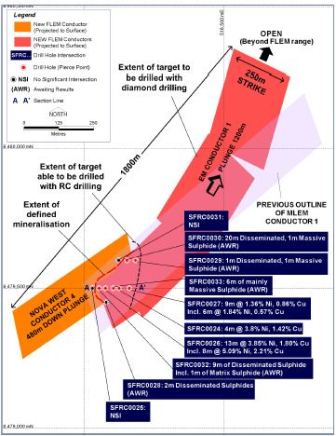
THE BOURSE WHISPERER: Fraser Range ‘neighbour of the year’ Sirius Resources has concluded a detailed electromagnetic (EM) surveying at its Nova nickel discovery, which the company said has confirmed and extended the main EM conductor (conductor 1) and also identified an entirely new EM conductor to the southwest of previous drilling.

The new conductor, known as conductor 4 or Nova West, is located beyond the western limit of the original EM survey.

According to Sirius the survey has confirmed and defined the main Nova conductor (conductor 1) in greater detail over a distance of 1,200 metres down plunge to a vertical depth of 650 metres.


Plan projection of EM conductor 1 (Nova) and conductor 4 (Nova West)
showing location of holes drilled to date. Source: Company announcement

As the conductor plunges beyond the depth range of the EM survey, Sirius is now planning  a more powerful deep penetrating survey in order to determine how much further this conductor may  continue down plunge.

The new EM conductor (conductor 4, or Nova West) is located beyond the limits of the original EM survey.

Sirius has modelled its strike length to 200m and a down plunge extent of 500m.

The Nova West conductor dips beneath the mineralisation Sirius has intersected in drilling to date on the main Nova conductor.

The company considers this could represent an entirely new mineralised zone.

The detailed EM survey comprises a combination of fixed loop EM (FLEM) and down hole EM (DHEM) which has enabled higher resolution definition of the conductive zones. The discovery of an additional EM conductor beyond the limit of the original survey also attests to the potential of the area beyond that explored to date.

“The board and management of Sirius are encouraged by the findings from this more detailed EM survey,” Sirius Resources managing director Mark Bennett said in the company’s announcement to the Australian Securities Exchange.

“Using FLEM and DHEM we now have a far better understanding of the Nova EM conductor which is critical in guiding the future diamond drilling program.

“The identification of an entirely new conductor is an added bonus that provides great encouragement for the regional potential of Sirius’ land holding”.

Sirius is continuing to push ahead with the accelerated exploration program at Nova.

The first diamond drill hole into the upper end of Nova is underway, which the company said will be followed by systematic drilling down dip and down plunge.

Follow The Roadhouse on Twitter: @RoadhouseWA


Wasabi raises Carbon stakes

THE BOURSE WHISPERER: Wasabi Energy has increased its stake in AAP Carbon from the 25 per cent it purchased in March this year to 62.5 per cent.

Wasabi’s power business is based on its proprietary Kalina Cycle® power generation technology which utilises low grade, waste heat from industrial facilities or geothermal sources to produce electricity.

AAP Carbon builds, accredits and invests in clean energy projects that generate carbon credits under the Clean Development Mechanism of the Kyoto Protocol.

According to Wasabi Energy, AAP Carbon’s focus has been the energy intensive ferrochrome industry where it harvests the off‐gases from furnaces for conversion into electricity by using gas‐fuel reciprocating engines.

Wasabi said the two companies will offer a combination of chemical and thermal energy conversion to electricity for Sub Saharan Africa.

 “Wasabi Energy has been working closely with AAP Carbon since early 2012,” Wasabi Energy executive chairman John Byrne said in the company’s announcement to the Australian Securities Exchange.

“We are impressed with the opportunities available to the group in South Africa and Sub Saharan Africa with a number of projects being well advanced.

“The joining together of AAP Carbon with Wasabi Energy’s business development activities provides a powerful combination of expertise, proven track record in the development and implementation of projects and a unique offering with the combination of chemical and thermal energy conversion with the use of the Kalina Cycle®.

Wasabi identified Sub Saharan Africa to be one of the world’s fastest growing regions, highlighting World Bank statistics indicating real growth at 5 per cent of GDP.

Although provision of reliable power is a key component to ensure ongoing economic growth, the region endures issues affecting levels of industrial activity resulting in a need to develop energy conversion of waste heat to power for industrial applications.

“We look forward to the growth in AAP Carbon and the development of a leading African power company,” Byrne said.

“Southern Africa is not alone in its requirement for reliable power, and the demand from around the world for the Kalina Cycle® continues to grow.

“We are therefore confident that through this and other licensees our growth targets will be achieved.”

Under the terms of the transaction, AAP Carbon will be granted a Kalina Cycle® license for Sub Saharan Africa which, together with its existing chemical energy conversion business, Wasabi is confident will deliver a unique offering to the African market.

AAP Carbon will issue 15.2 million new shares and 4.7 million warrants exercisable at 10 cent each to Wasabi as consideration for an exclusive Kalina Cycle® license (excluding the cement and lime industry which has been granted to FLSmidth) and Wasabi’s business development activities in Sub Saharan Africa, which include the engineering study for two Kalina Cycle® power plants at ArcelorMittal’s Vanderbijlpark steel works and several other projects in South Africa and Kenya.

IMX inks MOU with Flinders Ports

THE BOURSE WHISPERER: IMX Resources has signed a Memorandum of Understanding (MOU) with Flinders Ports.

The MOU will investigate the feasibility for development of a port solution at Port Pirie to support the development of the company’s 100 per cent-owned Snaefell magnetite project in South Australia.

IMX said the MOU with Flinders Ports was an important step towards proving the feasibility of the Snaefell magnetite project, which forms part of the much larger Mt Woods magnetite project.

“IMX is an established South Australian iron ore producer and has demonstrated its ability to work cooperatively with Flinders Ports in the establishment of our innovative containerised iron ore storage and loading facilities at Port Adelaide. IMX Resources managing director Neil Meadows said in the company’s announcement to the Australian Securities Exchange.

“This MOU provides the basis for IMX and Flinders Ports to work towards developing a port solution to support the development of a large scale iron ore export and trans-shipment facility at Port Pirie for the Snaefell magnetite project.”

IMX is developing the Mt Woods magnetite project on the Mt Woods Inlier in SA.

The company owns 100 per cent of the iron ore rights of the Mt Woods tenement package.

The current JORC Inferred Resource at the Snaefell magnetite deposit stands at 569 million tonnes at 27 per cent iron.

IMX has a Global Exploration Target of between 200 million tonnes to 380 million tonnes at 25 to 35 per cent iron elsewhere in the project.

Studies into water, power, ore characterisation, transport and logistics in anticipation of reaching a decision to commit to funding a Pre-Feasibility Study on the Snaefell project by the end of 2012 have been started.

IMX has also commenced the search for a suitable partner to support the development of the Snaefell Magnetite Project.

The company also has a joint venture with OZ Minerals (the Mt Woods copper-gold JV project) to explore the Mt Woods tenements for copper and gold.

OZ Minerals is spending a minimum of $20 million for a 51 per cent interest in the non-iron rights, with IMX retaining a 49 per cent stake.


Laconia identifies new targets at Rasuhuilca

THE BOURSE WHISPERER: Laconia Resources has received encouraging results from the company’s 100 per cent-owned Rasuhuilca gold-silver project in Peru.

Laconia has conducted a review of surface and underground channel sampling data, which has revealed an extension to a high-grade silver zone at the Rasuhuilca vein.

The recent activity has enabled the company to identify a range of additional target areas, which it considers to warrant follow-up exploration.

The work has entailed a comprehensive review of all existing and available data including high grade rock chip samples, channel sampling at surface and underground adits.

Throughout the review, which is ongoing, laconia said it was placing specific emphasis on the potential expansion of the existing resource at Rasuhuilca and the surrounding project area.

The Rasuhuilca project has a current Inferred Resource estimate of 360,000 tonnes at 1.97 grams per tonne gold and 179 grams per tonne silver.

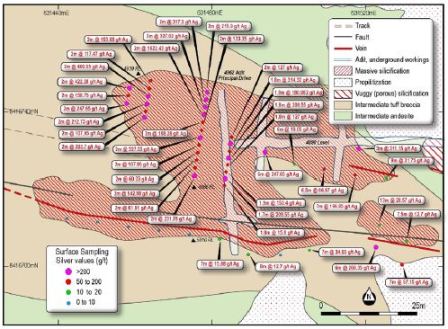
“The western high-grade silver zone at the Rasuhuilca deposit lies 110 metres west of the main body of mineralisation,” laconia Resources said in its ASX announcement.

“Underground development from the main Rasuhuilca underground workings are already established (4890 Level), providing a location to drill test this western zone.


Results from surface sampling above 4962 Level Rasuhuilca West zone. Source: Company announcement


“The high-grade silver zone at the west end of the Rasuhuilca deposit has to date been subject to surface sampling and a single underground adit development.

“Only a small part of the zone has been tested sufficiently for inclusion in the existing inferred resource.”

Highlights from the recent work include:
 
–    1.5  metres at 11.68 grams per tonne gold and 236.74 grams per tonne silver;

–    1m at 3.64g/t gold and 330.19g/t silver; and

–    2m at 1.14g/t gold and 1,622.43g/t silver at surface.

Laconia has also identified a number of new exploration targets from historical exploration undertaken at the Marcelita veins and Elsa Breccia, located south east of the Rasuhuilca vein system.

Historical results include:

–    1.5m at 14.76g/t gold and 208g/t silver from Elsa Breccia;

–    1.5m at 22.80g/t gold and 45.20g/t silver from Elsa Breccia; and

–    3.5m at 6.53g/t gold and 244.66g/t silver from Veta Marcelita 2.

Laconia has a program of underground diamond drilling scheduled to commence in the fourth quarter of this year, subject to permitting.

It is also continuing with assessment of a 2008 Feasibility Study, which it anticipates to be updated following results of the underground drilling program.


PanAust acquires remainder of Carmen copper‐gold deposit in Chile.

THE BOURSE WHISPERER: PanAust Limited has acquired the balance of the tenements, which it did not already own, over the Carmen copper‐gold deposit in Chile.

The total acquisition cost for Carmen was US$14 million in two tranches following PanAust having acquired the first tranche of tenements in 2010 for US$6 million.

The now 100 per cent PanAust-owned Carmen deposit is located 14 kilometres southwest of the Inca de Oro copper‐gold project (PanAust 59.8 per cent).


Project location map. Source: Company announcement


The combined Measured, Indicated and Inferred Mineral Resource estimate for Carmen is 45.8 million tonnes at 0.34 per cent copper, 0.34 grams per tonne gold and 1 gram per tonne silver (approximately 0.55 per cent copper equivalent).

The deposit contains, in situ, over 150,000t copper, 500,000oz gold and nearly
1.5 million ounces of silver.

PanAust announced the results of a feasibility study conducted at the Inca de Oro project in its June 2012 quarterly report.

According to the company the study identified a mining and processing schedule for Inca de Oro that comprised 180Mt of mill feed at an average head grade of 0.43 per cent copper and 0.12g/t gold (approximately 0.5per cent copper equivalent1).

“The study concluded that the cost profile after the first five years of production needed to be reduced for the Inca de Oro project to be economically robust,” PanAust explained in its ASX announcement.

“Carmen is a near‐surface iron oxide copper‐gold (IOCG) mineralised system, which may support a low strip ratio satellite open pit to augment Inca de Oro mill feed.

“PanAust’s strategy is to demonstrate that the incorporation into the mining schedule of higher value (through a higher contained metal value and potentially lower strip ratio and process costs) mineralisation from the Carmen copper‐gold deposit will materially improve the operating cost profile identified in the feasibility study for the Inca de Oro project and thereby improve the robustness of the project.”

PanAust intends conducting infill and resource extension drilling at Carmen over the next 12 months aimed at improving the company’s confidence in the current resource estimate and identifying extensions to the deposit.

Drilling is also underway at the Inca de Oro project, on the Artemisa copper‐gold prospect, situated five kilometres north of the Inca de Oro deposit, where previous drilling by Codelco intersected broad zones of copper‐gold mineralisation.

PanAust said the objective of drilling at Artemisa over the next 6 to 12 months will be to provide an initial resource estimate.


Mithril completes Illogwa spend at Sammy JV

THE BOURSE WHISPERER: Base metals explorer Mithril Resources has earned an 80 per cent interest in the Illogwa IOCG Target Area tenements under the Sammy Joint Venture by completing expenditure of $2 million.

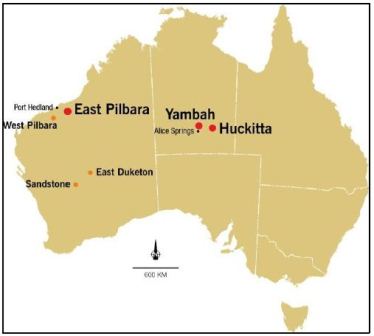
Illogwa is situated on Mithril’s Huckitta project, which is located east of Alice Springs in the Northern Territory.


Project location plan. Source: Company announcement


It lays within three tenements, two of which are subject to a joint venture with Sammy Resources, a wholly owned subsidiary of ASX-listed Cazaly Resources.

Mithril has notified Sammy it has satisfied its earn-in expenditure under the agreement.

Sammy now has 60 days to elect to contribute pro-rata on expenditure going forward or revert to a 1.5 per cent Net Smelter Returns royalty.

Should this be the case, Mithril will take a 100 per cent interest in the project.

Mithril recently announced it the commencement of a 3,800 metre program of air core, reverse circulation and diamond drilling, representing the first ever test of four priority drill targets at Illogwa, as well as multiple conceptual geophysical targets.

“Each of the priority drill targets has significant outcropping copper mineralisation and associated alteration,” Mithril Resources said in its ASX announcement.

“Illogwa represents a newly recognised Proterozoic copper – gold province characterised by a 50 kilometre long belt of structurally deformed granite and sedimentary sequences that contain variable amounts of quartz veining, strong iron and fluorite alteration, and outcropping copper – gold mineralisation.”

Mithril said it anticipates receiving the first results from the drilling program by late August.

Gindalbie shifts first train-load of Karara iron ore

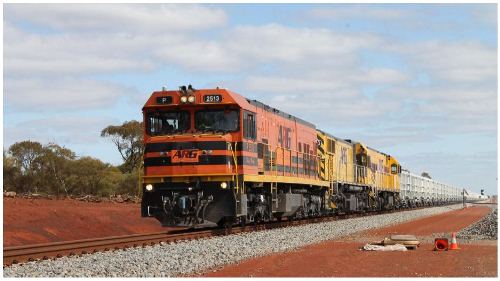
THE BOURSE WHISPERER: Gindalbie Metals has dispatched the first train-load of iron ore from the company’s Karara iron ore project in Western Australia’s Midwest region.

The event is an important one for Gindalbie as it represents the first time the Karara project’s integrated mine and rail logistics chain has been used.

The shipment follows the successful commissioning of a new 85 kilometre rail spur connecting the Karara mine site to the existing rail network in Western Australia’s Midwest region and receipt of all necessary Government approvals to allow ore haulage to begin.


Source: Company announcement

“It’s not every day that Western Australia sees the completion and commissioning of such a significant piece of transportation infrastructure, with our new 85 kilometre long rail spur now linking seamlessly with the existing Midwest rail network,” Gindalbie Metals managing director Tim Netscher said in the company’s announcement to the Australian Securities Exchange.

“With the Karara Export Terminal at Geraldton due to be completed and commissioned shortly, this should provide clear evidence that the Karara project is now in the home straight and is moving inexorably towards production of first magnetite concentrate by the end of September 2012,” he said.

Ore shipped from Karara will be temporarily stored in train cars at Narngulu, just outside Geraldton, while final port works are completed, due to some minor delays to the final completion of the Karara Export Terminal.

Gindalbie said it expects all the remaining work to be completed within the coming weeks.

Once this happens ore will be able to be received at the Karara port storage facility and when sufficient ore has been accumulated to accommodate a full ship load, commercial shipments will recommence.

“This is a good example of the positive flow-on effects that result from the development of a major new integrated resources project such as Karara,” Netscher said.

“Karara has directly invested over $1 billion in new infrastructure in the Midwest region, much of which is common-user infrastructure, which will help unlock the value of the region’s resources for the benefit of the entire State.

“Combined with the investments of other third parties in upgrading and enhancing the existing rail network, the region stands to benefit enormously from the development and delivery of the Karara project.”

More than two million tonnes of hematite lump and fines ore has been stockpiled at the Karara mine site in readiness for the commissioning of the full logistics chain.

The new 85km spur line runs from the rail loop at Karara to Tilley Siding, near Morawa, where it interconnects with the existing 200km railway, owned by Brookfield Rail, providing a fully integrated rail solution for the Karara project.

Brookfield Rail is continuing work to upgrade the existing line from Morawa to Geraldton to enable it to accommodate Karara’s Stage One production of 10 million tonnes per annum (Mtpa) and the anticipated Stage Two expansion to 16Mtpa, which is currently the subject of a Feasibility Study.

Brookfield Rail’s work is currently ahead of schedule to meet Karara’s anticipated ramp-up, and is targeted for completion by the end of 2012.


Perseus re-estimates Edikan Reserves

THE BOURSE WHISPERER: Perseus Mining has updated the Ore Reserves estimate for the company’s Edikan gold mine in Ghana, West Africa.

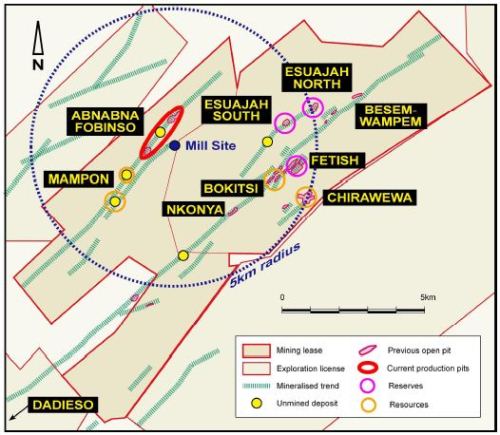
The company has had new pit designs completed for the Abnabna-Fobinso, Esuajah North, Esuajah South and Fetish deposits at Edikan.


Edikan gold mining leases and deposits. Source: Company announcement


Ore Reserves for the four deposits are estimated to be 93.8 million tonnes containing 3.38 million ounces of gold as at June 30 2012.

Perseus’s total Ore Reserves, including the 9.7 million tonnes at 2.1 grams per tonne Ore Reserve at the Sissingué gold deposit, stand at 103.5 million tonnes containing 4.04 million ounces of gold.

Mining is currently taking place at Abnabna-Fobinso and Perseus anticipates the other three deposits will most likely be mined during the next four years.

The Edikan Ore Reserves have only been estimated for these four deposits where the company plans to mine in this time.

“Ore Reserves from the initial four deposits have increased by 3.2 per cent in terms of total contained ounces and 22.4 per cent in terms of contained proven ounces, net of processing depletion of 3.7 million tonnes of ore containing 164,800 ounces of gold,” Perseus Mining managing director Mark Calderwood said in the company’s announcement to the Australian Securities Exchange.

“There were a number of reasons for the modest Ore Reserve increase.

“Allowance for mining cost increases of approximately 10 per cent since the previous Ore Reserve estimate and more conservative pit slopes than the DFS resulted in minimal changes to projected pit depths at this stage, while extra drilling is required to upgrade Inferred Mineral Resources before calculating Ore Reserves for new pits.”

Measured and Indicated Mineral Resources for six deposits at Edikan total 156.3Mt, containing 5.6Moz of gold.

Total Inferred Mineral Resources are 50.6Mt containing 1.7Moz of gold, from nine deposits.

Perseus is carrying out further resource and reserve work on the Bokitsi, Chirawewa, Chirawewa South, Mampong, Dadieso deposits amongst others.

It is also assessing the underground potential of the Esuajah South and the Fetish deposits.

The company said it is continuing to work on long-term initiatives to improve open pit mining methods and equipment selection with the aim of reducing mining unit costs.

“It is expected that a reassessment of the life of mine plan and ore reserve upgrade scheduled for first half 2013 will incorporate results from the ongoing drilling, a review of mining methods, processing improvements and a better understanding of geotechnical and hydrological controls across the site,” Calderwood said.

“Until then we have taken a conservative view on pit designs and haven’t looked beyond the first 12 years of mine life at this stage.

“Our principal long term opportunity at Edikan is to reduce unit mining cost given that we already have one of the lowest processing costs in the industry.

“The company also plans to update the Sissingué Ore Reserve estimate before the end of 2012.”