Will commonsense eventually prevail? Bigger is by no means better

One of the most common sense opinions I’ve heard expressed in the resources sector over recent times came from a North American mining company executive, James Hekseth, who in a presentation recently to a mining association conference panel discussion on mine financing, urged miners not to be pressured into building large mining projects in an effort to keep major investors and mining analysts happy.

James Hesketh is the president and CEO of junior resources play, Atna Resources, who in his commentary suggested that the mining industry is now suffering from an “insane drive for capital raising.”

According to his estimates, less than 25 per cent of mining projects actually get to the feasibility stage, whilst some mining companies are over-capitalizing ore bodies, essentially destroying their economic value by proposing projects that are too large.

“While others are looking for mega capital, we are starting small,” he stated.

Hesketh also urged emerging mining companies to “Stick to your knitting and build what you’ve got.”

Atna is a company that has concentrated on building value from its existing properties.

Atna plans to continue executing its strategy of developing advanced-stage growth projects using the cash flow from existing mines.

I know such comments would be music to the ears of Evy Hambro, the outspoken resources head of the world’s largest find manager, BlackRock.

The group has been harsh critics of mining companies, particularly the heavyweight miners (like BHP Billiton and Rio Tinto) and gold miners (like Barrick and Newmont), who they’ve accused of wasting money on acquisitions and not returning enough cash to long-suffering shareholders.

BlackRock has singled out the gold sector, which the group believes could end a period of dramatic underperformance by ceasing to chase volumes and instead improving returns to shareholders.

The evidence is compelling – the price of gold bullion has soared roughly 500 per cent since 2000 (from less than US$300/oz to around US$1,700/oz), but global gold equity prices have grown at just a quarter of that rate.

BlackRock has rightly pointed to production that has stagnated over the past decade, whilst project quality has deteriorated in the race for ounces.

“It is easy to blame Mother Nature, but… if you look at capital discipline in the industry, it has been appalling,” according to Evy Hambro at a recent London conference.

Most of the gold industry’s production growth since 2008 has come from up-and-coming players in emerging countries such as China.

Meanwhile, the established giants of the gold industry such as Barrick and Newmont have chased lower-grade supply for the sake of scale, whilst they’ve also used cost measurements that in my view don’t fully reflect the actual cost of production.

There is also the issue of poor dividends – the oil sector pays out 45 per cent of profit, whilst the gold sector pays out just 25 per cent.

The 16-member benchmark Arca Gold BUGS Index (which includes all North American heavyweight producers), has risen by 8.4 per cent since early 2008, whilst the price of gold has more than doubled over the same period.

Members of Arca Gold BUGS will pay an average 1.6 per cent dividend yield this year, which compares with an average 3.8 per cent for the STOXX Europe 600 and 2.5 per cent for the 140-member Bloomberg World Mining Index, despite the fact that gold prices have risen for 11 consecutive years.
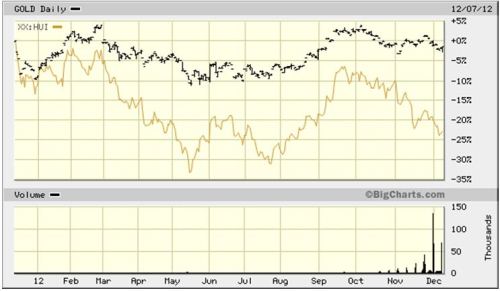
 

Figure 1: Spot Gold Price v Gold Bugs Index – Courtesy BigCharts

One of the key factors in the underperformance is rising cash production costs (which are crimping margins) – the average cost per ounce of gold for large producers has advanced for nine consecutive years and rose by 23 per cent  during 2011 alone to $584.70, according to data compiled by Bloomberg.

In reality the average overall production cost is most likely close to double this estimate.

Evy Hambro has demanded that gold companies stop “misleading” investors with their focus on cash costs and come up with new measures that show the total “all-in” costs including capital.

“The worst thing that could possibly happen is if the gold price went up because that would take the pressure off management to take hard decisions,” Hambro said.

According to Bloomberg data, up until around 2005 gold mining companies typically boasted valuations that were more than twice those of other mining companies.

The forward price-earnings (PE) ratio of gold miners was 30 to 35 during 2005/06, compared with less than 15 for world equities.

The situation has now however switched, with gold miners currently at 10 versus around 12 for global equities.
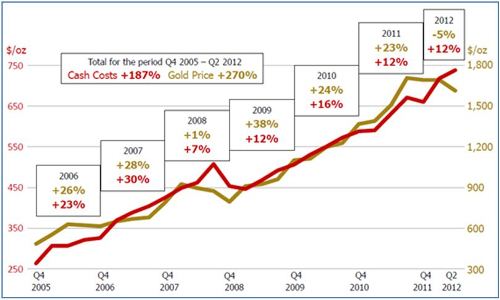
 

Figure 2: Rising Gold production Costs – Courtesy Thomson Reuters GFMS

Certainly mining company executives are feeling the pressure, with Newmont Mining CEO Richard O’Brien to step down from 1 March next year as the company looks to boost production amid rising costs.

BHP Billiton has also announced that it is looking for a new chief, whilst Anglo American’s CEO Cynthia Carroll stepped down from her position in October.

Newmont is probably one of the best – or worst examples (depending on your perspective) of an under-achieving gold company.

For the first half of this year, Newmont reported attributable gold production of 2.49 million ounces, down from 2.56 million ounces for the same period last year.

Meanwhile, net income of $294 million for the second quarter ($0.59/share) was down massively from $445 million ($0.90/share).

The mining industry cannot afford to be complacent.

Years of strong commodity prices and robust demand have unfortunately encouraged laziness and ineptitude in some instances, whilst also masking poor management decision-making.

At the end of the day shareholders have every right to demand higher returns from a sector that has experienced boom times, yet in many instances has disappointed.

Whether miners will have the intestinal fortitude to concentrate on earnings and returns rather than size, remains to be seen.

Perhaps tough economic circumstances will assist management in reaching the right conclusions, as project funding is increasingly difficult to source and will likely remain so for the foreseeable future.

Perhaps the management of miners will realize that bigger isn’t necessarily better?


Gavin Wendt is the founder of MineLife, publisher of the MineLife Weekly Resource Report

2012 – A tough year for investors and explorers

If you weren’t invested in CSL Limited (ASX: CSL), The Commonwealth Bank, (ASX: CBA), Telstra (ASX: TLS) and/or Sirius Resources (ASX: SIR) it’s been a pretty tough old year in the investment community.

CSL is up 66.25 per cent, Telstra is up 30.3 per cent, and CBA is up 23.75 per cent.

These three stocks would have also given their shareholders dividend yields of: 6.8 per cent for CBA if you bought at the start of the year; 8.4 per cent for Telstra; and CSL would have given you 2.6 per cent for the year.

These yields were for the purchaser if they bought these stocks on January 2nd, 2012.

The bonus would have been the imputation credits that you were entitled to from Telstra and CBA.

In Resources Land, the standout performer was undoubtedly Sirius Resources.

On 25 July 2012 the stock closed at 5.7 cents, it is now trading around $2.

Capital appreciation for this is 3510 per cent.

Now to coin a phrase from a much advertised credit card commercial, that is priceless.

It can happen, but in resource exploration it’s very unlikely.

For every Sandfire Resources (ASX: SFR), Sirius or Western Areas (ASX: WSA), there are hundreds of companies that don’t strike it rich.

Additionally, with regards to Sirius and Sandfire the drill campaigns were the last roll of the dice in those respective areas.

In Sirius’ case, the Nova deposit was discovered at the back end of $20million exploration spend in the Fraser Range.

Both discoveries have ignited areas that had been considered in the past, but not necessarily for the mineral that was actually discovered.

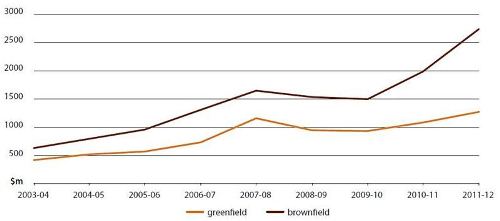
According to the Bureau of Resources and Energy Economics (BREE), expenditure on mineral exploration activities increased in recent years, however, it is a spend which has not been equally distributed between Greenfield and Brownfield sites.


Greenfield Vs Brownfiled exploration spend 2003-04 to 2011-12. Source: BREE

For those unfamiliar with the vernacular, Greenfield sites are areas that have been subjected to minimal exploration activity, if any, while Brownfield sites usually have operating mines in the region with supporting infrastructure and exploration activity is generally undertaken in an effort to identify additional resources.

BREE statistics for the past two years indicate most of the growth in exploration expenditure has been at Brownfield sites with Brownfield exploration expenditure in 2011–12 totalling $2.8 billion, an increase of 38 per cent from 2010–11 (in 2012–13 prices).

Over the same period, Greenfield exploration expenditure increased 17 per cent to $1.3 billion.

Exploration is a tough gig, and many more people have lost money looking for minerals than have found them.

That job is made even more difficult when the current governments have no empathy for minerals exploration, and their first consideration is to tax the industry instead of helping it.

There is no doubt an exploration rebate is long overdue for Australian exploration companies, akin to the Canadian system.

The numbers crunched by BREE show the average cost per metre drilled at Greenfield and Brownfield sites have converged over the last eight years and are now at similar levels.


Cost per metre drilled 2003-04 to 2011-12 (2012-13 Australian dollars). Source: BREE

The Bureau puts this down to the cost of Greenfield exploration increasing faster than the cost of Brownfield exploration.

While this may have led to a rise in exploration activity due to the cost per metre drilled for the two types of exploration having been relatively similar, it has also resulted in Brownfield exploration, in terms of both metres drilled and expenditure, growing at a substantially higher rate.

“The different growth rates in exploration metres drilled, particularly since the Global Financial Crisis in 2008–09, indicate the tendency of mining and exploration companies to focus on Brownfield sites,” BREE said.

“In part, this is because Brownfield sites typically have a lower development cost compared to Greenfield developments.”

It’s obvious to everyone in the real world that mining helped Australia avoid a recession twice recently, and without encouragement for new discoveries, the mining industry has been looking at other municipalities for future investment.

This is particularly the case for the smaller sector.

Truth be told, a lot of Aussie exploration companies would like to explore in their back yard, but the current impediments make it more likely that they will head offshore.

The history of the exploration success via Mark Creasy, Graeme Hutton and Lang Hancock may just be that if exploration companies and prospectors are not given further incentives to help find the next Nova.

The big companies are the lifeblood of the mining industry, as they are the ones that still spend when the market gets tough.

But smaller companies are generally pushing the proverbial uphill with regards to exploration spend, and they have only one source of funding.

This funding dries up when the going gets tough, and tax deductions for investors would make that funding easier.


Peter Hayes
Investment Manager


Corazon Mining maintains nickel focus amid new acquisitions

THE INSIDE STORY: To simply describe 2012 as hectic for Australian exploration company Corazon Mining (ASX: CZN) would be understating the company’s achievements.

While continuing to develop its Lynn Lake nickel asset in Canada, Corazon took advantage of opportunistic market conditions in 2012 to add new, quality projects to its portfolio.

These included the Canadian Beaucage Lake gold project and the recently-announced option to acquire the copper-gold Top Up Rise (TUR) project in Western Australia.

The new additions complement Corazon’s core focus to advance its Lynn Lake nickel-copper project, which the company believes represents a significant development opportunity.

Lynn Lake is a historical nickel, copper and cobalt mining camp which operated for more than 20 years.

The project’s exploration upside was boosted after Corazon discovered high-grade mineralisation beneath the old EL Mine, which also boasts defined near-surface mineralisation beneficial for any new mining operation.

The EL Mine was one of the highest grade nickel mines in the district, operating between 1954 and 1962 and producing 1.9 million tonnes at 2.5 per cent nickel and 1.15 per cent copper.

Corazon has estimated an interim Inferred Resource for the EL Deposit at Lynne Lake of 1.8 million tonnes at one percent nickel equivalent, including contained metal of 14,000 tonnes nickel, 9,000 tonnes copper and 400 tonnes cobalt at a cut-off grade of 0.6 percent nickel equivalent.

“We’re very much committed to nickel and to our Lynn Lake project in Canada,” Corazon Mining managing director Brett Smith told The Inside Story.

“We have a resource, and we also have significant drill-defined tonnages at surface that aren’t included in the resource, which we consider to hold potential to more than double the resource tonnage.

“We have conceptual open-cut mining studies that identify some 2 to 3 million tonnes of surface material that is not included in our resource.

“These factors will be key to starting up a mining operation in the Lynn Lake area.”

Testament to its commitment to Lynn Lake, Corazon renegotiated its Earn-In and Option agreements to acquire the project and expanded the project area.

The original agreement provided Corazon an option to acquire 100 percent ownership of the project by spending CAD$3 million on exploration and paying CAD$2 million in cash prior to 20th October 2012.

The new deal extended the option period to 20th October 2015, reduced the purchase payment to CAD$1 million and added the South Plug nickel-copper target and Barrington Lake copper deposit to the project.

The South Plug nickel-copper target is located immediately south of Corazon’s land holding and contains a differentiated mafic/ultramafic intrusion similar to those hosting the Lynn Lake mining camp nickel-copper deposits.

The Barrington Lake copper deposit is located 43 kilometres east-northeast of Lynn Lake.

Exploration activities conducted on Barrington Lake in the 1990’s defined copper mineralisation and numerous geophysical anomalies, which have never been subjected to any follow-up drilling.

Most of the historic attention at Barrington Lake focused on an outcropping zone of approximately 107m in strike and 4.6m in width, with an average grade of 2.63 percent copper.

Corazon also added a Canadian gold project to its portfolio in a strategic move to maximise its activities in the Lynn Lake region.

Corazon acquired the Beaucage Lake gold project, located 45km from the Lynn Lake project in a region hosting several one to two million ounce gold deposits.

“The Beaucage Lake acquisition wasn’t one that we deliberately pursued,” Smith explained.

“It was more opportunistic as exploration and investment activity in Canada has not been as enthusiastic as it has been in Australia recently.

“A great number of projects are becoming available and Beaucage Lake was one in which we see great exploration potential.

“It is located nearby to Lynn Lake so it provides us with an additional exploration focus that complements our other Canadian assets.”

Extensive high-grade gold mineralisation has previously been identified at surface at Beaucage Lake over a 7 to 8km strike length.

Corazon is currently compiling all available historical data for the project with a view to applying modern exploration techniques to define drill targets.

“The data accompanying the acquisition dates back to the 1980s and, not being digital, is difficult to reference,” Smith explained.

“As such, we have to get all that old information into new-world order.

“There is a lot of information including numerous high-grade gold drill results that have never been put together and looked at the way we are looking at them.”

In October, Corazon secured an option to earn up to 75 percent of private company Border Exploration, which owns 100 percent of the Top Up Rise project in Western Australia.

The TUR project is located in the Gibson Desert region of north-eastern Western Australia and is prospective for large gold-copper intrusive related deposits, similar in style to Olympic Dam, Prominent Hill and Carapateena.

The primary target identified at TUR is an unexplored gravity anomaly, which presents one of the largest amplitude residual gravity anomalies in Australia.

Exploration work conducted by Border defined the core of the anomaly to be 8km by 4km in area, which is similar in size to Olympic Dam’s geophysical anomaly.

Other exploration work at TUR has been conducted by the Australian Geological Survey Organisation and the Geological Survey of Western Australia.

This work identified a granite intrusive and alteration complex at Mt Webb, which was described as being, “large by Australian standards”, with, “characteristics of world class copper-gold systems”.

The impetus to conduct the deal came from Corazon’s broker, Hartleys, which considered the project to be an ideal joint venture for the two companies.

Smith, a director of Corazon and Border, initially believed the TUR project was more suited to development by a larger company, and was cautious in pursuing the joint venture option.

“Border’s intention was to advance the project as a private entity,” Smith said.

“Border had expressions of interest in the project from other companies, but considered it was too early for such a deal and that Border would be able to inexpensively add a lot of value to the project on its own.

“The success of early stage exploration plays such as De Graca for Sandfire and Nova for Sirius was definitely a catalyst for both Corazon and Border recognising a mutually beneficial joint venture.”

Smith stressed Corazon’s latest raft of acquisitions do not signal a shift away from the company’s chief focus – nickel.

“When you look at our Lynn Lake nickel-copper sulphide project in Canada, it is obvious nickel remains our most valuable metal, but it’s well supported by the early-stage exploration plays,” he said.

“When we extended the option on Lynn Lake we also picked up the Barrington Lake copper project and soon after completed the Beaucage gold project deal.

“These project areas in Canada also include a multitude of VMS targets containing lead, zinc and gold mineralisation.

“The reality is that Corazon’s assets already have numerous prospects containing various metals, so it’s not as if we’re chasing anything new.

“The only really obvious deviation for Corazon as far as the TUR project is concerned is that it is located in Australia, our own backyard.

“We are a small company, conscious of the cash we have and how we can preserve that cash and diligently work all the opportunities within our portfolio.
 
“2013 will be a very busy year for us.”


Corazon Mining Limited (CZN)
…The Short Story

HEAD OFFICE
Level 1
350 Hay Street,
Subiaco  WA  6008

Ph: +61 8 6364 0518   
Fax: +61 8 6210 1872

Email: info@corazon.com.au
Web: www.corazon.com.au

DIRECTORS and MANAGEMENT

Clive Jones, Brett Smith, Jonathon Downes, Adrian Byass

MAJOR SHAREHOLDERS

Top 20                 30.44%
Macquarie Bank Ltd.         5.89%
The Board                 5.19%

UBS Wealth Management     3.10%


Mutiny Gold shores up new project funding

THE BOURSE WHISPERER: Mutiny Gold (ASX: MYG) has struck a financing agreement with Canadian Institution, Sandstorm Gold (TSX: SSL) for $41 million (US$43 million), which the company indicated is pivotal to meeting the $102 million financing requirements needed to bring its Deflector gold-copper project in the Murchison region of Western Australia into production by Q4 2013.


Mutiny Gold tenement location. Source: Company


The agreement is for a US$43 million Metals Purchase Agreement with Sandstorm Gold comprising US$38 million in upfront payments, US$5 million in equity and a possible additional US$4 million in performance based payments.

The latter is intended as supplemental finance for plant expansion in year 3 of mining at the Deflector project.

Sandstorm has agreed to purchase an amount equal to 15 per cent of the gold produced from Deflector.

Sandstorm will make an initial upfront cash payment to Mutiny of US$9 million and will make a future cash remittance of US$29 million once Mutiny has received final mine permits for Deflector as well as completed certain funding conditions.

In addition, Sandstorm will make ongoing per ounce payments equal to the lesser of US$500 per ounce of gold and the prevailing market price of gold.

If Deflector produces more than 85,000 ounces of gold in a given year, Sandstorm will make a one-time US$4 million payment to Mutiny.

“As the first Australian company to negotiate a transaction of this type with Sandstorm, which we believe in itself is a strong endorsement of Deflector and our broader strategy, Mutiny has broken new ground in this innovative form of project funding,” Mutiny Gold managing director John Greeve said in the company’s announcement to the Australian Securities Exchange..

“Working in conjunction with our advisors Noah’s Rule we have been able to negotiate the Metals Purchase Agreement in a way that has made it highly complementary to traditional project finance, rather than as an alternative, as it is often seen.

“The process has not been without its challenges and has taken longer than we expected but we hope existing shareholders will be delighted with the outcome in terms of the equity dilution avoided.”

Mutiny highlighted what it considers to be an important feature of the MPA being its right, but not obligation, for a period of 36 months from the date of the Second Deposit, to repurchase in whole or in part, up to 50 per cent of the Gold Stream by making a payment equal to the greater of US$24.7 million or the value of 14,742 gold ounces, whereupon the percentage of gold that Sandstorm is entitled to purchase shall be decreased from 15 per cent to 7.5 per cent.

“This is a very positive move for Mutiny, as we have now created the platform which encompasses the majority of the funding requirements for Deflector,” Greeve said.

“This is completely in line with our stated objective to minimise overly dilutive equity issues while progressing Deflector.

“Our next steps will see us continue to resolve the outstanding administrative matters required for final funding of both the Metals Purchase Agreement with Sandstorm and the Bank Project Financing, as we move to production.

“We have also discussed ongoing collaborative development funding arrangements with Sandstorm which could cover our future expansion plans.

“There is the potential for a high degree of mutual interest between Sandstorm and Mutiny in supporting our strategy of bringing online a pipeline of gold and copper mines.

“This is not limited to Deflector and may include future asset acquisitions.”

Sandfire moves first shipment of DeGrussa copper

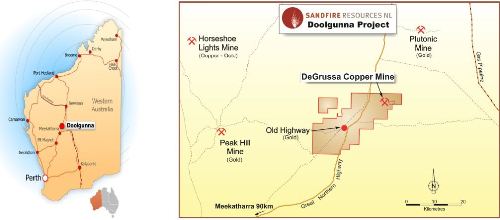
THE BOURSE WHISPERER: Sandfire Resources (ASX: SFR) has sold its first shipment of copper concentrate from the company’s 100 per cent-owned DeGrussa copper-gold mine in Western Australia.


DeGrussa copper mine location. Source: Company announcement


The maiden shipment comprised 4,958 dry tonnes of copper concentrate grading approximately 22 per cent copper and was produced as part of the commissioning process for the 1.5 million tonnes per annum DeGrussa concentrator.

The company explained this lower grade commissioning concentrate is being produced and sold on a spot basis ahead of its main copper concentrate sales contracts, which are scheduled to commence in January 2013.

To date Sandfire has moved 10 shipments of high-grade Direct Shipping Ore (DSO) chalcocite from the open pit at DeGrussa, totalling 98,489 tonnes grading 28 per cent copper containing 27,555 tonnes of copper metal.

Mining of Stage I of the open pit is now complete with all DSO chalcolcite mined.

Mining of Stage II will continue into mid-2013 extracting further sulphide and oxide copper material.

Sandfire has also inked a further three sales contracts for DeGrussa’s copper concentrate, increasing its total number of sales contracts to four.

The sales contracts, for up to 3-year terms, have been signed with international trading companies and smelters.

Shipments under the sales contracts are scheduled to commence in January 2013 as the company completes its production ramp-up.

“Plant commissioning and production ramp-up at DeGrussa is proceeding with the company on track to achieve steady-state nameplate production rates of 77,000 tonnes per annum of copper in concentrate in early 2013.” Sandfire resources managing director Karl Simich said in the company’s announcement to the Australian Securities Exchange.

“Our first shipment of copper concentrate is another pleasing milestone for our project development team, and represents another great achievement.”

Simich went on to explain Sandfire now has product sales agreements in place, which cover the bulk of its forecast near-term production from DeGrussa.

“Over the next few months we plan to complete production ramp up, ready to commence full scale commercial shipments in the New Year,” he said.

Viking scores second high-grade gold hit at Akoase

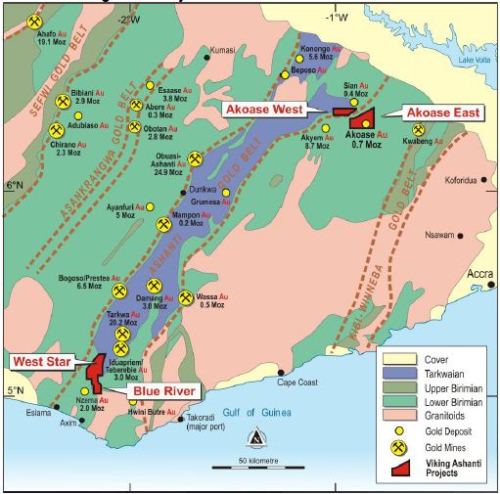
THE DRILL SERGEANT: Perth-based Viking Ashanti (ASX:VKA) has reported a second high-grade gold hit over 20 metres down hole width and at shallow depth from drilling conducted at the company’s Akoase gold project in southern Ghana, West Africa.


Project locations in Southern Ghana. Source: Company announcement


According to Vikings announcement to the ASX the intersection was achieved at the Alimac prospect and returned:

–    20.6 metres at 4.42 grams per tonne gold;

This was contained within a broader altered and mineralized zone of:

–    39.6m at 2.71g/t gold, at a depth of 70m vertically below surface.

The latest intersection follows another hole Viking reported in March this year at Alimac, which recorded a high-grade intersection of:

–    31m at 7.84g/t gold at less than 100m depth – the thickest and highest grade drill intersection recorded to date on the Akoase project.

The most recent hole was part of a 10 hole program of Reverse Circulation (RC) and diamond drilling Viking completed in mid-November, targeting down dip and along strike extensions of the higher grade mineralization intersected by previous early 2012 drilling at the Alimac prospect.

The company has received assay results from the first four RC precollared diamond holes drilled.

Two additional holes have also returned encouraging grade and width intersections including:

–    4.7m at 3.04g/t gold and 6m at 1.91g/t gold; and

–    7m at 2.39g/t gold and 4m at 1.65g/t gold.

Viking said these intersections have confirmed extensions of the mineralisation below existing drilling for at least a further 50 metres down dip.

The fourth hole intersected 2m at 2.44g/t gold at the bottom of the hole, before being terminated prematurely, before passing through the target zone, due to drilling difficulties.

Viking said it expects to receive results for the remaining six holes in the next two weeks.

IPO Watch

UPCOMING FLOATS: Who’s due to list on the boards of the Australian Securities Exchange and what they’re all about.

Enterprise Uranium Limited
Proposed ASX code:     ENU
Proposed listing date:     12 December 2012

Western Australia-based Enterprise Uranium is focused on uranium exploration in Australia with an objective to discover and develop one, or more, ‘Tier 1’ uranium resources.

The company was incorporated by its former parent company Enterprise Metals in August 2012 after its Board decided to demerge its uranium assets into the new entity.

The demerger was approved by Enterprise Metals’ shareholders in October.

The purpose of the IPO is to expand Enterprise Uranium’s shareholder base, with the company hopeful of one or two cornerstone investors coming on board.

Enterprise Uranium hopes to raise sufficient funds to conduct uranium exploration and drilling programs on its project areas.

The Enterprise Metals demerger resulted in the company picking up five uranium projects, some of which include other, secondary commodities.

All of the company’s current projects are located on the Yilgarn Craton in Western Australia.

Proposed exploration for the first year will focus on targets the company has generated from geophysical data, including magnetics, radiometrics and airborne electromagnetics.

Enterprise Uranium anticipates following up results from the first year activities with infill and step out drilling programs.

The company is looking to raise $5.1 million through the issue of 25.5 million shares at 20 cents each.


Source: Australian Securites Exchange

Geocrystal Limited
Proposed ASX code:     GEO
Proposed listing date:     17 December 2012

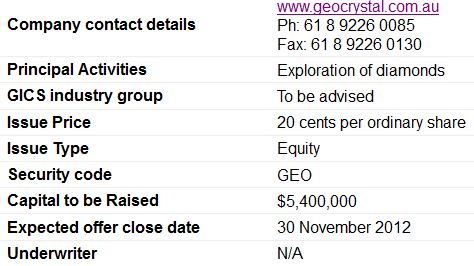
GeoCrystal Limited is focused predominantly on diamond exploration and discovery in Australia.

The company has assembled a portfolio of diamond projects in Australia and is searching for old volcanic pipes containing diamonds known as kimberlites.

GeoCrystal has negotiated a farmin arrangement over the Webb diamond project located in the remote Gibson desert region in Western Australia.

According to GeoCrystal the Webb project has never been explored on the ground for diamonds before and contains a cluster of 50 discrete, circular magnetic features, which the company considers may represent a kimberlite field, similar to kimberlite fields found elsewhere in the world.

This project has been earmarked by GeoCrystal as a priority for a drilling program once it has successfully listed on the ASX.

Any drilling is subject to permits being obtained to enter, what is Aboriginal Reserve land.

GeoCrystal also owns a tenement application over a diamond project at Beta Creek located in a known diamondiferous province in the North Kimberley Region of Western Australia.

Diamonds have been found in Beta Creek channels and in neighbouring streams that GeoCrystal indicated require exploration to find the diamond source.

In the Northern Territory of Australia, GeoCrystal has acquired a majority interest in the Moroak diamond project where diamondiferous kimberlite rocks were discovered previously by De Beers.

Moroak is modelled on the Merlin diamond field in the Northern Territory which became a renowned producer of large, good quality white diamonds and produced a 105 carat diamond, Australia’s largest.

The company also owns the Ruby Plains property located in the East Kimberley region of Western Australia, which it considers to be prospective for old buried river channels containing deposits of diamond and gold.

The company also considers the property to have potential for kimberlite occurrence.

GeoCrystal is raising a minimum of $3.5 million through the issue of 17.5 million shares and up to $5.4 million through the issue of 27 million shares at 20 cents each.


Source: Australian Securites Exchange

Disclaimer:  The above information is not investment advice. The Roadhouse accepts no responsibility for
investments made from this information.

Silver Lake continues to de-construct Eelya Complex

THE DRILL SEREGANT: Silver Lake Resources (ASX: SLR) has provided an update on drilling activities from an ongoing $20 million exploration program targeting copper and other base metals within the Eelya Complex, part of the company’s Murchison project located 600 kilometres North of Perth.

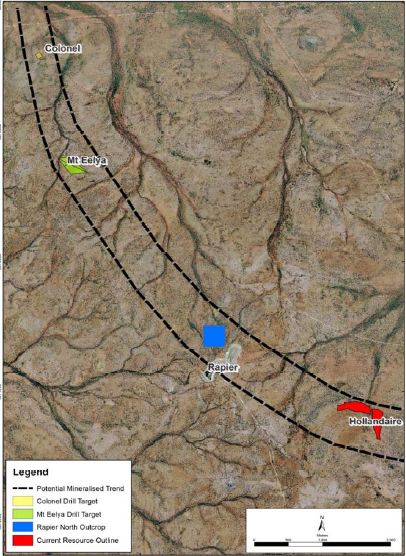
Silver Lake commenced drilling at the Eelya Complex in September 2011, during which time it has encountered mineralisation along a mineralised corridor including the Hollandaire, Mount Eelya and Colonel deposits.


Ariel view of potential mineralised trend north of the Hollandaire deposit. Source: Company announcement


“We are confident that the current resource at Hollandaire is the catalyst to commence the pre-feasibility study which is further complemented by the ongoing drilling campaign, which has intersected mineralisation along a 10 kilometre trend” Silver Lake Resources managing director Les Davis said in the company’s announcement to the Australian Securities Exchange.

“The Eelya complex has the potential to further enhance the economics of our Murchison gold project with expanded gold production, copper and other base metal credits which can be processed at a marginal capital and operating cost at the nearby gold mill.

“We have drilled less than 100 holes in a 50 square kilometre area that is already showing to be well endowed with base metals.”

Recent assay results received from drilling at the Hollandaire deposit include:

–    5.4 metres at 4.5 per cent copper, 0.6 grams per tonne gold and 27 grams per tonne silver from 102 metres;

–    6.7m at 3.1 per cent copper, 0.3g/t gold and 16g/t silver from 93m; and

–    13.7m at 2 per cent copper, 0.2g/t gold and 6g/t silver from 254m (deepest drill hole to date).

Silver Lake said the Hollandaire copper resource sits below gold mineralisation that extends from the surface down to approx. 50 vertical metres depth.

It has an inferred resource totalling 2.8 million tonnes at 1.6 per cent copper, 0.4g/t gold and 5g/t silver with a supergene zone averaging 4.7 per cent copper.

The mineralisation remains open to the south west and at depth.

The company indicated it anticipates results from the pre-feasibility to be announced in the June 2013 quarter.


Upcoming Floats

UPCOMING FLOATS: Who’s due to list on the ASX this week and what they’re all about.

Zeus Resources Limited
Proposed ASX Code: ZEU
Proposed Listing Date: 6 December 2012

Zeus Resources has obtained a cornerstone investment from Zhengyuan International Mining Co. Ltd, which is a wholly-owned subsidiary of Chinese State Owned Enterprise, China Metallurgical Deology Bureau, one of the largest multi-commodity mineral exploration, development and mining organisations in China.Zeus was formed to explore for uranium, principally in Western Australia, however, it now proposes an active project generation and acquisition program for a range of commodities, in WA and beyond.

The company has assembled an initial tenement package – inclusive of exploration licences and EL applications – covering approximately 5,700 square kilometres, comprising seven uranium exploration projects.

Zeus describes these to range from being projects with existing drill targets and prospects for defining a resource within 12 months to others that are grassroots with upside potential.

Tenemnts holdings are located at Narnoo in the vicinity of the Mulga Rock discoveries as well as a previously unexplored holding in the Musgraves area.

The portfolio is rounded off by two projects in the Gascoyne province.

Zeus is looking to raise approximately $11 million through the issue of 67.7 million shares at 20 cents per share.


Source: ASX


Paringa Resources Limited
Proposed ASX Code: PNL
Proposed Listing Date: 7 December 2012

Paringa Resources has interests in gold, gold-copper and graphite exploration projects in Brazil.

The company claims its goal is to build a successful resource company through the exploration and future exploitation of these projects.

A key focus is on exploration at the Minaçu gold project, which has been subject to several historical gold workings.

These have been mined by artisanal miners for approximately 120,000 ounces of gold in the 1980’s and 1990’s.

The project area has had limited exploration since the 1990’s and Paringa’s two year exploration program is based on the existence of gold occurrences and deposits, regional geological features, gold anomalies, presence of gossanous material and quartz veins.

The São Luis gold project in northern Brazil lies within the São Luis Craton, which is the extension of both the Guyana Shield (known gold endowment of over 100 million ounces) and West African Craton.

The Paringa tenements cover a strike length of areas of high-magnetic relief and overlie the interpreted extension to Proterozoic greenstones and structures associated with major gold deposits and occurrences.

The company says its intends to carry out a progressive two-phase exploration program at the São Luis gold project.

Brazil is responsible for approximately 7 per cent of the global graphite production and approximately 26 per cent of production outside of China.

Paringa has two graphite projects, the Santo Antônio de Pádua graphite project and the São Fidélis graphite project – both located in northern Rio de Janeiro State.

Subject to exploration licenses being granted, Paringa intends to carry out a two year exploration program including geological structure mapping, rock-chip sampling, and preliminary petrography and trenching to sample mineralised zones.

Paringa boats a management team with proven corporate, exploration, project development and production track records, which it says will take a disciplined approach to maximise the value of the current portfolio and increase shareholder value through future growth.

Paringa is seeking to raise approximately $10 million through the issue of 33.3 million shares at an issue price of 30 cents each to provide funds to achieve its immediate objective of exploring the current portfolio and to develop a strong project pipeline.

Source: ASX

Disclaimer:  The Roadhouse accepts no responsibility for
investments made from this information.

What the Brokers say

WHAT THE BROKERS SAY: Interesting news and views from across the Resource Analyst universe


 Celamin Holdings NL (ASX: CNL)

Celamin Holdings NL is focused on the exploration and development of resource projects in North Africa, initially in Tunisia and Algeria.

The company’s immediate focus is the advanced Chaketma phosphate project (CNL 80 per cent, reducing to 50 per cent at development stage) held in partnership with local company, Tunisian Mining Services SA (TMS).

Celamin is advancing the Chaketma project with a Definitive Feasibility Study and has production targeted for early 2015.

Celamin has also acquired rights to several base metal tailings projects in Tunisia with TMS and is farming in to an Exploration Permit with base metal (lead-zinc) targets in Algeria.

The Chaketma phosphate project has quickly advanced to become a potential ‘company maker’ for Celamin and was recently the subject of a positive scoping study completed by experts Direct Mining Services Pty Ltd.

The success of this study led Celamin to proceed immediately to a Definitive Feasibility Study (DFS).

The maiden JORC-compliant Inferred resource containing 37 million tonnes at 21.0 per cent phosphate covers just one of seven prospects at Chaketma.

Earlier investigations estimated the potential for a substantial “Pre-Resource Mineralisation” of approximately 229 million tonnes at 20 per cent phosphate.

The Chaketma scoping study indicated an economically robust and viable project with a (pre-tax) US$605 million NPV, IRR of 28 per cent, capex of US$364 million, a payback of 3.5 years and a potential mine life of over 50 years on maximum output of 1.5 million tonnes per annum phosphate concentrate.

The project is located in a mature phosphate mining province and is close to existing infrastructure and Euro markets.

Strong demand for fertiliser commodities, such as phosphate, is expected to continue as a result of global population growth and the shortage of arable land for increased food needs.

Recommendation: Speculative BUY


Monadelphous Group Limited (ASX: MND)

Monadelphous Group Limited provided revenue guidance for FY13 to “be about 25 per cent” but “margins are coming under pressure in this more competitive environment.”

The company also said that 1H revenue was 40 per cent above pcp [prior corresponding period].

Guidance implies 1H revenue of $1.23 billion and 2H revenue of $1.15 billion.

Given the history of conservatism and the building momentum in oil and gas construction, we believe the guidance of 25 per cent revenue growth for FY13 is too conservative, and we have revised our estimates to approx. 30 per cent growth.

We have lowered our FY13 EBITDA margin estimate to 9.7 per cent and our NPAT estimate is now $152.3 million.

We expect a dividend of 140 cents per share (upside risk).

We expect 1H13 NPAT of $77.6 million and an approx. 65 censt per share dividend.

For FY14, we assume approx. 9 per cent revenue growth, NPAT of $156 million and a dividend of 150 cents per share (payout ratio approx. 88 per cent).

The simplicity and consistency of the MND accounts make them relatively simple to analyse.

The high returns (approx. 56 per cent ROE, 20.4 per cent ROA), low capital intensity, track record of earnings delivery, established and meaningful maintenance and infrastructure divisions (ie recurring revenue) give us confidence in near term earnings performance.

We have a fundamental valuation for MND of $23.11, which is based on MND growing top-line by 9 per cent per annum for the next five years to approx. $2.9 billion by FY17 and then maintaining that level into perpetuity.

Our Gordon growth model valuation is $28.50 including value for franking credits suggesting there is decent value for long term holders (we have reduced our DDM cost-of-equity assumption to 8 per cent).

We have a $25.44 twelve month price target which puts a large emphasis on the dividend stream from MND.


Recommendation: We are upgrading to a Buy (from Accumulate).


Disclaimer: The above is intended as a guide only. The Roadhouse accepts no responsibility for investments made from this advice.