Goldphyre to commence drilling at Lake Wells project

THE BOURSE WHISPERER: Goldphyre Resources has advised the Australian Securities Commission that RC and AC drilling is to commence next week on the Axford prospect at the Lake Wells project, 160 kilometres north-north east of Laverton, Western Australia. 

The combined drilling program proposed is 76 holes for 3,200 metres.


 Lake Wells-Yamarna Region showing Goldphyre project areas and targets. Source: Company announcement

A track-mounted drill rig has been secured to test shallow, historic drill-hole gold anomalies at the Axford prospect.

Historic gold anomalism has never been followed up adequately at depth or along strike and no Reverse Circulation (RC) drilling has been completed on the project area. 


Recent gold-in-hole anomalies generated by Goldphyre will also be tested in the drilling campaign.

Cuesta Coal completes exploration drilling at Amberley

THE DRILL SERGEANT: Cuesta Coal  has reported completion of its resource expansion drilling program at the company’s 100 per cent-owned Amberley project located in the Clarence-Moreton Basin in Queensland. 

Fourteen open holes and three cored holes were completed for 2,040 metres of drilling.

All holes have been geophysically logged, surveyed and rehabilitation work is underway.


Drill hole locations of the current round of drilling by Cuesta. Source: Company announcement

The results from the drilling indicate that banded coal seams are present at less than 150 metres from the surface.

Samples collected from the coring activities have been sent for analysis and results are expected in the next six to eight weeks.

Highlights of coal intersections include:

  •         Cumulative coal thickness of 16.98 metres to a depth of 136.7 metres in cored hole AM016C
  •         Cumulative coal thickness of 8.0 metres to a depth of 57 metres in open hole AM007
  •         Cumulative coal thickness of 12.2 metres to a depth of 114.7 metres in open hole AM0014 


Cuesta’s technical team is now mobilising to the Eastern Galilee project for a planned 20 hole drill program that will occur over eight to twelve weeks.

“We were particularly encouraged by the presence of coal close to surface at Amberley and look forward to updating shareholders on a potential resource expansion,” Cuesta Coal’s managing director, Matthew Crawford commented in the company’s release to the ASX.

High-grade gold hits at Tandarra

THE DRILL SERGEANT: Gold and base metals exploration company Navarre Minerals has reported multiple zones of high-grade gold mineralisation between 20.1m and 49.2m down-hole in diamond drill hole DDT001 at the Tandarra prospect, part of the Bendigo North Project, located 40 kilometres north of Bendigo, Victoria, Australia.  


Initial results from DDT001 recorded the following shallow, high-grade drill intercepts from within a down-hole interval of 29.1m, which includes several zones of core loss as a result of drilling action through soft, weathered, near- surface rock:

  •         1.3 metres at 18.1 grams gold per tonne, 0.7 metres at 28.6 grams gold from 20.1 metres down-hole
  •         0.8m at 5.6g gold per tonne from 35.7m
  •         0.5m at 10.5g gold per tonne from 36.9m
  •         0.7m at 3.6g gold per tonne from 45.1m

 These initial results are from the first diamond drill hole completed on the Tomorrow line of reef.

Further assay results are awaited from this hole and a further six diamond holes. 


Location map of the Tandarra project. Source: Company announcement

“This result is further confirmation of the shallow, gold-bearing quartz reefs we are discovering at this prospect,” asserted Navarre managing director Geoff McDermott in the company’s release to the Australian Securities Commission.

“Logging of the diamond core has revealed further evidence of the similarities of the geological structure and gold bearing reefs under cover at Tandarra and the Bendigo Goldfield, 40 kilometres to the south.”

“Although the diamond drilling program was specifically designed to confirm structure for the geological model, the intersection in DDT001 is pleasing as it not only confirms the local structures, but also demonstrates some strong gold intersections within shallow distance from the surface,”  McDermott said.

Navarre also reported further broad zones of gold mineralisation occurring close to surface from reverse circulation drilling.

The company said it was pressing ahead with modelling the geology and will soon embark on the initial stages of conceptual mining studies, which would give them the preliminary economics of building a potential open pit mine.

“It is too early to pre-empt the results of the studies, but the diamond results support our confidence in the potential for a mineral resource, while at the same time providing further evidence of high grades within broad zones of gold mineralisation,” commented McDermott.

Open pit mining to commence at Black Reef

THE BOURSE WHISPERER: 
Gold-focused exploration and mining company Octagonal Resources has announced it has received regulatory approval to mine a 200,000 tonne open pit on the Black Reef at Wehla in Central Victoria, with mining activities commencing during July and the first gold production expected during September. 


Octagonal’s projects are located in the under-explored areas of two of Australia’s most significant gold producing regions; the Central Victorian Goldfields and the Eastern Goldfields of Western Australia.

The Wehla Goldfield is located 60 kilometres from the company’s Porcupine Flat gold processing plant at Maldon, Victoria.


Octagonal Resources project locations. Source: Company announcement

Previous drilling in the goldfield has intersected high-grade gold mineralisation; however, the gold grade distribution and structural controls on this mineralisation are not well understood. 
        

Octagonal intends to resolve these issues by mining a trial open pit at Black Reef in an area where a costean returned 14 metres grading 4.6 grams per tonne gold and drilling intersected 5 metres grading 35.4 g/t gold and 5 metres grading 14.9 g/t gold. 


Better understanding of the nugget effect and structural controls on the distribution of gold mineralisation in the Wehla Goldfield is expected to justify a larger open pit mining operation within the goldfield.

The main gold workings consist of a north trending line of reefs; Adelaide, Prince of Wales, Frenchman’s, Petticoat, Black, Bismark and Little Nell.

Recorded production from the Wehla Goldfield is approximately 100,000 ounces of gold.

Sovereign Gold proposes takeover of Precious Metal Resources

THE BOURSE WHISPERER; In a release to the ASX  today, the Board of Sovereign Gold has advised that it has entered into a binding Takeover Bid Implementation Agreement (TBIA) with Precious Metal Resources (PMR).

Subject to the terms of the TBIA, Sovereign Gold proposes to acquire all PMR ordinary shares not currently held by Sovereign Gold by way of an off‐market takeover bid.

Sovereign Gold is offering nine of its ordinary shares for every ten ordinary shares in PMR.

The bid is subject to a number of conditions including an 80 per cent minimum acceptance condition.

The offer, which implies a value of 25.2 cents for the PMR shares, represents a 14.55 per cent premium over the closing trading price of 22.0 cents for PMR; based on the closing price of 28.0 cents for Sovereign Gold shares on Monday, 9 July 2012.

All PMR Directors have stated that they intend to accept the Sovereign Gold offer in respect of any PMR shares they own or control, subject to an independent expert concluding that the offer is fair and reasonable to PMR shareholders and subject to there being no superior proposal and no material adverse event occurring in respect to Sovereign Gold.

The TBIA provides for, among other things, the exchange of confidential information that will assist Sovereign Gold to prepare a Bidder’s statement, which is planned to be lodged with the Australian Securities & Investments Commission and be sent to PMR shareholders in mid-to-late July 2012.

Cove Resources to acquire titanium project

THE BOURSE WHISPERER; Diversified exploration company Cove Resources has announced the execution of a definitive agreement to acquire the advanced-stage Koivu Titanium project in Finland.

The agreements are with Swedish public company Endomines AB for a total consideration of €9 million (~A$11.2 million) plus a two per cent net smelter royalty.

Cove’s Due Diligence Study outcome supports mine production of a high quality titanium pigment concentrate to supply the European market, with first full year production planned for 2015.

Cove will complete scoping study in the next two weeks and then commence a Bankable Feasibility Study (BFS) for an initial 20 year/250,000 tonne titanium pigment concentrate output operation.

Consideration is €3 million cash paid over 27 months + 2 per cent net smelter royalty to Endomines AB (as seller) and a share component with Delta Minerals FZE equivalent to €6 million based at A$0.20 per Cove share – a significant premium to current share price.


Location of the Koivu Titanium Project relative to the port of Kokkola and TiO2 plants in the region. Source: Company Announcement

The acquisition of the Koivu Titanium Project will enable Cove to quickly progress from explorer to producer and become an international supplier of high quality titanium pigment feedstock.

 The project area hosts five titanium deposits with aggregated JORC Indicated and Inferred Resources of 68.7 million tonnes averaging 7.5 per cent titanium dioxide (TiO2), which equates to over 5 million tonnes of contained TiO2.

There is potential to expand the titanium resource through drilling as the current JORC compliant ore bodies remain open at depth, also the resource inventory can be significantly increased by proceeding to JORC estimates at other deposits at the project.

The Koivu Project also hosts potentially economic bi-products of magnetite and phosphorus which may complement the mining economics.

Invictus acquires option to purchase gold project in Turkey

THE BOURSE WHISPERER: Invictus Gold has announced that the company has acquired an option to purchase 100 per cent of the Himmetdede South project located 50 kilometres north of the city of Kayseri in the emerging mineral province of Central Anatolia, Turkey.

The project is south west of, and adjacent to, the Himmetdede gold deposit owned by major Turkish company Koza Gold.

Location of the Himmetdede South Project. Source: Company Announcement

Invictus has commenced ground exploration on the project: an extensive soil geochemistry survey over the entire licence of 7.12 square kilometres is in progress.

According to its ASX release, Invictus has made the decision to expand its operations into Turkey because most of the country lies within the Tethyan Metallogenic Belt that is host to many multi-million ounce gold and multi-million pound copper deposits.

Invictus also considers Turkey to be a promising prospect due to it being very poorly explored despite a long history of mining, and having a positive fiscal and legislative regime for mining.

The Himmetdede gold deposit is owned by Koza Gold, a company listed on the Istanbul Stock Exchange which produces about 400,000 ounces of gold per year.

The deposit has a measured, indicated and inferred resource base of 31 million tonnes at 0.7 grams per tonne gold for a contained 800,000 ounces of gold and is undergoing feasibility studies as an open pit and heap leach operation.

Drilling is on-going at the deposit and is within 1,000 m of the licence boundary of Invictus Gold’s Himmetdede South Project.

The principal terms of the option to purchase agreement are:

1. A non-refundable payment of $100,000 on transfer of the licence to Invictus’ Turkish subsidiary (completed);
2. Invictus can withdraw at any time after the first payment and transfer the licence back to the owner;

3. Further payments over five years will secure 100 per cent ownership of the licence for Invictus.

When production starts, a 2.5 per cent Net Smelter Royalty is payable to the owner. 


Black Fire’s Pilot Mountain project exceeds expectations

THE DRILL SERGEANT: Black Fire Minerals has announced an encouraging maiden JORC resource estimate for the Desert Scheelite Deposit at the Pilot Mountain tungsten – copper project in Nevada.

The results include 6.79 million tonnes at 0.31 per cent tungsten trioxide (WO3), 22.8 grams per tonne silver and 0.17 per cent copper reported at a 0.2 per cent WO3 cut- off with 90per cent of this resource in the Indicated category.

This 0.2 per cent WO3 cut-off resource has exceeded the original quoted exploration target for Desert Scheelite of 4 – 5 million tonnes at 0.30 – 0.33 percent WO3 by some 36 per cent.

The Desert Scheelite deposit remains open in all directions with the most easterly drill hole (DSDD-15) of the recent diamond drilling program returning an exceptional intersection of 13.9 metres 0.89 per cent WO3, 1.75 percent copper and 31g/t silver.

The above resource falls within a larger Indicated and Inferred resource of 12.99 million tonnes 0.23 per cent WO3, 17.2g/t silver and 0.12 per cent copper (0.1 per cent WO3 cut-off) representing a potentially significant bulk tonnage target with 84 per cent of the resource in the Indicated category.

While tungsten is the primary commodity focus for the project, significant copper & silver mineralisation and lesser zinc and lead mineralisation has also been identified by drilling.

Updated Project Global Exploration Target

Based on the highly successful resource definition program at Desert Scheelite, the Company has updated the “Global” resource potential for the Project.

The new combined exploration target across the three primary prospects, including the Desert Scheelite 0.2 per cent WO3 JORC resource, is 10.8 – 12.5 million tonnes at 0.32 – 0.35 per cent WO3.

In addition to this exploration target, a total of 11 other prospects within the project area are yet to be assessed.


JORC resource and exploration target summary. Source; Company Announcement

“The Company will now push forward with the next steps in advancing
the project including metallurgical test work and scoping studies and
looks forward to reporting results to shareholders in the fourth quarter
2012,” stated Black Fire’s chairman, Anthony Baillieu, in the company’s
announcement to the Australian Securities Exchange.

Project Background Information

The Pilot Mountain project is located on the eastern flank of Pilot Mountain, 250 kilometres southeast of the city of Reno and 20 km east of the town of Mina, in Nevada USA.

The Desert Scheelite Deposit is one of three advanced prospects at the Pilot Mountain Project which were historically extensively drilled and subjected to mining Feasibility Studies by Union Carbide Corporation during the early 1980’s.

Union Carbide “mothballed” the project in the mid-1980’s in response to a significant fall in tungsten prices at that time.

There has been no significant exploration undertaken since then.

Are Australian Superannuation Funds benefitting from the mining boom?

The mining boom in this country has been going for over a decade, with data from the RBA highlighting that investment in this one sector has grown from two per cent to 10 per cent of Gross Domestic Product (GDP) since the turn of the century.

Speaking at the Broken Hill Resources and Energy Symposium in May 2012, Michael Blythe, chief economist for the Commonwealth Bank of Australia highlighted its importance to Australia’s future economic growth, with consensus expectations (based of CBA/RBA data at the time) that fully one-half to two thirds of Australia’s growth in the period ahead may come from this one sector.

Despite the decade long boom, one key component of the Australian economy that has not fully benefited is the Australian Superannuation Industry. According to Superannuation consultancy firm Chant West, the median return for 10 years for ‘balanced growth’ funds (the default option for most Australians) to end 2011 was circa 4.60 per cent, barely in line with the cash rate.

This figure is a result of the allocations to various asset classes that the funds adopt, and how those asset classes have performed.

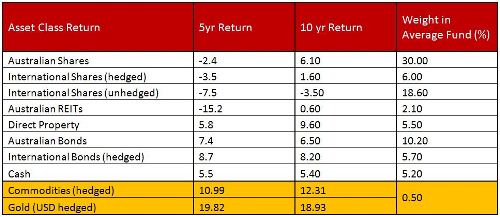
The table below, which shows various asset class returns over the five and 10 year period  to end 2011, along with the end 2011 weightings within default funds, highlights why returns have been so poor.

Despite returning between -2.5 and -15 per cent over the past five years, funds have kept circa 60 per cent of their money in equities and REITS.

International shares, which have gone backwards in real terms over the decade, still comprise nearly 25 per cent of investor portfolios.

The table also highlights which assets superannuation funds have barely invested in, like commodities, which have been up over 10 per cent, and gold, which was up nearly 20 per cent (in US Dollar terms) between 2006 and 2011. Had superannuation funds devoted a larger portion of their capital into these markets, returns to members would have been significantly enhanced.

Australian Superannuation funds have also tended to steer clear of the junior mining sector, which whilst volatile, has provided some fantastic investment opportunities over the past decade.

Considering the disappointing returns investors have received, and the lack of targeted investment into commodities, precious metals and resource stocks, it’s perhaps not surprising the Australian public feel they are not benefitting from the mining boom.
 

There is also a risk that, given the uncertain economic outlook, balanced growth funds could continue to perform poorly for the foreseeable future.

With circa 90 per cent of their assets in large-cap equities, bonds (mostly government), cash and listed and unlisted property (based on data from Chant West) these funds are significantly exposed to many of the risks that face the global economy today.

These risks include:

–    The threat of sovereign debt default;

–    50 year lows in yields on US and Australian debt;

–    Inflation due to continued money printing;

–    An undercapitalized banking system in Europe;

–    Ageing demographics in the developed world; and

–    The exceptionally high level of Australian home prices.

The potential for further losses to Superannuation products in the period ahead will play an even greater role in the financial position Australians find themselves in going forward, given the increase in compulsory superannuation from 9 per cent to 12 per cent, which is being implemented in phases starting in the 2013/14 financial year.

Given high income paying Australians in their early 30’s could put up to three quarters of a million dollars into superannuation (and well over a million for a couple in the same demographic), getting the investment mix right will be critical for most Australians looking to secure their financial future and have a comfortable retirement.

Considering the risks (and opportunities) that exist in this environment, we believe it is a concern that most Australians lack a meaningful exposure to commodities, gold, and resource stocks in their portfolios, and that overlooking these investments could continue to have a drag on the returns their superannuation funds generate.

There are, however opportunities for Australians to mitigate some of the risks in their existing superannuation funds, as well as open their portfolios to the opportunity of participating more directly in the mining boom.

Some superannuation fund platforms enable direct share investments, or enable individuals to buy Exchange Traded Funds (ETFs), some of which are linked to the resources sector.

Whilst not necessarily appropriate for everyone, setting up a Self-Managed Superannuation Fund (SMSF), gives the individual complete control and flexibility to invest in physical metals and ETF’s, as well as resource stocks, including the juniors, which are not necessarily available through the traditional funds and platforms.

Setting up a SMSF has become cheaper, more efficient and more accessible as the size of the market has grown (it is now the largest component of the super industry with well over $400 billion under management).

With the right advice, and appropriate administration, it is now a relatively straightforward process setting up an SMSF, and it enables Australians to take complete control of this important asset.

There are other benefits around estate planning which are also worth considering.

Dissatisfaction with existing Superannuation funds, coupled with the control and flexibility an SMSF gives you in terms of where to put your money is the main reason why the SMSF sector is the fastest growing component of Australia’s superannuation landscape, with over 2,100 new funds being created every month according to the Australian Tax Office.

Investment opportunities individuals could access via an SMSF include assets like physical gold and silver, which have traditionally been ignored by large fund managers (and still are being ignored).

Investors could also choose to allocate a portion of their capital into commodities more directly, via an ETF.

Commodity ETFs issued by companies like Betashares and ETF Securities now cover specific products like wheat and oil, or one can choose to diversify across a basket of commodities, via products which have exposure to a combination of energy, agriculture, base and precious metals.

Australians could also invest some of their superannuation monies into specific mining companies they (or a broker they trust) are familiar with, or a broad range of junior resource companies.

A diversified exposure could be achieved via ETFs like the Digga Australian Mining ETF (ASX code DGA), or through the use of managed funds which specialize in the sector, like the LSC Australian Resources Hi-Alpha Fund, which as at 31 March 2012 had returned 37.4 per cent over 3 years, compared to only eight per cent for most Australian Super Funds.

In conclusion, there are many ways that every day Australians can invest in and benefit from the resources boom, and the current economic environment.

Returns equal to or below the cash rate should not be seen as acceptable. Whilst the Superannuation sector continues to innovate to reduce costs, there does not seem to be the same focus on reviewing investment strategies to capitalize on stronger performing assets.

Considering the return potential on offer in Australian mining and resources, as well as the inflationary protection commodities (especially gold) offer investors, now is the time for all Australians to review their current arrangements to ensure they are aware of the underlying investment strategy of their fund.

The emerging world will need natural resources, and the traditional asset allocations in larger funds are not necessarily best positioned to capture this. Australians are often not participating in this opportunity because of the lack of education and information, but this is becoming more readily available.

LJ Financial Group is partnering with the resources sector to increase awareness of the importance of investment in the current boom. The firm is independent (therefore not aligned to any of the larger funds or banks), and tailors advice which capitalizes on opportunities within the changing economic environment. The company conducts monthly seminars in its offices in Sydney, and produces a weekly publication, the ‘LJ News’, which people are welcome to subscribe too via the company website at www.ljfinancial.com.au

Helix acquires Chilean mine

THE BOURSE WHISPERER: Minerals exploration company Helix Resources has announced the purchase of the Blanco Y Negro Mine and surrounding mining leases in Region IV, Chile.

Blanco Y Negro is hosted in a regionally significant shear situated 21 kilometres north east of Glencore’s Punitaqui operations and 10 kilometres south west of a large service town, Ovalle in Region IV Chile.

Helix has agreed to purchase the mining concessions from a private vendor for US$80,000, giving the company 100 per cent ownership of approximately 128 hectares of exploitation concessions within the regional Huallillinga Project.

Geological due diligence, carried out as part of Helix’s regional exploration program, has identified Blanco Y Negro Mine to be part of a large Copper/Gold system.

The associated gold was not previously identified, nor was it credited in the limited production from the mine area.

Mapping has isolated at least two mineralising events in the mine area, with several structural directions mineralised with both copper and gold.

First-pass rock-chips have returned up to 1.1 per cent Copper (over 4.5 metres) and up to 1.3 grams per tonne (over 4.2metres) in channel samples taken from outcrop.

Of 43 channel samples collected, the results averaged 0.4 per cent Copper, 0.2 g/t Gold and 47ppm Molybdenum, over a strike exceeding 900m, providing evidence that a large Copper/Gold target is present.

More detailed sampling is planned to define drill targets.