The price of gold has rallied strongly over the last five years.

When the Global Financial Crisis started back in 2007, you could pick up an ounce of gold for just $670.

Wind the clock forward to today, and gold is now trading at $1690 – a rise of over $1000 per ounce.

The increase in price has led many market pundits to declare gold is ‘in a bubble’ and the price will soon crash.

In this article, we look at some of the myths about gold and debate the questions that regularly come up about this asset class.

Some of the questions commonly asked about gold include:

What is gold?

Is gold just another commodity?

Is the gold market an illiquid and obscure market?

Who owns the world’s gold?

Is gold really in ‘a bubble’?

Let’s look at each of these in turn.

What is Gold?

Gold is a monetary asset. There are two forms; gold (and silver) and paper money.

Over the long run gold is a far superior form of money than the paper dollars we are paid in and store in our bank accounts.

This is because gold, the supply of which is both finite and stable, is immune to the ravages of inflation that always end up reducing the value of paper money.

Is Gold just another commodity?

Gold is not a commodity, like wheat or oil, because it isn’t used up like other commodities are.

Wheat and oil are valuable because they are consumed (used either to eat or run an engine etc.).

Nearly all the gold that has ever been produced is still available (it’s either being worn as jewellery, sitting in a safe deposit box or being stored in a central bank vault).

Is the Gold Market illiquid and obscure?

The gold market is neither obscure nor illiquid. In fact it is huge. The value of all the above ground gold in the world is roughly US$9 Trillion dollars. That’s over six times the size of the entire Australian economy.

It’s also a highly liquid asset. Over $30 billion a day of gold is traded on the London Bullion Market, six times larger than the daily volume traded on the Australian Stock Exchange.

Who owns the World’s Gold?

Nearly 50 per cent of all gold holdings in the world are held in jewellery form.

The rest is predominantly held either by private individuals or by the central banks of the Western world.

These central banks and governments, including those of the United States, Germany, France and Italy hold three quarters of their foreign reserves in gold, highlighting the fact gold is an asset of strategic importance to their overall economic stability.

Governments in emerging markets (China/Russia etc.) are also busily acquiring gold to help diversify their asset base, with imports of gold into China from Hong Kong nearly quadrupling between 2010 and 2011.

Is Gold in a bubble?

And so to the last and most important question – is gold in ‘a bubble’?

To debate this point, it’s important to look at some relevant ratios to help come to a conclusion.

Whilst the gold price is no longer ‘cheap’ in nominal price terms, when you look at gold vs. the equity market, gold vs. inflation, or gold vs. the paper money supply (remember central banks are creating money out of thin air these days), gold remains much under-priced by historical standards.

To give just one example, if the ratio between gold and equities was to reach the same level it does in typical gold bull markets, the gold price will need to go over $10,000 (or the equity market will need to crash).

This is not a price prediction, but a useful number to keep in mind, and offers a strong rebuttal to anyone who suggests gold is ‘a bubble’ today.

Whilst there is good reason to think the gold price will continue rising, it is important that investors and potential investors in gold understand that the metal can be volatile in the short term (like the share market), and that the price will not go up in a straight line.

Significant corrections in price are a common trait of any major bull market, and gold is no exception in this regard.

Over the last decade (a period in which gold has gone from $255 to around $1690), there have been three major corrections.

The fall in the gold price during these corrections has been between 16 per cent and 29 per cent.

These numbers should help put the current pullback in price (from $1895 in September last year to $1531 in December) into context. That’s a fall of 19 per cent.

Whilst it’s never nice to see your assets fall in price, this is a perfectly healthy and normal correction in an ongoing bull market.

To give even more historical context, back in the 1970’s gold bull market, there was actually a period where the Gold Price fell just under 50 per cent at one point (from $193 in December 1974 to $104 in August 1976).

No doubt investors who bought in around $190 felt very nervous about their gold holdings after a fall like that.

Had they sold their gold though after that correction, they would have not only locked in a loss on their investment, but more importantly, missed out on one of the great bull markets of our time as over the next four years the gold price went on to trade at over $850 an ounce.

Finally, it’s important to remember what ended the last Gold Bull market back in 1980. Interest rates were over 15 per cent at the time. Obviously, the higher the rate of return you can get on paper money, the less attractive it is to hold gold, and vice versa.

This is exactly the economic environment we find ourselves in today, with interest rates in the majority of the developed world negative in real terms.

Considering the debt problems these countries face, interest rates may well remain negative in real terms for many years to come.

Until this issue is resolved, the gold price is likely to remain strong, as in this environment, it’s a more attractive asset to hold than paper money.

All Australians would benefit from getting some advice about investing in gold, the best way to own it and what it can do for your overall portfolio.

You can buy gold through retail superannuation (in ETF form only) if you are using the right super provider, or if you have a Self-Managed Super Fund (SMSF), you can actually buy and store physical gold (and silver) in your fund.

This process is no harder than buying shares on the stock exchange.

Times are tough out there. The Global debt crisis that we will struggle with for many years is in many ways more challenging than the problems which led to the Great Depression.

In times like these, saving and protecting your wealth should be of paramount importance.

Jordan Eliseo – Director of investments and advice



Bruce McQuitty – Sheffield Resources

Sheffield Resources managing director Bruce McQuitty dropped by The Roadhouse on his way home from Dampier to tell us about the company’s recent activities.


Sheffield Resources (ASX:SFX) has a few different projects, could you just quickly run through them?

We have three substantial mineral sands projects, all located in Western Australia, as well as our Red Bull project, located near the Nova discovery of Sirius Resources (ASX:SIR).


Our mineral sands deposits are of global significance. Our Dampier project certainly has the size and grade that rank it on a global scale.

Our McCalls project, located in the Northern Perth Basin, about 100 kilometres north of Perth is another very large deposit.

It is lower grade than Dampier but it is the largest accumulation of chloride ilmenite known in the world.

What is significant about chloride ilmenite?

Chloride ilmenite is a higher-level titanium ilmenite suitable for the chloride pigment process, and there are not too many deposits of that type around.

African deposits tend to be of a lower grade ilmenite, which are not suitable for the chloride process.

How large is your Dampier tenement holding?

Surrounding the Dampier discovery, in what is an under-explored are for mineral sands, we have managed to secure a large tenement holding of over 3000 square kilometres of prospective ground.

Iluka Resources (ASX:ILU) recently moved in and pegged the remaining ground, approximately 8000 square kilometres, in the Canning Basin.

So the big boys have recognised the real estate potential of your neighbourhood?

We think it adds some credibility to our position up there.

Which is your leading project at this stage?

We recently announced the discovery of the Thunderbird deposit, which has made the Dampier mineral sands project our main focus.

Next would be the Eneabba project, another mineral sands play – smaller than Dampier more advanced.

Eneabba consists of multiple mineral sands deposits, which we are evaluating with the concept of sequential mining.

We have done some scoping work there that suggests a strong economic basis for the project, so we are conducting further work there, which includes the recent addition of a new resource at the Durack deposit.

The Durack resource has added 170,000 tonnes of zircon, 824,000 tonnes of ilmenite, 65,000 tonnes of leucoxene and 33,000 tonnes of rutile to the Eneabba project resource inventory, which now stands at 5.29 million tonnes of contained heavy minerals.

You alluded earlier to a recent announcement of the new Thunderbird discovery. Is this a totally new discovery?

Rio Tinto (ASX:RIO) had previously run a couple of lines of drilling across Thunder bird, but apart from that it is our discovery.

We have drilled 170 holes, where Rio had previously only drilled eight holes into the main target area.


So it wasn’t a case of Sheffield going in wondering what the tenement held, you already had a fair idea of what you expected to see there?

That’s right. It’s not a grassroots discovery as there were early indications from the scout drilling Rio undertook.

What exactly is the Dampier project?

It is a very large mineral sands deposit that appears to have formed in an off-shore environment.

It is broad, currently measuring around four kilometres by five kilometres, which has been outlined by drilling.

It is a zircon-rich mineral assemblage grading around eight per cent, based on previous work, and if you multiply that by the average grade of the deposit it looks like it could contain high in-situ zircon content.

It appears zircon is going to be the main targeted commodity at Dampier?

At least half the value of the deposit is tied up in zircon, but it also has good quantities of ilmenite and rutile.

How does Dampier rate on a global scale?

Its size and scale certainly rank it amongst the top tier of undeveloped zircon projects.

We have previously published an exploration target on the deposit of 450 to 840 million tonnes at five to ten per cent heavy minerals.

Even at the lower end of the tonnage it is still likely to have around 1.6 million tonnes of contained zircon.

Do you anticipate adding to those numbers by the end of the year?

We’re currently drilling up there. Once that has been completed we anticipate getting the assays back to commence a Resource Estimate we hope to have ready around late November.

So by the end of this calendar year we should have a good idea of what that deposit contains and the quality of the mineralogy.

We’re thinking, based on the small amount of previous work that was conducted there, we will be looking at a very large resource and a zircon-rich mineral assemblage.

Once we have all that data together we will be undertaking some scoping work ahead of the next phase of drilling and metallurgical work next year.

What are mineral sands products used for?

Mineral sands are industrial minerals. Zircon is used as an opacifier in ceramics such as tiles and porcelain, while ilmenite and rutile are classified as titanium minerals, which are mainly used for paint pigmentation.

So that gives us two different product streams, both of which are benign, non-toxic minerals with end-use applications aligned to the housing and construction industries.

How is the project positioned in terms of transport infrastructure?

What we are modelling at Dampier is a deposit that will produce in excess of 500 thousand tonnes per annum of heavy mineral concentrate.

Transportation is reasonably simple by road train, because there are no environmental concerns with the products.


We are located between Broome and Derby, both towns with ports that currently ship, or have shipped, similar tonnages.

It is important to note that we won’t be shipping huge tonnages, as these are high-value products.

What shape is the global market for zircon, ilmenite and rutile currently in?

Each one of those products trebled in price during 2011. During the early part of 2012 there has been a softening of demand as Chinese construction activity has come of its highs.

However, the pricing levels are still holding up – in other words producers are maintaining their margins, they’re just reducing their volumes.

So the markets have softened but the prices have remained at their record levels.

Does that mean you’re not as reliant on the Chinese market as some other commodities may be?

They are products that are employed in everyday use, but the real driver behind their market growth has been Chinese urbanisation.

Having said that, people in other countries around the world continue to build and renovate.

Industry leaders do expect the market to tighten up later this year and in 2013 to be quite strong.

Given that our Dampier project is still at a relatively early stage of evaluation, we are more concerned about how the market may appear in 2015 – 2016.

Your projects are a good demonstration of the diversity of Australian mining in that they show there are more than one or two commodities driving the industry?


The mineral sands sector is relatively small with only about 30 players globally.

It is dominated by a few large players with Rio Tinto and Iluka being amongst the largest. Iluka is solely focused on mineral sands, while the others are more diverse.

Iluka is a good bell weather of the strength of the mineral sands industry as they set the pace – especially in regards to zircon.

They had a record year last year. They have come back a bit since but that has mainly been due to their exposure to the short-term softening of the zircon market.

Mining Family Matters roadshow to visit Pilbara communities

The families of mining industry workers are often overlooked when discussion arises regarding the pressures affecting their lifestyle and home life.

Pilbara families will be armed with practical strategies to overcome these pressures when Mining Family Matters presents two workshops in Port Hedland and Karratha.

The Mining Family Matters website www.miningfm.com.au was established in February 2010 to support Australian families linked to the mining and resources sector.

The free presentations, sponsored by Caltex, are aimed at celebrating families in mining, oil and gas, while also offering professional advice and simple tips for tackling fly-in/fly-out rosters and living in isolated mining communities.


The one-hour presentations on Mining: making it work for your family, will be presented by Mining Family Matters founder Alicia Ranford, on topics including:

Recognising that as a mining family, you do face pressures;

What partners find most challenging about life with a FIFO/DIDO miner;

How to communicate effectively to tackle relationship issues;

The importance of consistency in parenting and strong routines for children, whether parents are home or away; and

Strategies for raising healthy, resilient children in mining households.

Ranford is familiar with the lifestyle having spent five years as a FIFO mum and moving six times in the space of a decade with her mining husband.

She said her most important message is always to reassure mining couples that they’re not alone in doing it tough sometimes.

“Communication, spending precious time together and making sure the kids are OK – we’ve found these are some of the most common pressures raised by mining couples on the Mining Family Matters website,” Ranford said.

“The mining couples who cope well are those who tackle issues together as a team, instead of regularly banging heads about the same old issues.

“Many couples, for example, agree on a set number of social activities when the miner is home on days off. Some partners write lists of jobs that need doing around the house.”

Mining Family Matters has been planning for some time to visit key mining towns such as Port Hedland and Karratha to celebrate the role of families in mining, oil and gas, and also offer one-on-one support.

“We’re extremely grateful to the team at Caltex for their sponsorship of this Pilbara roadshow, and for their continued support of our website, which allows us to provide free professional support and advice to more than 11,000 families every month,” Randford explained.

Caltex business development manager – mining Amanda Keogh said the Pilbara roadshow is an important part of the company’s commitment to local mining communities.

“Caltex is committed to supporting communities in which we work and live,” Keogh said in support of the initiative.

Our sponsorship of the Mining Family Matters website and the Pilbara roadshow are key parts of that commitment.”
 
“We’re proud to lend our support to Mining Family Matters so that miners and their families can access information and support services when they need it.”

Details for the two presentations are:

Port Hedland: All Seasons Hotel, 10am Tuesday 11 September;

Karratha: Frank Butler Community Centre, 10am Thursday 13 September.

Morning tea will be provided after both presentations and all participants will receive a free copy of The Survival Guide for Mining Families, containing information and advice most commonly requested of the Mining Family Matters crew.

To register for the free presentations, please contact Lainie Anderson at lainie@miningfm.com.au

Asterios Satrazemis – Aggreko

The Olympic Games may be over but Aggreko boss Asterios Satrazemis told The Roadhouse his company is still powering along.

When I walk around mine sites I notice many pieces of equipment with Aggreko written on them and have often wondered what exactly it is that you do.

Aggreko is a global PLC (Public Limited Company) company with our headquarters based out of Glasgow in Scotland.

We trade on the London Stock Exchange and are the largest global provider of temporary power and temperature control equipment.

As a global company we operate in 100 countries across 165 locations employing over 4000 staff.


Our business is basically split into two areas. We have what we call our International Power Projects business, which is where we go into less developed countries that have utility issues and supply support to the grid.

We supply 100 megawatt temporary power stations that help support those power grid issues.

We also operate what we call our Local Business, which is made up of depots located across North America and Europe as well as our businesses here in Australia and over in New Zealand.

We have 25 locations in the Australian – New Zealand market, from which we provide temporary power and temperature control wherever it may be needed.

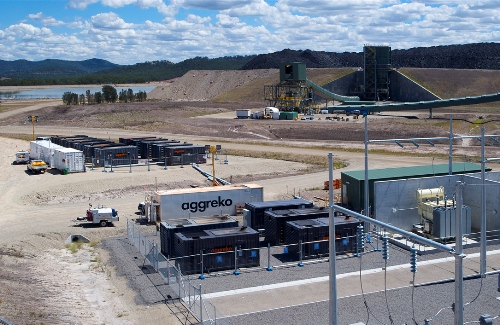
That may be for the mining industry supplying construction power for building camps or cooling applications for underground mines.

So why would a mining company come knocking on your door and when they do what would you expect them to ask for?

We can cover their power needs from dry-hire to a full turnkey solution – so some miners would come to us and tell us they’re bidding out a job for the provision of power to their camp.

So we will do the bid and factor in their specific needs. We can drop in a 5, 10, 15, or 20 megawatt power station, depending on the size of the camp.

Additionally there will be instances where they may be waiting for the utility to physically reach the site. We can fill that gap. That’s why we are a temporary solution.

That’s exactly what we did for a client in New South Wales; where grid power was supposed to be connected but it wasn’t going to happen fast enough.

The company realised that if they didn’t have power they wouldn’t be able to commence production on schedule, which ultimately would cost them a lot of money so they had us install a 15 megawatt power station, which had them up and running straight away.

Power is one of the more necessary boxes to tick for a mining operation; especially those in remote areas that may be a start-up exploration play, how flexible are you in being able to meet individual demands?

We have had plenty of cases just like that; when somebody just needs a 125 kilovolt power set for some particular application.

We have also catered for cases when a company may be reopening a mine that may just have a three to four year mine life so they don’t want to make the investment in permanent power infrastructure.

They come to us and we provide base load power.

To what extent are you involved? Do you just walk up and say, ‘here’s your power’ and walk away and come back when they’re finished to take it back, or are you more hands on?

Some customers want us to do everything. That means we install a power generator unit then fuel it and service it throughout the life of the project.

Other customers have their own staff that they have who will look after all that.

How is your power generation fleet powered?

We have two options available. We have diesel operated generators or we also have gas powered generators.

The gas generators are something we introduced globally about six years ago and we have had some good success with them here in Australia.

We will have three gas powered applications in place by the end of the year providing just over 50 megawatts of gas power generated base load power.

Does the gas supply solution offer companies a lower carbon footprint?

Obviously the gas would have a lower carbon emission than the diesel and we are starting to see a lot of enquiries from companies wanting to know more about it.

The limitation is whether or not a company has access to a gas pipeline. The way things stand at present, if they are in a remote location without such access, there isn’t a current turnkey solution.

It is something we are exploring at the moment, but for those with access to gas it is a great solution that does offer a lower carbon footprint.

Your business extends beyond the mining industry and I believe you were the power generator of choice for the recent London Olympic Games?

That’s a great example of an events job for us, which was high-profile and high stress.

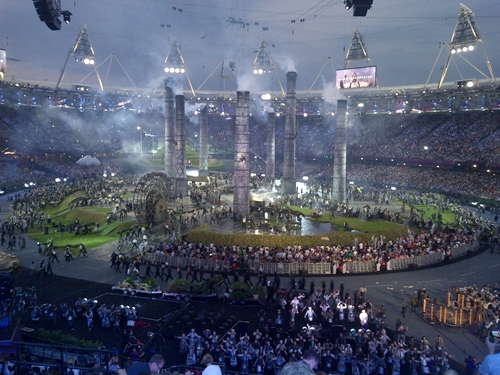
The guys did a great job. It was the largest ever temporary power project in the United Kingdom.

It was 260 megawatts provided by around 550 generators. It was a great achievement.

That must have given watching the Olympics an extra edge of excitement?

Absolutely; we were the base power providers for the opening and closing ceremonies, so you can imagine what it must have been like watching it all unfold.


It was a great testament to the team up there; they did an incredible job without a hitch for something that was so spread out across such a large area of one of the world’s busiest cities.

It also demonstrated the scale of job you are able to cater for?

Aggreko has a long history of events like the Olympics and we have also provide power solutions for the soccer and rugby World Cups.

Those events get a lot of attention, for obvious reasons, they capture the world’s collective imagination.

Any given day, though, we will be running base load power for a number of mines, large or small, around the country where if the power goes down they could potentially start losing millions of dollars in revenue.

I find the stress level of thinking about that just as frightening as the lights going out as Usain Bolt crosses the finish line of the 100 metre sprint.

China no threat to Australian investment in Africa – K Rudd

AFRICA DOWNUNDER: Perth – Australia has enjoyed its time as China’s resources mistress but the emergence of Africa has given our biggest commodities customer reason to stray.

China took over from Japan as Australia’s largest trading partner in 2009, right in the middle of the iron ore-led resources boom.

In 2005/06 the dollar figure placed on approvals for Chinese investment in Australia’s mining sector sat at $6.8 billion.

By 2009/10 that number had almost doubled, hitting $12.2 billion.

The future for the Australian / China relationship appears rosy enough, although there could be a few bumps in the road ahead.

Fear of growing Chinese investment in the resources and agricultural sectors will keep the Foreign Investment Review Board busy as they assess each deal on its merits.

It has been mooted that the cooling down of the Chinese economy may result in a weakening for the demand of Australian resource exports.

Any concerns on this front should be allayed once people understand that the Chinese economy may slow but it is not predicted to go backwards, which means it will still be at the levels that created much of the demands we are currently trying to meet.

If industry observers consider there may be a possible Sino-induced threat to the future health of the Australian industry their fears are not shared by former Prime Minister / Foreign Minister and Member for Griffith Kevin Rudd.


“Australian investors succeed in the international market place based on the quality of what they have to offer and the price they offer,” Rudd told journalists gathered to ambush him at the Paydirt Africa Downunder conference in Perth.

“We have done that against American miners, Canadian miners, European miners; they’re doing it against Latin American miners out of Brazil, out of Chile.

“And we succeed on the basis of the competitiveness of our bids.”

For the benefit of those who may not have heard of Africa, it is the second largest continent on the planet, consisting of, at last count, 55 different nations.

If you were to take a pair of scissors to your atlas you could arrange the countries of the United States, India, a good chunk of Europe, and China to fit within the continent’s coastline.

Economically, Africa has been on the move boasting six of the world’s ten fastest growing countries over the last ten years.

Eight of these past 10 years have seen Africa enjoy economic growth of a greater rate than that of East Asia.

China has been spending like a sailor on shore leave in Africa as it works to develop what is coming to be in global terms, one of the most important economic relationships of the century.

This is obvious by the amount of Chinese investment pouring into Africa since 2008 when around 800 Chinese companies were operating there.

That figure has exploded to over 2000 with an estimated one million Chinese people now calling Africa home.

The influx of people and resource and infrastructure investment has placed China as Africa’s largest trading partner.

According to The World Bank around two-thirds of Africa’s 55 nations have financial agreements in place covering the development of infrastructure.

Currently oil and gas receives the greatest amount of attention with 19 per cent of the total Chinese spend.

However, iron ore, copper, uranium, and gold are all travelling around the economic landscape under different umbrellas.

Once they are added up as one figure, along with all other Chinese backed mining activity the number hits an impressive 27.3 per cent.

As vast as the inroads China has made in Africa, Australia has also been busy.

The Department of Foreign Affairs and Trade (DFAT) tells us that the committed and planned investment by Australia companies in resources projects totals more than $20 billion.

DFAT figures also show Australia’s trade with Africa to have undergone steady growth over the last decade achieving an average rate of 6.1 per cent.

Australia’s total merchandise trade with Africa was valued at $5.8 billion for the year 2009/10.

Currently there are over 230 Australian companies working up some 650 mining projects across 42 countries in Africa.

Rudd told his fourth estate audience the good health of the industry was demonstrated by the fact there are more than 200 Australian mining companies participating in so many African projects.

“It’s because the good folks in Africa think we have something to offer,” he said.

“I believe in a competitive environment, always have believed; and I think the Australian industry has done well.

“And I believe that when it comes to working in the future there is a whole lot more that Australia and Africa can do together without creating any third country friction with anyone else, including China.”

Africa’s richest copper producer makes case for diverse resource investment

AFRICA DOWNUNDER: Perth – Copper rich Zambia has called on the world’s resource investment powerhouses to drive an expansion of the country’s mineral riches into a far more diversified mineral extraction and processing sector rather than its historic renown as Africa’s largest red metal producer.

In an impassioned speech in Perth today on the second day of the three day 2012 Paydirt Africa Downunder conference, Zambia’s Mines, Energy and Water Development Minister, the Hon Yamfwa Mukanga, said mining remained the country’s number one economic driver, accounting for up to 80 per cent of its foreign exchange earnings, underpinned by substantial copper and cobalt output.

“We have 16 producing copper mines, three new ones coming on stream in two years, backed up by existing and new smelting and refinery capacity and known reserves for at least 50 years of future production,” Mukanga said.

“However, we have reshaped our mining investment strategy as we need to intensify exploration for the development of new mines and mineral based exports to deliver a new level of long term benefits from our resources.

“This more intense focus includes required new investment in our oil and gas potential, boosting manufacturing capacity to process a wider spectrum of minerals, and to parallel that growth with new manufacturing capacity for mining industry consumables.”

The Minister said direct foreign investment was one of the best ways to achieve the new strategy objectives.

These investment opportunities included:

–    New manufacturing for engineering products for copper, iron, steel and cobalt operations;

–    Beneficiation of phosphates and related fertilisers in a new agrochecmical sector;

–    Beneficiation of rock material into cement; and

–    Bio-fuels, and thermal power plants.

“There is a major gap in Zambia’s economy in downstream processing our gemstones industrial minerals and dimensional stone and there are few if any local manufacturers of mining equipment such as drill rods, bits, jack hammers and piping,” Mukanga continued.

“On that basis, we need both junior and large mining companies and resources investment houses, to install Zambia on their high priority investment agendas.”

 He appealed to all would be investors to invest in Zambia as it was a fertile environment for investment, since it was politically stable and a rich untapped mineral resource, with the biggest asset being the people themselves.

He closed by calling on anybody thinking of investing in mining to do so in Zambia.

New uranium development needs price range up to US$90 per pound

AFRICA DOWNUNDER: Perth – An incentivised price range of between US$75 and US$90 a pound is needed to drive any new investment in greenfields uranium mines according to Perth-based uranium developer, Bannerman Resources.

Speaking in Perth at the 2012 Paydirt Africa Downunder conference, Bannerman chief executive officer Len Jubber said that while the industry had been through some turmoil following the Fukushima incident last year, there were significant signs of demand upturn and reactor development activity.

“Any examination of the price and supply trend of the past ten years shows a generally upward trend,” Jubber said.

“What we have come to recognise is that uranium will have its price spikes but it is the longer term trend that is the real sector indicator.

“In this mix is the increasing tiredness of a lot of uranium mines globally, historic inadequate pricing, the need for renewal for some existing operations such as Ranger mine in the Northern Territory going underground, project swaps, and sudden market impacts such as the deferral of the Olympic dam decision – an event that has ended much market speculation about potential future cheap volumes of uranium flooding the market.

“The market has to look seriously at those companies that have taken their projects to definitive feasibility stage because this is where the cost realities come in for future uranium projects.

“It gets rid of the blue sky numbers at the scoping study levels and sets the range at where new uranium mines can be viable.

“Our assessment of all current projects shows this price range will need to be in the US$75-90 a pound-range to see incentive decisions for new uranium mine developments.”

Jubber went on to say that any resurgence globally in the uranium space this year could be measured by better valuing the fact 433 reactors continued to operate worldwide, in 30 countries, 63 new plants were under construction and a significant 489 were planned and proposed.

“Add to that China’s stated intention to increase its nuclear output from 12 gigawatts to between 60 to 70 gigawatts by 2020 and you can see that demand will not be easing as that target only represents six to seven per cent of China’s total requirement to replace some of its fossil fuels – and course India is a sleeper at this stage,” he said.

Bannerman is developing the Etango uranium project in Namibia, with a Definitive Feasibility Study completed in April this year for the 119 million pound uranium reserve inventory.

The DFS outlined a 16 year mine life for Etango with a capital expenditure development cost of US$870 million.


Resource nationalism – the modern day ‘Native Title’

AFRICA DOWNUNDER: Perth – Resource nationalism is scaring the global resources sector and is being seen by many as a modern day “native title controversy”, a leading Australian resources lawyer believes.

Speaking in Perth on the first day of the 2012 Paydirt Africa Downunder conference, Gilbert and Tobins Lawyers partner Michael Blakiston said many in the sector were becoming increasingly disenchanted by the issue, but questioned whether such pessimism was warranted.

“You don’t need to look that far back to remember the initial concern that Native Title caused,” Blakiston said.

“It may have taken many years, but we did find a re-alignment with native title legislation where all related parties are today sharing an economic outcome.

“The same is occurring with resource nationalism.

“And let’s just not concentrate on Africa – this is a worldwide phenomenon that is not just about economics.

“This is a cyclic event – resource nationalism hasn’t happened over past 1-2 years.

“Today there is a massive realignment occurring in the industry, and the issue needs to be continued to be debated. Not simply with raw emotion, but rather with a level of intelligent engagement and understanding.”

In a wide-ranging presentation, Blakiston said that Governments of all persuasions needed to listen to what stresses the resources industry.

He said it was simply not viable for Governments to ignore reality and believe they can develop major resource projects on their own using bilateral or multi-lateral finance.

He indicated the temptation of some Governments to take projects away from the original proponents and award them to other players would come at significant cost, including that country’s sovereign reputation as a safe place to invest.

He warned that subsequent project proponents may be less concerned about acting responsibly and in accordance with international standards in order to ensure the economies of the project.

Central and West Africa to be next major iron ore supplier

AFRICA DOWNUNDER: Perth – Central and West Africa will be the world’s next major supplier of iron ore according to Africa-focused Australian iron ore developer, Equatorial Resources.

Speaking in Perth on the first day of the 2012 Paydirt Africa Downunder conference, Equatorial managing director John Welborn said China, by 2015, wanted to import 50 per cent of its iron ore from Chinese-owned mines elsewhere in the world – and this meant resolving the issue of alternative sources of supply.

“China remains by far the dominant buyer of seaborne iron ore, importing more than 650 million tonnes last calendar year or 63 per cent of total global seaborne iron ore demand,” Welborn said.

“Historically more than 75 per cent of China’s seaborne iron ore supply has come from Australia, Brazil and India where China has relied heavily on the big three producers.

“Chinese steels mills are suffering from high input costs and low profitability and need to find new sources of supply.

“Global demand is forecast to be more than 3.5 billion tonnes by 2030 and with current annual production figures showing approximately 500 million tonnes coming from Australia, 240 million tonnes from India, 390 million tonnes from South America, and 55 million tonnes from south Africa, it poses the question of where the extra supply will come from.

“Increased production from the traditional iron ore regions will not fill the gap and so it is a certainty that projects in central and western Africa will be developed to fill the demand gap.”

Welborn said this had generated a “race to production” along the western African coastline with companies from all over world racing to develop a range of iron projects in that province, both as stand-alone projects or as part of iron ore clusters.

“Central and west African iron ore offers the upside of massive scale, high quality resources, coarse grained ore bodies and low cost of production,” Welborn said.

“The challenge is the infrastructure reality, as the area needs the development of railways, ports, and mines amid many regional opportunities. New iron ore production is only coming on stream in Africa where two conditions exist –the presence of high grade, near surface iron ore bodies in close proximity to existing rail infrastructure.”

Welborn said the near term focus from the region would therefore continue to be growing output from mines close to infrastructure ports needed to get ore to market.

In the medium to longer term, new rail infrastructure development will drive large-scale production.

Equatorial is focused on developing two iron ore projects in the Republic of Congo including the Mayoko-Moussondji iron project (targeting maiden resource in 2H 2012) and the Badondo iron project.

The company is midway through a 70,000 metre drilling program at Mayoko-Moussondji targeting high grade direct shipping ore hematite over a 12 kilometre strike length.

It has also defined an exploration target of 1.3 billion to 2.2 billion tonnes at 30 to 65 per cent iron for the Badondo iron project.

Australian presence in Africa benefits both

AFRICA DOWNUNDER: Perth – Opening the Paydirt Africa Downunder Conference in Perth Australia’s Minister for Foreign Affairs Bob Carr spoke about the growing presence and increasing engagement Australian was having in Africa.

“We are strengthening political links with African regional organisations and through high-level contact,” Carr said.

“Our development assistance – to help Africa increase economic self-reliance – has quadrupled in the last five years.

“And we are helping to build capacity by providing more than 1,000 scholarships for Africans to study in Australia this year alone, through the Australia Awards.

“Our trade and investment with Africa is growing rapidly.”

The Australian mining sector is playing a particularly important role in the current development of Africa’s minerals and resources sector.

Our rock kickers and diggers are well-represented on the continent with some 200 Australian companies involved in 650 projects in 37 countries.

One in 20 Australian companies listed on the Australian Securities Exchange has an investment in Africa.

Africa hosts the largest number of Australian mining projects of any region outside Australia accounting for around 40 per cent of all overseas mining projects.

“Like Africa, we understand the opportunities and risks of natural resource endowment,” Carr said.

“On our side, however, we have the advantage of mature, world’s best practice mining and gas industries.

“In many ways we are natural partners.”

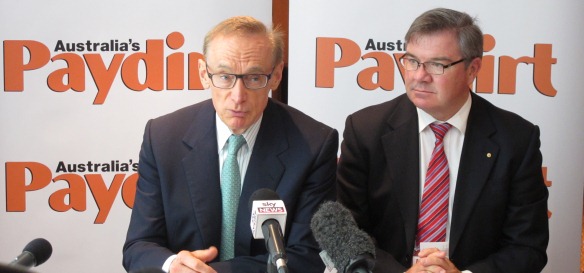
After his opening address, Carr flanked by Special Minister of State and furious head-nodder Gary Gray, faced a phalanx of resources journalists.


Asked whether he was worried about the perception of Australia being a high-sovereign-risk environment as far as investment goes, Carr was quickly onto the front foot.

“Australia has got the best business climate in the world,” he responded.

“Where would you put your money in the world at the present time?

“Would you go into Europe, with the uncertainty generated by Greece and the banking system in other states?

“Would you go into the United States with a pretty tough regulatory regime? I’ve heard investors in the mining and energy sectors say that to me.

“They think Australia offers a better regulatory regime than the US.

“Where would you put your money? Australia offers a superb business investment climate. There is a political certainty here and continuity of regulatory standards.”

The next question without notice from the floor enquired as to whether Carr considered the mining boom was indeed over.

He responded by saying the mining boom wasn’t over because the country had billions of investment still in the pipeline for three giant gas projects to be developed in Darwin, Gladstone, and Gorgon.

“You’re looking at about $130 billion dollars of investment with tens of thousands of jobs,” Carr said seemingly unaware mining and oil and gas fall under two separate resources sector umbrellas.

 “There is still a huge amount of investment in the pipeline and that is played out for a recovery in world demand and a return of price levels – and I am talking about down the track.

“Because Australia offers such advantages for investment, the investment flow will continue to be here generating jobs in Australia.

To his credit, Gray did focus his response on the global demands for metals, which he said is yet to reach its peak.

“It [demand for metals] drove first a commodity price increase that benefited the Australian economy through the middle 2000s,” Gray said.

“Then it drove an investment tidal wave – the next consequent of that is a massive lift in Australian production – of iron ore in particular in Western Australia, of oil, of gas, of LNG, of LPG, of CNG – the whole range of hydrocarbon products into global markets where previously Australia hasn’t been present.”

Gray implied the story that will emerge for the future of the industry, not only for Australia but for Africa as well, would be nations such as China as they, “continue to grow and continue to build cities the size of Chicago – they need a lot of iron, they need a lot of copper, they need a lot of zinc, they need a lot of coal,” Gray said demonstrating a capacity to unnecessarily repeat phrases.

“They need the minerals and the metals that we can mine in Australia – and that’s what this conference is about – showing the way in Africa to do that well.

“To do that in a way of which we can be proud and to do it in a way that is sustainable.”

It seems charitable for Australia to be so willing to export its mining industry expertise at such levels; however a similar willingness to let elite swimming coaches ply their trade overseas resulted in the nation recording its worse effort in the pool at an Olympic Games in recent memory.

Could such a transposition of intellectual property come back to bite Australia in the homeland, especially in what is an increasingly competitive global market?

“What we have in Australia is globally significant expertise in extractive industries,” Gray said.

“We have in Australia the world’s best regulatory framework, environmental and also, importantly in governance of tenements.

“It is actually incumbent upon us to share that knowledge and that experience with growing economies.

“It’s the right thing to do. It’s how we set global benchmarks of performance that mean that the world will be in better hands for future generations.

“Australia isn’t simply a resources powerhouse; it’s also a globally significant environmental power.

“We have the insight and the capacity to help countries grow and reach levels of economic independence through our capital investment in projects, through our expertise in mining, but also through our elite knowledge and experience in the regulatory environment.

“It’s the right thing to be doing.”