Early Bird registration offer for Mining 2012

Resources conference specialists Vertical Events  are offering an Early Bird Registration at the discounted rate of $1,100.00 (incl. GST) to attend the company’s upcoming Mining 2012 Resources Convention in Brisbane.

The final day to take advantage of this offer is close of business Friday 31 August 2012. (Perth time)

Running over three days at the Brisbane Convention & Exhibition Centre, this event will feature over 100 presentations across two auditoria.

Supplemented by a bustling exhibition area, housing over 130 exhibition booths, coffee and juice lounges as well as an internet station, this year’s Mining Convention is a must-attend on the resource event calendar. With numerous social and networking functions also held in association with the event you will be sure to maximise your investment.

For further details on the convention, to view the programme and register online click below

BC Iron joins Cleveland Mining for Brazilian tango

There has been much speculation and breath holding in anticipation of what may be the next project or destination for Pilbara iron ore producer BC Iron (ASX:BCI).

In 2006, led by its indefatigable managing director Mike Young, BC Iron took an iron ore exploration play located in what was in at the time, inaccessible territory, to emerge as one of the success stories of the junior iron ore sector rush.

Access to infrastructure was the secret behind that success with the company’s Nullagine mine located close to a train station on the Fortescue Metals Group (ASX:FMG) express train to Port Hedland.

BC Iron’s 50:50 Nullagine Joint Venture with FMG now produces iron ore at a rate of five million tonnes per annum.

Throughout the 2012 financial year the Joint Venture mined and crushed 3.54 million tonnes of iron ore, resulting in shipment of 3.55 million tonnes.

Ore Reserves at Nullagine have been increased to 41 million tonnes at 57.1 per cent iron and the company is sitting comfortably on a bank balance of over $93 million.
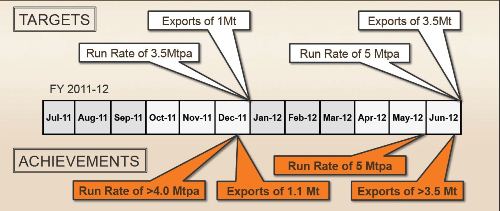
 

The Nullagine Jint Venture has hit all advancement targets ahead of schedule

History is repeating with infrastructure a factor behind BC Iron recently joining forces with ASX-listed Cleveland Mining (ASX:CDG) to look for projects in the South American country of Brazil.

“It’s a very strategic move in that it covers all of Brazil for Joint Ventures in iron ore,” Young told The Inside Story.

“The Board of Cleveland mining, collectively, has a great deal of in-country experience.

“They have connections with the main players within the country’s infrastructure sector, which is very important.

“Brazil is not much different to Australia in the fact there is lots of iron ore, but there is not a lot of infrastructure.

“Brazil has a domestic pig iron industry if you want to start up small and get a bit of cash flow going.

“With a project of the Nullagine JV you could make money selling into the domestic market – you just wouldn’t make the margins that we are making.”

The Board members of Cleveland Mining are no strangers to BC Iron with FMG non-executive director Russell Scrimshaw and FMG founding member Jim Williams both having a seat at the table.

Russell Scrimshaw was a key person in the relationship between Fortescue and BC Iron.

Cleveland managing director David Mendelawitz is also a FMG alumnus, where he held the position of Head of Business Improvement, while company chairman Don Baily was a founding shareholder and chairman of LionOre Mining before it was purchased by Norilsk Nickel.

Bailey has also been deputy mining director of Rio Tinto running its operations in South America, Southern Africa and Continental Europe.

“That meant that the due diligence required in terms of Cleveland’s Board and management was relatively straight forward,” Young said.

“I think people may now look again at Cleveland and realise it has a really good team.”

Cleveland Mining’s main focus, at present is the Premier gold mine in the company’s Crixás Hub, located in Goiás state in Brazil.

Construction of the Premier mine is nearing completion and Cleveland plans to commence commissioning of the plant shortly.

“They started the gold mine to generate some cash flow as they wanted to be self-funding, which is great as that keeps their capital structure nice and tight, like ours,” Young said.

“That mine serves two purposes: one, it produces gold, which is as good as cash in terms of maintaining liquidity; and it establishes them as miners in Brazil and gives them bona fides with the regulatory bodies.”

Young explained that by establishing a mine in Brazil a company also establishes its bona fides as a miner.

The logic is similar to that pertaining to companies operating in Australia; if a company can demonstrate it can meet the strict approvals processes once it means it can approach the approval of its next project with confidence.

“I have no doubt that if we had looked at another project in Western Australia we would have a gold star next to our name in terms of meeting approval requirements,” Young said.

“And I believe that it’s the same for Cleveland in Brazil.”

As exciting as the new deal is Young said it didn’t mean BC Iron would be shifting its focus from its Pilbara operations or blinker its sights in regards to other acquisitions within WA.
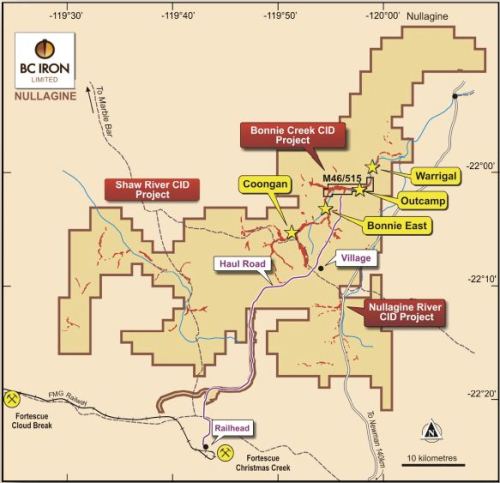
 

Nullagine Joint Venture location map.

The company has long-stated it has a modelled a three tiered business development strategy and it is determined to stick to it.

The first tier involves extending the known resources at the Nullagine JV, which is classified as Project Inventory.

“That means being fully informed as to what we have got and what we can mine down to every single tonne,” Young said.

“Our workforce is constantly working on developing that and we expect to deliver those results in the third quarter of this current financial year.”

The second tier to BC Iron’s strategy entails seeking out new opportunities to work with FMG.

“It’s pretty simple,” Young continued.

“They have a railway, we have a relationship, we know how they work, and they know how we work.

“Great; let’s go look at other projects.”

The third tier is the deal with Cleveland, which allows BC Iron scope to pursue projects in Brazil.

The deal is consistent with the ethos behind the BC Iron strategy in that it allows the company a very low cost entry into Brazil.

It also leverages off Cleveland’s vast intellectual property as well as the healthy amount of goodwill that company has built up during the past three years of operating in the country.

Cleveland recently completed a placement of approximately 16.9 million new ordinary shares raising approximately $10.7 million before costs.

BC Iron put its hand up for approximately 8.8 million of these at the price of 64.2 cents per share at a cost of approximately $5.64 million, representing five per cent of the total ordinary shares Cleveland will have on offer once the placement has been finalised.

“We took a placement in Cleveland as a good investment,” Young said.

“We decided that if we are going to work with these guys we may as well back them.

“It tells the market we support them, and it also tells Cleveland that we support them.”

With all the goodwill and cash in place, all the newly formed JV needs is a project to develop.

The intention now is to set up a Joint Venture committee to run its collective eye over a number of targets that are already under consideration.

“The Joint Venture committee will go and assess those targets, come up with drilling programs, assessment programs and co-fund it all,” Young said.

“We have formed a Joint Venture with a good company with very good management to operate in a good mining jurisdiction.

“All we need now is the right project.”

BC Iron Limited (ASX:BCI)
…The Short Story

HEAD OFFICE
Level 1

15 Rheola Street
West Perth WA 6005

Ph: +61 8 6311 3400
Fax: +61 8 6311 3449

Email: info@bciron.com.au
Web: www.bciron.com.au

DIRECTORS

Tony Kiernan, Mike Young, Morgan Ball, Terry Ransted, Andrew Haslam, Malcolm McComas, Jamie Gibson

MAJOR SHAREHOLDERS

Consolidated Minerals 23.9%
Regent Pacific Group 23.1%
Henghou Industries 9.9%

SHARES ON OFFER

104 million

MARKET CAPITALISATION

$271.1 million (at 23/8/12)

The rise of computer trading on the ASX – mum and dad investors getting burned

The Australian Securities Exchange is seen by many as one of the most transparent markets in the world, a place where everyone is informed at the same time and where investors big and small can trade shares on equal terms.

The ASX says of itself and its own standards, “By providing systems, processes and services needed for a fair, orderly and transparent market, ASX inspires confidence in the markets.”


Unfortunately, the recent emergence of computer based trading has meant that the market is no longer fair, orderly or transparent and therefore confidence in the market is at an all-time low.

These trading houses are making vast sums of money, and the mum and dad investors, who are the ‘lifeblood” of our exchange, are being severely disadvantaged.

In Australia, it is believed that computer based trading accounts for up to 30 per cent of the total volume on the ASX, and in the micro-cap/ mid-cap area of the market it may be as much as 50 per cent of all trading volume.

Computer based trading is not a new phenomenon, it has been in existence in the United States and other international markets for some years, but we have only seen the emergence of this type of trading on the ASX in the past 12 months.

In essence, there are two types of computer based trading platforms, Algorithmic trading and High Frequency Trading (HFT).

Both are managed by very complex computer programs that have no interest in the core drivers of investment decisions, such as a company’s assets, its management, or its prospects, but only the ability to generate profit from trading.

Algorithms create masses of small orders which can be observed being traded in certain patterns throughout the day and are used to acquire, or dispose of, large parcels of shares in a manner so as to not affect the market in those shares.

Here is where it becomes an issue. HFT participants also use algorithms to firstly detect another algorithm trying to orderly dispose or acquire shares, then preys on the large order it has found which is being executed into the market.

The HFT algorithm will then begin to place orders into the market that are in front of the original algorithm, forcing the original algorithm to buy at higher and higher prices.

Meanwhile, the HFT algorithm has been buying shares ahead of the original algorithm and then selling them at a higher price all the while using the original algorithm to drive the price into its favour.

This sets the original buyer at a disadvantage as it has created an unfair and false market. The same situation can occur while pushing the price of the stock downwards.

HFT algorithms react very fast to these orders.

They ‘flashes’ their offers and bids into the market in milliseconds so that they are almost impossible to transact except via other HFT orders.

When they come against each other or find each other acting in unison, there is no manual over-ride.

Recently this was seen in the US where Knight Capital lost US$440 million and is also what is believed to have caused the 2010 flash crash when the US market dropped 1000 points and then recovered within minutes.

Billions of dollars were wiped out, gone, investments destroyed, retirement funds wrecked, lives altered. Sounds like something from a horror movie doesn’t it?

But where it really begins to turn nasty is when two or more HFT algorithms all begin to work against one another resulting in the share price being forced in a more extreme manner – either up or down.

In unfavourable economic times, when normal market investors are thinner than usual, the direction is then more than likely to be in the downwards direction.

Which companies are most affected? High volume, mining companies who make up almost half of those listed on the ASX (950 out of 2200 ASX-listed companies) are particularly vulnerable.

Some would say this is the market in action, and liquidity is being created.

The problem is genuine participants are being used as cannon fodder. Institutional brokers are also being impacted, having to depend on HFT at micro commissions which offset their ability to run a traditional equities brokerage.

The winner is the professional trading houses and in a zero sum game like the bad market we are in retail investors are potentially the big losers – they can’t operate as fast and don’t have the huge computer power available and straight to market execution systems that these guys have.

Up to 50 per cent of trading in smaller ASX-listed companies is being done by computers with no interest in the company, its assets, its people or its prospects, and at a speed far superior to any human trade.

If an operator manually entered HFT-type trades, they would be penalised for manipulative trading – why should there be one rule for man and another for machines programed by man?

David Tasker

National Director, Investor Relations – Professional Public Relations

david.tasker@ppr.com.au


This article first appeared in The West Australian

Chris Gale – Latin Resources

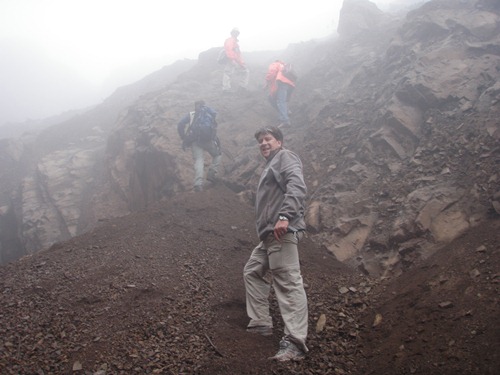
It should be no surprise a company called Latin Resources would have a South America-focus. The company’s managing director Chris Gale climbed down from the company’s project in Peru to drop by The Roadhouse for a quick chat.

Latin Resources has two projects in Peru, the Mariela iron ore project and the Guadaluptio iron heavy mineral sands project. Magnetite and minerals sands are an interesting combination. How will they work together?

The magnetite, from our perspective, is a no brainer.

The large South American steel manufacturer Gerdau operates a plant some 25 kilometres south of the Guadalupito project and we anticipate selling our magnetite into their plant, from which they will produce pig iron for steel manufacture.

Guadalupito is our flagship project. Besides the magnetite it is also a multi commodity mineral sands project.

It was identified by one of our geologists two years ago, who said that if it was in Australia it would have been in operation 20 years ago.

You recently announced a new JORC-compliant inferred heavy mineral resource at Guadalupito. How do the numbers stack up?

The resource within the 1070 hectare Tres Chosas area is 257 million tonnes at 3.9 per cent heavy minerals in situ.

The latest estimate also updated 850 hectares of the Heldmaier area for 136 million tonnes at 5.5 per cent heavy minerals.

We now have a total at Guadalupito of 393 million tonnes at 4.5 per cent heavy minerals in situ for 17.7 million tonnes of contained heavy minerals.

Like the Guadalupito project the term ‘Heavy Minerals’ covers a lot of ground. What particular commodity is emerging as the key at Guadalupito?

The major mineral we have at Guadalupito is magnetite and andalusite, which is used in the manufacture of refractory bricks for kilns.

It is also becoming a replacement for zircon in a number of products.

Most andalusite currently comes out of South Africa; it’s not a huge market with sales of globally of 400,000 to 500,000 tonne but will increase as it potentially replaces some Zircon products.

What is worth noting however, is that over the past four years the price for andalusite has gone from around $120 per tonne to $350 to $400 per tonne.

What about Mariela, what type of project is that shaping up to be?

We consider Mariela to be situated in, what is emerging to be, an iron-oxide/copper/gold (IOCG) province.

BHP Billiton has just staked around 400,000 hectares through the district, Antofagasta from Chile has around 600,000 hectares and CST Mining recently sold its Mina Justa copper project for over $500 million. Metminco’s project is around 300 kilometres north of Mariela

We think Mariela could be a very big IOCG project, but of course, we can’t be totally sure until we have conducted enough drilling to be certain.

And there is currently some drilling being carried out at Mariela by your Joint Venture partners?

That’s right, we joint venture the Mariela project to a Chinese concern called Junefield Group, which is our largest shareholder.

They will spend $35 million on a Bankable Feasibility Study to earn a 70 per cent interest.

They recently moved a second drill rig onto the project after drilling just three holes of the current 20 hole program.

They must like what they’re seeing?

 Perhaps, I don’t think they would move a second rig in if they didn’t.

How long have you been there?

We hold 100,000 hectares in the area; we started pegging ground there in 2008.

This particular project, Mariela that we are focused on at present is 5,000 hectares.

Have you been able to identify any other reasonable targets within that tenement holding?

Ilo Norte is displaying some copper gold potential – we have already drilled eight holes there and anticipate drilling a further 10 towards the end of this year.

It’s in a very good area. Southern Copper own three mines there and they have produced around 400,000 tonnes of copper.

It appears you are in a reasonably populated area in mining terms so there must be a good deal of infrastructure in the vicinity?

Mariela is 40 kilometres from a major port, from which Southern Copper exports all its copper.

One of our key strategies has been to locate close to ports and close to infrastructure because we don’t have the money to build railways and ports.

We’re focused on mining districts – for a number of reasons.

One, for infrastructure and also for community involvement; South America is a very mining friendly jurisdiction and Peru is a great example of that.

Community relations and social issues are very important and it is very important for a company to get these things right.

That’s why we maintain a strong local focus in terms of where we want to sell or product and who we employ.

Is your strategy of looking to supply local markets contributing to the local aspect of the projects?

We employ 40 local people out on site. We have about 60 to 70 people working for us in Peru now; around 40 to 50 of those are at Guadalupito, and about 10 more at Ilo Norte, which is a small town within Mariela.

The local people recognise us as an avenue for employment, which for us is important.

Has South America always been the main target region for the company?

We started operations in Peru in 2008 as a private mining company. We were the third Australian explorer into Peru; there are now twelve.

I was told at the recent Latin Down Under conference that in 2008 there were 20 Australian explorers in South America, there is now 80.

I think everybody needs to look at what is happening in South America versus what is happening in Africa.

There’s no doubt South America has really become a popular destination. What was the attraction for Latin Resources to go to Peru?

We always considered Peru to be an ideal jurisdiction to set up a mining operation.

Two years ago our confidence was confirmed when the Fraser Institute rated Peru as the third-best destination for mining. It has always been in the Fraser Institute’s top ten.

There are over 900 million people in Latin America and the growth in the region is obvious.

Brazil has just eclipsed the United Kingdom as the sixth largest economy in the world.

Forget China for the moment, there are six countries in South America that have grown over six per cent over the last three years.

The internal demand for construction and materials in Brazil, Chile, Columbia, Peru, Ecuador – Mexico also falls under the Latin America banner – you would probably put Argentina on that list too, is phenomenal.

Vale sells all its iron ore to China, there’s not enough iron ore left to actually supply the growth that is occurring in South America.

Would these internal South American countries be your targeted customer base?

Gerdau is the largest steel producers in Brazil at 21 million tonnes per annum. They have 52 plants scattered across the Americas, and they’re using scrap iron to feed most of those plants.

That’s their model, but they are running out of scrap metal. They can’t buy enough economically viable iron ore from Vale. They are actually starting to buy their own mines now.

How does the cost of mining in Peru compare to Australia?

To employ a geologist in Peru costs us $60,000 – $70,000. We wouldn’t get change out of $200,000 to employ an Australian geologist.

To drill a diamond hole in Peru costs around $150 per metre, while in Australia it can be anywhere from $300 per metre.

You’re obviously happy working in Peru?

Absolutely. Watch this space; I think South America is going to be a wonderful mining destination.

Richard Beazley – Peak Resources

The Roadhouse was paid a visit by rare earth exploration play Peak Resources managing director Richard Beazley.


Peak Resources listed in November 2006, was that on the back of the Ngualla rare earths project?

No. When Peak listed the then Board was focused on a number of gold exploration leases in Australia.

When current non-executive chairman Alistair Hunter joined the business he contributed some gold leases located in Tanzania. That was pivotal in the sense it put Peak Resources into East Africa.

The next pivotal Board decision was to broaden our exploration for phosphates – which brings us to where we are today.

So Ngualla was originally a phosphate target. Why the change of focus from gold to phosphate?

It was the opportunity for phosphate development in the country and supplying phosphates into the African space for fertilisers, and into India as well, potentially.

Rare earths really are a new frontier aren’t they? If you will excuse the pun, they really are breaking new ground in the mining industry.

It’s an emerging market. They’ve been used for a while in specific applications.

Now they’re being brought forward because our technologies demand those applications be used in products we use every day.

The rare earths at Ngualla have become Peak’s major focus now?

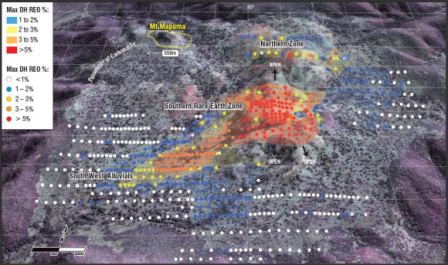
What we have in the centre of the project area is an area rich in rare earth oxides.


The discovery of which came about when drilling for phosphate?

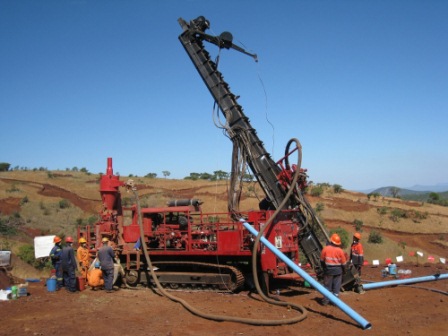
Correct. On the outer rim of the project is the phosphate, where we commenced drilling.

During the program, two holes were drilled in to the central area and two holes in the northern area of the project.

These returned assay results that demonstrated the value for the rare earths at Ngualla as potentially 200 times more than the value for the phosphates.

On that basis we decided to change the drilling program around to the centre of the project where the rare earths are situated.

What do you now know about your, what is now, rare earths play?

We have identified three different mineralised zones that have given us a resource of 170 million tonnes.

That is a significant number as it places Ngualla as the fifth largest rare earths project in the world, outside of China.


The rare earth market is nominally 120 to 130 thousand tonnes of rare earths per annum.

This is 170 million tonnes grading well above the norm. This represents potentially many centuries of mining.

Commercially, where we are developing is in the weathered high-grade zone known as the Southern Rare Earth Zone, which provides more ‘returns’ for ore above our cut-off grade of three per cent.

We have 40 million tonnes over four per cent.

There are a number of companies within the rare earth space at the moment, many with resources that may be economical, but nowhere near as substantial as the reserves you appear to have?

That’s right.

So what advantages does Peak Resources have over its competitors?

Firstly in terms of tonnes, we have mine life. There are a lot of mines with ‘tonnes’ so we can tick that off, but that doesn’t really cull the pack all that much.

Our important advantage is grade. As in all mines, it’s all about tonnes and grade and grade is king as they say, so when I compare our grades to those within our peer group – we have 170Mt for around 4Mt of contained rare earth oxides.

There are some other projects with very high grades but they generally have very low tonnages.

This is a rare earth project, which means it’s not a typical gold mine or base metals play.

We’re dealing with 15 elements, not just one or two, which complicates the picture somewhat.

That’s a lot of elements for one project. How do you know which will deliver the best value?

We need to understand the marketability of those elements – what it means in terms of price, as one rare earth element has different pricing to the others.

They range in price from tens of dollars per kilogram to several thousand dollars per kilogram.

We need to understand that. For us value is very important when we look at the mix of elements we have got in our ground. To understand value in a closed market we need to engage with targeted customers and negotiate positions.

Have your recent studies enabled to you focuses on which of the 15 elements present are the ones for you to concentrate on?

Yes. The ones that have value are those for which there will be an under-supply that will increase in price due to that situation and that we have significant supply.

Thus our attention will be on neodymium for the magnet market and europium for the phosphor markets around the globe.

The cerium market is predicted to be in over-supply and there will be downward pressure on price.

Having said that, there’s always the view that part of that over-supply will be taken up by new products as the metal, has been to date, relatively unavailable for new product development.

For instance, Molycorp, in the United States, has developed a new water absorbing product that uses cerium.

Now that is a product outside the current market space. Molycorp’s anticipates all its cerium production will be funnelled into this new product.

That means the quantity of cerium coming out of that mine will not impact the current market, so the impact on price will be lessened, hopefully maintained at current levels.

Is that why people may have trouble understanding the rare earths market? They hear about rare earth companies yet they don’t know about rare earths and how they are really used. There is a certain mystique surrounding them.

Non-technically minded people get them confused with a whole raft of other elements like lithium and graphite that overlap in products like batteries, which causes some confusion.

The other issue I’ve found after travelling through the UK, North America, and Australasia is, particularly with the Australian market, investors see time to be a major issue.

When we look at the development time at Mt Weld, or Arafura and Alkane – you’re talking decades to bring the product to market, which just add to the uncertainty and risk.

Our project is a bit different in that we have an ore body that is cleaner, in a relative sense; it’s simpler because we essentially have low levels of acid-consuming minerals, no deleterious minerals, effectively background levels of uranium and thorium and no other economic minerals to complicate the metallurgy.

That’s important from a processing point of view. The chemistry is simpler and removes potential complications in the metallurgy downstream that our competitors have to expend cash and time to reslove.

You have low levels of uranium and thorium. Why does that add and not subtract to the project value?

We virtually have no uranium or thorium – just background levels – so that is not going to cause any issues with processing and limits problems from a cost point of view for processing, handling, storage, and transport.

Importantly, there are no other economic minerals in our rare earths. That means our metallurgy solution is far simpler. We don’t have to extract other minerals apart from the rare earths.

So would you describe Ngualla as a ‘simple’ rare earths project?

I would use the word relatively in there as well. If I just say it is simple people might think it’s like a gold mine, it ain’t like a gold mine.

The rare earth business is far more complicated.

I would say – in a relative sense to other rare earth projects, Ngualla is ‘simpler’.

Australian mining sees light on the Dark Continent

A BIG STORY: Hillary Clinton’s recent tour of Africa may well been seen as a consequential step for the future of Australian mining on the resources-rich continent.

For, while the story of Chinese mining ambitions in Africa is well-known, it is becoming apparent that Australia also has an important role to play.

The United States is becoming increasingly concerned over China’s growing interest in Africa, which is home to seven of the world’s 10 fastest-growing economies, thanks partly to massive injections of Chinese cash, such as the $20 billion in loans just announced by Chinese President Hu Jintao.

During the US Secretary of State’s 11-day swing around the continent, one of her major themes was the nature of foreign investment.

Without mentioning China by name, Clinton urged African leaders to carefully consider foreign-sponsored projects.

China’s involvement in Africa is usually characterised as having devastating consequences for the populations of impoverished countries in terms of harsh labour conditions, corruption, human rights abuses and economic exploitation.


Certainly Chinese investment often comes at a cost.

African resources are dug out of the ground and shipped to China for processing and value-addition.

Infrastructure projects, which sometimes collapse or need to be closed within a few years, often employ entirely Chinese workforces.

And loans are nearly always tied – meaning the money can only be spent with Chinese companies.

Zambia has been a particular flashpoint in Sino-African relations, with a Chinese mine manager killed last week by workers in a riot over labour conditions that have allegedly led to dozens of deaths through poor safety, beatings, summary dismissals, non-payment of wages and, in at least one instance, mine security staff firing into crowds of unruly employees.

Australia’s approach, on the other hand, has been markedly understated and so far reasonably successful.

At the African Union Summit, held in Addis Ababa last month, the Australian Government was singled out for praise in helping African countries with improvement to their mining governance.

The Federal Government is engaging with their African counterparts to assist with transparent mining regulations, contract reviews and – ironically, perhaps – mineral taxation policies.

According to the ABC News, South Africa’s African National Congress party sent a delegation to Australia to study the Mineral Resources Rent Tax.

And last April the Prime Minister’s newly-appointed special envoy to Africa, Joanna Hewitt, signed an agreement with the Liberian government to provide $700,000 to help set up a natural resource taxation unit.

Her visit received no media attention in Australia, but Liberian officials appreciated Australia’s support.

There are currently more than 220 ASX-listed exploration and mining companies that have a combined market capitalisation in excess of $250 billion with interests in Africa, according to the Australia-Africa Mining Industry Group (AAMIG), which is a Federal government-assisted body.

With more than $50 billion so far invested in African mining and an understated diplomatic approach to providing assistance, it could be that Australia emerges as the quiet achiever over coming decades.


By Steven Jones of Corporate Zest
steve@corporatezest.com.au 

This article first is published courtesy of Symposium and Corporate Zest

http://www.symposium.net.au/blog.html

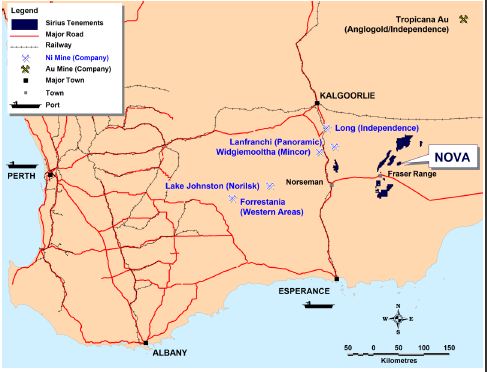
Time to get Sirius

The recent stellar performance of Sirius Resources from 5.7 cents to yesterday’s high of $1.25 has shown there is plenty of life left in the junior exploration sector.

Not only do we now know that major hits will be rewarded, the best news is that the fear of missing out (FOMO) is also alive and well and when you throw in greed I think it spells recovery.

Based on the lack of movement in base and precious metals sectors a regional mini-bubble was always going to be one of the favourites when it came to a catalyst.

With the amount of high risk/high reward drilling a number of my covered companies are undertaking or planning it would have been nice for one of them to take the lead but regardless of this I have been watching the Sirius story unfold and mentioned to a client advisor that it felt like a repeat of what occurred at Ventnor Resources in August 2011.

The two most profitable phases for junior resource investors includes the initial discovery excitement and the final ramp up phase towards production.

Buying at the height of the exploration madness may turn out to be profitable but it can be a perfectly good waste of three to five years of your investment career.

Those buying Sirius now are exposed to a number of risks as the fact remains there is considerable work ahead and, as we have seen this week, the company will have to go back to the market in the short-term.

The trading conditions also become far more dangerous and despite the massive rise I am sure that many day and short-term traders would have been stopped out along the way and some on the first day of the release when the stock touched a low of 19c.

I have no idea how high Sirius could go before the frenzy settles down and even though I would have loved to have held some (Sirius was the old Croesus so many of us would have held it at some stage prior to administration and the recon) I do not feel the urge to start chasing it either.


Source: Sirius company presentation

Over time I have learnt to become less anxious about intra-day price movements and buying a stock in the hope that it goes higher straight away is only going to lead to future bad habits that are very difficult to turn around. (From my experience as a broker).

Sirius’ success and the implications will go well beyond the lucky shareholders and management/technical team that must feel as chuffed as the South Australian who won $50 million in powerball last week.

Although, I have been involved in a number of major growth stories since, I will still never forget the day that Ramelius announced 48 metres at 152 grams per tonne gold and my clients were holding a sizeable chunk of the company at the time.

For some who braved the savage tax loss selling of June 2004 and didn’t watch the stock every few minutes the ultimate reward was six cents to a return greater than $3.00 per share with bonus options, capital return and a dividend.
 
I have noticed that in some of my recent commentary I may have been guilty of overusing the “Multiple share price upside” stamp just like mining companies wore out the “We are seeking new investment opportunities in the technology sector to enhance shareholder value” during the Dotcom bubble or “Olympic Dam” style target when interest returned.

When perfectly sounds stocks are being belted (especially the ones you hold) it isn’t hard to let the market get to you, however you learn to either switch of the computer, buy where possible or do nothing.

Over the last week or so not only have I been reminiscing about the ten-baggers of old but I have also been breaking down a number of stocks and am stunned at the value I am now seeing.

I tend to make plenty of noise in the early stages of the recovery and am now asking other market participants, to steal a line from Lara, “Where the bloody hell are ya?”.
 
Regards
 

Tony Locantro


More gold merger news from Diggers and Dealers

DIGGERS AND DEALERS: Just before Endeavour Mining Corporation executive director and CEO Mark Connelly was to deliver his presentation at Diggers & Dealers, the ASX and TSX-listed company announced it had entered into a definitive arrangement agreement with Avion Gold Corporation.

The deal will result in Endeavour acquiring all of the issued and outstanding common shares of Avion via a court-approved plan of arrangement.

Summary of the transaction:

–    Acquisition of Avion in an all share transaction with each Avion common share exchanged for 0.365 of an Endeavour common share valuing Avion at CDN$0.88 per share or CDN$389 million, using closing prices on the TSX as of August 7, 2012;

–    The acquisition will immediately increase Endeavour’s forecast gold production by approximately 50 per cent to 282,000 to 304,000 ounces for 2012;

–    Endeavour is providing a US$20 million short term exchangeable loan to Avion to restart the Tabakoto mill capacity upgrade, leading to further gold production growth to over 450,000 ounces per year when Agbaou reaches steady state production;

–    Endeavour’s NI 43-101 compliant, attributable Proven and Probable gold reserves will increase by 31 per cent to 2.8 million ounces and Measured and Indicated gold resources increase by 52 per cent to 6.0 million ounces and Inferred gold resources increase by 167 per cent to 3.3 million ounces; and

–    The acquisition of Avion will create one of the largest West African mining companies with three producing mines, a fourth mine currently in construction, and an attractive pipeline of exploration and resource development properties.


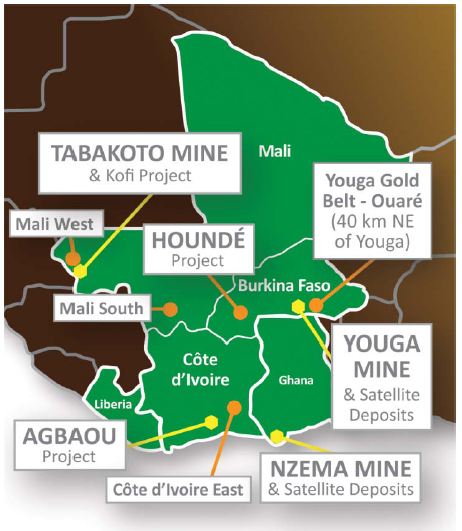
Mine and project location map. Source: Company announcement


Speaking to journalists after his presentation, Connelly said the company’s reasoning behind the deal was its desire to grow.

He said the deal reflects the company’s previously announced plans to become a 450,000 to 500,000 ounce producer by the end of 2013.

“This presents that today,” he said.

“We will be at 450,000 [ounces] with the acquisition of Avion, plus the upgrade of the Tabakoto mine in Mali.

Connelly said Endeavour had been looking at a number of opportunities that had become increasingly attractive due to valuations easing within some of the targets the company had been focused on.

“Our primary targets have always been in West Africa,” he explained.

“We have our technical operational base there, we have demonstrated we can build projects, permit them and operate them successfully within West Africa.

“Avion has open pit mining and underground at Tabakoto and Kofi in Mali. They have a very good exploration opportunity in Burkina Faso, called Houndé.

“We see Mali as being another potential for us. It is the southwest part of Mali; all the operational mines are there…so we are in the right jurisdiction and right location.”

Ampella to get jump on African assays

DIGGERS AND DEALERS: The lag time for drill results in Africa has been a common complaint suffered by companies operating on the continent.

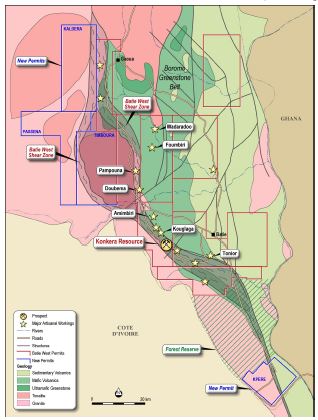
Ampella Mining has taken the matter to task and has announced a sample preparation laboratory based at the company’s 100 per cent-owned Batie West gold project in Burkina Faso has now been commissioned and is fully operational.


Location diagram of Ampella Mining’s Batie West project in Burkina Faso. Source: Company announcement


Ampella decided to bite the bullet in 2011 to construct its own sample preparation lab to combat the long delays occurring in the Burkina Faso laboratories.

Being able to prepare samples ready for assay in its own facility will alleviate the turnaround times from the Burkina labs and will also provide Ampella the flexibility to send the samples overseas for assay if necessary.

“The driver for us putting our own lab on site was the fact that we could see that the West African labs were all snowed under as there are a lot of exploration companies all moving into West Africa, particularly in the two years and the labs just couldn’t cope,” Ampella Mining managing director and CEO told The Roadhouse at Diggers and Dealers.

“The main reason they can’t copies that they don’t have enough prep facilities.

“So we decided late last year that we would build our own prep lab onsite.”

The company said it considered maintaining its own strict QA/QC procedures was an imperative and that it has retained independent contractor, SGS, to operate the lab to maintain independence of results from all drill programs.

“We can do about 8,000 samples per month and we believe that gives us enough edge to be able to get a quicker turnaround,” Kitto said.

“We are expecting a turnaround on samples now of around two weeks as opposed to six months.”

The timing of commissioning is advantageous for the company with the African wet season now in full swing, resulting in its drilling programs slowing accordingly.

This will allow the new lab to concentrate on clearing the previous backlog of 46,000 samples awaiting assay.

A number of these samples have been with assay labs in Ouagadougou for over six months and the commissioning of the Batie West lab will enable Ampella to systematically recall unprepped samples to site thereby reducing the turnaround time for gold assay

The company said between the Batie West lab and the existing facilities in Ouagadougou, the backlog of 46,000 samples will be cleared for assay by the end of October.

Even after this backlog has been cleared Kitto said there would be plenty more to take their place.

“I think we will keep it flat out and we will probably still have to send samples elsewhere, but the key samples can go through our lab, and that’s been the issue.

“Trying to explore without results, particularly when results take six months to come back, is like having both arms cut off.”

G J Stokes Memorial Award – Geoff Loudon

Each year, Diggers and Dealers recognise an individual who has made an exceptional contribution to the Resources’ Industry.

This year the Award was presented to Geoff Loudon.

Loudon is currently chairman with Nautilus Minerals, a venture that is breaking barriers with a first-to-market strategy utilising innovative underwater mining technology and strategies.

He was associated with the discovery and development of the 40 million ounce Lihir Gold deposit in Papua New Guinea.

Loudon has been involved with exploration syndicates as a mentor, promoter and financier of exploration in emerging economies with first mover advantage focused on highly prospective but low developed economies such as South America in the 1990’s.

The strategy has delivered strong successes including an eight million ounce gold discovery in Peru, success in Chile, Paraguay, NZ, PNG and Australia.