


Australian presence in Africa benefits both
AFRICA DOWNUNDER: Perth – Opening the Paydirt Africa Downunder Conference in Perth Australia’s Minister for Foreign Affairs Bob Carr spoke about the growing presence and increasing engagement Australian was having in Africa.
“We are strengthening political links with African regional organisations and through high-level contact,” Carr said.
“Our development assistance – to help Africa increase economic self-reliance – has quadrupled in the last five years.
“And we are helping to build capacity by providing more than 1,000 scholarships for Africans to study in Australia this year alone, through the Australia Awards.
“Our trade and investment with Africa is growing rapidly.”
The Australian mining sector is playing a particularly important role in the current development of Africa’s minerals and resources sector.
Our rock kickers and diggers are well-represented on the continent with some 200 Australian companies involved in 650 projects in 37 countries.
One in 20 Australian companies listed on the Australian Securities Exchange has an investment in Africa.
Africa hosts the largest number of Australian mining projects of any region outside Australia accounting for around 40 per cent of all overseas mining projects.
“Like Africa, we understand the opportunities and risks of natural resource endowment,” Carr said.
“On our side, however, we have the advantage of mature, world’s best practice mining and gas industries.
“In many ways we are natural partners.”
After his opening address, Carr flanked by Special Minister of State and furious head-nodder Gary Gray, faced a phalanx of resources journalists.
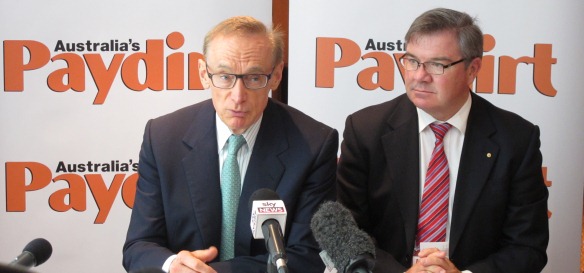
Asked whether he was worried about the perception of Australia being a high-sovereign-risk environment as far as investment goes, Carr was quickly onto the front foot.
“Australia has got the best business climate in the world,” he responded.
“Where would you put your money in the world at the present time?
“Would you go into Europe, with the uncertainty generated by Greece and the banking system in other states?
“Would you go into the United States with a pretty tough regulatory regime? I’ve heard investors in the mining and energy sectors say that to me.
“They think Australia offers a better regulatory regime than the US.
“Where would you put your money? Australia offers a superb business investment climate. There is a political certainty here and continuity of regulatory standards.”
The next question without notice from the floor enquired as to whether Carr considered the mining boom was indeed over.
He responded by saying the mining boom wasn’t over because the country had billions of investment still in the pipeline for three giant gas projects to be developed in Darwin, Gladstone, and Gorgon.
“You’re looking at about $130 billion dollars of investment with tens of thousands of jobs,” Carr said seemingly unaware mining and oil and gas fall under two separate resources sector umbrellas.
“There is still a huge amount of investment in the pipeline and that is played out for a recovery in world demand and a return of price levels – and I am talking about down the track.
“Because Australia offers such advantages for investment, the investment flow will continue to be here generating jobs in Australia.
To his credit, Gray did focus his response on the global demands for metals, which he said is yet to reach its peak.
“It [demand for metals] drove first a commodity price increase that benefited the Australian economy through the middle 2000s,” Gray said.
“Then it drove an investment tidal wave – the next consequent of that is a massive lift in Australian production – of iron ore in particular in Western Australia, of oil, of gas, of LNG, of LPG, of CNG – the whole range of hydrocarbon products into global markets where previously Australia hasn’t been present.”
Gray implied the story that will emerge for the future of the industry, not only for Australia but for Africa as well, would be nations such as China as they, “continue to grow and continue to build cities the size of Chicago – they need a lot of iron, they need a lot of copper, they need a lot of zinc, they need a lot of coal,” Gray said demonstrating a capacity to unnecessarily repeat phrases.
“They need the minerals and the metals that we can mine in Australia – and that’s what this conference is about – showing the way in Africa to do that well.
“To do that in a way of which we can be proud and to do it in a way that is sustainable.”
It seems charitable for Australia to be so willing to export its mining industry expertise at such levels; however a similar willingness to let elite swimming coaches ply their trade overseas resulted in the nation recording its worse effort in the pool at an Olympic Games in recent memory.
Could such a transposition of intellectual property come back to bite Australia in the homeland, especially in what is an increasingly competitive global market?
“What we have in Australia is globally significant expertise in extractive industries,” Gray said.
“We have in Australia the world’s best regulatory framework, environmental and also, importantly in governance of tenements.
“It is actually incumbent upon us to share that knowledge and that experience with growing economies.
“It’s the right thing to do. It’s how we set global benchmarks of performance that mean that the world will be in better hands for future generations.
“Australia isn’t simply a resources powerhouse; it’s also a globally significant environmental power.
“We have the insight and the capacity to help countries grow and reach levels of economic independence through our capital investment in projects, through our expertise in mining, but also through our elite knowledge and experience in the regulatory environment.
“It’s the right thing to be doing.”