Musgrave Minerals Drills with Standalone Intent

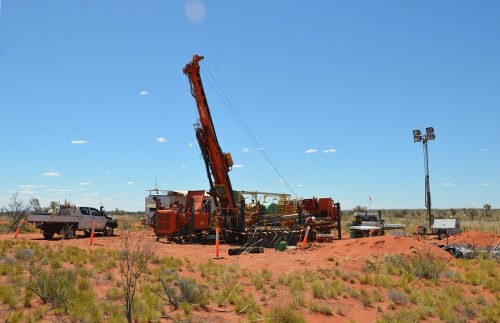
Musgrave Minerals’ (ASX: MGV) New Years’ resolution is simple enough: to maintain the flow of positive drilling results coming from the company’s Cue project in Western Australia and define a resource capable of sustaining a standalone operation.

Musgrave Minerals’ Cue project is in the Murchison district of Western Australia and contains the 4.83 million tonnes at 2.84 grams per tonne gold for 441,000 ounces of gold.

The main contributors to the resource are the Lena and Break of Day deposits, the latter of which being where Musgrave has concentrated a great deal of drilling activity.

Break of Day’s currently hosts an Indicated and Inferred Mineral Resource of 868,000 tonnes at 7.15g/t gold for 199,000 ounces of gold, which Musgrave expects to increase from further drilling.

The company’s confidence is understandable given results received towards the end of 2017 from a reverse circulation (RC) drilling program.

Intersections included:

17MORC108
11 metres at 13.8 grams per tonne gold from 115m down hole, including 6m at 24.5g/t gold from 120m down hole;

17MORC107
10m at 7.6g/t gold from 96m down hole;

17MORC117
6m at 8.2g/t gold from 84m down hole, including 2m at 20.9g/t gold from 86m down hole; and

17MORC118
3m at 12.6g/t gold from 142m down hole within a broader interval assaying 39m at 1.7g/t gold from 142m.

These results were followed by further outstanding results the company interpreted to highlight the opportunity it has at Break of Day to grow the Resource.

Musgrave concluded a successful 2017 by announcing further intersections from Break of Day that included:

17MORC127
30m at 11.3g/t gold from 120m down hole, including 4m at 22.3g/t gold from 120m and 8m at 28.1g/t gold from 136m;

17MORC125
6m at 13.2g/t gold from 56m down hole, including 3m at 23.5g/t gold from 136m;

17MORC120
4m at 9.3g/t gold from 288m down hole, including 2m at 16.8g/t gold from 289m; and

17MORC116
3m at 9.2g/t gold from 278m down hole.

The intercept recorded in17MORC120 is of note as it lies more than 160m outside the current resource boundary.

Similarly, the high-grade intersection in 17MORC127 highlights a substantial high-grade pod at relatively shallow depths that Musgrave believes will be potentially amenable to open-cut mining.

While all this was happening, Musgrave claimed a new gold discovery at the Louise prospect, located 750m south of the Break of Day deposit.

As part of the RC drill program at Break of Day, three drill holes were carried out on the Louise prospect along the same shear zone that hosts Break of Day with mineralisation observed to be similar in style and nature.

Drill holes 17MORC112 and 17MORC111 both intersected the targeted structure and quartz lode at Louise demonstrating continuity of mineralisation over strike.

17MORC112 intersected:
4m at 15.4g/t gold from 79m down hole, including 2m at 29.9g/t gold from 81m, which remains open to north and down dip.

Musgrave interpreted the northern plunge from the historical workings at surface through 17MORC112, to be similar to the plunge on the Velvet Lode at Break of Day.

“This was a great initial result at Louise as it immediately highlighted potential exists for new high-grade gold discoveries within the 20 kilometres of prospective strike we control in this under explored belt,” Musgrave Minerals managing director Rob Waugh told The Resources Roadhouse.”

“Louise is the second high-grade gold discovery for Musgrave within 18 months, which is a great achievement.”

“The mineralisation is within the southern continuation of the Break of Day shear and is wide open along strike and down dip.”

“It also combines with the high–grade result in 17MORC120 on the Velvet lode at Break of Day to highlights the existence of a substantial target for us to focus on between Break of Day and the new Louise prospect.”

The high-grade gold intersection at Louise demonstrates the potential for the formation of multiple high-grade gold shoots, particularly since there has only been one shallow basement drill hole carried out testing the shear zone along the 750m of strike between Louise and Break of Day.

So, a new year sees a new program of drilling announced for both Break of Day and Louise.

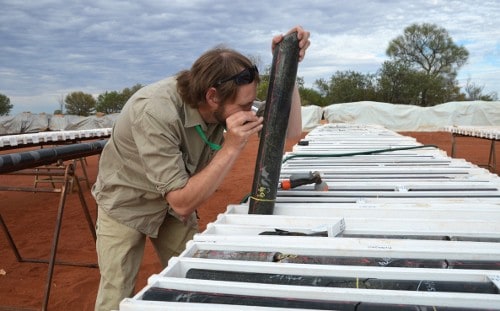
A program of diamond drilling being carried out at Break of Day has been tasked with extending the high-grade shoots outside the current resource boundary that remain open down plunge, where Musgrave intersected 11m at 54g/t gold in drill hole 17MORC084 mid-2017.

The current diamond drilling program was commenced in early December and is expected to have first assays returned in early February.

The Louise discovery is also being targeted by a nine-hole program of reverse circulation (RC) drilling designed to follow-up the near surface discovery intersection, from hole 17MORC112.

First assays from this program are also expected to arrive in late February.

“The diamond drilling is being undertaken to confirm the continuity of the geology and extend the gold mineralisation in the high-grade gold shoots at depth at Break of Day,” Waugh said.

“The RC follow-up drilling at Louise will aim to extend the newly discovered near surface high-grade gold mineralisation as well as infilling the 750-metre gap that currently exists between the Break of Day and Louise drill results.

“It should be no surprise that the company has classed this as a high-priority area, as we are confident there is significant upside potential to extend and grow our current high-grade gold resource.”

To the north west of the Break of Day deposit, and not to be forgotten, is the Lena deposit.

Although it is lower grade at an average grade of 1.8g/t gold per tonne, Lena boasts JORC resources of approximately 153,000 ounces.

Mineralisation at Lena remains open to the North and down plunge while the Leviticus and Numbers deposits south of Break of Day add another 50,000 ounces to the resource base.

These figures come into play when it taken into consideration that the company is targeting gold resources to support a standalone production facility.

A recent research not from Veritas Securities identified ongoing exploration would continue to add resources to support a standalone facility producing around 60,000 ounces of gold per annum for a capital cost Veritas estimated at approximately $60 million.

Veritas also noted the extent of infrastructure within the Murchison region, saying four third party mills dot the landscape with potential available for toll milling.

“Two of these mills are nearby, within 40 kilometres of Break of Day,” the analysts identified.

“Westgold’s Tuckabianna Mill (currently being refurbished by Westgold) with a capacity of 1.2 million tonnes per annum, and Ramelius Resources’ Mt Magnet Checkers Mill with a capacity of 1.7 million tonnes per annum.

“There are many reasons why either Ramelius or Westgold would wish to process high-grade ore from Break of Day.”


Musgrave Minerals Ltd (ASX: MGV)
…The Short Story

HEAD OFFICE
28 Richardson Street
West Perth WA 6005

Ph: +61 8 9324 1061

Email: info@musgraveminerals.com.au
Website: www.mugraveminerals.com.au

DIRECTORS
Graham Ascough, Rob Waugh, Kelly Ross, John Percival

Alliance Resources Ready to Move at Weednanna

Alliance Resources (ASX: AGS) wasted little time in letting the market know of its intentions for 2018.

Alliance Resources had hardly placed the New Year’s Eve champagne bottles in the recycling bin when it announced results from the third round of reverse circulation (RC) drilling at its flagship Weednanna gold prospect late in 2017.

The Weednanna gold prospect has a strike length of 1.3 kilometres, along which Alliance has identified exceptionally high-grade zones that are open in at least one direction.

The company has taken a systematic approach to Weednanna, including a review of past exploration results, which initially saw it focus on three high-grade areas – Targets 1, 2 and 3 with the aim of drilling for sufficient detail to enable a mineral resource estimate to be established.

Early results across Targets 1, 2 and 3 produced bonanza gold grades of:

49 metres at 6.3 grams per tonne gold from 45m, including 21m at 10.7g/t gold from 48m;

14m at 36.1g/t gold from 118m, including 5m at 95.6g/t gold from 120m;

16m at 7.7g/t gold from 81m, including 8m at 12.9g/t gold from 88m; and

60m at 5.6g/t gold from 47m, including 9m at 15.6g/t gold from 63m and 8m at 13.4g/t gold from 99m.

Buoyed by these results, Alliance widened its scope to include drilling at Target 4, which confirmed it as a new high-grade gold zone within the project complex.

The entire program saw a total of 21 RC holes (17WDRC050-70) drilled, 15 of which returned intercepts of greater than one gram per tonne gold, with four holes returning greater than 50g/t-metres gold.

The most recent results to be announced included:

17WDRC051
35 metres at 3.65 grams per tonne gold from 43m (Target 1), including 9m at 8.91g/t gold from 44m;

17WDRC057
6m at 13.63g/t gold from 59m (Target 2), including 3m at 26.6g/t gold from 62m;

17WDRC067
15m at 18.21g/t gold from 107m (Target 4), including 7m at 35.94g/t gold from 109m; and

17WDRC070
3m at 25.45g/t gold from 81m (Target 4), including 1m at 74.2g/t gold from 81m.

“In February we will be launching a fourth drilling program at Weednanna,” Alliance Resources managing director Steven Johnston told The Resources Roadhouse.

“Weednanna has assumed the greatest importance for us, especially since our drilling programs have continued to define these discrete, but high-grade, shoots.

“We have drilled the first three targets out to a spacing that makes a good case for launching into a Mineral Resource.

“We have one more program to conduct there, which will be carried out on Target 4, to bring it up to the same drilling pattern and then we’ll commence 3D modelling and a mineral resource estimate on those high-grade target areas.”

The Weednanna gold prospect forms part of the Wilcherry Project Joint Venture in the Gawler Craton of South Australia between Alliance (67.35%) and Tyranna Resources (ASX: TYX) (32.65%).

In September 2016, Alliance acquired a 51 per cent interest in the Wilcherry project for a moderate outlay of $2 million.

The deal placed Alliance in the position as the JV leader of an advanced project in the mineral-rich Gawler Craton that has, to date, been the subject of about $55 million in past exploration.

“We have been increasing our equity in the JV as a result of Tyranna Resources electing not to contribute to the fiscal year budget from 1 July 2017,” Johnston explained.

“By the end of the December 2017 Quarter we had increased our equity to 67.35 per cent, which will continue to increase in line with each quarterly expenditure.

“We believe the original decision we took to get involved with the project has paid off.

“We are achieving some great gold results and I am increasingly confident that Weednanna will be a mine one day and hopefully that will be sooner than later.”

Those hopes were boosted with positive results received from recent preliminary metallurgical testing of high-grade gold samples from Targets 1 and 3 at the Weednanna gold prospect.

The results demonstrated that at a grind size of P80 75 microns, cyanide bottle roll gold extraction over a 24 hour period was 89.4 per cent for WDMET001 and 92.8 per cent for WDMET003.

Using a finer grind size of P80 38 microns incrementally increased gold extraction for WDMET001 to 90.8 per cent and WDMET002 to 95.5 per cent.

“The positive results from the test work ticked an important box in the path to production,” Johnston said.

“That being the gold mineralisation is amenable to conventional grinding and cyanide recovery techniques.”

With Weednanna progressing to a satisfactory beat, Alliance is also looking to progress its Nepean South gold project, located 26 kilometres southwest of Coolgardie in Western Australia.

Alliance considers Nepean South to be prospective for both komatiitic-hosted nickel sulphide deposits and greenstone-hosted orogenic gold deposits.

Results from a final phase of infill auger soil sampling completed in the north-eastern part of the project area confirmed gold anomalism the company had previously indicated by wider-spaced sampling.

Subsequent results from all phases of soil sampling defined two coherent anomalies greater than 7.5ppb gold and totalling 2.1 square kilometres in area.

The company completed a 90-hole aircore drilling program in January, the first phase of which is designed to test for low-level gold in regolith (weathered Archaean rock) anomalism beneath gold in soil sampling anomalism.

Alliance believes results from this program could indicate vectors towards a primary gold deposit.

“We’ve currently awaiting the assays from Nepean South, which is something that I’m very excited about – not to take anything away from Wilcherry – but I certainly hope that Nepean will produce something of interest,” Johnston said.

“At Nepean we have a couple of large soil anomalies, the bulk of which have never been drilled before.

“The Nepean project is an increasingly interesting area that is located just four kilometres to the southwest of the Nepean nickel mine.

“Initially we picked the ground up looking for nickel, but through the exploration work we have carried out we have outlined gold anomalism there.

“It’s proximity to Coolgardie means it is located close to several gold processing plants, any of which could possibly take the mill feed should we prove up an economic discovery.”

Alliance is also continuing to work up regional targets within the Wilcherry JV area from the 26 conductive targets that were identified by a Heli-EM survey carried out in 2016 that may be prospective for massive sulphides, including copper, tin, zinc, lead and silver.

“The ground EM crew is continuing to work on identifying the next targets from that data.

“We are still conducting regional exploration for base metals and we only need to unlock one of those targets to be a game changer.

“After we’ve completed the drilling at Weednanna we’ll move the RC rig onto the next batch of regional targets.”


Alliance Resources Limited (ASX: AGS)
…The Short Story

HEAD OFFICE
Suite 3
51 – 55 City Road
Southbank, VIC, 3006

Ph: +61 3 9697 9090

Email: info@allianceresources.com.au
Web: www.allianceresources.com.au

DIRECTORS
Ian Gandel, Tony Lethlean, Steve Johnston

Gold Road Yamarna_May2017 (300x225)

Good News is Best News for Gold Road Resources

THE INSIDE STORY: Gold Road Resources’ (ASX: GOR) is determined to repeat the Gruyere gold discovery from its substantial 6,000 square kilometre Yamarna Belt tenement holding in Western Australia.

Having negotiated the Gruyere Joint Venture (GJV) deal with Gold Fields Ltd, which the Diggers & Dealers Mining Forum declared, the ‘Deal of the Year’, Gold Road Resources embarked on a $30 million greenfield exploration drilling program.

This recent drilling was centred on the Wanderrie and Corkwood Camps, located within the company’s 100 per cent-owned North Yamarna tenements.

This included RC and diamond bedrock testing of prioritised highest-ranked targets, and infill definition of gold anomalies identified through regional aircore drilling completed while Gruyere studies were being completed.

Of interest was developing an improved understanding of these targets with Santana and Satriani (Wanderrie Camp), and Ibanez (Corkwood Camp) receiving priority attention.

Broad spaced drilling confirmed gold bedrock mineralisation along the main mineralised shear through the Santana and Satriani prospects, which form part of a continuous 11-kilometre-long mineralised corridor known as the Wanderrie Supergroup Trend.

Best Wanderrie mineralised intersections included:

Satriani RC

17WDRC0033
2m at 14.74g/t gold from 73m;

Santana RC

17TARC0028
1m at 17.73g/t gold from 68m; and

17TARC0025

5m at 2.03g/t gold from 108m.

Similar bedrock drilling testing the Ibanez prospect at the Corkwood Camp returned intersections of:

Ibanez DDH

17CWDD0015
8.2m at 11.63g/t gold from 229.67m, including 3.33m at 27.48g/t gold from 232.26m; and

Ibanez RC

17CWRC0057
10m at 28.67g/t gold from 240m, including 2m at 136.57g/t gold from 240m.

Each new drilling campaign at all three prospects encouraged the company, with planning now underway for systematic framework drilling to definine greater extents of the mineralised systems.


Anticipated results from this extended work will provide a deeper understanding of each prospect’s potential as the company aims to progress at least one of these areas to advanced infill drilling in 2018.

Other work completed on the North Yamarna tenements included aircore definition of a five-kilometre southern continuation of the Wanderrie Supergroup Trend through the Gilmour and Morello prospects, where early bedrock drilling intersected gold mineralisation.

Gold Road interprets Supergroup Trend to be the southern continuation of the Attila‐Alaric Trend, which already hosts 420,000 ounces of gold in Mineral Resources.

The Attila‐Alaric Trend continues over 30 kilometres further south to the Yaffler and Toppin Hill prospects on the company’s South Yamarna Joint Venture tenure, a 50:50 Joint Venture with Sumitomo Metal Mining Oceania Pty Ltd.

The JV’s recent exploration efforts at South Yamarna centred on selective testing of priority targets, particularly the Breelya‐Toppin Hill, Spearwood and Kurrajong Camp Scale targets, where a total of 12 Reverse Circulation (RC) and 103 aircore drill holes were carried out.

Bedrock mineralisation was intersected at Yaffler South, in the Breelya‐Toppin Hill Camp, piquing the JV’s interest by delineating a thick mineralised shear zone close to the contact of a dolerite with a sedimentary unit, which it is confident can be identified in magnetics.

A strike length of 1.4km of mineralisation has been identified to date, providing room for follow‐up drilling that is pencilled in, at this stage, for next year, enhancing the JV’s portfolio of advanced drilling targets.

Best bedrock intersections at Yaffler South, included:

17SYRC0113
2m at 4.34g/t gold from 142m; and

17SYRC0111
15m at 0.68g/t gold from 40m, including 1m at 5.84g/t gold from 49m.

A further program, consisting 103 aircore holes was carried out at the Kingston North target, designed to infill and extend anomalism delineated by drilling completed last year.

The drilling confirmed the Kingston North target includes an area of structural complexity with north to north‐west striking shear zones being interpreted from geophysical data.

The company’s geological interpretation of the Kingston North results indicates anomalous gold mineralisation associated with zones of stronger shearing.

These anomalous zones are being incorporated into a detailed geological and structural re‐interpretation that will form the basis for follow up drilling.

“The drilling we have completed this year has provided some extremely encouraging results,” Gold Road Resources executive director ‐ exploration & growth Justin Osborne told The Resources Roadhouse.

“The Gruyere project team has been keeping the project build right on schedule, which has allowed us to focus on speeding up our exploration programme across the broad Yamarna Belt.”

Progress of the Gruyere gold project is happening without much fanfare or headlines, which Gold Road Resources is very pleased about.

As exciting as it is to be building a project of the scale of Gruyere, Osborne said the company was holding the advice of chairman Tim Netscher in high regard.

“It’s great having somebody with the experience of Tim as our chairman and working so close with the Board and the Steering Committee,” Osborne said.

“He’s been through all this before and he knows that the most common news you expect to hear during development of a project is bad news – so we are more than happy not to be generating headlines as the project ticks along on schedule.”

It has been a case of so far so good for the Gruyere gold project, which has quietly progressed, on schedule and budget, under the stewardship of JV partner Gold Fields.

The right boxes continue to be ticked with engineering, procurement and construction (EPC) contractor Amec Foster Wheeler Civmec Joint Venture (ACJV) having commenced process plant construction.

A concrete batch plant was also commissioned, allowing the ACJV to complete the first concrete pour in the carbon‐in‐leach (CIL) area.

Fabrication of the steel plate for the CIL plant tanks, the first of the major components required for the process plant, commenced in Civmec’s Henderson facility south of Perth, which will complete all of the steel fabrication from 100 per cent Australian sourced steel.

Bulk earthworks contractor MACA has completed clearing of the process plant site, construction of the Gruyere airstrip and Gruyere main access road, and has also commenced clearing for the Stage 1 open pit, having completed clearing for the Tailings Storage Facility.

MACA has also started initial construction works for the installation of production and monitoring bores for the Yeo borefield, which will supply the mine and process plant.

A strong field of companies tendering for the mining services contract has been whittled down to a short list of three.

It is expected this contract will be finalised by the end of the year, allowing the successful party to start mobilising to site in the March 2018 quarter.

There may not be as many months left in the year as there were, but Gold Road shows no sign of slowing down before Christmas.

Work on the North Yamarna tenements will include diamond and RC drilling at Ibanez targeting stacked high‐grade lode structures to allow further advanced infill drilling.

On the Gruyere JV, Gold Road expects to report a maiden Mineral Resource estimate for YAM14 in early 2018.

Alaric and Attila pre‐feasibility studies are near completion which if positive will allow reporting of first Ore Reserves also early in 2018.

A high level conceptual mining study for the northern higher-grade zone of Gruyere is also underway to assess potential for future drilling in this area of the deposit.

The South Yamarna JV will conduct drilling at Yaffler, subject to pending assays, in concert with development of a structural and geological map for Kingston North to guide future bedrock testing.


Gold Road Resources (ASX: GOR)
… The Short Story

HEAD OFFICE
Level 2
26 Colin Street
West Perth WA 6005

Ph: +61 8 9200 1600

Email: perth@goldroad.com.au
Website: www.goldroad.com.au

DIRECTORS
Tim Netscher, Ian Murray, Justin Osborne, Sharon Warburton, Brian Levet

Lithium Australia Aims For Sustainability In Energy Metals

THE INSIDE STORY: Lithium Australia NL (ASX: LIT), one of the first mining companies to enter the burgeoning lithium space, aims to “close the loop on the energy metal cycle” and create a sustainable lithium future.

While LIT continues to hone its SiLeach® metallurgical technology, its pending acquisition of the Very Small Particle Company (VSPC) will see it move into cathode production as well.

That move is an extension of LIT’s previously announced plans to form a viable battery recycling business.

LIT’s primary focus is the creation of a seamless and sustainable business chain involving several stages: sourcing lithium mineral resources (including mining ‘waste’) as feedstock; processing that feedstock via its SiLeach technology to produce high-quality lithium chemicals and value-adding by-products; further processing the lithium chemicals to create advanced lithium ion (Li-ion) battery cathode materials, and recycling energy metals from spent Li-ion batteries to re-use in new battery production.

The mainstay of this business chain is LIT’s disruptive SiLeach process, designed to efficiently digest and recover metal values from any silicate mineral, without the need for high-temperature, energy-intensive and environmentally adverse roasting.

What drove LIT’s development of SiLeach was its perception that the sustainability of lithium production could be improved by processing materials neglected by others as a feed source for lithium chemicals.

SiLeach is a hydrometallurgical process characterised by low energy consumption and high metal recoveries, with the benefit of extensive by-product credits.

Importantly, it can be applied across a wide range of lithium feedstock, including spodumene, but also lithium micas, which are at present an under-utilised resource.

“We can access lithium from sources that until now were considered unviable, due to a lack of appropriate processing routes – it means we can effectively create value from waste material that would otherwise end up in tailings dams,” Lithium Australia business development manager Brett Fowler told The Resources Roadhouse.

Earlier this year, LIT worked with The Australian Nuclear Science and Technology Organisation (ANSTO) to produce battery-grade lithium carbonate feed from its SiLeach pilot plant.

Ore from the Lepidolite Hill lithium deposit in Western Australia was used as feedstock.

Subsequently, further engineering design studies and financial modelling for the construction of a proposed large-scale pilot plant (LSPP) have been completed.

“Our next goal is the construction of that plant,” said Fowler.

“We’ve completed a pre-feasibility study, which showed a positive outcome, and are now completing optimisation studies.

“Lithium Australia will make an investment decision on whether to proceed at the end of 2017 or very early in 2018.

“Our large-scale pilot plant is expected to produce 2,500 tonnes of lithium carbonate per annum, approximately one-tenth of what would be produced by a full-scale production plant.”

LIT’s proposed LSPP will be based on studies that indicate it can be cash-positive, based on the production of lithium carbonate only and before by-product credits. With economies of scale, and with the inclusion of valuable by-products, a full-scale plant promises a low-cost production route.

The studies concluded that:

• recovery of high-purity lithium carbonate, such as that produced by the ANSTO-operated pilot plant and meeting offtake specification, can be achieved;

• hydrometallurgical plant operating costs would be around US$5,600 to US$6,400 per tonne of lithium carbonate produced, without taking into account potential by-product credits;

• by-product credits may significantly reduce operating costs;

• there is potential for further significant improvements to both capital and operating costs as a result of:

o improved water management;

o optimisation of reagent mix and usage;

o better control of neutralisation to minimise lithium losses;

o optimising the trade-off between residence time and recovery, and

o economies of scale transitioning from pilot-plant testing to commercial operations.

LIT’s preferred supply model is sourcing lithium mica from the waste streams of already operating mines or historical dumps and tailings; however, it is also pursuing exploration activity to secure alternative supplies, both within Australia and globally.

The company has identified sourcing of the feed material as a high priority and a critical requirement for committing to the construction of the LSPP.

In the meantime, further optimisation studies aim to improve both capital and operating costs.

“We hope to make a decision, as a company, to go ahead with that construction by early 2018 – spending in the order of $40 million to do so,” Fowler said.

“We’ve been looking at potential sites for the plant in Asia, including Malaysia; however, a West Australian-based facility is a strong option too.”

LIT is currently seeking expressions of interest regarding product offtake agreements for the LSPP.

“There’s already a significant amount of international interest in LIT’s approach and the large-scale pilot plant,” Fowler continued.

“Development activities at the moment include the structuring of finance options and the development of off-take marketing strategies; both have a completion objective of early next year.

“We think interest will grow once the large-scale pilot plant shifts into gear and we successfully demonstrate our SiLeach® approach. It will lead the way to a full-scale production plant.”

Meanwhile, LIT has finalised its due diligence for the acquisition of advanced cathode-material producer VSPC.

VSPC owns a proprietary process for the production of advanced, high-quality lithium-iron-phosphate (LFP) battery cathode nano-powder material, as well as a pilot plant with advanced laboratory and large-scale testing facilities.

The VSPC technology, which can be adapted to generate a wide range of cathode nano-powder materials, is a simple and cost-effective method of producing such materials in an environment of superior quality control.

“Independent testing by a German laboratory of product generated from the VSPC’s facility showed it to be better than the standards required,” Fowler explained.

“It’s an advanced technology that was invented in Australia a few years ago, but for one reason or another things didn’t go ahead as planned.

“LIT recognised the opportunity and saw the business as a natural fit with our sustainability and value-adding strategies – we’re aiming to lead in Australia’s nascent clean-tech manufacturing sector.”

VSPC’s process is compatible with solutions produced during the processing of hard-rock minerals to recover lithium carbonate, or lithium hydroxide. It means that lithium carbonate produced by virtue of LIT’s SiLeach technology can be used as feedstock for VSPC’s cathode production.

The advantage for LIT lies in the fact that direct production of cathode materials from SiLeach-produced solutions potentially removes two process steps usually inherent in the manufacture of cathode materials.

As a result, LIT creates a revolutionary flowsheet that capitalises on the value-add of shortening the route from lithium chemicals to cathode materials.

As governments worldwide – among them China, Britain, France, Germany, Norway and The Netherlands – legislate to transition from internal combustion engines to all-electric vehicles (EVs), the emerging market for EVs could create an industry worth hundreds of billions of dollars.

EVs require reliable, high-performance batteries, production of which will rely on greater, and more sustainable, supplies of lithium and other energy metals. It’s a situation LIT is monitoring closely and taking very seriously indeed.

Lithium Australia NL (ASX: LIT)
… the short story

HEAD OFFICE
Level 1,
675 Murray Street,
West Perth WA 6005

Ph: +61 8 6145 0288

Email: info@lithium-au.com
Web: www.lithium-au.com 

DIRECTORS
Adrian Griffin, George Bauk, Bryan Dixon

Peel Mining Persistence Pays Off

Tuesday, October 31, 2017
THE INSIDE STORY: There is no argument that modern exploration techniques assist in the discovery of new deposits, but it also helps to be exploring in the right area.

Persistence also helps, and for coming up to eight years, Peel Mining (ASX: PEX) has been focused on the company’s Cobar Basin projects in New South Wales where it has made systematic discoveries of copper and base metals, most notably at the Mallee Bull and Wirlong deposits.

Peel has always had confidence in both prospects, however it was a recent announcement from the Wagga Tank prospect area that set the market abuzz.

Peel acquired tenements EL6695 and EL7226 last year and quickly designated Wagga Tank as the ‘prospect most likely’.

“When we conducted our initial review of the historic results at Wagga Tank we quickly realised the previous owners probably hadn’t given the area the attention it deserved,” Peel Mining managing director Rob Tyson told The Resources Roadhouse.

“Results from our own drilling this year provided the impetus for us to conduct further drilling, mainly because we thought we were on to something and the best way to confirm such opinions is to drill.”

The Wagga Tank drilling provided the company with plenty to think about, including:

WTRCDD023
11m at 7.15 per cent zinc, 2.31 per cent lead, 58 grams per tonne silver from 396m;

WTRCDD020
6m at 8.52 per cent zinc, 2.97 per cent lead, 12g/t silver from 282m; and

WTRCDD022
6m at 1.5 per cent copper from 92m.

“As part of the program we drilled step-out hole WTRCDD021, in what was then known as Wagga Tank South, basically to test coincident chargeable IP and magnetic geophysical anomalies,” Tyson explained.

“The IP chargeability looked particularly compelling, so we decided to drill and see what was there.”

The 456.6m hole was collared one kilometre south of the Wagga Tank deposit at what is now called the Southern Nights area, intersecting a broad zone of deformation, alteration and sulphide mineralisation, including a zone of variable zinc-lead-silver (sphalerite-pyrite-galena) breccia/stringer sulphide mineralisation between 390m and 410m downhole.

The hole was a combination of RC and diamond drilling, demonstrating highly anomalous zinc, lead, copper, silver and gold present over the greater part of the diamond tail (234.1m to 418m).

Highlights included:

4m at 3.38 per cent zinc, 1 per cent lead, 13g/t silver from 289m;

3m at 3.07 per cent zinc, 1.23 per cent lead, 26g/t silver from 346m; and

20m at 2.40 per cent zinc, 0.8 per cent lead, 44g/t silver from 390m.

Peel quickly followed-up drilling of the WTRCDD021 discovery hole at Southern Nights, and at time of writing had completed four RC drillholes (WTRC031, WTRC033-035).

Assays are pending, but better hand-held XRF results included:

21m at 24.5 per cent zinc, 8.6 per cent lead, 102g/t silver from 194m in WTRC035

70m at 4.8 per cent zinc, 1.0 per cent lead, 18g/t silver from 128m (including 8m at 14.9 per cent zinc, 2.2 per cent lead, 15g/t silver from 188m) in WTRC033

The latest drilling was concentrated near WTRCDD021 with the furthest (WTRC031) just 160m south and 80m to the west.

WTRC031 (depth 185m) was designed to further test the Southern Nights chargeable IP anomaly, and to test along strike and up-dip of WTRCDD021.

The hole intersected a broad zone of strongly anomalous zinc-lead-arsenic-silver-copper from approx. 70m below surface through to end-of-hole at 185m.

WTRC033 (200m) was collared 80m west of WTRCDD021 to test immediately up-dip of WTRCDD021, intersecting a broad zone of strongly anomalous zinc-lead-arsenic-silver-copper from approx. 80m below surface through to end-of-hole (200m), intercepting the broad, strong zone of mineralisation highlighted above.

WTRC034 (199m) was collared 40m west of WTRC033 to test immediately up-dip of WTRC033.

WTRC034 intersected a broad zone of weakly anomalous zinc-lead-arsenic from surface to end-of-hole, which was interpreted to suggest the hole was positioned too far west to intersect mineralisation.

WTRC035 (216m) was collared 40m south of WTRC033 to test along strike of WTRC033.

WTRC035 intersected a broad zone of strongly anomalous zinc-lead-arsenic-silver-copper from approx. 40m below surface through to end-of-hole (216m).

The drillhole intercepted several strong zones of mineralisation including:

19m at 3.2 per cent zinc, 0.7 per cent lead, 21g/t silver from 126m and 21m at 24.5 per cent zinc, 8.6 per cent lead, 102g/t silver from 194m (as highlighted above).

Holes WTRC031, WTRC033 WTRC035 were all terminated prematurely in mineralisation due to high water inflows.

Diamond tail drilling is planned for each in due course.

“The true width of these mineralised intercepts is unknown due to the early stage of investigation, however, of importance, is that the mineralisation present in all drillholes appears to be related to the Vivigani Formation,” Tyson said.

“The Vivigani Formation is host to the mineralisation present at Wagga Tank.”

The Vivigani Formation a stratigraphic unit comprising volcanic sandstones, conglomerate, sedimentary breccia, interlayered low energy turbidites, epiclastics, rare felsic lavas, ignimbrites, and bioclastic limestone debris.

“The exciting aspect of these latest results is that they demonstrate Wagga Tank could be a much larger system than previously thought to be,” Tyson said.

“We have drilling at Southern Nights ongoing with a minimum of 10 additional RC drillholes planned in the near term.

“These drillholes will be designed to primarily test for strike extensions.”

The Southern Nights discovery garnered a good deal of market interest with the company’s share price enjoying an almost 50 per cent rise on announcement.

That doesn’t mean, though, the company has taken its eye of the Mallee Bull deposit, located near Cobar in western NSW.

Peel has also had the drill bit spinning at Mallee Bull, releasing results relating to prefeasibility work into the development of a high-grade, near surface T1 zinc-lead-silver lens.

Peel is undertaking a pre-feasibility study on the high-grade, near-surface zinc-lead-silver-gold T1 lens at Mallee Bull in Joint Venture (50:50) with CBH Resources.

The study is investigating conceptual development of T1 as a ‘dig and truck’ operation, where ore would be milled at CBH’s Endeavor mine approximately 150km away, where surplus milling capacity exists.

The PFS is looking at open pit and underground mining scenarios, followed by the development of an exploration decline to approx. 300m below surface to enable underground drilling of the primary Mallee Bull copper mineralisation.

The JV believes this scenario could allow for a reduction in total capital expenditure and the staged mining development of the Mallee Bull deposit.

Recent drilling under the PFS included 39 RC/diamond drillholes charged with infilling a maximum 20m by 20m drill spacing, and to define the limits of T1 mineralisation.

T1 resource definition drilling returned:

MBRC085
9m at 20.82 per cent zinc, 10.64 per cent lead, 338g/t silver and 1.91g/t gold from 88m;

MBRC089
9m at 10.80 per cent zinc, 6.89 per cent lead, 337g/t silver and 0.45g/t gold from 129m;

MBRC088
3m at 12.74 per cent zinc, 6.93 per cent lead, 263g/t silver and 1.25g/t gold from 119m;

MBRC073
10m at 7.10 per cent lead, 19g/t silver and 0.53g/t gold from 46m; and

MBRC084
3m at 5.98 per cent zinc, 3.33 per cent lead, 54g/t silver from 77m.

“We have received all the results for that drilling, which are currently being included in an updated geological and resource model for T1,” Tyson said.

“Prefeasibility work is continuing.”

Peel Mining Ltd. (ASX: PEX)
… The Short Story

Unit 1
34 Kings Park Road
West Perth WA 6005

Ph: (08) 9382 3955

Email: info@peelmining.com.au
Web: www.peelmining.com.au

DIRECTORS
Rob Tyson, Simon Hadfield, Graham Hardie

Cassini Resources Set to Ride the Nickel Cycle High

Thursday, October 12, 2017
THE INSIDE STORY: Cassini Resources (ASX: CZI) is well-positioned to take advantage of the expected growing global demand for nickel and copper created by the emerging electric vehicle industry.

There was a time in the not-to-distant past when it was thought that stalwart metals such as nickel and copper were to become the horse-and-cart of modern battery technology as demand grew for a fresher suite of commodities.

That was until technology overlord and Tesla CEO Elon Musk was reported on the Benchmark Mineral Intelligence Blog to have said:

“Our cells should be called nickel-graphite, because primarily the cathode is nickel and the anode side is graphite with silicon oxide… [there’s] a little bit of lithium in there, but it’s like the salt on the salad.”

It was a moment that made the market stand back and take notice of the position nickel could once again occupy on the global stage.

As analysts and market watchers realised the importance of nickel and its capacity as a critical input for electric vehicle battery manufacturers, Musk’s words and the subsequent response were not lost on mining giant BHP, which flagged its intention to take its share of the electric vehicle inspired nickel pie by building the world’s biggest nickel sulphate plant.

BHP Nickel West will spend $US43.2 million on a downstream processing plant at Kwinana, south of Perth, as part of a broader plan to reposition the business around the lithium-ion battery market.

BHP Nickel considers demand from the battery market could account for about 90 per cent of BHP’s nickel output within five or six years.

The conversation in the nickel market has been driven by this demand, particularly surrounding the industry’s preferred feedstock – high purity nickel sulphate.

It is becoming apparent that an insufficiency of sulphate production capacity exists to meet even the conservative demand growth scenarios being developed.

“There is a demand for good sulphide feed,” Cassini Resources managing director Richard Bevan told The Resources Roadhouse.

“Through our original scoping study and the current Further Scoping Study, we have demonstrated that we can produce a high-quality, clean concentrate that will be very marketable.

“The other thing presently in our favour, is that there are very few projects like ours in the pipeline.

“Now that the Nova operation of Independence Group (ASX: IGO) has come online, we haven’t been able to find another nickel sulphide project to be at the same stage we are – one that is funded, and of the same scale as the West Musgrave Project.”

Cassini Resources’ focus of late has been centred on the company’s West Musgrave Project, which is subject to a farm-in and Joint Venture deal with OZ Minerals (ASX: OZL)

The WMP is a world-class asset with a current Resource boasting over 850,000 tonnes of contained nickel and 1.8 million tonnes of contained copper within the Nebo and Babel deposits.

It also contains the 156 million tonnes at 0.6 per cent copper Succoth deposit

The farm-in and Joint Venture Agreement entitles OZ Minerals to earn up to 70 per cent of the project by spending $36 million towards feasibility studies and exploration.

The first stage of the farm-in is currently underway and involves Further Scoping Study (FSS) activities aimed to follow-up results achieved in an earlier Scoping Study completed by Cassini in 2015.

The latest work includes metallurgy, mining optimisation and alternative power solutions, and is due for completion during Q4 this year.

The testwork carried out by Cassini in the 2015 scoping study was focused on the relatively high head grade ore domains, which would be processed through a 1.5 million tonnes per annum treatment plant.

The FSS testwork program has been looking at whole ore composites and variability samples, representative of the ore domains and average head grades aligned with the increased project size development options.

To date, the JV has been able to increase its understanding and confidence in the metallurgical performances across a complete range of mineralisation types within the Nebo-Babel deposits.

This was achieved through focussing on lower head grade samples across the primary and weathered ore domains, some of which were not previously tested.

A major component of the testwork included optimisation of the process flow sheet, and testing of alternative reagent regimes, all of which were aimed at further improving nickel and copper recoveries and concentrate grades.

The program has produced separate, saleable nickel and copper concentrates from all mineralised domains, from which Cassini expects to receive by-product credits for cobalt, platinum, palladium and gold.

“When we commenced the FSS we were targeting two key technical outcomes to ensure the viability of the project – the identification of a near-by groundwater source, and confirmation that the metallurgy results we had previously achieved could be reproduced at lower nickel and copper grades and throughout the weathered zones,” Bevan said.

“We were extremely pleased to achieve positive outcomes in both endeavours.

“The most important outcomes were that the metallurgical program confirmed there to be no fatal flaws in the mineralogy and that the processing flowsheet will be comparable to other nickel and copper sulphide projects globally

“With the amount of metallurgical work for a scoping level study we have carried out through the course of the FSS, we are extremely confident that we will continue to improve these outcomes as we progress through the next study phases.”

Cassini has no desire to rest on its metallurgy laurels and is preparing further work on the optimisation of concentrate grades and recoveries by completing additional locked cycle tests on multiple master composites, representing run of mine material across different ore domains and nickel and copper grades at various stages through the mine plan.

Cassini also completed a trial magnetic separation test on Nebo massive sulphide mineralisation as an alternative processing method aimed at improving nickel concentrate grade in the final step of the process flow sheet.

This produced encouraging results, including a 11.7 per cent nickel concentrate with greater than 80 per cent recovery.

This proof of concept will be applied to the disseminated styles of mineralisation, and if proven successful could potentially lead to lower capital and operating costs.

An important aspect of the deal with OZ Minerals that should not be overlooked is that as a junior exploration and development company, Cassini is free carried through to a Decision to mine at the WMP.

The farm-in/JV also includes OZ to undertake a minimum of $8 million expenditure on regional exploration in Stages 2 & 3.

All of which, provides the company with a clear and defined development pathway to cashflow.

“The thing that we have always believed with the West Musgrave Project, which we have demonstrated and now confirmed with this latest work, is that we are going to have a project that has a long mine life – that allows us to take advantage of the cyclical nature of commodity prices,” Bevan said.

“A really key decision for us will be whether OZ Minerals wants to proceed or not.

“It’s always been a big project, so for a company like Cassini the question has always been – how do we fund that?

“Should OZ decide to push the button on the next phase that immediately provides more certainty around the funding pathway.”

Cassini Resources Limited (ASX: CZI)
… The Short Story

HEAD OFFICE
10 Richardson Street
West Perth WA 6005

Phone: +61 8 6164 8900

Email: admin@cassiniresources.com.au
Web: www.cassiniresources.com.au

DIRECTORS
Mike Young, Richard Bevan, Dr Jon Hronsky, Phil Warren, Greg Miles

Blackham Resources Executes Funding Plan


THE INSIDE STORY: Despite the recent efforts of the Western Australian government to hamstring the state’s gold sector, the commodity has been enjoying a buoyant 2017.

Globally, the actions of governments of larger scale and influence have provided a boost to the gold price resulting in it having gained nine per cent in just the past two months, and 17 per cent for the calendar year to date, to be hovering above the $1600 (US$1300) per ounce range.

For any local company currently catalogued in the ‘gold producer’ category this is good news, especially if its project can demonstrate it has room to improve and has the support of strong financial backers.

Blackham Resources (ASX: BLK) recently completed an Expansion Preliminary Feasibility Study (PFS) on the company’s 100 per cent-owned 6.2-million-ounce Matilda and Wiluna gold operation in Western Australia.

The PFS demonstrated robust economics, a large increase in reserves and improved economies of scale supporting the operation’s expansion.

Over the last six years, Blackham has consolidated the Wiluna Goldfield with a tenement package covering over 1,100 square kilometres, into one operation that has historically produced over 4.3 million ounces.

Blackham recommenced production in October 2016, and for the period from commencement until 30 June 2017, has produced 39,402 ounces of gold, with production for the coming September quarter expected to increase due to both higher tonnes processed and a higher-grade profile from mining to commence in the project’s open pits.

Blackham is the latest in a line of owners of the project, however, the company’s renewed approach to the operation has enabled to breathe life into it where previous owners had struggled.

Historically, over the last 20 years, the Matilda operation had relied predominately on underground feed.

Blackham has established 15 million tonnes at 2.3 grams per tonne gold (85 per cent at Reserve classification) in open pit feed, which is included in the current Expansion PFS Mine Plan.

Where the company has been particularly successful to date is having identified consolidating, and defining orebodies all located within 20 kilometres of the existing Wiluna gold plant.

From the large existing Resource base of JORC 2012-compliant 61 million tonnes at 3.1g/t gold for 6.2 million ounces of gold, the Expansion PFS brings Reserves at the Wiluna and Matilda operation to 1.2 million ounces of gold (15Mt at 2.5g/t) – representing an increase of 116 per cent in the space of one year.

The Wiluna and Matilda Expansion PFS outlines an economic plan to process both oxide ore (1.8Mtpa) and sulphide ores (1.5Mtpa) for a combined processing capacity of between 2.3 and 3.3 million tonnes per annum.

Key operating parameters to emerge from the PFS include:

Gold Production of 1.47 million ounces of gold from processing 19.1 million tonnes at 2.8g/t gold at an 86 per cent recovery over nine years;

The first six years of expanded plant gold production to average 207,000 ounces of gold at 3.1g/t gold;

Base load open pit production (including stockpiles) to underpin plant feed, which totals 15.1 million tonnes at 2.3g/t gold with an average stripping ratio of 11.7:1 mined over nine years; and

An initial underground production total of 4 million tonnes at 4.7g/t mined over nine years, which is likely to be extended from the large underground resources currently sitting outside the mine plan of 3 million ounces (20Mt at 4.8g/t gold);

The study determined the is expected to take 15 months from commencement and is assumed to be completed in June 2019.

“The Expansion PFS also provided an initial assessment of alternate processing routes to the base case expansion scenario while also providing an indication as to where the business model can further be improved,” Blackham Resources managing director Bryan Dixon told The Resources Roadhouse.

“As we move into the Expansion Definitive Feasibility Study, we will run some of these other possible cases as parallel investigations to benchmark capital cost and return metrics to verify the best possible case for the Board to consider.

“There are not many operations sitting in premium mining jurisdictions that have the geology on a scale such as what Wiluna and Matilda boasts.

“We have the potential to support a plus-200,000-ounce operation with strong grade profile and long mine life as the expanded Wiluna processing facility will have the ability to process a variety of ore types.”

The work completed by Blackham and the potential it has revealed may have bypassed the attention of local sophisticated investors, but not that of The Australian Special Opportunity Fund, a New York-based institutional investor, managed by The Lind Partners.

Lind Partners has come on board to the tune of $72 million in funds to enable Blackham to continue to advance the Expansion DFS and, more importantly, to manage its balance sheet whilst it implements improving operational cash flows from the operation.

“We have been following Blackham since Lind’s first investment in 2012, shortly after it bought into the Matilda gold project and have seen them evolve from an explorer with a 300,000 ounce resource to a gold producer with a 6.2 million ounce resource and an impressive growth story.” Lind Partners managing director Jeff Easton said when the deal was announced.

“We are excited to return at this crucial point to fund Blackham and back management as they demonstrate the next chapter of their significant growth story.”

Although it has access to the funds, Blackham doesn’t expect it will need to draw down on them anytime soon as it plans to utilise its operating cash flows to fund the Expansion.

Of course, this will require a suitable funding solution, but what the Lind Facility provides is time to choose the optimal funding solution without Blackham needing to head back to the market, tapping its loyal shareholder base in a capital raising.

“Our final funding solution for the Expansion will ideally mean that we can secure a fully-funded solution that minimises dilution to existing Blackham shareholders,” Dixon said.

“The Lind funding basically allows a flexible funding solution that ensures we continue with the exploration and reserve definition work we have been carrying out.

“It also increases our current hedge facilities, allowing us to manage gold price risk.”

The agreement allows Blackham to carry out additional private placements of equity and debt funding facilities without restricting the company’s ability to enter into strategic industry partnerships.

As the Wiluna and Matilda operation’s production profile grows, Blackham has the flexibility to manage its funding requirements monthly, letting it monitor gold price fluctuations and feasibility and resource/reserve drilling requirements.

The Lind Fund facility provides Blackham with certainty of a flexible base level of funding over the next 24 months.

“The Lind Partner funding has given us more than cash, it has provided us with valuable time, with which we can take the robust economics defined by the Expansion PFS to enter into discussions with potential financiers to allow financing to be gained on attractive financing terms,” Dixon said.

“We have appointed a financing advisor who has opened discussions with potential financiers with a view to re-sizing the current debt facility.

“We have received a number of expressions of interests for the financing of the Expansion and we intend to continue discussions with financiers in parallel to the completion of the Expansion DFS.”

Blackham Resources Limited (ASX: BLK)
… The Short Story

HEAD OFFICE
Level 2, 38 Richardson St
West Perth WA 6005

Ph: +61 8 9322 6418

Email: info@blackhamresources.com.au
Web: www.blackhamresources.com.au 

DIRECTORS
Milan Jerkovic, Bryan Dixon, Alan Thom, Greg Miles, Peter Rozenauers


Sheffield Resources in Preparation for Thunderbird landing


THE INSIDE STORY: Sheffield Resources (ASX: SFX) expects to have preliminary approval in August/September for the company’s giant Thunderbird mineral sands project. By Ron Berryman

The Thunderbird project is located on the Dampier Peninsula about 60 kilometres west of the township of Derby in Western Australia.

As it approaches development of Thunderbird, the company is currently in what managing director Bruce McFadzean described as a funding phase.

“We’ve got engineering, procurement and construction (EPC) negotiations going on at the moment,” McFadzean told The Resources Roadhouse.

“We’re down to the last two contractors tendering and we’re doing all the offtake so there’s a million things going on in parallel right now.”

On the funding front, Sheffield has engaged Azure Capital to run two legs of the funding – these being the debt and joint venture sides respectively.

These are running in parallel, but quite separate to each other.

As the project has grown, so too has the company’s team, reflecting the amount of work Sheffield has already carried out and what it will be required to do going forward.

“We’re quite excited by the interest the project is generating amongst international financial and strategic investors,” McFadzean said.

“We haven’t been seeking any money at all because that’s not we’re doing right now other than engaging with overseas investors.

“It is going to require a funding solution that delivers at least $355 million in new capital via debt, equity and/or joint venture options.”

Much of the interest currently being shown in funding the Thunderbird project was generated courtesy of the recently completed pre-feasibility study.

Sheffield Resources has been kept busy having non-binding talks with European, Indian and Chinese off-takers, which have subsequently signed Memorandum of Understandings (MoU) for 70 percent of the project’s premium zircon.

“We are now negotiating the last bit of that,” McFadzean said.

“We’ve got 45 percent of our zircon concentrate going into China because China is the only one that takes the concentrates, and we’re just now completing the last 55 percent of that.

“We’ve done approximately 43 percent of our primary ilmenite and we’re now negotiating with other parties for the other 57 percent, so that’ll all be done.

“That just leaves our leucoxene which is four percent of our revenue and our titano-magnetite which is a by-product of ilmenite, and we’ve just talking to groups about the offtake of that.

“Clearly our focus is on zircon, which will be 62 percent of our revenue and ilmenite, which will be 30 percent.”

McFadzean explained that offtake discussions were currently non-binding because binding agreements had to be done in conjunction with the debt provider as they had to be tripartite agreements.

“The process of doing non-binding agreements is only on volume, we haven’t done anything on pricing, there are no discounts being discussed,” he said.

He pointed out that there were international consumers who wanted to secure long-term output from a stable jurisdiction.

“I think we’re one of the key players in this space,” McFadzean mused.

“The ilmenite market has already taken off; the zircon market has started taking off.

“We just want a steady market but already the ilmenite market is exceeding our bankable feasibility study (BFS) price and the zircon price is growing faster than our BFS – we’re already ahead of where we said we would be in 2019.”

The current timeline is for Sheffield to have its mine lease granted by the Department of Mines and Petroleum; finalise funding and offtake into the third or fourth quarter; commence pre-works – roads, camp, site preparation – in the second half of the third quarter; and finalise the engineering, procurement and construction (EPC) in the next month or two.

“From there we’ll move straight into commencing engineering and long lead purchases so we can start construction in the fourth quarter,” McFadzean explained.

“We want to be well set up and established before the start of the wet season, so we are currently concluding all of the environmental permitting.

“We’ve been through all of the public phases of that permitting and received overwhelming support from the local community for the project.

“It’s benign mining and they’re benign products.

“This project will have an enormous impact on the township of Derby and Broome including about 140 fulltime jobs and business opportunities with a focus on Aboriginal participation.”

In June this year, Sheffield received notification from the National Native Title Tribunal that the lease upon which the Thunderbird project is located has been granted.

This will enable the Department of Mines and Petroleum to finalise the grant of the company’s mining lease after the current appeal is finalised.

Construction is scheduled to continue until late 2018 or early 2019 with progressive commissioning of mining, processing and logistics plant in 2019 followed by a progressive ramp-up to full production.

Another factor in the attractiveness of the project is its proximity to the key Asian markets and the availability of port facilities.

It is proposed to truck mine products the 140km to Derby and Broome, 110km of it on a sealed highway.

The company has an access agreement in place for port storage, wharf and bulk handling at Derby with an option for packaged products through Broome.

The Thunderbird project is big by any standard and is the first major mineral sands deposit to be discovered in the Canning Basin and one of the largest mineral sands deposits to be discovered in the last 30 years.

The project feasibility study (BFS), delivered in March 2017, highlighted zircon as the key value driver of the project with the remainder of revenue generated from substantial amounts of high-grade sulphate ilmenite and lesser amounts of leucoxene.

Thunderbird has a mineral resource of 3.23 billion tonnes at 6.9 percent heavy minerals (measured, indicated and inferred at 3 percent heavy minerals cut-off), including 18.6 million tonnes of zircon, 5.9 million tonnes of high-titanium leucoxene, 6.5 million tonnes of leucoxene and 61.7 million tonnes of ilmenite.

The resource includes a coherent and mineable high grade zone (at 7.5 percent heavy minerals cut-off) of 1,050 million tonnes at 12.2 percent heavy minerals (measured, indicated and inferred) containing 9.7 million tonnes of zircon, 3 million tonnes of high-titanium leucoxene, 2.7 million tonnes of leucoxene and 35 million tonnes of ilmenite.

The high in-situ valuable heavy mineral (VHM) grades for this zone of 0.93 percent zircon, 0.28 percent high-titanium leucoxene, 0.26 percent leucoxene and 3.3 percent ilmenite place Thunderbird within the top tier of mineral sands deposits globally.

McFadzean emphasised that Thunderbird is a seriously large project.

“Thunderbird is a huge project,” he exclaimed.

“I joined Rio Tinto from BHP in 1985 to work on the Argyle diamond project.

“We were in production with first diamonds in 1986 and that project is forecast to shut down in 2020 making it a 34-year mine life.

“At Thunderbird, we have an estimated mine life of 42 years – and we could be bigger than 42 years, it’s still open at down dip and on the project economics we’ve actually cut it off to conclude the studies because you’ve got to stop somewhere.”

Sheffield Resources Limited (ASX: SFX)
…The Short Story

HEAD OFFICE
Level 2
41-47 Colin Street
West Perth WA 6005

Ph: + 61 8 6424 8440

Email: info@sheffieldresources.com.au
Website: www.sheffieldresources.com.au

DIRECTORS 
Will Burbury, Bruce McFadzean, Bruce McQuitty, David Archer


Investigator Resources Explores Paris Silver Lining

THE INSIDE STORY: Infill drilling conducted at a silver-copper project in the southern Gawler Craton, South Australia, supported Investigator Resource’s (ASX: IVR) belief that its Paris project is Australia’s best undeveloped silver deposit.

“The infill program completed in late 2016 achieved a significant increase of 26 percent to 42 million ounces of contained silver at a grade of 139 grams per tonne, which is way above any of our peer deposits as far as grade goes,” Investigator Resources managing director John Alexander told The Resources Roadhouse.

“It’s a very robust project.

“With the infill drilling we confirmed the geological model for the project and believe there’s potential to add another 20 percent from an area we now recognise we haven’t drilled, but we’re happy with where the resource now stands, especially with the upgrade which converted 55 percent of our contained ounces to indicated.

“We’ve now got ourselves into a position where we can now move into a pre-feasibility study.”

The component of the recently announced resource – classified as Indicated – largely corresponds with the area of infill drilling and shows a 41 percent increase in grade to 163g/t silver over the 2015 Inferred resource of 8.8 million tonnes at 116g/t silver for 35 million ounces of silver.

The revised resource was independently prepared by H & S Consulting Pty Ltd (H&SC) using the Multiple Indicator Kriging (MIK) method of estimation, considered the most suitable estimation method for the complex mineralisation style of the Paris deposit.

The mineral resource estimates were reported using a silver cut-off grade of 50g/t and were constrained to above the 25 metres relative level (mRL).

As well as the high grades for the open pit development scenario the tonnage grade profiles also offered flexibilities by adjusting the cut-off grades for more ounces at times of higher silver prices; e.g. to 30g/t cut-off for 50 million ounces silver or to higher grades at times of lower silver prices; e.g. to 70g/t cut-off for 6.2 million tonnes at 179g/t silver for 36 million ounces.

The retention of the bulk of the ounces at the high cut-off is a reflection of the robust grade profile for the Paris project.

Investigator discovered the Paris silver resource in 2011 and then developed flow-on discovery opportunities for copper-gold porphyry-style deposit at Nankivel, five kilometres southeast of the Paris project all within the company’s 100 percent-held Peterlumbo Tenement.

The Paris silver deposit is the first solid discovery in South Australia of an epithermal deposit style.

The Peterlumbo tenement is 583 square kilometres in size and located in the pastoral country of the northern Eyre Peninsula district approximately 350 kilometres northwest of Adelaide and 60 kilometres northwest of the town of Kimba.

Anderson said that company would now concentrate on the pre-feasibility study and does not need to go back to drilling Paris at this time.

“The extent of the resource has been pretty well defined and we’ve closed the drilling,” he explained.

“However, having said that there’s lots of exploration potential to add resource to Paris in satellite deposits, in fact Paris may be a satellite deposit to something bigger going on with regards to the mineral system.

“It’s quite shallow with the shallowest mineralisation coming to within 5m of the surface and stems down to about 160 metres.

“It’s a breccia so it’s highly variable in grade and distribution of the resource box but we’ve been drilling with a lot more confidence knowing that high-grade parts of the deposit are very much part and parcel of the resource population.

“That’s the main reason we’ve been able to increase the grade and resource to contained ounces basically by infill drilling an area that had previously been drilled.”

On the subject of production, Anderson said that once the pre-feasibility had been completed he expected the company to move quickly onto full feasibility, but he felt it would be several years before the decision to mine was made. 

In the meantime, optimisation studies are being conducted regarding high-grade starter pits, mineralised waste and the type of metallurgical options available to treat the ore.

“The choices we’re looking at came out of our original metallurgical work in 2013 which produced positive results in both leaching and flotation.

Standard leaching is the likely best option but we are also looking at flotation as an alternative to produce a concentrate we could possibly sell to a smelter.”

The soft host rock and shallow depth of the Paris deposit offers the potential for an open pit mining operation and H&SC has modelled and classified the Paris resource in accordance with this assumption.

“We’re a lot smaller than a project like Carrapateena but we’re at the surface and the Paris project is a very good fit for a company of our size, however we are aiming higher,” Anderson said.

“There’s potential for more silver, but more importantly larger copper-gold targets in the immediate Paris area.

“We believe the Nankivel prospect, just five kilometres south of Paris, is the start.

“We’ve located a large intrusive system, which is the centre to the whole mineral system, to which we think Paris is a satellite epithermal deposit and we see potential for other shallow epithermal deposits over the Nankivel area.

“We’re postulating that there’s porphyry copper-gold potential deeper under the epithermal outcrops.

“That’s a real breakthrough for South Australian geology because we believe these rocks are Olympic Dam age and that’s really challenging the dogma that Olympic Dam is a style where you wouldn’t expect porphyry deposits to be associated within the same province.”

Co-funded by the South Australian Plan for Accelerating Exploration (PACE) drilling initiative, results from Investigator’s first hole at Nankivel in August, 2016, strongly implied the hole was on the margin of a copper-gold mineralised porphyry system.

Four diamond drill holes were drilled in early 2017 aimed at Induce Polarisation chargeability anomalies within a large demagnetised zone.

All holes intersected potassic-altered porphyritic monzodiorite over the drilled area variously showing the fracturing, veining and multiple intrusives expected in a mineralised porphyry system.

The potassic alteration has the minerals expected in a mineralised porphyry – potash feldspar, biotite, magnetite and tourmaline.

The assays are pending, but the copper mineralisation is visually estimated to be low to modest in content and is not expected to produce significant grades.

The mineral zoning suggests that any higher-grade copper shell to a modelled late intrusive is at least 500m below the surface beneath current drilling.

Although deep, there is alteration and intrusive evidence for multiple porphyry events at Nankivel that implies shallower (telescoped) porphyry deposits.

The nearest town to the project is Kimba about 60km to the southeast with the Iron Road iron ore project to the west and the major town of Whyalla another 140km to the east.

Anderson said railway and port facilities were not a consideration as the company planned to produce silver dore that could be trucked quite easily.

A likely water source has been identified in a large palaeochannel aquifer 12km east of the Paris project through prior Investigator drilling and collaborative airborne electromagnetic surveying by CSIRO.

Investigator Resources Limited (ASX: IVR)
…The Short Story

HEAD OFFICE
18 King Street
Norwood SA 5067

Ph: +61 8 7325 2222

Email: info@investres.com.au
Web: www.investres.com.au

DIRECTORS
David Ransom, John Anderson, Bruce Foy, David Jones

Northern Hemisphere Shines on S2 Resources

THE INSIDE STORY: S2 Resources (ASX: S2R) celebrates its second anniversary this October – just as the Northern Lights, aurora borealis, reappear over Swedish Lapland to rejoice in their own electrically charged skyward festival. By Margie Livingston

In just two short years, S2 Resources has established a strategic land holding in Scandinavia, achieved exploration success across its projects and has remained well positioned to fund further exploration and expansion in its quest to discover the next ‘Nova’.

With a shareholder base and management team established on the back of Sirius Resources’ Nova success, S2 feels the weight of expectation, and believes Scandinavia may well be the region that contains terrific opportunity and the next noteworthy result for investors.

The company’s current priority is its Scandinavian projects where it expects better outcomes per drilling dollar spent.

“We believe, that at the current time, our drilling dollars will be more intelligently spent on the projects in Sweden and Finland, rather than Western Australia, because there are numerous targets with surface or near surface clues” S2 Resources managing director and CEO Dr Mark BennetThe Resources Roadhouse.

S2’s exploration has advanced with positive drilling and geophysical results at the Bjurtraskgruvan and Skaggtraskberget VMS prospects within its 100 per cent-owned Skellefte project in Sweden.

The last prospect drilled at Bjurtraskgruvan during the northern hemisphere winter returned the best intersection yet and an electromagnetic survey suggests it might continue for another 450 metres down plunge.

“A single hole drilled 135 metres down plunge from previous S2 drilling at Bjurtraskgruvan intersected the thickest zone of copper mineralisation seen so far,” Bennett said.

The hole intersected a 24.4m thick zone grading 1.1 per cent copper from 220.7m, comprising remobilised veinlets of chalcopyrite, with several intervals of higher grade copper mineralisation, including:

1.05m at 4.11 per cent copper, 0.65 per cent zinc and 19 grams per tonne silver from 221.5m and

3.6m at 2.44 per cent copper and 11.5g/t silver from 224.3m.

The new intersection is considered close to true width, and demonstrates the Bjurtraskgruvan VMS system extends for at least 450m down plunge from its outcrop, remaining open down plunge.

A downhole electromagnetic survey identified a conductor centred approximately 30m to the east of the hole, suggesting the intercept may be adjacent to more massive sulphides.

In addition, the results of a new fixed loop electromagnetic (FLEM) survey defined a large plunging conductor extending a further 470m down plunge from this hole, for a total plunge extent of 900m – so far.

The VTEM anomaly highlights the up-plunge near surface projection of the VMS system, but FLEM better indicates the potential size, extent and position of it at depth.

S2’s drilling and geophysics confirms the Bjurtraskgruvan prospect comprises an elongated shoot which represents a substantial volume of mineralised material.

“The focus of future drilling at Bjurtraskgruvan will be to define its limits and identify any higher grade sweet spots within the overall system,” Bennett said.

Meanwhile, at Skaggtraskberget, a prospect located 4.5 kilometres west of Bjurtraskgruvan, deeper drilling represents an opportunity where S2 has confirmed the presence of a 350m long mineralised zone containing elevated levels of silver and will continue to assess and explore in this world-class VMS belt.

Drilling will recommence in Sweden once the spring thaw is completed with Skaggtraskberget likely to be the first drilled in the summer drilling campaign.

With ground being exposed by melting snow, various targets and prospects in Sweden and Finland will be explored using surface prospecting.

Two large new exploration licences surrounding granted licences at Nasvattnet and Tjalmtrask have been applied for and surface prospecting will include searching for the source of the clusters of mineralised boulders at these two prospects.

In addition to applying for exploration licences in Sweden, S2 has been increasing its tenure in the Central Lapland Greenstone Belt (CLGB) in Finland following the recent discovery of outcropping high-grade gold mineralisation at the nearby Aurora zone of the Risti gold prospect, owned by TSXV-listed Aurion Resources.

This discovery reaffirms S2’s view of the CLGB being a potentially highly endowed but under-explored gold province.

S2’s summer drilling campaign will also involve first pass field assessment of this extensive land package, approximately 1,030 square metres.

The company believes its focus on the Scandinavian region deserves a strong human resources presence to ensure effective management of exploration programs.

“S2 is fully committed to its Scandinavian projects and as such three Perth based geologists have relocated to northern Sweden,” Bennett explained.

“This is a direct reflection of our commitment to exploration in the region and managing programs meticulously and expeditiously.”

With the northern hemisphere being a focus for S2 it seems the name of its Western Australian asset may have taken inspiration from the north as well.

‘Polar Bear’ is a large unexplored holding in the heart of the WA goldfields, on trend from major gold mines.

The Baloo-Nanook trend is a 10km long prospective corridor with three gold hotspots in wide spaced shallow aircore drilling.

To date, 348,000 ounces of gold resources have been delineated at Baloo and Nanook.
 
However great the potential of Polar Bear it is not, at this stage, a priority.

“While we focus on projects in Finland and Sweden the company could entertain ways of divesting Polar Bear” Bennett said.

“As a junior resource company, we are always looking at ways to grow and add value for shareholders.

“Our focus is on mainstream commodities such as gold and base metals in politically stable jurisdictions such as Australia and Europe.

“We constantly look at opportunities with low sovereign risk and well developed infrastructure, which both regions have.

The Fraser Institute’s 2016 annual survey of mining and exploration companies (published February 2017) determined the top jurisdictions in the world for investment based on the Investment Attractiveness Index, which takes into consideration both mineral and policy perception, are Saskatchewan, Manitoba, WA, Nevada, Finland, Quebec, Arizona, Sweden, the Republic of Ireland and Queensland.

“We like North America as a jurisdiction and Nevada in particular, as it is a prolific gold district,”Bennett enthused.

“There is huge production and resources in the area with 10, 20, 30 million ounce deposits and more big deposits still being found.

“Our shareholders would obviously like S2 to discover another Nova, something big, and as a Board we aim to find an elephant rather than a tiddler.

“To do that, our search for assets to complement and increase our portfolio, which hopefully leads to a large discovery, is an ongoing process and one that is global.”

S2 is well positioned to achieve this objective with a highly successful team of explorers, a breadth of corporate experience, a portfolio of highly prospective and strategic ground and a strong balance sheet.

“Our Scandinavian prospects are exciting and we are fortunate to be in a position of having the cash to be able to seriously consider acquisition or joint venture opportunities,” Bennett said.

“Our objective is to find the next big prospect – it might be next month or it might be a few years, but we are focusing on that.”

As the mysterious phenomena of the Northern Lights dances in the skies over the northern magnetic pole, perhaps it will shine some magic over S2’s current and future prospects, leading to that next phenomenal discovery.

S2 Resources (ASX; S2R)
…The Short Story

HEAD OFFICE
North Wing, Level 2
1 Manning Street
Scarborough WA 6019

Ph: +61 8 6166 0240

Email: admin@s2resources.com.au
Web: www.s2resources.com.au

DIRECTORS
Jeff Dowling, Mark Bennett, Anna Neuling, Grey Egerton Warburton.