Big gold hits signal Resource upgrade for Paulsens

THE DRILL SERGEANT: Northern Star Resources has announced some impressive drilling results from the company’s Paulsens gold mine in Western Australia.

The company said the results, including one intersection of one metre at 3390 grams per tonne, have laid the foundations for a substantial resource upgrade at the Paulsens gold mine.

This was part of an overall diamond drill hole intersection of 8.4m at 412.5g/t and follows a previously announced intersection at Voyager of 0.8m at 12178g/t.

Recent results received from drilling at the Voyager 1 lode at Paulsens include 0.54m at 1016g/t.

Northern Star recently announced an increased resource of 318,000 ounces at Paulsens and has outlined plans to grow production there from its current rate of around 80,000 ounces per annum to 100,000 ounces per annum.
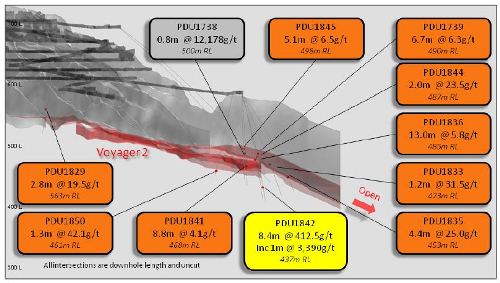
 

Oblique long section view of drill results for Voyager 2 Lode. Source: Company announcement

Results from drilling at Voyager 2 include (uncut):

–    8.4 metres at 412.5 grams per tonne gold (true width 2.0 metres) from 437m, including 1.0 metre at 3390 grams per tonne gold;

–    4.4m at 25.0g/t gold (true width 1.8m) from 453m;

–    1.3m at 42.1g/t gold (true width 1.0m) from 461m;

–    1.2m at 31.5g/t gold (true width 0.9m) from 473m;

–    2.0m at 23.5g/t gold (true width 1.0m) from 487m;

–    2.8m at 19.5g/t gold (true width 2.7m) from 563m; and

–    13.0m at 5.8g/t gold (true width 8.1m) from 485m.

Results from Voyager 1 include (uncut):

–    5.2m at 108.6g/t gold (true width 4.2m) from 593m, including 0.54m at 1016g/t;

–    5.3m at 93.3g/t gold (true width 2.3m) from 545m;

–    3.4m at 61.7g/t gold (true width 3.1m) from 597m;

–    2.7m at 48.7g/t gold (true width 1.9m) from 598m;

–    4.0m at 45.0g/t gold (true width 2.4m) from 612m;

–    2.5m at 43.0g/t gold (true width 2.3m) from 596m; and

–    7.3m at 33.5g/t gold (true width 3.0m) from 613m.

Northern Start said the latest drilling results will be combined with previous results, including 0.8m at 12178gpt, to generate a maiden resource figure for Voyager 2 by mid-2012.

The company said the recent results confirm its view that Voyager 2 would be an integral source of ore at Paulsens in years to come.

“Part of the $45 million raising has been earmarked for rapid capital development to mine the Voyager 2 lode ahead of schedule and for installing a gravity circuit due to the very high grades,” Northern Star Resources managing director Bill Beament said in the company’s announcement to the Australian Securities Exchange.

Northern Star has an exploration target at Voyager 2 of 100,000 to 250,000 ounces.

All the known mineralisation at Voyager 2 is excluded from the recently released Paulsens project Resource estimate of 318,000 ounces.

Golden Rim commences drilling at Yako

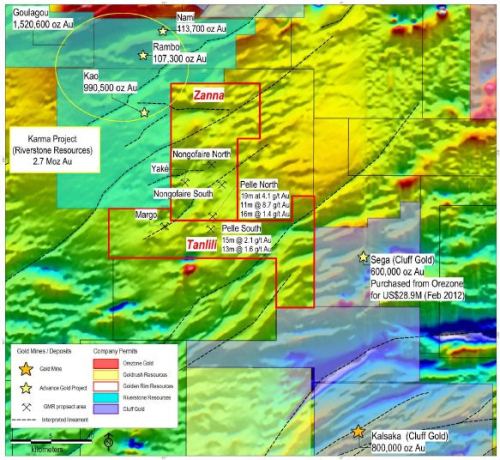
THE DRILL SERGEANT: Golden Rim Resources has kicked off a program of reverse circulation (RC) drilling on the company’s Yako project located in Burkina Faso.

Golden Rim has a program comprising approximately 3,000 metres of RC drilling planned.

The company will be testing a number of areas on the Zanna permit and the newly-acquired Tanlili permit.

Key target areas include the Pelle South and Pelle North prospects.

Location of artisanal mining sites within the Yako project Burkina Faso. Source: Company announcement

The Pelle South prospect occurs on the Tanlili Permit and consists of two parallel zones of artisanal workings.

RC drilling conducted on Pelle South by a previous explorer returned intersections including: 42 metres at 1.6 grams per tonne gold and 8 metres at 1.9 grams per tonne gold.

Golden Rim said it scheduled program will include infill drilling around the previous intercepts and drilling to test for strike extensions to the mineralisation.

Pelle North is located on the Zanna permit around 700m northeast of Pelle South and was subjected to a drilling campaign by Golden Rim in 2011.

Intercepts achieved by Golden Rim include:

–    14m at 0.88 g/t gold from 13m;

–    19m at 4.08 g/t gold, including 1m at 38.1 g/t gold from 42m and 10m at 0.42 g/t gold from 92m;

–    8m at 1.05 g/t gold from 50m; and

–    8m at 0.95 g/t gold from 37m.

Drilling by a previous explorer at Pelle North returned intercepts such as: 11m at 8.7 g/t gold, 10m at 1.6 g/t gold and 16m at 1.4 g/t gold.

“The gold mineralisation at Pelle North trends northeast to southwest and has been identified over a strike length of 700 metres, Golden Rim Resources said in its ASX announcement.

“It is open to the south where it extends under a lateritic cap.

“The style of the mineralisation is identical to that at Pelle South.

“Drilling at Pelle North will include infill drilling around the previous intercepts and target extensions of mineralisation to the south.

“Golden Rim is hoping to link the mineralisation identified at the Pelle North prospect to the mineralisation at Pelle South.”


Saracen confirms mineralised zone at Whirling Dervish

THE DRILL SERGEANT: Saracen Mineral Holdings has been encouraged by the receipt of gold assay results from an ongoing drilling program being conducted at the company’s Whirling Dervish mine.

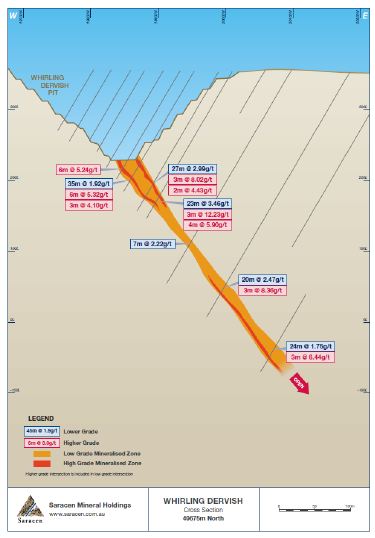
Saracen said the latest higher-grade gold intercepts it has achieved confirm the likely continuation of the main “footwall” ore body for at least 400 metres to the north of the present open pit mine.


Whirling Dervish Cross section. Source: Company announcement

Results include:

–    3 metres at 20.14 grams per tonne gold/t and 12 metres at 4.77 grams per tonne gold, including 5 metres at 7.59 grams per tonne gold;

–    8m at 5.51g/t gold;

–    3m at 8.36g/t gold; and

–    3m at 6.44g/t gold.

The results follow previously announced results of:

–    10m at 5.52g/t gold;

–    16m at 4.39g/t gold; and

–    15m at 5.41g/t.

The recent diamond drilling carried out by Saracen has targeted strike extensions of the main footwall ore body.

This program has extended the known strike of the mineralised zone by 400m, which the company claims is now confirmed to remain open to the north and at depth.

The main footwall ore body has to date provided the higher grade feed to the existing Carosue Dam processing plant.

It continues below the present pit floor and Saracen is utilising the remaining ore reserve (after the first phase of open-pit mining) by incorporating it into the present underground mining study.

“The Whirling Dervish mineralised system is much more extensive than previously thought,” Saracen Mineral Holdings executive chairman Guido Staltari said in the company’s announcement to the Australian Securities Exchange.

“With our underground mining study in train, and two rigs in operation here, we are aiming for a material lift in resources and gold production from this area.

“Confirmation of the continuation of the footwall ore body for another 400 metres along strike is a very positive finding and lends further weight to our exploration target concept.”

Saracen has completed nine holes to target depth with results received for eight of these, all of which intersected significant mineralisation.

Rex confirms Hillside potential

THE DRILL SERGEANT: Rex Minerals has received further assay results from infill drilling and new extensions at the company’s 100 per cent-owned Hillside copper project on the Yorke Peninsula in South Australia.

The company said the new results continue to confirm the potential for it to be able to add to the open pit resources and will play a significant part in Rex optimising Hillside’s Pre‐feasibility production schedule.

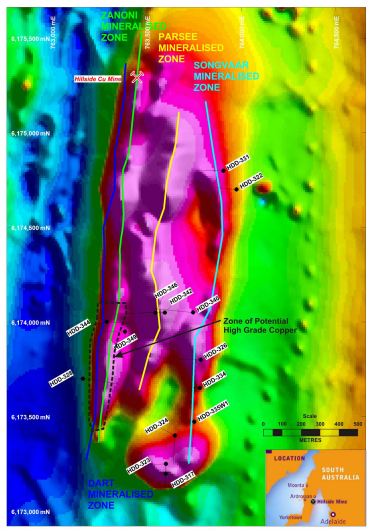
The company also claimed the higher than expected copper grades received along the Dart and Zanoni structures, suggest the potential for this zone of high-grade copper to extend for over 600 metres.


Hillside magnetic image showing recent drill holes. Source: Company announcement


Highlights from the recent drilling program at the Zanoni structure at Hillside include:

57 metres at 1.8 per cent copper, 0.4 grams per tonne gold and 20 per cent iron. (2.1 per cent copper equivalent).

Including 9m at 4.3 per cent copper, 0.8g/t gold and 33 per cent iron. (4.8 per cent copper equivalent);

Including 11m at 4.6 per cent copper, 1.4g/t gold and 25 per cent iron. (5.2 per cent copper equivalent); and

40m at 1.0per cent copper, 0.2g/t gold and 14per cent iron. (1.2per cent copper equivalent);

Including 3m at 8.8 per cent copper, 1.2g/t gold and 30 per cent iron. (9.1 per cent copper equivalent).

*All assay results are reported as down hole lengths.

“As we continue to infill drill at Hillside, we are identifying new areas of high grade copper mineralisation that potentially could become part of the early open pit production schedule,” Rex Minerals managing director Steven Olsen said in the company’s announcement to the Australian Securities Exchange.

“Rex is confident that further results of this calibre will be delivered over the coming months as we work towards finalising the Pre‐feasibility Study at Hillside.”

Rex currently has five diamond drill rigs focussed on the Hillside project primarily focussed on Resource infill drilling, Resource extensions, metallurgical drilling and geotechnical drilling.

Two additional exploration drill rigs are also focussed on testing regional targets.

These two rigs are expected to continue on the regional drill program until mid to late April testing features at Rex’s Equis, Port Julia and Ranald targets.

Rubianna records high-grade gold at Bloodstone

THE DRILL SERGEANT: Perth-based gold and base metal exploration company Rubianna Resources has announced that results from the company’s ‘Phase Two’ drilling program at its Bloodstone project have returned multiple high-grade gold intercepts of up to 108 grams per tonne. By Mark Jones.

The Bloodstone project is within Rubianna’s 100 per cent-owned Murchison tenements located in the highly prospective Peak Hill mining district of Western Australia.

The Murchison project comprises 17 granted tenements covering approximately 1,400 square kilometres.

Project location. Source: Company announcement

Previous drilling by Rubianna at Bloodstone returned gold results of up to 8 metres at 28 grams per tonne and 4 metres at 16 grams per tonne.

Best drilling results included:

5 metres at 21.8 grams per tonne gold, including 1 metre at108.0 grams per tonne gold;

4m at10.9 g/t gold, including 1mat 43.0 g/t gold;

5m at 4.2 g/t gold, including 1mat 19.1 g/t gold;

12m at 2.3 g/t gold, including 1mat 15.4 g/t gold; and

 1m at19.3 g/t gold.

The ‘Phase two’ Bloodstone drill program consisted of thirteen holes for a total of 1096 metres of RC drilling with the objective of defining further mineralisation in the western and down-dip extensions of the Bloodstone prospect.

Multiple high-grade intersections (>1g/t gold) have been returned that appear to define at least one and possibly two, NW-trending, high-grade shoots within a broader low-grade (0.1 to 1 g/t gold) halo. Importantly, the system remains open to the west.

 “The confirmation of the high-grade gold shoot and improved definition of the strike and dip extent within the Bloodstone prospect matched our pre-drill expectations and will significantly improve our future targeting. The next drill programme will test the continuity of the shoot to the west and look for repetitions of the shoot at depth,”
Rubianna Resources general manager Steve Batty in the company’s announcement to the Australian Securities Exchange said.

The company is planning to undertake the next phase of exploration work at Bloodstone during the second quarter of 2012.

Kitumba continues Blackthorn’s merriment

THE DRILL SERGEANT: Blackthorn Resources continued to light up the boards of the ASX after the company released further copper and gold assay results from its Mumbwa project in Zambia.

The latest copper assays received from Mumbwa have confirmed the continuation of the high-grade copper zone at Kitumba.

Best drilled thickness intercepts include:

187 metres at 2.62 per cent copper between 311 metres and 498 metres, including:

10m at 7.83 per cent copper between 338m and 348m;

3m at 6.30 per cent copper between 377m and 380m and

9m at 6.52 per cent copper between 386m and 395m.


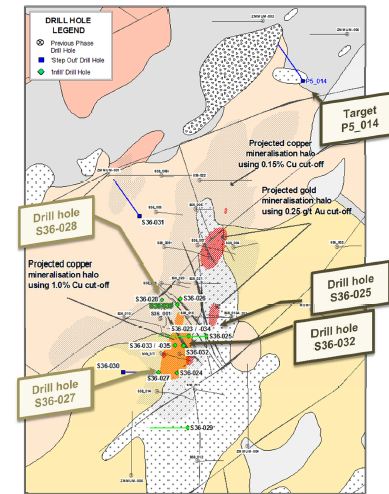
Drill hole location plan for the Kitumba mineral resource area. Source: Company announcement


Blackthorn said the drilling has demonstrated the Mumbwa project appears to host a high-grade, supergene enriched horizon of copper mineralisation which occurs below a 100m to 200m leached zone at surface.

The company has also received gold assay results from its Kitumba and Mutoya prospects.

Best gold mineralisation was intersected close to surface with drilled thickness intercepts including:

51.3m at 0.47 grams per tonne gold between 4m and 55.3m.

“These are excellent follow-up results in drill hole S36-032 confirming the continuity of high-grade mineralisation with the exceptional copper results from the adjacent hole S36-033 reported last week,” Blackthorn Resources managing director Scott Lowe said in the company’s announcement to the Australian Securities Exchange.

“These holes are spaced 50 metres apart.

“The company is reviewing all elements of the exploration strategy, including consideration of drilling deeper holes to better understand the nature and dimensions of the mineralised zones.

“The central high-grade zone of enriched supergene mineralisation is becoming better understood and will form an important part in developing the project going forward.”

Talisman identifies 18 targets at Springfield

THE DRILL SERGEANT: Talisman Mining is about to commence a targeted drilling program at its Springfield copper-gold project in Western Australia.

The drill program is scheduled to commence in the second half of March and has been designed to test 18 newly identified Tier-One copper-gold exploration targets.

The program will comprise approximately 10,000 metres of combined diamond and RC drilling, with scope to extend this further dependent upon geological information obtained in the field and ongoing assay results.

Springfield is located four kilometres from the DeGrussa copper-gold project of Sandfire Resources.

Over the past three months, Talisman has undertaken a detailed and integrated review of the data fromits earlier exploration activities at Springfield to identify key stratigraphic horizons, primary structural controls and geochemical vectors to mineralisation.
 

This has led Talisman to develop a 3D geological model for the Springfield project, from which it has identified 18 Tier-One target areas the company claims contains all of the four key elements required for the potential formation of a VMS copper gold deposit.


3D model looking East showing areas within the Springfield project
with a geological and structural setting similar to the DeGrussa
copper-gold mine. Source: Company announcement


Talisman will systematically drill test these 18 target areas over the coming months while it also carrys out down-hole electromagnetic surveys at all holes.

The company said it had identified these initial 18 targets at Springfield as a result of its commitment to reconnaissance exploration activities to assemble a series of extensive key datasets.

“By utilising state-of-the-art geo-scientific techniques, these extensive datasets have enabled us to develop a comprehensive 3D geological model for Springfield,” Talisman Mining managing director Gary Lethridge said in the company’s announcement to the Australian Securities Exchange.

“This interpretative model is, we believe, the key to giving Talisman the best possible chance of making a new copper-gold discovery at Springfield.

“We have always been clear that this is our primary objective and this recent work takes us a step closer to achieving that objective.”

Azumah confirms gold between Kunche and Bepkong

THE DRILL SERGEANT: Azumah Resources has received encouraging results from a follow-up drilling program conducted between its adjacent flagship Kunche and Bepkong deposits in northwest Ghana.

The company said the results support the likelihood of the delineation of new, shallow open pitable resources close to the proposed location of its Wa gold project processing plant.

Best intercepts received from the combined 139 RC holes include:

–    3m at 9.17g/t gold from 27m;

–    10m at 4.43g/t gold from 140m;

–    4m at 4.43g/t gold from 43m;

–    8m at 4.18g/t gold from 40m;

–    6m at 2.78g/t gold from 23m;

–    4m at 10.33g/t gold from 47m;

–    14m at 2.15g/t gold from 62m; and

–    4m at 9.34g/t gold from 20m.

“These results reinforce the company’s increasing belief that the Kunche and Bepkong deposits are components of a larger system of interconnected mineralised structures, and therefore the strong likelihood of an increase to the current Indicated Mineral Resource of 646,000 ounces of gold and Inferred Mineral Resource of 518,900 ounces of gold at the Wa gold project.” Azumah Resources managing director Stephen Stone said in the company’s announcement to the Australian Securities Exchange.

“A new phase of RC drilling will commence shortly to evaluate continuity of the mineralisation and to follow-up other intersections off the main Aduane trend.”

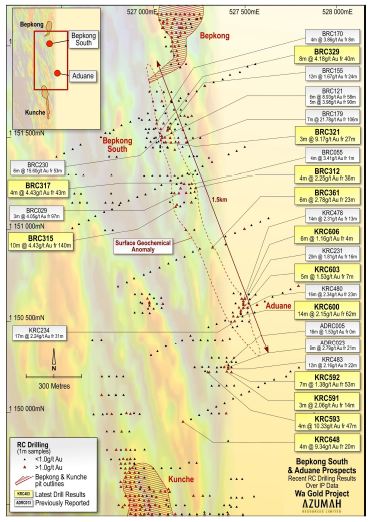
Azumah considers the recent results imply mineralisation intersected at the Bepkong South and Aduane prospects may sit at either end of a 1.5 kilometre north-northwest trending zone of surface geochemical anomalism.


Bepkong South and Aduane prospects – latest drilling results. Source: Company announcement


It pointed to the intercepts of 10m at 4.43g/t gold from 140m, and 6m at 2.78g/t gold from 23m, which it considers to indicate a suggested continuity to the mineralisation.

The company said it has already seen this association of mineralisation with a north-northwest trend at the northern end of Kunche, which hosts consistent mineralisation over 1.4km, and on the eastern margin of Bepkong.

Azumah also highlighted the 4m at 10.33g/t gold from 47m, and 4m at 9.34g/t gold from 20m mineralised intercepts offset from the Aduane trend, could also possibly indicate parallel or other mineralised structures.

GBM froths up Milo maiden

THE DRILL SERGEANT: Australian resources company GBM Resources has released a maiden rare earth resource for the company’s Milo iron oxide copper gold (IOCG) and Rare Earth Elements and Yttrium (REEY) project in northwest Queensland.

The maiden resource for Milo follows a string of strong drilling results and includes 103 million tonnes containing an estimated 82,500 tonnes of total rare earth elements and yttrium oxide (TREEYO) at an average grade of 760 parts per million TREEYO based on a 400 parts per million cut‐off grade.


Computer model of the Milo TREEYO mineralised zone looking
approximately grid west. The current model extends to approximately 400 m
below surface and is limited by drilling. Source: Company announcement


GBM claim the mineralised zone to be up to 200 metres wide and continuous over a strike length of more than
800 metres, open in all directions.

The current drilling has extended the current mineralised zone by at least 380m, which is outside the rare earth resource.

“It is noteworthy that 21 per cent of this material is comprised of neodymium, europium, yttrium and dysprosium, elements that have recently been deemed as in critical supply for the short to medium term by the US Department of Energy,” GBM Resources said in its ASX announcement.

“The resource is contained within a broad mineralised zone and using lower cut‐off grades the tonnage potential increase markedly representing significant upside to the current resource, subject to outcomes of the scoping study.”

GBM has commenced a scoping study at Milo, which is scheduled to be completed by June 2012.

The study will be used to delineate a maiden copper equivalent resource for the project and will also carry out metallurgical testing for both copper equivalent metals and rare earth elements.

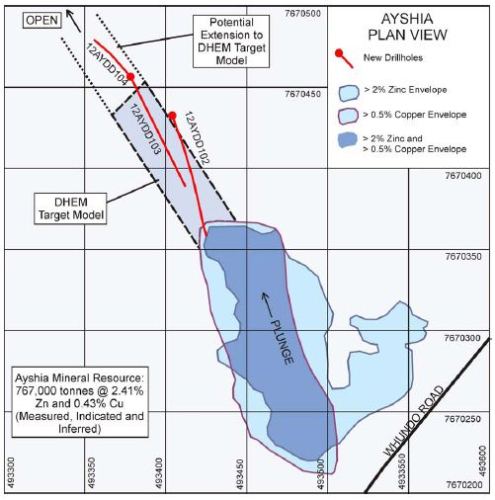
Fox sniffs out copper mineralisation with first Ayshia drill hole

THE DRILL SERGEANT: Base metals development company Fox Resources has intersected copper-bearing mineralisation while drilling at the Ayshia deposit, in the company’s West Pilbara tenement holding.

The first hole Fox drilled in the latest program at Ayshia intersected:

–    34.85 metres at 1.10 per cent copper, 0.46 per cent zinc, 0.20 grams per tonne gold and 3.39 grams per tonne silver, from 169.65 metres to 204.5 metres downhole.

–    This included 10.35m at1.98 per cent copper, 0.3 per cent zinc, 0.25g/t gold and 6.78g/t silver from 169.65m to 180m.

“We are pleased with these initial results, which show the strong potential of the Ayshia deposit,” Fox resources chief executive officer Laurie Chew said in the company’s announcement to the Australian Securities Exchange.

The diamond drilling program Fox currently has underway is targeting additional mineralisation down-plunge of the known Ayshia deposit.

The Ayshia deposit was discovered by Fox in 2006.

A subsequent resource drill-out yielded a mineral resource of 767,000 tonnes grading at 2.41 per cent zinc and 0.43 per cent copper (measured, indicated and inferred).

The company completed a down-hole EM (DHEM) program last year, and the results were utilised to generate the targets drilled during February 2012.

This drilling was focused on testing a copper-bearing zone that is interpreted to extend down-plunge from the known deposit.

Fox said the drilling results to date indicate the copper-bearing zone of the Ayshia deposit extends beyond the extent of previous drilling.


Ayshia project – Resource mineralisation envelopes and 2012 diamond drill hole location plan. Source: Company announcement

The copper mineralisation in the above-mentioned hole is the thickest the company has hit to date at Ayshia, and is drilled almost perpendicular to the orientation of the mineralisation, which Fox considers to represent a near true thickness.

Two further holes have tested the geophysical anomaly associated with the copper-bearing zone for further down-plunge mineralisation.

Both drillholes intersected copper sulphide (chalcopyrite) mineralisation, with assay results pending.

“Following these very encouraging drilling results, a down hole EM crew was mobilised and is currently on site surveying all three drill holes,” Chew said.

“Final results of the drilling and DHEM will be published as they become available.”