Tanami extends Groundrush

THE DRILL SERGEANT: Australian gold producer Tanami Gold has continued its run of exploration success at the company’s 100 per cent-owned Central Tanami project in the Northern Territory.

Recent highlights from ongoing infill and extension drilling at the Groundrush deposit has returned results including:

17.3 metres at 4.7 grams per tonne gold;

12.5 metres at 5.8g/t gold;

10.8 metres at 6.3g/t gold;

9.2 metres at 5.2g/t gold; and

7.7 metres at 8.5g/t gold;

“The continued exploration and drilling success at the Central Tanami project is very pleasing as it provides a high level of confidence in the project leading into the dry season which will see increasing drilling activity,” Tanami Gold deputy chairman Denis Waddell said in the company’s announcement to the Australian Securities Exchange.

“We are particularly encouraged that positive results are being returned at both the Groundrush deposit and regionally, as highlighted in the ripcord Prospect results reported on 16 March 2012.”

Tanami has continued with drilling at the Groundrush deposit since drilling its initial hole was drilled in April 2011.
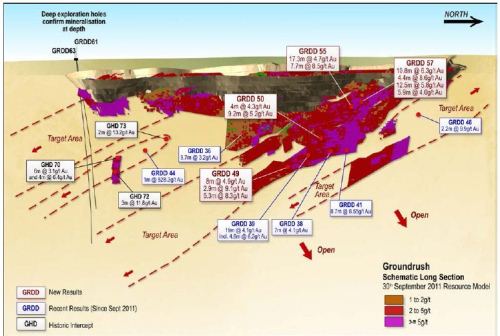
 

Groundrush schematic longsection. Source: Company announcement


To date, over 80 diamond drill holes have been drilled enabling the company to define a Resource of 535,000 ounces, which remains open in all directions.

Tanami’s technical team has recently carried out a complete re-log of the core drilled to date to enable detailed geological, alteration and mineralisation models to be developed.

This has been done in order to assist the company with ongoing exploration targeting as well as increasing its confidence in the current Resources.

Drilling is set to ramp up in coming months with additional rigs secured.

The current and planned drill programs include infill drilling and testing for depth and strike extensions to the current Resource.

Castle intersects gold at Wa South

THE DRILL SERGEANT: West Africa-focused gold exploration play Castle Minerals has kicked off its maiden RC drill testing program at the Wa South prospect, part of company’s 100 per cent-owned Wa Project located in Ghana.

The first-up wide-spaced RC drilling has intersected zones of oxide and bedrock gold mineralisation within Birimian meta‐sediments.


RC drill plan at Wa South showing results from the first phase of drilling. Source: Company announcement


Intercepts from 5 metre composite RC sampling include:

–    10 metres at 1.73 grams per tonne gold from 40 metres, including 5 metres at 3.03 grams per tonne gold from 40 metres; and

–    15m at 0.56g/t gold from 65m, including 5m at 1.23g/t gold from 70m.

Castle claimed the results to be the first recorded occurrence of bedrock gold mineralisation in, what has been up to now, a previously unexplored area.

The company has already been able to identify two open gold trends it considers require follow up drilling.

This first RC drilling on the prospect follows earlier exploration activity Castle has undertaken, including programs of soil sampling, auger and aircore drilling.

The company also has RAB, RC and auger drilling, and soil geochemical programs ongoing elsewhere within the Wa project, from which it has around 10,000 samples awaiting analysis.

“These results represent the first known bedrock gold mineralisation in the area and are very encouraging especially considering the wide drill spacing and gold reporting in two separate areas one kilometre apart,” Castle Minerals managing director Mike Ivey said in the company’s announcement to the Australian Securities Exchange.

“It also demonstrates the wider prospectivity and potential of our large landholding in Ghana.

“We currently have an RC rig drilling at our Kandia Prospect ( approximately 100 kilometres northeast) and are arranging for the this rig to return to Wa South towards determining the exact geometry and scope of the mineralisation intersected.

“We have only drilled 12 holes at Wa South and look forward to following up these exciting results.”

Archer grows Sugarloaf exploration target

THE DRILL SERGEANT: Recent drilling conducted by Archer Exploration has confirmed the presence of an eastern graphite limb at the company’s Sugarloaf graphite deposit.

The Sugarloaf graphite deposit is located on Carappee Hill near Darke Peak on Eyre Peninsula, South Australia.


Drill section superimposed on EM signature. Source: Company announcement


Three RC holes were drilled on the eastern side of the Sugarloaf Hill to confirm the presence of an eastern graphite limb to the Sugarloaf anticline as indicated by historic holes drilled for gold and EM data and two historic shafts,” Archer Exploration said in its ASX announcement.

“Archer’s previous drilling had only concentrated on the western graphite limb.

“The drilling confirmed that the Sugarloaf graphite deposit occurs in a broad open anticline.

“All three holes intersected graphite schist.”

The best graphite intervals reported from the recently completed drilling include:

–    20 metres at 7.8 per cent carbon from 54 metres and 7 metres at 10.6 per cent carbon from 76 metres;

–    34m at 6.3 per cent carbon from 55m and 23m at 10.6 per cent carbon from 96m, including 7m at 16.0 per cent carbon.

–    25m at 6.4 per cent carbon from 42m and 22m at 5.2 per cent carbon from 82m.

That latest results have led to Archer increasing its exploration target at Sugarloaf from 24 to 37 million tonnes grading 10 to 12 per cent carbon to 40 to 70 million tonnes at 10 to 12 per cent carbon.

Before Archer acquired the Sugarloaf tenement it had been subjected to drilling which had recorded numerous intercepts of graphite.

However, graphite was not a focus of the owners at that time and the intervals were never assayed for carbon.

Archer reviewed the historical drill logs noting graphitic intervals while geological logs had recorded intervals of graphite varying from 4m to 61m.

Archer has achieved an amorphous graphite product of 82 per cent Total Graphitic Carbon from a composite sample from one of the recent drill holes using conventional flotation techniques and standard reagents.

The Total Graphitic Carbon content rose to 85 per cent using an acid digest.
The concentrate had 91 per cent Total Organic Elemental Carbon and the sample head grade was 10 per cent carbon.
 
Archer said upcoming work will focus on testing several other sections of the deposit in order for the company to get a better understanding of the average flotation performance across the deposit.

MOD drills up further encouragement at Sams Creek

THE DRILL SERGEANT: MOD Resources has received further encouraging assay results from the company’s initial 2,000 metre diamond drilling program at its Sams Creek gold project.

Mod claims the Sams Creek project, located at the northern end of the South Island of New Zealand, to be the country’s biggest undeveloped gold project.

Best results from the recent drilling included:

–    35 metres at 1.85 grams per tonne gold;

–    29m at 2.23g/t gold, including 10m at 4.27g/t gold from 142m;

–    9m at 3.17g/t gold and 12m at 2.11g/t gold; and

–    7m at 1.17g/t gold from 242m to 249m.

MOD is earning up to 80 per cent of the Sams Creek gold project from OceanaGold Corporation by undertaking sole-funding staged exploration programs.


Source: Company announcement


The 2,000m drilling program is the first conducted at Sams Creek since 2004.

MOD hopes to build on the existing JORC-compliant Inferred gold resource at Sams Creek of 770,000 ounces based on 13.5 million tonnes grading 1.78g/t gold.

The existing 770,000oz resource is all estimated within the Main Zone prospect at Sams Creek, which covers 600m of the known six kilometre strike length within the permit.

“The known gold mineralisation at Sams Creek is contained within a porphyritic felsic dyke up to 40 metres thick that intrudes a metasedimentary rock sequence,” MOD Resources said in its ASX announcement.

“The dyke dips to the north at 60 degrees and can be traced over six kilometres along strike within the permit and at least one kilometre down dip, where it remains open.

“The 2,000 metre diamond drilling program will also assist the company in better defining the east and west margins of the Main Zone mineralisation and to further test grade continuity by intersecting the mineralised ladder veins at a high angle by drilling down the centre of the dyke.”

MOD said it remains on schedule to complete its initial 9 hole drilling program at Sams Creek by the end of March 2012.

All drilling is being conducted in the Main Zone.

Focus writes new chapter in Treasure Island story

THE DRILL SERGEANT: Focus Minerals has received preliminary results from a recent infill drilling program conducted at the company’s 100 per cent-owned Treasure Island gold project on Lake Cowan in Western Australia.

The company has received assay results for 105 infill holes so far, approximately 50 per cent of which have returned anomalous gold.

The company’s original regional reconnaissance program at Treasure Island resulted in only 2 to 3 per cent of the holes returning anomalous gold.

Focus said the latest results indicate the company is beginning to define the position of a mineralised system beneath the lake.

It has already identified two targets for preliminary diamond drill testing expected to start next week.

“The aircore program on the lake has been testing a potential thrust repeat of the Treasure Island stratigraphy,” Focus Minerals Treasure Island principal geologist Dean Goodwin said in the company’s announcement to the Australian Securities Exchange.

“What we have been doing with the infill is to drill down to the base of oxidation through the lake sediment looking for gold as it spreads out away from the primary deposit in the bedrock below.

Cross section showing initial planned stratigraphy diamond drill hole. Source: Company announcement

“A hyper-saline environment like the lake is a perfect place to look for this supergene effect where over time the gold spreads out at the base of the water table creating a blanket.

“What we achieved in the regional reconnaissance aircore is to find where these blankets are, and now with the infill we are starting to pinpoint where we think the primary ore bodies might be.”

The Treasure Island gold project is located 35 kilometres south-south east along strike from the major St Ives gold mine of South African company Gold Fields in Kambalda, where over 15 million ounces of gold has been discovered over the last 22 years.
Goodwin said the detailed aeromagnetics show that the structural framework Focus is finding in the Treasure Island area looks similar to what is found at St Ives.

“There’s a lot of structural complexity evident on the eastern zone, and this level of complexity along with the favourable geology increases the chance of finding gold,” he said.

“One of the holes LCAC593 returned a 4 metre composite grading 1.07 grams per tonne gold (part of a 9m end of hole intersection grading 416 parts per billion), which is a significant amount of gold for an aircore program.

“This is a strong indicator that we are possibly close to the primary structure.”

Focus Minerals said a lot more data is required from the whole infill drilling program before it can make an assessment of the full potential of the area.

The company expects to receive remaining assays for the infill aircore program in the coming weeks.

Convergent confirms gold at Blue Vein

THE DRILL SERGEANT: Convergent Minerals has received initial results from drilling carried out beneath the Blue Vein gold mine at the Bounty Goldfield in Western Australia.

Highlights from the drilling included:

–    5 metres at 16.07 grams per tonne gold from 166 metres from within a broader zone of 19 metres at 5.63 grams per tonne gold;

–    5m at 4.20g/t gold from 268m; and

–    4m at 10.27g/t gold from 270m from within a broader envelope of 7m at 7.81g/t gold.

“The company is delighted with the progress of the drilling program and the results achieved to date,” Convergent Minerals chief executive officer David Price said in the company’s announcement to the Australian Securities Exchange.

“Results of this strength confirm high grade gold continues at depth and the company is increasingly confident that deeper drilling will result in additional gold being identified at depth.”

One of the holes drilled at the southern end of the Blue Vein open cut mine (5m at 16.07g/t gold) returned higher grades than historical drill holes that were drilled closer to surface.

Convergent said this may suggest previous drilling may have under-estimated the amount of gold at Blue Vein.

Convergent drilled its deepest hole to date at Blue Vein, 80m deeper than any previous drill hole (4m at 10.27g/t gold).

This hole intersected massive sulphides, with some individual intervals containing up to 85 per cent sulphides, including pyrrhotite, pyrite and arsenopyrite.

The hole also intersected:

–    3m at 3.37g/t gold;

With individual metres returning:

–    6.85g/t gold and 4.06g/t gold from an overall zone of 9m grading 2.32g/t gold from the entire mineralized shear.


A Longitudinal projection of Blue Vein showing previous drilling
results (white boxes) and current drilling results (yellow boxes).


Convergent said these results demonstrate gold mineralisation continues at depth and helps the company in its task to confirm the continuity and orientation of the mineralising structures.

“The geological team is currently planning a deeper drilling program using a diamond drill rig,” Price added.

“The diamond drilling is designed to test the shear at Blue Vein to depths of 300 metres to 500 metres below surface.”

Convergent said it is building each result into its existing geological model to progress towards a re-estimation of the mineral resource at Blue Vein.

Gold Road continues to deliver results

THE DRILL SERGEANT: Gold Road Resources has received further high-grade gold intercepts, which it claims has identified at least three new gold targets in the Central Bore Area across its wholly-owned Yamarna Belt, located in Western Australia.

The latest results from Central Bore were achieved on Central Bore North and the Attila Trend.

“Our continued exploration success and continuing resource delineation in the Central Bore area is providing Gold Road with a solid foundation for us to move the Company into a development phase and future gold production in the region,” Gold Road Resources chairman Ian Murray said in the company’s announcement to the Australian Securities Exchange.

Gold Road said around two thirds, (~100,000 metres) of the company’s 2012 drilling program will focus on finding and proving-up new gold discoveries across the tenements.

This drilling will be carried out on the Tatar, VTEM, Dorothy Hills, Tobin Hill targets.

The remaining third of the drilling campaign (~50,000m) will focus on Gold Road’s advanced projects at Central Bore and Attila Trend.


Drill-hole plan showing location of Attila Trend gold deposits. Source: Company announcement


Gold Road’s current extensional and infill drilling program along the Attila Trend aims to identify additional higher-grade resources to supplement production from the high-grade Central Bore Project in order to justify the development of our own moderate-tonnage processing plant.

It is also aiming to increase the overall resource with the aim of growing towards a bulk-tonnage operation.

The company expects this drilling to improve its confidence in the projects and expand the existing resources.

Exploration highlights from activities located on or around Gold Road’s advanced projects include:

Khan North

–    1 metre at 17.35 grams per tonne gold from 112 metres.

Alaric

–    1m at 30.28g/t gold and 1m at 4.62 g/t gold from 77m; and

–    1m at 12.03g/t gold from 126m.

Attila North

–    1m at 23.40g/t gold from 74m within 34m zone at 0.98g/t gold from 51m; and

–    1m at 11.88g/t gold from 69m within 4m zone at 3.47g/t gold from 67m.

Attila South

–    6m at 3.17g/t gold from 94m within 20m zone.

Elvis – Hann South area

–    Drilling has identified mineralised zones associated with five trends: Elvis; Contact; Attila; Tamerlane; and Hann.

Central Bore North

–    4m at 6.11g/t gold from 119m, including 1m at 18.4g/t gold;

–    3m at 3.64g/t gold from 146m and 3m at 5.37g/t gold; and

–    5m at 3.84g/t gold from 41m, including 1m at 13.4g/t gold.

Gold Road also conducted a Sub-Audio Magnetics (SAM) geophysical survey across the Central Bore Area, which confirmed the existing mineralised structures and identified at least three new targets.

The company is of the opinion SAM could be a quick and cost effective tool in gold exploration in other parts of the Yamarna Belt by assisting it to generate and narrow-down new drill targets.

West African hits 6m at 5.78g/t gold at Moktedu

THE DRILL SERGEANT: West African Resources has received high-grade results from a recently-completed first-pass diamond drilling at the Moktedu prospect situated on the company’s 100 per cent-owned Boulsa gold project in Burkina Faso.

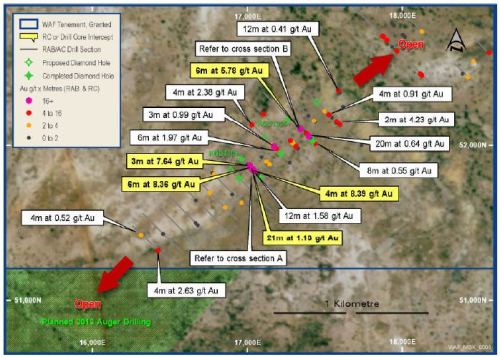
West African completed six core holes in December 2011 and January 2012 for a total of 720 metres (including pre-collars) over a strike length of approximately 500 metres in the central portion of the Moktedu prospect.


Moktedu prospect drill plan. Source: Company announcement


The company said two of the latest holes had confirmed high-grade mineralisation dips to the northwest, in contrast to its previous interpretation based on earlier shallow drilling.

The diamond drilling program has returned two significant results:

–    21 metres at 1.13 grams per tonne gold from 121 metres, including 1 metre at 10.96 grams per tonne gold; and

–    6m at 5.78g/t gold from 74m, including 1m at 28.40g/t gold.

The company said some shallow drilling has been carried out between these two results that it has not optimised to properly intersect the moderate northwest dip of mineralisation.

The area is to be tested with diamond drilling oriented towards the southeast once the company has completed a diamond drilling program it currently has underway at the Meguet prospect.

West Africa has also received further near surface high-grade results from reverse circulation (RC) drilling including:

–    4m at 2.67g/t gold from 4m;

–    8m at 1.71g/t gold from surface;

–    4m at 8.39g/t gold from 4m; and

–    20m at 0.64g/t gold from surface, including 8m at 1.24g/t gold.

The company highlighted the point that the 6m at 5.78 g/t gold intercept occurs 50m down dip of the RC drilling intercept of 20m at 0.64g/t gold and another of 5m at 0.92g/t gold.

It said these intercepts combine to indicate potential to intercept further mineralisation in deeper drilling beneath numerous near surface broad plus-0.5g/t gold intercepts from aircore and RAB drilling along strike to the northeast and southwest.

“A result like six metres at 5.78 grams per tonne gold, 50 metres down dip of a modest result of five metres at 0.92 grams per tonne opens up the potential right along the eight kilometre Moktedu strike length,” West African Resources managing director Richard Hyde said in the company’s announcement to the Australian Securities Exchange.

“We are continuing to map the Moktedu structure with shallow aircore and RAB drilling.

“Numerous anomalous results have been returned, which will be followed-up by deeper diamond core and RC drilling during the field season.”

IMX eyes Tomahawk Target

THE DRILL SERGEANT: IMX Resources identified an Exploration Target tonnage of 150 million tonnes to 230 million tonnes at 25 per cent to 35 per cent iron for the Tomahawk iron prospect, located 25 kilometres southeast of the Cairn Hill magnetite-copper mine in South Australia.

The new Tomahawk Exploration Target estimate brings the current global iron Exploration Target tonnage for the company’s 100 per cent-owned Mt Woods iron project to between 200Mt to 380Mt.

This figure includes the Exploration Target for the Bumblebee and Fitzgerald Dam iron prospects the company previously reported in November 2009.


Location of Tomahawk Exploration Target and untested magnetite anomaly targets. Source: Company announcement


“IMX is now approaching a potential one billion tonnes combined iron resources and targets for the Mt Woods iron project based on exploration target tonnages and the recently announced iron resource of over half a billion tonnes at Snaefell,” IMX Resources managing director Neil Meadows said in the company’s announcement to the Australian Securities Exchange.

“Our South Australian magnetite strategy is on track with the Mt Woods iron project continuing to develop into a major iron ore asset with enormous upside growth potential.”

The target tonnage was estimated along a 3km strike length of the main Tomahawk magnetite prospect.

IMX said it still has a number of other magnetic targets nearby, which it has yet to drill-test that missed out on being included.

The company is now planning a number of drill campaigns over the next nine months to test these and other targets with a view to adding them to the Mt Woods iron project global exploration target resource base.

Intermin hits deeper gold at Teal prospect

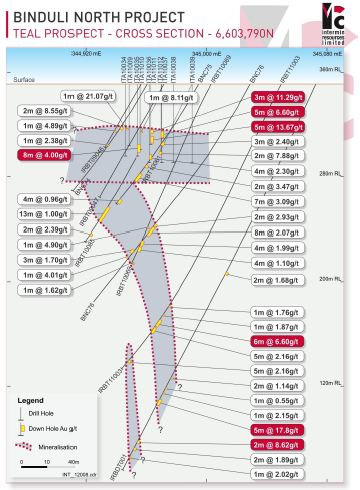
THE DRILL SERGEANT: Intermin Resources has received assays for two deep cored holes recently drilled at the Teal prospect situated on the company’s Binduli north project, located 12 kilometres northwest of Kalgoorlie.

According to Intermin the drilling resulted in multiple intercepts of gold mineralisation at depths up to 300 metres from surface.

This is much deeper than the mineralisation the company had previously identified at the Teal prospect.

Highlights from the drilling include:

–    5 metres at 17.8 grams per tonne gold from 269 metres;

–    2m at 8.62g/t gold from 305m;

–    3m at 2.15g/t gold from 221m; and

–    4m at 2.66g/t gold from 230m.

The recent drilling was undertaken by Interim to test for extension of gold mineralisation at depth, to obtain information on the Teal ore body structure and to provide samples of Teal primary mineralisation for metallurgical testwork.


Source: Company announcement

The company said observation of stronger grade mineralisation is consistent with a near vertical shoot of mineralisation with a southerly plunge.

Intermin has paid a lot of attention to the Teal prospect in regard to exploration activity over the past three years.

Drilling has resulted in the definition of gold resources of approximately 100,000 ounces at Teal in the form of a supergene resource overlying primary mineralisation.

“Recent pit optimisation of the Teal resource suggests that a relatively low risk starter pit accessing principally soft oxide supergene mineralisation could be established and a pit design has been developed based on this scenario,” Intermin Resources said in its ASX announcement.

“Total mineralisation within the Stage 1 starter pit was estimated at 271,000 tonnes at 2.63 grams per tonne gold for a total of 22,888 ounces.”

Intermin said it was anticipating receiving approvals for the mining of the Teal supergene soon.

The company will make a final decision to mine upon receipt of these approvals and the conclusion of toll treatment arrangements currently being negotiated.