THE DRILL SERGEANT: Gold exploration company Navarre Minerals has announced further results from a 25,000 metre RC drill program currently underway at the Tandarra prospect, part of the company’s Bendigo North project, located 40 kilometres north of Bendigo in Victoria.
The drilling has returned near surface intersections of gold mineralisation including:
– 17 metres at 1.0 grams per tonne gold t from 27 metres down hole, including 1 metre at 10.6 grams per tonne gold and 6 metres at 1.9 grams per tonne gold from 54 metres down hole;
– 19m at 1.1g/t from 60m down hole, including 1m at 7.5g/t;
– 18m at 1.0g/t from 53m down hole, including 9m at 1.8g/t from 53m down hole; and
– 9m at 1.0g/t from 27m down hole.
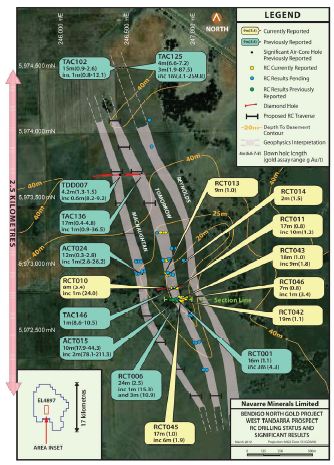
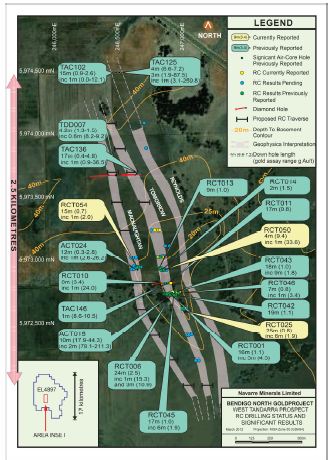
Satellite image of Tandarra prospect showing location of diamond
drilling, significant drill intercepts and status of RC drilling.
Source: Company announcement
Navarre said it believes the broad zones of shallow gold mineralisation identified at the Tandarra prospect may offer potential for open pit bulk mining opportunities.
“We are very pleased to continue to encounter multiple broad zones of gold mineralisation from shallow depths,’ Navarre Minerals managing director Geoff McDermott said in the company’s announcement to the Australian Securities Exchange.
“The higher grade gold intersected appears to be erratically distributed and coarse in nature, which is within our expectations.
“These higher grades occur within a broad halo of mineralised quartz and we expect that as the drilling density is increased we should see further high grade intercepts.”
The current RC drill program has been designed to provide Navarre sufficient data to enable the estimation of a maiden mineral resource at Tandarra by the end of 2012.
So far, Navarre has drilled 47 air-core and 53 RC holes on the project targeting a ‘buried hill’ of approximately 35km square in area.
The company said this drilling has confirmed this buried hill to contain multiple mineralised quartz reefs concealed below a thin veneer of sedimentary cover ranging in thickness from 15 metres to 80 metres.
“The widths and assays that we seeing are consistent with our concept that an open pit allows the recovery of more reef material, increasing the potential to capture any nuggets which, due to their erratic distribution, can be difficult to target through drilling,” McDermott said.
“We are at an early stage of evaluation, but what I can say is that the reefs are near surface, they are well defined by geophysics, they repeat at depth and in parallel and they carry gold grade in the main target zones of the Macnaughtan and the Tomorrow Lines.”