Cleveland set to investigate Brazilian targets

THE DRILL SERGEANT: Cleveland Mining Company is following up a number of drill targets it has identified as being, “worthy of further investigation”, on the company’s Porto Grande iron ore project in Amapá State, northern Brazil.

Cleveland has The Company has secured two diamond drill rigs to immediately commence reconnaissance drilling, which will remain on the project area for at least three months.

The company said recently completed geophysics, mapping and sampling had identified five initial drilling targets.

First pass exploratory drilling will be performed on all five target areas, with drill‐hole design determined via field observations.

“We came to Amapá last year and secured a 1300 square kilometre unexplored area linked to excellent infrastructure and surrounded by projects with significant iron‐ore mineralisation,” Cleveland Mining Company managing director David Mendelawitz said in the company’s announcement to the Australian Securities Exchange.

Within days of beginning the first pass of work we had found mineralisation with iron content as high as 63 per cent.

“The company is greatly encouraged by the geological fieldwork already performed on its tenements and has mobilised a larger team of focused professionals and a couple of drill rigs to begin to test the initial targets that we have generated.”

Cleveland is continuing with due diligence on another iron ore project over which it signed a non‐binding Memorandum of Understanding in February.

The Resource at this project is currently undergoing re‐modelled to a JORC standard whilst the Company works on a Binding Option to Purchase Agreement with the vendors.

Correction: The Roadhouse originally incorrectly reported this iron ore project
to be the Porto Grande iron ore project.

We apologise for any confusion this may have caused.

Fox launches follow up drill campaign at Ayshia

THE DRILL SERGEANT: Base metals development and exploration company Fox Resources is gearing up to commence a new program of drilling at the company’s 100 per cent-owned Ayshia volcanogenic massive-sulphide (VMS) deposit.

The drill testing follows encouraging drill results from the Ayshia deposit reported by Fox during February and March 2012.


Planned drilling in relationship to recently completed holes, DHEM
targets and known mineralisation at Ayshia. Source: Company announcement


The company is currently in advanced discussion with a drill contractor and expects to have a contract organised shortly.

The new program is to consist of six diamond drill holes for a total of approximately 2500 metres of drilling, which is planned to test down-hole electromagnetic (DHEM) targets Fox defined via a geophysical surveying program undertaken at the end of its last drilling campaign.

The company is of the opinion the DHEM targets indicate the presence of mineralisation both along strike and down plunge of the current drilling extents.

“Since the initial zinc resource was defined in 2006, no further exploration has been conducted at Ayshia,” Fox Resources chief executive officer Laurie Chew said in the company’s announcement to the Australian Securities Exchange.

“It is now pleasing to see the results of our geological re-assessment produce positive drill results and exploration momentum.”

The previously reported results from Ayshia include:

–    34.85 metres at 1.1 per cent copper, 0.5 per cent zinc, 3.4 grams per tonne silver and 0.2 grams per tonne gold from 169.65 metres to 204.5 metres downhole;

–    23.7m at 3.2 per cent copper, 0.4 per cent zinc, 7.3g/t silver and 0.14g/t gold from 209m to 232.7m downhole; and

–    9.25m at 4.4 per cent copper, 1.7 per cent zinc, 16.9g/t silver and 0.22g/t gold from 259.6m to 268.85m downhole.

Fox said its recent exploration at Ayshia has highlighted the potential of the Whundo VMS district where the company currently holds, within its tenure, three VMS deposits for which mineral resources have been calculated, along with a number of other VMS occurrences.

Panoramic hits high-grades beneath Heron South pit

THE DRILL SERGEANT: Panoramic Resources has received the results for a first pass of resource verification Reverse Circulation (RC) drilling completed beneath the Heron South pit at the company’s Gidgee project, located 640 kilometres northeast of Perth.

Best intersections from the drilling program include:

–    6 metres at 37.13 grams per tonne gold from 123 metres;

–    8m at 8.11g/t gold from 146m; and

–    6m at 6.44g/t gold from 129m.

In December 2011, Panoramic completed a seven-hole RC drill program for 1,368 metres beneath the Heron South pit at the Gidgee project.

The company has now received final one metre assays results for this program.

In its ASX announcement Panoramic said the latest results, combined with several historical drill holes, have confirmed the presence of a consistent, steep, east dipping, mineralised bedrock structure beneath the Heron South pit.


Longitudinal section Heron South pit showing drill hole pierce points and grades. Source: Company announcement

This mineralised bedrock structure is open to the north, south and at depth with a consistent nature of bedrock structure that allows the company to estimate the true width of each intersection.

Further RC drilling and metallurgical testwork is scheduled for Heron South this calendar year.

Ventnor Resources receives Thaduna / Green Dragon assays

THE DRILL SERGEANT: Ventnor Resources has had previously reported visual intersections from drilling carried out at the Thaduna prospect assayed and has also received additional assays from Phase 4 drilling at its Thaduna and Green Dragon copper project.


Results from the assays include:

–    19 metres at 1.85 per cent copper from 246 metres, including 6.57 metres at 3.93 per cent copper and 19.2 grams per tonne silver from 258 metres downhole;

–    13m at 2.87 per cent copper from 130m including 8m at 4.48 per cent copper and 15.6g/t silver from 131m downhole; and

–    9m at 2.68 per cent copper from 180m downhole.

“The assays have confirmed our visual observations of the mineralisation and have increased our confidence to drill deeper,” Ventnor Resources managing director Bruce Maluish said in the company’s announcement to the Australian Securities Exchange.

“Particularly significant is the type of mineralisation which has been encountered as it conforms to a typical hydrothermal system and supports the possibility of deeper primary copper mineralisation.

“The deep drilling program is underway after a short delay due to the recent rain in the region with five deeper holes to test the mineralisation at 275 to 300 metres below the surface expected to be completed by the end of April.”


Drillhole location plan for Thaduna showing the location of the reported drillholes. Source: Company announcement

Ventnor commenced the Phase 4 drilling in January with a program of around 9,000m of predominantly deeper diamond core drilling down dip and along strike of previously outlined mineralisation with some RC infill drilling above 200m vertical.

In March the company announced a strong intersection of visible chalcopyrite and bornite, the core of which was logged and cut with half core samples submitted for assay.

Ventnor said it has also received additional assays that confirm a continuous mineralised zone over 520m of strike length under the existing pit at Thaduna.

The company has further infill drilling planned in this area as part of the Phase 4 program, which is scheduled to be completed following the current campaign of deeper drilling.

The Thaduna and Green Dragon copper project is located 170 kilometres north of Meekatharra in Western Australia.

The project is situated in the the Doolgunna district, 40 kilometres east of the Degrussa project of Sandfire Resources.

Potash West identifies Dandaragan targets

THE DRILL SERGEANT: Potash West recently completed a road verge drilling program over the company’s Dandaragan Trough potash project in the Mid-West Region of Western Australia.

The company commenced the 153 hole, 8,300 metre program in November 2011 and completed the final stage in February 2012.

Potash West said the program had identified ten prospective target zones within the Dandaragan Trough potash project over a distance of 140 kilometres between Gingin and Coorow to the north of Perth.


Drill-hole locations. Source: Company announcement

The ten targets all contain significant grades of potassium at shallow depth with low overburden ratios.

Potash West said a majority of drill holes penetrated significant thicknesses of Coolyena Group sediments consisting of fine to medium grained glauconitic sandstone, siltstone and claystone.

According to the company the drilling demonstrated near surface grades above four per cent potassium are present confirming primary targets.

The drilling has also generated other target areas spread out over most of the tenement holding, which the company said indicates potential for multiple zones of mineralisation.

Targets generated by the drilling will now be evaluated by Potash West by grid drilling over prospective zones.

This work is expected to commence in the current quarter.

“These results confirm the widespread nature of the potassium mineralisation throughout the Dandaragan Trough,” Potash West managing director Patrick McManus said in the company’s announcement to the Australian Securities Exchange.

“With several target areas to drill out, the company is on track to achieve its target of proving up a 50 to 75 million tonne JORC compliant resource by September 2012.”

Cashed-up Ampella to embark on big exploration spend

THE DRILL SERGEANT: Having recently raised $45 million via a placement of new shares, Ampella Mining has working capital squirrelled away of almost $55 million.

The healthy bank account has provided the impetus for budget approvals for $25.3 million, which will be used by Ampella to fund a large exploration push at the company’s Batie West gold project in Burkina Faso, West Africa.


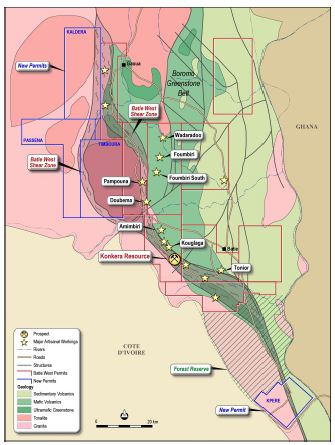
Location diagram of Ampella’s Batie West project covering 2600sqkm where
it intends spending $25.3M on exploration in 2012. Source: Company
announcement

The current focus for exploration programs in 2012 is to complete large regional auger and aircore drilling programs along the 150 kilometre Batie West Shear Zone.

These will consist of a proposed 144,000 metres of auger geochemistry drilling that will cover the remaining untested northern regions of the Batie West Shear Zone and include the company’s three newly-acquired permits, Kaldera, Passena and Timboura.

The new permits are situated north west of the JORC-compliant 3.1 million ounce Konkera gold resource, which includes an Indicated Resource of 30 million tonnes at 1.6 grams per tonne gold for 1.5 million ounces gold and an Inferred Resource of 31.8Mt at 1.5g/t gold for 1.6 million ounces gold.

Auger drilling will also be used for first pass geochemical tests of the new permit called Kpere, south of Konkera.

Ampella’s 2012 drilling will also entail approximately 127,000 metres of aircore drilling with aircore rig currently drilling at a number of gold anomalies identified on Ampella’s Gbingbina and Mabera permits.
 
An estimated 88,000m of reverse-circulation (RC) drilling and 7,300m of diamond drilling has been proposed to follow up previous scout drilling and infill programs.

Infill drilling has also been allocated to what the company considers to be ‘near mine’ prospects at Kouglaga West and Konkera East.

In addition to these $25.3 million regional exploration programs, Ampella also intends continuing a number of separate drill programs associated with feasibility studies on the Konkera gold resource.

 “The approval of $25.3 million by the Ampella Board to continue aggressive regional exploration programs highlights the company’s belief in the Batie West project where we have identified 3.1 million ounces of gold at the Konkera Resource in a three year period on ground which has never previously been explored,” Ampella Mining managing director Dr Paul Kitto said in the company’s announcement to the Australian Securities Exchange.

“Our focused aggressive regional exploration programs in 2012 over untested areas along the 150 kilometre long Batie West Shear Zone aim to identify the next generation of potential gold targets.”

Clancy hits further gold-copper-sliver at Meritilga

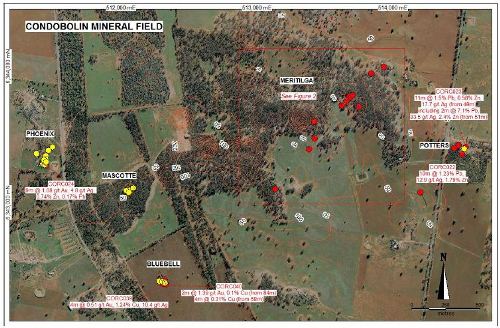
THE DRILL SERGEANT: Clancy Exploration has received results for the final seven holes of a recent reverse circulation (RC) drilling campaign conducted on the company’s 100 per cent-owned Condobolin project in central New South Wales.

The drilling was carried out at the Meritilga prospect, where the company said broad gold, copper and silver zone surrounding the high-grade shoot has been intersected along strike to the south-west and north-east, also containing lead and zinc.


Plan view of RC drill program over the Condobolin mineral field. Source: Company announcement

Highlights of the campaign include:

–    7 metres at 0.3 grams per tonne gold, 0.3 per cent copper, 0.2 per cent lead, 6.88 grams per tonne silver from 59 metres, including 3 metres at 0.27 grams per tonne gold, 0.1 per cent copper, 0.3 per cent lead, 0.26 per cent zinc, 11 grams per tonne silver;

–    5m at 0.33g/t gold, 4.1g/t silver from 87m;

–    6m at 0.17g/t gold, 0.22 per cent zinc, 0.12 per cent lead, 3.6g/t silver from 104m;

–    4m at 0.38g/t gold, 4.6g/t silver, 0.23 per cent zinc from 80m; and

–    5m at 0.2g/t gold, 0.18 per cent zinc from 70m.

Clancy said the mineralised strike length of the Meritilga Fault Zone has now been extended to 600m.

The company said the new assay results have confirmed the potential of the Condobolin project to deliver multiple lodes within a complex and widespread system.

“What is clear is that we have really just scratched the surface at Meritilga which is emerging as a zoned polymetallic deposit, with the addition of lead and zinc at depth and along strike to the south-west, to the broad halo of gold-silver and copper which surrounds the high-grade shoot,” Clancy Exploration managing director Gordon Barnes said in the company’s announcement to the Australian Securities Exchange.

“When we model the assay results, we can see that there is more than one parallel structure within the Meritilga Fault Zone, which doubles its currently defined width.

“There is considerable potential for further structures within the broad Meritilga anomaly, and we are targeting a further drilling program.

“Meritilga is the first prospect within the Condobolin Mineral Field where we have confirmed gold, silver, copper, lead and zinc in the one occurrence.

“Furthermore, this occurrence is the most extensive to date, with virtually no historic mining.”

Whim Creek drilling continues to encourage Venturex Resources

THE DRILL SERGEANT: Venturex Resources has received assays from an initial exploration drilling program completed last quarter at the company’s Whim Creek project in the western Pilbara region of Western Australia.

The drilling was concentrated on the Mons Cupri South West prospect, located approximately one kilometre south west of the existing Mons Cupri copper-zinc deposit.

Plan of Mons Cupri South West exploration area. Source: Company announcement

The company conducted a a total of 11 RC/diamond holes for 4,201.4 metres, which tested conceptual geological/geophysical anomalies within the target Mons Cupri horizon.

Results include an intersection of 23 metres (from 170.4 metres) of strong chlorite-sericite-pyrite alteration, Venturex said was typical of the nearby Mons Cupri feeder system.

This intersection included 1 metre at 1.09 per cent zinc, 0.38 per cent lead and 3.0 grams per tonne silver from 194.0 metres.

A further hole intersected a broad zone of strong chlorite-sericite alteration from 271.0 metres with the following results:

–    43.4m at 0.40 per cent zinc, 0.10 per cent lead and 3.0g/t silver from 271.0 metres, including 8.9m at 0.93 per cent zinc, 0.29 per cent lead and 3.8g/t silver.

The southernmost drill hole conducted throughout the program also intersected a broad alteration zone containing:

–    2.5m at 0.07 per cent copper, 2.18 per cent zinc, 0.01 per cent lead in a stratigraphic position equivalent to the Mons Cupri deposit which included a high grade zone with preserved massive sulphide fragments grading;

–    0.6m at 0.28 per cent copper, 7.26 per cent zinc, 0.01 per cent lead, 5g/t silver and 0.07g/t gold.

In a further development, an RC pre-collar intersected:

–    2.0m at 0.71 per cent copper, 0.73 per cent zinc, 0.99 per cent lead, 60.0g/t silver from 39m.

Venturex said this is believed to be the first mineralised intersection of the Whim Creek horizon within the Mons Cupri exploration area, which has opened up a second target for future exploration.

“The intersection of highly anomalous base metal values within the new alteration system in Mons Cupri South West area is extremely encouraging,” Venturex Resources managing director Michael Mulroney said in the company’s announcement to the Australian Securities Exchange.

“The extent and orientation of the new system suggests that we may be seeing another mineralised zone within the Mons Cupri sub-basin.

“The shallow intersection of significant sulphide mineralisation equivalent to the Whim Creek deposit has highlighted the broader potential of the Whim Creek district to host clusters of ore deposits on several stratigraphic levels”

Exco upgrades Kangaroo Rat

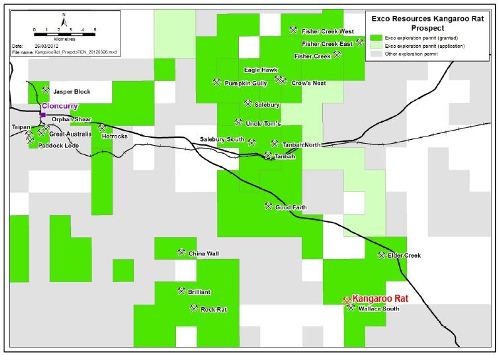
THE DRILL SERGEANT: Exco Resources has completed an updated resource estimate for the Kangaroo Rat deposit, located approximately 30 kilometres southwest of Cloncurry in northwest Queensland.

The new Inferred Mineral Resource for Kangaroo Rat stands at 1.26 million tonnes at 1.29 per cent copper and 0.63 grams per tonne gold (0.5 g/t cut-off).

The kangaroo update has increased the total Resource at the company’s Cloncurry project to 8.05 million tonnes at 1.62 per cent copper and 0.49g/t gold.

Exco used a total of 56 Reverse Circulation (RC) and Diamond drill holes in the estimation, 35 of which were drilled by the company with the remaining 21 from historical sources.


Location map of the Kangaroo Rat deposit. Source: Company announcement

The western-most hole drilled to date by Exco at Kangaroo Rat intersected 10m at 1.35 per cent copper and 1.13g/t gold from 17m.

The historic data shows a hole was drilled 50m to the south-west of the recent hole, which the company said is believed to have drilled over the main mineralised envelope at the project.

The combination of the new and old information has resulted in Exco planning a drilling program to test for western extensions to the Kangaroo Rat Resource.

Exco said the Mineral Resource has been classified as Inferred primarily to reflect the low number of bulk density measurements it has been able to collect to date.

The company is of the opinion that additional bulk density measurements from a limited diamond drilling program could allow it to convert the Mineral Resource to Indicated status.

“Exco intends to lodge an application for a new Kangaroo Rat Mining Lease during the current year,” the company said in its ASX announcement.

“The new Mining Lease will encompass the entire Kangaroo Rat deposit and will allow sufficient area for infrastructure development.
“Field surveys will also be completed for the Wallace South deposit (1.0Mt at 1.6g/t gold) located 1.5 kilometres south of Kangaroo Rat.

“A mining lease application is currently being considered for the Wallace South deposit adjoining Kangaroo Rat.”

Pan Asia confirms second South Kalimantan underground deposit

THE DRILL SERGEANT: Pan Asia Corporation has confirmed a potential second underground deposit in the north of the company’s TCM coal concession in South Kalimantan, Indonesia.

Pan Asia said drill core and geophysical logging of four exploratory drill holes in the north of the concession, have confirmed continuity of the same coal seams from the TCM North deposit.

The current JORC resources at the TCM Project, following completion of
35 boreholes in October 2011. Source: Company announcement

“This is an excellent result confirming the probability of a similar
deposit in the northern half of the concession,” Pan Asia Corporation
chief executive officer Alan Hopkins said in the company’s announcement
to the Australian Securities Exchange.

The TCM North deposit contains a 114 million tonne JORC resource and is curerently undergoing a feasibility study for an underground longwall mining operation.

The spacing of these latest drill holes extended around 1.5 kilometres north from the previously drilled limit of the TCM South deposit and it remains open for approximately another four kilometres to the north.

TCM project map. Source: Company announcement