


Sirius confirms grade-width copper at Nova discovery
THE DRILL SERGEANT: Sirius Resources has undertaken preliminary XRF analysis of the sulphide zones intersected in further holes undertaken at the company’s market-jolting Nova nickel discovery.
These holes were drilled, at what the company described to be, a considerable distance either side of the discovery hole at Nova, which intersected 4 metres at 3.8 per cent nickel and 1.42 per cent copper to spark a run of ASX releases by companies eager to let investors know they live next door.
The first hole, drilled 55 metres up-dip from the discovery hole, intersected 13m averaging 4.1 pwer cent nickel and 2.2 per cent copper from 123m, including 6m averaging 6.1 per cent nickel and 2.6 per cent copper from 128m.
The second was drilled 50 metres down-dip from the discovery hole and intersected 5m averaging 2.0 per cent nickel and 0.4 per cent copper from 233m, within a broader intercept of 9m averaging 1.2 per cent nickel and 0.7 per cent copper from 229m.
The company highlighted this intersection also contained a one metre interval of massive sulphide grading 4.1 per cent nickel, which it said indicated high-grade massive sulphides continue down dip.
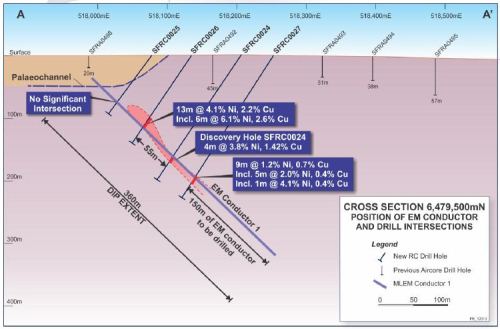
Cross section of the uppermost tip of EM conductor 1 showing new
intersection, approximately 50 metres down dip from discovery hole and
the modelled position of sulphides based on the EM anomaly. Source:
Company announcement
“These preliminary results are very encouraging as they are good grade and width over a considerable distance,” Sirius Resources managing director Mark Bennett said in the company’s announcement to the Australian Securities Exchange.
“The next step is to determine how far the mineralisation extends down plunge to the north, and how consistent it is.
“We are gearing up for a diamond drill program and while we push forward with this we will also be doing some preliminary work on the metallurgical characteristics of the mineralisation in order to get an early feel for the flotation and metal liberation characteristics of the sulphides and the levels of those elements which can potentially add to or detract from value of any concentrate.”
Sirius drilled a single hole around 50m to the south of the discovery drill hole, to determine the extreme up-plunge end of the target, which did not intersect sulphide mineralisation.
This was the first of an additional six RC holes the company intends to drill south and north of the discovery drill section.
The company is conducting RC drilling to scope the uppermost tip of the EM target and has a diamond drill program scheduled to commence next week.
The purpose behind this program will be to initially scope the extent of the mineralisation and infill drilling to determine its internal continuity.
While all this is going on systematic downhole electromagnetic (DHEM) surveys will be conducted to guide and optimise the drilling.
Sirius said it will also commence preliminary metallurgical characterisation of the mineralisation as soon as is practicable.